


 by Tom Gurney
Tom Gurney BSc (Hons) is an art history expert with over 20 years experience
Published on June 19, 2020 / Updated on November 20, 2026
Email: tomgurney1@gmail.com / Phone: +44 7429 011000
Introduction
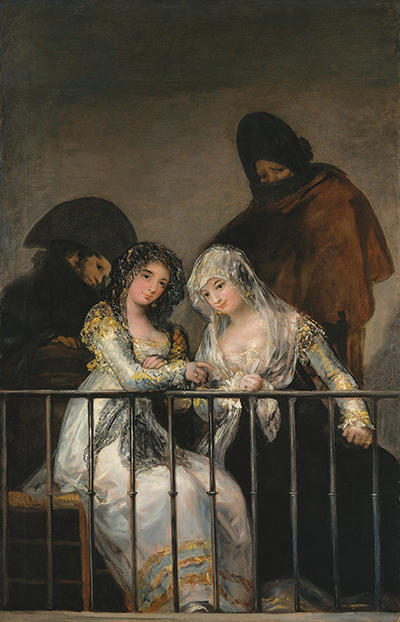
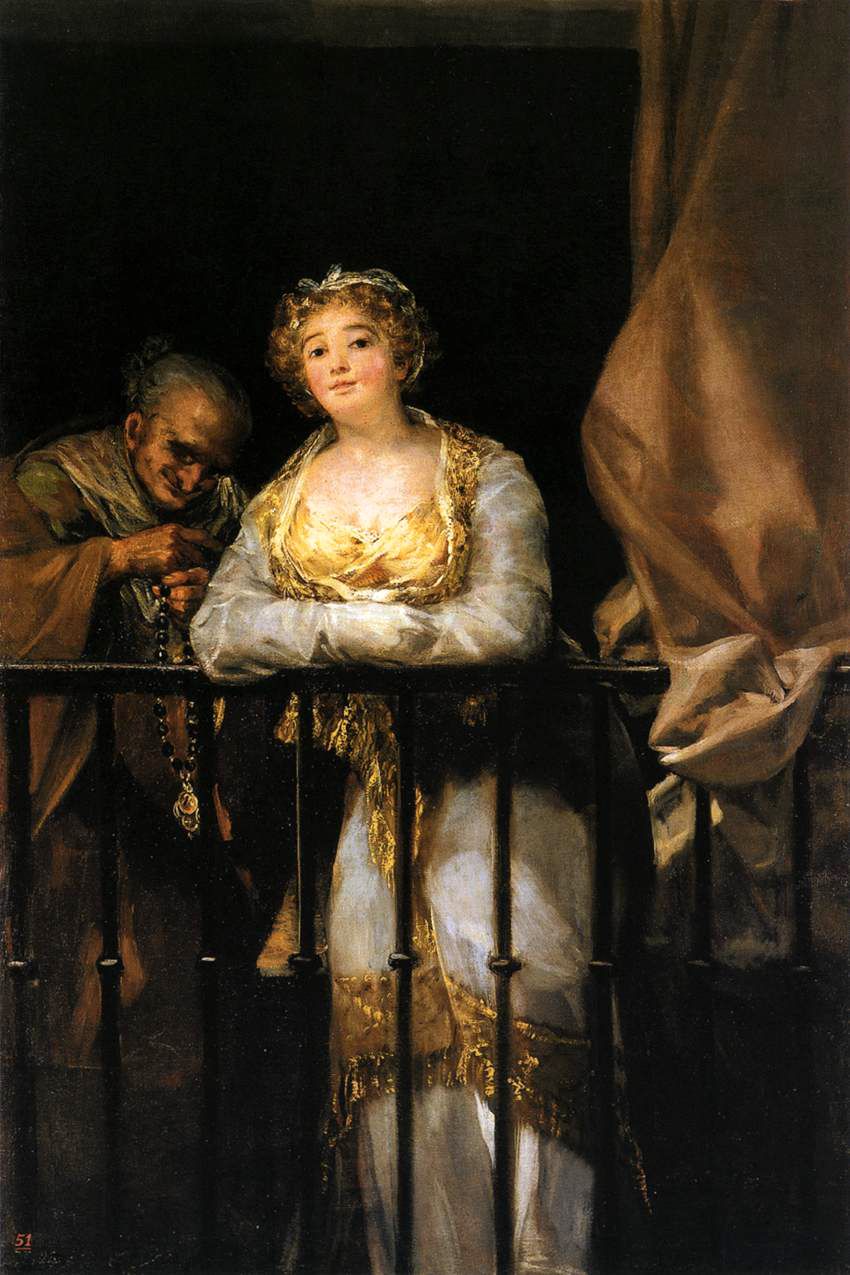
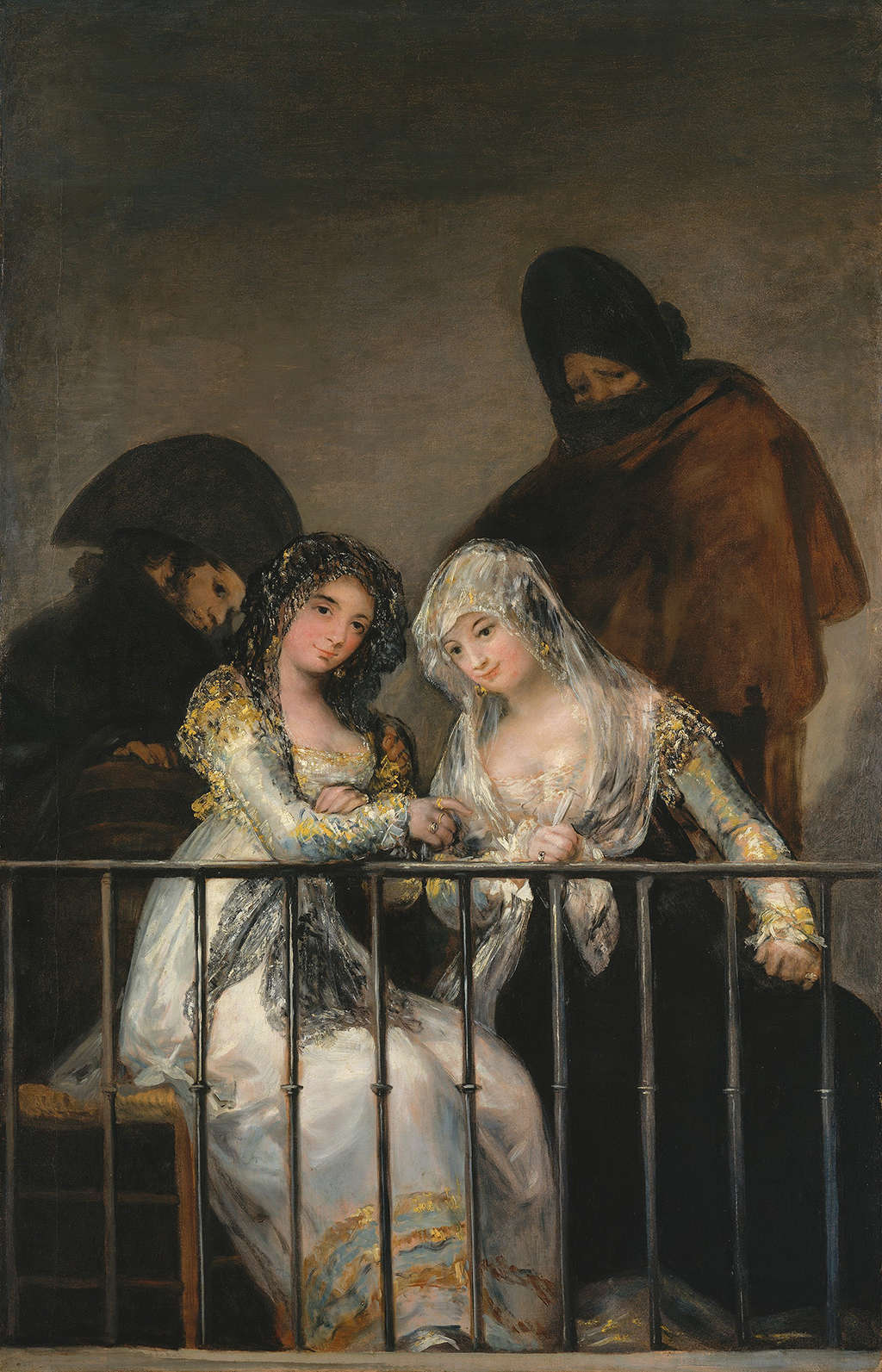
Two women lean towards each other behind a balcony rail. Flecks of gold catch the light on their sleeves, and a pale veil descends from the head of the woman at the right almost to her hands. The men behind them are harder to read. One bends his head under a broad black hat. The other, wrapped in a brown cloak, looks down with the lower half of his face covered. The painting illustrated here is the larger of two closely related canvases, the one in the Metropolitan Museum of Art in New York. The black lace around the left woman’s face leaves her eyes and forehead visible. In the documented version by Francisco de Goya, the lace falls across them. [1] [2] [3]
At a Glance
- TitleMajas on a Balcony, also catalogued in Spanish as Majas al balcón. [1] [2]
- Artist and dateThe Metropolitan Museum of Art catalogues this version as attributed to Francisco de Goya y Lucientes, c. 1800–1810. [1]
- Medium and dimensionsOil on canvas, 194.9 × 125.7 cm. [1]
- CollectionThe Metropolitan Museum of Art, New York, 29.100.10. H. O. Havemeyer Collection, Bequest of Mrs. H. O. Havemeyer, 1929. [1]
Works across Goya’s career
The Parasol
1777The Nude Maja
1795–1800Saturn Devouring His Son
c. 1820–23The Dog
c. 1820–23The balcony seen from the street
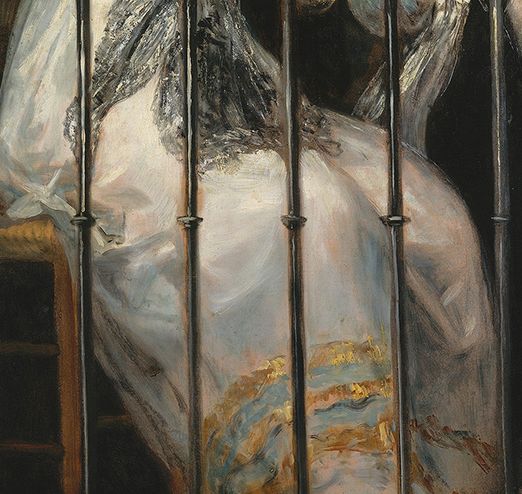
In the Met picture the top of the rail crosses almost the entire width of the canvas at the women’s forearms. Its vertical bars interrupt the white skirt and the glints of gold at the hem. At the left a small strip of woven seat and a slim wooden leg show through the ironwork, enough to establish how the woman is sitting. The view stops at the bottom edge of the balcony. With no pavement in view, the rail gives us our clearest sense of where we stand in relation to the women. Anyone looking at the painting occupies something like the position of a passer-by who has looked up. [1]
The faces and hands pull the eye in different directions. The left woman’s elbow rests by the rail and her head inclines towards her companion. Her companion’s pale veil comes down in long brushstrokes on either side of her face. At the centre, the hands lie so close that the eye follows them almost as one group. Farther right a hand hangs at the end of an extended arm, below the top of the rail. The two women seem at home in the tight space. The man at the left is pressed close enough for his hat to loom above the dark mantilla. The higher head at the right has room around it, against the bare brown-grey background. That patch of space makes it easy to miss him at first and hard to overlook him once seen. [1]
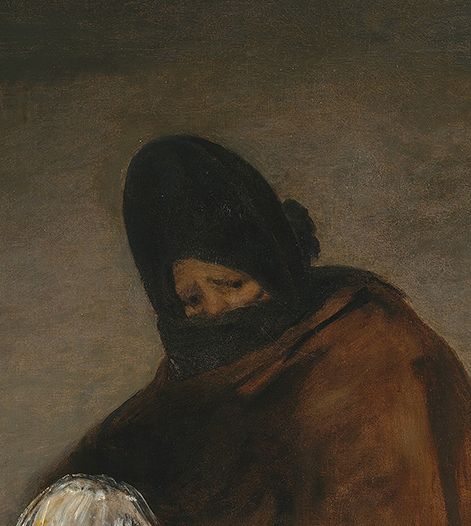
The veil and cloak both cover parts of a face, with different effects. Light on the edge of the woman’s veil leads the eye towards her expression. The top of the man’s cloak makes his expression more difficult to recover, even when we can make out where his eyes are. Notice also how little scenery the figures need. The paint supplies neither an identifiable street nor a particular building. A few straight bars and the figures acting in relation to them are enough to suggest a boundary between a private gathering and a place where anyone outside might see it. [1]
Annotated Details from Majas on a Balcony
Look at the two women’s faces and hands before following the ironwork and the shadowed men.
Details from MAJAS ON A BALCONY
Details from the Metropolitan Museum canvas (29.100.10).
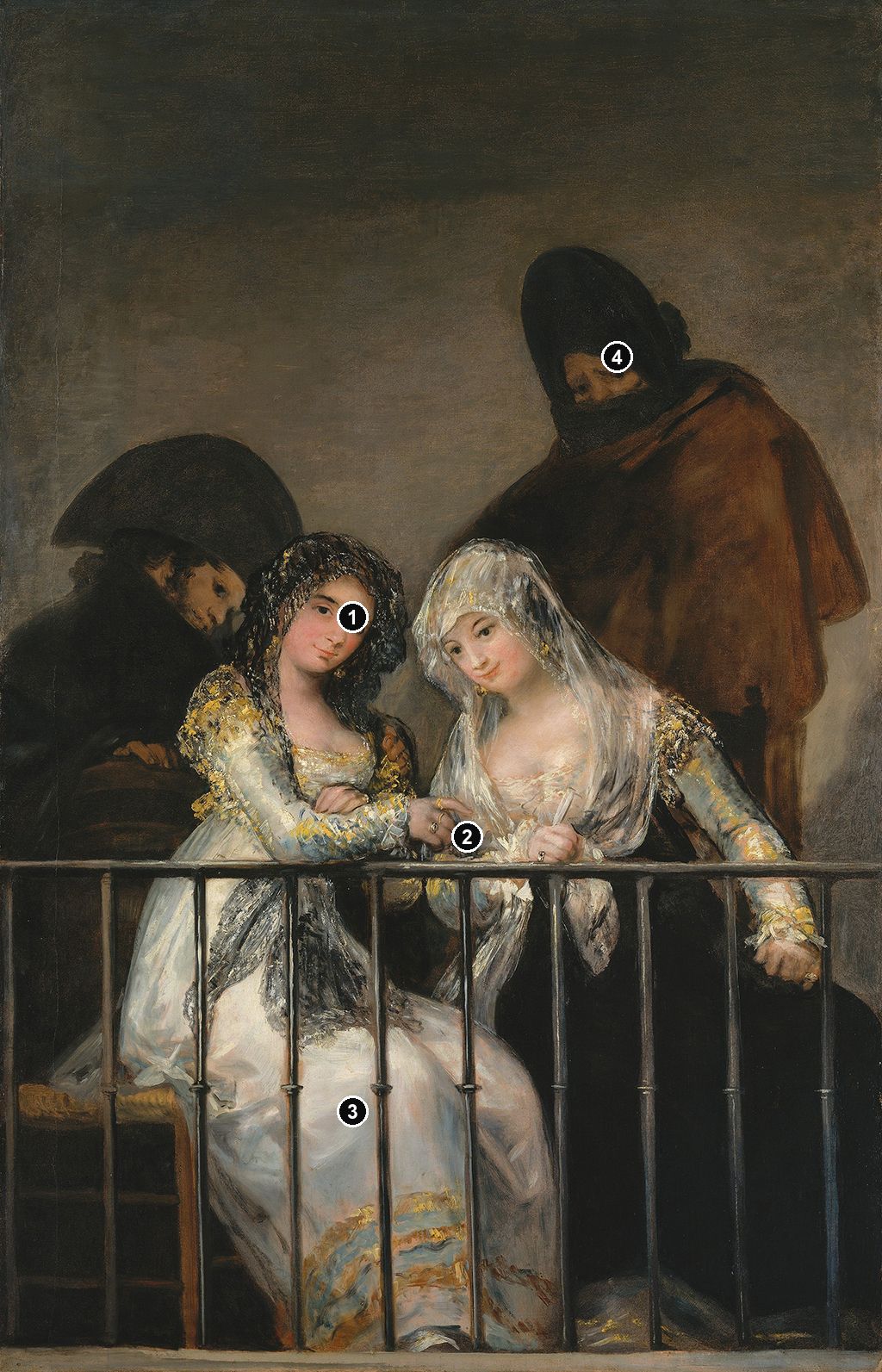
The face framed by dark lace
Dark lace frames the uncovered face on the left.
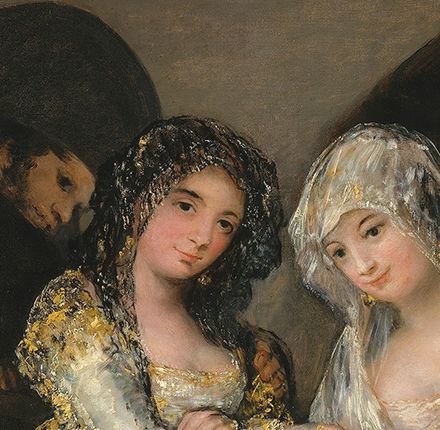
Hands above the rail
The two women’s hands meet just above the horizontal rail.
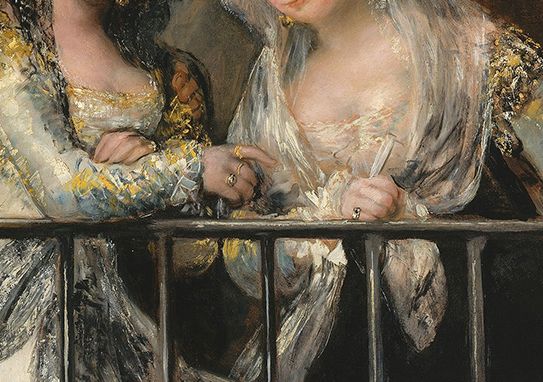
The embroidered skirt and rail
Dark vertical bars interrupt the pale embroidered fabric.
A figure in shadow
Only a sliver of the face is visible between the hood and the cloak.
Dress and the people wearing it
Maja evoked a woman recognisable by an emphatic style of dress associated with Spanish popular life. The style could cross class boundaries. As dress historian Aileen Ribeiro explains, forms of fashionable popular dress could also be adopted by elite women. Here the bright embroidery, fitted bodices and mantillas announce a style immediately. The sheen coming off the sleeves changes as the arms bend, and the dark lace around the left woman’s neck stands out against the pale dress beneath. The two costumes give the women a public presence before the viewer has had a chance to read their faces. [1] [4]
The Fundación discusses a possible reading of the documented Swiss version in which the women are sex workers and the men accompanying them are procurers. The setting and the guarded presence of the men are part of the case for that reading. The picture supplies no transaction, and the foundation also entertains a reading in which the women are simply amusing themselves from a position where they feel secure. The Met version unsettles the viewer in much the same way. Someone below could see a great deal of the finery while knowing very little about the people wearing it. The question of who has the advantage in that exchange stays open. [1] [3]
Goya on film
Five films explore Goya’s portraits, prints, Black Paintings and painting techniques.
The Duke of Wellington by Goya
The portrait, its military decorations and its later theft.
Watch on YouTubeTwo canvases with different histories
The privately held painting is catalogued by the Fundación as an oil on canvas of about 1808–1812. It measures 162 × 107 cm and bears the mark X.24 in the lower left. When Goya and his son Javier divided property following Josefa Bayeu’s death in 1812, the inventory listed two paintings of young women on a balcony together at number 24, with a joint valuation of 400 reales. The other canvas in that entry is Maja and Celestina on a Balcony, where an older figure keeps company with a single young woman. The inventory entry and the surviving mark give the Swiss Majas an early history which can be followed through Javier Goya, Louis-Philippe’s Galerie Espagnole and the Montpensier family. [3] [5] [6]
The Met’s 1995 exhibition catalogue first places its own painting in the documentary record in 1835, seven years after Goya died, and discusses its prominence in the collection of the Infante Sebastián Gabriel. The painting later passed through the Paris dealer Durand-Ruel and the Havemeyer collection before entering the Met by bequest. The museum’s exhibition brought the two canvases together in 1995. Because they share the same group of four people, the direct comparison gives weight to details that would be easy to miss from the title alone. The foundation points to the open face of the Met’s left maja, the wider space at the left edge and a change in who holds the fan. In the Met canvas the fan belongs to the woman at the right, while in the Swiss version it is with her companion. [1] [2] [7]
The Met exhibition catalogue describes differences even beneath the surface. One argument against Goya’s authorship concerns the order of painting. In the Met canvas the rail preceded the dresses, while in the documented canvas the ironwork was added across the painted clothing. There are also differences in support. The documented painting reuses an older canvas, while the museum’s version was executed on a fresh one. The catalogue also sets out the case for retaining the possibility of Goya’s involvement. Old damage and repainting complicate any judgement of the original surface. The handling of the main group has been read as direct and assured enough for it to be considered a first stage of an unfinished work. Those are competing readings of physical evidence from the same painting. [7]
From Murillo’s window to Manet’s balcony
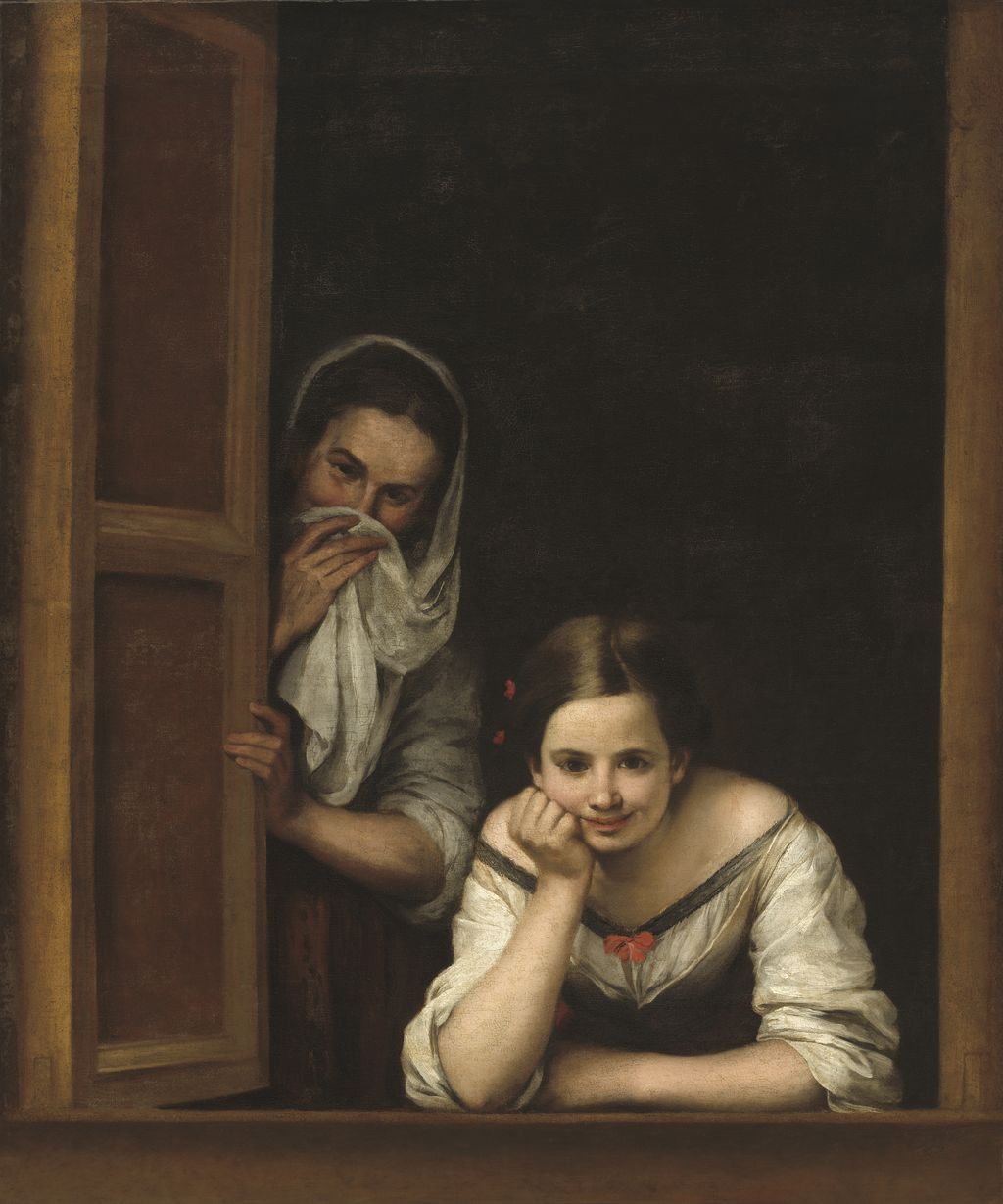
The Fundación cites Bartolomé Esteban Murillo’s Two Women at a Window as a possible precedent for Goya’s composition. Murillo sets one woman at the sill and another a little way back, where she raises her shawl over her mouth. The opening fills much of the picture. Seen in a room, the painting can give the impression of looking through a real window and being seen from the other side. The balcony composition uses that same possibility and lets the railing carry it nearly from edge to edge. Its women are farther out in the light, while the men watch from behind. [3] [8]
In Édouard Manet’s The Balcony, painted in 1868–69, bright clothing and a dark interior again meet along a railing. The ironwork is a vivid green, repeated in the shutters. Berthe Morisot sits at the left as the other prominent figures stand behind her. For a viewer familiar with the Majas, the gaps between Manet’s sitters feel as consequential as the Spanish women’s closeness. Each person seems absorbed in a separate line of thought. The Musée d’Orsay identifies the debt to Goya and records how the green and the strong contrast between white dresses and background shadow challenged expectations at the 1869 Salon. The Prado’s account of Manet also points to an engraved Majas in Charles Yriarte’s 1867 book and to another balcony version from the Salamanca sale. More than one channel made the composition available to Manet’s generation. [9] [10]
Artworks directory
| Name | Date | Medium |
|---|---|---|
| And There’s No Help for It, Plate 15 | Printed 1863 | |
| Asmodea | c. 1820–23 | Wall painting transferred to canvas |
| Boys Inflating a Bladder | 1777–78 | Tapestry cartoon |
| Boys Picking Fruit | 1778 | Tapestry cartoon |
| Bullfight in a Divided Ring | 1825 | Lithograph |
| Card Players | 1777–78 | Tapestry cartoon |
| Card Players (sketch) | 1777–78 | Painted sketch |
| Dance on the Banks of the Manzanares | 1777 | Tapestry cartoon |
| Duel with Cudgels | c. 1820–23 | Wall painting transferred to canvas |
| Heads in a Landscape | c. 1820–23 | Easel painting |
| Judith and Holofernes | c. 1820–23 | Wall painting transferred to canvas |
| Leocadia | c. 1820–23 | Wall painting transferred to canvas |
| Maja and Cloaked Men | 1777 | Tapestry cartoon |
| Maja and Cloaked Men (sketch) | 1777 | Painted sketch |
| Majo Clapping in Time to the Music | 1777 | Drawing |
| Men Reading | c. 1820–23 | Wall painting transferred to canvas |
| Out Hunting for Teeth, Plate 12 | 1799 | Etching, burnished aquatint and burin |
| Picnic in the Countryside (sketch) | 1776–78 | Painted sketch |
| Picnic on the Banks of the Manzanares | 1776 | Tapestry cartoon |
| Pilgrimage to San Isidro | c. 1820–23 | Wall painting transferred to canvas |
| Preparatory study for The Sleep of Reason Produces Monsters | c. 1796–97 | Drawing |
| Procession of the Holy Office | c. 1820–23 | Wall painting transferred to canvas |
| Quarrel at the Cockerel Inn (sketch) | 1777 | Painted sketch |
| Quarrel in the New Tavern | 1777 | Tapestry cartoon |
| Saturn Devouring His Son | c. 1820–23 | Wall painting transferred to canvas |
| Seated Majo Smoking | c. 1776 | Drawing |
| The Dog | c. 1820–23 | Wall painting transferred to canvas |
| The Drinker | 1777 | Tapestry cartoon |
| The Fates | c. 1820–23 | Wall painting transferred to canvas |
| The Great He-Goat | c. 1820–23 | Wall painting transferred to canvas |
| The Kite | 1777–78 | Tapestry cartoon |
| The Parasol | 1777 | Oil on canvas, tapestry cartoon |
| The Second of May 1808 | 1814 | Oil on canvas |
| The Sleep of Reason Produces Monsters, Plate 43 | 1799 | Etching and aquatint |
| The Third of May 1808 | 1814 | Oil on canvas |
| Thou Who Canst Not, Plate 42 | 1799 | Etching and burnished aquatint |
| Three Figures | 1776 | Drawing (lost) |
| Two Old Men | c. 1820–23 | Wall painting transferred to canvas |
| Two Old Men Eating Soup | c. 1820–23 | Wall painting transferred to canvas |
| Two Women and a Man | c. 1820–23 | Wall painting transferred to canvas |
| Universal Language: The Author Dreaming | 1797 | Drawing |
| The Family of Charles IV | 1800 | Oil on canvas |
| Witches’ Sabbath (Osuna painting) | 1797–98 | Oil on canvas |
| The Nude Maja | 1795–1800 | Oil on canvas |
| The Clothed Maja | 1800–07 | Oil on canvas |
| Self-Portrait (Drawing) | c. 1796 | Brush and carbon black ink on laid paper |
| The Swing, Madrid Album B.21 | 1795–97 | Brush and carbon black washes |
| Majas Fighting, a Majo Observing, Madrid Album B.15 | 1796–97 | Brush, grey and black washes on laid paper |
| Majos and Majas Conversing, Madrid Album B.16 | c. 1794–97 | Ink wash on paper |
| Weeping Woman and Three Men, Madrid Album B.17 | 1795–97 | Brush, carbon black washes and black chalk |
| Maja Seated on a Chair and Two Companions Behind, Madrid Album B.18 | 1795–97 | Brush and carbon black washes |
| Girl and Bull, Madrid Album B.23 | 1796–97 | Brush and carbon black washes |
| Lovers Sitting on a Rock, Madrid Album B.24 | 1796–97 | Brush and carbon black washes |
| Mariano Ceballos Riding a Bull | 1825 | Crayon lithograph and scraper |
| Landscape (lifetime impression) | c. 1807–10 | Etching and aquatint |
| Self-Portrait (1815), Prado canvas | 1815 | Oil on canvas |
| Self-Portrait (1815), Academy panel | 1815 | Oil on panel |
| Self-Portrait with Dr Arrieta | 1820 | Oil on canvas |
| Christ Crucified | 1780 | Oil on canvas |
| The Last Communion of Saint Joseph of Calasanz | 1819 | Oil on canvas |
| Christ on the Mount of Olives | 1819 | Oil on panel |
| The Flower Girls, or Spring | 1786–87 | Oil on canvas |
| The Grape Harvest, or Autumn | 1786–87 | Oil on canvas |
| The Snowstorm, or Winter | 1786–87 | Oil on canvas |
| The Threshing Ground, or Summer | 1786–87 | Oil on canvas |
| Picnic on the Banks of the Manzanares | 1776 | Oil on canvas |
| The Kite | 1777–78 | Oil on canvas |
| Dance on the Banks of the Manzanares | 1777 | Oil on canvas |
| A Fight at the Venta Nueva | 1777 | Oil on canvas |
| Blind Man’s Bluff | 1788 | Oil on canvas |
| Dogs on a Lead | 1775 | Oil on canvas |
| Hunting with a Decoy | 1775 | Oil on canvas |
| Hunter Loading His Rifle | 1775 | Oil on canvas |
| The Angler | 1775 | Oil on canvas |
| The Hermitage of San Isidro on His Feast Day | 1788 | Oil on canvas |
| The Meadow of San Isidro | 1788 | Oil on canvas |
| The Straw Manikin | 1791–92 | Oil on canvas |
| Witches’ Flight | c. 1797–98 | Oil on canvas |
| A Scene from ‘The Forcibly Bewitched’ | 1798 | Oil on canvas |
| The Duchess of Alba in Black | 1797 | Oil on canvas |
| The Duchess of Alba in White | 1795 | Oil on canvas |
| Charles III in Hunting Dress | c. 1786 | Oil on canvas |
| The Duke and Duchess of Osuna and Their Children | 1787–88 | Oil on canvas |
| Manuel Osorio Manrique de Zúñiga | 1787–88 | Oil on canvas |
| The Marquesa de Pontejos | c. 1786 | Oil on canvas |
| Equestrian Portrait of the 1st Duke of Wellington | 1812 | Oil on canvas |
| The Duke of Wellington | 1812–14 | Oil on wood |
| Portrait of Ferdinand VII of Spain | 1814 | Oil on canvas |
| Gaspar Melchor de Jovellanos | 1798 | Oil on canvas |
| María Tomasa Palafox y Portocarrero | 1804 | Oil on canvas |
| Señora Sabasa García | c. 1806–11 | Oil on canvas |
| Don Juan Bautista de Muguiro | 1827 | Oil on canvas |
| Doña Isabel de Porcel | Before 1805 | Oil on canvas |
| The Colossus | After 1808 | Oil on canvas |
| The Burial of the Sardine | 1808–12 | Oil on panel |
| The Madhouse | 1808–12 | Oil on panel |
| A Procession of Flagellants | 1808–12 | Oil on panel |
| Portrait of Jacques Galos | 1826 | Oil on canvas |
| Portrait of Mariano Goya, the Artist’s Grandson | 1827 | Oil on canvas |
| Milkmaid of Bordeaux | c. 1827 | Oil on canvas |
| Portrait of Don Juan Antonio Cuervo | 1819 | Oil on canvas |
| María Luisa of Parma (Naples version) | c. 1800 | Oil on canvas |
| The Countess of Baena | 1819 | Oil on canvas |
| The Family of the Infante Don Luis | 1783–84 | Oil on canvas |
| The Holy Family | c. 1787 | Oil on canvas |
| Saint Barbara | c. 1773 | Oil on canvas |
| Saints Justa and Rufina | 1817 | Oil on canvas |
| El Tío Paquete | c. 1819–20 | Oil on canvas |
| The Forge | c. 1815–20 | Oil on canvas |
| Majas on a Balcony (Metropolitan Museum version) | c. 1800–10 | Oil on canvas |
| Maja and Celestina on a Balcony | c. 1808–12 | Oil on canvas |
| The Water Bearer | 1808–12 | Oil on canvas |
| Time and the Old Women | c. 1810 | Oil on canvas |
Frequently Asked Questions
Start with the woman at the left. In the Met canvas you can see her face clearly within a frame of dark lace. In the documented version the black mantilla extends across her forehead and eyes. The figures are arranged similarly in both, so this small change is a quicker identifier than the number of people or the position of the rail. [1] [2] [3]
The balcony picture shows two women sitting upright in company, both fully dressed. The Prado records the companion reclining figures as The Naked Maja and The Clothed Maja. They are separate compositions with their own histories. [1] [11] [12]
Discussion
Look again at the images and ideas explored in Majas on a Balcony. These editorial prompts invite your observations.
When did you first notice the man at the right? Now look again at the women’s hands and the strip of light on the top of the rail. Does the picture feel like a moment you have chanced upon, or do the women seem to have chosen who may see them?
Reader Insights
Follow the rail to see where the figures lean forwards.
How does the background change what you can see of the two men?
Join the Conversation
Share a detail, comparison or question about Majas on a Balcony below.
References
- The Metropolitan Museum of Art, Majas on a Balcony, 29.100.10, current collection record. View source.
- Fundación Goya en Aragón, Majas al balcón, Metropolitan Museum of Art version, catalogue record 184. View source.
- Fundación Goya en Aragón, Majas al balcón, Swiss private collection version, catalogue record 183. View source.
- Aileen Ribeiro, “Fashioning the Feminine: Dress in Goya’s Portraits of Women”, in Goya: Images of Women, Museo Nacional del Prado and National Gallery of Art, 2001–02. View source.
- Fundación Goya en Aragón, Maja y celestina al balcón, catalogue record 182. View source.
- Juliet Wilson-Bareau, “Goya and the X Numbers: The 1812 Inventory and Early Acquisitions of ‘Goya’ Pictures”, Metropolitan Museum Journal 31, 1996, pp. 159–174. View source.
- Colta Ives and Susan Alyson Stein, Goya in The Metropolitan Museum of Art, exhibition catalogue, 1995, pp. 46–48 and 64–66. View source.
- National Gallery of Art, Bartolomé Esteban Murillo, Two Women at a Window, 1942.9.46. View source.
- Musée d’Orsay, Édouard Manet, Le Balcon, RF 2772. View source.
- Museo Nacional del Prado, “Manet, Édouard”, encyclopaedia entry. View source.
- Museo Nacional del Prado, The Naked Maja, P000742. View source.
- Museo Nacional del Prado, The Clothed Maja, P000741. View source.







