


 by Tom Gurney
Tom Gurney BSc (Hons) is an art history expert with over 20 years experience
Published on June 19, 2020 / Updated on November 20, 2026
Email: tomgurney1@gmail.com / Phone: +44 7429 011000
Introduction
Turn page 43 of Francisco de Goya’s Italian Notebook sideways and two little warriors come into view. One is lightly set down in black chalk. Goya went back over the other in pen, making the helmet and stance easier to pick out. Personal notes occupy the top of the page in its original orientation. In the oil painting he sent to the Parma Academy in 1771, Hannibal stands on an Alpine ridge, accompanied by a winged figure. His armour catches the light. Below him, a bull-headed personification of the river Po pours water from a vessel. The page is where Goya could try out how the commander would stand and move. The canvas gives that gesture a landscape, an audience and a destination. [1] [2]
At a Glance
- ArtistFrancisco de Goya y Lucientes (1746–1828). [3]
- Early working bookThe Italian Notebook, Museo Nacional del Prado, D006068, contains drawings and written notes made from about 1770 to 1786. [1] [4]
- Drawing albumsEight groups conventionally lettered A to H, from the 1790s to Goya’s Bordeaux years. Paper, technique and numbering help establish where individual drawings belong. [5] [6]
- MediaBrush and ink washes, pen and ink, black or red chalk, and, in the late albums, lithographic crayon. [7] [8]
- CollectionsThe Museo Nacional del Prado holds the largest group. Important sheets also survive at the Metropolitan Museum of Art and the Hispanic Society of America in New York. [7] [9] [10]
From a portable notebook to a painting
The two sketches on page 43 occupy only part of a page about nineteen centimetres high. The pen figure advances in three-quarter view, its leading leg clear under the armour. The lighter figure faces more directly forward and extends an arm. The Fundación Goya en Aragón’s catalogue explains that this lighter figure was once read as a study for the winged companion and is now more often interpreted as another version of Hannibal himself. The armour and exposed legs favour the second reading. In the painting Goya retained the force of a forward stride while making the commander’s attention travel off to the side, towards the country he is about to enter. Even this small adjustment changes how the viewer enters the scene. The first thing to follow on the page is the movement of the legs. In the painting the commander’s gaze and the winged figure’s gesture lead out into the distance. [1] [2]
The academy had specified the moment, including the visor and a winged companion. The painted composition had to make those requirements legible together. Five pages of the Italian Notebook are associated with the project, and two separate oil sketches also survive. On page 37 another trial for the composition is overlapped by a study of a fountain mask. Such a juxtaposition is easier to understand in a portable working book, where the available paper can serve several needs. Goya kept using the book well beyond his Italian journey. Its drawings share space with written notes, and the title names the circumstances in which he began it. The biography follows the documentary trail from the entry sent from Rome to the rediscovery of the canvas. [2] [4] [11]
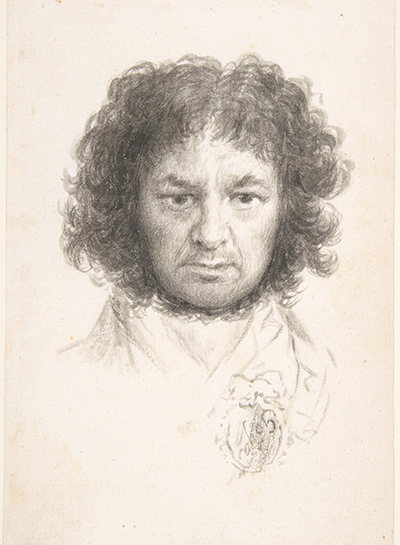
Preparation is a function a drawing can serve, whether it sits inside a book or on a loose sheet. The eight later albums afforded Goya a further kind of work. He could carry a figure or a question across successive images and give each drawing an effect of its own. A sheet could also have a life outside a numbered group. In the Met’s small Self-Portrait, made around 1796 in carbon black ink, Goya describes the face crisply and lets the brush leave much of his clothing unresolved. The tiny badge on the lapel bears his name. The difference in finish directs the eye back to the face each time it strays towards the coat. The Met leaves open whether he made it for himself, for someone else, or with a print in mind. The drawing was later mounted at the head of a collection of his sheets. That later position gave it a role regardless of what Goya had first intended. [7] [9] [12]
Two sides of the early albums
In Young Woman Raising Her Arms, from Album A, a grey-black block of wash gives a lightly dressed figure something to stand against. She has her back to us. Her raised hands reach above the block into clear paper, and the narrow marks of the brush convey the looseness of the garment. The block could be a wall or a balcony. Goya leaves its exact identity and whatever prompts the gesture outside the action we can see. Turn the sheet over and there is a woman pulling up her stocking. The Prado and National Gallery of Victoria exhibition catalogue dates the two sides to 1794–95 and links the stocking drawing with Plate 17 of Los Caprichos. Pictures on the same piece of paper could therefore differ in where they led. One remains an open-ended scene. The other supplied a gesture that Goya could put to work in a published scene. [7] [13]
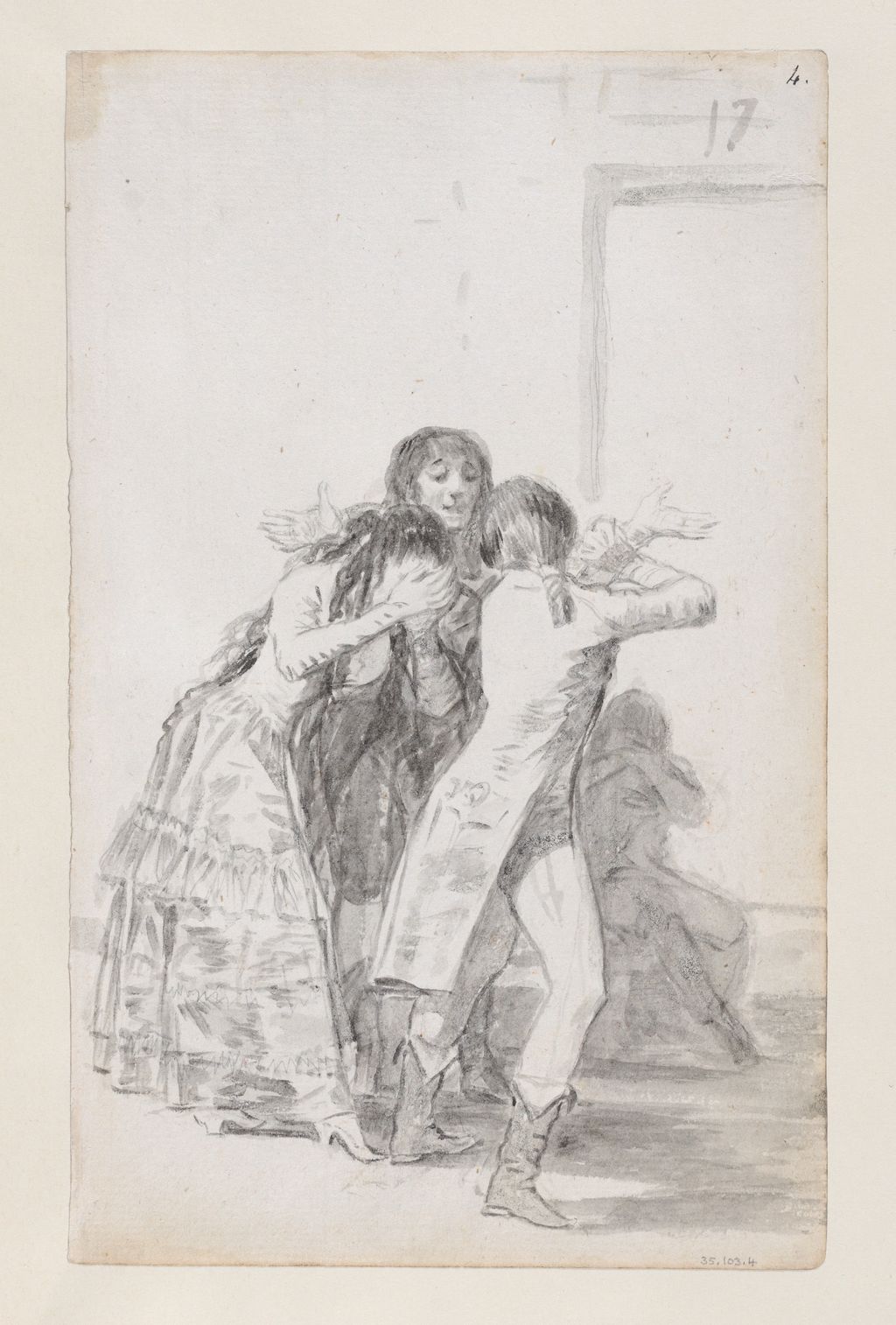
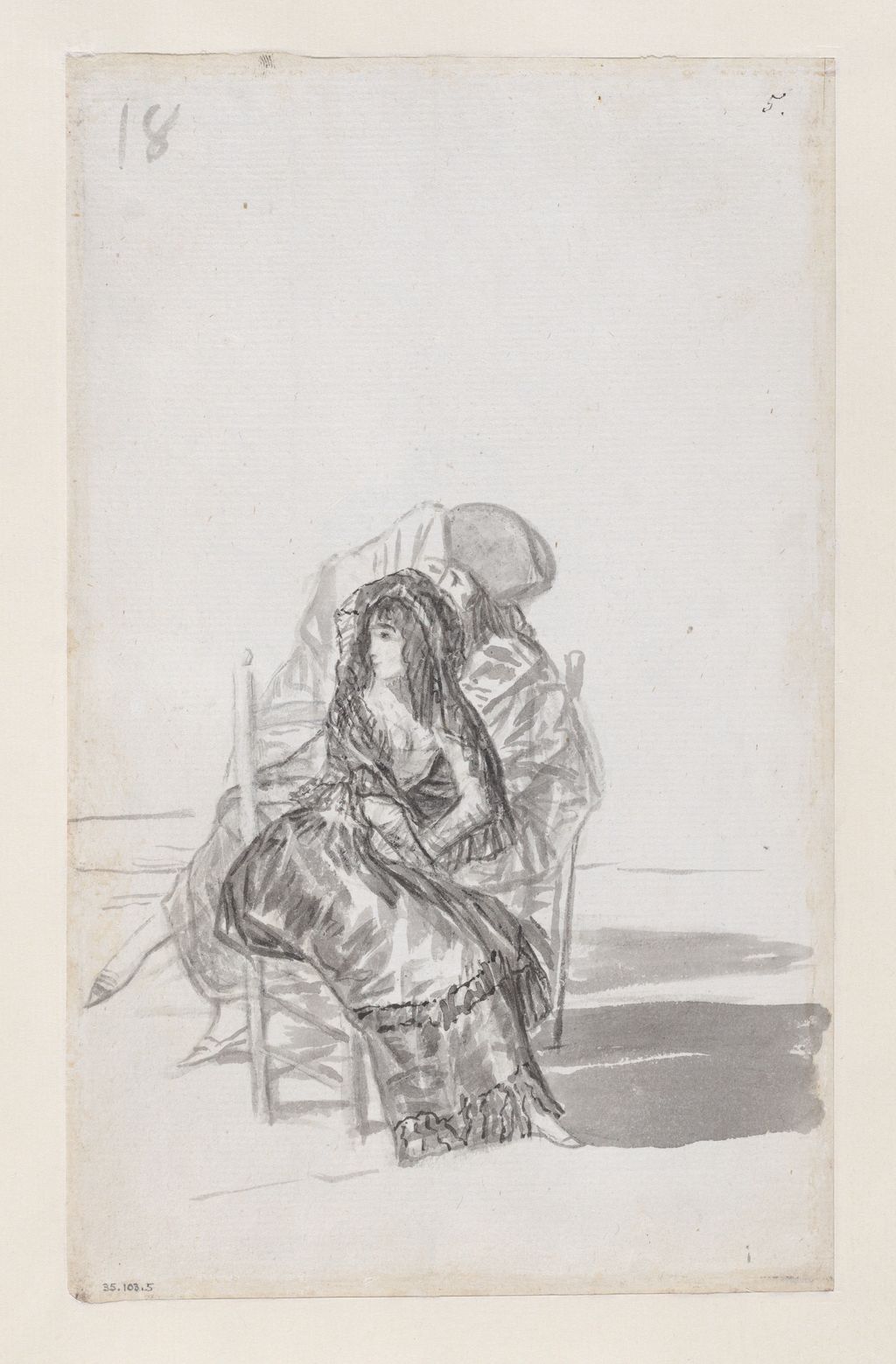
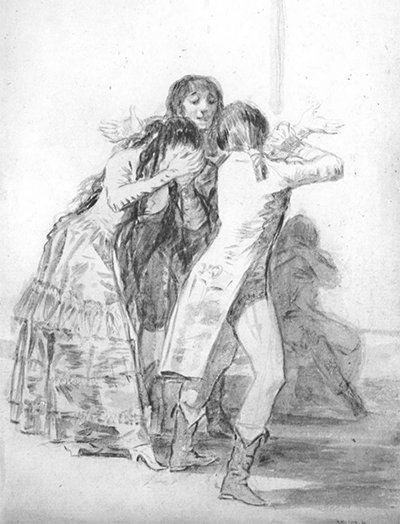
The surviving leaves of Album B are often large enough to let several figures keep their distance from one another. In Weeping Woman and Three Men, B.17, two men flank a woman who covers her face and turns away. The turn makes the space immediately around her feel crowded. The Met records carbon black washes and black chalk. Brush marks establish the dark figures, while the sheet stays much lighter around the hands and face. The gestures make distress plain and leave the circumstances open. On the reverse, B.18, another woman turns her body sharply and directs her gaze to the side. Seeing both faces of the leaf shifts attention from what might have happened to the first woman to what Goya can communicate through the angle of a shoulder or the direction of a glance. [14]
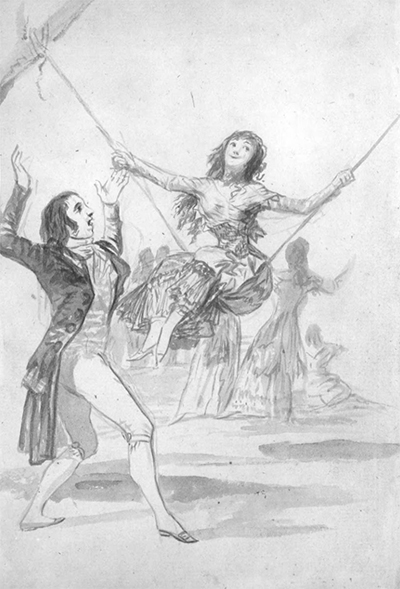
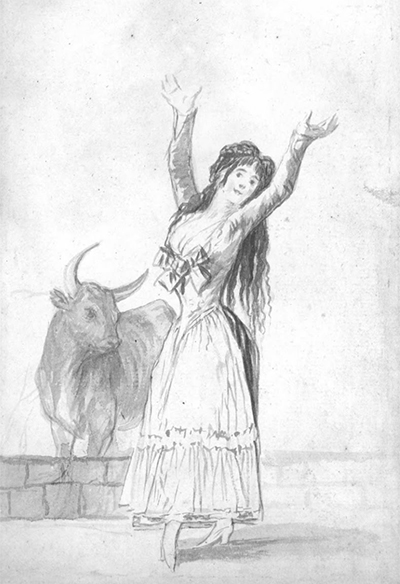
Other sides from the Madrid album make the relation between movement and spectatorship more playful. In The Swing, B.21, a man lifting both hands answers the arc of a girl swinging above the ground. The verso, B.22, brings a young woman and an officer into a closer encounter. In Girl and Bull, B.23, a woman raises both arms while the bull stays in the background. The title leaves open what to make of that relation. The gap between the figures gives much of the sheet to her gesture, and the viewer can read it as animation, alarm or a deliberate performance for someone outside the picture. Each page asks a slightly different question about who is looking and what the person being watched knows. [9] [15] [16]
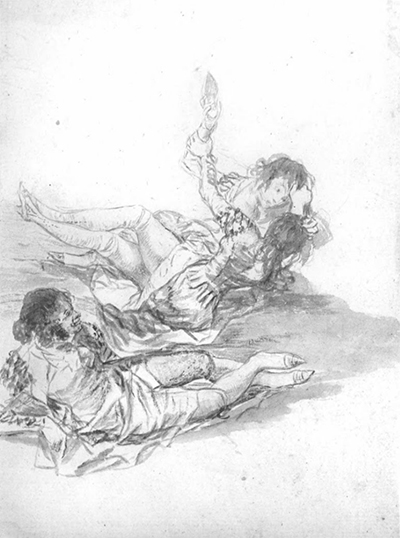
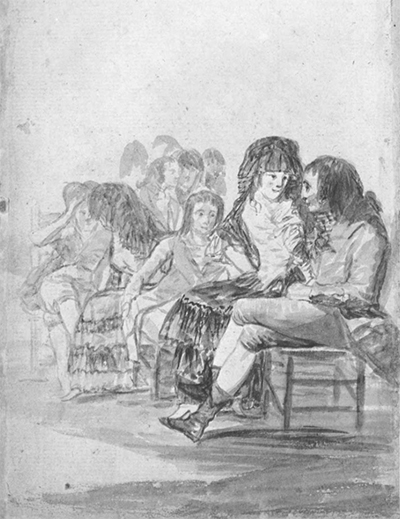
Two scenes now in the Hispanic Society of America offer a particularly literal reason to turn the paper. Majo Laughing at Two Girls Fighting, B.15, places a reclining spectator in front of two fighting women. A hand reaching for hair and a shoe used against an opponent give the fight its physical detail. In Majos and Majas Conversing, B.16, a cluster of fashionable figures occupies the lower part of the composition. The way Goya gathers them invites a slower look at how bodies lean towards or away from one another. The Fundación catalogues the two sides under distinct inventory numbers, A 3309 and A 3310, and identifies them as the front and back of the same leaf. The course from scuffle to conversation takes one turn of the paper. [10]
Goya on film
Five films explore Goya’s portraits, prints, Black Paintings and painting techniques.
The Duke of Wellington by Goya
The portrait, its military decorations and its later theft.
Watch on YouTubeHow the albums were put back in order
The letters A to H come from scholarship. Eleanor Sayre used them to organise groups that differed in their paper, materials and format. The letters give readers a stable way to name a group even as proposed dates change. The Prado and NGV catalogue places Young Woman Raising Her Arms in 1794–95, while the Met dates its Album B examples to 1795–97. The familiar names Sanlúcar and Madrid are also conventions. Centro Botín notes that Album A may have begun in Madrid before the visit to the Duchess of Alba’s estate traditionally associated with it. [5] [7] [14] [17]
A number in Goya’s hand establishes a position in a sequence. Janis Tomlinson’s study of Album B proposes that the numbering and binding may have followed the making of the drawings, leaving time for additions such as a wash background or a caption. The edges and surfaces of the paper offer other clues. Elvira Cámara López documents the watermark on Coche barato y tapado, Album G, sheet 25 (Museo Cerralbo, 04711). A heart topped with a trefoil was formed by wire in the mould used to make the paper, and is clearest when the sheet is viewed by transmitted light. On the reverse the museum identifies a faint trace from the next drawing, G.26, evidence that the two sheets once lay against each other. Chain lines, which appear as more widely spaced lines in handmade laid paper, can likewise be compared across sheets. A watermark can help establish a connection in the paper stock. To establish a place within a group, it can be read alongside page numbers, dimensions, medium and provenance. [5] [6]
Later owners left their own traces. The Prado’s Album A drawing of the woman raising her arms bears a pencil number associated with the Garreta or Madrazo collection and a stamp from the Museo de la Trinidad, which acquired it in 1866. It entered the Prado in 1872. The Met bought fifty drawings together in 1935, mounted on pink scrapbook pages. Colta Ives and Susan Alyson Stein describe the volume as an assembly apparently made by Goya’s son Javier from four of his father’s albums, subsequently associated with the Madrazo and Fortuny collections. It is evidence of how the drawings circulated after Goya’s death. Its sequence records the arrangement of a later collection, while the leaves still preserve parts of earlier sequences. [7] [9] [13]
Reading the reverse of a sheet
The Met’s red-chalk self-portrait for the first plate of Los Caprichos offers a useful test for anyone starting with a digital gallery. The face in profile appears on the front, together with a drawn boundary defining its field. Two further studies of the face appear on the back. A single page of results can make the two sides look like unrelated drawings, especially if one has a fuller title than the other. Reading both sides restores a practical relationship. A draughtsman could use the same piece of paper to try a larger arrangement and work out separate details. [24] [25]
The private album drawings present a related problem. In a bound arrangement the viewer turned pages to see another image, whereas the owner of an unbound sheet can turn that same sheet over. The distinction affects how one reads numbers, inscriptions and traces of reuse. A mark near an edge might once have been read in relation to a facing leaf. Sheets separated through sale or mounted by later collectors can lose part of that context. Comparison of media, inscriptions and recto-verso relationships helps establish which drawings are likely to have belonged together. [24] [25]
The National Gallery of Victoria’s exhibition of drawings from the Prado put groups of sheets into a new sequence for its visitors. A reconstruction and an exhibition do different things. One argues from the surviving material about relations a historical reader could have encountered. The other can put works from separate series side by side in order to make a recurring motif visible. Both benefit from attending to the sheet as an object. A close look at what is carried on its back may matter more than a convincing thematic resemblance. [24] [25]
The catalogue record gives the two sides of the Met sheet different combinations of drawing materials. The more developed front uses red chalk, while the further studies on the back include pen and ink with red chalk. That difference is a reason to distinguish the decision to use the same piece of paper from the decision to keep employing the same means of drawing. It also shows why catalogue descriptions of medium sometimes need to specify a side. A digital viewer can compare front and back under deceptively similar conditions. The catalogue lets the viewer recover a difference of tool and handling within a single object. [24] [25]
When a drawing became a print
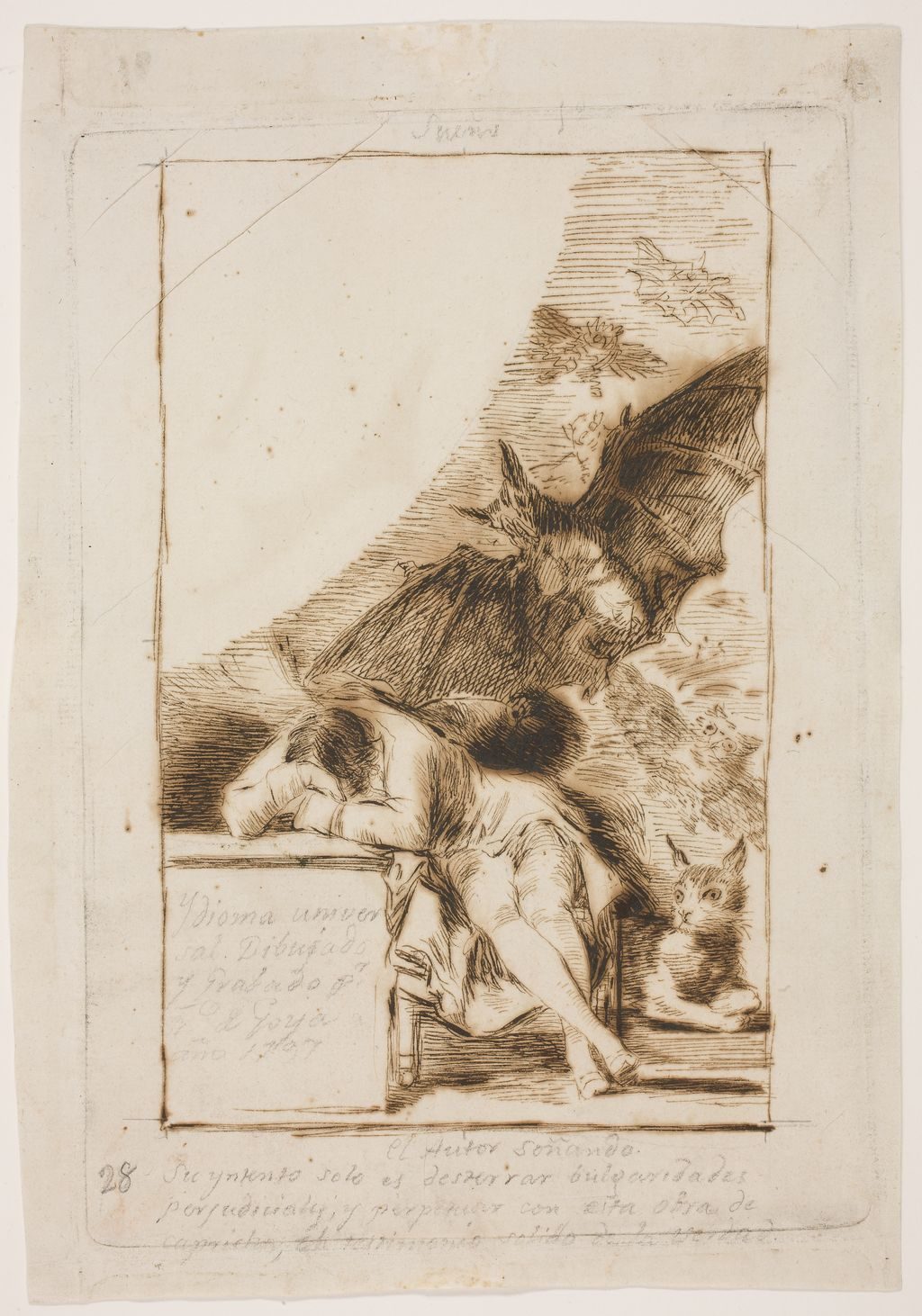
In the case of The Sleep of Reason Produces Monsters, the evidence of purpose extends to the surface of the paper. Two sheets in the Prado precede the print. In the first, D4162, faint heads and animal forms make the space above the sleeper look full of experiments. In the dated drawing of 1797, D3923, Goya kept the folded body and revised the surrounding shapes. He wrote “Sueño 1º” at the top, assigned the words “Ydioma universal” to the front of the table and identified the figure below as “El Autor soñando”. The words earmark the drawing for an opening. A reader would have met a named author from the first page, only to see him with his face lowered. [18] [19]
The dated drawing carries marks from transfer to copper. A sheet placed face down against a plate and run through a press could leave its outlines on the metal as a guide and receive the pressure of the plate’s edges. Compare the drawing with the Met’s published impression, Plate 43 of the 1799 first edition. The sleeper and table still anchor the lower half of the composition. The printed sequence gives the composition a different number, and the table carries a shorter title. Aquatint makes it possible to print broad areas of shade around the forms, changing how sharply they emerge. The press could transmit a layout, while decisions about the words, the surrounding creatures and the depth of the blacks continued into the print. The drawing survives as a record both of a proposed beginning and of a step in making an image that found its place deeper inside the series. [7] [18] [20]
The captions in Albums C and G
The placing of words matters differently in Album C. In sheet 87, Prado D04055, they sit in short lines on the garment of Orosia Moreno, a woman subjected to public punishment by the Inquisition. A conical penitential hat and an encircling darkness make her face particularly exposed. The brush lays broad grey-brown and iron gall ink washes over traces of black chalk, while fine pen strokes form the tiny lines of writing. Goya describes the gag and blows to her face, and writes “Yo la bi”, meaning “I saw her”. The contrast between the gag and the writing is striking. Moreno is prevented from speaking inside the picture, while her name and a description of her treatment remain legible on the clothing imposed upon her. [7] [21]
Francisco J. R. Chaparro used archival evidence to identify Moreno’s trial and the public ceremony in Zaragoza in 1760. Whether Goya witnessed it remains debated. Chaparro reads the sheet in the context of a later return to the event, when the artist was making images about the Inquisition and its claims to authority. He proposes an earlier date for the drawing, about 1811–12, than the 1814–23 range used by the Fundación and NGV. The archival finding anchors the event in time. The drawing’s date and its relationship to personal memory are separate questions. Amid other numbered sheets concerned with those prosecuted by the Inquisition, the inclusion of one woman’s name gives a specific person a place in a sequence about a system. [7] [21] [22]
In Bordeaux, Goya worked with black chalk and lithographic crayon. In I Am Still Learning, G.54, Prado D04151, dark crayon strokes gather behind the bowed body of an old man and leave his beard and hair standing out in the light. Each walking stick takes some of his weight as he advances. Goya’s words “Aun aprendo” sit in the open space above him. The first person can sound like the old man speaking or like a motto the ageing artist has chosen for himself. The Fundación also relates it to the emblematic tradition of Ancora imparo, in which an ageing figure embodies the continuing work of learning. The drawing turns that idea into the movement of a single step. Its bent stance and beard recall Two Old Men, the earlier mural at the Quinta del Sordo. In the mural a companion leans towards the old man’s ear. In the late drawing the solitary figure has words of his own. [8] [23]
Selected drawings
Artworks directory
| Name | Date | Medium |
|---|---|---|
| And There’s No Help for It, Plate 15 | Printed 1863 | |
| Asmodea | c. 1820–23 | Wall painting transferred to canvas |
| Boys Inflating a Bladder | 1777–78 | Tapestry cartoon |
| Boys Picking Fruit | 1778 | Tapestry cartoon |
| Bullfight in a Divided Ring | 1825 | Lithograph |
| Card Players | 1777–78 | Tapestry cartoon |
| Card Players (sketch) | 1777–78 | Painted sketch |
| Dance on the Banks of the Manzanares | 1777 | Tapestry cartoon |
| Duel with Cudgels | c. 1820–23 | Wall painting transferred to canvas |
| Heads in a Landscape | c. 1820–23 | Easel painting |
| Judith and Holofernes | c. 1820–23 | Wall painting transferred to canvas |
| Leocadia | c. 1820–23 | Wall painting transferred to canvas |
| Maja and Cloaked Men | 1777 | Tapestry cartoon |
| Maja and Cloaked Men (sketch) | 1777 | Painted sketch |
| Majo Clapping in Time to the Music | 1777 | Drawing |
| Men Reading | c. 1820–23 | Wall painting transferred to canvas |
| Out Hunting for Teeth, Plate 12 | 1799 | Etching, burnished aquatint and burin |
| Picnic in the Countryside (sketch) | 1776–78 | Painted sketch |
| Picnic on the Banks of the Manzanares | 1776 | Tapestry cartoon |
| Pilgrimage to San Isidro | c. 1820–23 | Wall painting transferred to canvas |
| Preparatory study for The Sleep of Reason Produces Monsters | c. 1796–97 | Drawing |
| Procession of the Holy Office | c. 1820–23 | Wall painting transferred to canvas |
| Quarrel at the Cockerel Inn (sketch) | 1777 | Painted sketch |
| Quarrel in the New Tavern | 1777 | Tapestry cartoon |
| Saturn Devouring His Son | c. 1820–23 | Wall painting transferred to canvas |
| Seated Majo Smoking | c. 1776 | Drawing |
| The Dog | c. 1820–23 | Wall painting transferred to canvas |
| The Drinker | 1777 | Tapestry cartoon |
| The Fates | c. 1820–23 | Wall painting transferred to canvas |
| The Great He-Goat | c. 1820–23 | Wall painting transferred to canvas |
| The Kite | 1777–78 | Tapestry cartoon |
| The Parasol | 1777 | Oil on canvas, tapestry cartoon |
| The Second of May 1808 | 1814 | Oil on canvas |
| The Sleep of Reason Produces Monsters, Plate 43 | 1799 | Etching and aquatint |
| The Third of May 1808 | 1814 | Oil on canvas |
| Thou Who Canst Not, Plate 42 | 1799 | Etching and burnished aquatint |
| Three Figures | 1776 | Drawing (lost) |
| Two Old Men | c. 1820–23 | Wall painting transferred to canvas |
| Two Old Men Eating Soup | c. 1820–23 | Wall painting transferred to canvas |
| Two Women and a Man | c. 1820–23 | Wall painting transferred to canvas |
| Universal Language: The Author Dreaming | 1797 | Drawing |
| The Family of Charles IV | 1800 | Oil on canvas |
| Witches’ Sabbath (Osuna painting) | 1797–98 | Oil on canvas |
| The Nude Maja | 1795–1800 | Oil on canvas |
| The Clothed Maja | 1800–07 | Oil on canvas |
| Self-Portrait (Drawing) | c. 1796 | Brush and carbon black ink on laid paper |
| The Swing, Madrid Album B.21 | 1795–97 | Brush and carbon black washes |
| Majas Fighting, a Majo Observing, Madrid Album B.15 | 1796–97 | Brush, grey and black washes on laid paper |
| Majos and Majas Conversing, Madrid Album B.16 | c. 1794–97 | Ink wash on paper |
| Weeping Woman and Three Men, Madrid Album B.17 | 1795–97 | Brush, carbon black washes and black chalk |
| Maja Seated on a Chair and Two Companions Behind, Madrid Album B.18 | 1795–97 | Brush and carbon black washes |
| Girl and Bull, Madrid Album B.23 | 1796–97 | Brush and carbon black washes |
| Lovers Sitting on a Rock, Madrid Album B.24 | 1796–97 | Brush and carbon black washes |
| Mariano Ceballos Riding a Bull | 1825 | Crayon lithograph and scraper |
| Landscape (lifetime impression) | c. 1807–10 | Etching and aquatint |
| Self-Portrait (1815), Prado canvas | 1815 | Oil on canvas |
| Self-Portrait (1815), Academy panel | 1815 | Oil on panel |
| Self-Portrait with Dr Arrieta | 1820 | Oil on canvas |
| Christ Crucified | 1780 | Oil on canvas |
| The Last Communion of Saint Joseph of Calasanz | 1819 | Oil on canvas |
| Christ on the Mount of Olives | 1819 | Oil on panel |
| The Flower Girls, or Spring | 1786–87 | Oil on canvas |
| The Grape Harvest, or Autumn | 1786–87 | Oil on canvas |
| The Snowstorm, or Winter | 1786–87 | Oil on canvas |
| The Threshing Ground, or Summer | 1786–87 | Oil on canvas |
| Picnic on the Banks of the Manzanares | 1776 | Oil on canvas |
| The Kite | 1777–78 | Oil on canvas |
| Dance on the Banks of the Manzanares | 1777 | Oil on canvas |
| A Fight at the Venta Nueva | 1777 | Oil on canvas |
| Blind Man’s Bluff | 1788 | Oil on canvas |
| Dogs on a Lead | 1775 | Oil on canvas |
| Hunting with a Decoy | 1775 | Oil on canvas |
| Hunter Loading His Rifle | 1775 | Oil on canvas |
| The Angler | 1775 | Oil on canvas |
| The Hermitage of San Isidro on His Feast Day | 1788 | Oil on canvas |
| The Meadow of San Isidro | 1788 | Oil on canvas |
| The Straw Manikin | 1791–92 | Oil on canvas |
| Witches’ Flight | c. 1797–98 | Oil on canvas |
| A Scene from ‘The Forcibly Bewitched’ | 1798 | Oil on canvas |
| The Duchess of Alba in Black | 1797 | Oil on canvas |
| The Duchess of Alba in White | 1795 | Oil on canvas |
| Charles III in Hunting Dress | c. 1786 | Oil on canvas |
| The Duke and Duchess of Osuna and Their Children | 1787–88 | Oil on canvas |
| Manuel Osorio Manrique de Zúñiga | 1787–88 | Oil on canvas |
| The Marquesa de Pontejos | c. 1786 | Oil on canvas |
| Equestrian Portrait of the 1st Duke of Wellington | 1812 | Oil on canvas |
| The Duke of Wellington | 1812–14 | Oil on wood |
| Portrait of Ferdinand VII of Spain | 1814 | Oil on canvas |
| Gaspar Melchor de Jovellanos | 1798 | Oil on canvas |
| María Tomasa Palafox y Portocarrero | 1804 | Oil on canvas |
| Señora Sabasa García | c. 1806–11 | Oil on canvas |
| Don Juan Bautista de Muguiro | 1827 | Oil on canvas |
| Doña Isabel de Porcel | Before 1805 | Oil on canvas |
| The Colossus | After 1808 | Oil on canvas |
| The Burial of the Sardine | 1808–12 | Oil on panel |
| The Madhouse | 1808–12 | Oil on panel |
| A Procession of Flagellants | 1808–12 | Oil on panel |
| Portrait of Jacques Galos | 1826 | Oil on canvas |
| Portrait of Mariano Goya, the Artist’s Grandson | 1827 | Oil on canvas |
| Milkmaid of Bordeaux | c. 1827 | Oil on canvas |
| Portrait of Don Juan Antonio Cuervo | 1819 | Oil on canvas |
| María Luisa of Parma (Naples version) | c. 1800 | Oil on canvas |
| The Countess of Baena | 1819 | Oil on canvas |
| The Family of the Infante Don Luis | 1783–84 | Oil on canvas |
| The Holy Family | c. 1787 | Oil on canvas |
| Saint Barbara | c. 1773 | Oil on canvas |
| Saints Justa and Rufina | 1817 | Oil on canvas |
| El Tío Paquete | c. 1819–20 | Oil on canvas |
| The Forge | c. 1815–20 | Oil on canvas |
| Majas on a Balcony (Metropolitan Museum version) | c. 1800–10 | Oil on canvas |
| Maja and Celestina on a Balcony | c. 1808–12 | Oil on canvas |
| The Water Bearer | 1808–12 | Oil on canvas |
| Time and the Old Women | c. 1810 | Oil on canvas |
Frequently Asked Questions
Scholars recognise eight groups labelled A to H, apart from the earlier Italian Notebook. They reconstruct the groups from surviving sheets. A reference such as B.17 identifies a position within a reconstructed album, while the museum’s inventory number identifies the object in its collection. Two sides of a leaf can have different numbers. [5] [14]
The Hannibal sketches and the two studies for Plate 43 have documented links to later works. Album C’s drawing of Orosia Moreno can be read as a composition in its own right, with the writing placed inside the image. A link to a print can also emerge for one side of a leaf, as happened with the Album A study of a woman pulling up a stocking. [1] [7] [18] [21]
The words and the old man’s persistence invite an autobiographical reading. The figure also belongs to a longer tradition of images about continuing to learn in old age. Compare the open but tiny eyes in this sheet with the closely observed face in the Met’s signed likeness of about 1796. The earlier drawing gives the viewer a recognisable sitter. The later sheet can express an affinity through the old man’s actions and words. [8] [12]
Discussion
Look again at the images and ideas explored in Goya’s drawings. These editorial prompts invite your observations.
Compare the light around the raised hands in Album A with the space reserved for the words in I Am Still Learning. In each drawing, what does the blank paper make you look at first?
Reader Insights
How does turning a sheet over change what you can learn about Goya’s practice?
Which change from a drawing to a print most affects the story you read?
Join the Conversation
Share a detail, comparison or question about Goya’s drawings below.
References
- Fundación Goya en Aragón, Estudios de las figuras de Aníbal y del Genio, Cuaderno italiano, p. 43, Prado D6068/43. View source.
- Museo Nacional del Prado, The Victorious Hannibal Seeing Italy from the Alps for the First Time, painting and notebook studies, and Memoria de actividades 2020, pp. 46–47, competition canvas and acquisition, P8313. View source 1. View source 2.
- Mark McDonald et al., Goya’s Graphic Imagination, Metropolitan Museum of Art, 2021. View source.
- Fundación Amigos del Museo del Prado, El Cuaderno Italiano de Goya, facsimile edition, and Museo Nacional del Prado, Paisaje con río, puente y casas, D006068/074. View source 1. View source 2.
- Janis Tomlinson, “Re-opening Goya’s Album ‘B’”, research presentation abstract, Spanish Drawings, from the 16th to the 18th Century, Courtauld Institute of Art, 2012. View source.
- Elvira Cámara López, Coche barato y tapado, un dibujo de Goya, Museo Cerralbo, 2006, and the museum’s object record, 04711. View source 1. View source 2.
- National Gallery of Victoria and Museo Nacional del Prado, Goya: Drawings from the Prado Museum, catalogue and object list and exhibition labels, 2021. View source 1. View source 2.
- Fundación Goya en Aragón, Aún aprendo (G.54), Prado D04151. View source.
- Colta Ives and Susan Alyson Stein, Goya in The Metropolitan Museum of Art, 1995, drawings catalogue and collection history. View source.
- Fundación Goya en Aragón, Majo riéndose de dos muchachas que se pegan, B.15, Hispanic Society of America A 3309 and Majos y majas conversando, B.16, A 3310. View source 1. View source 2.
- Fundación Goya en Aragón, fountain mask superimposed on a preparatory study for Aníbal vencedor, Cuaderno italiano, p. 37. View source.
- The Metropolitan Museum of Art, Self-Portrait, 35.103.1. View source.
- Fundación Goya en Aragón, Young Woman Raising Her Arms, A.i, Prado D04185 and Young Woman Stretching Her Stocking, A.j, Prado D04186. View source 1. View source 2.
- The Metropolitan Museum of Art, weeping young woman, B.17, 35.103.4, with a description of B.18 on the other side. View source.
- The Metropolitan Museum of Art, girl on a swing, B.21, 35.103.2 and maja and officer, B.22, 35.103.3. View source 1. View source 2.
- The Metropolitan Museum of Art, young woman with a bull in the background, B.23, 35.103.7. View source.
- José Manuel Matilla and Manuela B. Mena Marqués, curators, Ligereza y atrevimiento. Dibujos de Goya, exhibition guide, Centro Botín and Museo Nacional del Prado, 2017, Álbum de Sanlúcar. See also the institutions’ drawings catalogue. View source 1. View source 2.
- Museo Nacional del Prado, Ydioma universal. El Autor soñando, D03923, and Fundación Goya en Aragón, transcription and analysis of the first Sueño. View source 1. View source 2.
- Fundación Goya en Aragón, preliminary drawing for The Sleep of Reason Produces Monsters, Prado D04162. View source.
- The Metropolitan Museum of Art, The Sleep of Reason Produces Monsters, Plate 43, 18.64(43). View source.
- Fundación Goya en Aragón, Le pusieron mordaza porque hablaba (C.87), Prado D04055, object record and inscription. View source.
- Francisco J. R. Chaparro, “Memoria y presente en Goya. El auto de fe de Orosia Moreno en 1760 y el Álbum C”, Dieciocho 41, no. 1 (2018), pp. 79–106. View source.
- Fundación Goya en Aragón, Two Old Men, painting and comparison with Aún aprendo. View source.
- National Gallery of Victoria, Goya: Drawings from the Prado Museum. View source.
- Metropolitan Museum of Art, Self-Portrait, recto and verso. View source.







