


 by Tom Gurney
Tom Gurney BSc (Hons) is an art history expert with over 20 years experience
Published on June 19, 2020 / Updated on November 20, 2026
Email: tomgurney1@gmail.com / Phone: +44 7429 011000
Introduction
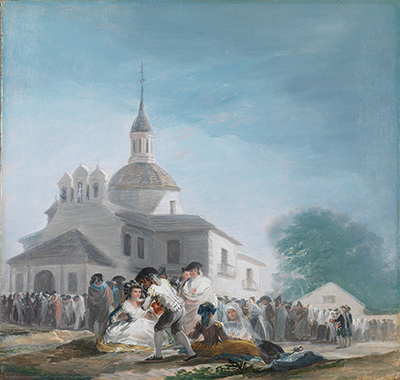
A man stoops towards a woman seated on the ground while a queue stretches behind them, almost from one edge of the canvas to the other. Above the crowd, the dome and narrow spire of a chapel rise into a broad blue sky. In The Hermitage of San Isidro, Francisco de Goya looks at the feast of Madrid’s patron saint from close to the shrine, where visitors came to drink from the spring. He painted this small oil sketch in 1788 for a projected tapestry at the Royal Palace of El Pardo. The sketch is now in the Museo Nacional del Prado. [1] [2]
At a Glance
- ArtistFrancisco José de Goya y Lucientes.
- Spanish titleLa ermita de San Isidro el día de la fiesta. [1]
- Date1788. [1]
- Medium and sizeOil on canvas, 41.8 × 43.8 cm, height by width. [1]
- CommissionPreparatory sketch for a tapestry intended for the Infantas’ bedchamber at El Pardo. [1] [2]
- CollectionMuseo Nacional del Prado, Madrid, P002783. [1] [2]
Works across Goya’s career
The Parasol
1777The Nude Maja
1795–1800Saturn Devouring His Son
c. 1820–23The Dog
c. 1820–23The chapel and the queue
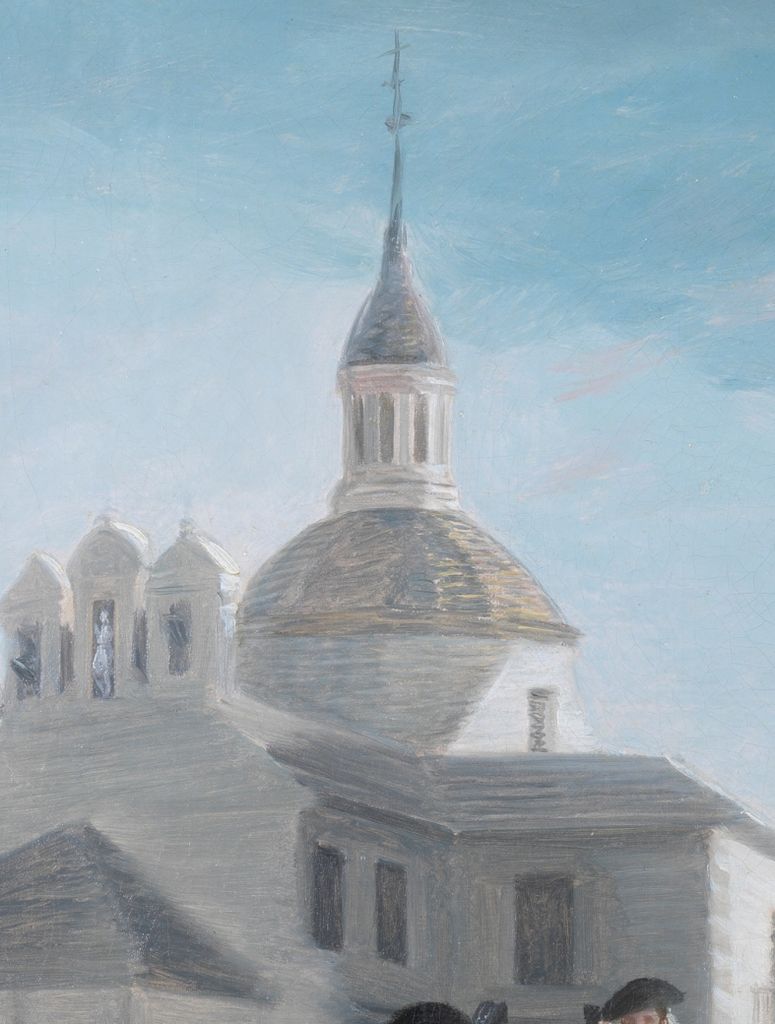
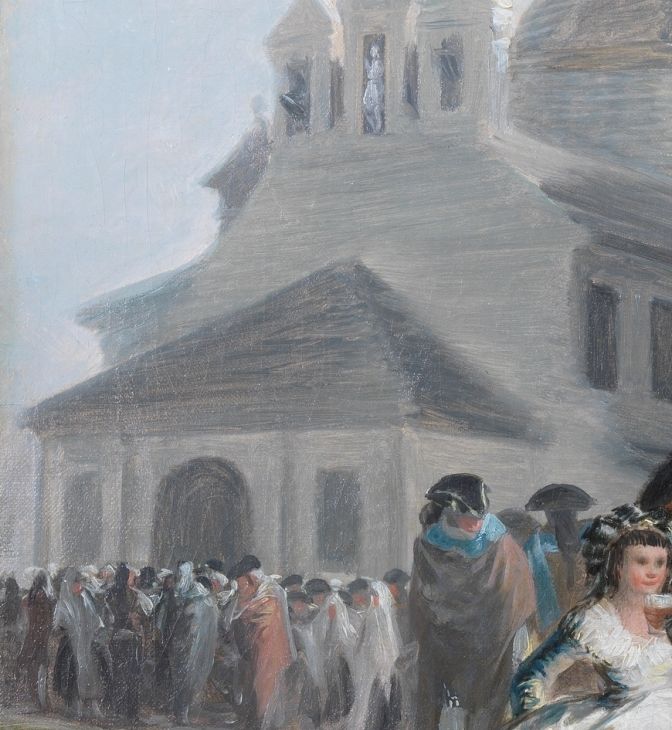
The chapel is seen obliquely. At the left its low entrance porch projects towards us, with a dark arch beneath its sloping roof. Above it, three narrow openings break the outline of the bell gable. The dome rises a little farther back and carries a lantern and a thin spire. Goya uses changes in light to resolve the architecture quickly. The shaded porch and window openings give weight to the left half, while the sunlit wall runs diagonally towards the right and almost dissolves into the pale distance. The roofline steps down towards a small gabled building and a mass of trees. That long descent sets off the abrupt rise to the tip of the spire, the apex of the composition. [1]
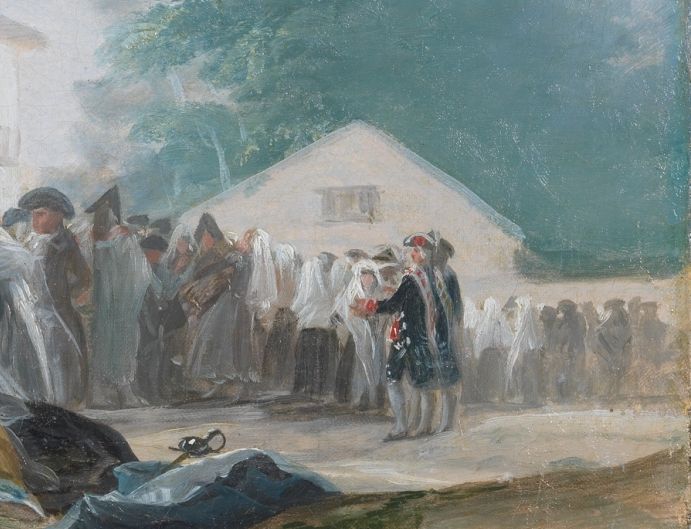
A band of people follows the buildings at ground level. In front of the porch they come almost shoulder to shoulder, their heads and hats picked out in alternating light and dark. Farther right, a patch of pale ground opens up around two uniformed figures. The Prado identifies them as members of the royal bodyguard, the Guardias de Corps, and suggests that their presence could indicate that the king or the Prince and Princess of Asturias were among those attending the feast. The two uniforms are easier to distinguish than the faces around them. Each has a legible silhouette against the line behind, with red accents that catch the eye even at this size. [1] [2]
The ground helps establish the distance to the crowd. At the left, a strip of light earth separates the nearest figures from the people under the porch. At the bottom, dark greens and browns cross the canvas in loose strokes and gather around the group seated practically at our feet. Their scale increases markedly, while their outlines cut across the queue. Above all this detail the sky occupies nearly half the picture, with broad, faintly diagonal strokes. The space around the spire gives the building a clear profile and leaves most of the painting’s activity within a comparatively shallow band. [1]
Annotated Details from The Hermitage of San Isidro on His Feast Day
Look from the small figures in the foreground to the crowd and chapel.
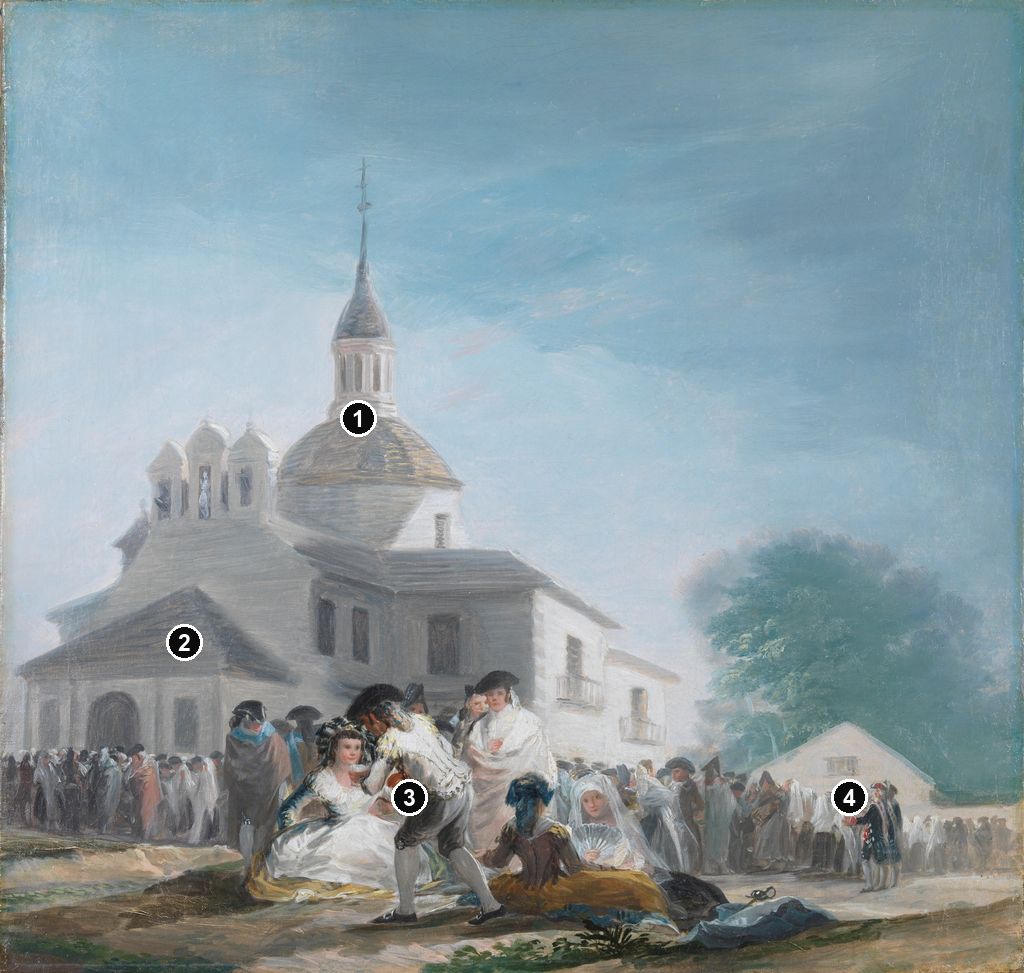
Details from THE HERMITAGE OF SAN ISIDRO ON HIS FEAST DAY
Details from the oil sketch in the Museo Nacional del Prado (P002783).
The dome and tower
The pale dome and tower rise above the darker front of the church.
The front of the chapel
Several archways sit beneath the shallow roof and above the dense line of figures.
The foreground group
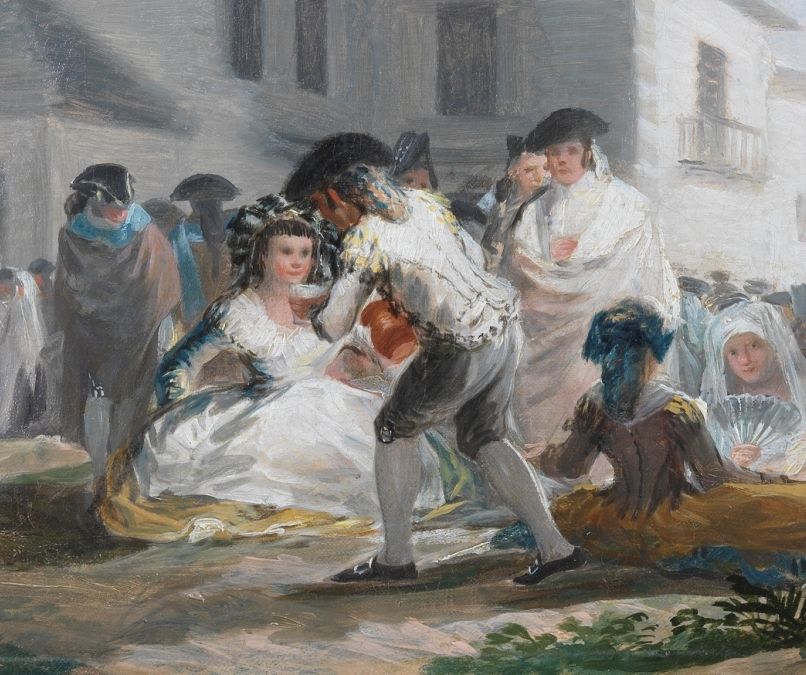
The nearest figures are picked out in white and grey as they lean towards one another.
The crowd to the right
Goya reduces the more distant people to short strokes of alternating light and dark.
Drinking from the spring
San Isidro Labrador, Madrid’s patron saint, is honoured on 15 May. The hermitage stands above the meadow on the west side of the Manzanares, in what is now Carabanchel. Local tradition holds that the saint made a spring flow there and that its water had healing properties. A shrine was built in the sixteenth century and substantially rebuilt in the eighteenth, the building Goya includes in the sketch. Drinking the water was part of the feast-day visit. The line at the chapel and the figures resting on the slope show different stages of that visit in the same painting. [1] [2] [3]
The Prado describes the seated women as majas, associated with the popular dress of Madrid, waiting for companions to bring glasses from the spring. At the left of the group, a woman in pale skirts with blue sleeves sits upright. The man in front of her has his knees bent and his feet set wide apart as he leans towards her. Behind him a standing woman wrapped in white holds a small glass. Farther right, a seated woman beneath a light veil holds an open fan. Beside her another woman turns her back towards us. The sweep of her ochre skirt runs along the bottom of the group and leads the eye back to the man’s feet. [1] [2]
The scale of the sketch makes the selectiveness of Goya’s brushwork particularly easy to see. The open fan is a handful of pale strokes radiating from the hand, and a few dark touches set off the trim of the bending man’s jacket. In the queue, a flick of white might stand for a collar or the edge of a shawl. The foreground gestures give the anonymous line of people a purpose. We see how an act repeated all along the queue ends up in the hands of someone sitting away from it. [1] [2]
Goya on film
Five films explore Goya’s portraits, prints, Black Paintings and painting techniques.
The Duke of Wellington by Goya
The portrait, its military decorations and its later theft.
Watch on YouTubeThe tapestry planned for El Pardo
The Fundación Goya en Aragón dates the commission to late 1787. On 31 May 1788 Goya wrote to his friend Martín Zapater that he had been ordered to have designs for the Infantas’ bedchamber ready when the court arrived. He was short of time and knew the king and the rest of the royal family would see his work. He singled out the bustle of the feast in the meadow as one of the hardest subjects he had to paint. The letter names the meadow design and establishes the setting in which Goya worked on the related hermitage sketch. The Prado proposes that the hermitage tapestry would have occupied the central section of a side wall opposite Blind Man’s Bluff. [1] [2] [4]
The death of Charles III in December 1788 interrupted the decoration of the palace. Of the designs in the series, only Blind Man’s Bluff reached the stage of a full-size painted cartoon, the model used by the weavers. In that case the sketch survives too, so we can see Goya simplify the design for the larger format, clearing away the distant crowd and giving the foreground players more of the picture. The hermitage was left at the sketch stage. Its small canvas therefore preserves the arrangement of the design before any comparable revision for the loom. [1] [2] [5]
The same feast seen from the meadow
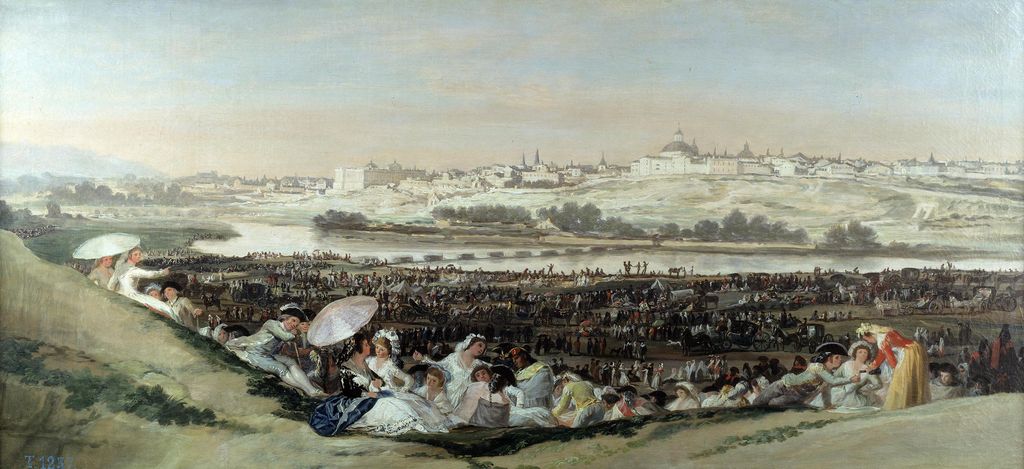
In The Meadow of San Isidro, the second surviving sketch of the feast, Goya spreads the occasion across a canvas more than twice as wide as it is high. People settle in groups across the bank, carriages pass behind them, and the Manzanares separates the gathering from the distant city. The Prado identifies the Royal Palace at the left and the great dome of San Francisco el Grande at the right. A few people are close enough for their poses to register, but the eye keeps moving laterally between gatherings and out to the skyline. The near-square Hermitage brings the view back to the point that draws the visitors up from the meadow. Here a single building and the approach to the spring organise almost the entire crowd. [1] [2] [6]
The two oil sketches went from Goya to the Duke and Duchess of Osuna in 1798 and were kept in the duchess’s cabinet at La Alameda. The sale of the collection in 1896 sent them down separate paths. The Meadow entered the Prado that year through a government purchase. Pedro Fernández Durán bought the Hermitage for 3,500 pesetas and bequeathed it to the museum, where it entered the collection on 2 September 1931. [1] [6]
The later pilgrimages
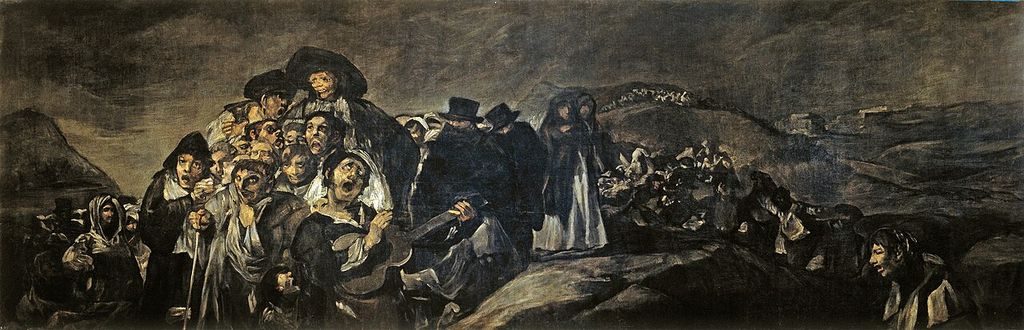
Two of the Black Paintings also carry titles linked to San Isidro. Goya painted them on the walls of his house, the Quinta del Sordo, more than thirty years after the El Pardo commission. In A Pilgrimage to San Isidro (P000760), the crowd presses forward from the lower left, led by a guitarist and faces turned towards us. In Pilgrimage to the Fountain of San Isidro (P000755), the foreground figures are on the right and the procession recedes towards a rocky slope. The latter mural also has the longstanding title The Holy Office, which the Prado uses in its inventory. In the 1788 sketch the dome tells us exactly where the crowd has gathered, and the small exchanges in front of the queue show what brought people there. In the murals the eye follows the procession through the landscape without an equivalent view of its destination. [1] [2] [7]

Artworks directory
| Name | Date | Medium |
|---|---|---|
| And There’s No Help for It, Plate 15 | Printed 1863 | |
| Asmodea | c. 1820–23 | Wall painting transferred to canvas |
| Boys Inflating a Bladder | 1777–78 | Tapestry cartoon |
| Boys Picking Fruit | 1778 | Tapestry cartoon |
| Bullfight in a Divided Ring | 1825 | Lithograph |
| Card Players | 1777–78 | Tapestry cartoon |
| Card Players (sketch) | 1777–78 | Painted sketch |
| Dance on the Banks of the Manzanares | 1777 | Tapestry cartoon |
| Duel with Cudgels | c. 1820–23 | Wall painting transferred to canvas |
| Heads in a Landscape | c. 1820–23 | Easel painting |
| Judith and Holofernes | c. 1820–23 | Wall painting transferred to canvas |
| Leocadia | c. 1820–23 | Wall painting transferred to canvas |
| Maja and Cloaked Men | 1777 | Tapestry cartoon |
| Maja and Cloaked Men (sketch) | 1777 | Painted sketch |
| Majo Clapping in Time to the Music | 1777 | Drawing |
| Men Reading | c. 1820–23 | Wall painting transferred to canvas |
| Out Hunting for Teeth, Plate 12 | 1799 | Etching, burnished aquatint and burin |
| Picnic in the Countryside (sketch) | 1776–78 | Painted sketch |
| Picnic on the Banks of the Manzanares | 1776 | Tapestry cartoon |
| Pilgrimage to San Isidro | c. 1820–23 | Wall painting transferred to canvas |
| Preparatory study for The Sleep of Reason Produces Monsters | c. 1796–97 | Drawing |
| Procession of the Holy Office | c. 1820–23 | Wall painting transferred to canvas |
| Quarrel at the Cockerel Inn (sketch) | 1777 | Painted sketch |
| Quarrel in the New Tavern | 1777 | Tapestry cartoon |
| Saturn Devouring His Son | c. 1820–23 | Wall painting transferred to canvas |
| Seated Majo Smoking | c. 1776 | Drawing |
| The Dog | c. 1820–23 | Wall painting transferred to canvas |
| The Drinker | 1777 | Tapestry cartoon |
| The Fates | c. 1820–23 | Wall painting transferred to canvas |
| The Great He-Goat | c. 1820–23 | Wall painting transferred to canvas |
| The Kite | 1777–78 | Tapestry cartoon |
| The Parasol | 1777 | Oil on canvas, tapestry cartoon |
| The Second of May 1808 | 1814 | Oil on canvas |
| The Sleep of Reason Produces Monsters, Plate 43 | 1799 | Etching and aquatint |
| The Third of May 1808 | 1814 | Oil on canvas |
| Thou Who Canst Not, Plate 42 | 1799 | Etching and burnished aquatint |
| Three Figures | 1776 | Drawing (lost) |
| Two Old Men | c. 1820–23 | Wall painting transferred to canvas |
| Two Old Men Eating Soup | c. 1820–23 | Wall painting transferred to canvas |
| Two Women and a Man | c. 1820–23 | Wall painting transferred to canvas |
| Universal Language: The Author Dreaming | 1797 | Drawing |
| The Family of Charles IV | 1800 | Oil on canvas |
| Witches’ Sabbath (Osuna painting) | 1797–98 | Oil on canvas |
| The Nude Maja | 1795–1800 | Oil on canvas |
| The Clothed Maja | 1800–07 | Oil on canvas |
| Self-Portrait (Drawing) | c. 1796 | Brush and carbon black ink on laid paper |
| The Swing, Madrid Album B.21 | 1795–97 | Brush and carbon black washes |
| Majas Fighting, a Majo Observing, Madrid Album B.15 | 1796–97 | Brush, grey and black washes on laid paper |
| Majos and Majas Conversing, Madrid Album B.16 | c. 1794–97 | Ink wash on paper |
| Weeping Woman and Three Men, Madrid Album B.17 | 1795–97 | Brush, carbon black washes and black chalk |
| Maja Seated on a Chair and Two Companions Behind, Madrid Album B.18 | 1795–97 | Brush and carbon black washes |
| Girl and Bull, Madrid Album B.23 | 1796–97 | Brush and carbon black washes |
| Lovers Sitting on a Rock, Madrid Album B.24 | 1796–97 | Brush and carbon black washes |
| Mariano Ceballos Riding a Bull | 1825 | Crayon lithograph and scraper |
| Landscape (lifetime impression) | c. 1807–10 | Etching and aquatint |
| Self-Portrait (1815), Prado canvas | 1815 | Oil on canvas |
| Self-Portrait (1815), Academy panel | 1815 | Oil on panel |
| Self-Portrait with Dr Arrieta | 1820 | Oil on canvas |
| Christ Crucified | 1780 | Oil on canvas |
| The Last Communion of Saint Joseph of Calasanz | 1819 | Oil on canvas |
| Christ on the Mount of Olives | 1819 | Oil on panel |
| The Flower Girls, or Spring | 1786–87 | Oil on canvas |
| The Grape Harvest, or Autumn | 1786–87 | Oil on canvas |
| The Snowstorm, or Winter | 1786–87 | Oil on canvas |
| The Threshing Ground, or Summer | 1786–87 | Oil on canvas |
| Picnic on the Banks of the Manzanares | 1776 | Oil on canvas |
| The Kite | 1777–78 | Oil on canvas |
| Dance on the Banks of the Manzanares | 1777 | Oil on canvas |
| A Fight at the Venta Nueva | 1777 | Oil on canvas |
| Blind Man’s Bluff | 1788 | Oil on canvas |
| Dogs on a Lead | 1775 | Oil on canvas |
| Hunting with a Decoy | 1775 | Oil on canvas |
| Hunter Loading His Rifle | 1775 | Oil on canvas |
| The Angler | 1775 | Oil on canvas |
| The Hermitage of San Isidro on His Feast Day | 1788 | Oil on canvas |
| The Meadow of San Isidro | 1788 | Oil on canvas |
| The Straw Manikin | 1791–92 | Oil on canvas |
| Witches’ Flight | c. 1797–98 | Oil on canvas |
| A Scene from ‘The Forcibly Bewitched’ | 1798 | Oil on canvas |
| The Duchess of Alba in Black | 1797 | Oil on canvas |
| The Duchess of Alba in White | 1795 | Oil on canvas |
| Charles III in Hunting Dress | c. 1786 | Oil on canvas |
| The Duke and Duchess of Osuna and Their Children | 1787–88 | Oil on canvas |
| Manuel Osorio Manrique de Zúñiga | 1787–88 | Oil on canvas |
| The Marquesa de Pontejos | c. 1786 | Oil on canvas |
| Equestrian Portrait of the 1st Duke of Wellington | 1812 | Oil on canvas |
| The Duke of Wellington | 1812–14 | Oil on wood |
| Portrait of Ferdinand VII of Spain | 1814 | Oil on canvas |
| Gaspar Melchor de Jovellanos | 1798 | Oil on canvas |
| María Tomasa Palafox y Portocarrero | 1804 | Oil on canvas |
| Señora Sabasa García | c. 1806–11 | Oil on canvas |
| Don Juan Bautista de Muguiro | 1827 | Oil on canvas |
| Doña Isabel de Porcel | Before 1805 | Oil on canvas |
| The Colossus | After 1808 | Oil on canvas |
| The Burial of the Sardine | 1808–12 | Oil on panel |
| The Madhouse | 1808–12 | Oil on panel |
| A Procession of Flagellants | 1808–12 | Oil on panel |
| Portrait of Jacques Galos | 1826 | Oil on canvas |
| Portrait of Mariano Goya, the Artist’s Grandson | 1827 | Oil on canvas |
| Milkmaid of Bordeaux | c. 1827 | Oil on canvas |
| Portrait of Don Juan Antonio Cuervo | 1819 | Oil on canvas |
| María Luisa of Parma (Naples version) | c. 1800 | Oil on canvas |
| The Countess of Baena | 1819 | Oil on canvas |
| The Family of the Infante Don Luis | 1783–84 | Oil on canvas |
| The Holy Family | c. 1787 | Oil on canvas |
| Saint Barbara | c. 1773 | Oil on canvas |
| Saints Justa and Rufina | 1817 | Oil on canvas |
| El Tío Paquete | c. 1819–20 | Oil on canvas |
| The Forge | c. 1815–20 | Oil on canvas |
| Majas on a Balcony (Metropolitan Museum version) | c. 1800–10 | Oil on canvas |
| Maja and Celestina on a Balcony | c. 1808–12 | Oil on canvas |
| The Water Bearer | 1808–12 | Oil on canvas |
| Time and the Old Women | c. 1810 | Oil on canvas |
Frequently Asked Questions
Discussion
Look again at the images and ideas explored in The Hermitage of San Isidro on His Feast Day. These editorial prompts invite your observations.
Look from the bending man in the foreground to the two uniformed figures at the right. Which changes in scale, light and brushwork make the space between them legible? Then try following the queue with the foreground group covered.
Reader Insights
Where does Goya change from describing individual figures to suggesting a crowd?
How does the chapel change the way you see the feast?
Join the Conversation
Share a detail, comparison or question about The Hermitage of San Isidro on His Feast Day below.
References
- Fundación Goya en Aragón, La ermita de San Isidro el día de la fiesta (boceto), collection details, colour reproduction, commission and provenance. View source.
- Museo Nacional del Prado, La ermita de San Isidro el día de la fiesta, P002783. See also Marta Torres del Rincón, Música española para piano y obras de Francisco de Goya, Museo Nacional del Prado, 2014, pp. 15–17, which reproduces the museum’s accounts of the four San Isidro works. View collection record ·. View source 1. View source 2.
- Ayuntamiento de Madrid, La renovación del parque de San Isidro dará esplendor a la pradera, 13 May 2021, on the chapel, spring and pilgrimage. View source.
- Francisco de Goya, letter to Martín Zapater, 31 May 1788, in Diplomatario de Goya. Addenda, Institución Fernando el Católico, document 143, pp. 25–26. View source.
- Fundación Goya en Aragón, La gallina ciega, collection entry on the full-size Blind Man’s Bluff cartoon and its preparatory sketch. View source.
- Fundación Goya en Aragón, La pradera de San Isidro (boceto), Prado P000750, companion sketch, provenance and composition. View source.
- Museo Nacional del Prado, inventory appendix to the agreement with the Government of Aragón, Boletín Oficial del Estado, August 2021, entries P755 and P760. View source.







