


 by Tom Gurney
Tom Gurney BSc (Hons) is an art history expert with over 20 years experience
Published on June 19, 2020 / Updated on November 20, 2026
Email: tomgurney1@gmail.com / Phone: +44 7429 011000
Introduction
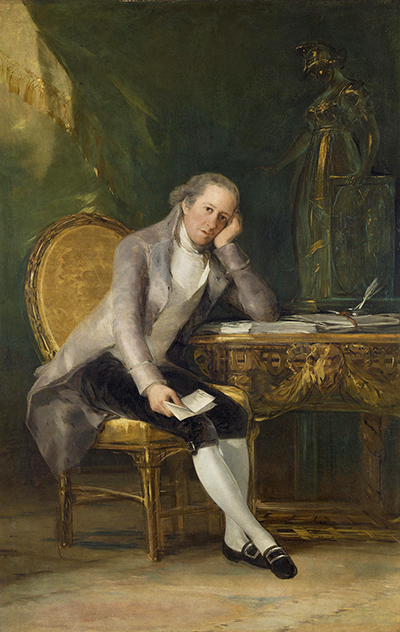
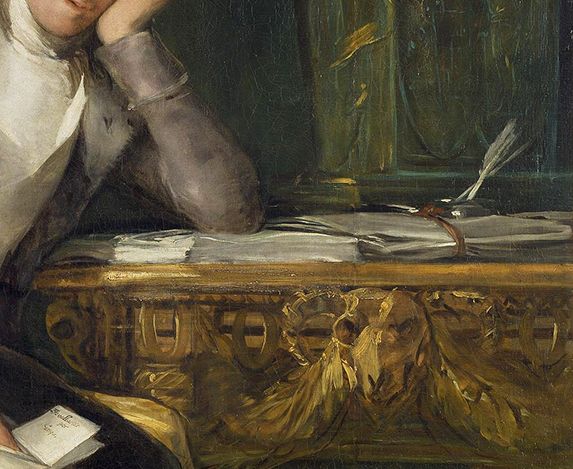
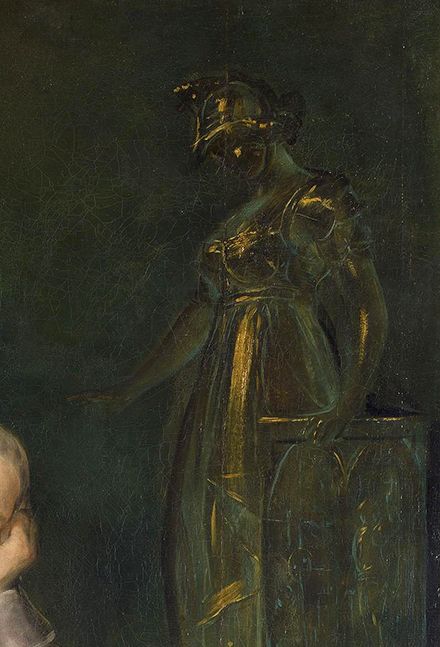
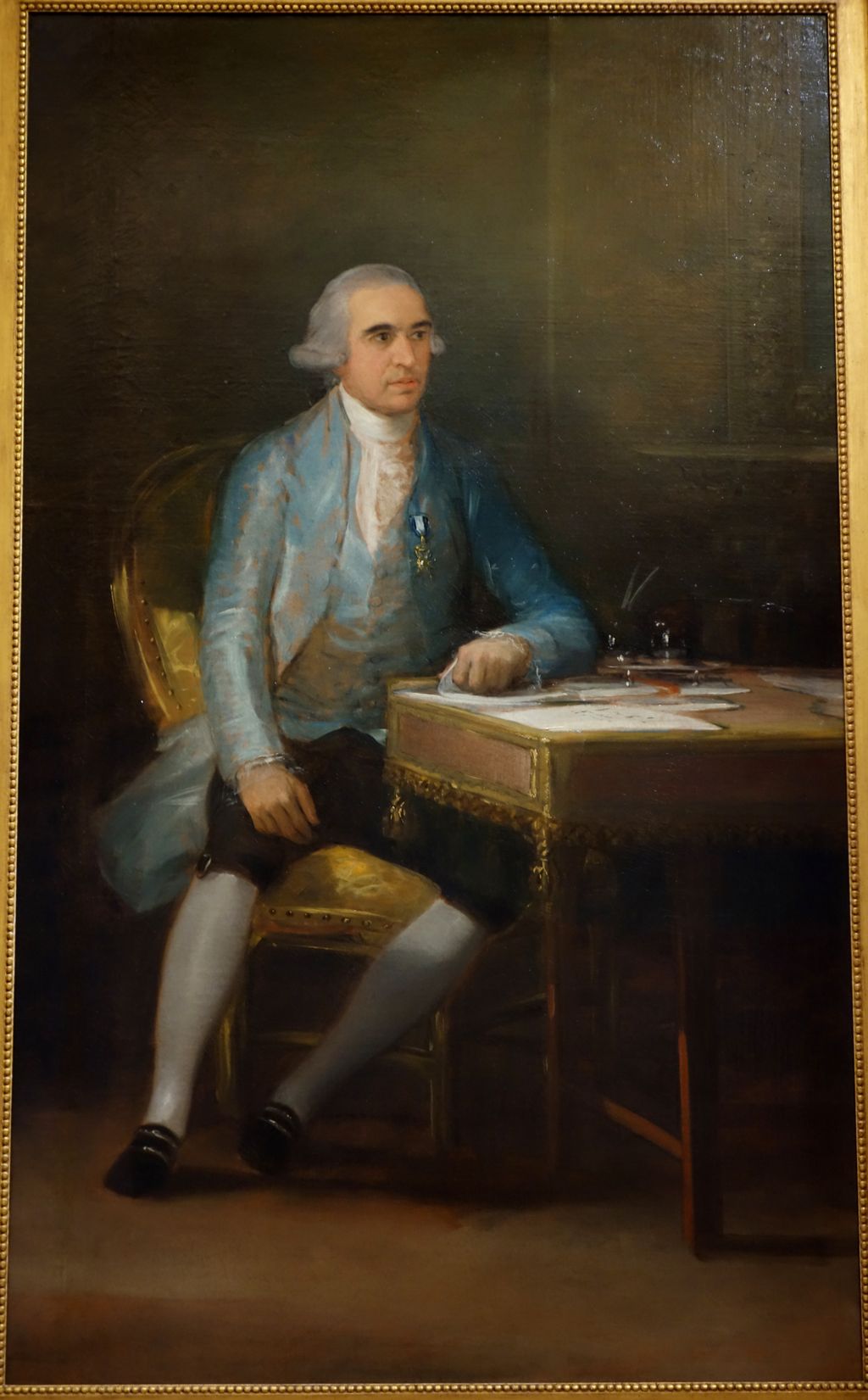
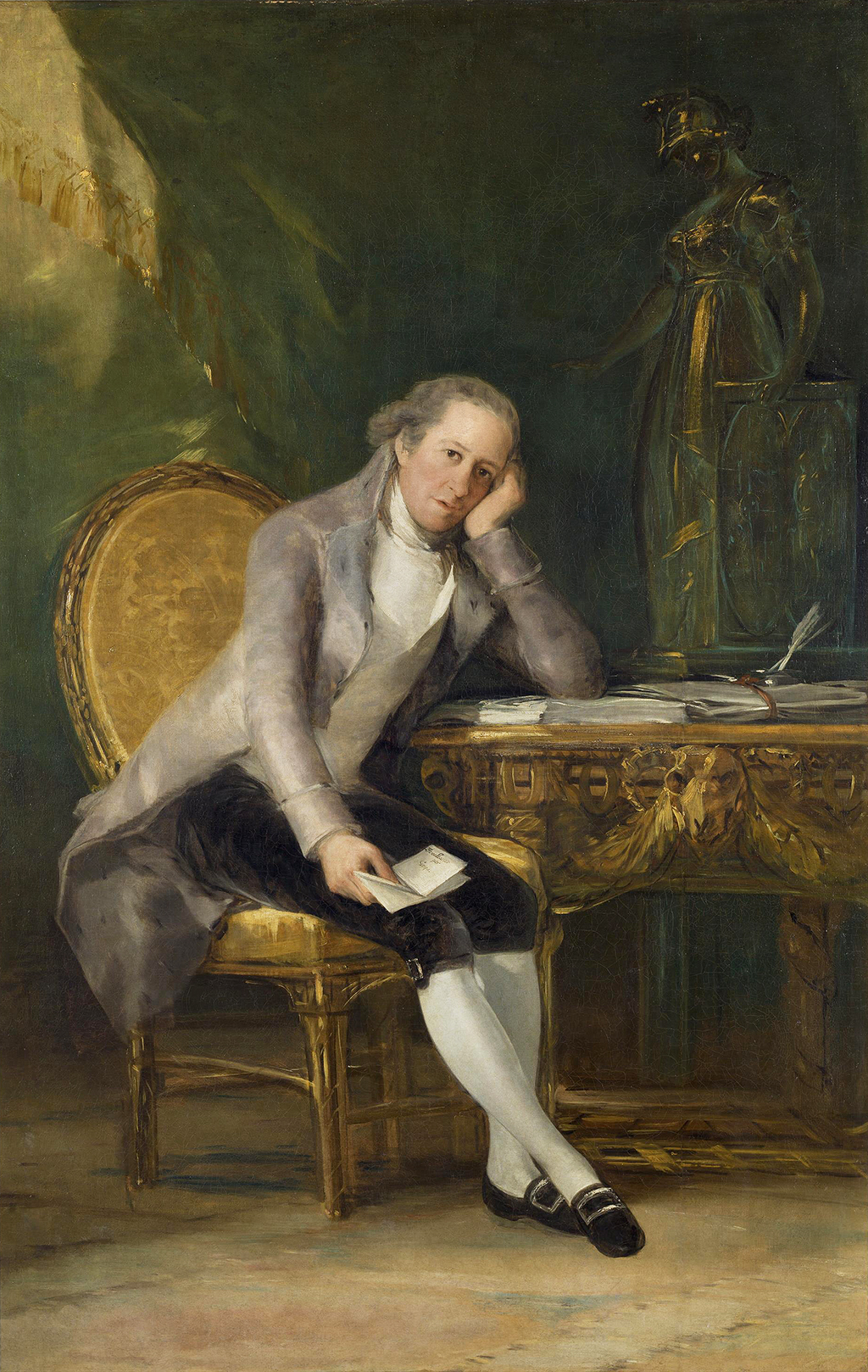
Gaspar Melchor de Jovellanos sits sideways at an elaborately carved desk, propping his head on one hand. His other hand holds a folded paper just above his knee. Goya puts his own name on that small sheet, well below the face that first holds our attention. Behind the desk a helmeted Minerva extends an arm towards the sitter. The portrait dates from 1798, when Jovellanos was Spain’s Minister of Grace and Justice. It gives the viewer time to look at a man whose time in office would last only about nine months. [1] [2] [3]
At a Glance
Works across Goya’s career
The Parasol
1777The Nude Maja
1795–1800Saturn Devouring His Son
c. 1820–23The Dog
c. 1820–23How Goya makes the sitter pause
The chair’s round, gold-coloured back frames the left side of the sitter’s grey coat. The coat hangs in a long fold over the edge of the seat. From there the eye can follow the crossed legs through the pale stockings to the glints on the shoe buckles. Goya makes the figure reach almost to the bottom of the tall canvas even though Jovellanos is seated. The forward leg runs diagonally across the upright chair legs and the side of the desk. Enough floor is visible to set the furniture firmly in the room and give the extended shoe some space. [2] [4]
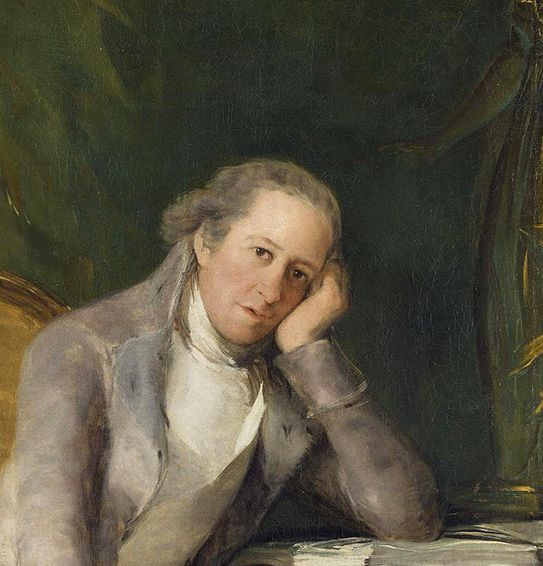
Start again at his face. The line from his temple through his wrist to his elbow is short and steep. The other arm travels almost the length of his coat to reach the folded sheet. The two hands put very different amounts of weight on the furniture. On one side his elbow presses into the pile of papers, and on the other his fingers barely need to hold the folded sheet in place. The slight turn of the face gives us a clear view of his eyes while the hand partly obscures his cheek. It is easy to imagine the sitter holding the pose for longer than we hold his gaze. [2] [4]
The National Gallery connects the head resting on the hand with the traditional pose of melancholy. Here the bowed head still faces out of the picture. The coat and waistcoat are restrained in colour, with the white linen worn close to his chin giving the face a bright edge. The room affords plenty of occasion for display, especially around the gilt furniture and the curtain. Goya makes the head and hands hold their own against it through the concentration of light and the care with which they are painted. [2] [4] [5]
Annotated Details from Gaspar Melchor de Jovellanos
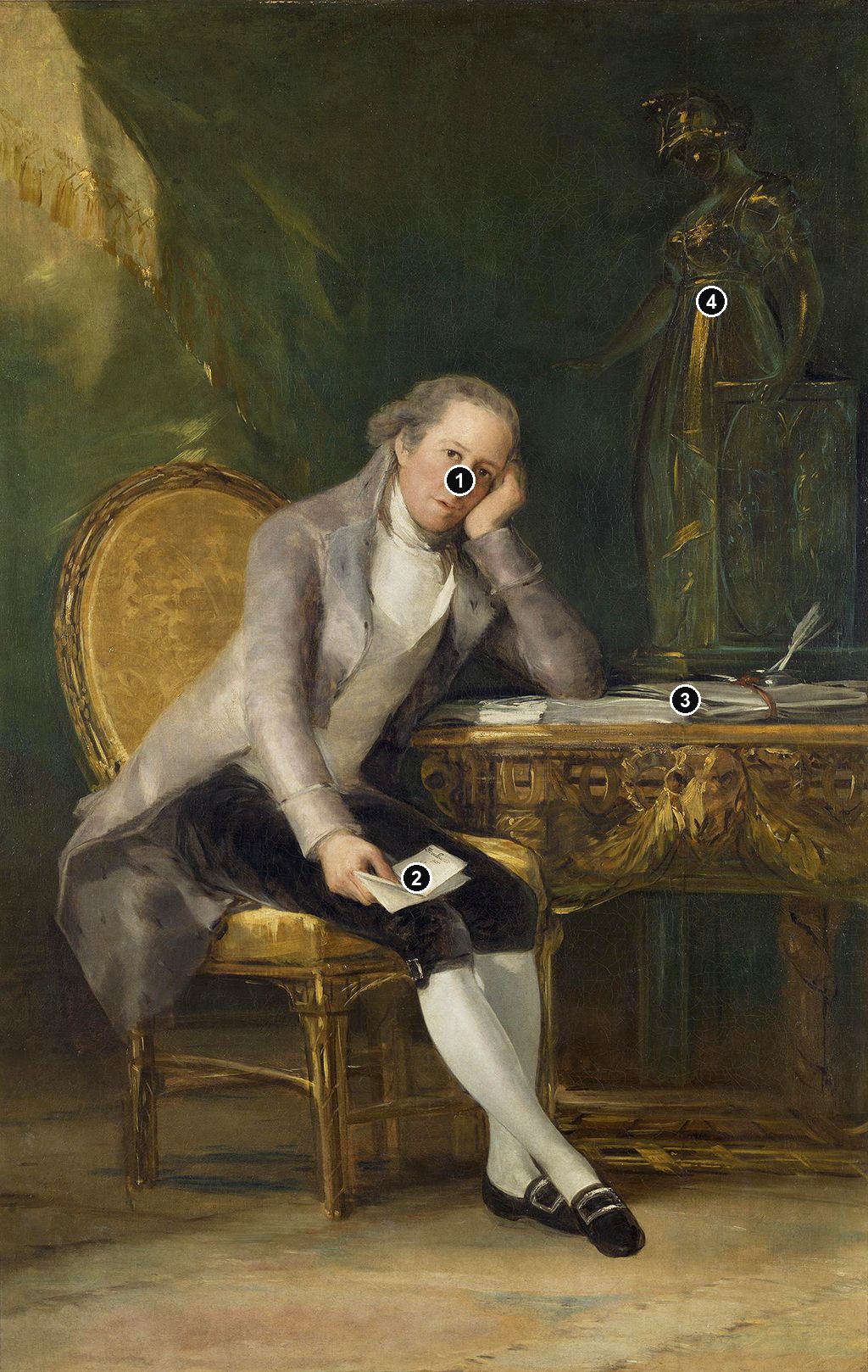
Look from Jovellanos's face and the paper in his hand to the figure behind the desk.
Details from GASPAR MELCHOR DE JOVELLANOS
Details from the Prado portrait (P003236).
The supported head
Jovellanos supports the side of his head with his left hand.
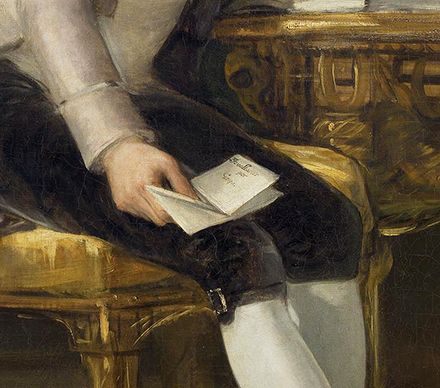
The paper in his hand
The pale slip rests loosely in his right hand, just above his knee.
The desk and writing materials
The slant of the quill is visible above the table edge.
The figure behind the desk
A helmeted figure rises out of the dark background.
The letter and the figure of Minerva
The Fundación Goya en Aragón transcribes the inscription on the folded paper as Jovellanos / por / Goya. The inscription names the sitter and painter and gives the hand a reason to turn the sheet outwards. Goya could have set his signature against the floor or the furniture. In the sitter’s hand it becomes one piece of paper among many. The pile on the desk is broader and brighter, and a quill rises from it towards the right edge. Once you have found the smaller page, the space between the two hands starts to look like an interruption in a sequence of reading or writing. The contents of the folded sheet beyond the inscription are unknown. [2] [4]
Above the desk the folds of Minerva’s clothing pick up narrow strokes of light, as do the rim of her helmet and the edge of her shield. Her darker form is easy to overlook when the whole painting is reduced to a small reproduction. The Fundación identifies her as the goddess associated with wisdom, the arts and the sciences. One arm extends towards Jovellanos and the other rests on a shield bearing the arms of the Royal Asturian Institute of Navigation and Mineralogy, established at his initiative in Gijón. Teaching began in January 1794 in a house belonging to his family. One of his last acts in Gijón before taking up the ministry was to lay the first stone of the institute’s new building, designed by the architect Juan de Villanueva. What looks at first like a conventional classical attribute turns out to bear the emblem of a school already teaching the practical skills of navigation and mining. [2] [12]
Goya had painted Jovellanos about sixteen years earlier. In that first portrait he stands on the shore at San Lorenzo in Gijón, a hat in one hand and a cane in the other. The Museo de Bellas Artes de Asturias identifies the bright green ribbon at his lapel with the Order of Alcántara and relates the coastal setting to his public work on transport links for Gijón. The coastline gives the earlier picture a place the sitter’s family would recognise. In the Prado painting that local association is concentrated in a shield behind a desk. The scale and placement of the two details affect how quickly we make the link. The ribbon stands out against the young Jovellanos’s lapel. In the later portrait our eyes have to adjust to the dark before the shield comes into focus. [2] [8]
Goya on film
Five films explore Goya’s portraits, prints, Black Paintings and painting techniques.
The Duke of Wellington by Goya
The portrait, its military decorations and its later theft.
Watch on YouTubeNine months in office
A jurist, essayist and advocate of educational and economic reform, Jovellanos received his appointment from Charles IV in November 1797 and was dismissed in August 1798. Goya painted the portrait during that interval. He already knew Jovellanos as a patron. In 1783 Jovellanos had commissioned three paintings from him for the church of the College of the Order of Calatrava in Salamanca. A preparatory sketch for the main altarpiece survived in Jovellanos’s collection and eventually entered the Prado. The minister’s appointment gave Goya a new public role to paint within a relationship that went back to the early 1780s. [2] [3] [9]
In a letter to Martín Zapater dated 27 March 1798, Goya describes visiting Jovellanos at Aranjuez. The minister took him out in his carriage and communicated with him by signs. Goya also records that Jovellanos wanted him to stay until Easter to paint Francisco de Saavedra, his friend. He says he left because he had brought neither canvas for the work nor a spare shirt. The detail puts the request for the other portrait in the middle of a visit between friends and gives us evidence of how that commission began. The gravity Goya gives Jovellanos at his desk belongs to the portrait’s design. Any reading of it as foreknowledge of his dismissal depends on events that were still to come. [3] [4] [6]
The portrait of Francisco de Saavedra
Saavedra was Minister of Finance when he sat for Goya. His portrait is now in the Courtauld Gallery in London. His desk is strewn with papers, and its folding design and plain surroundings make the setting look temporary. Saavedra turns sharply in the chair and holds his upper body upright. The Courtauld calls attention to the loose strokes that suggest the sheen of his coat and the desk accessories, with thicker paint and more detailed modelling in the face and hands. The National Gallery hung the two works together in its 2015–16 Goya exhibition. The Courtauld describes the Prado picture as a possible companion. The letter establishes the request for Saavedra’s portrait, while their appearance together lets us see the visual relationship for ourselves. [4] [5] [6] [7]
The paintings’ resemblance goes beyond the furniture, scale and angle of the two figures. A study by Courtauld researchers working with the Prado found a pinkish ground beneath both portraits. It also found that Goya gave their faces and hands closer attention than the expanses of fabric and wood around them. In the X-radiograph of the Prado portrait, earlier positions of the collar, hands and feet are visible. Even a gesture that feels as simple as sitting with one’s head in one’s hand was worked out in paint. The X-radiographs also show that both canvases were widened by sewing on extra fabric, on the right in the Prado portrait and on the left in the Courtauld’s. Subsequent lining complicates the reconstruction of their original sizes. [4]
The study also complicates a comparison based on surface alone. Conservators removed discoloured varnish from the Saavedra portrait, revealing fast brushwork and areas where the paint has become more transparent with age. The researchers found yellowed varnish on the Jovellanos portrait at the time of their study. Looking at these surfaces side by side means seeing both the way Goya handled paint in 1798 and what has happened to each picture since. The pose and furnishings are the clearest indications of the two distinct ways Goya presented his sitters. [4]
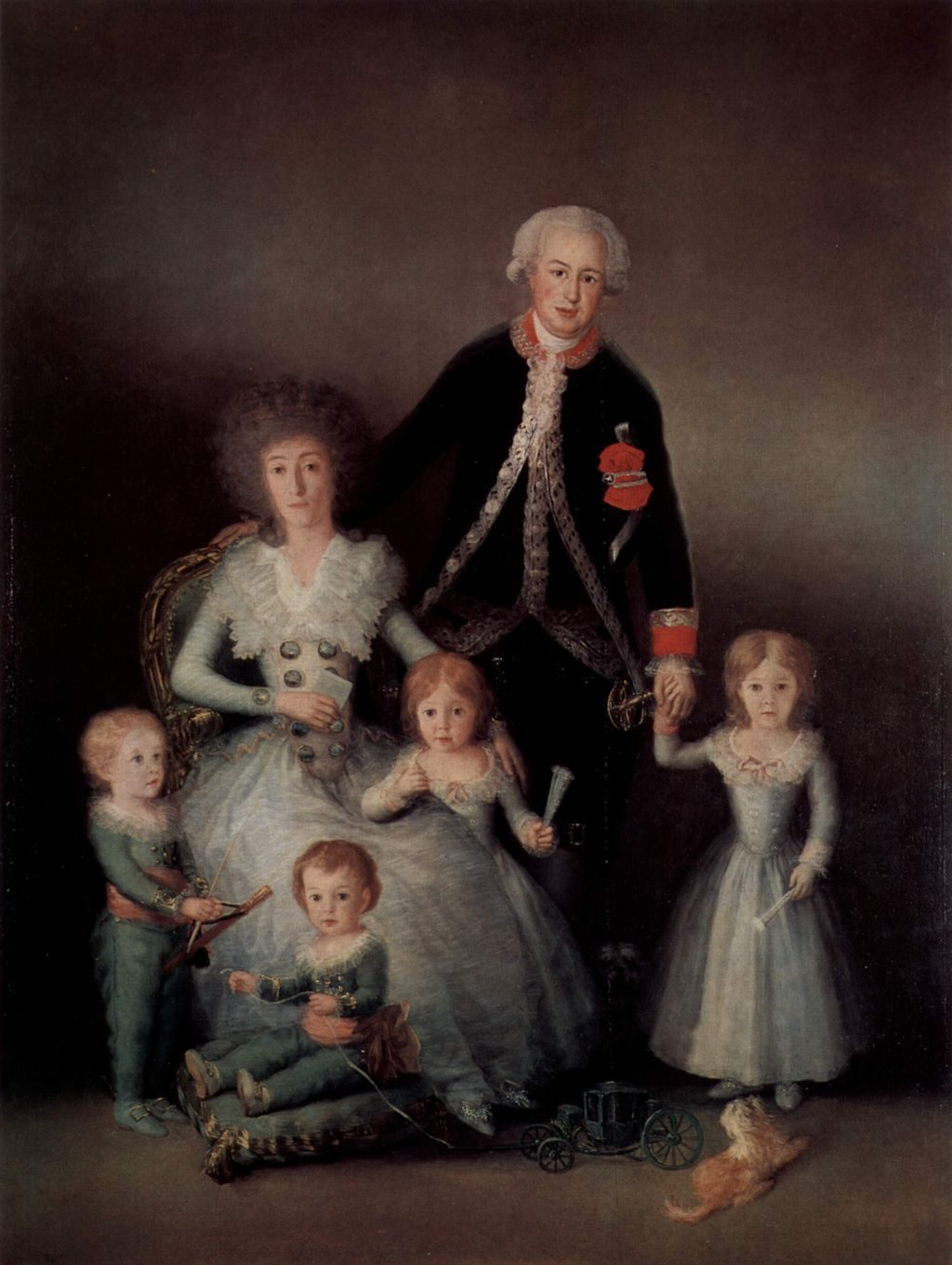
Spain’s Ministry of Education bought the painting for the Prado in 1974. Two other portraits in its collection offer a way to place it among Goya’s commissions. In The Duke and Duchess of Osuna and Their Children, the adults’ hands establish bonds with the children around them. The duke’s baton appears down near the floor, where a boy has made a game of it. In The Family of Charles IV, royal orders worn across the group make family rank visible at a glance. Jovellanos’s plain coat gives us few such markers. To find out more about the man, we have to look around his chair at the things within reach of him and at the statue beyond. [2] [10] [11]
Artworks directory
| Name | Date | Medium |
|---|---|---|
| And There’s No Help for It, Plate 15 | Printed 1863 | |
| Asmodea | c. 1820–23 | Wall painting transferred to canvas |
| Boys Inflating a Bladder | 1777–78 | Tapestry cartoon |
| Boys Picking Fruit | 1778 | Tapestry cartoon |
| Bullfight in a Divided Ring | 1825 | Lithograph |
| Card Players | 1777–78 | Tapestry cartoon |
| Card Players (sketch) | 1777–78 | Painted sketch |
| Dance on the Banks of the Manzanares | 1777 | Tapestry cartoon |
| Duel with Cudgels | c. 1820–23 | Wall painting transferred to canvas |
| Heads in a Landscape | c. 1820–23 | Easel painting |
| Judith and Holofernes | c. 1820–23 | Wall painting transferred to canvas |
| Leocadia | c. 1820–23 | Wall painting transferred to canvas |
| Maja and Cloaked Men | 1777 | Tapestry cartoon |
| Maja and Cloaked Men (sketch) | 1777 | Painted sketch |
| Majo Clapping in Time to the Music | 1777 | Drawing |
| Men Reading | c. 1820–23 | Wall painting transferred to canvas |
| Out Hunting for Teeth, Plate 12 | 1799 | Etching, burnished aquatint and burin |
| Picnic in the Countryside (sketch) | 1776–78 | Painted sketch |
| Picnic on the Banks of the Manzanares | 1776 | Tapestry cartoon |
| Pilgrimage to San Isidro | c. 1820–23 | Wall painting transferred to canvas |
| Preparatory study for The Sleep of Reason Produces Monsters | c. 1796–97 | Drawing |
| Procession of the Holy Office | c. 1820–23 | Wall painting transferred to canvas |
| Quarrel at the Cockerel Inn (sketch) | 1777 | Painted sketch |
| Quarrel in the New Tavern | 1777 | Tapestry cartoon |
| Saturn Devouring His Son | c. 1820–23 | Wall painting transferred to canvas |
| Seated Majo Smoking | c. 1776 | Drawing |
| The Dog | c. 1820–23 | Wall painting transferred to canvas |
| The Drinker | 1777 | Tapestry cartoon |
| The Fates | c. 1820–23 | Wall painting transferred to canvas |
| The Great He-Goat | c. 1820–23 | Wall painting transferred to canvas |
| The Kite | 1777–78 | Tapestry cartoon |
| The Parasol | 1777 | Oil on canvas, tapestry cartoon |
| The Second of May 1808 | 1814 | Oil on canvas |
| The Sleep of Reason Produces Monsters, Plate 43 | 1799 | Etching and aquatint |
| The Third of May 1808 | 1814 | Oil on canvas |
| Thou Who Canst Not, Plate 42 | 1799 | Etching and burnished aquatint |
| Three Figures | 1776 | Drawing (lost) |
| Two Old Men | c. 1820–23 | Wall painting transferred to canvas |
| Two Old Men Eating Soup | c. 1820–23 | Wall painting transferred to canvas |
| Two Women and a Man | c. 1820–23 | Wall painting transferred to canvas |
| Universal Language: The Author Dreaming | 1797 | Drawing |
| The Family of Charles IV | 1800 | Oil on canvas |
| Witches’ Sabbath (Osuna painting) | 1797–98 | Oil on canvas |
| The Nude Maja | 1795–1800 | Oil on canvas |
| The Clothed Maja | 1800–07 | Oil on canvas |
| Self-Portrait (Drawing) | c. 1796 | Brush and carbon black ink on laid paper |
| The Swing, Madrid Album B.21 | 1795–97 | Brush and carbon black washes |
| Majas Fighting, a Majo Observing, Madrid Album B.15 | 1796–97 | Brush, grey and black washes on laid paper |
| Majos and Majas Conversing, Madrid Album B.16 | c. 1794–97 | Ink wash on paper |
| Weeping Woman and Three Men, Madrid Album B.17 | 1795–97 | Brush, carbon black washes and black chalk |
| Maja Seated on a Chair and Two Companions Behind, Madrid Album B.18 | 1795–97 | Brush and carbon black washes |
| Girl and Bull, Madrid Album B.23 | 1796–97 | Brush and carbon black washes |
| Lovers Sitting on a Rock, Madrid Album B.24 | 1796–97 | Brush and carbon black washes |
| Mariano Ceballos Riding a Bull | 1825 | Crayon lithograph and scraper |
| Landscape (lifetime impression) | c. 1807–10 | Etching and aquatint |
| Self-Portrait (1815), Prado canvas | 1815 | Oil on canvas |
| Self-Portrait (1815), Academy panel | 1815 | Oil on panel |
| Self-Portrait with Dr Arrieta | 1820 | Oil on canvas |
| Christ Crucified | 1780 | Oil on canvas |
| The Last Communion of Saint Joseph of Calasanz | 1819 | Oil on canvas |
| Christ on the Mount of Olives | 1819 | Oil on panel |
| The Flower Girls, or Spring | 1786–87 | Oil on canvas |
| The Grape Harvest, or Autumn | 1786–87 | Oil on canvas |
| The Snowstorm, or Winter | 1786–87 | Oil on canvas |
| The Threshing Ground, or Summer | 1786–87 | Oil on canvas |
| Picnic on the Banks of the Manzanares | 1776 | Oil on canvas |
| The Kite | 1777–78 | Oil on canvas |
| Dance on the Banks of the Manzanares | 1777 | Oil on canvas |
| A Fight at the Venta Nueva | 1777 | Oil on canvas |
| Blind Man’s Bluff | 1788 | Oil on canvas |
| Dogs on a Lead | 1775 | Oil on canvas |
| Hunting with a Decoy | 1775 | Oil on canvas |
| Hunter Loading His Rifle | 1775 | Oil on canvas |
| The Angler | 1775 | Oil on canvas |
| The Hermitage of San Isidro on His Feast Day | 1788 | Oil on canvas |
| The Meadow of San Isidro | 1788 | Oil on canvas |
| The Straw Manikin | 1791–92 | Oil on canvas |
| Witches’ Flight | c. 1797–98 | Oil on canvas |
| A Scene from ‘The Forcibly Bewitched’ | 1798 | Oil on canvas |
| The Duchess of Alba in Black | 1797 | Oil on canvas |
| The Duchess of Alba in White | 1795 | Oil on canvas |
| Charles III in Hunting Dress | c. 1786 | Oil on canvas |
| The Duke and Duchess of Osuna and Their Children | 1787–88 | Oil on canvas |
| Manuel Osorio Manrique de Zúñiga | 1787–88 | Oil on canvas |
| The Marquesa de Pontejos | c. 1786 | Oil on canvas |
| Equestrian Portrait of the 1st Duke of Wellington | 1812 | Oil on canvas |
| The Duke of Wellington | 1812–14 | Oil on wood |
| Portrait of Ferdinand VII of Spain | 1814 | Oil on canvas |
| Gaspar Melchor de Jovellanos | 1798 | Oil on canvas |
| María Tomasa Palafox y Portocarrero | 1804 | Oil on canvas |
| Señora Sabasa García | c. 1806–11 | Oil on canvas |
| Don Juan Bautista de Muguiro | 1827 | Oil on canvas |
| Doña Isabel de Porcel | Before 1805 | Oil on canvas |
| The Colossus | After 1808 | Oil on canvas |
| The Burial of the Sardine | 1808–12 | Oil on panel |
| The Madhouse | 1808–12 | Oil on panel |
| A Procession of Flagellants | 1808–12 | Oil on panel |
| Portrait of Jacques Galos | 1826 | Oil on canvas |
| Portrait of Mariano Goya, the Artist’s Grandson | 1827 | Oil on canvas |
| Milkmaid of Bordeaux | c. 1827 | Oil on canvas |
| Portrait of Don Juan Antonio Cuervo | 1819 | Oil on canvas |
| María Luisa of Parma (Naples version) | c. 1800 | Oil on canvas |
| The Countess of Baena | 1819 | Oil on canvas |
| The Family of the Infante Don Luis | 1783–84 | Oil on canvas |
| The Holy Family | c. 1787 | Oil on canvas |
| Saint Barbara | c. 1773 | Oil on canvas |
| Saints Justa and Rufina | 1817 | Oil on canvas |
| El Tío Paquete | c. 1819–20 | Oil on canvas |
| The Forge | c. 1815–20 | Oil on canvas |
| Majas on a Balcony (Metropolitan Museum version) | c. 1800–10 | Oil on canvas |
| Maja and Celestina on a Balcony | c. 1808–12 | Oil on canvas |
| The Water Bearer | 1808–12 | Oil on canvas |
| Time and the Old Women | c. 1810 | Oil on canvas |
Frequently Asked Questions
The Fundación Goya en Aragón records three lines, Jovellanos / por / Goya, meaning ‘Jovellanos, by Goya’. The little sheet functions as the painter’s signature and identifies the sitter. [2]
Portrait of Don Francisco de Saavedra belongs to the Courtauld Gallery in London, accession P.1947.LF.180. The Courtauld collection record shows the painting. The two works were exhibited together at the National Gallery in 2015–16. [5] [7]
Discussion
Look again at the images and ideas explored in Gaspar Melchor de Jovellanos. These editorial prompts invite your observations.
Follow Jovellanos’s gaze and then look at the two hands. Which detail most strongly suggests that Goya has caught him in the middle of his work? What changes if you look first at the papers, then at Minerva’s shield?
Reader Insights
What do the sitter’s hands and the two papers tell you?
Compare the way Goya places each man at his desk.
Join the Conversation
Share a detail, comparison or question about Gaspar Melchor de Jovellanos below.
References
- Museo Nacional del Prado, Gaspar Melchor de Jovellanos, collection record P003236. See also inventory 3236 in the Prado exhibition checklist published in the Boletín Oficial del Estado. View source 1. View source 2.
- Fundación Goya en Aragón, Gaspar Melchor de Jovellanos, catalogue entry 352. View source.
- Biblioteca Virtual Miguel de Cervantes, ‘Cronología de Gaspar Melchor de Jovellanos’, entries for 1797 and 1798. View source.
- Aviva Burnstock, Maureen Cross and Karen Serres, ‘Goya’s Portrait of Francisco de Saavedra. Materials, techniques, conservation and context’, Technè 53 (2022), pp. 38–45. Fig. 2 reproduces the Prado portrait and gives its inventory number, and figs. 4, 6 and 7 reproduce technical and detail comparisons. View source.
- National Gallery, London, ‘The Spanish Enlightenment’, exhibition material for Goya: The Portraits (2015–16). View source.
- Francisco de Goya, letter to Martín Zapater, 27 March 1798, transcribed in the Biblioteca Nacional de España’s tercentenary exhibition catalogue, entry on Jovellanos’s bookplate. See also Burnstock, Cross and Serres, pp. 39 and 45, note 1. View source.
- The Courtauld Gallery, Portrait of Don Francisco de Saavedra, collection record P.1947.LF.180. View source.
- Museo de Bellas Artes de Asturias, Retrato de Jovellanos en el arenal de San Lorenzo, collection entry for the earlier portrait. View source.
- Museo Nacional del Prado, The Immaculate Conception, collection record P003260. View source.
- Fundación Goya en Aragón, La familia del duque de Osuna, catalogue entry. View source.
- Museo Nacional del Prado, The Family of Charles IV, collection record P000726. View source.
- Ayuntamiento de Gijón/Xixón, Antiguo Instituto Jovellanos, municipal heritage catalogue, entry ED-68-I. View source.







