


 by Tom Gurney
Tom Gurney BSc (Hons) is an art history expert with over 20 years experience
Published on June 19, 2020 / Updated on November 20, 2026
Email: tomgurney1@gmail.com / Phone: +44 7429 011000
Introduction
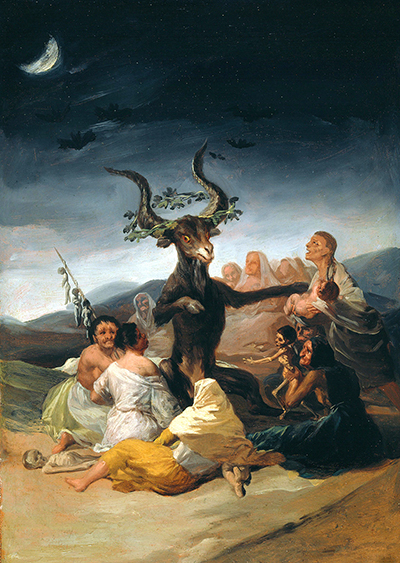
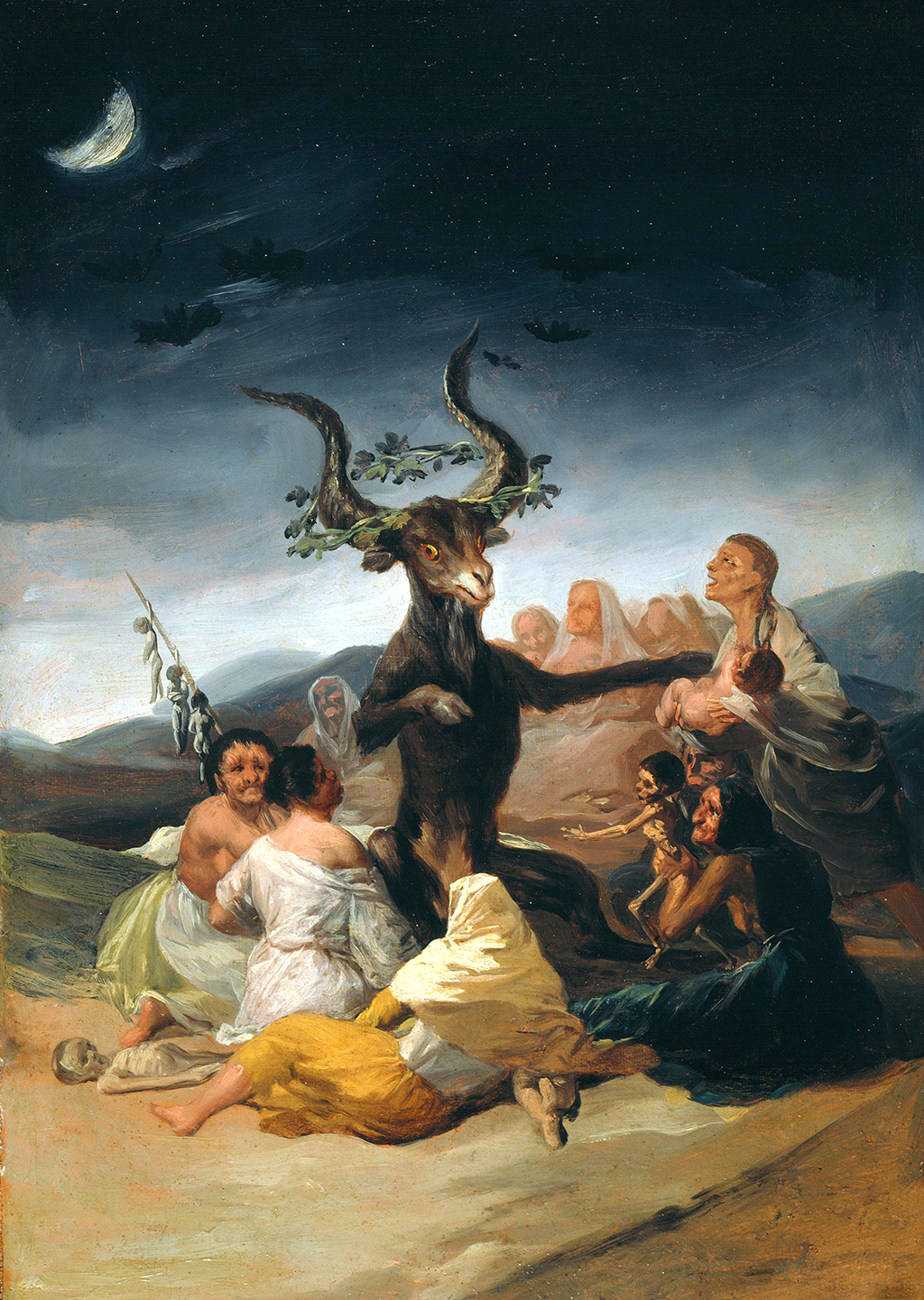
A goat wearing a crown of vine leaves reaches towards a woman holding a baby. An older woman holds up an emaciated child beside her, while bats cross the sky above the goat’s horns. Francisco de Goya painted this gathering on a canvas only 43 centimetres high, one of six pictures on supernatural subjects acquired by the Duke and Duchess of Osuna for their country estate near Madrid. The little canvas now belongs to the Museo Lázaro Galdiano. More than twenty years later, Goya returned to the same subject on a wall of his own house. [1] [2] [3]
At a Glance
- ArtistFrancisco de Goya
- Spanish titleEl aquelarre
- Date1797–1798
- MediumOil on canvas
- Dimensions43 × 30 cm, height before width, unframed
- CollectionMuseo Lázaro Galdiano, Madrid, 02006
- Original settingEl Capricho, the Osunas’ country estate at La Alameda
- Related workThe separate Witches’ Sabbath or The Great He-Goat, about 1820–1823, Museo Nacional del Prado
Works across Goya’s career
The Parasol
1777The Nude Maja
1795–1800Saturn Devouring His Son
c. 1820–23The Dog
c. 1820–23The circle around the goat
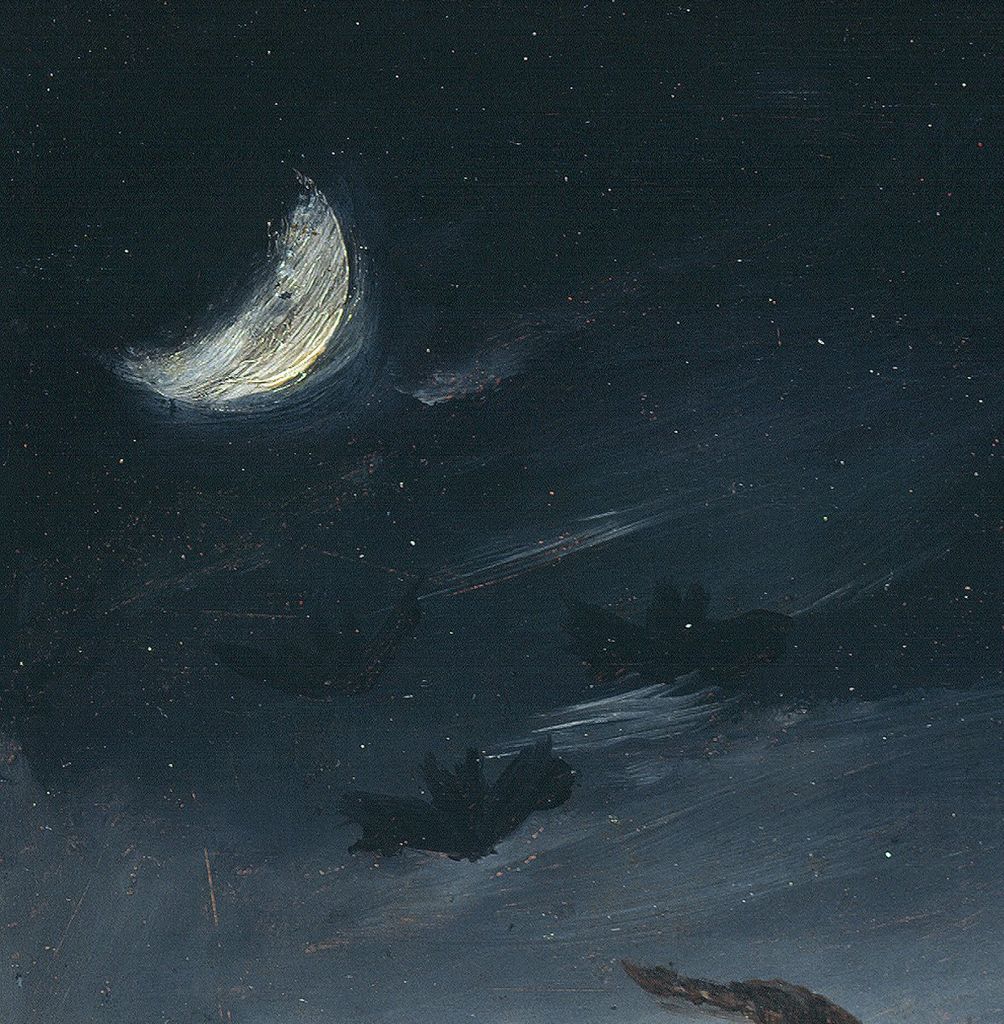
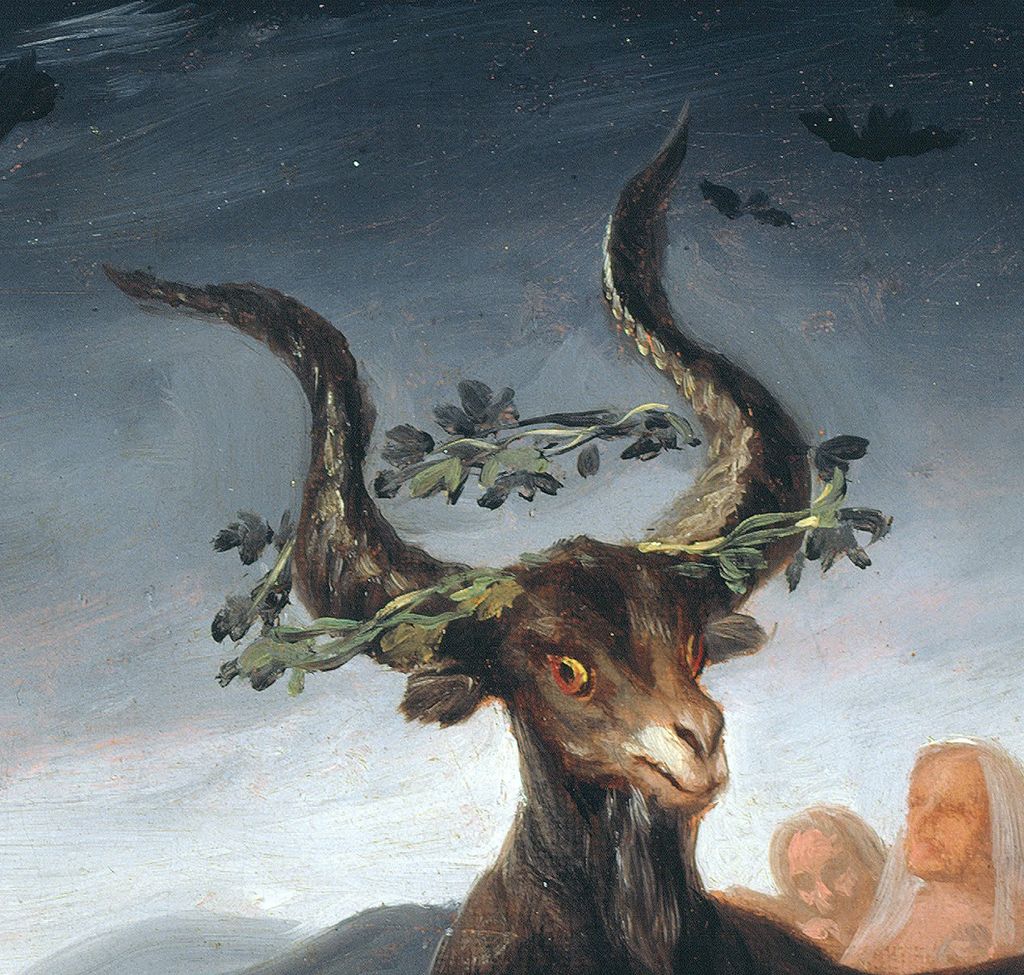
The crescent sits high on the left, with streaks of blue-grey below it and dark wings scattered across the sky. Lower down, the horizon brightens behind the goat, so that its long, irregular horns stand clear of the distant hills. Green leaves wind around the bases of the horns and hang between them. The Fundación Goya en Aragón sees an allusion to Bacchus in the vine wreath. The foliage also does something more immediate in the picture. It makes the goat look as though someone has prepared it for a ceremony. Its reddish eyes and pale muzzle are legible even when its dark chest almost merges with the landscape. [1] [2]
The goat sits upright at the centre of the company. One foreleg is bent across its body, while the other reaches to the right, nearly touching the infant a woman supports in the folds of her wrap. Her chin lifts as she looks towards the goat. Just below, an older woman holds the wasted figure of another child, whose narrow arm reaches in the same direction. The two presentations share a diagonal, but Goya distinguishes the rounded flesh of the infant from the sharp outline of the figure below. The gesture of offering is clear. There is room for doubt about whether the extended foreleg is about to receive the child, touch it or acknowledge the woman. [1] [2]
On the left, a woman in a white garment has her back to us. One of her bare shoulders picks up the light, and the person beside her looks outwards. Behind them, a thin pole carries tiny dangling forms, identified by the Fundación as foetuses. Another small figure lies on the ground near the lower left, separated from the active group. Across the foreground, yellow cloth and a pale hood catch the eye. The hooded figure stoops so low that fabric obscures the face, and the Fundación associates the pose with a drapery study on folio 6r of Goya’s Italian Sketchbook. The comparison concerns the way a bent body can be made legible through the cloth wrapped around it. [1] [2]
The figures in pale coverings behind the goat are much less defined. Several faces consist of little more than warm patches within the white fabric, and the hills are only slightly firmer in outline. This gives the goat a ring of companions without making the circle look mechanically regular. The near figures interrupt the view of the ground and of one another, while the far figures seem almost to dissolve into the light. Across this shallow space the paint shifts from cool blues and greens to dense black, earthy browns and sharp accents of ochre and white. The crescent places the gathering at night. The direction of the light on faces and sleeves is harder to trace to any one source. [1] [2]
How preparatory designs and prints organise a coven
There is a useful comparison between a painting made for a private interior and witchcraft figures drawn for a work on paper. On the Prado sheet known as Los Zanganos de las Brujas, a reader can look closely at the group and at the marks of writing associated with it. The record places the drawing among work associated with the Sueños and Caprichos. It supplies context for the image’s place among other inventions. The picture at the Lázaro Galdiano puts the sequence inside the painted scene. A viewer can follow the offerings and the line of figures without any written caption at the edge of the canvas. [14] [12]
In Ensayos much of the uncertainty arises from what a participant is doing and whether the act is a lesson, a performance or a misuse of knowledge. A name for the activity can invite the reader to look for a teacher or pupil. In the Osuna canvas, the goat’s posture and the reactions of the surrounding group produce an impression of authority before anyone has identified the occasion. The figures relate to it from different levels on the ground. Their inclinations support a reading of participation, even as the bodies offered to the goat complicate any single emotional response to the group. [14] [12]
These comparisons locate witchcraft in Goya’s practice without treating every picture as evidence for the same incident or idea. A drawing can clarify relations within a figure group close to the hand. An impression gives a detachable scene a short title for a larger public. A painting made for an aristocratic household could participate in a programme of subjects visible at once on a set of walls. Some of Goya’s most forceful effects come from choosing which of those surroundings the viewer needs in order to understand the act. [14] [12]
The distinction between the sheets and the painting also affects their pace. A caption can be read in a glance and then held in mind while the viewer searches for its implication. The goat painting gives the viewer no prescribed first sentence. Goya stages the gathering through the different intervals between heads and offerings. The spacing of the Osuna paintings in a room could have set up further comparisons, whereas a work on paper depends on the surrounding sheets or on the order in which somebody pulls them out for a look. The potential audience and its movements belong to the range of effects that makes these related witchcraft scenes distinct. [14] [12]
Annotated Details from Witches’ Sabbath
Follow the crescent down to the horns, then look at the hands and faces in the circle.
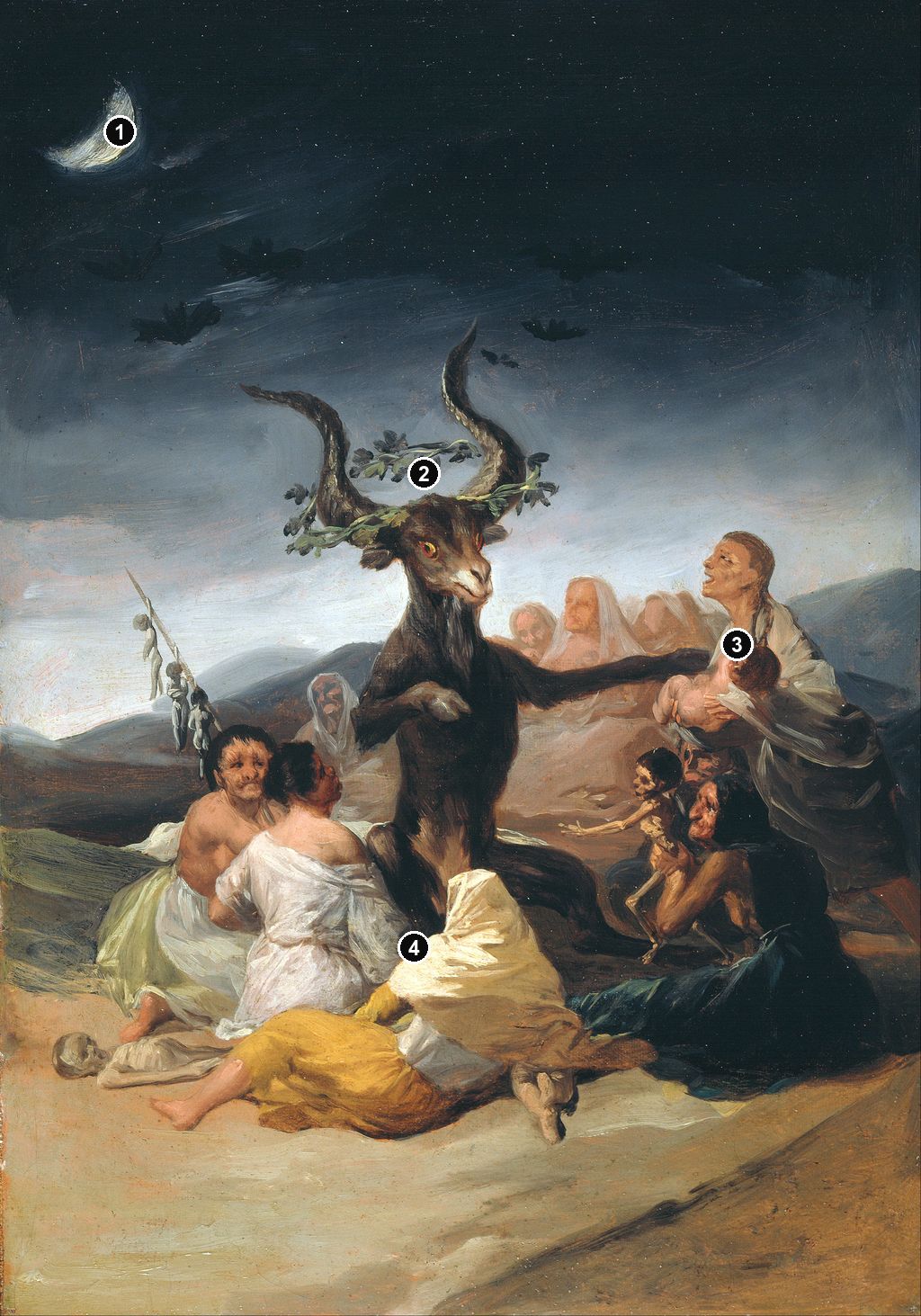
Details from WITCHES’ SABBATH
Details from the smaller Osuna painting now in the Museo Lázaro Galdiano (inventory 2006).
Crescent and silhouettes
The bright crescent lies near the upper left. Small dark shapes cross the lighter sky below it.
Leaves around the horns
Twigs and leaves pass across the curve of the horns. The pointed ears and the glint in the eye emerge from the brown fur.
A figure lifts a child
At right, the figure lifts a child towards the outstretched foreleg. Her face turns towards the goat.
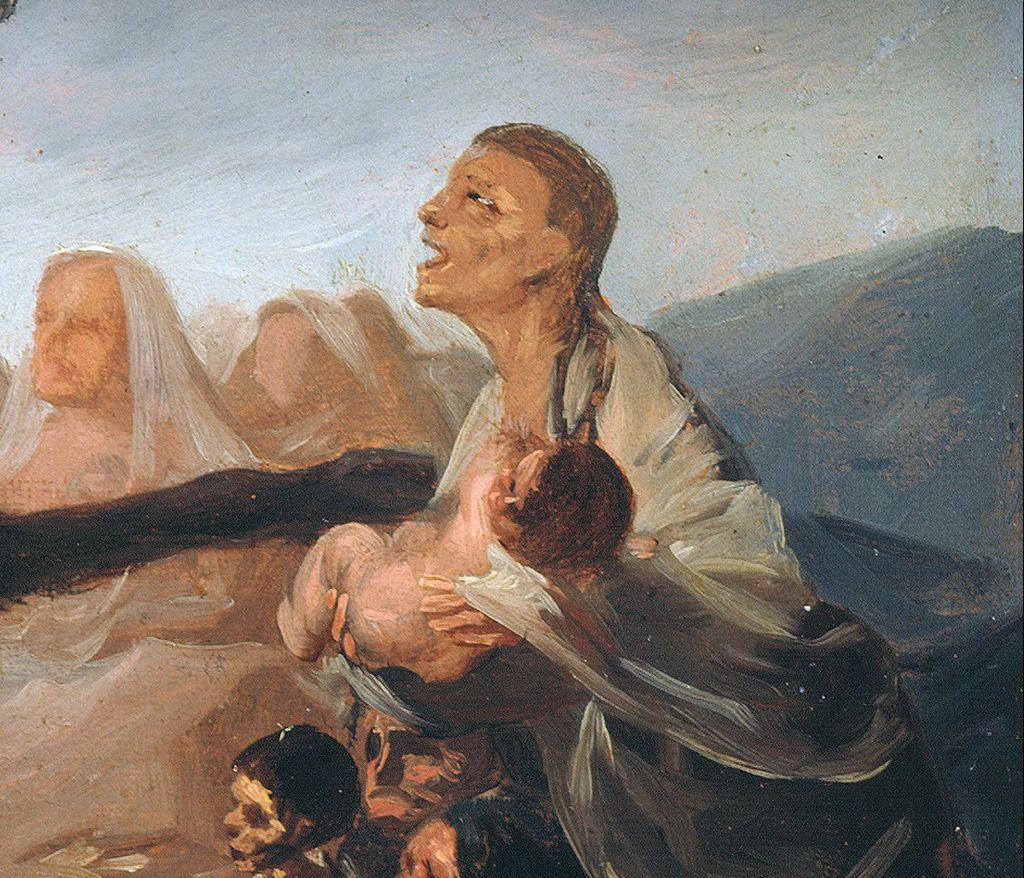
A circle seen from behind
The white and yellow fabric of the seated figures spreads across the near side of the circle.
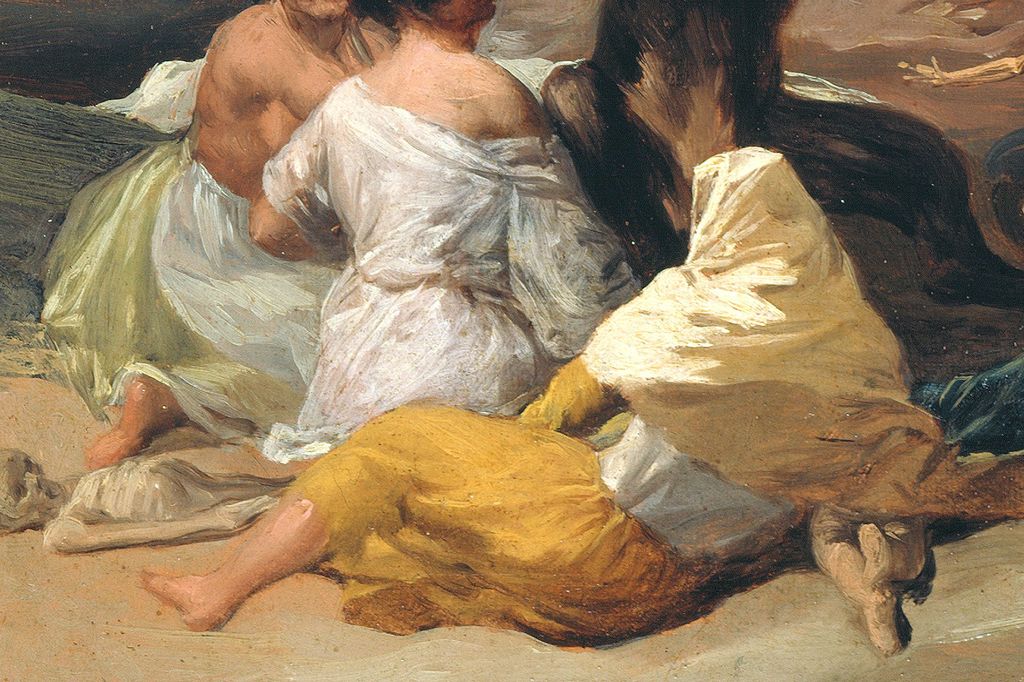
Goya on film
Five films explore Goya’s portraits, prints, Black Paintings and painting techniques.
The Duke of Wellington by Goya
The portrait, its military decorations and its later theft.
Watch on YouTubeSix canvases for La Alameda
The buyers were the ninth Duke of Osuna, Pedro de Alcántara Téllez-Girón y Pacheco, and his wife, María Josefa de la Soledad Pimentel. Their estate at La Alameda was known as El Capricho. A dated account reproduced by the Fundación Goya records that on 27 June 1798 Goya charged 6,000 reales de vellón for six paintings of witch subjects already at La Alameda. This securely connects the group to the estate and gives a date by which the pictures were there. The museum and the Fundación describe the group as a commission. The wording of the account records the transaction after the pictures were made and leaves open who first proposed the subjects and what terms the artist and patrons agreed in advance. [1] [4]
The Museo Lázaro Galdiano identifies the Sala de países as the room decorated with the set and records that it later became known as the library. The National Gallery’s provenance for one of the companions cautiously associates it with a group of fifteen small Goyas recorded in the library by the mid-nineteenth century. The descriptions offer a setting for the paintings, with their arrangement and precise sequence still open. The Lázaro Galdiano also notes that Witches’ Sabbath, its companion The Incantation and the Prado’s Witches’ Flight retain matching neoclassical frames. In the Sabbath’s frame, carved foliage and a dark band with an intertwined branch pattern surround a scene in which foliage doubles as the goat’s crown. [1] [5]
The group comprised Witches’ Sabbath, The Incantation, Witches’ Flight, The Witches’ Kitchen, The Bewitched Man and Don Juan and the Commendatore. Their subjects range from a moonlit ritual to scenes that evoke the theatre. In The Bewitched Man, now in the National Gallery, London, Goya illustrates Antonio de Zamora’s comedy El hechizado por fuerza. A frightened man pours oil into a lamp because he believes his life depends on keeping it alight. The play gives the spectator a reason to recognise the terror as an effect of deception. In Witches’ Sabbath, Goya gives us the goat, the gathering and the offerings, leaving the relation between what we see and what the figures believe much less settled. [5] [6]
In Witches’ Flight, three figures wearing tall, pointed headgear hold a naked man above the ground. Beneath them, one man covers his head with a sheet and another crouches with his hands over his ears. A donkey stands in the dark at the right. Goya uses a similarly narrow canvas for Witches’ Sabbath, but places its drama much lower down. We can see hills and a moon, while figures at several levels lead the eye towards the goat. In Witches’ Flight, the dark leaves the ground and the floating group almost disconnected. The two pictures make fear visible by different means. One brings the spectator close enough to inspect a ritual. The other shows two figures trying to shut out the very thing the painter lifts into view. [1] [4]
The two small paintings still together in the Museo Lázaro Galdiano also reward comparison. In The Incantation, a woman in a white headdress reads by candlelight and the other figures gather around a man on his knees. The curator Carmen Espinosa points to a detail that may represent a witch pushing a needle into a child-shaped doll. The candle creates a local point of light within the dense dark, and the written spell makes the gathering feel different from the exchange of looks and gestures around the goat. The repeated association of children and witchcraft is part of the pictorial language of the series. Each scene gives the fear a different object and a different setting. [1] [7]
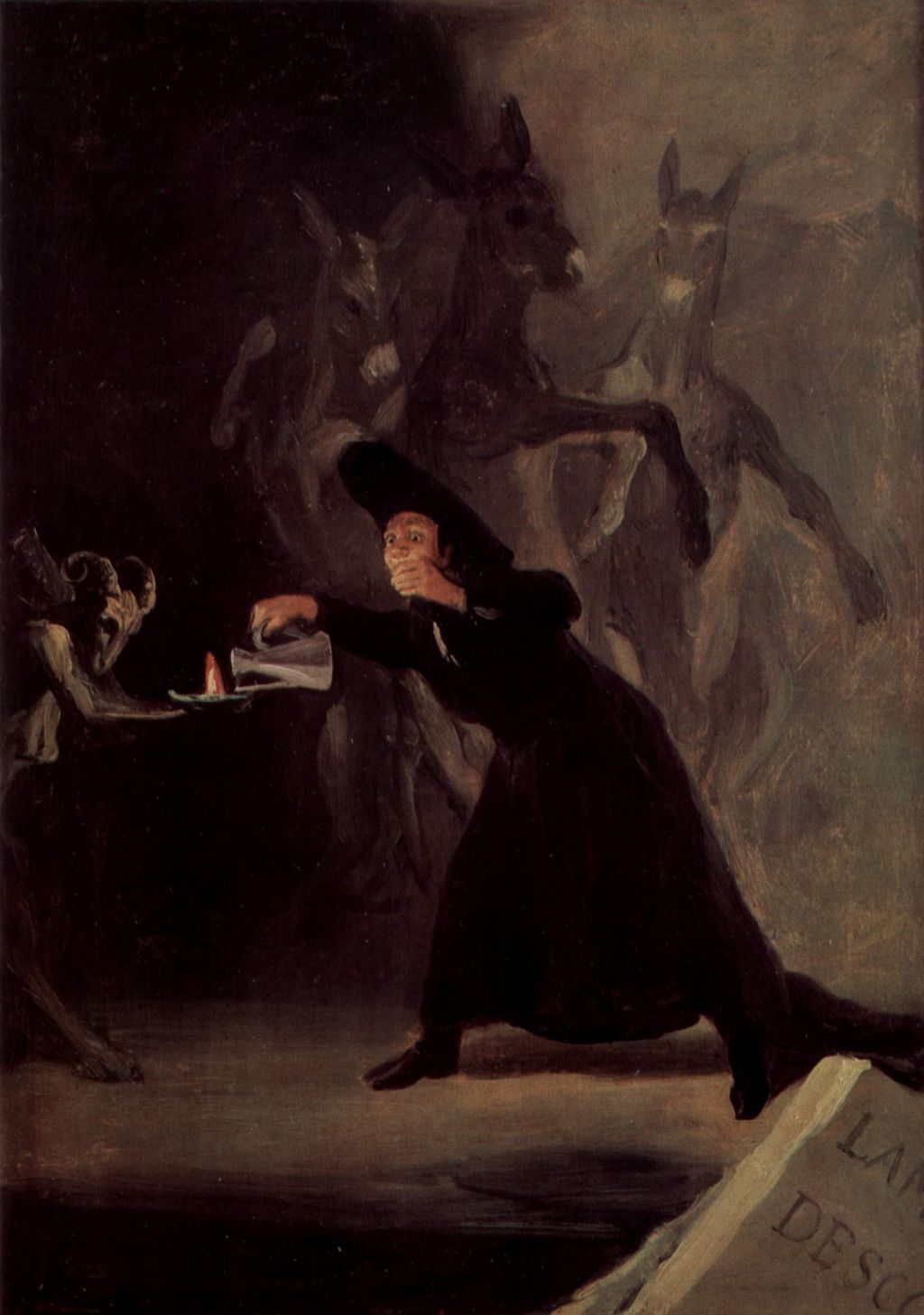
Logroño, Moratín and the Caprichos
On 7 and 8 November 1610 the Spanish Inquisition held a public auto de fe at Logroño, where sentences were pronounced against people including alleged witches from Zugarramurdi. Juan de Mongastón printed an account in 1611. Its descriptions of supposed dealings with the devil preserve accusations circulated around the proceedings. This distinction matters when looking at the painting. Reports that accused people brought harm to children help explain why the subject would have been recognisable. Such accusations tell us about the fears of accusers and the stories publicised by the trial. Goya’s hillside, with its goat and supernatural gathering, gives form to the kind of thing people were invited to imagine. [2] [8]
The playwright Leandro Fernández de Moratín republished the Logroño account in 1811 with ironic notes under the name Ginés de Posadilla. The Fundación raises the possibility that Goya and Moratín spoke about the subject in the late 1790s. The literary historian René Andioc dates the surviving notes much closer to their publication, using references within them to later events and writings. The nineteenth-century edition therefore belongs to the later history of sceptical readings of the account. Goya could have known the older relation or heard stories that shared its themes. The particular route by which they reached this canvas remains uncertain. [2] [8] [9]
Close contemporary parallels are in Goya’s own work. Plate 47 of Los Caprichos, published in 1799, is titled Obsequio á el maestro (A Gift for the Master). Several stooping figures bring an offering before a seated figure with a human face and a hairy, goat-like body. The title makes the encounter sound like a courtesy paid to a teacher. The printed figure’s human head and animal body reverse the emphasis of the painting, where the goat’s muzzle and horns dominate a pose with a human bearing. In plate 60, Ensayos (Trials), a goat looks on as a witch helps a pupil into the air. The caption invites us to consider the awkward action as a lesson or rehearsal. Both prints place supernatural conduct within recognisable arrangements of authority and apprenticeship. [10] [11] [12]
The Museo Lázaro Galdiano reads the canvas as satire on superstition. Calling it satire still leaves the disturbing contrast between the figures of the two children to account for. Goya makes the coven look absurd in the dignity it accords a goat with a leafy crown, and paints its supposed victims with enough specificity to make the proceedings hard to dismiss as a joke. In this reading the horror lies partly in the grotesque things people can picture and partly in their readiness to give those inventions authority. [1] [2]
From the Osuna collection to the museum
The canvas passed down through the Osuna family and appeared as lot 84 in the sale of the collection in Madrid in 1896. By about 1928 it belonged to Rodrigo de Figueroa y Torres, the first Duke of Tovar. The museum dates José Lázaro’s purchase to after 1928 and before 1936, with the Duke of Tovar’s heirs the probable sellers after his death in 1929. During the Spanish Civil War, both the Sabbath and The Incantation were stored at the Prado and then sent from Madrid to Valencia. They subsequently reached Geneva, where they were placed under the protection of the League of Nations. The paintings now form part of the collection built by Lázaro and housed in his former Madrid residence, which opened as a museum in 1951. [1] [13]
The later Sabbath in the Black Paintings
In The Great He-Goat, painted about 1820–1823, another goat presides over a gathering. This time the animal is a dark profile at the left, with a crowd running to the right in a long band. The composition belonged to the ground floor of Goya’s Quinta del Sordo and is now in the Prado. Oil paint on plaster was transferred to canvas in the nineteenth century, and early photographs show that the wall painting once extended considerably farther to the right. Even in its present form the later work is over four metres wide. At El Capricho, the small, upright canvas draws the eye into a circle of gestures around the goat. At the Quinta, the viewer’s gaze moves along a wall, passing from the goat through a succession of faces towards the seated woman. [1] [3]
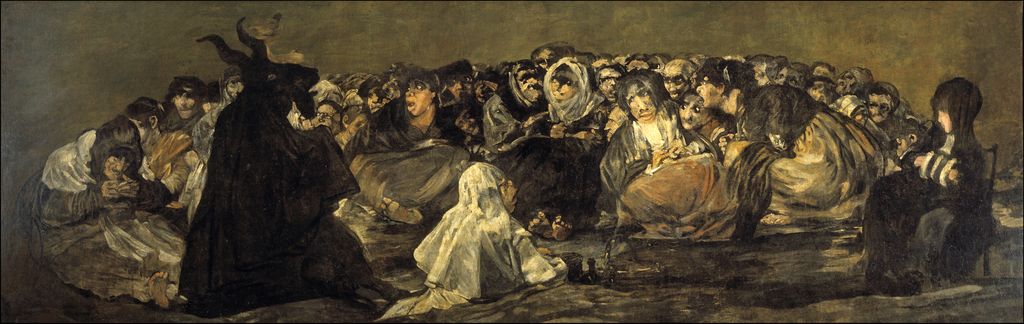
Artworks directory
| Name | Date | Medium |
|---|---|---|
| And There’s No Help for It, Plate 15 | Printed 1863 | |
| Asmodea | c. 1820–23 | Wall painting transferred to canvas |
| Boys Inflating a Bladder | 1777–78 | Tapestry cartoon |
| Boys Picking Fruit | 1778 | Tapestry cartoon |
| Bullfight in a Divided Ring | 1825 | Lithograph |
| Card Players | 1777–78 | Tapestry cartoon |
| Card Players (sketch) | 1777–78 | Painted sketch |
| Dance on the Banks of the Manzanares | 1777 | Tapestry cartoon |
| Duel with Cudgels | c. 1820–23 | Wall painting transferred to canvas |
| Heads in a Landscape | c. 1820–23 | Easel painting |
| Judith and Holofernes | c. 1820–23 | Wall painting transferred to canvas |
| Leocadia | c. 1820–23 | Wall painting transferred to canvas |
| Maja and Cloaked Men | 1777 | Tapestry cartoon |
| Maja and Cloaked Men (sketch) | 1777 | Painted sketch |
| Majo Clapping in Time to the Music | 1777 | Drawing |
| Men Reading | c. 1820–23 | Wall painting transferred to canvas |
| Out Hunting for Teeth, Plate 12 | 1799 | Etching, burnished aquatint and burin |
| Picnic in the Countryside (sketch) | 1776–78 | Painted sketch |
| Picnic on the Banks of the Manzanares | 1776 | Tapestry cartoon |
| Pilgrimage to San Isidro | c. 1820–23 | Wall painting transferred to canvas |
| Preparatory study for The Sleep of Reason Produces Monsters | c. 1796–97 | Drawing |
| Procession of the Holy Office | c. 1820–23 | Wall painting transferred to canvas |
| Quarrel at the Cockerel Inn (sketch) | 1777 | Painted sketch |
| Quarrel in the New Tavern | 1777 | Tapestry cartoon |
| Saturn Devouring His Son | c. 1820–23 | Wall painting transferred to canvas |
| Seated Majo Smoking | c. 1776 | Drawing |
| The Dog | c. 1820–23 | Wall painting transferred to canvas |
| The Drinker | 1777 | Tapestry cartoon |
| The Fates | c. 1820–23 | Wall painting transferred to canvas |
| The Great He-Goat | c. 1820–23 | Wall painting transferred to canvas |
| The Kite | 1777–78 | Tapestry cartoon |
| The Parasol | 1777 | Oil on canvas, tapestry cartoon |
| The Second of May 1808 | 1814 | Oil on canvas |
| The Sleep of Reason Produces Monsters, Plate 43 | 1799 | Etching and aquatint |
| The Third of May 1808 | 1814 | Oil on canvas |
| Thou Who Canst Not, Plate 42 | 1799 | Etching and burnished aquatint |
| Three Figures | 1776 | Drawing (lost) |
| Two Old Men | c. 1820–23 | Wall painting transferred to canvas |
| Two Old Men Eating Soup | c. 1820–23 | Wall painting transferred to canvas |
| Two Women and a Man | c. 1820–23 | Wall painting transferred to canvas |
| Universal Language: The Author Dreaming | 1797 | Drawing |
| The Family of Charles IV | 1800 | Oil on canvas |
| Witches’ Sabbath (Osuna painting) | 1797–98 | Oil on canvas |
| The Nude Maja | 1795–1800 | Oil on canvas |
| The Clothed Maja | 1800–07 | Oil on canvas |
| Self-Portrait (Drawing) | c. 1796 | Brush and carbon black ink on laid paper |
| The Swing, Madrid Album B.21 | 1795–97 | Brush and carbon black washes |
| Majas Fighting, a Majo Observing, Madrid Album B.15 | 1796–97 | Brush, grey and black washes on laid paper |
| Majos and Majas Conversing, Madrid Album B.16 | c. 1794–97 | Ink wash on paper |
| Weeping Woman and Three Men, Madrid Album B.17 | 1795–97 | Brush, carbon black washes and black chalk |
| Maja Seated on a Chair and Two Companions Behind, Madrid Album B.18 | 1795–97 | Brush and carbon black washes |
| Girl and Bull, Madrid Album B.23 | 1796–97 | Brush and carbon black washes |
| Lovers Sitting on a Rock, Madrid Album B.24 | 1796–97 | Brush and carbon black washes |
| Mariano Ceballos Riding a Bull | 1825 | Crayon lithograph and scraper |
| Landscape (lifetime impression) | c. 1807–10 | Etching and aquatint |
| Self-Portrait (1815), Prado canvas | 1815 | Oil on canvas |
| Self-Portrait (1815), Academy panel | 1815 | Oil on panel |
| Self-Portrait with Dr Arrieta | 1820 | Oil on canvas |
| Christ Crucified | 1780 | Oil on canvas |
| The Last Communion of Saint Joseph of Calasanz | 1819 | Oil on canvas |
| Christ on the Mount of Olives | 1819 | Oil on panel |
| The Flower Girls, or Spring | 1786–87 | Oil on canvas |
| The Grape Harvest, or Autumn | 1786–87 | Oil on canvas |
| The Snowstorm, or Winter | 1786–87 | Oil on canvas |
| The Threshing Ground, or Summer | 1786–87 | Oil on canvas |
| Picnic on the Banks of the Manzanares | 1776 | Oil on canvas |
| The Kite | 1777–78 | Oil on canvas |
| Dance on the Banks of the Manzanares | 1777 | Oil on canvas |
| A Fight at the Venta Nueva | 1777 | Oil on canvas |
| Blind Man’s Bluff | 1788 | Oil on canvas |
| Dogs on a Lead | 1775 | Oil on canvas |
| Hunting with a Decoy | 1775 | Oil on canvas |
| Hunter Loading His Rifle | 1775 | Oil on canvas |
| The Angler | 1775 | Oil on canvas |
| The Hermitage of San Isidro on His Feast Day | 1788 | Oil on canvas |
| The Meadow of San Isidro | 1788 | Oil on canvas |
| The Straw Manikin | 1791–92 | Oil on canvas |
| Witches’ Flight | c. 1797–98 | Oil on canvas |
| A Scene from ‘The Forcibly Bewitched’ | 1798 | Oil on canvas |
| The Duchess of Alba in Black | 1797 | Oil on canvas |
| The Duchess of Alba in White | 1795 | Oil on canvas |
| Charles III in Hunting Dress | c. 1786 | Oil on canvas |
| The Duke and Duchess of Osuna and Their Children | 1787–88 | Oil on canvas |
| Manuel Osorio Manrique de Zúñiga | 1787–88 | Oil on canvas |
| The Marquesa de Pontejos | c. 1786 | Oil on canvas |
| Equestrian Portrait of the 1st Duke of Wellington | 1812 | Oil on canvas |
| The Duke of Wellington | 1812–14 | Oil on wood |
| Portrait of Ferdinand VII of Spain | 1814 | Oil on canvas |
| Gaspar Melchor de Jovellanos | 1798 | Oil on canvas |
| María Tomasa Palafox y Portocarrero | 1804 | Oil on canvas |
| Señora Sabasa García | c. 1806–11 | Oil on canvas |
| Don Juan Bautista de Muguiro | 1827 | Oil on canvas |
| Doña Isabel de Porcel | Before 1805 | Oil on canvas |
| The Colossus | After 1808 | Oil on canvas |
| The Burial of the Sardine | 1808–12 | Oil on panel |
| The Madhouse | 1808–12 | Oil on panel |
| A Procession of Flagellants | 1808–12 | Oil on panel |
| Portrait of Jacques Galos | 1826 | Oil on canvas |
| Portrait of Mariano Goya, the Artist’s Grandson | 1827 | Oil on canvas |
| Milkmaid of Bordeaux | c. 1827 | Oil on canvas |
| Portrait of Don Juan Antonio Cuervo | 1819 | Oil on canvas |
| María Luisa of Parma (Naples version) | c. 1800 | Oil on canvas |
| The Countess of Baena | 1819 | Oil on canvas |
| The Family of the Infante Don Luis | 1783–84 | Oil on canvas |
| The Holy Family | c. 1787 | Oil on canvas |
| Saint Barbara | c. 1773 | Oil on canvas |
| Saints Justa and Rufina | 1817 | Oil on canvas |
| El Tío Paquete | c. 1819–20 | Oil on canvas |
| The Forge | c. 1815–20 | Oil on canvas |
| Majas on a Balcony (Metropolitan Museum version) | c. 1800–10 | Oil on canvas |
| Maja and Celestina on a Balcony | c. 1808–12 | Oil on canvas |
| The Water Bearer | 1808–12 | Oil on canvas |
| Time and the Old Women | c. 1810 | Oil on canvas |
Frequently Asked Questions
Discussion
Look again at the images and ideas explored in Witches’ Sabbath. These editorial prompts invite your observations.
Follow the goat’s extended foreleg, then look at the arms of the two women holding children. How much of the scene’s meaning changes if the goat’s gesture is read as a welcome, a demand or a blessing? Compare it with the more formal gesture of presentation in A Gift for the Master. What does the print’s seemingly polite title do to the encounter? [1] [10]
Reader Insights
How does the crescent affect the way you read the gathering?
Where do the figures look in this painting, and where do they look in the later mural?
Join the Conversation
Share a detail, comparison or question about Witches’ Sabbath below.
References
- Museo Lázaro Galdiano, El Aquelarre, inventory 02006, with entries by Carmen Espinosa and Carlos Sánchez Díez. View source.
- Fundación Goya en Aragón, El Aquelarre, catalogue entry 526, with a reproduction of the Osuna canvas. View source.
- Fundación Goya en Aragón, Witches’ Sabbath (El aquelarre), catalogue entry 659 for the Prado mural. View source.
- Fundación Goya en Aragón, Vuelo de brujas, catalogue entry 525, transcribing Goya’s account of 27 June 1798. View source.
- National Gallery, London, A Scene from ‘The Forcibly Bewitched’, NG1472, including provenance from Neil MacLaren’s The Spanish School, revised by Allan Braham (1988). View source.
- Fundación Goya en Aragón, Asuntos de brujas para la Alameda de Osuna, catalogue of the six paintings. View source.
- Museo Lázaro Galdiano, El Conjuro o Las Brujas, inventory 02004, with Carmen Espinosa’s discussion. View source.
- René Andioc, ‘Las reediciones del “Auto de fe” de Logroño en vida de Moratín’, Biblioteca Virtual Miguel de Cervantes, including the history of Mongastón’s 1611 printing. View source.
- René Andioc, ‘Sobre Goya y Moratín hijo’, Biblioteca Virtual Miguel de Cervantes, reproduced from Hispanic Review 50, no. 2 (1982), pp. 119–132. View source.
- Metropolitan Museum of Art, A Gift for the Master (Obsequio á el maestro), 1799, plate 47 of Los Caprichos, 18.64(47). View source.
- Fundación Goya en Aragón, Obsequio al maestro, catalogue entry 917. View source.
- Fundación Goya en Aragón, Trials (Ensayos), catalogue entry 930, plate 60 of Los Caprichos. View source.
- Museo Lázaro Galdiano, Historia de la colección, history of the collection and its conversion from a private residence into a museum. View source.
- Museo Nacional del Prado, Los Zanganos de las Brujas. View source.







