


 by Tom Gurney
Tom Gurney BSc (Hons) is an art history expert with over 20 years experience
Published on June 19, 2020 / Updated on November 20, 2026
Email: tomgurney1@gmail.com / Phone: +44 7429 011000
Introduction
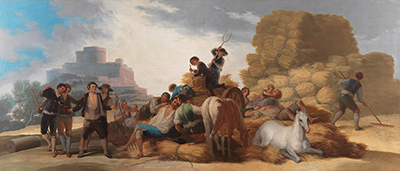
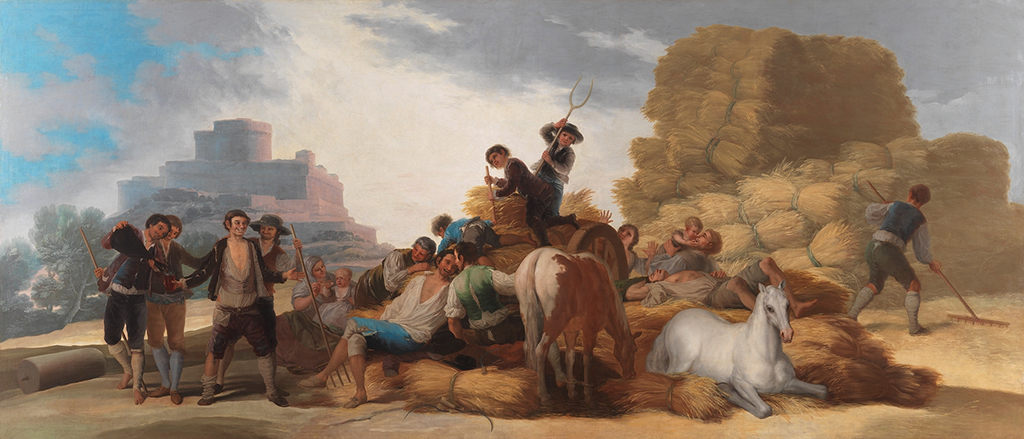
A man sweeps a rake over the ground while, a few paces away, a white horse lies among the sheaves. Children have climbed onto a cart, and four men at the left are occupied with a glass of wine. Goya spreads these incidents across more than six metres of canvas in The Threshing Ground, also called The Threshing Floor, Summer or La era. He painted it as the full-size design for a tapestry in Charles III’s apartments at the Royal Palace of El Pardo. The cartoon is now in the Museo Nacional del Prado. [1] [2] [3]
At a Glance
Works across Goya’s career
The Parasol
1777The Nude Maja
1795–1800Saturn Devouring His Son
c. 1820–23The Dog
c. 1820–23How Goya fills the west-wall canvas
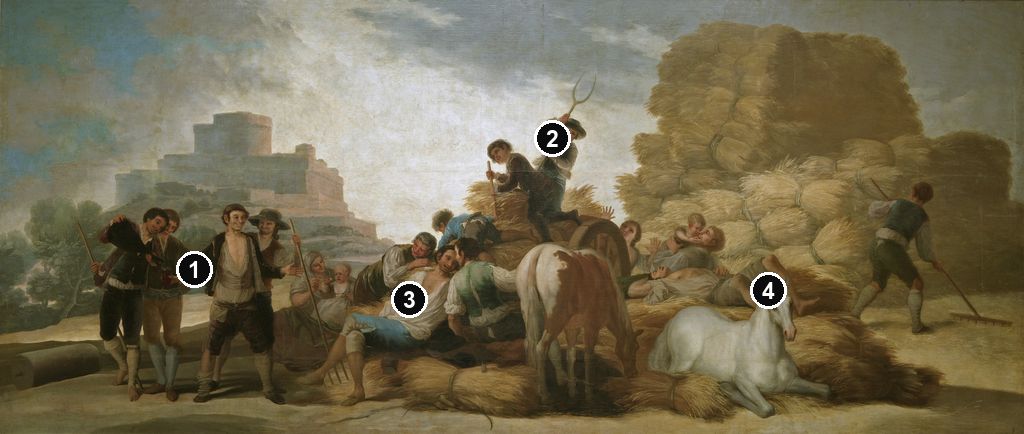
Look first at the two masses at opposite ends of the picture. To the left, the castle rises in terraces from a wooded slope. Blue-grey paint makes its walls recede, with pink catching on the side that faces the light. On the right, the stack of sheaves is much nearer and its bundles are individually tied. The castle’s outer edges are straight and its towers have flat tops, while stalks stick out all along the stack. The Fundación Goya en Aragón notes how the castle balances the pile across the width of the painting. Their positions leave a bright opening above the cart, where the children stand out against the sky. [2] [4]
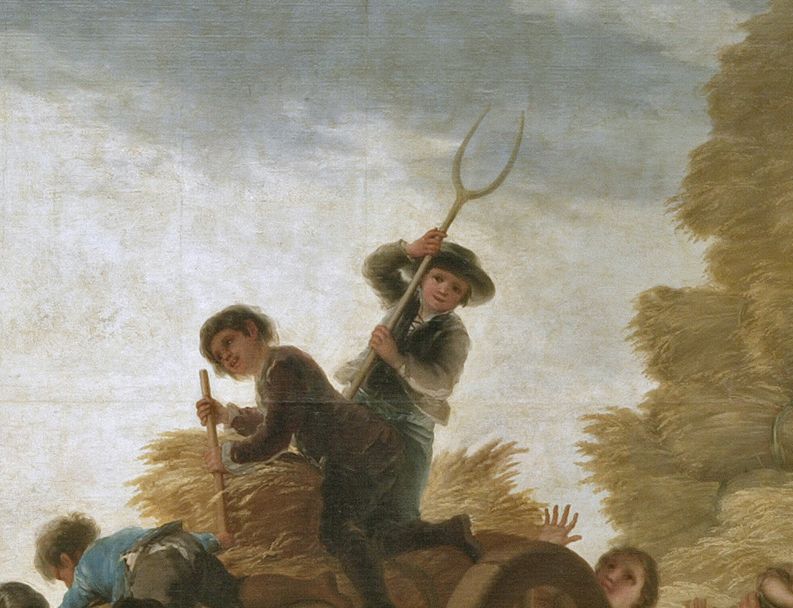
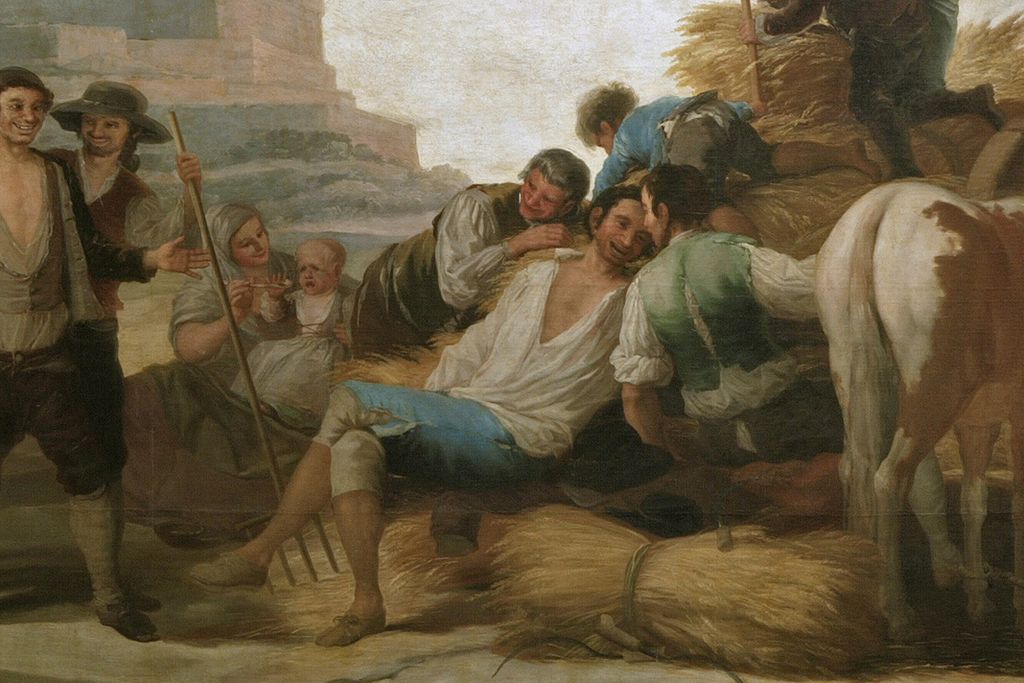
The cart almost disappears behind bodies and bundles. Its wheel shows below the dark-clad child who bends forward. Higher up, the child in a hat lifts a fork that breaks the line of the clouds. At ground level, the reclining man in a white shirt extends one leg towards the left while the standing horse and the figures beside the wheel carry the group towards the right. The Fundación relates the central pyramid to the compositional practice Goya learned from Anton Raphael Mengs. The child’s raised fork marks the apex of the figure group, and the crest of the wheat stack rises higher still. The figures at either end then have room for gestures of their own. [2]
Much of the action happens close to the lower edge. To see how the groups fit together, follow the poles and tools across the picture. At the left a man holds a slender stick away from his body, and another has a longer implement upright by his shoulder. A fork crosses the ground near the bare foot of the reclining labourer. The fork above the cart draws the eye upwards before the long handle at the far right brings it down again to the flat ground. From across a room, these strokes help the viewer follow the movement of people whose faces and expressions reward a closer look. [2]
Annotated Details from The Threshing Ground, or Summer
Look from the people at the left to the central group resting beside the harvest.
Details from THE THRESHING GROUND, OR SUMMER
Details from the tapestry cartoon in the Museo Nacional del Prado (P000794).
The figures at left
Standing figures cluster near the left foreground, below the distant building.
The raised tool
A toothed implement rises above the figures gathered by the stack.
The resting group
The bodies around the straw interrupt the upright figures to either side.
Stack and animals
The animals stand or rest in front of the rising heap of cut grain.
A pause in the work
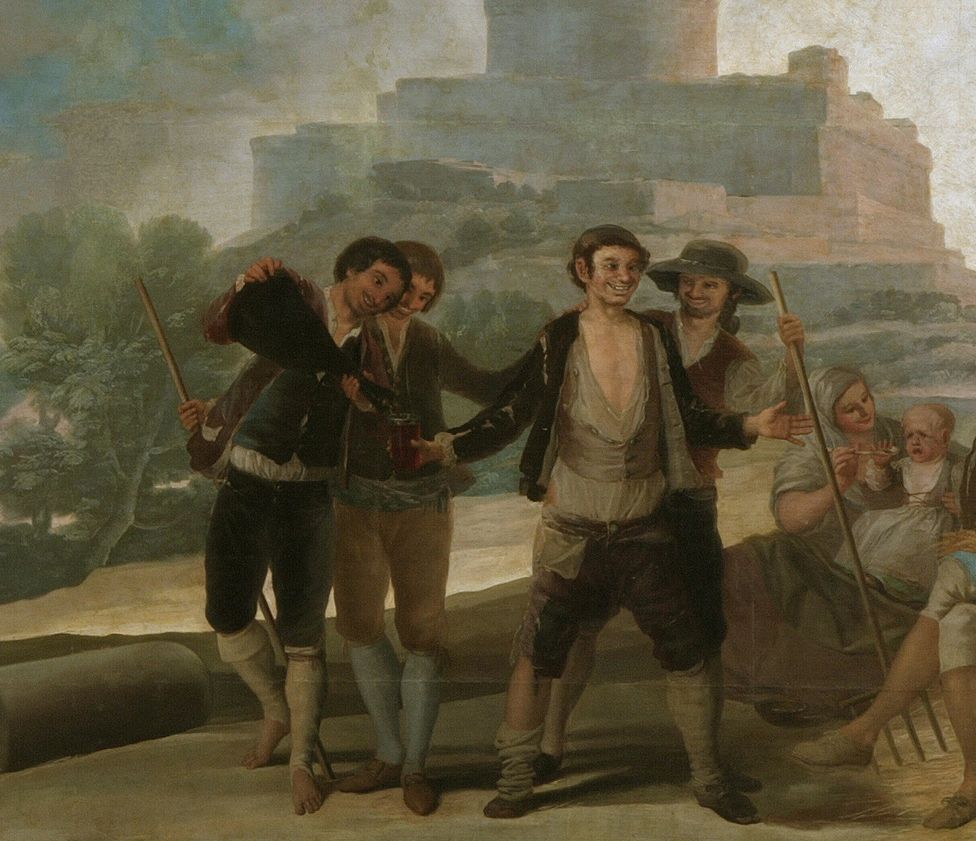
The wheat lies in bundles on the ground where several of the harvesters sit or stretch out. In the group at the left, one man tilts a dark wineskin over a glass. The man holding the glass also has his other arm stretched out, his shirt open and his jacket hanging back. His companions lean close enough to put a hand on his shoulder. The conservator Almudena Sánchez describes the scene as a group getting one of its own drunk. The flush on the faces suggests that the joke has been going on for some time. Beside them, the man in the low, open white shirt rests his weight on a sheaf as the people around him lean in. His folds of white cloth catch the light across a broad area, while the drink catches it in a tiny patch of red. [2] [4]
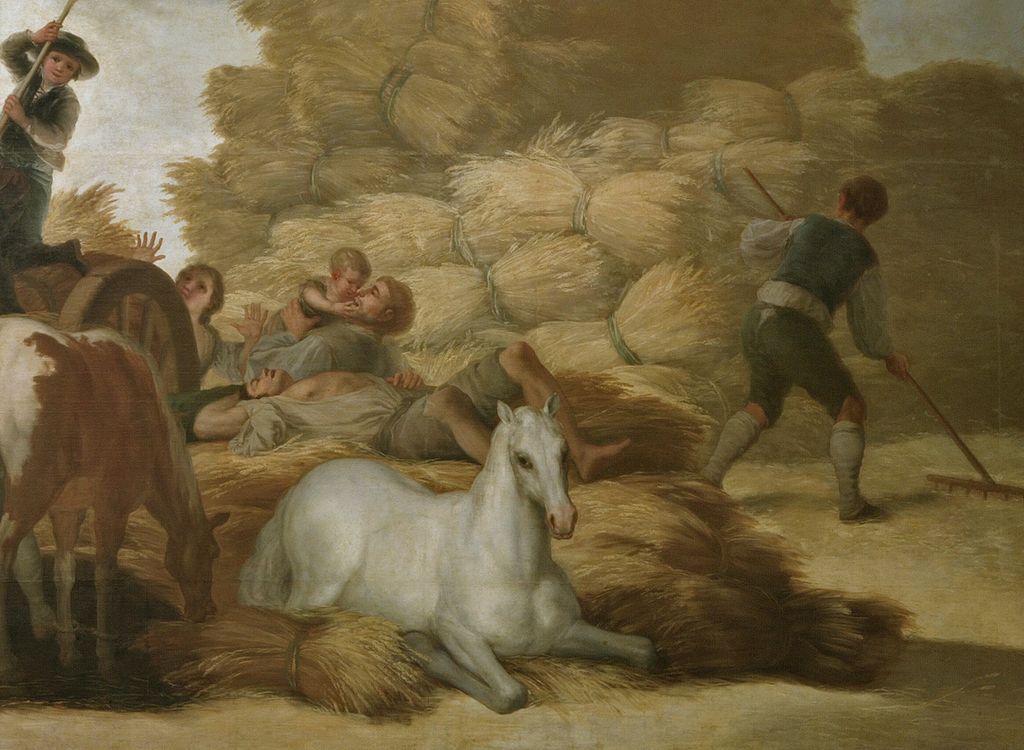
Beyond the cart, an adult holds a child up close to his face. A reclining man lies on his back nearby, loose cloth falling across his bent knee. Below him, the pale horse rests with its forelegs bent and its head turned out towards the viewer. The standing horse presents its hindquarters, its head lowered among the bundles. The two horses place a long break between the central group and the worker at the edge. His back turns towards the rest of the company as he leans on the rake, which reaches out over a patch of ground that has already been cleared of the heaped sheaves. At the opposite edge, a heavy roller lies on its side. Threshing separates the grain from the ears after reaping. Goya shows the cut wheat and the equipment alongside the people taking a break, so the work has a visible place even where the activity is drinking or play. [2] [5]
Goya on film
Five films explore Goya’s portraits, prints, Black Paintings and painting techniques.
The Duke of Wellington by Goya
The portrait, its military decorations and its later theft.
Watch on YouTubeThe seasons around the king’s room
Goya was appointed painter to Charles III in 1786, the year he began this commission. It was his first set of tapestry designs for the king’s own apartments after earlier work for the Prince of Asturias. The wall hangings were made to fit the room’s architecture. José Luis Sancho’s reconstruction for Patrimonio Nacional places Summer on the west wall between two door openings, one of which was a false door that balanced the entrance to the king’s gallery. He places The Snowstorm on the north wall and The Grape Harvest and The Flower Girls on either side of the balcony on the south wall. The set never hung together in its intended arrangement. [3]
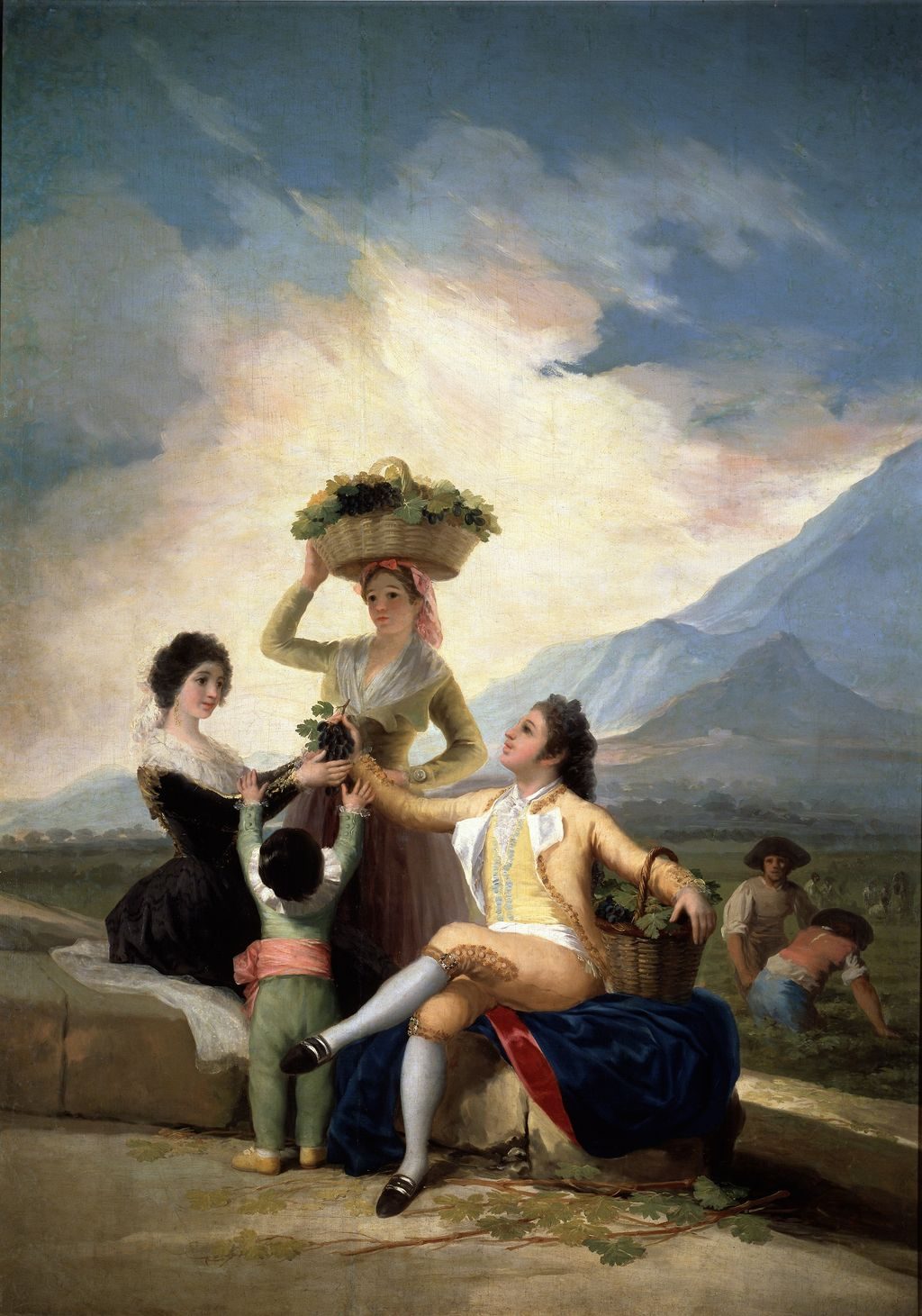
The four subjects would have been seen in succession as a viewer turned through the room. In spring a woman carries flowers and a man raises a rabbit behind her. In autumn a child reaches up towards a bunch of grapes held by a well-dressed man. Summer gives even more of the picture to the harvested crop and the people among it. The Fundación points out that an earlier convention gave summer a single emblematic figure, a woman wearing ears of wheat. Here, the heap of sheaves makes the season recognisable from a distance and the individual gestures give it a story. In winter, the wind draws the travellers into a tight knot. Summer’s open ground lets the harvesters gather or disperse at will. [2] [3] [6] [7] [8]
From oil sketch to tapestry
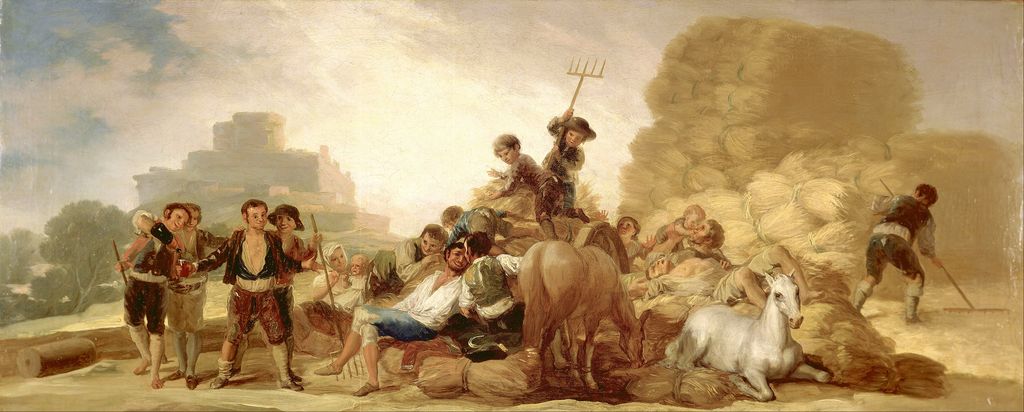
The small oil sketch for the cartoon survives at the Museo Lázaro Galdiano in Madrid. It measures 33.5 × 79.5 cm and dates to 1786. The Fundación Goya en Aragón cites Goya’s request to be reimbursed for the carriage that took him to El Escorial to present his designs to the king. The sketched scene already contains the major groups, the castle and the pile of wheat. Look at the child’s raised tool to see how closely Goya kept the arrangement while revising individual forms. The sketch has four short, close points at the top of the handle. The full-size cartoon has two longer prongs that curve apart against the sky. The standing horse also changes from a largely brown shape into one with a broad white patch across its rump, which helps it stand out from the stacked wheat. [2] [9] [10]
The ninth Duke of Osuna acquired the sketch in 1799. It passed through the sale of the Osuna collection in 1896 to Richard Traumann and later to José Lázaro Galdiano. The cartoon had a different purpose and history. It was the painted model for the weavers at the Royal Tapestry Factory. The finished wall hanging was made by weaving the design in coloured thread. Patrimonio Nacional lists a woven La era o El verano under the Vandergoten brothers and Goya. The Spanish Army documented the return of a restored tapestry of the subject to the Goya room in Madrid’s Palacio de Buenavista in 2010, where it hung alongside a woven Grape Harvest. [9] [10] [11] [12]
At the Prado, Almudena Sánchez’s restoration of the cartoon, completed in 2015, removed yellowed varnish that had dulled the sky and the pinks and blues of the distant castle. She described how Goya loaded a fine brush to give the ears of wheat a raised surface. He used much drier strokes around a child’s hair where it catches the light, and two touches of red to suggest light through the glass of wine. The weave could carry the positions and colours of the forms into the royal room. These details belong to the particular way Goya handled the paint on the full-size canvas. [1] [4]
Artworks directory
| Name | Date | Medium |
|---|---|---|
| And There’s No Help for It, Plate 15 | Printed 1863 | |
| Asmodea | c. 1820–23 | Wall painting transferred to canvas |
| Boys Inflating a Bladder | 1777–78 | Tapestry cartoon |
| Boys Picking Fruit | 1778 | Tapestry cartoon |
| Bullfight in a Divided Ring | 1825 | Lithograph |
| Card Players | 1777–78 | Tapestry cartoon |
| Card Players (sketch) | 1777–78 | Painted sketch |
| Dance on the Banks of the Manzanares | 1777 | Tapestry cartoon |
| Duel with Cudgels | c. 1820–23 | Wall painting transferred to canvas |
| Heads in a Landscape | c. 1820–23 | Easel painting |
| Judith and Holofernes | c. 1820–23 | Wall painting transferred to canvas |
| Leocadia | c. 1820–23 | Wall painting transferred to canvas |
| Maja and Cloaked Men | 1777 | Tapestry cartoon |
| Maja and Cloaked Men (sketch) | 1777 | Painted sketch |
| Majo Clapping in Time to the Music | 1777 | Drawing |
| Men Reading | c. 1820–23 | Wall painting transferred to canvas |
| Out Hunting for Teeth, Plate 12 | 1799 | Etching, burnished aquatint and burin |
| Picnic in the Countryside (sketch) | 1776–78 | Painted sketch |
| Picnic on the Banks of the Manzanares | 1776 | Tapestry cartoon |
| Pilgrimage to San Isidro | c. 1820–23 | Wall painting transferred to canvas |
| Preparatory study for The Sleep of Reason Produces Monsters | c. 1796–97 | Drawing |
| Procession of the Holy Office | c. 1820–23 | Wall painting transferred to canvas |
| Quarrel at the Cockerel Inn (sketch) | 1777 | Painted sketch |
| Quarrel in the New Tavern | 1777 | Tapestry cartoon |
| Saturn Devouring His Son | c. 1820–23 | Wall painting transferred to canvas |
| Seated Majo Smoking | c. 1776 | Drawing |
| The Dog | c. 1820–23 | Wall painting transferred to canvas |
| The Drinker | 1777 | Tapestry cartoon |
| The Fates | c. 1820–23 | Wall painting transferred to canvas |
| The Great He-Goat | c. 1820–23 | Wall painting transferred to canvas |
| The Kite | 1777–78 | Tapestry cartoon |
| The Parasol | 1777 | Oil on canvas, tapestry cartoon |
| The Second of May 1808 | 1814 | Oil on canvas |
| The Sleep of Reason Produces Monsters, Plate 43 | 1799 | Etching and aquatint |
| The Third of May 1808 | 1814 | Oil on canvas |
| Thou Who Canst Not, Plate 42 | 1799 | Etching and burnished aquatint |
| Three Figures | 1776 | Drawing (lost) |
| Two Old Men | c. 1820–23 | Wall painting transferred to canvas |
| Two Old Men Eating Soup | c. 1820–23 | Wall painting transferred to canvas |
| Two Women and a Man | c. 1820–23 | Wall painting transferred to canvas |
| Universal Language: The Author Dreaming | 1797 | Drawing |
| The Family of Charles IV | 1800 | Oil on canvas |
| Witches’ Sabbath (Osuna painting) | 1797–98 | Oil on canvas |
| The Nude Maja | 1795–1800 | Oil on canvas |
| The Clothed Maja | 1800–07 | Oil on canvas |
| Self-Portrait (Drawing) | c. 1796 | Brush and carbon black ink on laid paper |
| The Swing, Madrid Album B.21 | 1795–97 | Brush and carbon black washes |
| Majas Fighting, a Majo Observing, Madrid Album B.15 | 1796–97 | Brush, grey and black washes on laid paper |
| Majos and Majas Conversing, Madrid Album B.16 | c. 1794–97 | Ink wash on paper |
| Weeping Woman and Three Men, Madrid Album B.17 | 1795–97 | Brush, carbon black washes and black chalk |
| Maja Seated on a Chair and Two Companions Behind, Madrid Album B.18 | 1795–97 | Brush and carbon black washes |
| Girl and Bull, Madrid Album B.23 | 1796–97 | Brush and carbon black washes |
| Lovers Sitting on a Rock, Madrid Album B.24 | 1796–97 | Brush and carbon black washes |
| Mariano Ceballos Riding a Bull | 1825 | Crayon lithograph and scraper |
| Landscape (lifetime impression) | c. 1807–10 | Etching and aquatint |
| Self-Portrait (1815), Prado canvas | 1815 | Oil on canvas |
| Self-Portrait (1815), Academy panel | 1815 | Oil on panel |
| Self-Portrait with Dr Arrieta | 1820 | Oil on canvas |
| Christ Crucified | 1780 | Oil on canvas |
| The Last Communion of Saint Joseph of Calasanz | 1819 | Oil on canvas |
| Christ on the Mount of Olives | 1819 | Oil on panel |
| The Flower Girls, or Spring | 1786–87 | Oil on canvas |
| The Grape Harvest, or Autumn | 1786–87 | Oil on canvas |
| The Snowstorm, or Winter | 1786–87 | Oil on canvas |
| The Threshing Ground, or Summer | 1786–87 | Oil on canvas |
| Picnic on the Banks of the Manzanares | 1776 | Oil on canvas |
| The Kite | 1777–78 | Oil on canvas |
| Dance on the Banks of the Manzanares | 1777 | Oil on canvas |
| A Fight at the Venta Nueva | 1777 | Oil on canvas |
| Blind Man’s Bluff | 1788 | Oil on canvas |
| Dogs on a Lead | 1775 | Oil on canvas |
| Hunting with a Decoy | 1775 | Oil on canvas |
| Hunter Loading His Rifle | 1775 | Oil on canvas |
| The Angler | 1775 | Oil on canvas |
| The Hermitage of San Isidro on His Feast Day | 1788 | Oil on canvas |
| The Meadow of San Isidro | 1788 | Oil on canvas |
| The Straw Manikin | 1791–92 | Oil on canvas |
| Witches’ Flight | c. 1797–98 | Oil on canvas |
| A Scene from ‘The Forcibly Bewitched’ | 1798 | Oil on canvas |
| The Duchess of Alba in Black | 1797 | Oil on canvas |
| The Duchess of Alba in White | 1795 | Oil on canvas |
| Charles III in Hunting Dress | c. 1786 | Oil on canvas |
| The Duke and Duchess of Osuna and Their Children | 1787–88 | Oil on canvas |
| Manuel Osorio Manrique de Zúñiga | 1787–88 | Oil on canvas |
| The Marquesa de Pontejos | c. 1786 | Oil on canvas |
| Equestrian Portrait of the 1st Duke of Wellington | 1812 | Oil on canvas |
| The Duke of Wellington | 1812–14 | Oil on wood |
| Portrait of Ferdinand VII of Spain | 1814 | Oil on canvas |
| Gaspar Melchor de Jovellanos | 1798 | Oil on canvas |
| María Tomasa Palafox y Portocarrero | 1804 | Oil on canvas |
| Señora Sabasa García | c. 1806–11 | Oil on canvas |
| Don Juan Bautista de Muguiro | 1827 | Oil on canvas |
| Doña Isabel de Porcel | Before 1805 | Oil on canvas |
| The Colossus | After 1808 | Oil on canvas |
| The Burial of the Sardine | 1808–12 | Oil on panel |
| The Madhouse | 1808–12 | Oil on panel |
| A Procession of Flagellants | 1808–12 | Oil on panel |
| Portrait of Jacques Galos | 1826 | Oil on canvas |
| Portrait of Mariano Goya, the Artist’s Grandson | 1827 | Oil on canvas |
| Milkmaid of Bordeaux | c. 1827 | Oil on canvas |
| Portrait of Don Juan Antonio Cuervo | 1819 | Oil on canvas |
| María Luisa of Parma (Naples version) | c. 1800 | Oil on canvas |
| The Countess of Baena | 1819 | Oil on canvas |
| The Family of the Infante Don Luis | 1783–84 | Oil on canvas |
| The Holy Family | c. 1787 | Oil on canvas |
| Saint Barbara | c. 1773 | Oil on canvas |
| Saints Justa and Rufina | 1817 | Oil on canvas |
| El Tío Paquete | c. 1819–20 | Oil on canvas |
| The Forge | c. 1815–20 | Oil on canvas |
| Majas on a Balcony (Metropolitan Museum version) | c. 1800–10 | Oil on canvas |
| Maja and Celestina on a Balcony | c. 1808–12 | Oil on canvas |
| The Water Bearer | 1808–12 | Oil on canvas |
| Time and the Old Women | c. 1810 | Oil on canvas |
Frequently Asked Questions
Discussion
Look again at the images and ideas explored in The Threshing Ground, or Summer. These editorial prompts invite your observations.
Which figure first drew your eye across this wide scene? How does the man still at work change the way you read the others’ rest among the sheaves?
Reader Insights
How does the wide canvas change the way you move between the groups?
Which changes stand out when you compare the small oil and the full cartoon?
Join the Conversation
Share a detail, comparison or question about The Threshing Ground, or Summer below.
References
- Museo Nacional del Prado, La era o El verano, P000794 and Memoria de actividades 2015, restoration and installation. View source 1. View source 2.
- Fundación Goya en Aragón, La era, cartoon catalogue entry and illustration. View source.
- José Luis Sancho, La nevada o El invierno, in Carlos III. Majestad y Ornato, Patrimonio Nacional, reconstruction of the room at El Pardo. View source.
- Almudena Sánchez, interview on the restoration of La era, interviewed by Ángela Sanz Coca for Descubrir el Arte, 2015. View source.
- Museo Lázaro Galdiano, Preparación de la visita, harvest, threshing and figures in the oil sketch. View source.
- Fundación Goya en Aragón, Las floreras, spring cartoon. View source.
- Fundación Goya en Aragón, La vendimia, autumn cartoon. View source.
- Fundación Goya en Aragón, La nevada, winter cartoon. View source.
- Fundación Goya en Aragón, El verano (boceto), preparatory sketch and provenance. View source.
- Museo Lázaro Galdiano, La Era o El Verano, 02510, and illustrated museum commentary. View source 1. View source 2.
- Patrimonio Nacional, Tapicería, royal tapestry collection and La era o El verano. View source.
- Ejército de Tierra, return of La Era to the Palacio de Buenavista, 2010 tapestry restoration. View source.







