


 by Tom Gurney
Tom Gurney BSc (Hons) is an art history expert with over 20 years experience
Published on June 19, 2020 / Updated on November 20, 2026
Email: tomgurney1@gmail.com / Phone: +44 7429 011000
Introduction
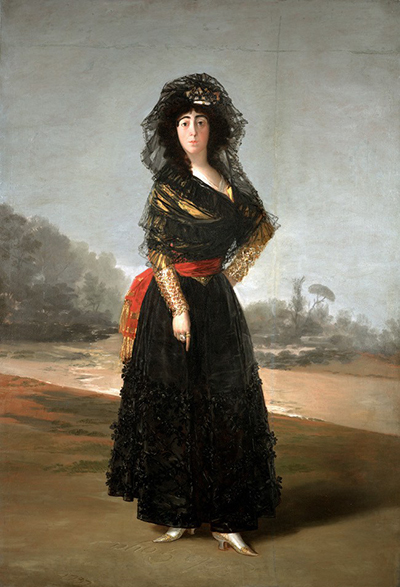
The Duchess of Alba stands on a bank of pale earth with her left hand at her waist and her right index finger directed down towards the ground. Her eyes look out of the canvas. Following her finger takes us away from that steady gaze, past a red sash and the edge of a black skirt to the words Solo Goya and the date 1797. Goya has put his signature where an inscription scratched into the ground might be found. The duchess’s hand also carries the names ‘Alba’ and ‘Goya’ on two rings. Their letters are small enough to escape a first look at a portrait more than two metres high. [1] [2] [3]
At a Glance
- ArtistFrancisco de Goya y Lucientes
- TitleThe Duchess of Alba, also called The Black Duchess or The Duchess of Alba in Black
- Date1797
- SitterMaría del Pilar Teresa Cayetana de Silva Álvarez de Toledo, 13th Duchess of Alba
- Medium and dimensionsOil on canvas, 210.2 × 149.2 cm (height × width)
- CollectionHispanic Society Museum & Library, New York, A102. [1] [12]
Works across Goya’s career
The Parasol
1777The Nude Maja
1795–1800Saturn Devouring His Son
c. 1820–23The Dog
c. 1820–23Milkmaid of Bordeaux
c. 1827The standing figure and the landscape
Her body turns slightly under a face that stays almost square to the viewer. The left elbow projects on our right, widening the upper figure. On our left the pointing arm drops close to the skirt. The red sash draws a horizontal across the centre before its fringed end falls at the side. At the bottom, pale shoes peep from under the skirt and give the figure a footing on the sloping bank. Each arm changes the outline in a different way. The bent elbow opens a space to one side that helps isolate the dark figure, while the lowered arm makes use of the dark cloth behind it to show the hand clearly. [2] [3]
The landscape is important to that effect. The pale sky occupies much of the height of the canvas, and the trees and banks gather below her shoulders. The distant shapes are soft enough to let the black lace read at the edges of her head. Nearer the ground, strips of warm and cool colour describe the uneven terrain that carries her shadow. The Hispanic Society’s collection study draws attention to the thin, translucent paint of the landscape and the more conspicuous brushwork of the costume. A heavier touch in the distance would have competed with the skirt and veil, where Goya needed the viewer to register dark patterns and folds at almost the same value. [2]
The duchess held her title in her own right. After her husband, José Álvarez de Toledo, died in 1796 she withdrew to Sanlúcar de Barrameda, near Cádiz. The Hispanic Society’s study identifies the setting with her estate, while the Fundación Goya en Aragón also suggests the neighbouring floodplains of the Guadalquivir. The painting gives us a terrain of low banks and scattered trees. The connection with Sanlúcar comes from the circumstances of the duchess’s life and the history of the portrait, and the view allows for more than one precise location. [2] [3]
Annotated Details from The Duchess of Alba in Black
Follow the dress, sash and pointing hand down from the face.
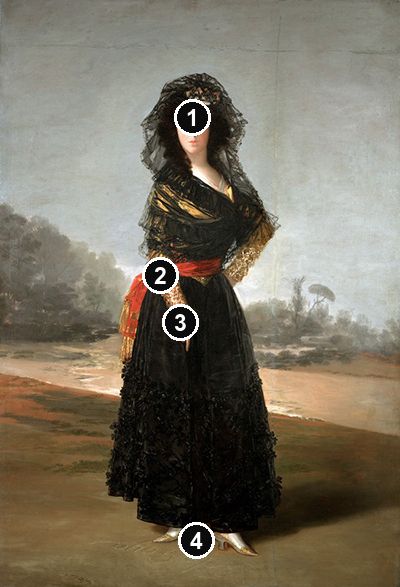
Details from THE DUCHESS OF ALBA IN BLACK
Details from the 1797 portrait in the Hispanic Society (A102).
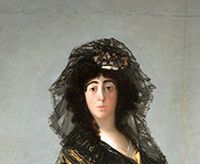
The dark veil
Dark lace frames the face and alters the outline of the head against the sky.
The sash
The broad red sash crosses the dark skirt before dropping down to the left.
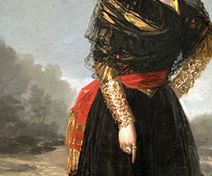
The pointing hand
The index finger extends beside the dark fabric.
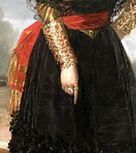
The feet and the ground
Pale shoes appear below the dark hem against the open ground.
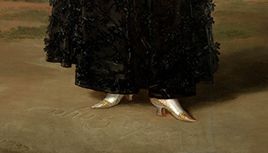
Black lace, gold sleeves and a red sash
The Fundación reads the black dress in the context of the duchess’s widowhood. The costume historian Aileen Ribeiro also situates it within the fashion for dressing as a maja, a style associated with women of Madrid’s popular classes and taken up by aristocratic women. She identifies the lace mantilla, worn over the head and brought across the breast, and the basquiña, a black silk overskirt with silk flower trim. The fringed red faja, or sash, borrows from the male majo wardrobe. Gold brocade belongs to the fitted bodice, where the sleeves show through and emerge from the lace. [3] [4]
Two places show how Goya keeps the costume readable. Follow the broken line of the veil along her temple and brow. Minute changes in tone allow the dark covering to stand out just enough from her dark hair. Farther down, look at the sleeve of the pointing arm. The gold pattern is easiest to see where the sleeve emerges alongside the body. The length of the sleeve guides us to the abrupt change to bare skin at the wrist, which makes the line of the finger easier to pick out. The sash has the strongest colour in this part of the painting. Its knot and hanging end carry the eye towards the same hand. [2] [4]
Ribeiro notes how fine fabrics and aristocratic bearing could make a sitter’s social position legible even in a popular style. Goya’s 1799 portrait of Queen María Luisa in a black mantilla shows the fashion at the royal court. The National Gallery exhibited the queen alongside the duchess in 2015, allowing viewers to compare two full-length portraits that depended on the same kind of veil to frame the face. In Alba’s portrait the lace also sets off the arm and hand that carry the detail of the two names. [4] [5]
Goya on film
Five films explore Goya’s portraits, prints, Black Paintings and painting techniques.
The Duke of Wellington by Goya
The portrait, its military decorations and its later theft.
Watch on YouTubeWho is meant to read the inscription?
From our side of the picture, the words at the duchess’s feet are inverted. The Fundación interprets their orientation as an address to the duchess herself. She stands on the side from which a person in the landscape could read them, and her finger calls attention to them. The viewer makes that discovery while her gaze remains directed outward. This produces a peculiar encounter. We are the people she looks at, yet the words are arranged for someone on the other side of the writing. On that reading, the viewer is invited to decipher words laid out for her. [2] [3]
The Hispanic Society study gives the usual translation, ‘only Goya’, and reads the words and rings in the context of the artist’s fascination with the sitter. Priscilla E. Muller records another reading proposed by the painter Ignacio Zuloaga, ‘Goya alone’. Muller links that sense to a possibility about the physical history of the work. The tone of solo differs slightly from the rest of the lettering, and traces of it can be seen in old photographs. She suggests that Goya might have added the word after the duchess’s death in 1802, when the canvas was still in his possession. In that reading the inscription speaks of Goya’s own solitude. Its wording and orientation have therefore prompted accounts of the address that give different roles to the painter and sitter. [1] [2] [6]
What cleaning and the rings can tell us
The conservation history affects what people have been able to read. Muller cites Elizabeth du Gué Trapier’s account of the word solo being brought to light in a 1959 cleaning. Zuloaga’s reading and the older photographs indicate earlier visibility, even though the word was harder to see. Muller also reports that surface cleaning lightened the sitter’s formerly duskier appearance. Much later, Prado conservators Enrique Quintana and Almudena Sánchez treated the portrait ahead of the Hispanic Society exhibition at the Prado in 2017. The Prado annual report records the presentation of the restored painting in its workshops in October 2016. [6] [7] [8]
The rings have their own history. The Hispanic Society and Fundación identify the names that are visible today. The biographical essay in the National Gallery of Victoria’s Prado drawings catalogue describes the inscribed rings as later additions, citing Gudrun Mühle-Maurer’s research. That distinction matters if we imagine how the painting first looked in 1797. In the picture we see today the pointing hand joins the two names on the rings to Goya’s name on the ground. The later dating proposed for the rings limits what this combination can tell us about the original sitting. [2] [3] [9]
The white portrait and the relationship story
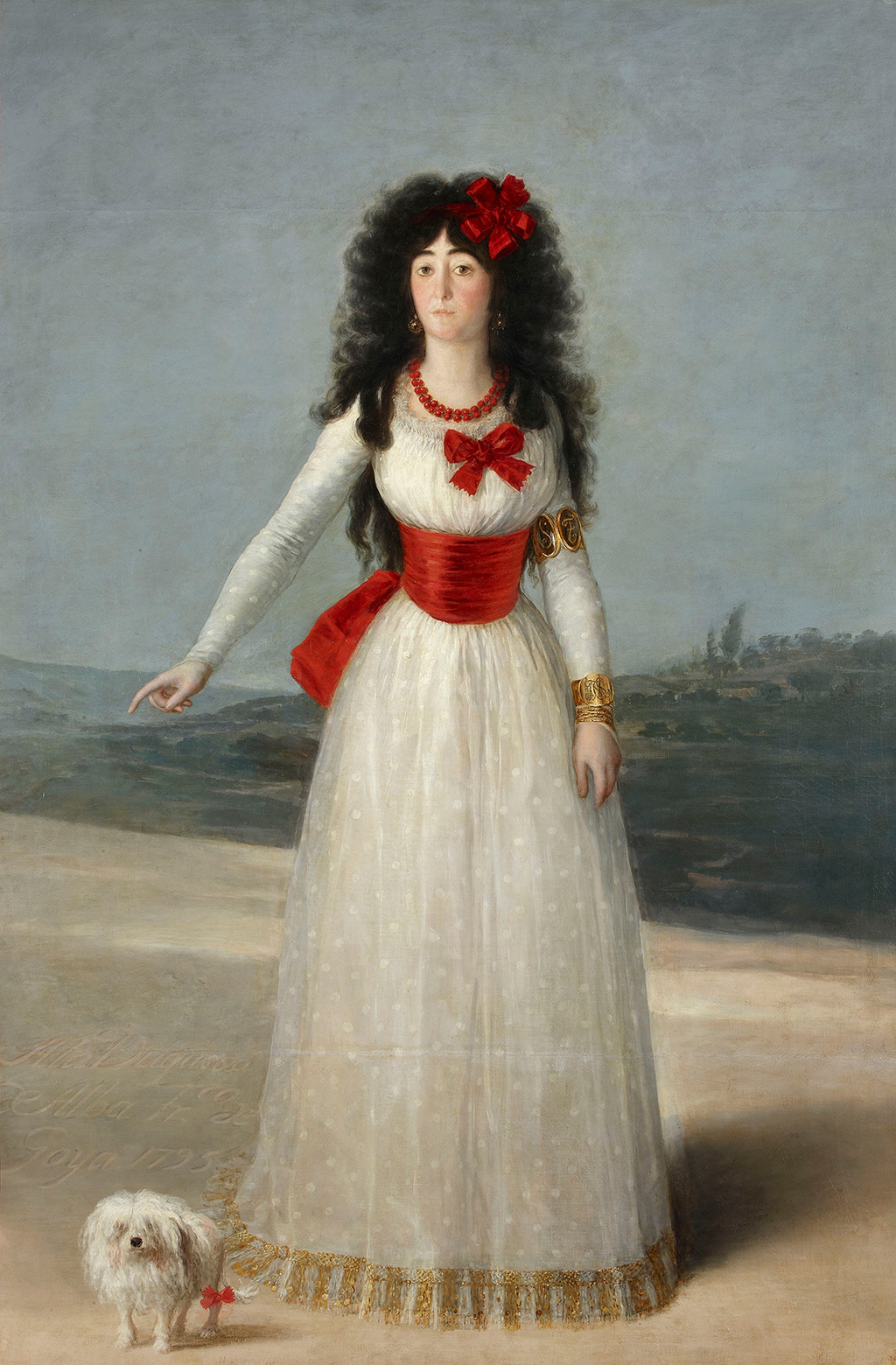
Goya’s portrait of the duchess in white is dated 1795 and belongs to the Fundación Casa de Alba at the Palacio de Liria in Madrid. Again her right hand indicates the ground. In the earlier picture she extends her arm farther into the open space beside her dress. Red is distributed across her hair, her breast and her waist, and a little white dog at her feet has a red ribbon too. The foreground carries an explicit dedication naming the duchess, Goya and the year. A viewer comparing the two paintings can see how Goya retained the setting and the pointing gesture while changing the way the hand and words meet. In the 1797 picture the bent elbow and closeness of the right hand to the skirt give the figure a more compact silhouette. [2] [10] [11]
The early portrait gives the relationship a documented setting in aristocratic patronage. Goya’s letter to his friend Martín Zapater describes the duchess coming to the studio to have her face painted and mentions the full-length portrait he was to make. Francisco Calvo Serraller takes the letter as evidence of familiarity between them and sees the breadth of Goya’s depictions of the duchess as a sign of unusual artistic interest. Manuela Mena Marqués traces the story of a mutual affair through the fictional versions of Goya’s life, including Luis Buñuel’s unrealised 1928 film script. The surviving letter establishes the painter and sitter’s contact. The painting’s gestures and inscriptions have supplied much of the material for speculation about what it meant for either of them. [9] [11]
The history of the black portrait after the sitting helps pin down one part of that story. The Royal Academy’s 2023 loan record puts it in Goya’s possession until 1812 and with his son Javier from that year. Javier sold it in 1836 for Louis-Philippe’s collection, and from 1838 the picture was shown in the Louvre’s Galerie Espagnole. After passing through several collections, it was bought in Paris in 1906 by Archer M. Huntington, who presented it to the Hispanic Society in 1907. Its years with Goya make an addition after the duchess’s death chronologically possible. The transfer to Javier marks the limit of the artist’s recorded ownership. [1] [6] [7]
Artworks directory
| Name | Date | Medium |
|---|---|---|
| And There’s No Help for It, Plate 15 | Printed 1863 | |
| Asmodea | c. 1820–23 | Wall painting transferred to canvas |
| Boys Inflating a Bladder | 1777–78 | Tapestry cartoon |
| Boys Picking Fruit | 1778 | Tapestry cartoon |
| Bullfight in a Divided Ring | 1825 | Lithograph |
| Card Players | 1777–78 | Tapestry cartoon |
| Card Players (sketch) | 1777–78 | Painted sketch |
| Dance on the Banks of the Manzanares | 1777 | Tapestry cartoon |
| Duel with Cudgels | c. 1820–23 | Wall painting transferred to canvas |
| Heads in a Landscape | c. 1820–23 | Easel painting |
| Judith and Holofernes | c. 1820–23 | Wall painting transferred to canvas |
| Leocadia | c. 1820–23 | Wall painting transferred to canvas |
| Maja and Cloaked Men | 1777 | Tapestry cartoon |
| Maja and Cloaked Men (sketch) | 1777 | Painted sketch |
| Majo Clapping in Time to the Music | 1777 | Drawing |
| Men Reading | c. 1820–23 | Wall painting transferred to canvas |
| Out Hunting for Teeth, Plate 12 | 1799 | Etching, burnished aquatint and burin |
| Picnic in the Countryside (sketch) | 1776–78 | Painted sketch |
| Picnic on the Banks of the Manzanares | 1776 | Tapestry cartoon |
| Pilgrimage to San Isidro | c. 1820–23 | Wall painting transferred to canvas |
| Preparatory study for The Sleep of Reason Produces Monsters | c. 1796–97 | Drawing |
| Procession of the Holy Office | c. 1820–23 | Wall painting transferred to canvas |
| Quarrel at the Cockerel Inn (sketch) | 1777 | Painted sketch |
| Quarrel in the New Tavern | 1777 | Tapestry cartoon |
| Saturn Devouring His Son | c. 1820–23 | Wall painting transferred to canvas |
| Seated Majo Smoking | c. 1776 | Drawing |
| The Dog | c. 1820–23 | Wall painting transferred to canvas |
| The Drinker | 1777 | Tapestry cartoon |
| The Fates | c. 1820–23 | Wall painting transferred to canvas |
| The Great He-Goat | c. 1820–23 | Wall painting transferred to canvas |
| The Kite | 1777–78 | Tapestry cartoon |
| The Parasol | 1777 | Oil on canvas, tapestry cartoon |
| The Second of May 1808 | 1814 | Oil on canvas |
| The Sleep of Reason Produces Monsters, Plate 43 | 1799 | Etching and aquatint |
| The Third of May 1808 | 1814 | Oil on canvas |
| Thou Who Canst Not, Plate 42 | 1799 | Etching and burnished aquatint |
| Three Figures | 1776 | Drawing (lost) |
| Two Old Men | c. 1820–23 | Wall painting transferred to canvas |
| Two Old Men Eating Soup | c. 1820–23 | Wall painting transferred to canvas |
| Two Women and a Man | c. 1820–23 | Wall painting transferred to canvas |
| Universal Language: The Author Dreaming | 1797 | Drawing |
| The Family of Charles IV | 1800 | Oil on canvas |
| Witches’ Sabbath (Osuna painting) | 1797–98 | Oil on canvas |
| The Nude Maja | 1795–1800 | Oil on canvas |
| The Clothed Maja | 1800–07 | Oil on canvas |
| Self-Portrait (Drawing) | c. 1796 | Brush and carbon black ink on laid paper |
| The Swing, Madrid Album B.21 | 1795–97 | Brush and carbon black washes |
| Majas Fighting, a Majo Observing, Madrid Album B.15 | 1796–97 | Brush, grey and black washes on laid paper |
| Majos and Majas Conversing, Madrid Album B.16 | c. 1794–97 | Ink wash on paper |
| Weeping Woman and Three Men, Madrid Album B.17 | 1795–97 | Brush, carbon black washes and black chalk |
| Maja Seated on a Chair and Two Companions Behind, Madrid Album B.18 | 1795–97 | Brush and carbon black washes |
| Girl and Bull, Madrid Album B.23 | 1796–97 | Brush and carbon black washes |
| Lovers Sitting on a Rock, Madrid Album B.24 | 1796–97 | Brush and carbon black washes |
| Mariano Ceballos Riding a Bull | 1825 | Crayon lithograph and scraper |
| Landscape (lifetime impression) | c. 1807–10 | Etching and aquatint |
| Self-Portrait (1815), Prado canvas | 1815 | Oil on canvas |
| Self-Portrait (1815), Academy panel | 1815 | Oil on panel |
| Self-Portrait with Dr Arrieta | 1820 | Oil on canvas |
| Christ Crucified | 1780 | Oil on canvas |
| The Last Communion of Saint Joseph of Calasanz | 1819 | Oil on canvas |
| Christ on the Mount of Olives | 1819 | Oil on panel |
| The Flower Girls, or Spring | 1786–87 | Oil on canvas |
| The Grape Harvest, or Autumn | 1786–87 | Oil on canvas |
| The Snowstorm, or Winter | 1786–87 | Oil on canvas |
| The Threshing Ground, or Summer | 1786–87 | Oil on canvas |
| Picnic on the Banks of the Manzanares | 1776 | Oil on canvas |
| The Kite | 1777–78 | Oil on canvas |
| Dance on the Banks of the Manzanares | 1777 | Oil on canvas |
| A Fight at the Venta Nueva | 1777 | Oil on canvas |
| Blind Man’s Bluff | 1788 | Oil on canvas |
| Dogs on a Lead | 1775 | Oil on canvas |
| Hunting with a Decoy | 1775 | Oil on canvas |
| Hunter Loading His Rifle | 1775 | Oil on canvas |
| The Angler | 1775 | Oil on canvas |
| The Hermitage of San Isidro on His Feast Day | 1788 | Oil on canvas |
| The Meadow of San Isidro | 1788 | Oil on canvas |
| The Straw Manikin | 1791–92 | Oil on canvas |
| Witches’ Flight | c. 1797–98 | Oil on canvas |
| A Scene from ‘The Forcibly Bewitched’ | 1798 | Oil on canvas |
| The Duchess of Alba in Black | 1797 | Oil on canvas |
| The Duchess of Alba in White | 1795 | Oil on canvas |
| Charles III in Hunting Dress | c. 1786 | Oil on canvas |
| The Duke and Duchess of Osuna and Their Children | 1787–88 | Oil on canvas |
| Manuel Osorio Manrique de Zúñiga | 1787–88 | Oil on canvas |
| The Marquesa de Pontejos | c. 1786 | Oil on canvas |
| Equestrian Portrait of the 1st Duke of Wellington | 1812 | Oil on canvas |
| The Duke of Wellington | 1812–14 | Oil on wood |
| Portrait of Ferdinand VII of Spain | 1814 | Oil on canvas |
| Gaspar Melchor de Jovellanos | 1798 | Oil on canvas |
| María Tomasa Palafox y Portocarrero | 1804 | Oil on canvas |
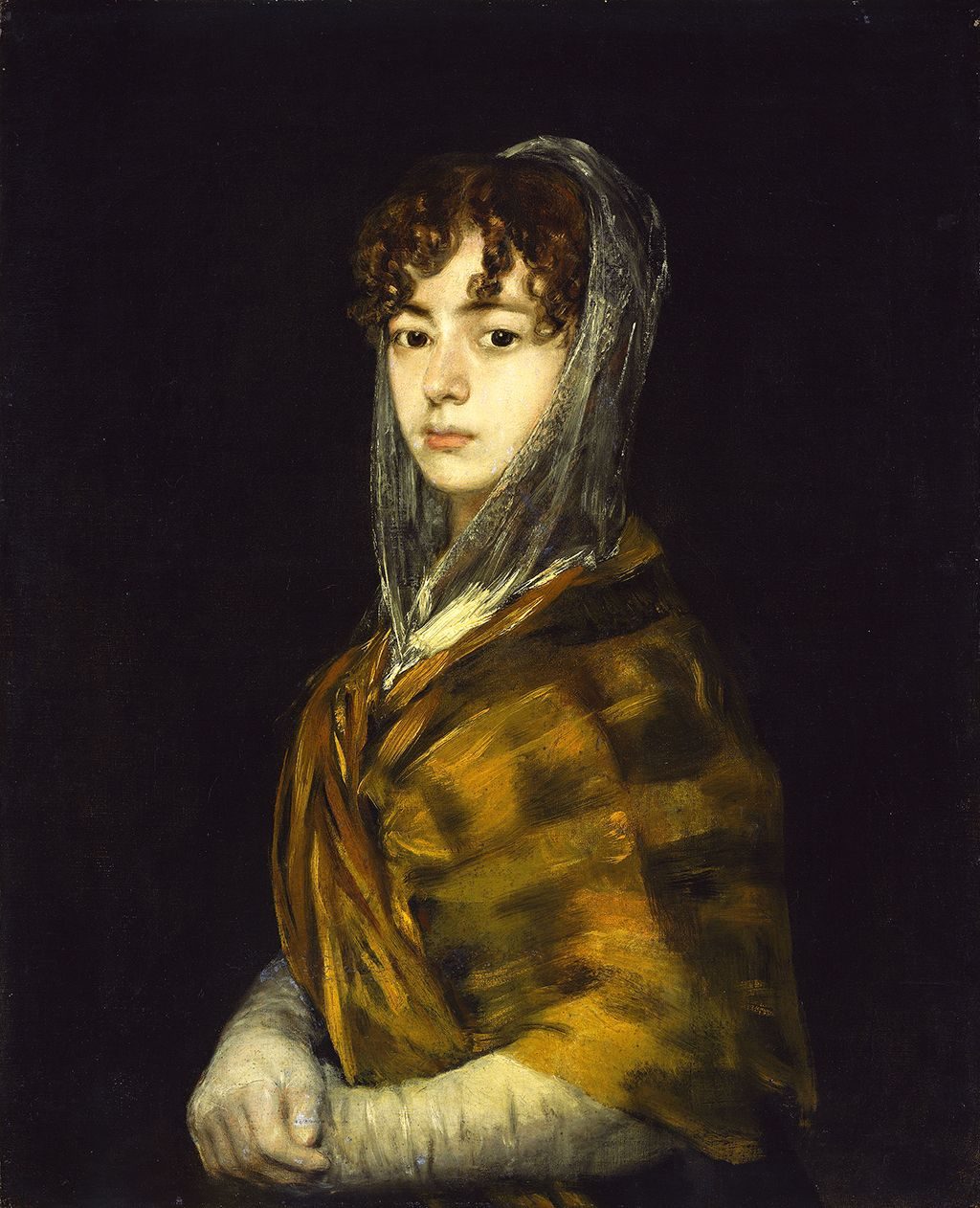
| Señora Sabasa García | c. 1806–11 | Oil on canvas |
| Don Juan Bautista de Muguiro | 1827 | Oil on canvas |
| Doña Isabel de Porcel | Before 1805 | Oil on canvas |
| The Colossus | After 1808 | Oil on canvas |
| The Burial of the Sardine | 1808–12 | Oil on panel |
| The Madhouse | 1808–12 | Oil on panel |
| A Procession of Flagellants | 1808–12 | Oil on panel |
| Portrait of Jacques Galos | 1826 | Oil on canvas |
| Portrait of Mariano Goya, the Artist’s Grandson | 1827 | Oil on canvas |
| Milkmaid of Bordeaux | c. 1827 | Oil on canvas |
| Portrait of Don Juan Antonio Cuervo | 1819 | Oil on canvas |
| María Luisa of Parma (Naples version) | c. 1800 | Oil on canvas |
| The Countess of Baena | 1819 | Oil on canvas |
| The Family of the Infante Don Luis | 1783–84 | Oil on canvas |
| The Holy Family | c. 1787 | Oil on canvas |
| Saint Barbara | c. 1773 | Oil on canvas |
| Saints Justa and Rufina | 1817 | Oil on canvas |
| El Tío Paquete | c. 1819–20 | Oil on canvas |
| The Forge | c. 1815–20 | Oil on canvas |
| Majas on a Balcony (Metropolitan Museum version) | c. 1800–10 | Oil on canvas |
| Maja and Celestina on a Balcony | c. 1808–12 | Oil on canvas |
| The Water Bearer | 1808–12 | Oil on canvas |
| Time and the Old Women | c. 1810 | Oil on canvas |
Frequently Asked Questions
Goya’s 1797 portrait belongs to the Hispanic Society Museum & Library in New York. Its accession number is A102. [12]
Discussion
Look again at the images and ideas explored in The Duchess of Alba in Black. These editorial prompts invite your observations.
Follow the duchess’s line of sight, then follow her pointing finger. What changes about your sense of whom the portrait addresses when you realise the writing is turned towards her?
Reader Insights
How does the pointing hand change the way you read the landscape?
Which elements does Goya repeat from the portrait in white?
Join the Conversation
Share a detail, comparison or question about The Duchess of Alba in Black below.
References
- Royal Academy of Arts, Spain and the Hispanic World, 2023 exhibition loan list, object A102, with dimensions and provenance. View source.
- The Hispanic Society of America and Columbia University, The Duchess of Alba, in A Collection in Context. View source.
- Fundación Goya en Aragón, catalogue entry 372 for the 1797 portrait, on the setting, costume and orientation of the inscription. View source.
- Aileen Ribeiro, ‘Fashioning the Feminine: Dress in Goya’s Portraits of Women’, in Janis A. Tomlinson, ed., Goya: Images of Women (National Gallery of Art, 2002), pp. 77–84. View source.
- National Gallery, London, announcement of the royal portrait loans to Goya: The Portraits, 2015. View source.
- Priscilla E. Muller, ‘Discerning Goya’, Metropolitan Museum Journal 31 (1996), especially p. 184 and note 38, pp. 186–187. View source.
- Hispanic Society Museum & Library, announcement of Treasures of the Hispanic Society of America at the Prado, on the acquisition and conservation treatment. View source.
- Museo Nacional del Prado, Memoria de actividades 2016, October entry on the presentation of the restored portrait. View source.
- Cathy Leahy and Manuela B. Mena Marqués, ‘Goya: A Biographical Sketch’ and ‘Perspectives through History: Truth and Fiction’, in Goya: Drawings from the Prado Museum (National Gallery of Victoria, 2021), pp. 6–7 and 50–53. View source.
- Fundación Goya en Aragón, catalogue entry 371 for the 1795 portrait in white. View source.
- Francisco Calvo Serraller, ‘Goya’s Women in Perspective’, in Janis A. Tomlinson, ed., Goya: Images of Women (National Gallery of Art, 2002), pp. 38–43 and fig. 5. Includes the account of Goya’s letter to Martín Zapater. View source.
- Boletín Oficial del Estado, order ECD/272/2017, Prado exhibition loan list, no. 163. View source.







