


 by Tom Gurney
Tom Gurney BSc (Hons) is an art history expert with over 20 years experience
Published on June 19, 2020 / Updated on November 20, 2026
Email: tomgurney1@gmail.com / Phone: +44 7429 011000
Introduction
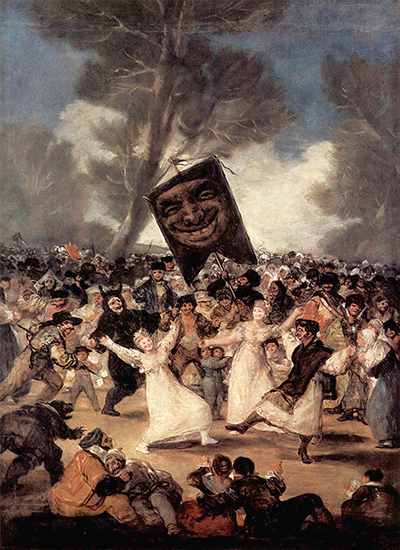
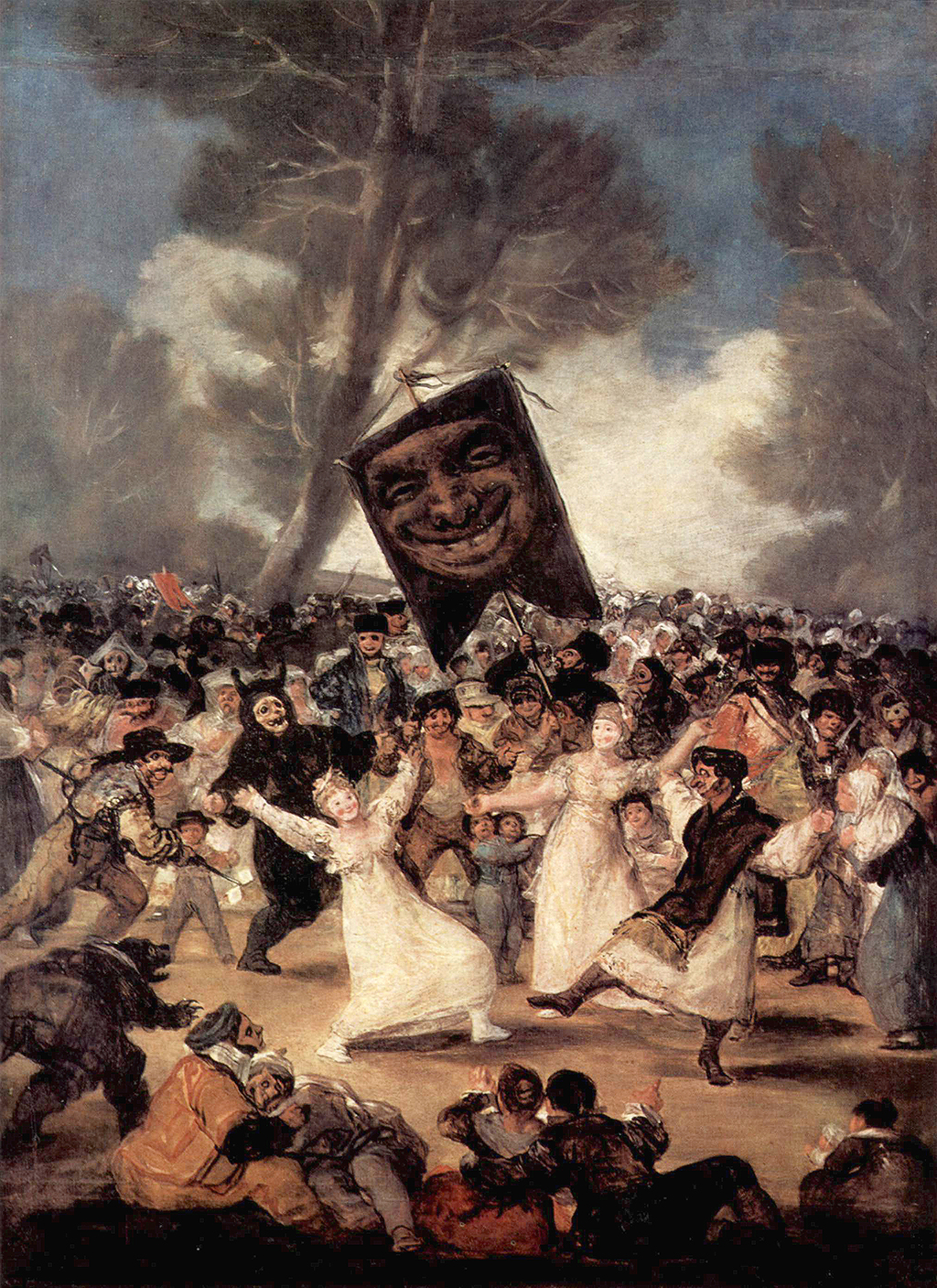
A grinning face rises above the crowd in Francisco de Goya’s The Burial of the Sardine. It is painted on a dark banner that tilts across the sky. Below it, two figures in pale dresses dance across a patch of open ground, close enough to the ring of revellers for their skirts and outstretched arms to brush against the crowd. The title refers to the mock funeral that marks the end of Carnival in Madrid. What Goya gives us is a dance whose mood changes as we look from one masked face to another. [1] [2]
At a Glance
- ArtistFrancisco de Goya y Lucientes
- TitleThe Burial of the Sardine (El entierro de la sardina)
- Date1808–12 in the Academy catalogue. The Fundación Goya en Aragón dates it to about 1814–16. [1] [2]
- Medium and dimensionsOil on wood panel, 82 × 60 cm (height × width). [1]
- CollectionReal Academia de Bellas Artes de San Fernando, Madrid, inventory 0676. [1]
Works across Goya’s career
The Parasol
1777The Nude Maja
1795–1800The Burial of the Sardine
1808–12Saturn Devouring His Son
c. 1820–23The Dog
c. 1820–23How the dance moves through the crowd
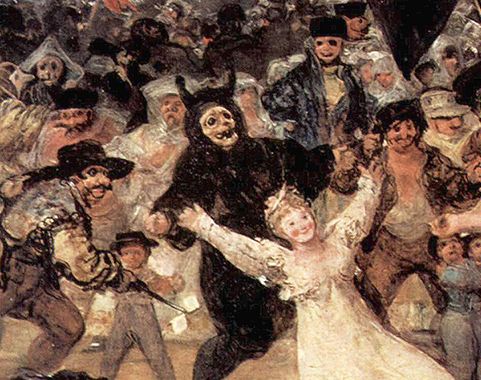
The open ground is broad enough for the dancers to take a few steps. Near the centre, a pale skirt fans out from a narrow waist and picks up the light along the hem. The other pale dress is broken by the dark coats and limbs around it. Nearby, a figure in black swings a bent leg towards the right, drawing the eye towards the people at the edge of the clearing. From there the line of heads carries us back towards the middle. Goya gives the dance room to unfold while placing spectators close to it on almost every side. [1] [2]
At the bottom of the panel the bodies are cut off and bunched together. A raised arm or the slope of a shoulder is enough to turn us back into the scene. Farther away, individual gestures dissolve into patches of light and dark. The relatively empty sky opens up above all this activity. Bare branches cross it behind the banner and there is a bright stretch of sky beside the dark cloth. The dancers have space at their feet, and the banner has space around its face. Those two clear areas let us read the action and see what presides over it before we sort out the crowd. [1]
The Fundación Goya en Aragón draws attention to the apparent second masks at the backs of the two central dancers’ heads. If one of the dancers turns away, a face can still appear to look back. A nearby costume suggests clerical dress, while another reveller wears black and a horned skull mask. On the left a figure holds what looks like a picador’s lance, and a dark figure beside him has the appearance of a bear. The Fundación reads these last two figures as a threat to one of the dancers. The lance and the animal figure give that reading some force, especially when we notice how close they stand to the circle. The painting leaves the next move to our imagination. [2]
The gestures at the edges of the dance vary even when the paint gives us very little information about each person. A figure who leans into the gap helps mark its boundary, and a hand raised within the crowd can look like an invitation or a warning. Behind the dancers the light touches faces in short patches. Eyes and mouths sometimes occupy almost all the space Goya gives a head. From a distance these marks bring the people together as a crowd. Looking more closely, we begin to follow one person’s reaction at a time, which makes it harder to assign a single mood to the scene. [1]
Annotated Details from The Burial of the Sardine
Look from the grinning banner to the dancers and the figures at the edge of the crowd.
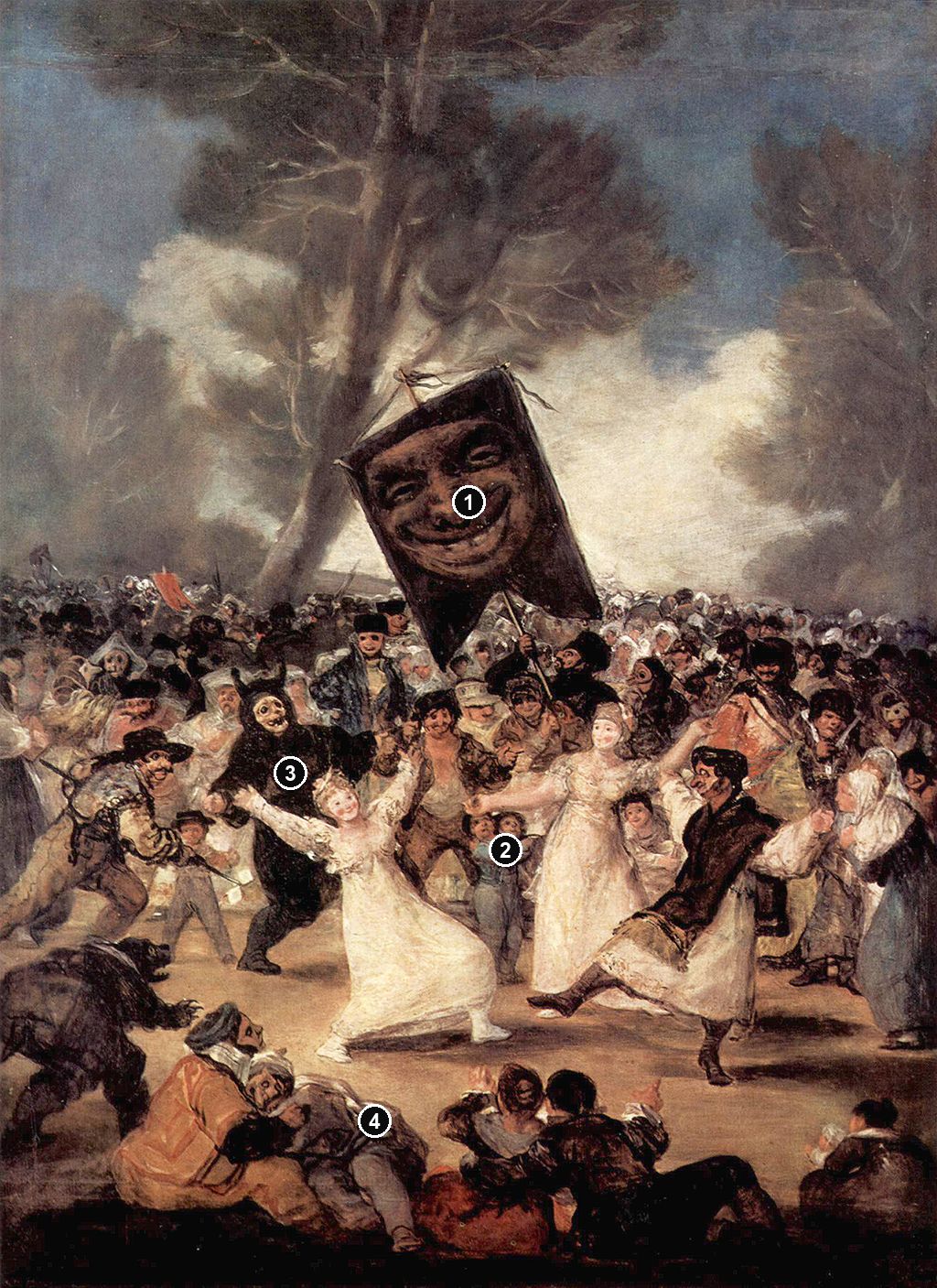
Details from THE BURIAL OF THE SARDINE
Details from the Academy painting (0676).
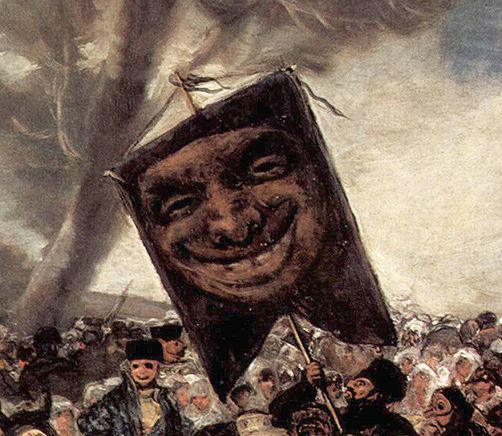
The grinning banner
A broad grin peers out of the dark banner above the crowd.
The figures in white
White costumes catch the light as the dancers turn near the front.
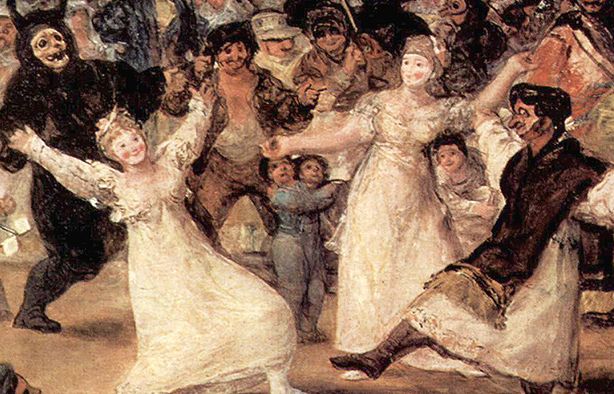
The raised arms
Arms and faces overlap along the left edge of the dancing group.
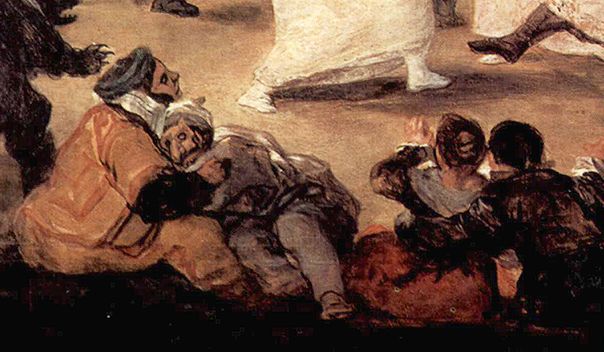
The foreground onlookers
Several figures watch from the shaded ground below the dancers.
From the mock funeral to the painted banner
In Madrid the traditional burial takes place on Ash Wednesday, at the start of Lent. The procession gives Carnival a mock funeral, complete with exaggerated mourning. Madrid’s municipal account describes the modern brotherhood carrying the festivities from the Manzanares neighbourhood into the Casa de Campo. A report on the 2024 Carnival records the burning of the sardine at the end of the procession. These are accounts of the modern observance, and the Fundación notes that mourners traditionally wore black and dressed as widows and clergy. The Academy places Goya’s dancers on the banks of the Manzanares. The panel shows a clearing full of masked dancers and onlookers, with little to fix the exact spot or the moment in the ritual. A viewer looking for the sardine itself has no clear fish to point to. [1] [2] [3] [4]
The Academy identifies the face on the banner with Momo, the figure of mockery associated with Carnival. It is large enough to read from across a room, with narrowed eyes and a mouth stretched into a grin. From close up, the flesh tones and the dark edge of the mouth give this broad caricature an unusually physical presence. Amid all the disguises below it, this painted face is the easiest one to remember. The Academy suggests that the picture may correspond to a work called Baile de máscaras, or Masked Dance, in an inventory traditionally associated with Goya’s death. That possible identification fits the action in the clearing and leaves open how the familiar title became attached to the panel. [1] [2] [5]
Goya on film
Five films explore Goya’s portraits, prints, Black Paintings and painting techniques.
The Duke of Wellington by Goya
The portrait, its military decorations and its later theft.
Watch on YouTubeThe banner beneath the grin
The Academy records an earlier inscription, MORTVS, and a skeleton beneath the smiling face. The lettering also appears on a banner in Una función de máscaras, a drawing held by the Prado under inventory number 4018. The Fundación reproduces the sheet. Its banner stands above a dense group, some of whose costumes have been read as religious dress. Covering the lettering on the panel changed what the banner asks of the viewer. A word tells us directly to think of death. The grin allows us to see the exuberance of the celebration first and take in the harder expressions and skull mask as our attention moves through the crowd. [1] [6] [7]
The Academy treats the Prado sheet as a study for the painting. The drawing’s authorship has been debated. The Fundación reports that scholars Manuela B. Mena Marqués and Gudrun Maurer questioned the attribution to Goya and proposed Leonardo Alenza as a possibility. The Fundación favours the connection to Goya, pointing to the lettering shared by the sheet and the earlier state of the panel. The two works plainly share more than a subject. The inscription connects the drawing to a stage in the painting’s development that is easy to miss when we look at the finished face. The authorship and timing of the drawing determine how confidently we can call it Goya’s first idea. [1] [6]
García de la Prada’s five paintings
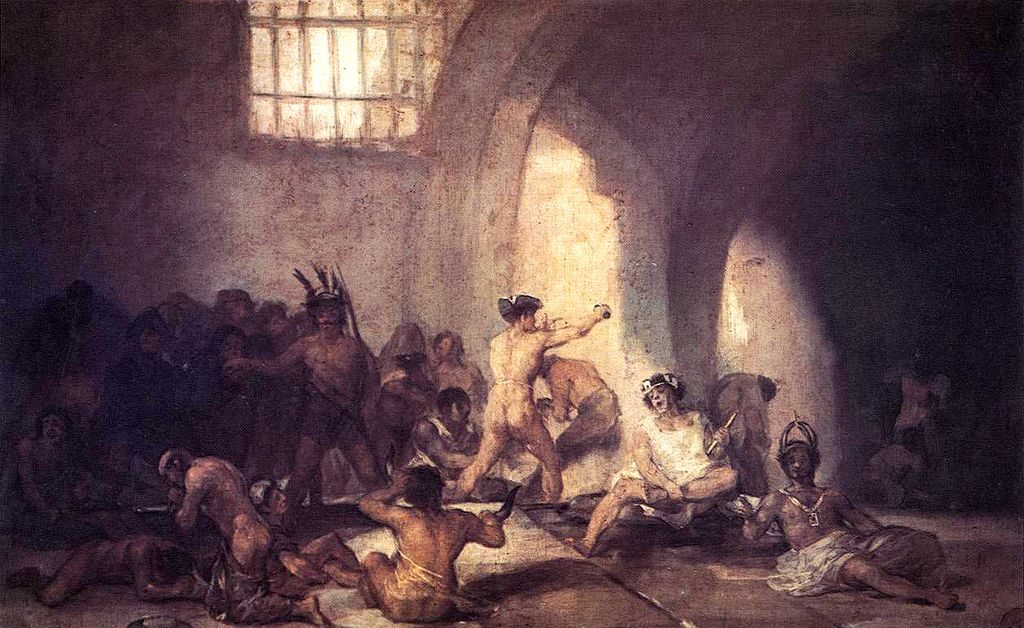
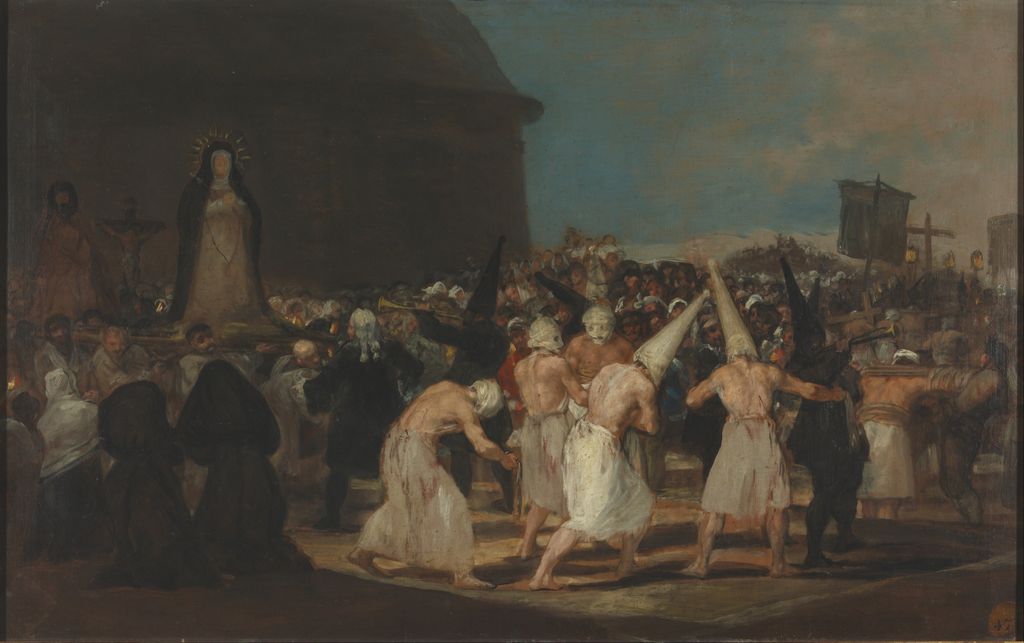
Manuel García de la Prada owned this panel and four other Goyas that entered the Academy in 1839 through his bequest. The other paintings show a bullfight, a procession of flagellants, an Inquisition tribunal and a madhouse. The Fundación records that the date of García de la Prada’s purchase is unknown. In a study published by the Prado, Itziar Arana Cobos cites a description from the bequest that identifies the larger picture as a masquerade. Goya had painted García de la Prada’s portrait, so a purchase directly from the painter is possible. The description in the bequest shows that the owner grouped the five works together and recognised the different scale of the masked scene. [10]
The Carnival picture stands apart in size and orientation from the other four. Its tall format gives nearly half the composition over to sky, branches and banner. The broader format of the Academy’s Bullfight takes the eye across an improvised arena and its spectators. In both paintings the backs of nearby onlookers help establish where the action starts and where we stand in relation to it. [1] [2] [5] [8]
The Academy’s catalogue assigns the Carnival panel to 1808–12. The Fundación favours the years after the Peninsular War, around 1814–16, and discusses the handling and affinities with the prints known as the Disparates. The shared bequest establishes when these five panels came together at the Academy. Their date and circumstances of production are harder to pin down, and the apparent absence of the Carnival panel from the earlier grouping of four has left room for treating it as a related work. Its costumes also connect it with another part of Goya’s work. In the later A Pilgrimage to San Isidro, the varied mouths and eyes of the people at the head of the crowd carry much of the expression that the Carnival picture gives to masks. Looking across the two pictures, the faces are often easier to make out than the purpose that has brought the people together. [1] [2] [5] [9]
The Academy put the painting into circulation in another form in 1885. José María Galván drew and engraved it for a series of prints reproducing selected works in the Academy’s collection. An accompanying text by Leopoldo Augusto de Cueto introduced the picture to readers. In a monochrome print, the artist had to translate the fall of light on the dancers and the rapid changes of colour around the clearing into areas of tone. The tilted banner, dark against the sky, remains a clear landmark even in that medium. By the time the image reached readers in print, the dark face and bright dance had already become the identifying features of the composition. [1]
Artworks directory
| Name | Date | Medium |
|---|---|---|
| And There’s No Help for It, Plate 15 | Printed 1863 | |
| Asmodea | c. 1820–23 | Wall painting transferred to canvas |
| Boys Inflating a Bladder | 1777–78 | Tapestry cartoon |
| Boys Picking Fruit | 1778 | Tapestry cartoon |
| Bullfight in a Divided Ring | 1825 | Lithograph |
| Card Players | 1777–78 | Tapestry cartoon |
| Card Players (sketch) | 1777–78 | Painted sketch |
| Dance on the Banks of the Manzanares | 1777 | Tapestry cartoon |
| Duel with Cudgels | c. 1820–23 | Wall painting transferred to canvas |
| Heads in a Landscape | c. 1820–23 | Easel painting |
| Judith and Holofernes | c. 1820–23 | Wall painting transferred to canvas |
| Leocadia | c. 1820–23 | Wall painting transferred to canvas |
| Maja and Cloaked Men | 1777 | Tapestry cartoon |
| Maja and Cloaked Men (sketch) | 1777 | Painted sketch |
| Majo Clapping in Time to the Music | 1777 | Drawing |
| Men Reading | c. 1820–23 | Wall painting transferred to canvas |
| Out Hunting for Teeth, Plate 12 | 1799 | Etching, burnished aquatint and burin |
| Picnic in the Countryside (sketch) | 1776–78 | Painted sketch |
| Picnic on the Banks of the Manzanares | 1776 | Tapestry cartoon |
| Pilgrimage to San Isidro | c. 1820–23 | Wall painting transferred to canvas |
| Preparatory study for The Sleep of Reason Produces Monsters | c. 1796–97 | Drawing |
| Procession of the Holy Office | c. 1820–23 | Wall painting transferred to canvas |
| Quarrel at the Cockerel Inn (sketch) | 1777 | Painted sketch |
| Quarrel in the New Tavern | 1777 | Tapestry cartoon |
| Saturn Devouring His Son | c. 1820–23 | Wall painting transferred to canvas |
| Seated Majo Smoking | c. 1776 | Drawing |
| The Dog | c. 1820–23 | Wall painting transferred to canvas |
| The Drinker | 1777 | Tapestry cartoon |
| The Fates | c. 1820–23 | Wall painting transferred to canvas |
| The Great He-Goat | c. 1820–23 | Wall painting transferred to canvas |
| The Kite | 1777–78 | Tapestry cartoon |
| The Parasol | 1777 | Oil on canvas, tapestry cartoon |
| The Second of May 1808 | 1814 | Oil on canvas |
| The Sleep of Reason Produces Monsters, Plate 43 | 1799 | Etching and aquatint |
| The Third of May 1808 | 1814 | Oil on canvas |
| Thou Who Canst Not, Plate 42 | 1799 | Etching and burnished aquatint |
| Three Figures | 1776 | Drawing (lost) |
| Two Old Men | c. 1820–23 | Wall painting transferred to canvas |
| Two Old Men Eating Soup | c. 1820–23 | Wall painting transferred to canvas |
| Two Women and a Man | c. 1820–23 | Wall painting transferred to canvas |
| Universal Language: The Author Dreaming | 1797 | Drawing |
| The Family of Charles IV | 1800 | Oil on canvas |
| Witches’ Sabbath (Osuna painting) | 1797–98 | Oil on canvas |
| The Nude Maja | 1795–1800 | Oil on canvas |
| The Clothed Maja | 1800–07 | Oil on canvas |
| Self-Portrait (Drawing) | c. 1796 | Brush and carbon black ink on laid paper |
| The Swing, Madrid Album B.21 | 1795–97 | Brush and carbon black washes |
| Majas Fighting, a Majo Observing, Madrid Album B.15 | 1796–97 | Brush, grey and black washes on laid paper |
| Majos and Majas Conversing, Madrid Album B.16 | c. 1794–97 | Ink wash on paper |
| Weeping Woman and Three Men, Madrid Album B.17 | 1795–97 | Brush, carbon black washes and black chalk |
| Maja Seated on a Chair and Two Companions Behind, Madrid Album B.18 | 1795–97 | Brush and carbon black washes |
| Girl and Bull, Madrid Album B.23 | 1796–97 | Brush and carbon black washes |
| Lovers Sitting on a Rock, Madrid Album B.24 | 1796–97 | Brush and carbon black washes |
| Mariano Ceballos Riding a Bull | 1825 | Crayon lithograph and scraper |
| Landscape (lifetime impression) | c. 1807–10 | Etching and aquatint |
| Self-Portrait (1815), Prado canvas | 1815 | Oil on canvas |
| Self-Portrait (1815), Academy panel | 1815 | Oil on panel |
| Self-Portrait with Dr Arrieta | 1820 | Oil on canvas |
| Christ Crucified | 1780 | Oil on canvas |
| The Last Communion of Saint Joseph of Calasanz | 1819 | Oil on canvas |
| Christ on the Mount of Olives | 1819 | Oil on panel |
| The Flower Girls, or Spring | 1786–87 | Oil on canvas |
| The Grape Harvest, or Autumn | 1786–87 | Oil on canvas |
| The Snowstorm, or Winter | 1786–87 | Oil on canvas |
| The Threshing Ground, or Summer | 1786–87 | Oil on canvas |
| Picnic on the Banks of the Manzanares | 1776 | Oil on canvas |
| The Kite | 1777–78 | Oil on canvas |
| Dance on the Banks of the Manzanares | 1777 | Oil on canvas |
| A Fight at the Venta Nueva | 1777 | Oil on canvas |
| Blind Man’s Bluff | 1788 | Oil on canvas |
| Dogs on a Lead | 1775 | Oil on canvas |
| Hunting with a Decoy | 1775 | Oil on canvas |
| Hunter Loading His Rifle | 1775 | Oil on canvas |
| The Angler | 1775 | Oil on canvas |
| The Hermitage of San Isidro on His Feast Day | 1788 | Oil on canvas |
| The Meadow of San Isidro | 1788 | Oil on canvas |
| The Straw Manikin | 1791–92 | Oil on canvas |
| Witches’ Flight | c. 1797–98 | Oil on canvas |
| A Scene from ‘The Forcibly Bewitched’ | 1798 | Oil on canvas |
| The Duchess of Alba in Black | 1797 | Oil on canvas |
| The Duchess of Alba in White | 1795 | Oil on canvas |
| Charles III in Hunting Dress | c. 1786 | Oil on canvas |
| The Duke and Duchess of Osuna and Their Children | 1787–88 | Oil on canvas |
| Manuel Osorio Manrique de Zúñiga | 1787–88 | Oil on canvas |
| The Marquesa de Pontejos | c. 1786 | Oil on canvas |
| Equestrian Portrait of the 1st Duke of Wellington | 1812 | Oil on canvas |
| The Duke of Wellington | 1812–14 | Oil on wood |
| Portrait of Ferdinand VII of Spain | 1814 | Oil on canvas |
| Gaspar Melchor de Jovellanos | 1798 | Oil on canvas |
| María Tomasa Palafox y Portocarrero | 1804 | Oil on canvas |
| Señora Sabasa García | c. 1806–11 | Oil on canvas |
| Don Juan Bautista de Muguiro | 1827 | Oil on canvas |
| Doña Isabel de Porcel | Before 1805 | Oil on canvas |
| The Colossus | After 1808 | Oil on canvas |
| The Burial of the Sardine | 1808–12 | Oil on panel |
| The Madhouse | 1808–12 | Oil on panel |
| A Procession of Flagellants | 1808–12 | Oil on panel |
| Portrait of Jacques Galos | 1826 | Oil on canvas |
| Portrait of Mariano Goya, the Artist’s Grandson | 1827 | Oil on canvas |
| Milkmaid of Bordeaux | c. 1827 | Oil on canvas |
| Portrait of Don Juan Antonio Cuervo | 1819 | Oil on canvas |
| María Luisa of Parma (Naples version) | c. 1800 | Oil on canvas |
| The Countess of Baena | 1819 | Oil on canvas |
| The Family of the Infante Don Luis | 1783–84 | Oil on canvas |
| The Holy Family | c. 1787 | Oil on canvas |
| Saint Barbara | c. 1773 | Oil on canvas |
| Saints Justa and Rufina | 1817 | Oil on canvas |
| El Tío Paquete | c. 1819–20 | Oil on canvas |
| The Forge | c. 1815–20 | Oil on canvas |
| Majas on a Balcony (Metropolitan Museum version) | c. 1800–10 | Oil on canvas |
| Maja and Celestina on a Balcony | c. 1808–12 | Oil on canvas |
| The Water Bearer | 1808–12 | Oil on canvas |
| Time and the Old Women | c. 1810 | Oil on canvas |
Frequently Asked Questions
The Academy identifies it as Momo, a figure associated with Carnival and mockery. The Academy records a skeleton and the inscription MORTVS beneath the painted grin. [1]
Discussion
Look again at the images and ideas explored in The Burial of the Sardine. These editorial prompts invite your observations.
Start with the pale dancers and follow the limbs and faces around the clearing. At what point does the dance start to feel uneasy? How would your first impression change if the banner still carried the word MORTVS?
Reader Insights
Where does the movement of the dancers lead your eye?
What part does the banner play in the scene?
Join the Conversation
Share a detail, comparison or question about The Burial of the Sardine below.
References
- Real Academia de Bellas Artes de San Fernando, El entierro de la sardina, collection record 0676 and reproduction. View source.
- Fundación Goya en Aragón, El entierro de la sardina, catalogue entry 467. View source.
- Ayuntamiento de Madrid, cultural map of the Entierro de la Sardina procession, 2023. View source.
- Ayuntamiento de Madrid, report on the 2024 Carnival and Ash Wednesday procession, 2024. View source.
- Juliet Wilson-Bareau, ‘Goya and the X Numbers’, Metropolitan Museum Journal 31 (1996), pp. 159–74, especially pp. 165–66 and 169–72. View source.
- Fundación Goya en Aragón, Una función de máscaras (El entierro de la sardina), catalogue entry 1413 and reproduction of the Prado drawing. View source.
- Museo Thyssen-Bornemisza, Open Windows 7, discussion of the change to the banner and comparison with the drawing, fig. 27. View source.
- Real Academia de Bellas Artes de San Fernando, La corrida de toros, collection record 0675 and reproduction. View source.
- Fundación Goya en Aragón, La romería de San Isidro, catalogue entry for the Black Painting. View source.
- Itziar Arana Cobos, ‘Los legados de Manuel García de la Prada y Fernando Guitarte’, in Las donaciones y legados de los museos españoles de titularidad pública, Museo Nacional del Prado, 2023, pp. 65–66 on the bequest. View source.







