


 by Tom Gurney
Tom Gurney BSc (Hons) is an art history expert with over 20 years experience
Published on June 19, 2020 / Updated on November 20, 2026
Email: tomgurney1@gmail.com / Phone: +44 7429 011000
Introduction
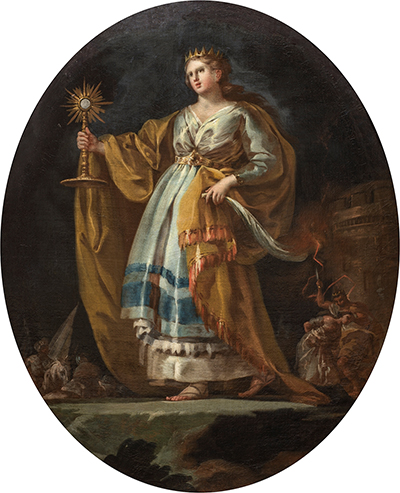
A gold sunburst shines beside Saint Barbara’s face. She holds it at arm’s length, high above a tiny group of riders at the edge of the picture. Behind her on the other side, a man raises a blade at the foot of a tower. It takes a moment for the eye to pick out that scene in the dark. Francisco de Goya gives Barbara’s standing figure most of the oval canvas and lets the violence of her story play out in miniature behind her. The painting is in the Museo Nacional del Prado in Madrid. The Fundación Goya en Aragón dates it to around 1773. [1] [2]
At a Glance
- ArtistFrancisco José de Goya y Lucientes (1746–1828). [1] [2]
- DateAround 1773. The Prado has also published a date of around 1772. [1] [2]
- Medium and dimensionsOil on canvas, 97.2 × 78.5 cm, oval. [1]
- SubjectSaint Barbara holding a monstrance and a martyr’s palm, with the tower and her execution in the background. [1]
- CollectionMuseo Nacional del Prado, Madrid, P007794. [1] [2]
Works across Goya’s career
Saint Barbara
c. 1773The Parasol
1777The Nude Maja
1795–1800Saturn Devouring His Son
c. 1820–23The Dog
c. 1820–23A figure above the story
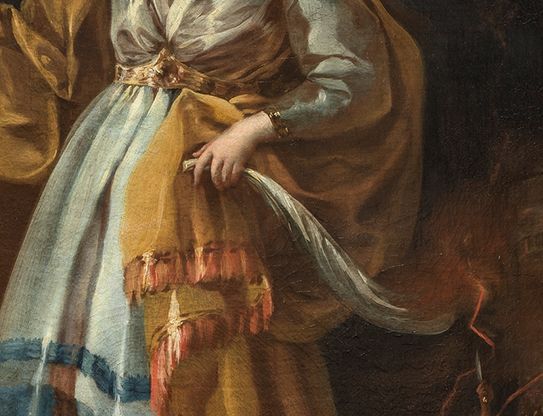
Barbara stands on a low ledge with a dark drop below it. One foot extends out from under the pale hem, its toes turned towards the viewer’s left. The body follows that suggestion of a step only part of the way. The face turns towards the raised hand while the other hand gathers the cloak close to the waist. There are open spaces between the body and the edge of the picture, especially beside the uplifted arm. The monstrance occupies one of those spaces, where the small rays around its centre stand out against almost uninterrupted darkness. [1]
The mantle drops from the raised arm in a long fold and picks up again in a sweep of fabric at Barbara’s other side. Across the front of the dress, two broad blue bands help show how the skirt turns over her knees. Their colour cools the light in the cloth, while the ochre mantle and its reddish fringe carry warmth down towards the ledge. At the neckline, short pale strokes crowd together where the fabric is gathered, then spread out along the folds. From a distance the figure reads as a single column of light. Up close, the lines of the sleeve, sash and patterned hem pull in different directions. [1]
The oval also changes the space available for the story. There is room at the widest point for Barbara’s bent elbow and the train of cloth, while the narrowing lower edge gathers the tower scene and the riders into the narrow spaces beside the ledge. The ledge gives Barbara a clear place to stand. The smaller figures beyond it are harder to locate. Goya uses that difference to let Barbara appear at once physically present and set apart from the events associated with her. [1]
Annotated Details from Saint Barbara
Look from the raised monstrance to the gestures and small scenes below.
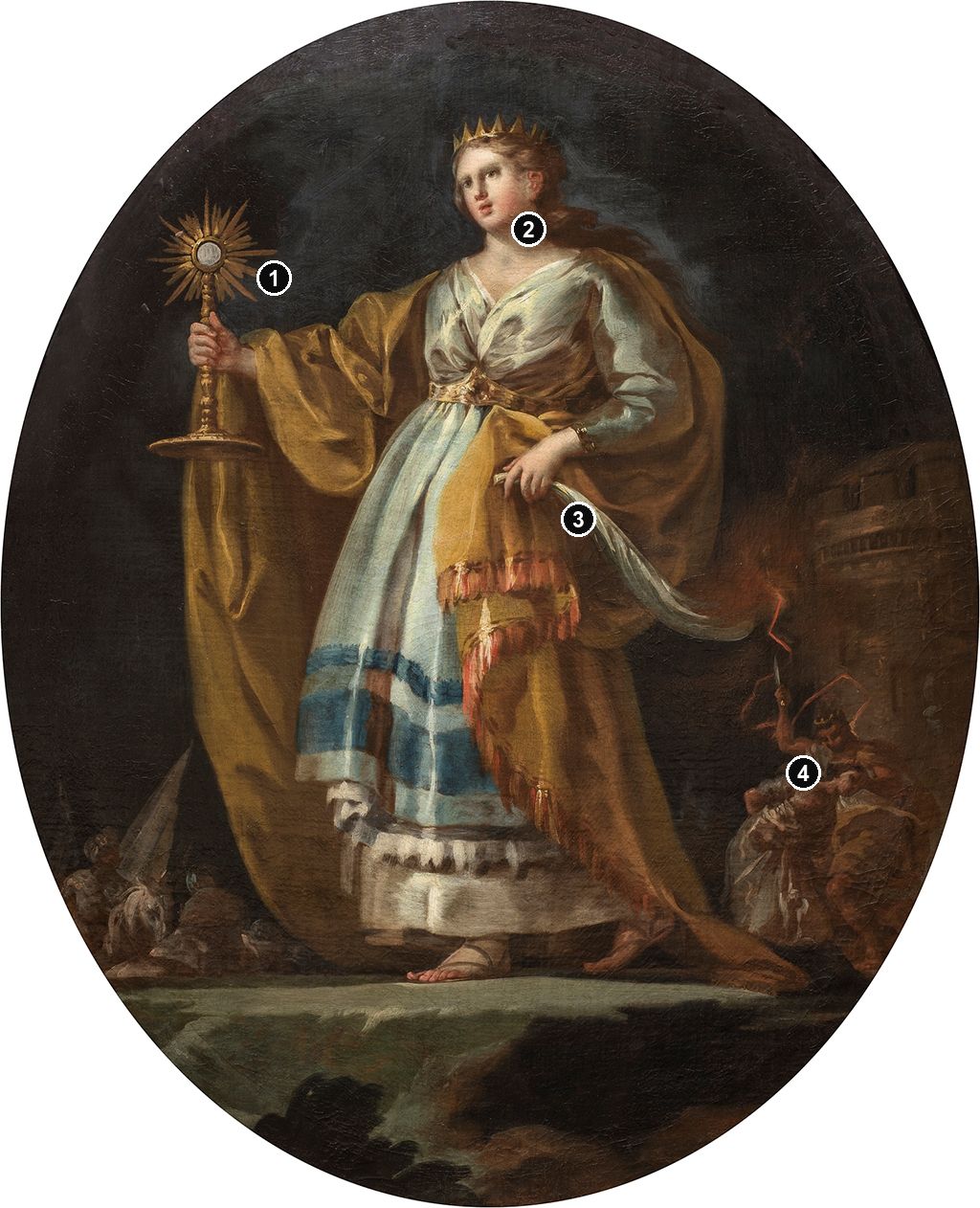
Details from SAINT BARBARA
Details from the Prado oval (P007794).
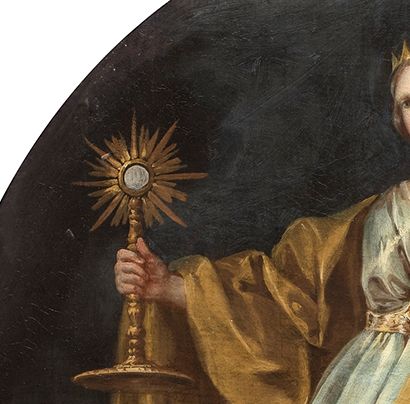
The monstrance
A pale centre sits inside the gold rays of the object she holds.
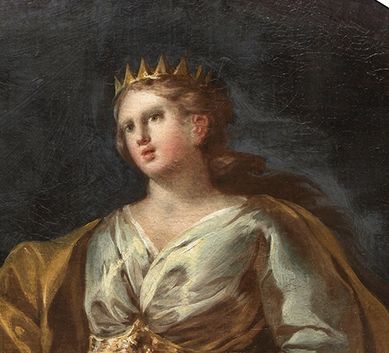
Barbara’s face
The face turns towards the raised monstrance.
The palm and sash
The palm passes near the folds of the sash at the waist.
The scene beside the tower
Tiny figures in the landscape sit at the edge of the oval.
The Host, the palm and the tower
The circular white centre of the sunburst is the Eucharistic Host. The gold object is a monstrance, a vessel designed to display the consecrated wafer. The Fundación’s entry for the related drawing connects it with an invocation to Barbara for the chance to receive Communion before death. Goya gives this small object an emphatic silhouette. From the shaft the eye travels up through the fingers to the central disc and out along the fine rays, then across to the points of the crown. The palm, traditionally a sign of martyrdom, is held across the body. Its long, curving form draws the eye from the low hand towards the faint scene on the right. The two attributes give different parts of the story visible form, one through the sacrament and the other through Barbara’s death. [1] [3]
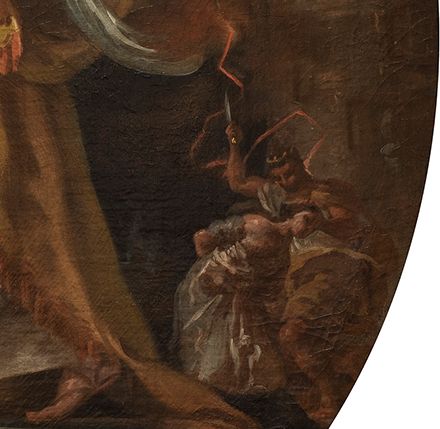
In the legend, Barbara’s father Dioscorus confines her in a tower. She converts to Christianity and he executes her. Lightning then strikes him dead. Goya brings those events together in the recess behind the saint. The dark masonry rises close against the oval edge and the father’s raised weapon forms a short, sharp diagonal under it. A narrow zigzag of reddish light threads through the scene. The weapons and figures are difficult to pick out at first, but their compact gestures make the story readable when the eye adjusts to the low contrast. Across the picture, the banner carried by the riders answers that cluster of small forms. The Fundación notes Barbara’s traditional association with armies and her invocation against storms. [1] [4]
The tower can bear even more of the picture’s meaning. In Jan van Eyck’s Saint Barbara of 1437, the saint sits with a book and a palm while workers build an elaborate tower behind her. The Royal Museum of Fine Arts Antwerp explains the third window in the legend as a reference to the Trinity. In Van Eyck’s panel, carts, hoists and stonecutters draw the eye into the work of building. Goya lets the tower emerge slowly and sets the decisive moment at its foot. His Barbara’s raised hand becomes the feature that holds our attention before the architecture comes into view. [1] [5]
Goya on film
Five films explore Goya’s portraits, prints, Black Paintings and painting techniques.
The Duke of Wellington by Goya
The portrait, its military decorations and its later theft.
Watch on YouTubeFrom the Italian Notebook to the oval
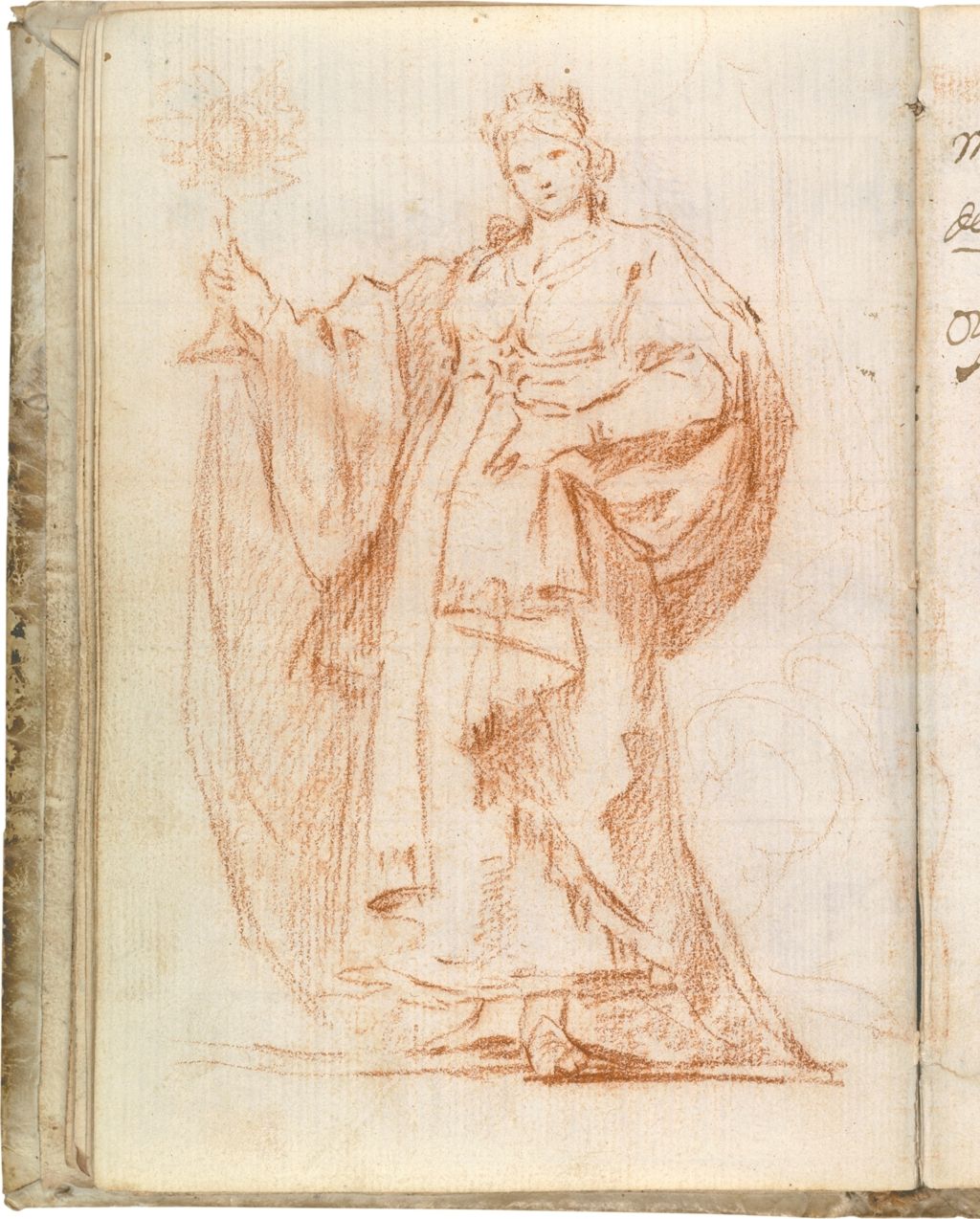
On page 88 of Goya’s Italian Notebook, also in the Prado, a crowned woman holds out a monstrance in much the same pose. He drew her in red chalk on laid paper. The free hand lies across the abdomen and the feet give the figure a settled stance. In the oil, the foot seen in profile suggests that she is about to move and the lowered hand gathers the fabric at the waist. The correspondence between the two figures is strong evidence for the painting’s authorship. The drawing also makes it possible to see a decision Goya took as he worked. The stately pose survives into the painting, with the foot and folds giving it a sense of movement. The page belongs to a group of drawings in which Goya worked through poses and heads on a scale small enough to hold in his hand. [1] [3]
Two sculptures help explain the form of that figure. Juliet Wilson-Bareau associated another notebook study, the crowned female head on page 63, with the ancient marble known as the Juno Cesi, now in Rome’s Capitoline Museums. The drawing brings out the weight of the head, the long line of the nose and the firmness of the chin. Barbara’s face in the oil has that same sculptural clarity even where Goya breaks up the edges of her hair and crown in quick strokes. The Fundación’s entry for the full-length study also points to Juan Adán’s statue of Saint Elizabeth of Portugal for the Spanish church of Santa Maria in Monserrato in Rome. Its upright, draped figure offers a possible model for the pose. The two comparisons help account for different decisions, from the turn of the face to the way the cloak frames the body. [3] [6] [7]
A trace of the red chalk transferred onto the facing notebook page, which also carries Goya’s note recording his wedding to Josefa Bayeu. The parish record corroborates the date of 25 July 1773. This is a clue to the period in which Goya used those pages. The date records the wedding, and the drawing could have been there when he made the note or could have been added later. The Fundación’s date of around 1773 allows for that uncertainty. A further point of comparison is Goya’s Visitation at the Charterhouse of Aula Dei near Zaragoza, dated to around 1774. There as here he gives the main women a firm, legible silhouette, with changes of colour marking the turn of fabric around the body while the smaller figures at the side dissolve into looser strokes. [1] [3] [8] [9]
From private collections to the Prado
The Fundación Goya en Aragón traces the painting to the collection of Juan Molina in 1932 and subsequently to the Torelló collection in Barcelona. In 1987, Spain’s official gazette published a notice opening proceedings to declare Alberto Torelló Enrich’s Santa Bárbara an object of cultural interest. The notice identified the painting as an eighteenth-century oil on canvas by Goya and gave slightly smaller measurements than the later catalogue. The work was exhibited in the Prado’s Goya: El capricho y la invención in 1993, a survey of his cabinet pictures, sketches and miniatures that travelled to London and Chicago. The Prado acquired the painting in 2001. [1] [10] [11]
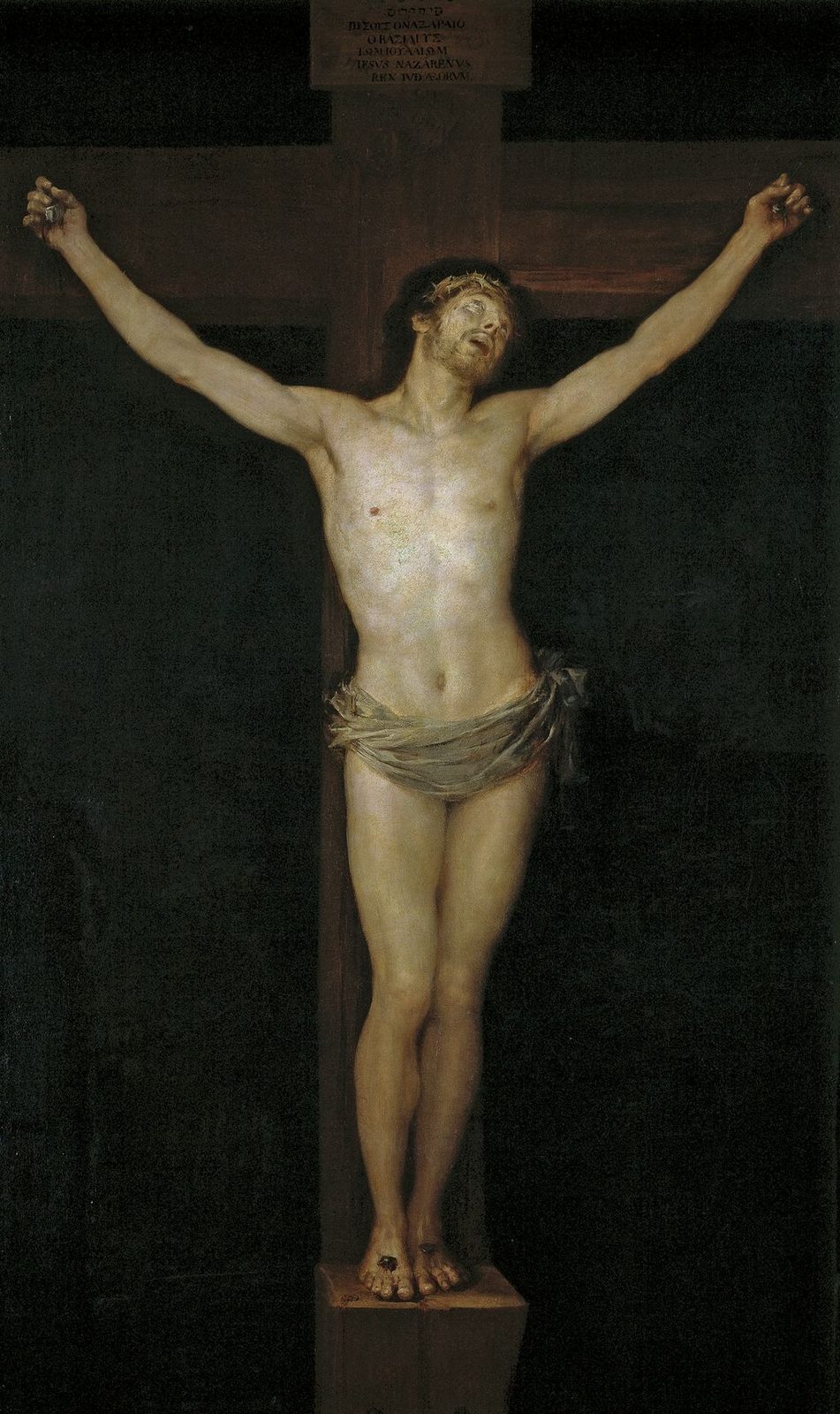
Its first patron and setting remain unknown. The Fundación records a suggestion that the subject might relate to Goya’s later employment at Madrid’s Royal Tapestry Factory of Santa Bárbara. The saint’s name is shared, but Goya’s documented tapestry work began in 1775 and the painting’s commission remains open. His Christ Crucified of 1780 has a clearer early history. He presented that canvas to the Royal Academy in Madrid. Both pictures give a single figure broad prominence against darkness. Barbara’s mantle and the little scenes around her distribute interest across the oval, while the later painting concentrates it in the light on Christ’s body and the turn of his face. [1] [12]

Artworks directory
| Name | Date | Medium |
|---|---|---|
| And There’s No Help for It, Plate 15 | Printed 1863 | |
| Asmodea | c. 1820–23 | Wall painting transferred to canvas |
| Boys Inflating a Bladder | 1777–78 | Tapestry cartoon |
| Boys Picking Fruit | 1778 | Tapestry cartoon |
| Bullfight in a Divided Ring | 1825 | Lithograph |
| Card Players | 1777–78 | Tapestry cartoon |
| Card Players (sketch) | 1777–78 | Painted sketch |
| Dance on the Banks of the Manzanares | 1777 | Tapestry cartoon |
| Duel with Cudgels | c. 1820–23 | Wall painting transferred to canvas |
| Heads in a Landscape | c. 1820–23 | Easel painting |
| Judith and Holofernes | c. 1820–23 | Wall painting transferred to canvas |
| Leocadia | c. 1820–23 | Wall painting transferred to canvas |
| Maja and Cloaked Men | 1777 | Tapestry cartoon |
| Maja and Cloaked Men (sketch) | 1777 | Painted sketch |
| Majo Clapping in Time to the Music | 1777 | Drawing |
| Men Reading | c. 1820–23 | Wall painting transferred to canvas |
| Out Hunting for Teeth, Plate 12 | 1799 | Etching, burnished aquatint and burin |
| Picnic in the Countryside (sketch) | 1776–78 | Painted sketch |
| Picnic on the Banks of the Manzanares | 1776 | Tapestry cartoon |
| Pilgrimage to San Isidro | c. 1820–23 | Wall painting transferred to canvas |
| Preparatory study for The Sleep of Reason Produces Monsters | c. 1796–97 | Drawing |
| Procession of the Holy Office | c. 1820–23 | Wall painting transferred to canvas |
| Quarrel at the Cockerel Inn (sketch) | 1777 | Painted sketch |
| Quarrel in the New Tavern | 1777 | Tapestry cartoon |
| Saturn Devouring His Son | c. 1820–23 | Wall painting transferred to canvas |
| Seated Majo Smoking | c. 1776 | Drawing |
| The Dog | c. 1820–23 | Wall painting transferred to canvas |
| The Drinker | 1777 | Tapestry cartoon |
| The Fates | c. 1820–23 | Wall painting transferred to canvas |
| The Great He-Goat | c. 1820–23 | Wall painting transferred to canvas |
| The Kite | 1777–78 | Tapestry cartoon |
| The Parasol | 1777 | Oil on canvas, tapestry cartoon |
| The Second of May 1808 | 1814 | Oil on canvas |
| The Sleep of Reason Produces Monsters, Plate 43 | 1799 | Etching and aquatint |
| The Third of May 1808 | 1814 | Oil on canvas |
| Thou Who Canst Not, Plate 42 | 1799 | Etching and burnished aquatint |
| Three Figures | 1776 | Drawing (lost) |
| Two Old Men | c. 1820–23 | Wall painting transferred to canvas |
| Two Old Men Eating Soup | c. 1820–23 | Wall painting transferred to canvas |
| Two Women and a Man | c. 1820–23 | Wall painting transferred to canvas |
| Universal Language: The Author Dreaming | 1797 | Drawing |
| The Family of Charles IV | 1800 | Oil on canvas |
| Witches’ Sabbath (Osuna painting) | 1797–98 | Oil on canvas |
| The Nude Maja | 1795–1800 | Oil on canvas |
| The Clothed Maja | 1800–07 | Oil on canvas |
| Self-Portrait (Drawing) | c. 1796 | Brush and carbon black ink on laid paper |
| The Swing, Madrid Album B.21 | 1795–97 | Brush and carbon black washes |
| Majas Fighting, a Majo Observing, Madrid Album B.15 | 1796–97 | Brush, grey and black washes on laid paper |
| Majos and Majas Conversing, Madrid Album B.16 | c. 1794–97 | Ink wash on paper |
| Weeping Woman and Three Men, Madrid Album B.17 | 1795–97 | Brush, carbon black washes and black chalk |
| Maja Seated on a Chair and Two Companions Behind, Madrid Album B.18 | 1795–97 | Brush and carbon black washes |
| Girl and Bull, Madrid Album B.23 | 1796–97 | Brush and carbon black washes |
| Lovers Sitting on a Rock, Madrid Album B.24 | 1796–97 | Brush and carbon black washes |
| Mariano Ceballos Riding a Bull | 1825 | Crayon lithograph and scraper |
| Landscape (lifetime impression) | c. 1807–10 | Etching and aquatint |
| Self-Portrait (1815), Prado canvas | 1815 | Oil on canvas |
| Self-Portrait (1815), Academy panel | 1815 | Oil on panel |
| Self-Portrait with Dr Arrieta | 1820 | Oil on canvas |
| Christ Crucified | 1780 | Oil on canvas |
| The Last Communion of Saint Joseph of Calasanz | 1819 | Oil on canvas |
| Christ on the Mount of Olives | 1819 | Oil on panel |
| The Flower Girls, or Spring | 1786–87 | Oil on canvas |
| The Grape Harvest, or Autumn | 1786–87 | Oil on canvas |
| The Snowstorm, or Winter | 1786–87 | Oil on canvas |
| The Threshing Ground, or Summer | 1786–87 | Oil on canvas |
| Picnic on the Banks of the Manzanares | 1776 | Oil on canvas |
| The Kite | 1777–78 | Oil on canvas |
| Dance on the Banks of the Manzanares | 1777 | Oil on canvas |
| A Fight at the Venta Nueva | 1777 | Oil on canvas |
| Blind Man’s Bluff | 1788 | Oil on canvas |
| Dogs on a Lead | 1775 | Oil on canvas |
| Hunting with a Decoy | 1775 | Oil on canvas |
| Hunter Loading His Rifle | 1775 | Oil on canvas |
| The Angler | 1775 | Oil on canvas |
| The Hermitage of San Isidro on His Feast Day | 1788 | Oil on canvas |
| The Meadow of San Isidro | 1788 | Oil on canvas |
| The Straw Manikin | 1791–92 | Oil on canvas |
| Witches’ Flight | c. 1797–98 | Oil on canvas |
| A Scene from ‘The Forcibly Bewitched’ | 1798 | Oil on canvas |
| The Duchess of Alba in Black | 1797 | Oil on canvas |
| The Duchess of Alba in White | 1795 | Oil on canvas |
| Charles III in Hunting Dress | c. 1786 | Oil on canvas |
| The Duke and Duchess of Osuna and Their Children | 1787–88 | Oil on canvas |
| Manuel Osorio Manrique de Zúñiga | 1787–88 | Oil on canvas |
| The Marquesa de Pontejos | c. 1786 | Oil on canvas |
| Equestrian Portrait of the 1st Duke of Wellington | 1812 | Oil on canvas |
| The Duke of Wellington | 1812–14 | Oil on wood |
| Portrait of Ferdinand VII of Spain | 1814 | Oil on canvas |
| Gaspar Melchor de Jovellanos | 1798 | Oil on canvas |
| María Tomasa Palafox y Portocarrero | 1804 | Oil on canvas |
| Señora Sabasa García | c. 1806–11 | Oil on canvas |
| Don Juan Bautista de Muguiro | 1827 | Oil on canvas |
| Doña Isabel de Porcel | Before 1805 | Oil on canvas |
| The Colossus | After 1808 | Oil on canvas |
| The Burial of the Sardine | 1808–12 | Oil on panel |
| The Madhouse | 1808–12 | Oil on panel |
| A Procession of Flagellants | 1808–12 | Oil on panel |
| Portrait of Jacques Galos | 1826 | Oil on canvas |
| Portrait of Mariano Goya, the Artist’s Grandson | 1827 | Oil on canvas |
| Milkmaid of Bordeaux | c. 1827 | Oil on canvas |
| Portrait of Don Juan Antonio Cuervo | 1819 | Oil on canvas |
| María Luisa of Parma (Naples version) | c. 1800 | Oil on canvas |
| The Countess of Baena | 1819 | Oil on canvas |
| The Family of the Infante Don Luis | 1783–84 | Oil on canvas |
| The Holy Family | c. 1787 | Oil on canvas |
| Saint Barbara | c. 1773 | Oil on canvas |
| Saints Justa and Rufina | 1817 | Oil on canvas |
| El Tío Paquete | c. 1819–20 | Oil on canvas |
| The Forge | c. 1815–20 | Oil on canvas |
| Majas on a Balcony (Metropolitan Museum version) | c. 1800–10 | Oil on canvas |
| Maja and Celestina on a Balcony | c. 1808–12 | Oil on canvas |
| The Water Bearer | 1808–12 | Oil on canvas |
| Time and the Old Women | c. 1810 | Oil on canvas |
Frequently Asked Questions
Discussion
Look again at the images and ideas explored in Saint Barbara. These editorial prompts invite your observations.
Follow the palm towards the tower, then return to the monstrance by Barbara’s face. How does the small scale of the execution change the way you read her expression? What would happen to that relationship if Goya had given the tower as much space as Van Eyck did?
Reader Insights
What does the raised monstrance draw your attention away from?
Compare the saint’s stance in the drawing and the painting.
Join the Conversation
Share a detail, comparison or question about Saint Barbara below.
References
- Fundación Goya en Aragón, Santa Bárbara, catalogue 98, painting data, provenance and analysis. View source.
- Museo Nacional del Prado, Santa Bárbara, P007794. The earlier Prado date is visible in a screenshot in the museum’s presentation The Prado on the Web. View source 1. View source 2.
- Fundación Goya en Aragón, Santa Bárbara, D6068/88, notebook study, composition and proposed models. View source.
- Agencia Estatal de Meteorología, “La meteorología en el Museo del Prado. III. Tormentas”, illustrated discussion of lightning and the saint’s legend. View source.
- Koninklijk Museum voor Schone Kunsten Antwerpen, Jan van Eyck, Saint Barbara, collection entry. View source.
- Fundación Goya en Aragón, Cabeza femenina clásica (Juno), D6068/63, notebook study and Wilson-Bareau’s identification. View source.
- Musei Capitolini, Sala del Gladiatore, location and description of the Juno Cesi. View source.
- Ángel Canellas López, ed., Francisco de Goya. Diplomatario, Institución Fernando el Católico, transcription of the 25 July 1773 marriage record. View source.
- Fundación Goya en Aragón, La visitación, Cartuja de Aula Dei mural, c. 1774. View source.
- Boletín Oficial del Estado, resolution of 11 June 1987, published 25 August 1987, p. 26351, Torelló collection and cultural-interest proceedings. View source.
- Getty, Goya: Truth and Fantasy: The Small Paintings, exhibition record for the 1993–94 tour, and Fundación Goya en Aragón, Santa Bárbara, exhibition history, catalogue 98. View source 1. View source 2.
- Real Academia de Bellas Artes de San Fernando, “La Academia y Goya”, Academy submission, and Fundación Goya en Aragón, “Biografía”, chronology of Goya’s royal tapestry work. View source 1. View source 2.







