


 by Tom Gurney
Tom Gurney BSc (Hons) is an art history expert with over 20 years experience
Published on June 19, 2020 / Updated on November 20, 2026
Email: tomgurney1@gmail.com / Phone: +44 7429 011000
Introduction
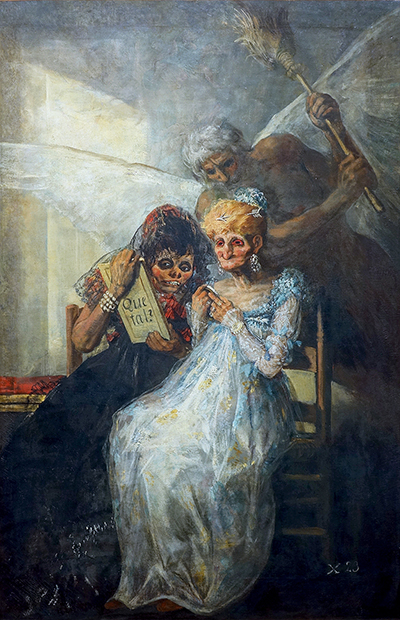
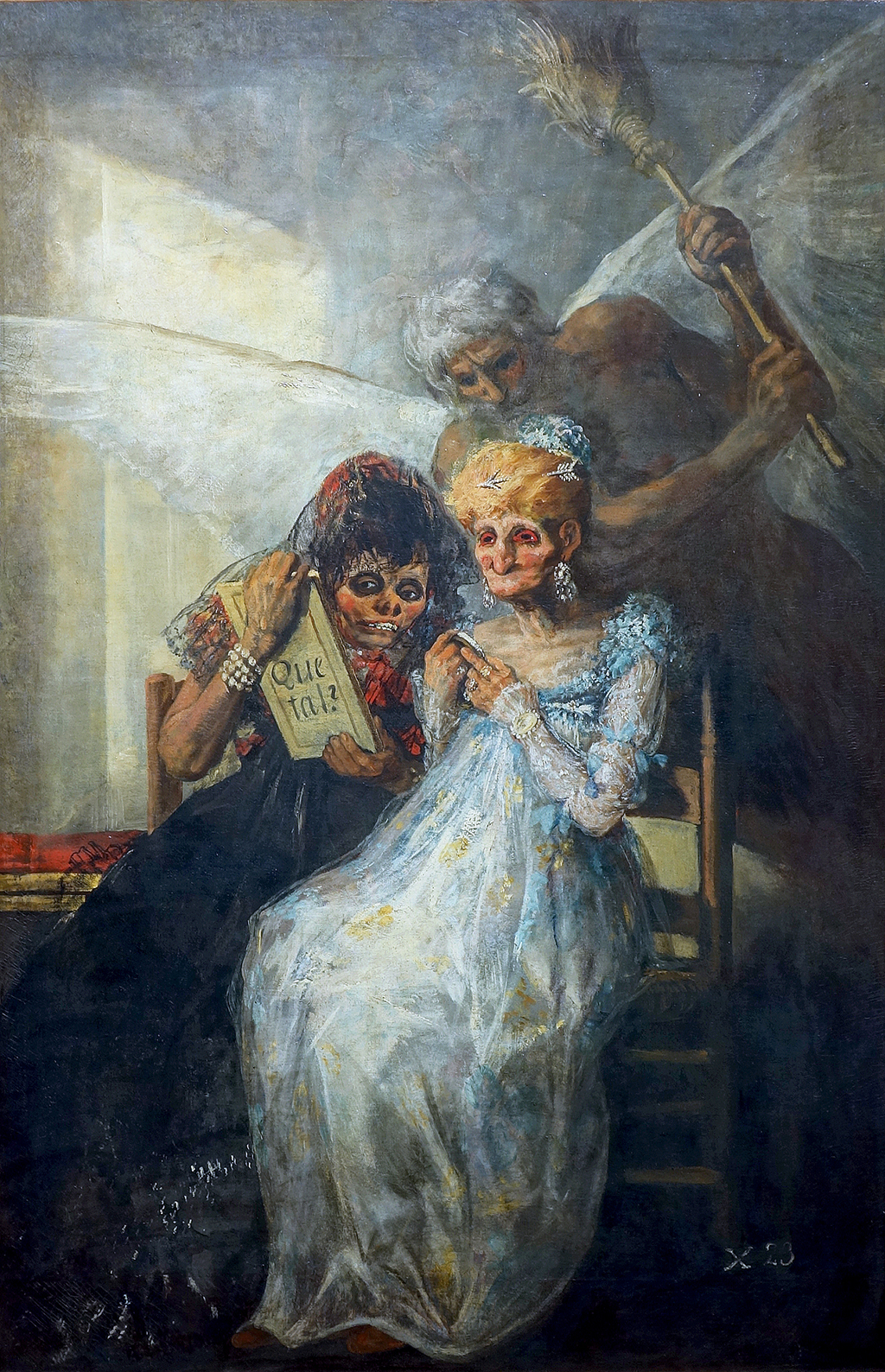
One woman holds up a mirror while the other examines a small object in her hand. On the back of the mirror, facing us, a Spanish question reads Que tal? Behind them, a winged man bends to look, holding a broom high above their heads. The two women are so intent on what they see that he has come within reach of them. Francisco de Goya's painting, in the Palais des Beaux-Arts de Lille, was recorded in his household inventory in 1812 as El Tiempo (Time). [1] [2] [3]
At a Glance
- ArtistFrancisco de Goya.
- Other titlesEl Tiempo, Las viejas, Le Temps and Les Vieilles. [1] [4]
- DateAbout 1810–1812. The painting is recorded in October 1812. [2] [3]
- MediumOil on canvas. The painting was later enlarged and transferred to another canvas. [2]
- Size181 × 125 cm in the Lille catalogue, height by width. [1]
- CollectionPalais des Beaux-Arts de Lille, P 50. [1]
Works across Goya’s career
The Parasol
1777The Nude Maja
1795–1800Time and the Old Women
c. 1810Saturn Devouring His Son
c. 1820–23The Dog
c. 1820–23The mirror and its question
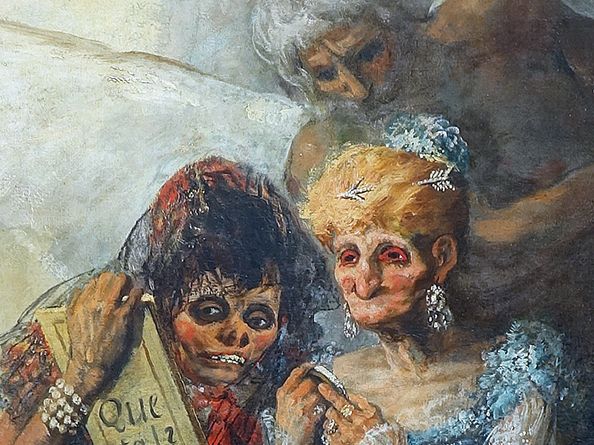
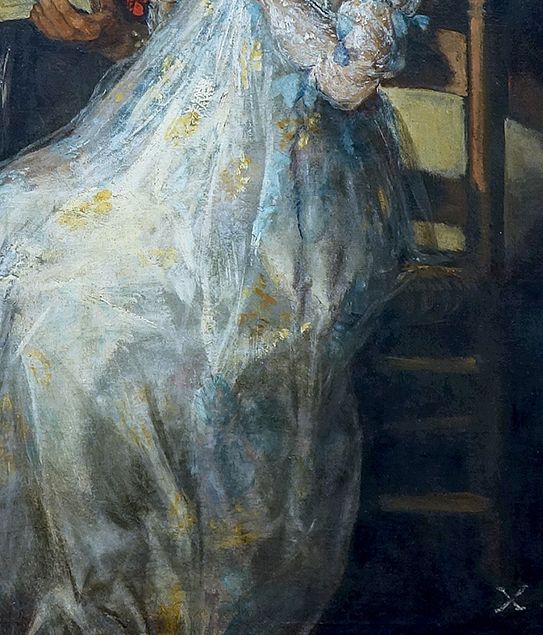
The woman on the right wears a pale gown that falls in twisting folds over her knees. Small touches of blue and yellow carry the ornament down the dress, while sharper glints pick out her earrings and the arrow in her hair. From the left, her dark-clad companion tips the mirror towards her. The women sit close enough for the edges of their sleeves to meet. Their eyes and fingers bring the scene to a focus between the dark mantilla and the white dress. [1] [4]
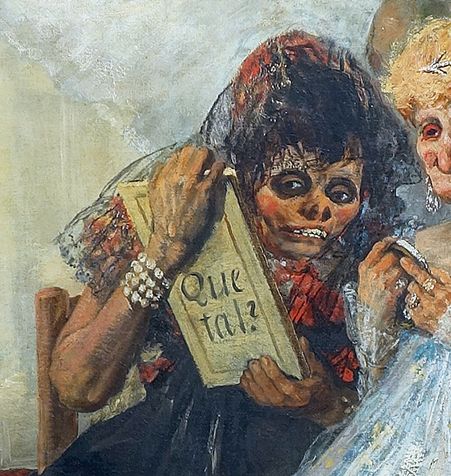
The back of the mirror is turned towards us. The painted words are set on two lines, with the question mark at the end of the second. In modern Spanish the phrase is written ¿Qué tal? It can mean 'How's it going?' In this setting 'How do I look?' catches its more pointed implication. The reflective surface remains on the women's side. Goya gives us the question and lets us look directly at both faces. What might pass as a casual inquiry between companions becomes awkward when the spectator is in a position to answer it. [1] [5]
Lille's catalogue describes the smaller object as a medallion. The museum's exhibition guide also entertains the possibility of a small mirror. If it is a portrait miniature, it might show the woman when younger or someone she remembers. Her fingers cover much of it, and the image offers little certainty about what is there. That makes the two objects work differently. The large mirror asks about her appearance now. The smaller object holds her attention and might give her a second image to weigh against what she sees. [1] [4] [5]
Annotated Details from Time and the Old Women
Read the mirror’s question, then look at the figures and the movement behind the chair.
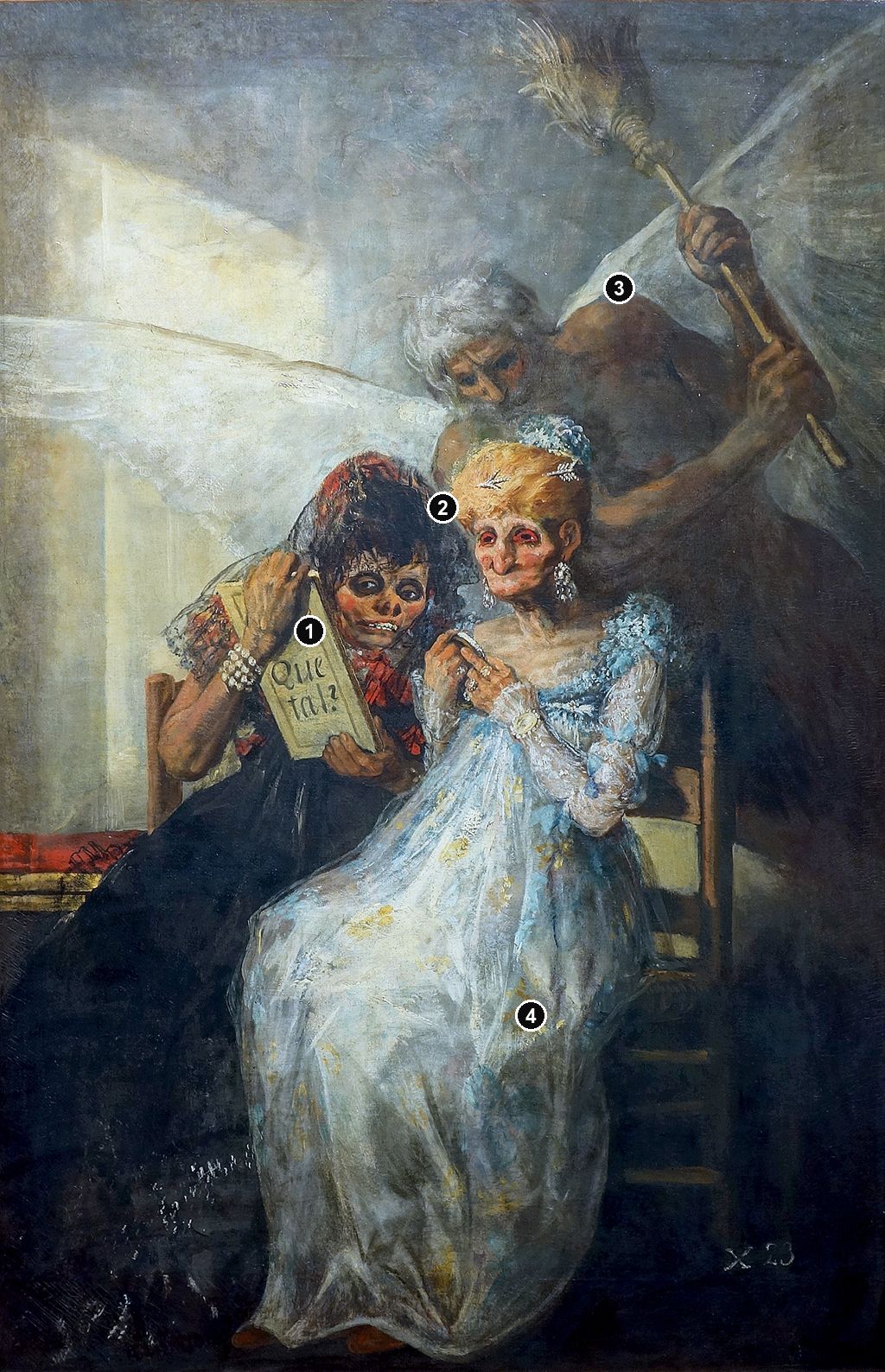
Details from TIME AND THE OLD WOMEN
Details from the Palais des Beaux-Arts de Lille painting (P 50).
The question on the mirror
The inscription appears on the back of the mirror.
Faces and ornaments
Small touches of colour pick out both faces and the hair ornaments.
The wing and the broom
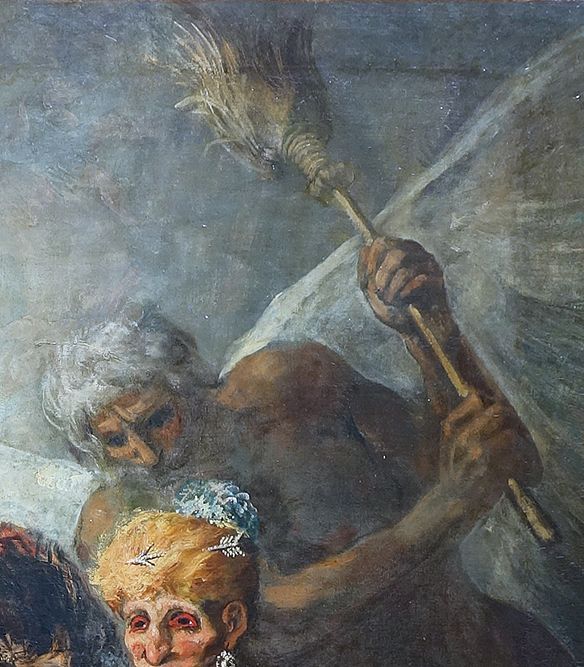
The winged figure raises a long-handled broom behind the women.
The pale dress
Light moves across the folds of the dress in front of the chair.
Time with a broom
The winged figure is the personification of Time. His wing spreads almost horizontally across the left of the painting. His bare arms and the shaft of the broom carry the eye back up the right side. His grey head hangs just above the women, as though he too were peering into the space between them. Their hands make small, concentrated movements. His two hands are spaced apart on the handle, poised to make a sweep much wider than anything the women can see. [1] [2]
Father Time often carries a scythe or an hourglass. A broom lends him the authority of someone clearing the room after everyone else has gone home. It is an ordinary implement to match the ordinary act of looking in a mirror. The women occupy themselves with the traces of youth, while Time can sweep away their gowns, seats and finery in the same stroke. The scene has the force of a memento mori, an image that prompts the viewer to remember death. Its comedy comes from the scale of the wings and the plainness of the tool. [1] [5]
The wall behind the figures gives only a few clues to their surroundings. At left, a shaft of light suggests an opening somewhere out of view. The broad wing passes straight across it, and the figures almost fill the space across the canvas at shoulder height. Below, the pale dress seems to spill towards us, with the strip of red at left and the chair at right providing the few clear horizontal accents. The space is shallow enough for the appearance of the winged man to feel immediate. His body is almost on top of them before the arc of the broom has even begun. [1]
The arrow and the court
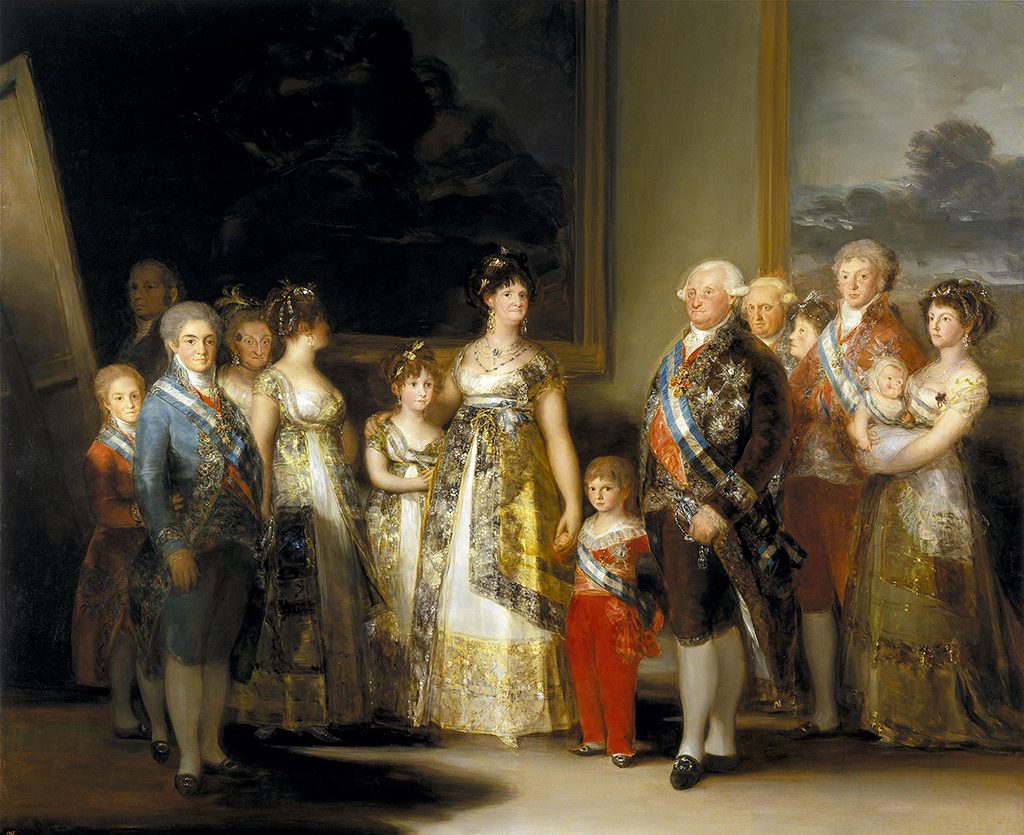
The bright arrow in the pale-haired woman's coiffure has prompted comparisons with Queen María Luisa of Parma in Goya's Family of Charles IV. The Fundación Goya en Aragón also discusses the infanta María Josefa as a possible point of comparison. Lille's exhibition guide notes that the type of jewel was fairly widespread. The detail makes the court association plausible, while the identities of the two women remain open. Fine clothes are central to the joke regardless of who wears them. Goya devotes close attention to the threads and glints of fashionable dress, even as he deepens eye sockets and makes the companion's grin flash in the dark. [2] [4] [5]
An earlier treatment of the subject appears in plate 55 of Los Caprichos, published in 1799. In Hasta la muerte (Until Death), a seated woman arranges her headwear before a mirror. Two men in the background give the episode an audience within the picture. In the painting, the winged man occupies the place behind the women and changes the nature of their audience. Goya also moves the words into the scene itself. The print's caption runs under the image, while the painting's question is written on an object the women handle. Each makes the viewer privy to something the woman looking into the glass can scarcely acknowledge. [4] [6]
Goya on film
Five films explore Goya’s portraits, prints, Black Paintings and painting techniques.
The Duke of Wellington by Goya
The portrait, its military decorations and its later theft.
Watch on YouTubeWhat the inventory and the canvas record
After Josefa Bayeu died, paintings and prints in the household were inventoried as part of the division of the couple's property. Goya, his son Francisco Xavier, usually called Javier, and the valuer Felipe Abas signed that portion of the inventory on 26 October 1812. El Tiempo was entry 23, valued at 150 reales. The mark X 23 survives near the lower right of the painting and ties the object to that entry. The record establishes that the canvas was in the household by October 1812. Its original destination remains uncertain. [2] [3] [7]
An X-ray taken in 1970 revealed an older painting beneath Goya's. It represents Air and probably dates from the seventeenth century. A partly unclothed figure sits at the centre, with birds in flight on one side and Christ rising from the tomb on the other. The arrangement derives from a print by the Flemish engraver Adriaen Collaert. Related allegories of Earth and Fire underlie the documented versions of Majas on a Balcony and Maja and Celestina on a Balcony. Their shared supports have prompted the suggestion that Goya conceived an ensemble. The estate inventory lists the balcony pictures together as entry 24 and gives El Tiempo its own entry. [2] [3] [4]
Infrared examination has traced changes in the outline of the mirror, the height of the left-hand woman's coiffure and the positions of Time's hands. Elemental imaging also revealed folds and flounces in the dark gown. Mottin describes the original colour as dark blue. Much of the nuance is hard to see on the surface today, where the dress reads as a large shadow beside the bright one. The technical evidence gives a better sense of how much pattern and detail once balanced the two women. [2]
How Les Jeunes became its companion
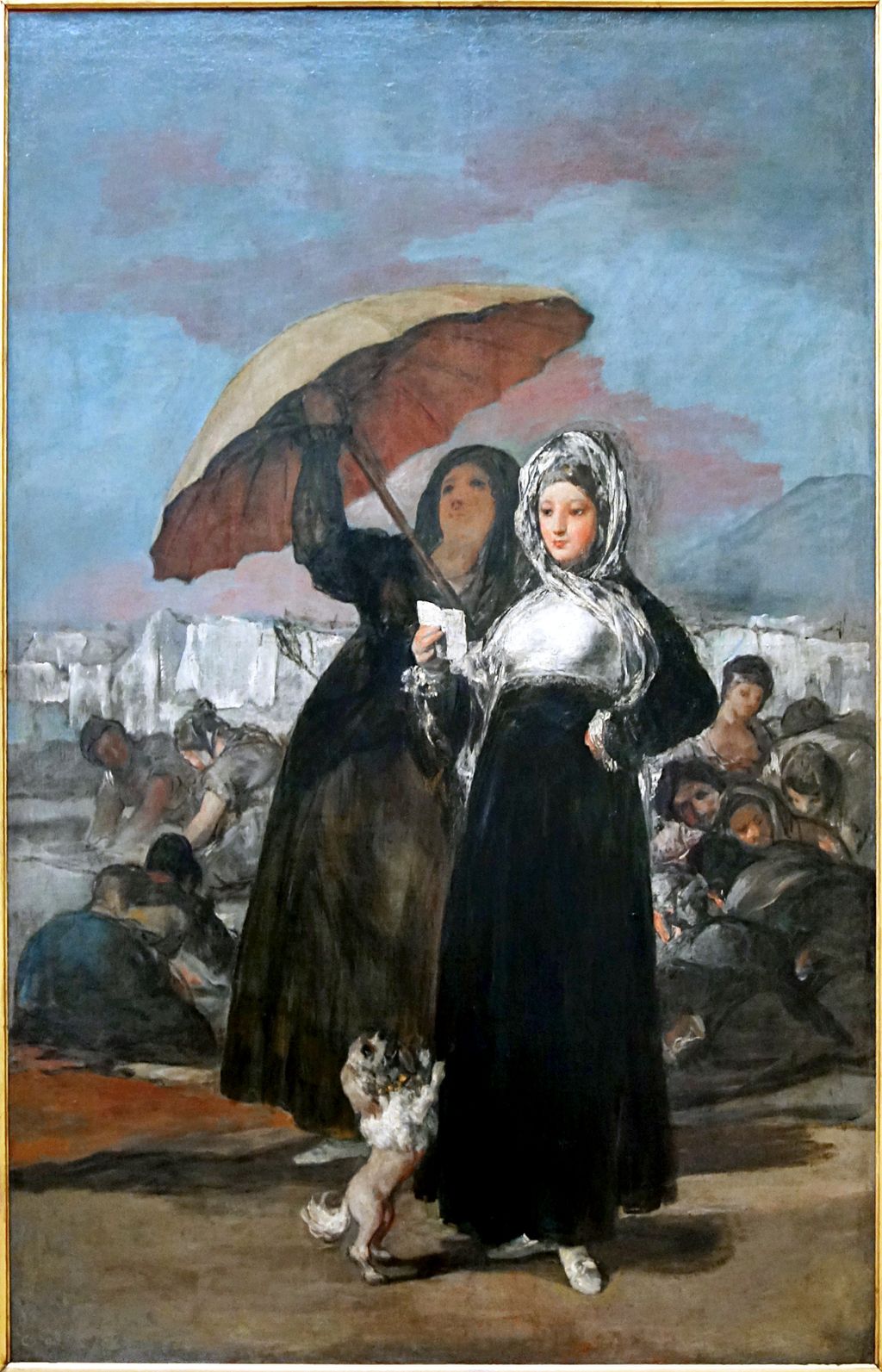
Javier sold El Tiempo in 1836 to agents buying for the Spanish Gallery of Louis-Philippe. The gallery's collection was dispersed at Christie's in London in 1853. The dealer Durlacher handled the paintings after the 1853 sale, and they later belonged to Lord Dalling and Bulwer. By the time his collection was sold in 1873, El Tiempo and Les Jeunes, also called La Lettre, were advertised as companions. Both passed through the dealer Édouard Warneck and reached Lille in the 1870s. Lille's exhibition materials describe the acquisition of Les Jeunes by the city and credit curator Édouard Reynart and other subscribers with securing El Tiempo. [1] [2] [5] [8]
The pairing has an immediate appeal. The women in Les Jeunes are out in the open air, with a parasol above them, laundry workers beyond and a dog at their feet. One reads a letter. The women of El Tiempo turn towards their mirror, shut in by Time's wings. Seeing the two together encourages the viewer to connect youth and age. That association was reinforced by alterations to the older women's canvas between the two London sales. X-rays show added bands around Goya's painted area. The additions supplied more room below the women's skirts, widened the seat at the left and extended the broom. Les Jeunes retains its original format, and the decision to enlarge El Tiempo to give it similar dimensions belongs to the nineteenth-century history of the two paintings. [2] [5] [9]
The date of Les Jeunes has itself been debated. It carries the painted number C 103, a mark of a different collection from the one recorded by X 23. Its absence from the 1812 family inventory has been used to suggest a later date. Mottin points out that it could already have been in another collection when the inventory was drawn up. The strongest evidence about how the works became a pair lies in the edges of the paintings and in their nineteenth-century sale history. [2] [9]
Artworks directory
| Name | Date | Medium |
|---|---|---|
| And There’s No Help for It, Plate 15 | Printed 1863 | |
| Asmodea | c. 1820–23 | Wall painting transferred to canvas |
| Boys Inflating a Bladder | 1777–78 | Tapestry cartoon |
| Boys Picking Fruit | 1778 | Tapestry cartoon |
| Bullfight in a Divided Ring | 1825 | Lithograph |
| Card Players | 1777–78 | Tapestry cartoon |
| Card Players (sketch) | 1777–78 | Painted sketch |
| Dance on the Banks of the Manzanares | 1777 | Tapestry cartoon |
| Duel with Cudgels | c. 1820–23 | Wall painting transferred to canvas |
| Heads in a Landscape | c. 1820–23 | Easel painting |
| Judith and Holofernes | c. 1820–23 | Wall painting transferred to canvas |
| Leocadia | c. 1820–23 | Wall painting transferred to canvas |
| Maja and Cloaked Men | 1777 | Tapestry cartoon |
| Maja and Cloaked Men (sketch) | 1777 | Painted sketch |
| Majo Clapping in Time to the Music | 1777 | Drawing |
| Men Reading | c. 1820–23 | Wall painting transferred to canvas |
| Out Hunting for Teeth, Plate 12 | 1799 | Etching, burnished aquatint and burin |
| Picnic in the Countryside (sketch) | 1776–78 | Painted sketch |
| Picnic on the Banks of the Manzanares | 1776 | Tapestry cartoon |
| Pilgrimage to San Isidro | c. 1820–23 | Wall painting transferred to canvas |
| Preparatory study for The Sleep of Reason Produces Monsters | c. 1796–97 | Drawing |
| Procession of the Holy Office | c. 1820–23 | Wall painting transferred to canvas |
| Quarrel at the Cockerel Inn (sketch) | 1777 | Painted sketch |
| Quarrel in the New Tavern | 1777 | Tapestry cartoon |
| Saturn Devouring His Son | c. 1820–23 | Wall painting transferred to canvas |
| Seated Majo Smoking | c. 1776 | Drawing |
| The Dog | c. 1820–23 | Wall painting transferred to canvas |
| The Drinker | 1777 | Tapestry cartoon |
| The Fates | c. 1820–23 | Wall painting transferred to canvas |
| The Great He-Goat | c. 1820–23 | Wall painting transferred to canvas |
| The Kite | 1777–78 | Tapestry cartoon |
| The Parasol | 1777 | Oil on canvas, tapestry cartoon |
| The Second of May 1808 | 1814 | Oil on canvas |
| The Sleep of Reason Produces Monsters, Plate 43 | 1799 | Etching and aquatint |
| The Third of May 1808 | 1814 | Oil on canvas |
| Thou Who Canst Not, Plate 42 | 1799 | Etching and burnished aquatint |
| Three Figures | 1776 | Drawing (lost) |
| Two Old Men | c. 1820–23 | Wall painting transferred to canvas |
| Two Old Men Eating Soup | c. 1820–23 | Wall painting transferred to canvas |
| Two Women and a Man | c. 1820–23 | Wall painting transferred to canvas |
| Universal Language: The Author Dreaming | 1797 | Drawing |
| The Family of Charles IV | 1800 | Oil on canvas |
| Witches’ Sabbath (Osuna painting) | 1797–98 | Oil on canvas |
| The Nude Maja | 1795–1800 | Oil on canvas |
| The Clothed Maja | 1800–07 | Oil on canvas |
| Self-Portrait (Drawing) | c. 1796 | Brush and carbon black ink on laid paper |
| The Swing, Madrid Album B.21 | 1795–97 | Brush and carbon black washes |
| Majas Fighting, a Majo Observing, Madrid Album B.15 | 1796–97 | Brush, grey and black washes on laid paper |
| Majos and Majas Conversing, Madrid Album B.16 | c. 1794–97 | Ink wash on paper |
| Weeping Woman and Three Men, Madrid Album B.17 | 1795–97 | Brush, carbon black washes and black chalk |
| Maja Seated on a Chair and Two Companions Behind, Madrid Album B.18 | 1795–97 | Brush and carbon black washes |
| Girl and Bull, Madrid Album B.23 | 1796–97 | Brush and carbon black washes |
| Lovers Sitting on a Rock, Madrid Album B.24 | 1796–97 | Brush and carbon black washes |
| Mariano Ceballos Riding a Bull | 1825 | Crayon lithograph and scraper |
| Landscape (lifetime impression) | c. 1807–10 | Etching and aquatint |
| Self-Portrait (1815), Prado canvas | 1815 | Oil on canvas |
| Self-Portrait (1815), Academy panel | 1815 | Oil on panel |
| Self-Portrait with Dr Arrieta | 1820 | Oil on canvas |
| Christ Crucified | 1780 | Oil on canvas |
| The Last Communion of Saint Joseph of Calasanz | 1819 | Oil on canvas |
| Christ on the Mount of Olives | 1819 | Oil on panel |
| The Flower Girls, or Spring | 1786–87 | Oil on canvas |
| The Grape Harvest, or Autumn | 1786–87 | Oil on canvas |
| The Snowstorm, or Winter | 1786–87 | Oil on canvas |
| The Threshing Ground, or Summer | 1786–87 | Oil on canvas |
| Picnic on the Banks of the Manzanares | 1776 | Oil on canvas |
| The Kite | 1777–78 | Oil on canvas |
| Dance on the Banks of the Manzanares | 1777 | Oil on canvas |
| A Fight at the Venta Nueva | 1777 | Oil on canvas |
| Blind Man’s Bluff | 1788 | Oil on canvas |
| Dogs on a Lead | 1775 | Oil on canvas |
| Hunting with a Decoy | 1775 | Oil on canvas |
| Hunter Loading His Rifle | 1775 | Oil on canvas |
| The Angler | 1775 | Oil on canvas |
| The Hermitage of San Isidro on His Feast Day | 1788 | Oil on canvas |
| The Meadow of San Isidro | 1788 | Oil on canvas |
| The Straw Manikin | 1791–92 | Oil on canvas |
| Witches’ Flight | c. 1797–98 | Oil on canvas |
| A Scene from ‘The Forcibly Bewitched’ | 1798 | Oil on canvas |
| The Duchess of Alba in Black | 1797 | Oil on canvas |
| The Duchess of Alba in White | 1795 | Oil on canvas |
| Charles III in Hunting Dress | c. 1786 | Oil on canvas |
| The Duke and Duchess of Osuna and Their Children | 1787–88 | Oil on canvas |
| Manuel Osorio Manrique de Zúñiga | 1787–88 | Oil on canvas |
| The Marquesa de Pontejos | c. 1786 | Oil on canvas |
| Equestrian Portrait of the 1st Duke of Wellington | 1812 | Oil on canvas |
| The Duke of Wellington | 1812–14 | Oil on wood |
| Portrait of Ferdinand VII of Spain | 1814 | Oil on canvas |
| Gaspar Melchor de Jovellanos | 1798 | Oil on canvas |
| María Tomasa Palafox y Portocarrero | 1804 | Oil on canvas |
| Señora Sabasa García | c. 1806–11 | Oil on canvas |
| Don Juan Bautista de Muguiro | 1827 | Oil on canvas |
| Doña Isabel de Porcel | Before 1805 | Oil on canvas |
| The Colossus | After 1808 | Oil on canvas |
| The Burial of the Sardine | 1808–12 | Oil on panel |
| The Madhouse | 1808–12 | Oil on panel |
| A Procession of Flagellants | 1808–12 | Oil on panel |
| Portrait of Jacques Galos | 1826 | Oil on canvas |
| Portrait of Mariano Goya, the Artist’s Grandson | 1827 | Oil on canvas |
| Milkmaid of Bordeaux | c. 1827 | Oil on canvas |
| Portrait of Don Juan Antonio Cuervo | 1819 | Oil on canvas |
| María Luisa of Parma (Naples version) | c. 1800 | Oil on canvas |
| The Countess of Baena | 1819 | Oil on canvas |
| The Family of the Infante Don Luis | 1783–84 | Oil on canvas |
| The Holy Family | c. 1787 | Oil on canvas |
| Saint Barbara | c. 1773 | Oil on canvas |
| Saints Justa and Rufina | 1817 | Oil on canvas |
| El Tío Paquete | c. 1819–20 | Oil on canvas |
| The Forge | c. 1815–20 | Oil on canvas |
| Majas on a Balcony (Metropolitan Museum version) | c. 1800–10 | Oil on canvas |
| Maja and Celestina on a Balcony | c. 1808–12 | Oil on canvas |
| The Water Bearer | 1808–12 | Oil on canvas |
| Time and the Old Women | c. 1810 | Oil on canvas |
Frequently Asked Questions
Time and the Old Women is a canvas listed in the 1812 inventory. The Black Paintings, including Two Old Ones Eating Soup, originated as murals in the Quinta del Sordo, the house Goya acquired in 1819. [2] [5]
Discussion
Look again at the images and ideas explored in Time and the Old Women. These editorial prompts invite your observations.
Follow the women's eyes towards the mirror and then follow the broom up towards the top of the canvas. At what point does the scene begin to feel threatening? Try reading the words on the mirror in the voice of the woman holding it, then in the voice of the figure behind her. How does the question change?
Reader Insights
Look from the mirror’s question to the two faces.
What does the winged figure’s movement add to the scene?
Join the Conversation
Share a detail, comparison or question about Time and the Old Women below.
References
- Palais des Beaux-Arts de Lille, Le temps (« les vieilles »), P 50, object record, photographs and Lenglart's 1893 catalogue description. View source.
- Bruno Mottin, Goya et les scènes de genre de grand format, Technè 53 (2022), pp. 90–97, especially figs. 1–4 and the technical records. View source.
- Juliet Wilson-Bareau, Goya and the X Numbers, Metropolitan Museum Journal 31 (1996), pp. 159–174, especially pp. 159–162. Fig. 1 reproduces the first and final pages of the paintings and prints inventory, Archivo Histórico de Protocolos de Madrid, protocolo 22.879. View source.
- Fundación Goya en Aragón, Las viejas, object catalogue. View source.
- Palais des Beaux-Arts de Lille, Prolongez l’expérience Goya, 2021 exhibition guide with chronology and entries for both Lille canvases. View source.
- Ashmolean Museum, Hasta la muerte (Until Death), plate 55 of Los Caprichos, WA1863.6450.55, object record and reproduction. View source.
- José Ignacio Calvo Ruata, Coleccionistas de Goya en el siglo XIX, Institución Fernando el Católico, p. 39, inventory wording for entry 23. View source.
- Ministère de la Culture, Les vieilles ou Le temps, Joconde P 50, including the 1853 sale reference. View source.
- Palais des Beaux-Arts de Lille, Les jeunes (« la lettre »), P 9, object record and photographs. View source.







