


 by Tom Gurney
Tom Gurney BSc (Hons) is an art history expert with over 20 years experience
Published on June 19, 2020 / Updated on November 20, 2026
Email: tomgurney1@gmail.com / Phone: +44 7429 011000
Introduction
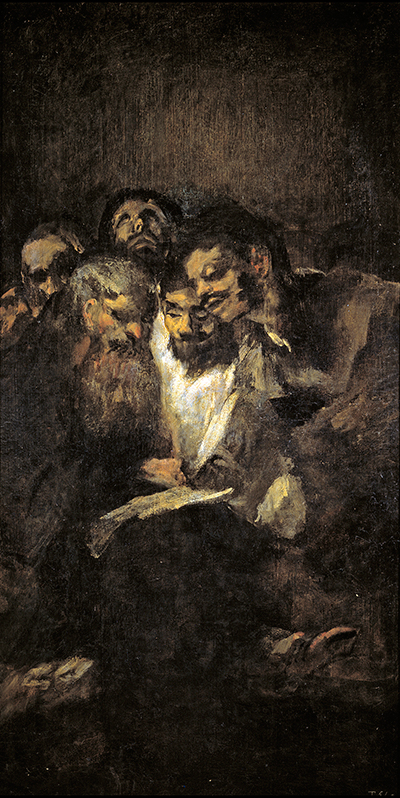
Three men bend towards a pale sheet in Francisco de Goya's Men Reading. The central figure holds it low, and the white of his shirt draws the eye down from the crowded faces to his hands. Behind him one face lifts out of the group and looks upwards. The sheet seems to command the room, although its contents are hidden from us. At the Quinta del Sordo the scene occupied a narrow stretch of wall. Today it is a canvas in the Museo Nacional del Prado, where it is catalogued as La lectura (The Reading). [1] [2]
At a Glance
- ArtistFrancisco de Goya
- Datec. 1820–1823. [1] [2]
- MediumOil on dry prepared wall, transferred to canvas in the nineteenth century. [1] [2]
- Dimensions126 × 66 cm on canvas. [1] [2]
- CollectionMuseo Nacional del Prado, Madrid, P000766. [1]
- Original settingUpper room of the Quinta del Sordo, paired with Two Women and a Man. [1] [3]
Works across Goya’s career
The Parasol
1777The Nude Maja
1795–1800Men Reading
c. 1820–23Saturn Devouring His Son
c. 1820–23The Dog
c. 1820–23How the group takes shape
The central man's white shirt forms a triangle that narrows towards his lap. Fine strokes give way to wider, broken patches of white and warm cream. On either side, two men bow their heads towards the same area. One has a broad grey beard whose light catches against the brown of his coat. The man on the right leans so far in that his head nearly overlaps the central man's. The pale edge of the sheet cuts across this inward movement. It runs at an angle below the hands and separates their small, compact gestures from the broad dark foreground. [1] [2]
Above the three inclined heads the upward tilt of another face interrupts the pattern. Farther left a brow and nose come forward while the body below is hard to separate from the dark. At the opposite edge a dim profile leans into the group. The Fundación Goya en Aragón counts six men. The transitions between their faces, hair and clothes are often made with just a few broad marks. The current canvas gives the impression of a group packed into a shallow space. It offers no clear view of the street or an identifiable room, and the light on the shirt and faces has no clearly depicted source. For a viewer, the open space below the paper offers a position at the edge of the gathering, close enough to follow the men's attention and still unable to read over their shoulders. [1] [2]
Annotated Details from Men Reading
Follow the cluster of heads to the pale sheet below.
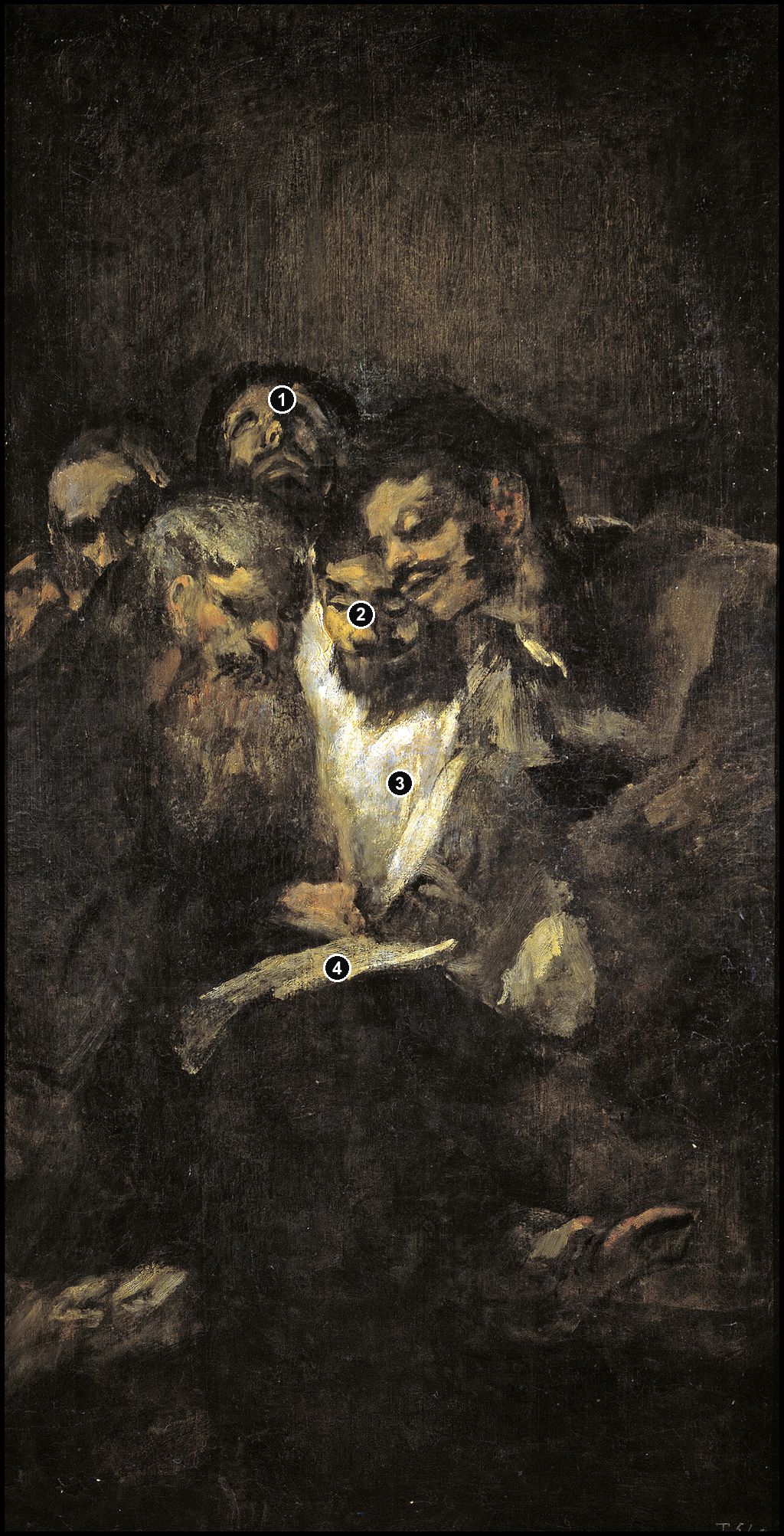
Details from MEN READING
Details from the transferred canvas in the Museo Nacional del Prado (P000766).
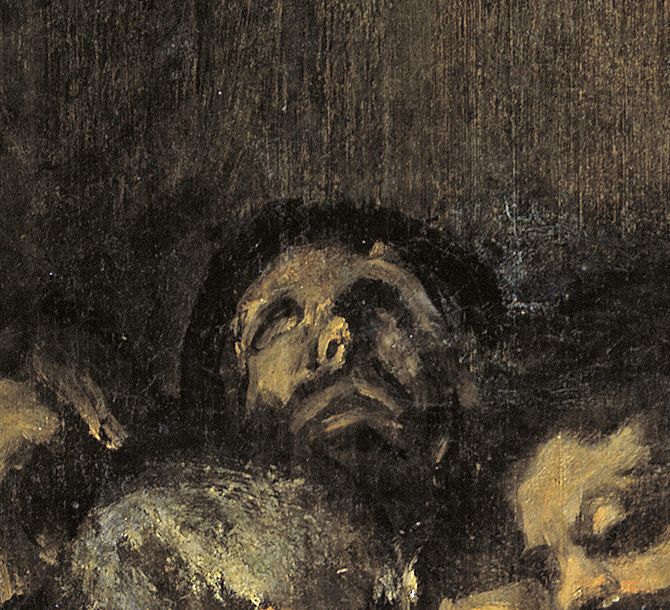
A face turned upwards
The head above the main cluster tilts upwards. Light catches its brow and cheek against the dark background.
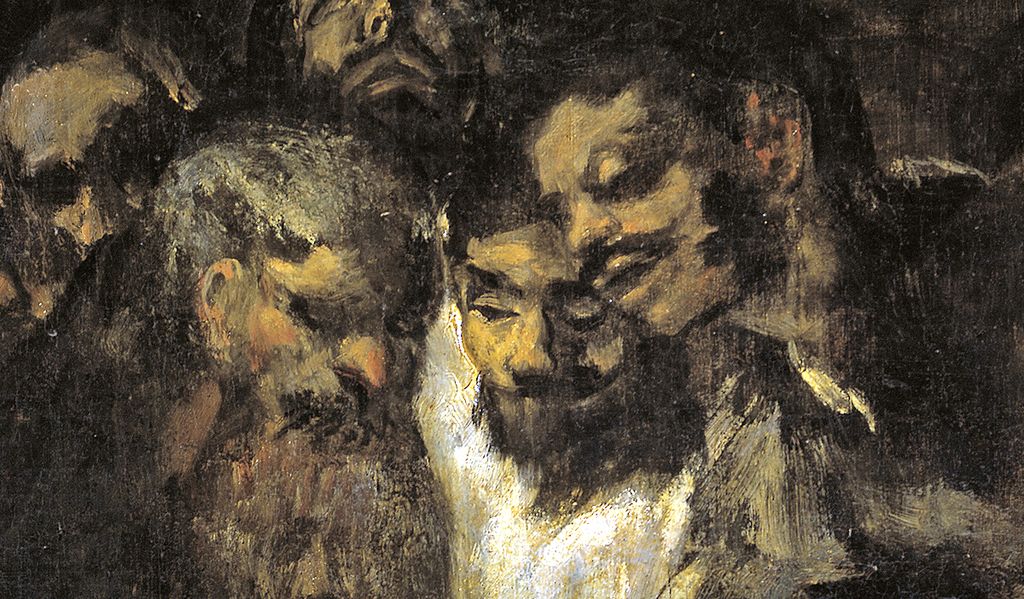
Heads inclined inwards
The heads around the central figure draw close enough for their edges to overlap.
White shirt and dark sleeve
Wide strokes of pale paint make the shirt one of the lightest areas. Dark cloth breaks its outline at the sides.
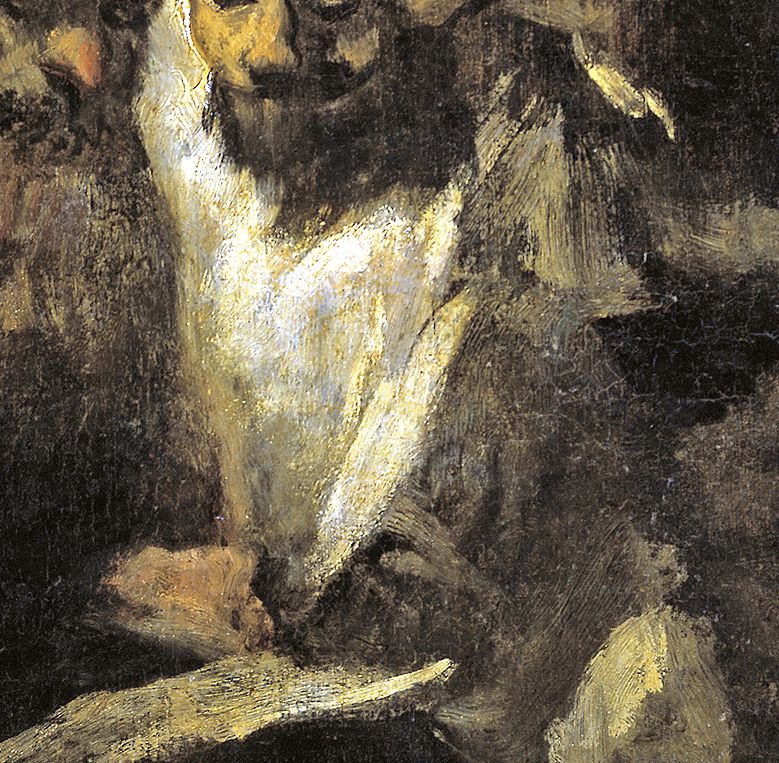
The pale sheet
The bright edge of the sheet angles across the lap without giving the viewer legible words.
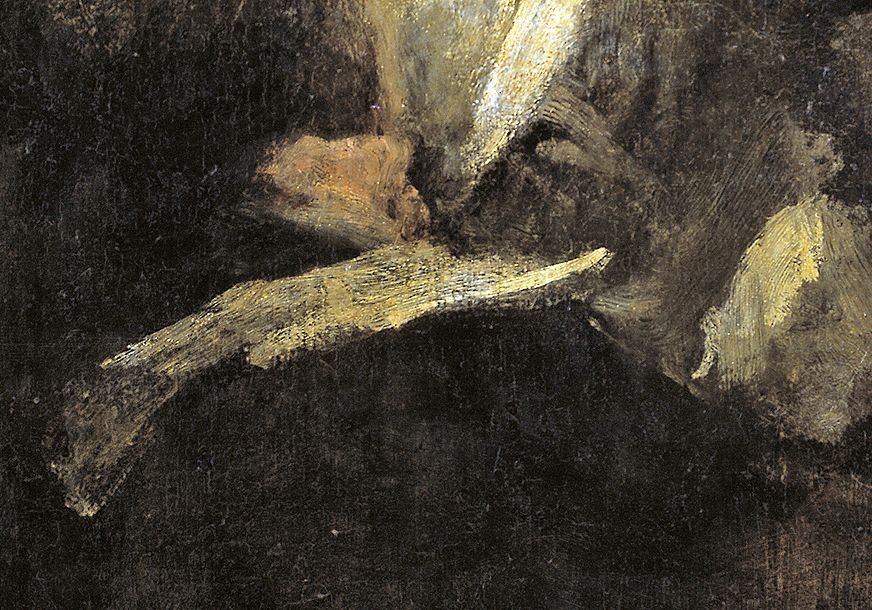
How the titles shape the story
The titles have accumulated at different points in the picture's history. The Prado attributes Dos hombres (Two Men) to Antonio Brugada's inventory of works associated with Goya's son. The museum treats the date of that list as uncertain and places it in the mid-nineteenth century. Two strongly modelled faces can dominate the first look at the cluster, and Glendinning observes that Brugada's lists often count only the principal figures. The inventory title leaves the surrounding heads to be picked out by anyone looking closely. [1] [7]
Yriarte used Les Politiques in his account of the house and as the caption to a woodcut. He wrote that the men were reading a piece of newspaper and remarked on the sinister quality of the faces. The paper is certainly a plausible vehicle for topical news, especially in the climate of the Liberal Triennium, when Spain saw a growth in political and satirical publications. Reading aloud would explain why some men seem to gather within earshot while only those closest to the sheet can see it clearly. The visible marks leave the type of publication and the affiliations of the men uncertain. La lectura, chosen for the Prado catalogue in 1900, puts the shared activity at the centre of the scene. [1] [2] [3]
Looking at Laurent's photograph, Foradada draws attention to the angle of the central man's fingers and the pressure of his hand on the sheet. He reads the gesture as writing and the open mouth at the right as dictation or reading aloud from the text being composed. His proposed title is La escritura (The Writing). He goes further, suggesting the men could be clerics composing a manifesto at the end of the Liberal Triennium, when ultra-absolutist groups met in Madrid convents. The conjecture depends on the reading of the hands, the interpretation of the clothes as religious habits and a connection with particular events in 1823. The earliest descriptions record a different impression of the action, and neither a legible document nor an identification of the participants survives to settle it. [3] [4] [5]
Goya on film
Five films explore Goya’s portraits, prints, Black Paintings and painting techniques.
The Duke of Wellington by Goya
The portrait, its military decorations and its later theft.
Watch on YouTubeWhat was on the wall when Laurent photographed it?
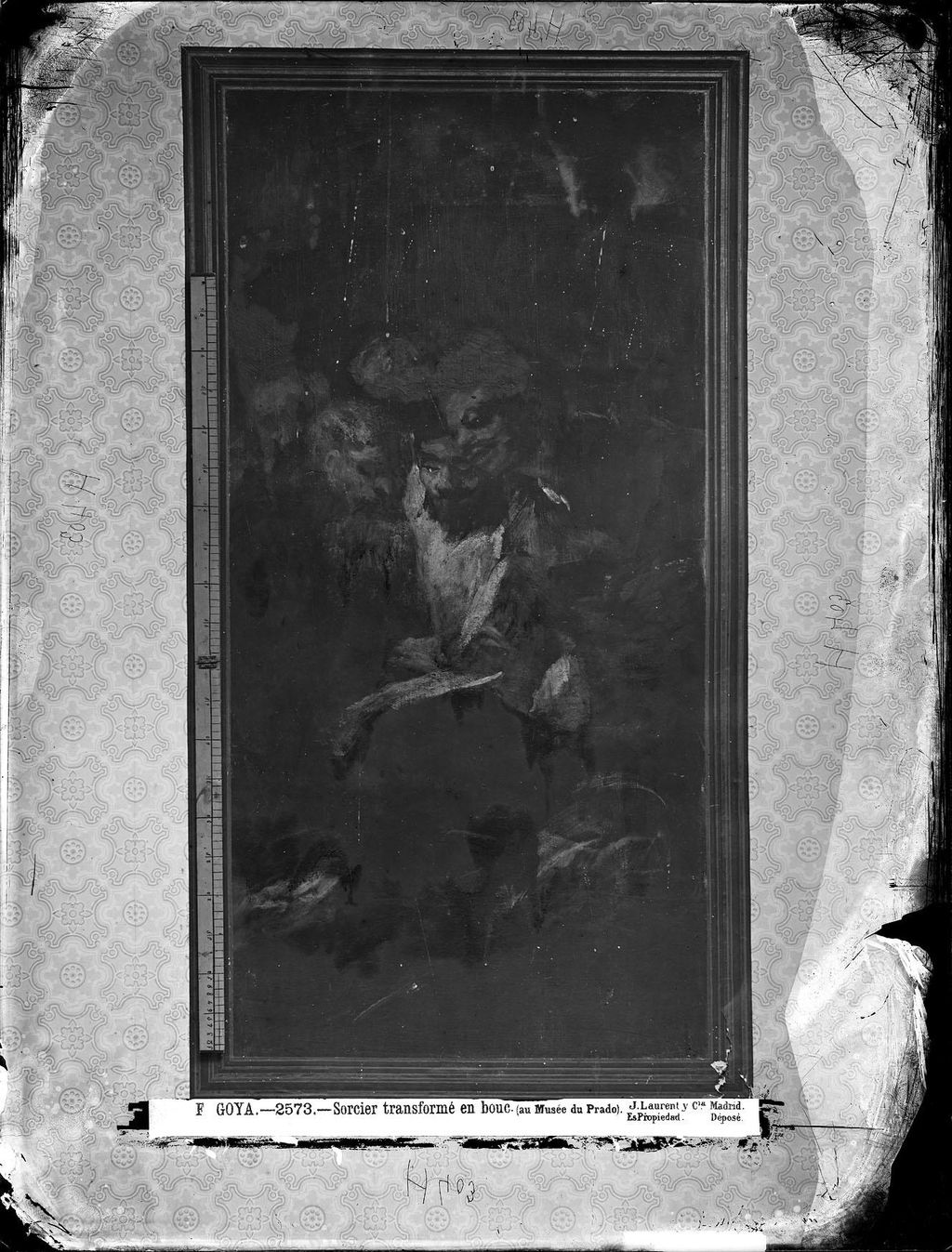
Laurent's glass negative VN-08120 P, preserved in the Ruiz Vernacci collection at Spain's Instituto del Patrimonio Cultural, records the painted panel within its wall decoration. The reproduction shows patterned wallpaper around a frame-like border, a measuring rule along the left edge and pale blemishes on the painted field. The label at the foot calls the scene Sorcier transformé en bouc (Sorcerer Transformed into a Goat). The caption's Prado designation was added after the picture had come to the museum. The mural, wallpaper and ruler belong to the moment of exposure. The label belongs to the photograph's subsequent life. The frontal view gives an excellent record of the surround immediately next to the picture. It stops short of the corners, doorway and window of the actual room. [5] [6]
Nigel Glendinning used an early published photograph to compare the mural with the modern canvas. He argued that the background face behind the main cluster had been worked up in restoration. In his reading the painted nose and mouth were sharpened, a moustache supplied and dark marks that may once have served as eyes recruited as eyebrows. He also thought the minor faces farther left had acquired more definite features. The digital reproduction of VN-08120 P shows a head in the disputed area before transfer. Teixidor, in his description of the plate, identifies a plaster fill near the mouth and regards the head itself as already tilted up. The restoration of a damaged face is consistent with a head having been present all along. The exact direction of its gaze on the wall remains harder to recover. [5] [7]
Two prints made while the mural was still in the Quinta give a further check on the faces. Charles Maurand's woodcut for Yriarte's 1867 book gives the figures more sharply articulated features than the photograph. Eduardo Gimeno's etching, published in 1868, keeps the background closer to the indistinct forms Glendinning saw in the early photograph. Glendinning nevertheless found that both printmakers drew in facial features where the photographic details were hard to read. In a print meant for a book or journal, a few clear lines can turn a patch of dark paint into an identifiable eye or mouth. Maurand's version served the story Yriarte told about the group, while Laurent's plate lets us see where the mural offered its nineteenth-century viewers less certainty. [3] [5] [7]
Glendinning also saw a basket-like handle at lower right and a light patch beyond the group that might represent a window or a ledge, provided it was a feature of the mural and not of the photograph. Either reading of the pale patch concerns space represented inside the picture. The window proposed between the two murals concerns the architecture of the Quinta. The monochrome plate preserves the locations of shapes and light patches, though the photographer's lighting and the condition of the paint affect their tone. The white shirt and the slant of the paper give the eye two points of comparison that are recognisable on both surfaces. [5] [6] [7]
A serious gathering beside a laughing one
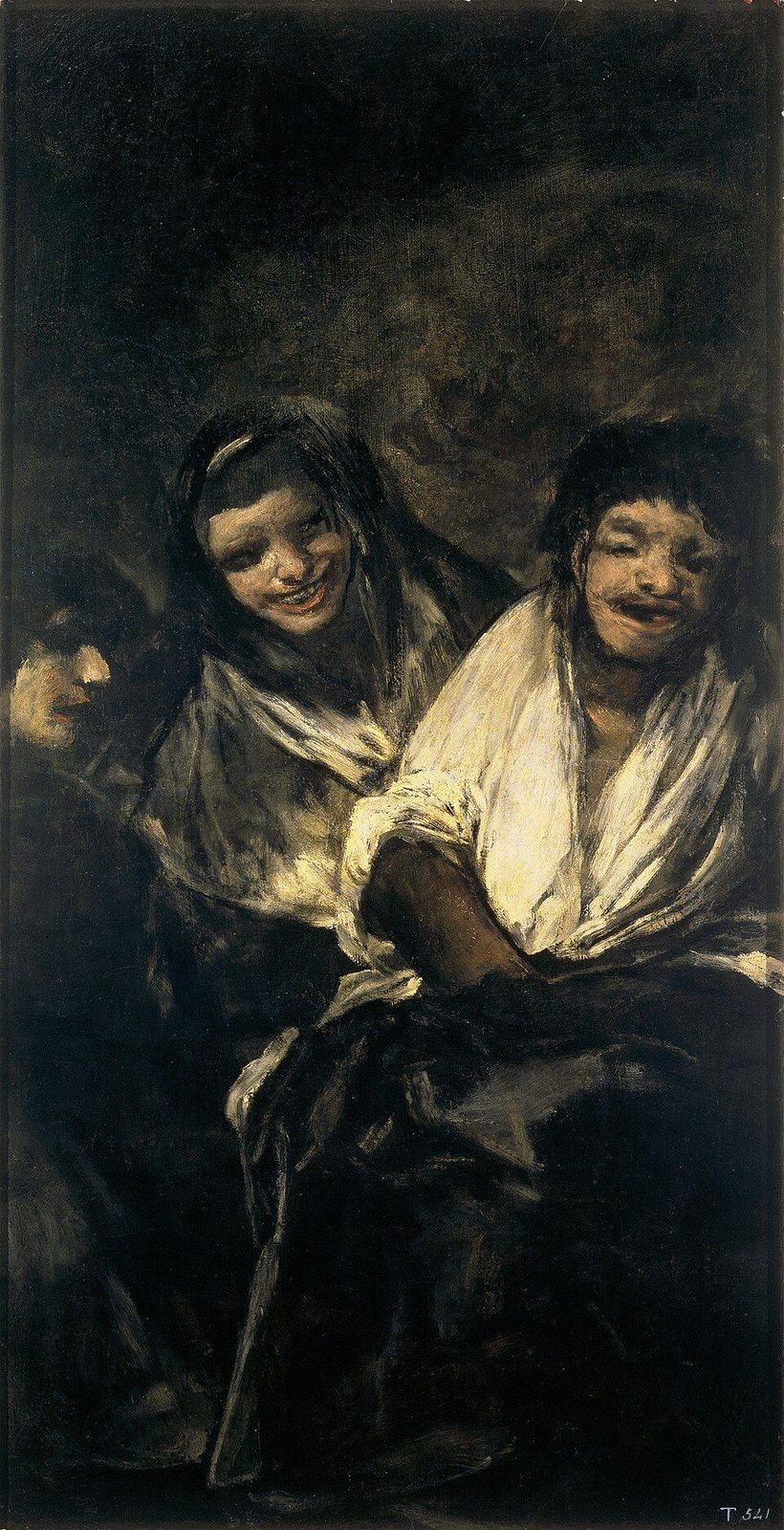
The most securely identified neighbour is Two Women and a Man, known here as Man Mocked by Two Women. Yriarte called the laughing women the readers' companion, and Glendinning noted that the visitor P. L. Imbert also treated them as pendants. The Prado places the panels together on a side wall of the upstairs room. The Fundación Goya en Aragón and the reconstruction by Foradada and colleagues place them on the short wall facing the entrance. That reconstruction sets Men Reading at the left and the laughing group at the right, with an opening between them. The case for comparing the pictures rests on their matching narrow proportions and the accounts of people who saw them in the house. Their exact position relative to the entrance depends on how those accounts are reconciled with the surviving evidence for its layout. [1] [2] [3] [7] [8]
Glendinning saw compositional weight in the opposing diagonals. The faces and sheet in Men Reading pull down towards the right, while gestures in the other painting carry the eye in the opposite direction. He also thought both groups might be occupied with a text. In the early photograph of Two Women and a Man he saw dark strokes on what might be a sheet held by the lower figure, perhaps simulating writing. That would give the serious and laughing groups a shared subject and different reactions. The Fundación Goya summarises Glendinning's interpretation as a pairing of the serious and comic sides of culture. [2] He also allowed the familiar possibility that the other scene is a sexual satire. Its laughter is plainly legible. What prompts it remains open, just as what absorbs the men around the paper remains open. For the place of both works in the wider decoration of the Quinta, see The Black Paintings. [7] [9]
Artworks directory
| Name | Date | Medium |
|---|---|---|
| And There’s No Help for It, Plate 15 | Printed 1863 | |
| Asmodea | c. 1820–23 | Wall painting transferred to canvas |
| Boys Inflating a Bladder | 1777–78 | Tapestry cartoon |
| Boys Picking Fruit | 1778 | Tapestry cartoon |
| Bullfight in a Divided Ring | 1825 | Lithograph |
| Card Players | 1777–78 | Tapestry cartoon |
| Card Players (sketch) | 1777–78 | Painted sketch |
| Dance on the Banks of the Manzanares | 1777 | Tapestry cartoon |
| Duel with Cudgels | c. 1820–23 | Wall painting transferred to canvas |
| Heads in a Landscape | c. 1820–23 | Easel painting |
| Judith and Holofernes | c. 1820–23 | Wall painting transferred to canvas |
| Leocadia | c. 1820–23 | Wall painting transferred to canvas |
| Maja and Cloaked Men | 1777 | Tapestry cartoon |
| Maja and Cloaked Men (sketch) | 1777 | Painted sketch |
| Majo Clapping in Time to the Music | 1777 | Drawing |
| Men Reading | c. 1820–23 | Wall painting transferred to canvas |
| Out Hunting for Teeth, Plate 12 | 1799 | Etching, burnished aquatint and burin |
| Picnic in the Countryside (sketch) | 1776–78 | Painted sketch |
| Picnic on the Banks of the Manzanares | 1776 | Tapestry cartoon |
| Pilgrimage to San Isidro | c. 1820–23 | Wall painting transferred to canvas |
| Preparatory study for The Sleep of Reason Produces Monsters | c. 1796–97 | Drawing |
| Procession of the Holy Office | c. 1820–23 | Wall painting transferred to canvas |
| Quarrel at the Cockerel Inn (sketch) | 1777 | Painted sketch |
| Quarrel in the New Tavern | 1777 | Tapestry cartoon |
| Saturn Devouring His Son | c. 1820–23 | Wall painting transferred to canvas |
| Seated Majo Smoking | c. 1776 | Drawing |
| The Dog | c. 1820–23 | Wall painting transferred to canvas |
| The Drinker | 1777 | Tapestry cartoon |
| The Fates | c. 1820–23 | Wall painting transferred to canvas |
| The Great He-Goat | c. 1820–23 | Wall painting transferred to canvas |
| The Kite | 1777–78 | Tapestry cartoon |
| The Parasol | 1777 | Oil on canvas, tapestry cartoon |
| The Second of May 1808 | 1814 | Oil on canvas |
| The Sleep of Reason Produces Monsters, Plate 43 | 1799 | Etching and aquatint |
| The Third of May 1808 | 1814 | Oil on canvas |
| Thou Who Canst Not, Plate 42 | 1799 | Etching and burnished aquatint |
| Three Figures | 1776 | Drawing (lost) |
| Two Old Men | c. 1820–23 | Wall painting transferred to canvas |
| Two Old Men Eating Soup | c. 1820–23 | Wall painting transferred to canvas |
| Two Women and a Man | c. 1820–23 | Wall painting transferred to canvas |
| Universal Language: The Author Dreaming | 1797 | Drawing |
| The Family of Charles IV | 1800 | Oil on canvas |
| Witches’ Sabbath (Osuna painting) | 1797–98 | Oil on canvas |
| The Nude Maja | 1795–1800 | Oil on canvas |
| The Clothed Maja | 1800–07 | Oil on canvas |
| Self-Portrait (Drawing) | c. 1796 | Brush and carbon black ink on laid paper |
| The Swing, Madrid Album B.21 | 1795–97 | Brush and carbon black washes |
| Majas Fighting, a Majo Observing, Madrid Album B.15 | 1796–97 | Brush, grey and black washes on laid paper |
| Majos and Majas Conversing, Madrid Album B.16 | c. 1794–97 | Ink wash on paper |
| Weeping Woman and Three Men, Madrid Album B.17 | 1795–97 | Brush, carbon black washes and black chalk |
| Maja Seated on a Chair and Two Companions Behind, Madrid Album B.18 | 1795–97 | Brush and carbon black washes |
| Girl and Bull, Madrid Album B.23 | 1796–97 | Brush and carbon black washes |
| Lovers Sitting on a Rock, Madrid Album B.24 | 1796–97 | Brush and carbon black washes |
| Mariano Ceballos Riding a Bull | 1825 | Crayon lithograph and scraper |
| Landscape (lifetime impression) | c. 1807–10 | Etching and aquatint |
| Self-Portrait (1815), Prado canvas | 1815 | Oil on canvas |
| Self-Portrait (1815), Academy panel | 1815 | Oil on panel |
| Self-Portrait with Dr Arrieta | 1820 | Oil on canvas |
| Christ Crucified | 1780 | Oil on canvas |
| The Last Communion of Saint Joseph of Calasanz | 1819 | Oil on canvas |
| Christ on the Mount of Olives | 1819 | Oil on panel |
| The Flower Girls, or Spring | 1786–87 | Oil on canvas |
| The Grape Harvest, or Autumn | 1786–87 | Oil on canvas |
| The Snowstorm, or Winter | 1786–87 | Oil on canvas |
| The Threshing Ground, or Summer | 1786–87 | Oil on canvas |
| Picnic on the Banks of the Manzanares | 1776 | Oil on canvas |
| The Kite | 1777–78 | Oil on canvas |
| Dance on the Banks of the Manzanares | 1777 | Oil on canvas |
| A Fight at the Venta Nueva | 1777 | Oil on canvas |
| Blind Man’s Bluff | 1788 | Oil on canvas |
| Dogs on a Lead | 1775 | Oil on canvas |
| Hunting with a Decoy | 1775 | Oil on canvas |
| Hunter Loading His Rifle | 1775 | Oil on canvas |
| The Angler | 1775 | Oil on canvas |
| The Hermitage of San Isidro on His Feast Day | 1788 | Oil on canvas |
| The Meadow of San Isidro | 1788 | Oil on canvas |
| The Straw Manikin | 1791–92 | Oil on canvas |
| Witches’ Flight | c. 1797–98 | Oil on canvas |
| A Scene from ‘The Forcibly Bewitched’ | 1798 | Oil on canvas |
| The Duchess of Alba in Black | 1797 | Oil on canvas |
| The Duchess of Alba in White | 1795 | Oil on canvas |
| Charles III in Hunting Dress | c. 1786 | Oil on canvas |
| The Duke and Duchess of Osuna and Their Children | 1787–88 | Oil on canvas |
| Manuel Osorio Manrique de Zúñiga | 1787–88 | Oil on canvas |
| The Marquesa de Pontejos | c. 1786 | Oil on canvas |
| Equestrian Portrait of the 1st Duke of Wellington | 1812 | Oil on canvas |
| The Duke of Wellington | 1812–14 | Oil on wood |
| Portrait of Ferdinand VII of Spain | 1814 | Oil on canvas |
| Gaspar Melchor de Jovellanos | 1798 | Oil on canvas |
| María Tomasa Palafox y Portocarrero | 1804 | Oil on canvas |
| Señora Sabasa García | c. 1806–11 | Oil on canvas |
| Don Juan Bautista de Muguiro | 1827 | Oil on canvas |
| Doña Isabel de Porcel | Before 1805 | Oil on canvas |
| The Colossus | After 1808 | Oil on canvas |
| The Burial of the Sardine | 1808–12 | Oil on panel |
| The Madhouse | 1808–12 | Oil on panel |
| A Procession of Flagellants | 1808–12 | Oil on panel |
| Portrait of Jacques Galos | 1826 | Oil on canvas |
| Portrait of Mariano Goya, the Artist’s Grandson | 1827 | Oil on canvas |
| Milkmaid of Bordeaux | c. 1827 | Oil on canvas |
| Portrait of Don Juan Antonio Cuervo | 1819 | Oil on canvas |
| María Luisa of Parma (Naples version) | c. 1800 | Oil on canvas |
| The Countess of Baena | 1819 | Oil on canvas |
| The Family of the Infante Don Luis | 1783–84 | Oil on canvas |
| The Holy Family | c. 1787 | Oil on canvas |
| Saint Barbara | c. 1773 | Oil on canvas |
| Saints Justa and Rufina | 1817 | Oil on canvas |
| El Tío Paquete | c. 1819–20 | Oil on canvas |
| The Forge | c. 1815–20 | Oil on canvas |
| Majas on a Balcony (Metropolitan Museum version) | c. 1800–10 | Oil on canvas |
| Maja and Celestina on a Balcony | c. 1808–12 | Oil on canvas |
| The Water Bearer | 1808–12 | Oil on canvas |
| Time and the Old Women | c. 1810 | Oil on canvas |
Frequently Asked Questions
The text is illegible. Yriarte described a fragment of newspaper, and the growth of the political and satirical press during the Liberal Triennium gives that suggestion a historical setting. Carlos Foradada sees the central hand as a writing hand and suggests the group may be drafting a document together. Both interpretations start from the same visible fact that the group has gathered around a sheet. [2] [3] [4]
Salvador Martínez Cubells undertook the private commission for Baron Émile d'Erlanger. Workshop records place the transfer project between 1874 and 1876, with the fourteen canvases back in the workshop in 1881 after their exhibition in Paris in 1878. These dates document the treatment of the group. Goya's painting belongs to the early 1820s, and Jean Laurent photographed it before detachment, around 1873 according to the Prado and in 1874 according to photographic studies by Carlos Teixidor and Raquel Esteban Vega. [1] [5] [6]
Discussion
Look again at the images and ideas explored in Men Reading. These editorial prompts invite your observations.
Compare the face that looks up in the Prado canvas with the same area in Laurent's photograph. How does that one figure affect your sense of what has brought the group together? [1] [5]
Reader Insights
Which figure’s gaze draws your attention away from the sheet?
What details leave the group’s activity open to more than one reading?
Join the Conversation
Share a detail, comparison or question about Men Reading below.
References
- Museo Nacional del Prado, La lectura, collection record P000766. View source.
- Fundación Goya en Aragón, La lectura, catalogue entry and conservation notes. View source.
- Charles Yriarte, Goya, Paris, 1867, pp. 91, 94–95 and the catalogue entry for Les Politiques. View source.
- Carlos Foradada, ‘El entorno político y social en los contenidos de las “Pinturas Negras” de Goya’, in Goya y su contexto, especially pp. 201–205 and figs. 3–4. View source.
- Jean Laurent, pre-transfer photograph of Men Reading, glass negative VN-08120 P, Archivo Ruiz Vernacci, Fototeca del Instituto del Patrimonio Cultural de España. Digitised reproduction and description by Carlos Teixidor Cadenas. View source.
- Raquel Esteban Vega, ‘Las fotografías de J. Laurent de las Pinturas negras de Goya’, in Goya en la literatura, en la música y en las creaciones audiovisuales, pp. 413–426. View source.
- Nigel Glendinning, ‘The Strange Translation of Goya's “Black Paintings”’, The Burlington Magazine, 117, no. 868 (1975), pp. 465–479, especially figs. 61–64 and pp. 475–476. View source.
- Carlos Foradada, Carlos Narbaiza, José Javier Luis and Alfonso Burgos, ‘Las medidas de la casa de Goya y sus Pinturas negras en su entorno original’, ASRI, no. 20 (2021), pp. 53–82, especially figs. 30 and 32. View source.
- Fundación Goya en Aragón, Dos mujeres y un hombre, companion mural catalogue entry. View source.








