


 by Tom Gurney
Tom Gurney BSc (Hons) is an art history expert with over 20 years experience
Published on June 19, 2020 / Updated on November 20, 2026
Email: tomgurney1@gmail.com / Phone: +44 7429 011000
Introduction
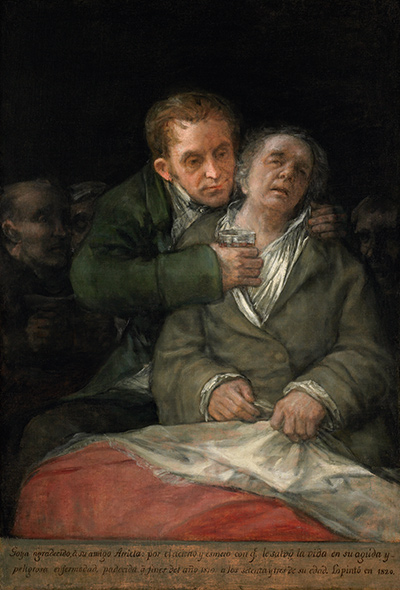
Francisco de Goya leans back into the arms of his doctor. His mouth is slightly open and his hands gather the bedclothes as Eugenio García Arrieta brings a glass to his lips. Behind them, faces are barely visible in the dark. Goya painted this bedside scene in 1820, after recovering from a dangerous illness. At the foot of the canvas he records what happened and thanks Arrieta, whom he calls his friend. The painting gives us the moment when Goya still needed someone to hold him upright. [1] [2]
At a Glance
- ArtistFrancisco José de Goya y Lucientes (1746–1828). [1]
- Date1820, as recorded in the painting’s inscription. [2]
- MediumOil on canvas. [1]
- Canvas size114.62 × 76.52 cm, as recorded by the Minneapolis Institute of Art. [3]
- SittersGoya and his physician, Eugenio García Arrieta. Goya was 73 when he fell ill in late 1819. [2] [4]
- CollectionMinneapolis Institute of Art, 52.14. Acquired in 1952 through the Ethel Morrison Van Derlip Fund. [2] [3]
Works across Goya’s career
The Parasol
1777The Nude Maja
1795–1800Saturn Devouring His Son
c. 1820–23The Dog
c. 1820–23Milkmaid of Bordeaux
c. 1827The doctor lifts his patient
The two men occupy the centre of the tall canvas. Goya’s head tips back and to one side, exposing the pale skin under his jaw. His partly open eyes have no clear point of focus. The grey around his temples and cheeks comes close to the colour of his gown, which has fallen open over a white nightshirt. The line of his body sinks into cloth. Arrieta leans in from behind and bends his head towards Goya’s face. The doctor’s cheek is warmer in colour, and his green coat gives his shoulder a clear outline where it comes forward into the light. Even in a small reproduction, the direction of the two heads makes their different roles clear. [1] [4] [9]
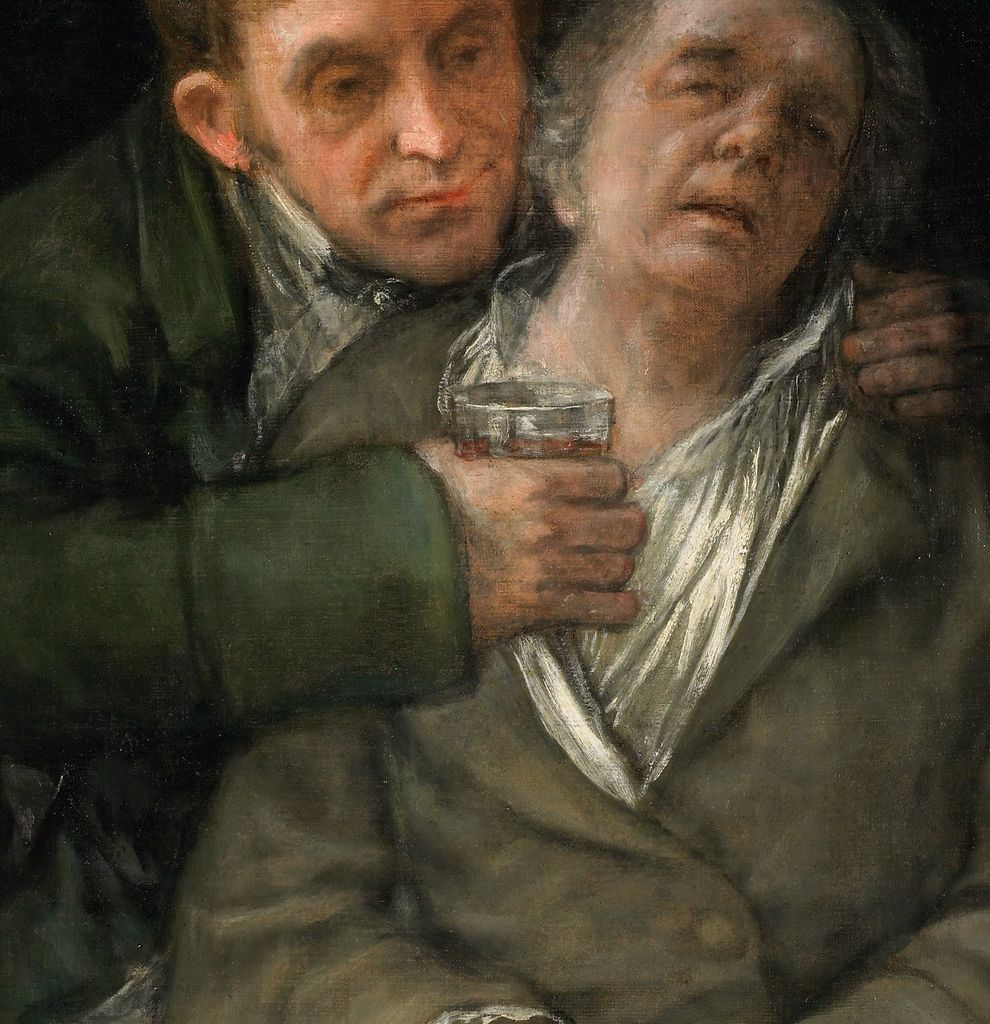
Arrieta’s arms perform two jobs at once. One braces Goya across the chest while the other brings the glass close. Look at the narrow space between its rim and Goya’s mouth. The patient’s head would have to move very little for him to take a sip, and the doctor has brought him most of the way. A reddish liquid is visible inside the glass, which the museum reads as a tonic. Pale highlights establish the rim and side of the vessel. The painting leaves the contents unspecified and shows the instant before we see whether Goya can drink. That pause makes the doctor’s attention to his patient as important as the glass he holds. [1] [2] [4]
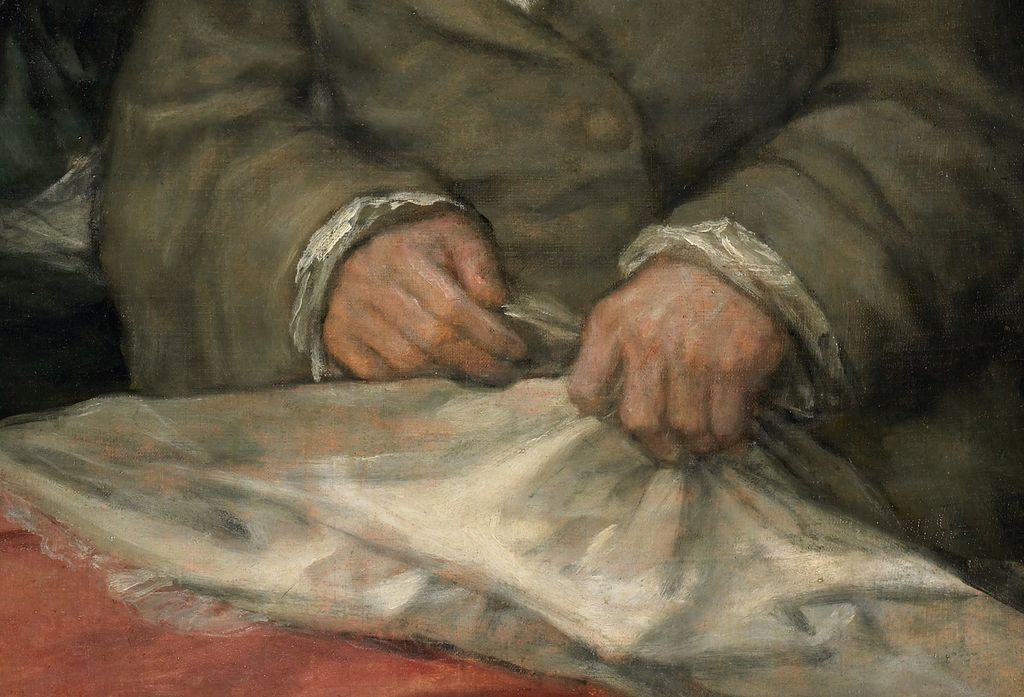
Lower down, the patient’s fingers have an action of their own. They close unevenly around the bedding, lifting small folds out of the sheet. There is enough light on the knuckles for us to see the effort. A red coverlet forms a broad band across the lower part of the bed. The white cloth above it gathers into peaks and hollows around Goya’s lap, then comes close to the white of his shirt. The bedding gives the hands something they can still do, even as Arrieta takes the weight of his upper body. [1] [4]
The close grouping also determines where we stand as viewers. Goya appears low in the bed, but his face is at roughly the same height as the doctor’s stooping face. From there we can follow the doctor’s attention down towards the mouth and glass, and then to Goya’s hands. Much of the canvas below is given over to the bed and the inscription. The scale gives these small exchanges of weight and movement room to be seen. [1]
Annotated Details from Self-Portrait with Dr Arrieta
Trace the doctor’s support and the patient’s grip down to Goya’s dedication.
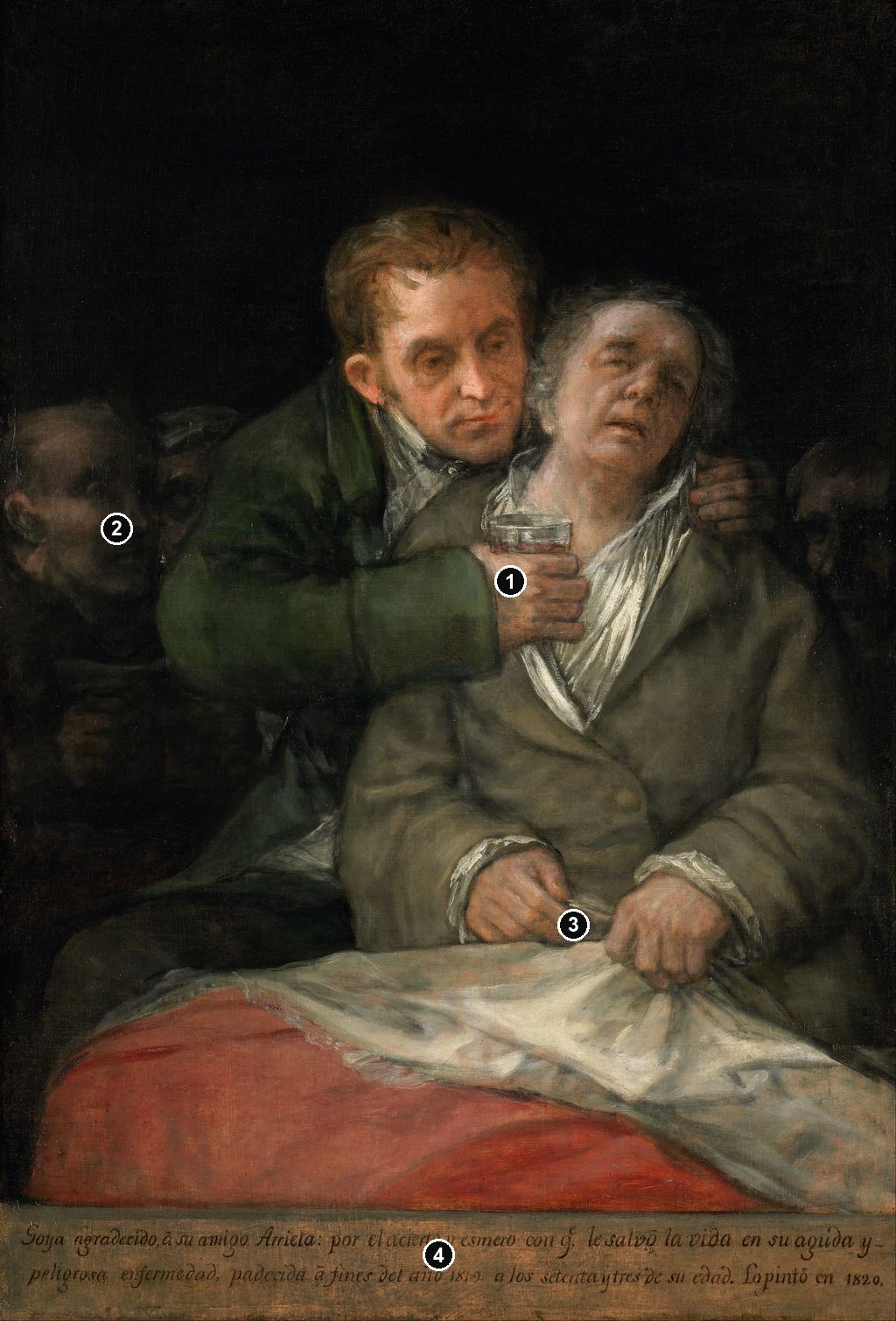
Details from SELF-PORTRAIT WITH DR ARRIETA
Details from the 1820 painting in the Minneapolis Institute of Art (52.14).
The doctor and the glass
Arrieta steadies the glass near Goya’s chest while supporting him from behind.
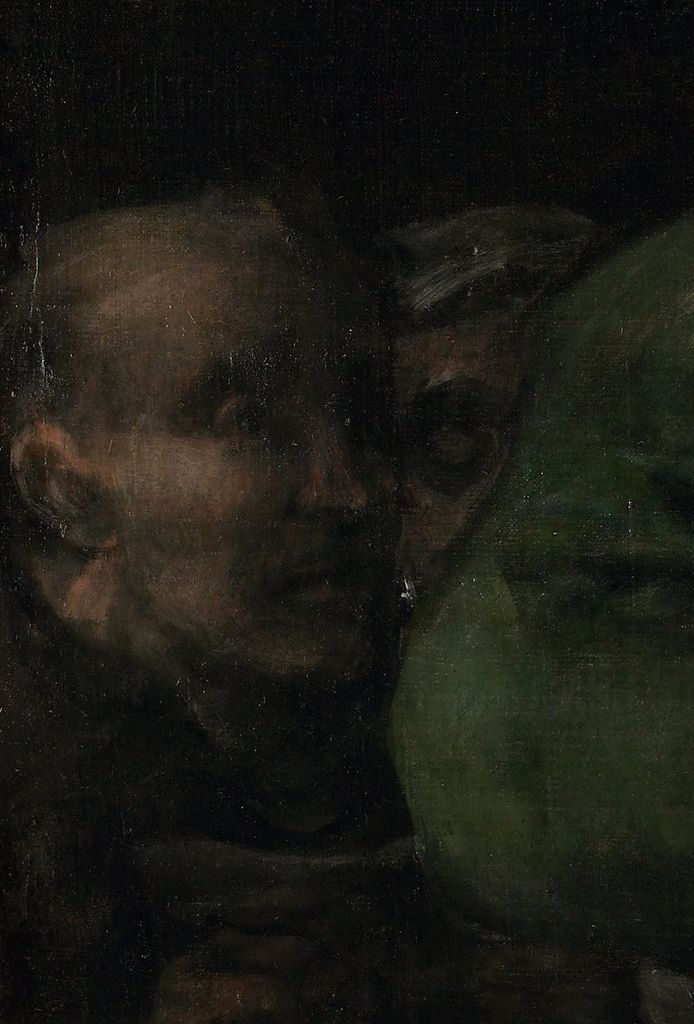
A figure in shadow
A dim face appears at left, only a few patches of light away from the surrounding dark.
Hands on the sheet
Goya’s hands gather the light bedding into folds across his lap.
The dedication
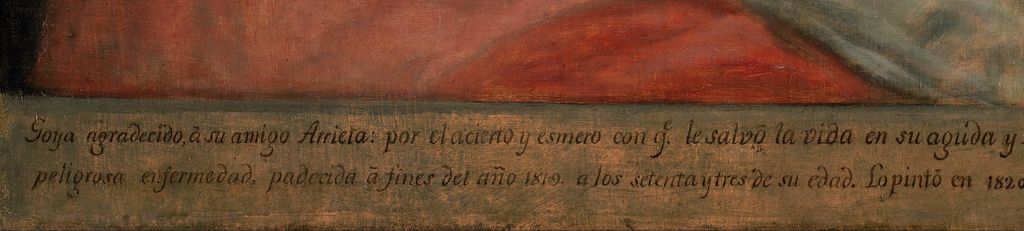
Goya gives thanks to Arrieta in the lines painted below the scene.
The figures in the dark
The longer we stay with the picture, the more the darkness behind the two men seems occupied. At the left a head and a possible vessel emerge. Farther back, other faces have just enough modelling to suggest eyes, noses and mouths. Their bodies are difficult to follow. Compare those heads with the doctor’s hand at Goya’s chest, where colour and light make the fingers easy to place. The background offers much less information about where people stand or what they are doing. The bedclothes provide a setting at the front, while the space behind them remains hard to locate. [1] [4] [5]
The National Gallery in London considers whether the figure on the left might be a friar with a vessel for the last rites, and also entertains the possibility that the figures are threatening presences. The Minneapolis Institute of Art asks whether they might be real people or visions arising during the illness. The possibility of a second vessel makes the small glass in the foreground particularly interesting. We can see how Arrieta holds it and where it is going. The object in the shadows has no equally clear destination. That difference gives the bedside action its assurance, even while the rest of the scene stays hard to read. [2] [5]
What Goya wrote beneath the bed
The painted inscription is set apart on a strip along the bottom edge. In the Minneapolis Institute of Art’s English translation, Goya thanks his friend Arrieta for the skilled attention that saved him during a severe and dangerous illness towards the end of 1819, when he was 73. The last sentence dates the painting to 1820. The two dates tell us that the painter could already know the outcome as he reconstructed the crisis. In the image his body still seems about to give way. In the writing he can say what the doctor accomplished. [2] [4]
The word “friend” matters to the way the dedication reads. Arrieta’s name is attached to a particular act of help, and the scene gives that help a physical form. When we look up again after reading, the arm across Goya’s chest and the hand with the glass give substance to the words about skill and care. The National Gallery records that Goya gave the painting to Arrieta. The doctor could recognise himself both in the likeness and in the description of what he had done. [2] [5]
Mia relates the painting to the ex-voto, an offering made in thanks for deliverance from danger. In Catholic painted ex-votos, the dangerous event could be depicted alongside a written acknowledgement of divine aid. Goya uses the combination of image and written thanks. The inscription names the person whose care he credits, and that person is shown working at the bedside. Curators at the Frick Collection have also noted the resemblance to a Pietà, in which the Virgin supports Christ’s body. The likeness lies in the bodily arrangement, especially the tilt of Goya’s head and Arrieta’s arm taking his weight. The glass poised beside the mouth holds open the possibility of what happens next. [1] [2] [6]
Goya on film
Five films explore Goya’s portraits, prints, Black Paintings and painting techniques.
The Duke of Wellington by Goya
The portrait, its military decorations and its later theft.
Watch on YouTubeTwo scenes of care in 1819 and 1820
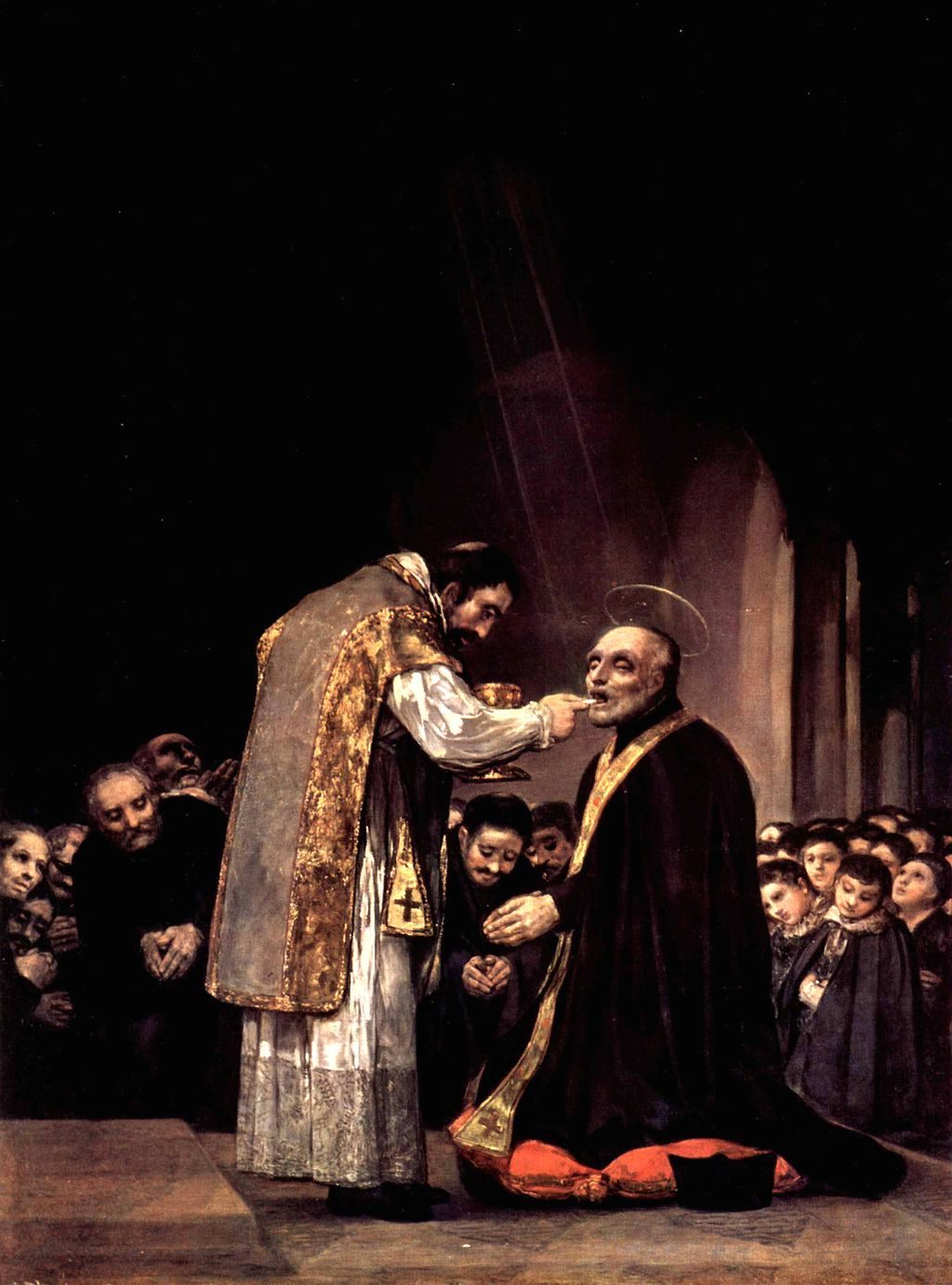
Earlier in 1819, Goya painted The Last Communion of Saint Joseph of Calasanz for the Piarist fathers of San Antón in Madrid. The large oil painting was installed on a side altar that August. It shows the elderly founder of the order kneeling near the end of his life. His face is raised and his hands joined as a priest brings the host towards him. Goya directs a narrow band of light towards the saint, with the people behind him less brightly lit. Both works ask us to attend to the approach of a hand to an older man’s mouth. In the altarpiece, the clothing, architecture and posture tell us we are looking at a sacrament. At Goya’s bedside the glass, nightshirt and bedding tell us how to read the immediate act of care. [1] [7]
The earlier ink self-portrait at the Metropolitan Museum of Art offers another way to look at the canvas. Dated about 1796, that drawing came after the serious illness of 1792–93 that left Goya profoundly deaf. The face is closely worked while the coat is lightly sketched. Goya looks squarely out of the sheet and puts his name on a small badge attached to his lapel. In Minneapolis his eyes drift away, and his name belongs to a dedication that makes room for a second person. The two works record how differently Goya could place himself before a viewer, from a face that holds our attention on its own to one whose condition we understand partly by watching someone else attend to it. [1] [2] [8]
What makes a painting an act of thanks
The Minneapolis Institute of Art sets the painting beside the long custom of making a material offering after help or recovery. In a painted offering the inscription can say who experienced danger, whose help was sought and how the image was intended to repay it. Goya’s inscription names the doctor and gives a point in time for the intervention, lending the picture some of that documentary shape. Look up from the text and the doctor's presence is established through his forearm, the glass and the steadiness with which he supports the patient. Those actions make the written thanks concrete. [2] [9]
The image also distributes its evidence unevenly. A viewer can read the identity of both principal people without solving the bodies in the shadows. Goya and Arrieta are linked through the work of drinking, which might be difficult for somebody who is weak or unable to sit up. The partly described faces behind them heighten the feeling that the event is witnessed. Assigning them a single identity would demand information the inscription does not provide. The picture retains a degree of uncertainty even though its central purpose is unusually well documented. [2] [9]
Putting the inscription and the gesture together lets the portrait be read in two directions. It tells a viewer that the sitter survived to remember the illness. It also gives that survivor the task of showing how little command he appears to have over his body in the painted episode. That physical dependence is especially striking in a self-portrait, where the painter ordinarily demonstrates control through the act of depicting himself. Arrieta’s capacity to hold the patient steady becomes as important to the finished image as the ability of the patient to paint it later. [2] [9]
The gesture of offering a cup makes care legible to viewers without requiring knowledge of a diagnosis or of the contents of the drink. That separation has a compositional effect. A viewer can follow the weight of the body into the doctor's supporting arm before reading the inscription and learning whose experience is represented. The text gives dates and names to that visible act. The combination lets the portrait operate both as a specific expression of gratitude from one person to another and as an occasion for a stranger to recognise what the help consisted of. [2] [9]
From Arrieta’s collection to Minneapolis
The Fundación Goya en Aragón lists Arrieta as the painting’s first owner and traces it through collections in Madrid and Paris, then through the New York dealers Seligman and M. Knoedler & Co. The Minneapolis Institute of Art acquired the canvas in 1952. Since then it has been shown at the Frick Collection in New York, where it appeared in Goya’s Last Works in 2006, and at the National Gallery in London in Goya: The Portraits in 2015. Seen among Goya’s other portraits, it gives the physician a place in his circle of sitters. It also records the act for which Goya wanted this particular sitter to be remembered. [4] [5] [6]
Artworks directory
| Name | Date | Medium |
|---|---|---|
| And There’s No Help for It, Plate 15 | Printed 1863 | |
| Asmodea | c. 1820–23 | Wall painting transferred to canvas |
| Boys Inflating a Bladder | 1777–78 | Tapestry cartoon |
| Boys Picking Fruit | 1778 | Tapestry cartoon |
| Bullfight in a Divided Ring | 1825 | Lithograph |
| Card Players | 1777–78 | Tapestry cartoon |
| Card Players (sketch) | 1777–78 | Painted sketch |
| Dance on the Banks of the Manzanares | 1777 | Tapestry cartoon |
| Duel with Cudgels | c. 1820–23 | Wall painting transferred to canvas |
| Heads in a Landscape | c. 1820–23 | Easel painting |
| Judith and Holofernes | c. 1820–23 | Wall painting transferred to canvas |
| Leocadia | c. 1820–23 | Wall painting transferred to canvas |
| Maja and Cloaked Men | 1777 | Tapestry cartoon |
| Maja and Cloaked Men (sketch) | 1777 | Painted sketch |
| Majo Clapping in Time to the Music | 1777 | Drawing |
| Men Reading | c. 1820–23 | Wall painting transferred to canvas |
| Out Hunting for Teeth, Plate 12 | 1799 | Etching, burnished aquatint and burin |
| Picnic in the Countryside (sketch) | 1776–78 | Painted sketch |
| Picnic on the Banks of the Manzanares | 1776 | Tapestry cartoon |
| Pilgrimage to San Isidro | c. 1820–23 | Wall painting transferred to canvas |
| Preparatory study for The Sleep of Reason Produces Monsters | c. 1796–97 | Drawing |
| Procession of the Holy Office | c. 1820–23 | Wall painting transferred to canvas |
| Quarrel at the Cockerel Inn (sketch) | 1777 | Painted sketch |
| Quarrel in the New Tavern | 1777 | Tapestry cartoon |
| Saturn Devouring His Son | c. 1820–23 | Wall painting transferred to canvas |
| Seated Majo Smoking | c. 1776 | Drawing |
| The Dog | c. 1820–23 | Wall painting transferred to canvas |
| The Drinker | 1777 | Tapestry cartoon |
| The Fates | c. 1820–23 | Wall painting transferred to canvas |
| The Great He-Goat | c. 1820–23 | Wall painting transferred to canvas |
| The Kite | 1777–78 | Tapestry cartoon |
| The Parasol | 1777 | Oil on canvas, tapestry cartoon |
| The Second of May 1808 | 1814 | Oil on canvas |
| The Sleep of Reason Produces Monsters, Plate 43 | 1799 | Etching and aquatint |
| The Third of May 1808 | 1814 | Oil on canvas |
| Thou Who Canst Not, Plate 42 | 1799 | Etching and burnished aquatint |
| Three Figures | 1776 | Drawing (lost) |
| Two Old Men | c. 1820–23 | Wall painting transferred to canvas |
| Two Old Men Eating Soup | c. 1820–23 | Wall painting transferred to canvas |
| Two Women and a Man | c. 1820–23 | Wall painting transferred to canvas |
| Universal Language: The Author Dreaming | 1797 | Drawing |
| The Family of Charles IV | 1800 | Oil on canvas |
| Witches’ Sabbath (Osuna painting) | 1797–98 | Oil on canvas |
| The Nude Maja | 1795–1800 | Oil on canvas |
| The Clothed Maja | 1800–07 | Oil on canvas |
| Self-Portrait (Drawing) | c. 1796 | Brush and carbon black ink on laid paper |
| The Swing, Madrid Album B.21 | 1795–97 | Brush and carbon black washes |
| Majas Fighting, a Majo Observing, Madrid Album B.15 | 1796–97 | Brush, grey and black washes on laid paper |
| Majos and Majas Conversing, Madrid Album B.16 | c. 1794–97 | Ink wash on paper |
| Weeping Woman and Three Men, Madrid Album B.17 | 1795–97 | Brush, carbon black washes and black chalk |
| Maja Seated on a Chair and Two Companions Behind, Madrid Album B.18 | 1795–97 | Brush and carbon black washes |
| Girl and Bull, Madrid Album B.23 | 1796–97 | Brush and carbon black washes |
| Lovers Sitting on a Rock, Madrid Album B.24 | 1796–97 | Brush and carbon black washes |
| Mariano Ceballos Riding a Bull | 1825 | Crayon lithograph and scraper |
| Landscape (lifetime impression) | c. 1807–10 | Etching and aquatint |
| Self-Portrait (1815), Prado canvas | 1815 | Oil on canvas |
| Self-Portrait (1815), Academy panel | 1815 | Oil on panel |
| Self-Portrait with Dr Arrieta | 1820 | Oil on canvas |
| Christ Crucified | 1780 | Oil on canvas |
| The Last Communion of Saint Joseph of Calasanz | 1819 | Oil on canvas |
| Christ on the Mount of Olives | 1819 | Oil on panel |
| The Flower Girls, or Spring | 1786–87 | Oil on canvas |
| The Grape Harvest, or Autumn | 1786–87 | Oil on canvas |
| The Snowstorm, or Winter | 1786–87 | Oil on canvas |
| The Threshing Ground, or Summer | 1786–87 | Oil on canvas |
| Picnic on the Banks of the Manzanares | 1776 | Oil on canvas |
| The Kite | 1777–78 | Oil on canvas |
| Dance on the Banks of the Manzanares | 1777 | Oil on canvas |
| A Fight at the Venta Nueva | 1777 | Oil on canvas |
| Blind Man’s Bluff | 1788 | Oil on canvas |
| Dogs on a Lead | 1775 | Oil on canvas |
| Hunting with a Decoy | 1775 | Oil on canvas |
| Hunter Loading His Rifle | 1775 | Oil on canvas |
| The Angler | 1775 | Oil on canvas |
| The Hermitage of San Isidro on His Feast Day | 1788 | Oil on canvas |
| The Meadow of San Isidro | 1788 | Oil on canvas |
| The Straw Manikin | 1791–92 | Oil on canvas |
| Witches’ Flight | c. 1797–98 | Oil on canvas |
| A Scene from ‘The Forcibly Bewitched’ | 1798 | Oil on canvas |
| The Duchess of Alba in Black | 1797 | Oil on canvas |
| The Duchess of Alba in White | 1795 | Oil on canvas |
| Charles III in Hunting Dress | c. 1786 | Oil on canvas |
| The Duke and Duchess of Osuna and Their Children | 1787–88 | Oil on canvas |
| Manuel Osorio Manrique de Zúñiga | 1787–88 | Oil on canvas |
| The Marquesa de Pontejos | c. 1786 | Oil on canvas |
| Equestrian Portrait of the 1st Duke of Wellington | 1812 | Oil on canvas |
| The Duke of Wellington | 1812–14 | Oil on wood |
| Portrait of Ferdinand VII of Spain | 1814 | Oil on canvas |
| Gaspar Melchor de Jovellanos | 1798 | Oil on canvas |
| María Tomasa Palafox y Portocarrero | 1804 | Oil on canvas |
| Señora Sabasa García | c. 1806–11 | Oil on canvas |
| Don Juan Bautista de Muguiro | 1827 | Oil on canvas |
| Doña Isabel de Porcel | Before 1805 | Oil on canvas |
| The Colossus | After 1808 | Oil on canvas |
| The Burial of the Sardine | 1808–12 | Oil on panel |
| The Madhouse | 1808–12 | Oil on panel |
| A Procession of Flagellants | 1808–12 | Oil on panel |
| Portrait of Jacques Galos | 1826 | Oil on canvas |
| Portrait of Mariano Goya, the Artist’s Grandson | 1827 | Oil on canvas |
| Milkmaid of Bordeaux | c. 1827 | Oil on canvas |
| Portrait of Don Juan Antonio Cuervo | 1819 | Oil on canvas |
| María Luisa of Parma (Naples version) | c. 1800 | Oil on canvas |
| The Countess of Baena | 1819 | Oil on canvas |
| The Family of the Infante Don Luis | 1783–84 | Oil on canvas |
| The Holy Family | c. 1787 | Oil on canvas |
| Saint Barbara | c. 1773 | Oil on canvas |
| Saints Justa and Rufina | 1817 | Oil on canvas |
| El Tío Paquete | c. 1819–20 | Oil on canvas |
| The Forge | c. 1815–20 | Oil on canvas |
| Majas on a Balcony (Metropolitan Museum version) | c. 1800–10 | Oil on canvas |
| Maja and Celestina on a Balcony | c. 1808–12 | Oil on canvas |
| The Water Bearer | 1808–12 | Oil on canvas |
| Time and the Old Women | c. 1810 | Oil on canvas |
Frequently Asked Questions
Discussion
Look again at the images and ideas explored in Self-Portrait with Dr Arrieta. These editorial prompts invite your observations.
Follow the doctor’s supporting arm, the hand with the glass and Goya’s fingers in the sheet. Which gesture first tells you how seriously ill the painter is? How does reading the dedication change the way you see that gesture?
Reader Insights
Where does the light bring your eye as Arrieta supports Goya?
How does the dedication change your reading of the scene?
Join the Conversation
Share a detail, comparison or question about Self-Portrait with Dr Arrieta below.
References
- Minneapolis Institute of Art, Self-Portrait with Dr. Arrieta, 52.14, collection record, image and published object data. View source 1. View source 2.
- Gretchen Halverson, “Goya’s Gratitude and the Long Tradition of Artistic Tributes to Health Workers”, Minneapolis Institute of Art, English translation of the inscription and discussion of the ex-voto. View source.
- Minneapolis Institute of Art, “Family, Friends, and Communities”, object data for 52.14. View source.
- Fundación Goya en Aragón, Goya to his Doctor Arrieta, 52.14, catalogue entry, Spanish inscription and analysis. View source.
- National Gallery, London, “The private Goya”, exhibition commentary on the gift and the background figures. View source.
- The Frick Collection, “Self-Portraits and Portraits”, Goya’s Last Works, catalogue no. 3. View source.
- Fundación Goya en Aragón, La última comunión de San José de Calasanz (in Spanish), commission, installation and analysis. View source.
- The Metropolitan Museum of Art, Self-Portrait, 35.103.1, object record and curatorial commentary. View source.
- Minneapolis Institute of Art, “Goya’s Self-Portrait with Dr. Arrieta”, illustrated artwork study. View source.







