


 by Tom Gurney
Tom Gurney BSc (Hons) is an art history expert with over 20 years experience
Published on June 19, 2020 / Updated on November 20, 2026
Email: tomgurney1@gmail.com / Phone: +44 7429 011000
Introduction
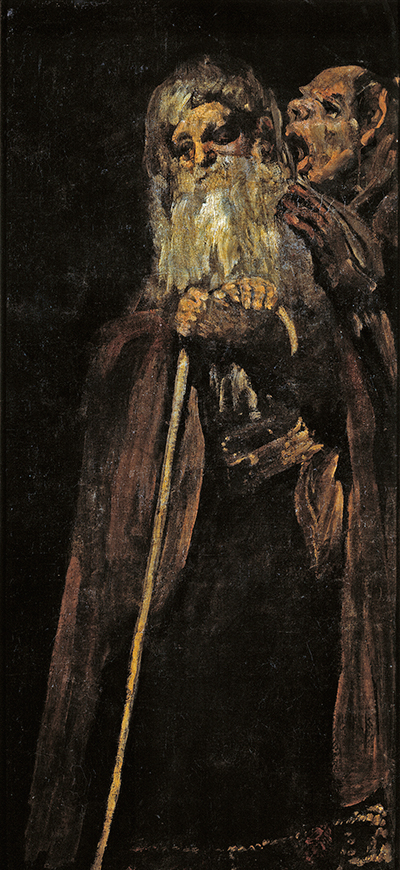
An old man bows over a walking staff. A second face comes up beside his ear, mouth open, close enough to make a whisper seem possible although the expression suggests a shout. The man with the staff gives little away. His hands stay clasped and his eyes are lowered. Francisco de Goya painted this uneven encounter on a wall of the Quinta del Sordo, his house outside Madrid. It survives as a narrow canvas in the Museo Nacional del Prado, one of the fourteen murals known as the Black Paintings. [1] [2]
At a Glance
- ArtistFrancisco de Goya y Lucientes
- DateAbout 1820–1823
- Spanish titleDos viejos. Also catalogued as Dos frailes (Two Friars).
- MediumMixed technique on a wall coating, transferred to canvas. The Fundación Goya en Aragón describes the original technique as oil on plaster.
- Dimensions142.5 × 65.6 cm, height before width, in the Prado data published in Spain’s official gazette. The Fundación gives a width of 66 cm.
- CollectionMuseo Nacional del Prado, Madrid, P000759. [1] [2]
Works across Goya’s career
The Parasol
1777The Nude Maja
1795–1800Saturn Devouring His Son
c. 1820–23The Dog
c. 1820–23Two Old Men
c. 1820–23The man with the staff
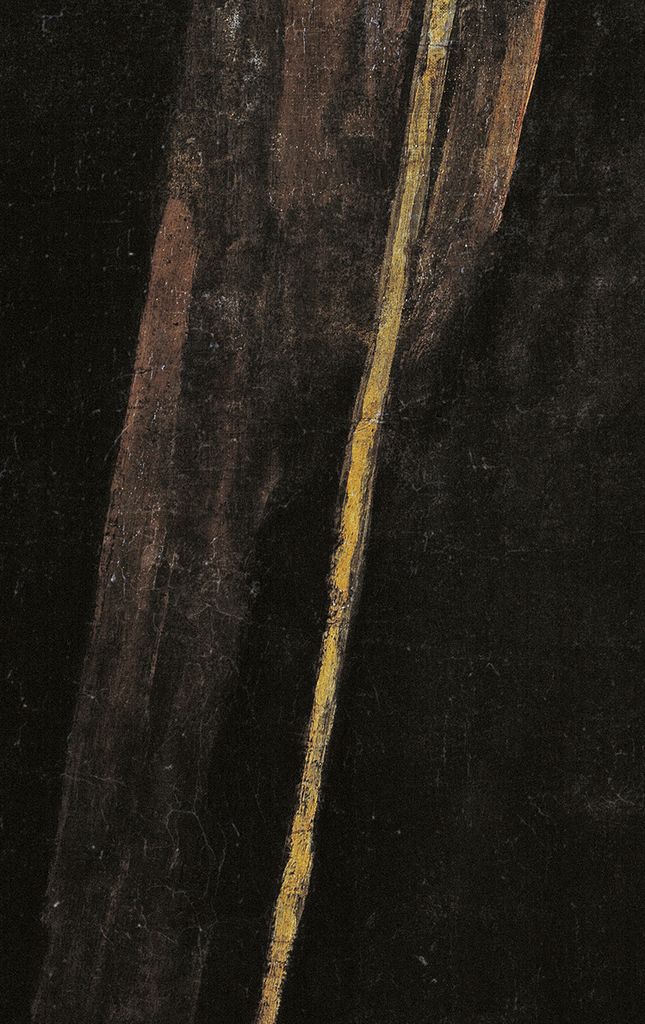
The staff enters near the bottom left and rises on a steep diagonal to the old man’s hands. It is almost a continuous pale line in a painting full of broken edges. His coat echoes its slope, but the line of his back and the fall of the beard draw his head back towards the middle of the panel. Even where the clothing becomes hard to distinguish from the black behind it, the staff keeps the body legible. Its position also suggests how the man stands. His weight seems to come down through the layered fabric and the hands resting over the top of the stick.
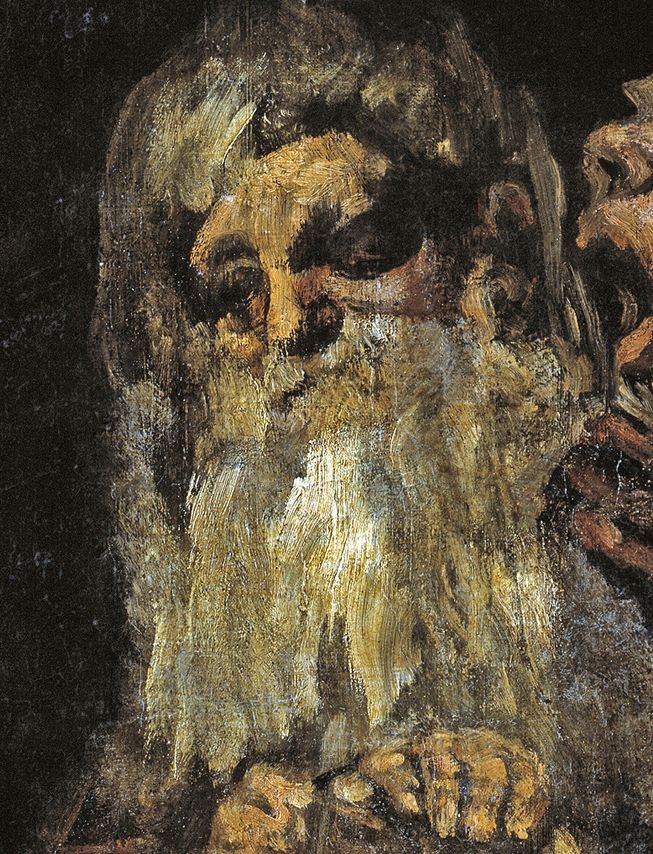
Small highlights pick out the knuckles. Above them the long beard is built up in broad interwoven strokes, cream and grey over darker passages. It almost covers the chest. The light reaches the bridge of the nose and the brow before running out in the eye sockets. That combination makes the head seem heavy. The Fundación Goya calls attention to the thick brushwork of the beard against the black base. The effect recalls a face glimpsed by candlelight, although the painted scene supplies no visible lamp or candle. The darkness gives the eye few places to go after it has found the hands and the face. [2]
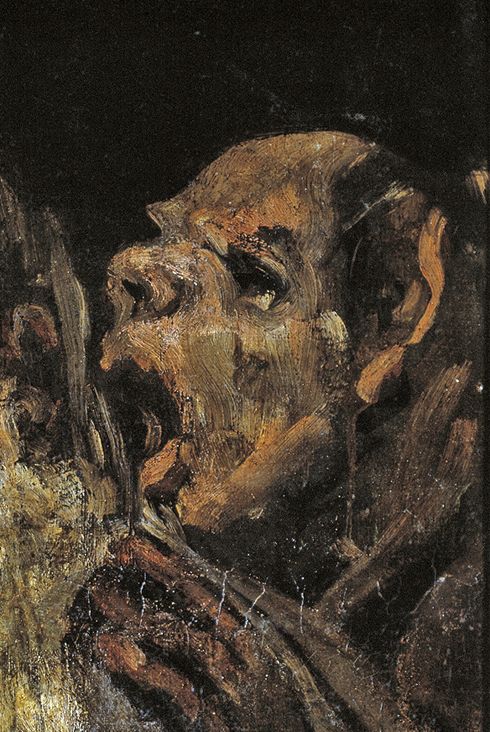
The second figure takes up much less of the surface. The eye, nose and open mouth show in the upper right and part of the body disappears behind the old man. The head thrusts forward almost horizontally, across the stronger vertical formed by the staff and beard. Following those lines through the composition makes the figures’ different actions apparent. The staff suggests a movement that has come to rest. The mouth suggests something still happening, even if the painting leaves its duration and volume to us. The second figure breaches the distance usually kept between faces, while the old man’s lowered head makes it hard to read whether he registers the intrusion. [2]
Annotated Details from Two Old Men
Look from the faces and hands to the diagonal of the staff.
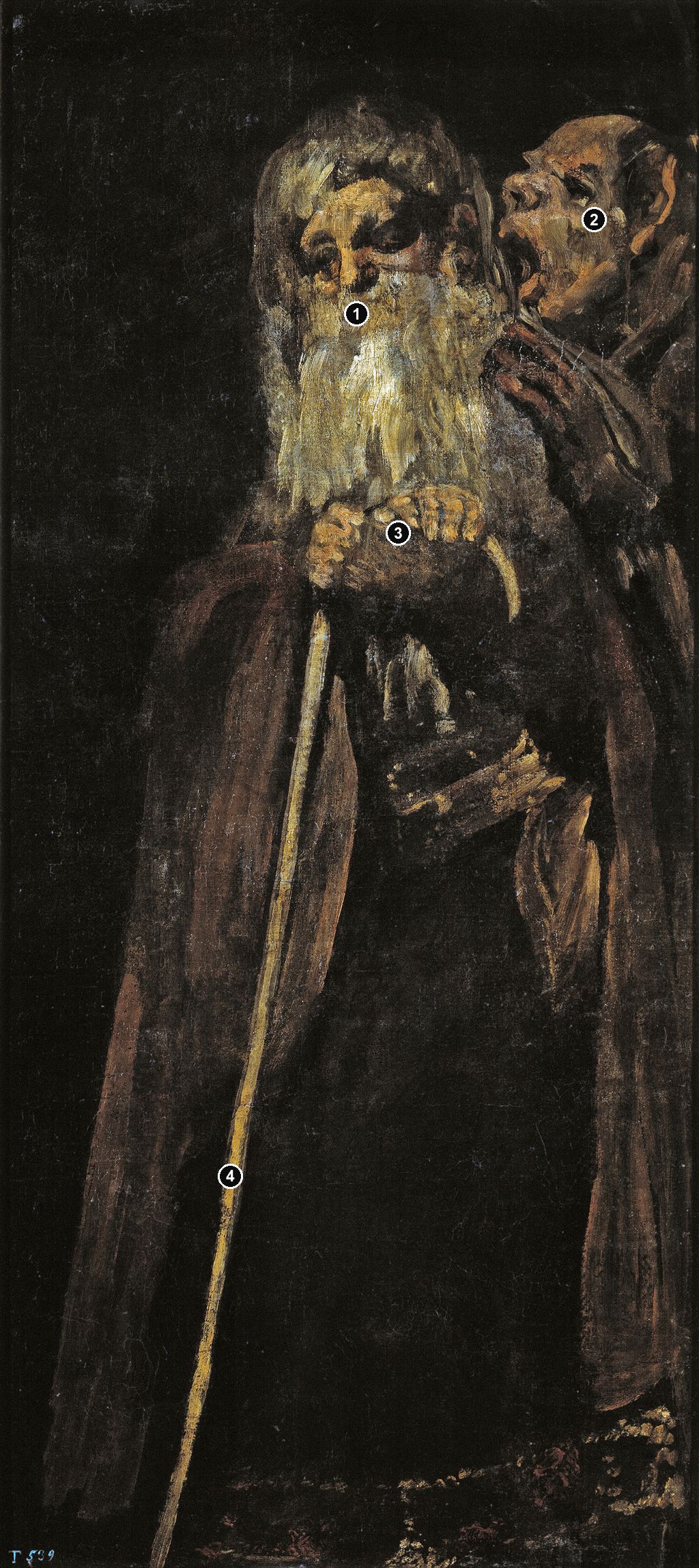
Details from TWO OLD MEN
Details from the transferred canvas in the Museo Nacional del Prado (P000759).
The lowered face
Thin light strokes extend the beard down from the head. Deep shadows at the eyes lower the figure’s gaze.
The face behind
The second face leans close behind the old man. Its open mouth is easy to pick out against the dark cheek and neck.
Hands on the staff
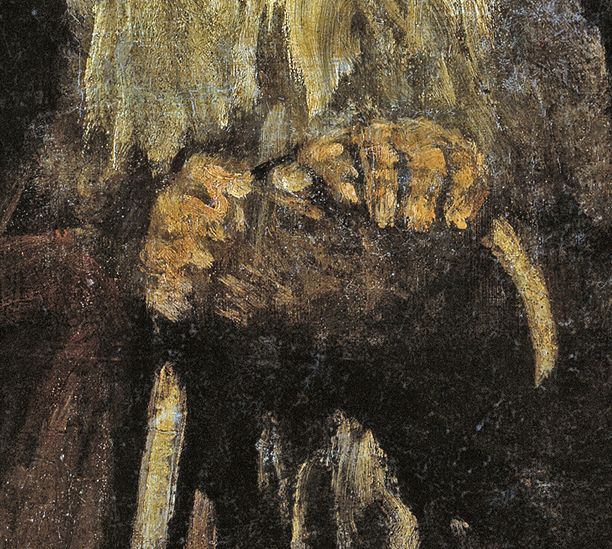
The knuckles catch the light in two patches where the hands come together above the shaft.
The long diagonal
A thin ochre line continues through the shadow. The surrounding garments break into broader and less definite strokes.
From old men to friars
The Prado’s earlier catalogue account records Dos viejos in an inventory associated with the painter Antonio Brugada and the works owned by Goya’s son Javier. The inventory is undated, and its date has been debated. Charles Yriarte included the mural as Les Vieillards in his 1867 study, the earliest dated description identified in the Prado account. He saw it among the pictures downstairs. In 1900 the Prado catalogue called it Dos frailes. The Fundación Goya also records a longer variant that singles out one of the two old friars for leaning on a stick. The same object can be tracked through those changes in wording by its composition and catalogue number. [2] [3] [4]
The heavy robe and the long beard can make the foremost man look like a friar or a hermit. A staff also belongs plausibly to a traveller or an elderly man who needs support. The shallow space makes the second figure harder to place. The Fundación describes its appearance as animal-like, an impression encouraged by the jutting face and exposed mouth. The surviving picture gives no clear badge of a religious order or other detail that settles who these characters are. The catalogue titles show how convincingly the first man suggests a type, and how quickly that association can extend to the second figure once a viewer has read the word friars. [2] [3]
The old man and Goya’s hearing
The art historian Folke Nordström linked the figure calling into the man’s ear to Goya’s deafness. The Fundación Goya also cites Nordström and Xavier de Salas for an association between the man’s age and the artist’s own. The image gives the hearing interpretation a particular point of contact. The effort seems to be all on the side of the speaker, while the man nearest to us scarcely changes his posture. That same contrast allows for other readings. His lowered gaze could be concentration, resignation or indifference. His age and Goya’s make the comparison possible, but the record supplies no named sitter. The house itself was already called the Quinta del Sordo before Goya bought it in 1819. [2] [3]
The Fundación compares the painted figure with the elderly man in Goya’s later Bordeaux drawing Aún aprendo (I Am Still Learning), sheet 54 from Album G, Prado D04151. In both works a long beard and an inclined body bring the weight of the figure forward. In the drawing the man braces himself on two walking sticks as he steps, and tiny eyes look out of the paper. His movement and the handwritten words at the top of the sheet give the figure something of his own to say. In the mural the single staff holds the man almost still, and the apparent voice comes from the figure behind him. The comparison shows Goya assigning different kinds of attention and purpose to similarly aged figures. The drawing belongs to his later years in France and has its own catalogue and history. [2] [5]
Goya on film
Five films explore Goya’s portraits, prints, Black Paintings and painting techniques.
The Duke of Wellington by Goya
The portrait, its military decorations and its later theft.
Watch on YouTubeOn the ground-floor wall
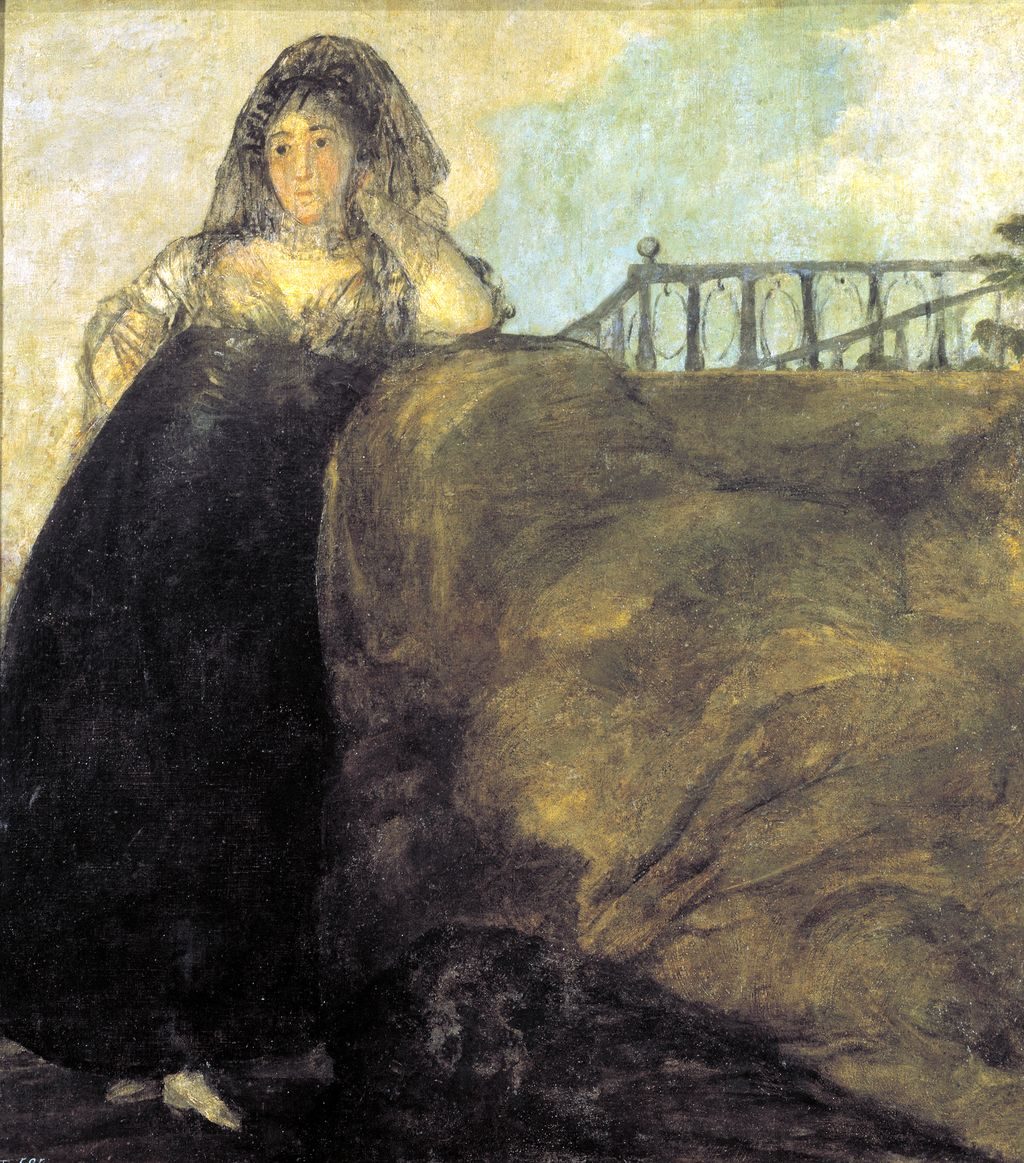
Carlos Teixidor Cadenas and Francisco Javier Laguna Rodríguez use the order of the catalogue on page 140 of Yriarte’s book to reconstruct a clockwise route through the ground-floor room. As they read it, a person facing the doorway from inside the room would have seen Two Old Men on the right and La Leocadia on the left. Carlos Foradada’s virtual reconstruction likewise places the vertical works on opposite sides of the door. The evidence includes the early descriptions, Laurent’s photographs of the murals and León Gil de Palacio’s scale model of Madrid, which shows the Quinta close to Goya’s lifetime. Yriarte’s prose account and catalogue are arranged differently. A proposed position on a diagram depends on how those accounts are reconciled with the physical evidence. [4] [6] [7]
Looking across that doorway would have brought two very different ways of leaning into view. The woman rests her elbow on a broad form at her side. Her panel has room to open up around her, and a lighter part of the background gives her dark dress a contour. The old man’s support is as narrow as a stick, and he has a face pressing in from behind. The Prado records the canvases at similar heights, with the woman’s nearly twice as wide. The Fundación also draws attention to the juxtaposition of a younger woman and an elderly man in the proposed arrangement. The pictures can sustain that comparison without requiring the two figures to be identified with people in Goya’s household. [1] [2] [6]
A third picture sometimes enters the same reconstruction. Two Old Ones Eating Soup is Prado P000762, a horizontal composition just under half a metre high. It shows a bowl and spoon and fits the space above a doorway in the Teixidor and Laguna proposal. The close grouping of the heads suits a compact panel meant to be taken in at a glance. The standing figure beside the door would have occupied much more of a visitor’s field of vision. Each image has its own record and Laurent negative. [1] [6] [7]
What Laurent photographed
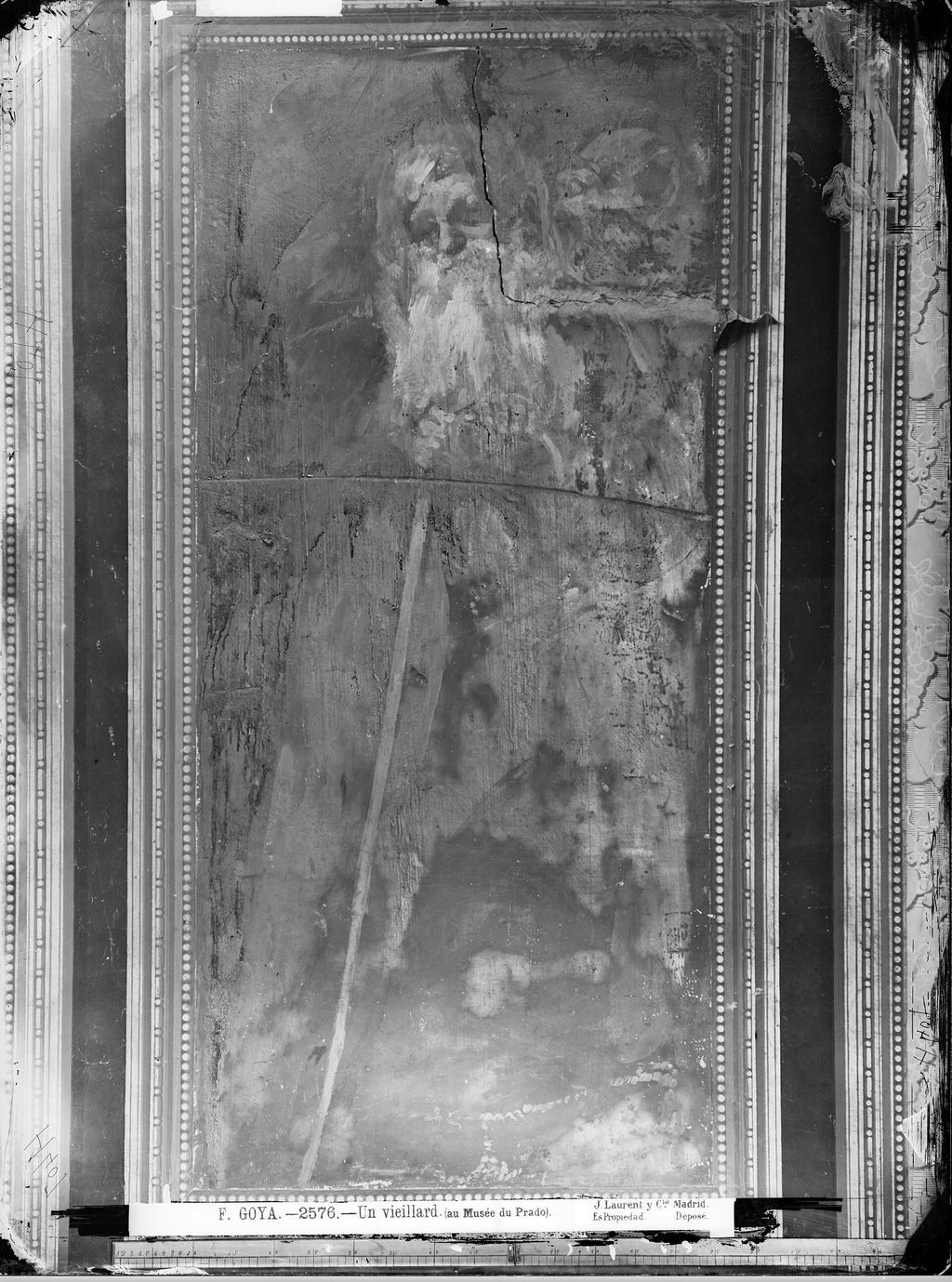
Jean Laurent photographed Two Old Men in 1874, while the mural was still on the Quinta wall. His glass negative, VN-08124, is held in the Archivo Ruiz Vernacci at Spain’s Instituto del Patrimonio Cultural. The full image shows a beaded paper surround, strips of wallpaper and a measuring scale below the scene. A prominent crack drops from the upper edge between the heads and then bends towards the right border. Another long break crosses the image below the beard. Along the bottom of the negative the label identifies the subject as 2576 — Un vieillard and gives its location as the Prado. The museum wording was added after the painting left the house. The wallpaper and the fractures belong to the earlier scene recorded by the camera. [6] [8]
The old man’s beard, the head immediately behind it and the diagonal staff provide points of comparison with the present canvas. The staff reaches almost to the lower edge inside the beaded border in the photograph, much as it reaches the foot of the canvas today. The second mouth was already close beside the old man’s head before the transfer. Its shape reads less readily amid the damaged wall and the light falling on the photographed surface. Comparing a photograph of that surface with a colour image of the canvas can establish the position of those features. A darker passage in one reproduction alone cannot establish when a given brushstroke was added. [2] [8]
Baron d’Erlanger, who acquired the Quinta in 1873, commissioned the restorer Salvador Martínez Cubells to take the murals off the walls and mount them on canvas. The Prado’s account records retouching associated with the extraction and restoration. The Fundación reports possible loss of preparation during removal and documents further conservation in 1973 and 1987. It lists the work at the Paris Universal Exhibition of 1878. D’Erlanger donated the paintings to the Spanish State in 1881, and they entered the Prado. The staff and open mouth survive as features of the painting at both stages of its history, while the paper surround survives as evidence of the room in which the mural was seen. [2] [3] [6] [8]
Artworks directory
| Name | Date | Medium |
|---|---|---|
| And There’s No Help for It, Plate 15 | Printed 1863 | |
| Asmodea | c. 1820–23 | Wall painting transferred to canvas |
| Boys Inflating a Bladder | 1777–78 | Tapestry cartoon |
| Boys Picking Fruit | 1778 | Tapestry cartoon |
| Bullfight in a Divided Ring | 1825 | Lithograph |
| Card Players | 1777–78 | Tapestry cartoon |
| Card Players (sketch) | 1777–78 | Painted sketch |
| Dance on the Banks of the Manzanares | 1777 | Tapestry cartoon |
| Duel with Cudgels | c. 1820–23 | Wall painting transferred to canvas |
| Heads in a Landscape | c. 1820–23 | Easel painting |
| Judith and Holofernes | c. 1820–23 | Wall painting transferred to canvas |
| Leocadia | c. 1820–23 | Wall painting transferred to canvas |
| Maja and Cloaked Men | 1777 | Tapestry cartoon |
| Maja and Cloaked Men (sketch) | 1777 | Painted sketch |
| Majo Clapping in Time to the Music | 1777 | Drawing |
| Men Reading | c. 1820–23 | Wall painting transferred to canvas |
| Out Hunting for Teeth, Plate 12 | 1799 | Etching, burnished aquatint and burin |
| Picnic in the Countryside (sketch) | 1776–78 | Painted sketch |
| Picnic on the Banks of the Manzanares | 1776 | Tapestry cartoon |
| Pilgrimage to San Isidro | c. 1820–23 | Wall painting transferred to canvas |
| Preparatory study for The Sleep of Reason Produces Monsters | c. 1796–97 | Drawing |
| Procession of the Holy Office | c. 1820–23 | Wall painting transferred to canvas |
| Quarrel at the Cockerel Inn (sketch) | 1777 | Painted sketch |
| Quarrel in the New Tavern | 1777 | Tapestry cartoon |
| Saturn Devouring His Son | c. 1820–23 | Wall painting transferred to canvas |
| Seated Majo Smoking | c. 1776 | Drawing |
| The Dog | c. 1820–23 | Wall painting transferred to canvas |
| The Drinker | 1777 | Tapestry cartoon |
| The Fates | c. 1820–23 | Wall painting transferred to canvas |
| The Great He-Goat | c. 1820–23 | Wall painting transferred to canvas |
| The Kite | 1777–78 | Tapestry cartoon |
| The Parasol | 1777 | Oil on canvas, tapestry cartoon |
| The Second of May 1808 | 1814 | Oil on canvas |
| The Sleep of Reason Produces Monsters, Plate 43 | 1799 | Etching and aquatint |
| The Third of May 1808 | 1814 | Oil on canvas |
| Thou Who Canst Not, Plate 42 | 1799 | Etching and burnished aquatint |
| Three Figures | 1776 | Drawing (lost) |
| Two Old Men | c. 1820–23 | Wall painting transferred to canvas |
| Two Old Men Eating Soup | c. 1820–23 | Wall painting transferred to canvas |
| Two Women and a Man | c. 1820–23 | Wall painting transferred to canvas |
| Universal Language: The Author Dreaming | 1797 | Drawing |
| The Family of Charles IV | 1800 | Oil on canvas |
| Witches’ Sabbath (Osuna painting) | 1797–98 | Oil on canvas |
| The Nude Maja | 1795–1800 | Oil on canvas |
| The Clothed Maja | 1800–07 | Oil on canvas |
| Self-Portrait (Drawing) | c. 1796 | Brush and carbon black ink on laid paper |
| The Swing, Madrid Album B.21 | 1795–97 | Brush and carbon black washes |
| Majas Fighting, a Majo Observing, Madrid Album B.15 | 1796–97 | Brush, grey and black washes on laid paper |
| Majos and Majas Conversing, Madrid Album B.16 | c. 1794–97 | Ink wash on paper |
| Weeping Woman and Three Men, Madrid Album B.17 | 1795–97 | Brush, carbon black washes and black chalk |
| Maja Seated on a Chair and Two Companions Behind, Madrid Album B.18 | 1795–97 | Brush and carbon black washes |
| Girl and Bull, Madrid Album B.23 | 1796–97 | Brush and carbon black washes |
| Lovers Sitting on a Rock, Madrid Album B.24 | 1796–97 | Brush and carbon black washes |
| Mariano Ceballos Riding a Bull | 1825 | Crayon lithograph and scraper |
| Landscape (lifetime impression) | c. 1807–10 | Etching and aquatint |
| Self-Portrait (1815), Prado canvas | 1815 | Oil on canvas |
| Self-Portrait (1815), Academy panel | 1815 | Oil on panel |
| Self-Portrait with Dr Arrieta | 1820 | Oil on canvas |
| Christ Crucified | 1780 | Oil on canvas |
| The Last Communion of Saint Joseph of Calasanz | 1819 | Oil on canvas |
| Christ on the Mount of Olives | 1819 | Oil on panel |
| The Flower Girls, or Spring | 1786–87 | Oil on canvas |
| The Grape Harvest, or Autumn | 1786–87 | Oil on canvas |
| The Snowstorm, or Winter | 1786–87 | Oil on canvas |
| The Threshing Ground, or Summer | 1786–87 | Oil on canvas |
| Picnic on the Banks of the Manzanares | 1776 | Oil on canvas |
| The Kite | 1777–78 | Oil on canvas |
| Dance on the Banks of the Manzanares | 1777 | Oil on canvas |
| A Fight at the Venta Nueva | 1777 | Oil on canvas |
| Blind Man’s Bluff | 1788 | Oil on canvas |
| Dogs on a Lead | 1775 | Oil on canvas |
| Hunting with a Decoy | 1775 | Oil on canvas |
| Hunter Loading His Rifle | 1775 | Oil on canvas |
| The Angler | 1775 | Oil on canvas |
| The Hermitage of San Isidro on His Feast Day | 1788 | Oil on canvas |
| The Meadow of San Isidro | 1788 | Oil on canvas |
| The Straw Manikin | 1791–92 | Oil on canvas |
| Witches’ Flight | c. 1797–98 | Oil on canvas |
| A Scene from ‘The Forcibly Bewitched’ | 1798 | Oil on canvas |
| The Duchess of Alba in Black | 1797 | Oil on canvas |
| The Duchess of Alba in White | 1795 | Oil on canvas |
| Charles III in Hunting Dress | c. 1786 | Oil on canvas |
| The Duke and Duchess of Osuna and Their Children | 1787–88 | Oil on canvas |
| Manuel Osorio Manrique de Zúñiga | 1787–88 | Oil on canvas |
| The Marquesa de Pontejos | c. 1786 | Oil on canvas |
| Equestrian Portrait of the 1st Duke of Wellington | 1812 | Oil on canvas |
| The Duke of Wellington | 1812–14 | Oil on wood |
| Portrait of Ferdinand VII of Spain | 1814 | Oil on canvas |
| Gaspar Melchor de Jovellanos | 1798 | Oil on canvas |
| María Tomasa Palafox y Portocarrero | 1804 | Oil on canvas |
| Señora Sabasa García | c. 1806–11 | Oil on canvas |
| Don Juan Bautista de Muguiro | 1827 | Oil on canvas |
| Doña Isabel de Porcel | Before 1805 | Oil on canvas |
| The Colossus | After 1808 | Oil on canvas |
| The Burial of the Sardine | 1808–12 | Oil on panel |
| The Madhouse | 1808–12 | Oil on panel |
| A Procession of Flagellants | 1808–12 | Oil on panel |
| Portrait of Jacques Galos | 1826 | Oil on canvas |
| Portrait of Mariano Goya, the Artist’s Grandson | 1827 | Oil on canvas |
| Milkmaid of Bordeaux | c. 1827 | Oil on canvas |
| Portrait of Don Juan Antonio Cuervo | 1819 | Oil on canvas |
| María Luisa of Parma (Naples version) | c. 1800 | Oil on canvas |
| The Countess of Baena | 1819 | Oil on canvas |
| The Family of the Infante Don Luis | 1783–84 | Oil on canvas |
| The Holy Family | c. 1787 | Oil on canvas |
| Saint Barbara | c. 1773 | Oil on canvas |
| Saints Justa and Rufina | 1817 | Oil on canvas |
| El Tío Paquete | c. 1819–20 | Oil on canvas |
| The Forge | c. 1815–20 | Oil on canvas |
| Majas on a Balcony (Metropolitan Museum version) | c. 1800–10 | Oil on canvas |
| Maja and Celestina on a Balcony | c. 1808–12 | Oil on canvas |
| The Water Bearer | 1808–12 | Oil on canvas |
| Time and the Old Women | c. 1810 | Oil on canvas |
Frequently Asked Questions
The Fundación Goya en Aragón catalogues an oil on canvas known as Two Old Men (sketch) in a private collection as attributed to Goya. It repeats the man with the staff and the figure at his ear. José Luis Morales y Marín regarded it as a small copy by another hand. Its relationship to the mural remains open. [9]
Discussion
Look again at the images and ideas explored in Two Old Men. These editorial prompts invite your observations.
Does the painter make the voice seem loud through the second figure’s mouth, or through how close he has to come? Try following the direction of the eyes as well as the line of the staff. What changes when you look at the old man’s hands before you look at either face?
Reader Insights
What does the staff contribute to the way you see the two figures?
How does the second face affect your reading of the first?
Join the Conversation
Share a detail, comparison or question about Two Old Men below.
References
- Museo Nacional del Prado, collection data for P759, Dos viejos, and P762, Dos viejos comiendo, Boletín Oficial del Estado, 2021, annex to the agreement. View source.
- Fundación Goya en Aragón, Dos viejos, Spanish catalogue and colour image. View source.
- Museo Nacional del Prado, Dos frailes, P00759, archived copy of the earlier Goya catalogue entry, especially pp. 1–2. View source.
- Charles Yriarte, Goya. Sa vie, son œuvre, Paris, Henri Plon, 1867, pp. 91–96 and p. 140. View source.
- Fundación Goya en Aragón, Aún aprendo (G.54), and Museo Nacional del Prado, earlier catalogue entry for Aun aprendo, D04151, archived copy. View source 1. View source 2.
- Carlos Teixidor Cadenas and Francisco Javier Laguna Rodríguez, ‘Las Pinturas negras en la Quinta de Goya. Reconstrucción de la planta baja, con las fotografías de J. Laurent de 1874’, pp. 401–412, especially pp. 405–411 and fig. 10. View source.
- Carlos Foradada, ‘El interior de la Quinta del Sordo’, AACA Digital, section 4 and fig. 12. View source.
- Jean Laurent, Un vieillard, photograph of the mural in situ, 1874, glass negative VN-08124, Archivo Ruiz Vernacci, Fototeca del IPCE. Digitised reproduction on Wikimedia Commons. View source.
- Fundación Goya en Aragón, Two Old Men (Dos viejos) (sketch), catalogue record for the attributed canvas. View source.








