by Tom Gurney
Tom Gurney BSc (Hons) is an art history expert with over 20 years experience
Published on June 19, 2020 / Updated on November 20, 2026
Email: tomgurney1@gmail.com / Phone: +44 7429 011000
Introduction
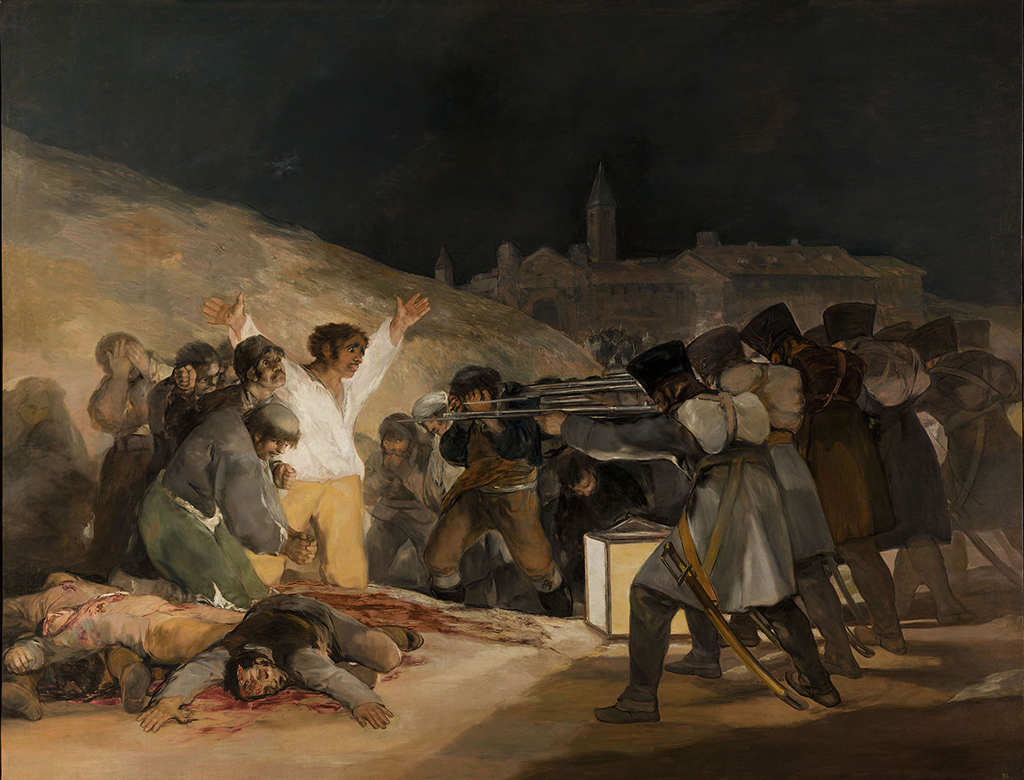
A man in a white shirt kneels on a hillside outside Madrid, his hands open and his arms raised. At his feet, another man lies with his own arms spread across the earth. The rifles from the right converge on the kneeling figure. A box lantern on the ground shines across the white shirt and catches the blood beside the body. Further back, other prisoners press forward, hands over mouths or faces, waiting to reach the patch of ground where the man in white is about to die. [1]
Francisco de Goya painted The Third of May 1808 in 1814, six years after the reprisals it depicts. The oil on canvas measures 268 by 347 centimetres and belongs to the Museo Nacional del Prado in Madrid, where it is catalogued as P000749. Its Spanish title is El 3 de mayo en Madrid o Los fusilamientos. Another familiar title places the shootings on the hill of Príncipe Pío, one of several sites where the French executed prisoners. [1] [2] [3]
Its companion, The Second of May 1808, shows civilians and French troops fighting at close quarters in the streets of Madrid. In The Third of May, control over the encounter has passed entirely to the troops. They get one shared pose, while every prisoner reacts differently. The painting gives as much attention to that enforced wait as it does to the moment of death. Both are visible alongside the aftermath in a single scene. [1] [4]
At a Glance
Works across Goya’s career
The Parasol
1777The Nude Maja
1795–1800Saturn Devouring His Son
c. 1820–23The Dog
c. 1820–23Milkmaid of Bordeaux
c. 1827The executions in Madrid
On 2 May 1808, a crowd gathered at Madrid’s Royal Palace as members of the Spanish royal family were being taken from the city. French troops dispersed the protesters and the fighting spread. Goya’s daytime canvas takes one episode from that uprising. The night picture depicts the reprisals ordered under Joachim Murat, Napoleon’s commander in Madrid. The Prado’s researchers date the beginning of the summary executions to the afternoon of 2 May. The Real Academia de la Historia records shootings that day in and around the Paseo del Prado and further executions at Príncipe Pío and the Retiro in the early hours of 3 May. The dates in the titles make an intelligible pair out of events that overlapped. [3] [4]
The traditional Príncipe Pío title connects the canvas to an actual place of execution. The hill and the buildings Goya painted give the scene the character of Madrid’s outskirts, but matching them to a particular spot is difficult. The Fundación Goya en Aragón notes that a feature resembling a gate in the painting presents a problem for the Príncipe Pío identification and discusses the Puerta de la Vega as another possibility. Mena Marqués and her colleagues at the Prado make a case for that latter area using the positions of two church towers they identify as Santa Cruz and Santa María la Real. Their reading gains an additional clue from a third tower, possibly San Nicolás, which Goya painted out. The skyline can therefore be read as an edited view of recognisable buildings. The execution site remains a matter of interpretation. [1] [4]
Goya was in a position to learn about the uprising and reprisals through accounts circulating in Madrid. The city’s experience had already been represented in prints and plays by the time he painted. Tomás López Enguídanos’s 1813 series, for example, followed the outbreak at the palace, the street fighting, the defence of the artillery park and executions on the Paseo del Prado. Goya’s choice to reduce this sequence to two scenes gives the contrast between fighting and reprisal the full weight of the pair. Documentary evidence for his presence at the shootings is lacking. The painting’s close view of the victims is evidence of how he composed the scene six years later. [4] [5]
What the surviving documents say about 1814
The surviving wording from Goya’s approach to the Regency, dated Madrid, 24 February 1814, includes the phrase “perpetuar por medio del pincel”, to perpetuate by means of the brush. He wanted to commemorate what he called the heroic actions of the uprising against Napoleon. On 9 March, Juan Álvarez Guerra wrote to the finance secretary conveying the Regency’s agreement. The Treasury would cover costs for canvas, preparation and colours, and pay Goya 1,500 reales de vellón per month while he carried out the work. The correspondence establishes the authorised rate. The final sum Goya received is uncertain. [5] [6]
As the monarchy was being restored, the city arranged decorations for Ferdinand VII’s ceremonial return to Madrid. The Prado research team found those civic arrangements documented separately from the paintings. In June and July, bills for making and gilding frames describe two large pictures connected with 2 May and refer to the king’s apartments. The bills establish a destination and the number of paintings involved in that work. Their dates also weaken the old account that the paintings themselves decorated the temporary arches for the king’s arrival in May. The Prado team found no record that the canvases actually went up in the king’s rooms, and neither work is recorded in the royal inventory of 1814. Confirmation of the pair’s location comes two decades later. [2] [4]
The petition’s language makes the choices in the painting all the more striking. Anyone expecting a heroic action would have found a struggle in the first canvas. Here, armed resistance is over. For the men in the lantern’s light, the available actions are to pray, look away or raise their hands. A public commemoration could have put a celebrated individual at its centre or painted the victory that justified the country’s sacrifices. Goya gives the greatest prominence to an unarmed man whose name is unknown. The open arms register across the room, while the expression on his face brings the viewer back to the ground beside him. [1]
How Goya directs the eye
The bodies and the pool of light
Start at the lower left, where the nearest dead man’s face is turned towards the viewer and his fingers splay out into the light. Another body lies partly across the ground just beyond him. Cloth, limbs and earth are difficult to separate where the bodies overlap. Goya brings the red of the blood through several levels of the scene. It appears under the face and arm at the very front, then recurs further back on the ground beneath the kneeling men. From a distance the red patches join up visually, carrying the eye towards a group of people who are still alive. Up close there are shifts from thin streaks to dense dark patches. The Prado’s examination of a sample from a red passage showed layers of red lake pigment and lead white modulating an initial red tone. The colour has both the spread of a liquid and the depth of a shadow. [1] [4]
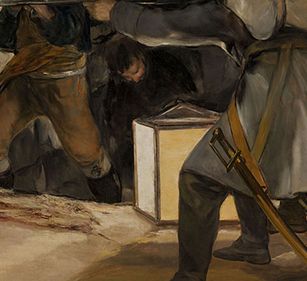
The lantern stands closer to the soldiers than to the man in white. Its bright rectangular faces form one of the few solid geometric shapes in the foreground. It sits low enough to illuminate the earth and the legs above it, while the light leaves much of the upper picture dark. Look at how the soldiers’ boots emerge at intervals along the lit strip of ground. Then look higher up, where their shoulders overlap, each blocking the light from the next. The same source that picks out the wrists and hands of the prisoners gives the soldiers a repeated pattern of small highlights. Their bodies become readable as an organisation of weight, equipment and posture, the prisoners as people who respond individually. [1] [4]
The man in white and the men beside him
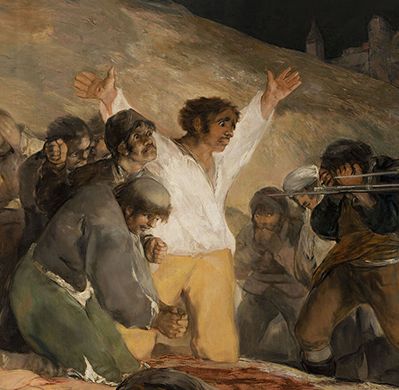
The large patch of white in the shirt makes the man’s face seem to float up out of the shadows until the eye fills in the shoulders and follows the sleeves. The yellow trousers catch the light differently and give weight to his kneeling body. He raises open hands above his head, presenting his chest to the firing party. Lower down, the outstretched arms of the corpse echo his. That rhyme makes the two postures inseparable in the eye. The wide gesture of the living man can read as appeal, surrender or horror. On the ground the same spread of the limbs shows a body’s weight, with the hands pressed into the dirt. [1]
The open arms have often invited a comparison with the Crucifixion. A small dark mark on the palm at the viewer’s left can look like a wound, strengthening the association for a viewer familiar with the wounds of Christ. That is one reading of the gesture and the mark. The scene also makes the arms intelligible through ordinary human behaviour. The man is on his knees, facing drawn weapons, his palms exposed. The lantern explains the concentration of light on him, and the person huddled close beside him makes a different appeal with his hands. The possible religious resonance enlarges the significance of a particular person under duress. [1] [7]
The man in brown and green who kneels to the left of the white shirt bows his head and holds his hands together. The Prado’s education guide points to his hair and clothing as indications that he could be a friar. One figure presses both hands to his face. Further to the right, a man advancing into the killing ground brings his hands to his mouth. It is worth pausing at this last figure. The guns cut across the space in front of him, and he still has to cross the short distance between the waiting group and the brightly lit foreground. An X-ray examined by the Prado team shows that Goya originally gave him a more upright pose. Lowering his head brought the expression of fear into the angle of his body. It also brought his face nearer to the line of the rifle barrels. [1] [4] [7]
The firing squad and the city
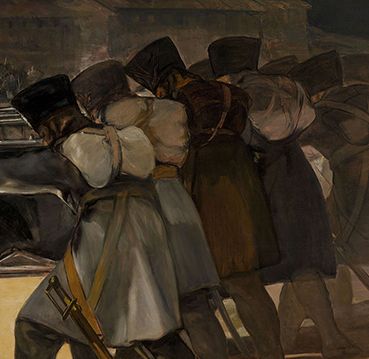
The soldiers are close enough for their packs and straps to be visible. Almost all we get of their heads is dark headgear. Their bodies turn in the same direction, their shoulders bunch together, and their equipment forms patches of similar size and colour. Forestalling the eye’s usual search for a face, the nearest soldier offers a back, a bent knee and a boot. The Prado study proposed a specific identification for the uniform, the sailors of the Imperial Guard. The identification rests on the dress and equipment, where the painting preserves the particularity of an army uniform even as it frustrates any attempt to individuate its wearers. [1] [4]
The line of rifles is more nearly horizontal than any of the slopes or limbs around it. Our eye meets the guns partway between the front of the firing party and the white shirt. Goya turns the few feet of open ground into a conspicuous interval, made especially stark by the compressed ranks on either side. The men with weapons are shown in the act of aiming. The fallen figures supply what the painting leaves out of that moment. To understand how far along the sequence we are, look past the kneeling man to the line of prisoners. The same arrangement could repeat once he falls. [1]
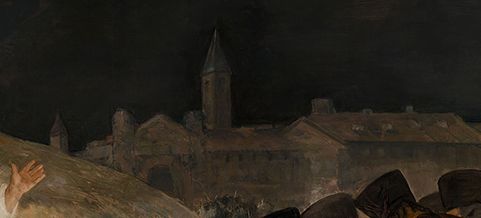
Above them all, the long descending edge of the hill meets the city. Goya’s decision to paint out the tower on the left leaves room above and behind the raised hands. A surviving tower stands some distance to the right, silhouetted against the sky. Below it, the city is a muted, low strip of walls and roofs. The figures are still near Madrid, within sight of its buildings, while the open area above them gives a sense of isolation. There is room in that darkness for a viewer to imagine help arriving, but the only signs of action are down at ground level. [1] [4]
Annotated Details from The Third of May 1808
Look from the pale shirt and raised hands to the lantern and the line of soldiers.
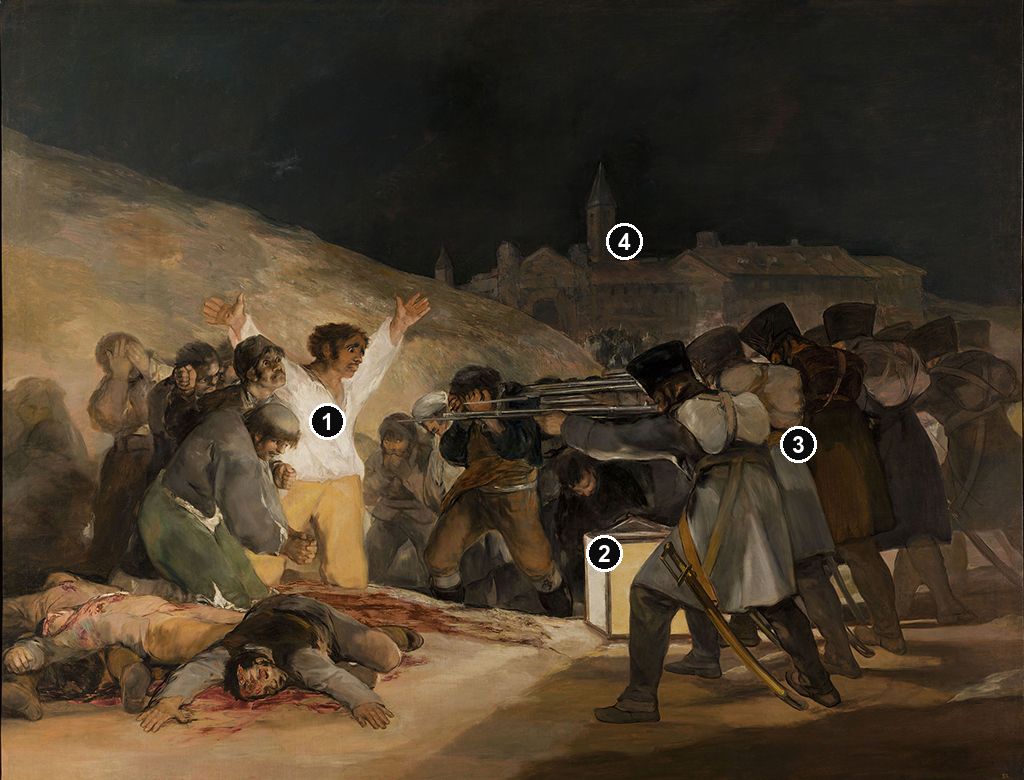
Details from THE THIRD OF MAY 1808
Details from the Prado canvas (P000749).
The raised hands and white shirt
The light catches the shirt and spreads up the raised arms.
The lantern
The lantern sits on the ground between the two groups.
The shoulders of the firing squad
The soldiers face the lit group with their own faces mostly hidden.
The dark outline of the city
Distant buildings barely break the dark skyline.
Goya on film
Five films explore Goya’s portraits, prints, Black Paintings and painting techniques.
The Duke of Wellington by Goya
The portrait, its military decorations and its later theft.
Watch on YouTubeThe canvas at the Prado
The 1834 inventory of the Royal Museum of Paintings lists the work as Las Victimas de la noche del 2 de Mayo de 1808, the victims of the night of 2 May 1808. It records the painting in the large reserve and values it at 8,900 reales. The inventory date gives a firm point in the work’s museum history. The choice of title is evidence of how the museum grouped the events around the uprising. It also makes the victims, as a body of people, the subject of the painting. By 1857 the museum inventory was already associating the scene with Príncipe Pío, and the 1872 catalogue identified it as scenes of 3 May. A title can preserve a historical association while changing which part of the story a visitor notices first. [2] [4]
The early display record is uneven. Théophile Gautier visited Spain in 1840 and described seeing the execution painting in an antechamber of the museum. The energy and fury of the scene impressed him. In Voyage en Espagne, he describes the painting as “reléguée sans honneur”, relegated without honour, to the antechamber. The Spanish Army Museum’s catalogue cites the Prado’s report of Clément de Ris seeing it in 1850. The Prado study also cites his published discussion of the paintings in 1859 and traces their move to a more prominent position in the 1860s. Charles Yriarte wrote about the works in his Goya monograph of 1867. The published 1872 catalogue is therefore a milestone in official recognition. Accounts of earlier viewers complicate the shorthand that links public visibility exclusively to nationalisation in 1868. Later photographs by Jean Laurent, dated by the Prado study to about 1882–83, show the two canvases together above rows of smaller pictures. [4] [5] [8]
War damage and later conservation
During the Spanish Civil War, the two canvases were evacuated from Madrid to Valencia. In 1938, on the way north from Valencia towards Girona, the lorry carrying them struck a balcony in Benicarló. The case broke and both paintings were damaged. The Prado team reconstructs the position of the canvases in the case from the relationship between the damaged areas. It proposes that The Third of May was packed upside down relative to its companion, which took the direct impact. The Third of May suffered transverse cuts, with the impact in the lower right according to the Prado’s reconstruction, and retained considerably more original canvas and paint than The Second of May. [4]
Manuel Arpe y Retamino and Tomás Pérez worked on the canvases during the evacuation. At Perelada they lined the paintings, attaching supporting fabric to stabilise the damaged originals before the journey continued to Geneva. The museum team found traces of the wartime work, including pinholes associated with aligning torn edges. After the canvases returned to the Prado, Arpe completed the repairs in 1939–40 and retouched gaps in the paint. The lining remained structurally sound when the museum undertook the much later conservation. By then uneven layers of varnish had yellowed and some retouching along the old cuts had become pale or dark relative to the surrounding paint. [4]
The Prado gradually reduced discoloured varnishes and removed altered retouching. Where old material extended over surviving paint, the team could uncover original passages. It could also retouch local losses to reduce the interruption a cut made across a figure or the ground. Such retouching remains distinguishable on examination. The intervention concluded with a new damar varnish. In a painting that depends on seeing through some areas of thin paint and recognising abrupt changes in others, a yellow or cloudy film can make the entire scene harder to follow. Cleaning helps the viewer see which darks belong to the forms and where Goya let neighbouring tones merge. [4]
The Prado’s close examination also brought out several ways Goya created light. He used almost pure lead white, with grains of calcite, in a sample from the central man’s shirt. The treatment of the soldier’s equipment depends in places on subtraction. The study identifies dark paint wiped back on parts of the equipment, particularly the straps, to expose the preparation below. At ground level the light between the soldiers’ legs picks out their edges. Higher up, where the packed bodies admit less light, those exposed light tones give the equipment definition. From across a gallery these very different effects belong to the same lamplit night. [4]
Looking at the paintings side by side
The paintings came together after conservation in the Prado’s bicentenary exhibition Goya in Times of War in 2008. The museum’s annual report describes a selection of paintings, drawings and prints spanning 1794 to 1819, with Manuela Mena Marqués, José Manuel Matilla, Gudrun Maurer and Juliet Wilson-Bareau responsible for the scholarly direction. The neighbouring works made it possible to ask how Goya approached the same years on a scale small enough for a print album and large enough to fill a wall. [1] [9]
The Prado research team reads the pair with The Second of May to the left and The Third of May to the right. Its approach begins with the civilians in the lower right of the first painting and moves across to the illuminated earth in the lower left of the second. On the left, movement spreads outward from the clash and is visible throughout the daylight scene. On the right, the light funnels attention from the dead in the foreground to the separate groups facing each other. The canvases have the same dimensions. The space the figures occupy feels abruptly different, even before one has worked out which historical events they represent. [4] [5]
From Goya’s prints to Manet’s execution paintings
The firing squad outside the frame
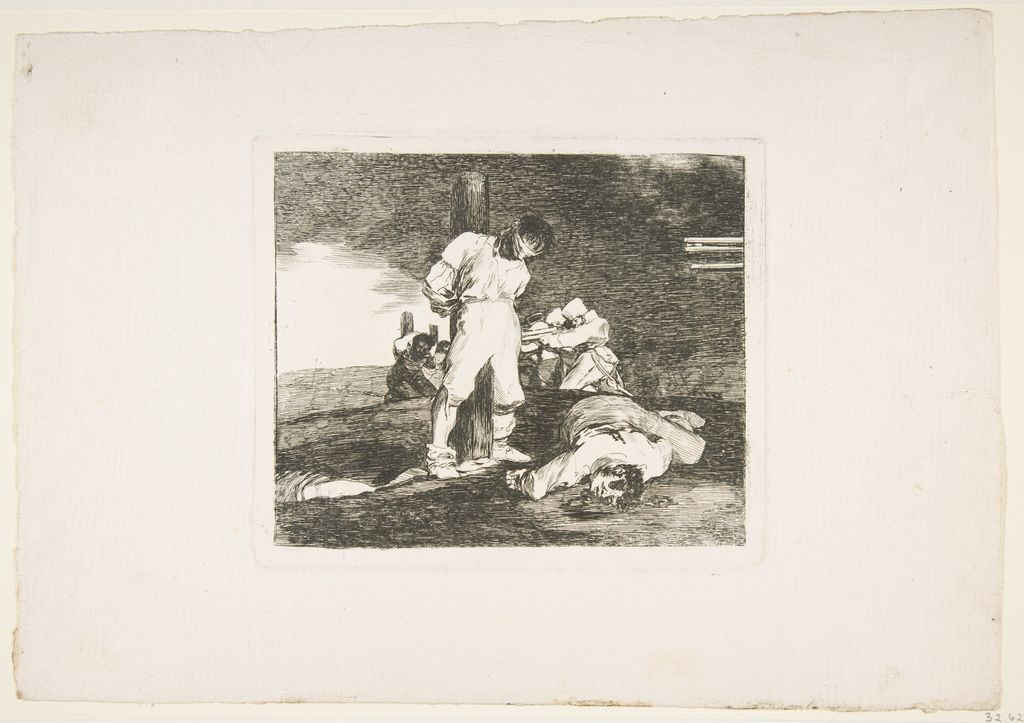
Goya tried a different arrangement in plate 15 of The Disasters of War, Y no hai remedio (And there’s no help for it). Princeton University Art Museum’s copy, accession 2011-86, is from the 1863 edition of the Real Academia de Bellas Artes de San Fernando. The museum dates the work on the plate to 1808/09–12 and identifies etching, drypoint and burin as its techniques. The Fundación Goya dates the design more broadly to about 1810–15. Both records distinguish the work on the plate, which took place during Goya’s lifetime, from the publication of the series decades later. A proof with a caption in Goya’s hand belonged to his friend Juan Agustín Ceán Bermúdez. After Goya’s death the academy issued the series, with this caption reproduced on the plate. [10] [11]
The main prisoner in the print stands bound to a post and blindfolded. The muzzle ends come in from the right, where the plate cuts off the shooters. Further back, a second group of soldiers can be seen firing. A body lies across the foreground, with its head turned towards the viewer. The print therefore gives the viewer different degrees of access to different parts of the execution. The nearest gunmen are outside the frame. The distant ones are too small for the viewer to pick out expressions. The prisoner identified most readily by his pale shirt cannot see them at all. That shirt gets its brightness from areas of unmarked paper bordered by etched lines. Goya uses the positive weight of lead-white paint to command attention on the canvas. On paper, the crowded marks around the prisoner make his shirt luminous by leaving most of it blank. [10] [11]
The large canvas also shows successive stages at once, with a body already down and other men still waiting. Here the white-shirted prisoner is free to move his upper body and faces the firing squad with his eyes open. The soldiers occupy a whole side of the picture. The print’s cropped gun barrels suggest a force whose extent can only be imagined. In the painting that force is given mass and rhythm, and it takes the near foreground alongside the prisoners. By varying who is visible, where they stand and whether they can look back, Goya made two distinct pictures out of the same basic relation between the rifles and the condemned. [1] [10]
Manet and the execution of Maximilian
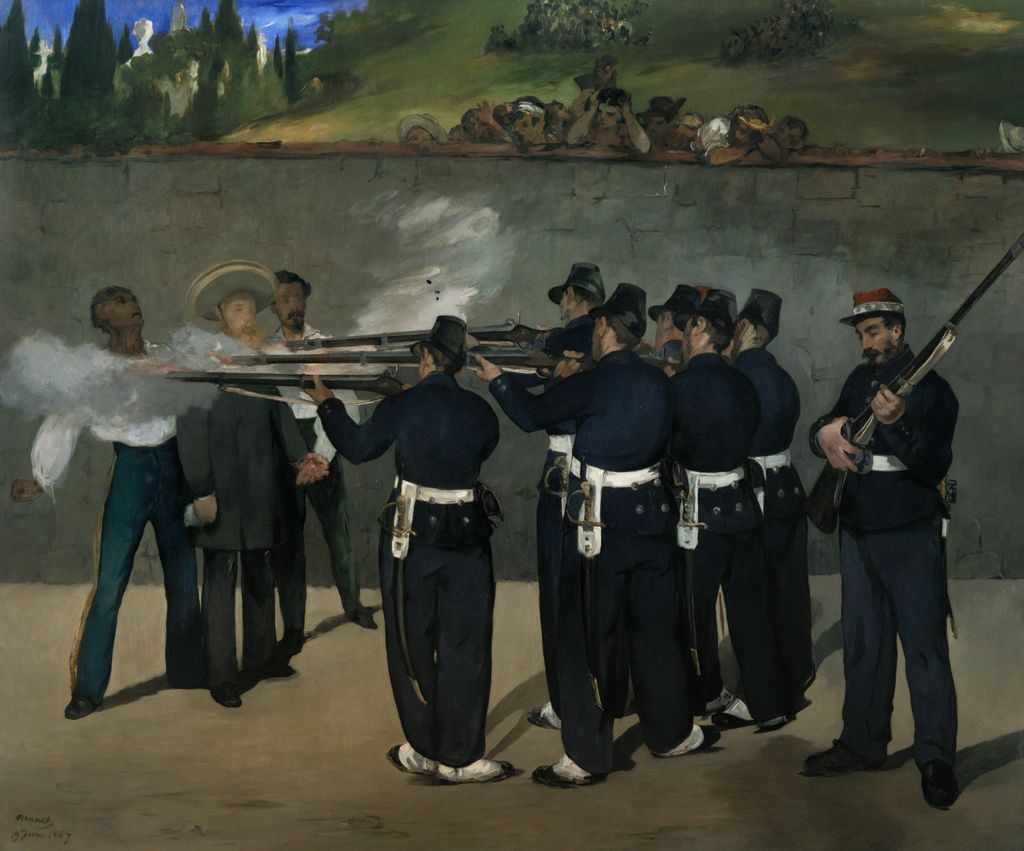
In 1867, Édouard Manet began painting the execution of Emperor Maximilian of Mexico and his generals Miguel Miramón and Tomás Mejía at Querétaro. The French government under Napoleon III had backed Maximilian’s rule. The first large version, now at the Museum of Fine Arts, Boston, is unfinished. Brushstrokes gather into a compressed group of shooters, while gun smoke encroaches on the condemned. As in Goya’s canvas, bunching one set of bodies together gives a different rhythm to the men on the receiving end. Manet places the scene outdoors and gives the condemned less visual separation from the firing party than Goya did with his conspicuous gap of lit earth. In place of the approaching sequence of deaths, Manet uses clouds of smoke to register the instant of the volley. [12] [13] [14]
The National Gallery identifies the Boston version as the clearest reference to Goya’s canvas. Manet travelled to Madrid in 1865, when The Third of May was displayed at the Prado. The gallery’s reading of the relationship is supported by the visit and by the picture itself. The Prado team notes that Manet’s surviving correspondence from the journey makes no specific mention of the two May paintings. Goya’s prints were also available by then in the 1863 edition, and the Princeton catalogue records that Manet owned a set. The canvases and prints both belong to the evidence for what he could have drawn on, while the placement of the figures and the landscape offer a more specific way to trace the artistic debt. [4] [10] [14] [15]
Manet reworked the subject as new accounts reached France. London’s canvas is the damaged second large version, with surviving fragments remounted onto a single support. The final painting at the Kunsthalle Mannheim has a wall and onlookers above it. Those figures give the killing a public audience inside the painting. In Goya’s canvas the most prominent people in a position to witness the event are the prisoners themselves. There was also a separate Manet lithograph. The French censor suppressed it in January 1869, and an edition was printed after Manet’s death in 1884. The afterlife of Goya’s painting thus involves a succession of choices about how to show organised killing and who gets to see it. [14] [15] [16]
What changed between Manet’s versions
The London and Mannheim paintings make the comparison with Goya through different objects. The National Gallery canvas survives in fragments, now arranged together. The missing pieces mean that a blank passage in the London display can mark a gap in what survives. In the completed Mannheim painting the crowd behind the wall belongs to the design. Its onlookers look down on the event from a platform within the picture, while Goya lets the bodies in the foreground bring the viewer close to the prisoners. The difference is worth tracing before drawing conclusions about which artist gives us a greater sense of distance. [14] [17]
The two compositions offer different ways to read a firing squad. Goya compresses the men into a diagonal whose rifles bridge most of the space between the groups. Manet spreads the men and victims across a shallower strip, with the figure adjusting his weapon at the right set apart from the others. In the finished picture the soldiers’ resemblance to French troops also complicates a scene that takes place in Mexico. Goya leaves the soldiers’ faces in shadow or turns them away, yet their equipment and common posture make collective force legible. Manet can separate one soldier from that common action without losing the sequence of the shooting. [14] [17]
The images also reached their audiences in different forms. MoMA’s exhibition assembled painted versions, a study and a lithograph. Comparison across that group shows a painter repeatedly testing the subject, rather than a single picture passing directly from Goya’s canvas to Manet’s. The lithograph matters because it puts the execution back into a reproducible medium, where differences in colour give way to shape and tone. It is a productive comparison with Goya’s war prints as well as with the large Madrid canvas. Look across the works for the distance between the rifles and the people they face, and for the first point at which each image allows an onlooker to intervene visually. [14] [17]
MoMA dates the firing squad in Mexico to 19 June 1867 and the arrival of the news in Paris to 1 July, the day of Napoleon III’s inauguration of the Universal Exposition. The exhibition traced Manet’s successive attempts through a changing supply of written reports and images. The contrast in working time is concrete. Manet began almost immediately, while Goya petitioned in 1814 about an uprising that had taken place six years earlier. The spectator figures and changing uniforms in Manet’s versions belong to that process of interpreting news. Goya had a longer interval in which to decide what a commemorative pair should make of an event that had already entered public memory. [14] [17]
Artworks directory
| Name | Date | Medium |
|---|---|---|
| And There’s No Help for It, Plate 15 | Printed 1863 | |
| Asmodea | c. 1820–23 | Wall painting transferred to canvas |
| Boys Inflating a Bladder | 1777–78 | Tapestry cartoon |
| Boys Picking Fruit | 1778 | Tapestry cartoon |
| Bullfight in a Divided Ring | 1825 | Lithograph |
| Card Players | 1777–78 | Tapestry cartoon |
| Card Players (sketch) | 1777–78 | Painted sketch |
| Dance on the Banks of the Manzanares | 1777 | Tapestry cartoon |
| Duel with Cudgels | c. 1820–23 | Wall painting transferred to canvas |
| Heads in a Landscape | c. 1820–23 | Easel painting |
| Judith and Holofernes | c. 1820–23 | Wall painting transferred to canvas |
| Leocadia | c. 1820–23 | Wall painting transferred to canvas |
| Maja and Cloaked Men | 1777 | Tapestry cartoon |
| Maja and Cloaked Men (sketch) | 1777 | Painted sketch |
| Majo Clapping in Time to the Music | 1777 | Drawing |
| Men Reading | c. 1820–23 | Wall painting transferred to canvas |
| Out Hunting for Teeth, Plate 12 | 1799 | Etching, burnished aquatint and burin |
| Picnic in the Countryside (sketch) | 1776–78 | Painted sketch |
| Picnic on the Banks of the Manzanares | 1776 | Tapestry cartoon |
| Pilgrimage to San Isidro | c. 1820–23 | Wall painting transferred to canvas |
| Preparatory study for The Sleep of Reason Produces Monsters | c. 1796–97 | Drawing |
| Procession of the Holy Office | c. 1820–23 | Wall painting transferred to canvas |
| Quarrel at the Cockerel Inn (sketch) | 1777 | Painted sketch |
| Quarrel in the New Tavern | 1777 | Tapestry cartoon |
| Saturn Devouring His Son | c. 1820–23 | Wall painting transferred to canvas |
| Seated Majo Smoking | c. 1776 | Drawing |
| The Dog | c. 1820–23 | Wall painting transferred to canvas |
| The Drinker | 1777 | Tapestry cartoon |
| The Fates | c. 1820–23 | Wall painting transferred to canvas |
| The Great He-Goat | c. 1820–23 | Wall painting transferred to canvas |
| The Kite | 1777–78 | Tapestry cartoon |
| The Parasol | 1777 | Oil on canvas, tapestry cartoon |
| The Second of May 1808 | 1814 | Oil on canvas |
| The Sleep of Reason Produces Monsters, Plate 43 | 1799 | Etching and aquatint |
| The Third of May 1808 | 1814 | Oil on canvas |
| Thou Who Canst Not, Plate 42 | 1799 | Etching and burnished aquatint |
| Three Figures | 1776 | Drawing (lost) |
| Two Old Men | c. 1820–23 | Wall painting transferred to canvas |
| Two Old Men Eating Soup | c. 1820–23 | Wall painting transferred to canvas |
| Two Women and a Man | c. 1820–23 | Wall painting transferred to canvas |
| Universal Language: The Author Dreaming | 1797 | Drawing |
| The Family of Charles IV | 1800 | Oil on canvas |
| Witches’ Sabbath (Osuna painting) | 1797–98 | Oil on canvas |
| The Nude Maja | 1795–1800 | Oil on canvas |
| The Clothed Maja | 1800–07 | Oil on canvas |
| Self-Portrait (Drawing) | c. 1796 | Brush and carbon black ink on laid paper |
| The Swing, Madrid Album B.21 | 1795–97 | Brush and carbon black washes |
| Majas Fighting, a Majo Observing, Madrid Album B.15 | 1796–97 | Brush, grey and black washes on laid paper |
| Majos and Majas Conversing, Madrid Album B.16 | c. 1794–97 | Ink wash on paper |
| Weeping Woman and Three Men, Madrid Album B.17 | 1795–97 | Brush, carbon black washes and black chalk |
| Maja Seated on a Chair and Two Companions Behind, Madrid Album B.18 | 1795–97 | Brush and carbon black washes |
| Girl and Bull, Madrid Album B.23 | 1796–97 | Brush and carbon black washes |
| Lovers Sitting on a Rock, Madrid Album B.24 | 1796–97 | Brush and carbon black washes |
| Mariano Ceballos Riding a Bull | 1825 | Crayon lithograph and scraper |
| Landscape (lifetime impression) | c. 1807–10 | Etching and aquatint |
| Self-Portrait (1815), Prado canvas | 1815 | Oil on canvas |
| Self-Portrait (1815), Academy panel | 1815 | Oil on panel |
| Self-Portrait with Dr Arrieta | 1820 | Oil on canvas |
| Christ Crucified | 1780 | Oil on canvas |
| The Last Communion of Saint Joseph of Calasanz | 1819 | Oil on canvas |
| Christ on the Mount of Olives | 1819 | Oil on panel |
| The Flower Girls, or Spring | 1786–87 | Oil on canvas |
| The Grape Harvest, or Autumn | 1786–87 | Oil on canvas |
| The Snowstorm, or Winter | 1786–87 | Oil on canvas |
| The Threshing Ground, or Summer | 1786–87 | Oil on canvas |
| Picnic on the Banks of the Manzanares | 1776 | Oil on canvas |
| The Kite | 1777–78 | Oil on canvas |
| Dance on the Banks of the Manzanares | 1777 | Oil on canvas |
| A Fight at the Venta Nueva | 1777 | Oil on canvas |
| Blind Man’s Bluff | 1788 | Oil on canvas |
| Dogs on a Lead | 1775 | Oil on canvas |
| Hunting with a Decoy | 1775 | Oil on canvas |
| Hunter Loading His Rifle | 1775 | Oil on canvas |
| The Angler | 1775 | Oil on canvas |
| The Hermitage of San Isidro on His Feast Day | 1788 | Oil on canvas |
| The Meadow of San Isidro | 1788 | Oil on canvas |
| The Straw Manikin | 1791–92 | Oil on canvas |
| Witches’ Flight | c. 1797–98 | Oil on canvas |
| A Scene from ‘The Forcibly Bewitched’ | 1798 | Oil on canvas |
| The Duchess of Alba in Black | 1797 | Oil on canvas |
| The Duchess of Alba in White | 1795 | Oil on canvas |
| Charles III in Hunting Dress | c. 1786 | Oil on canvas |
| The Duke and Duchess of Osuna and Their Children | 1787–88 | Oil on canvas |
| Manuel Osorio Manrique de Zúñiga | 1787–88 | Oil on canvas |
| The Marquesa de Pontejos | c. 1786 | Oil on canvas |
| Equestrian Portrait of the 1st Duke of Wellington | 1812 | Oil on canvas |
| The Duke of Wellington | 1812–14 | Oil on wood |
| Portrait of Ferdinand VII of Spain | 1814 | Oil on canvas |
| Gaspar Melchor de Jovellanos | 1798 | Oil on canvas |
| María Tomasa Palafox y Portocarrero | 1804 | Oil on canvas |
| Señora Sabasa García | c. 1806–11 | Oil on canvas |
| Don Juan Bautista de Muguiro | 1827 | Oil on canvas |
| Doña Isabel de Porcel | Before 1805 | Oil on canvas |
| The Colossus | After 1808 | Oil on canvas |
| The Burial of the Sardine | 1808–12 | Oil on panel |
| The Madhouse | 1808–12 | Oil on panel |
| A Procession of Flagellants | 1808–12 | Oil on panel |
| Portrait of Jacques Galos | 1826 | Oil on canvas |
| Portrait of Mariano Goya, the Artist’s Grandson | 1827 | Oil on canvas |
| Milkmaid of Bordeaux | c. 1827 | Oil on canvas |
| Portrait of Don Juan Antonio Cuervo | 1819 | Oil on canvas |
| María Luisa of Parma (Naples version) | c. 1800 | Oil on canvas |
| The Countess of Baena | 1819 | Oil on canvas |
| The Family of the Infante Don Luis | 1783–84 | Oil on canvas |
| The Holy Family | c. 1787 | Oil on canvas |
| Saint Barbara | c. 1773 | Oil on canvas |
| Saints Justa and Rufina | 1817 | Oil on canvas |
| El Tío Paquete | c. 1819–20 | Oil on canvas |
| The Forge | c. 1815–20 | Oil on canvas |
| Majas on a Balcony (Metropolitan Museum version) | c. 1800–10 | Oil on canvas |
| Maja and Celestina on a Balcony | c. 1808–12 | Oil on canvas |
| The Water Bearer | 1808–12 | Oil on canvas |
| Time and the Old Women | c. 1810 | Oil on canvas |
Frequently Asked Questions
It is 268 centimetres high and 347 centimetres wide. The original oil on canvas is in the collection of the Museo del Prado in Madrid, accession P000749. [1] [2]
Discussion
Look again at the images and ideas explored in The Third of May 1808. These editorial prompts invite your observations.
Follow the hands from the man with his palms open to the bowed figure beside him, then back towards the men waiting in partial shadow. Which gesture tells you most about the moments before the rifles fire?
Continue with The Second of May 1808, The Disasters of War or Goya’s paintings.
Reader Insights
How does the lantern affect which faces you can see?
What do the hands of the waiting men add to the scene?
Join the Conversation
Share a detail, comparison or question about The Third of May 1808 below.
References
- Fundación Goya en Aragón, Third of May 1808, collection record and reproduction, View source.
- Poder, patrimonio y cultura en España, El 3 de mayo en Madrid o “Los fusilamientos”, with the Royal Museum’s 1834 inventory entry, fol. 420v, View source.
- Real Academia de la Historia, 2 de Mayo de 1808, chronology and places, View source.
- Manuela B. Mena Marqués, Gudrun Maurer, Carmen Garrido Pérez and colleagues, “Goya: el Dos y el Tres de mayo de 1808 en Madrid. Estudio y restauración”, Boletín del Museo del Prado 27, no. 45 (2009), pp. 129–149, View source. Publication record.
- Fundación Goya en Aragón, El dos de mayo de 1808, including the commission and the paired paintings, View source.
- Francisco de Goya and Juan Álvarez Guerra, approach to the Regency of 24 February 1814 and letter to the finance secretary of 9 March 1814, transcribed in Francisco de Goya. Diplomatario, docs. 240 and CXXIV, View source.
- Museo Nacional del Prado, Hablemos de arte: El tres de mayo de 1808, Francisco de Goya, education guide, pp. 47–50, View source.
- Museo del Ejército, Galdós en el Museo del Ejército, “La guerra”, n. 7, View source.
- Museo Nacional del Prado, Memoria de actividades 2008, “Goya en tiempos de guerra”, View source.
- Princeton University Art Museum, Y no hai remedio (And there’s no help for it), accession 2011-86, View source.
- Fundación Goya en Aragón, Y no hay remedio, print states and the Ceán Bermúdez proof, View source.
- Museum of Fine Arts, Boston, War and Discontent, View source.
- Museum of Modern Art, Execution of the Emperor Maximilian, Boston painting, accession 30.444, in Manet and the Execution of Maximilian (2006), View source.
- National Gallery, London, Édouard Manet, The Execution of Maximilian, NG3294, View source.
- National Gallery, London, “Inspired and inspiring”, in In the Line of Fire: Manet’s The Execution of Maximilian, View source.
- National Gallery, London, “Genesis of the composition”, in In the Line of Fire: Manet’s The Execution of Maximilian, View source.
- Museum of Modern Art, Manet and the Execution of Maximilian. View source.