


 by Tom Gurney
Tom Gurney BSc (Hons) is an art history expert with over 20 years experience
Published on June 19, 2020 / Updated on November 20, 2026
Email: tomgurney1@gmail.com / Phone: +44 7429 011000
Introduction
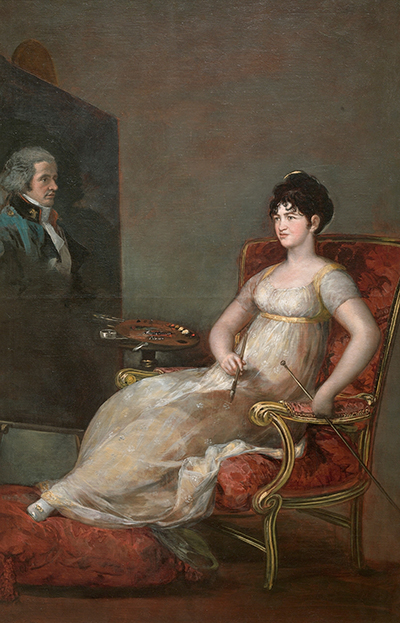
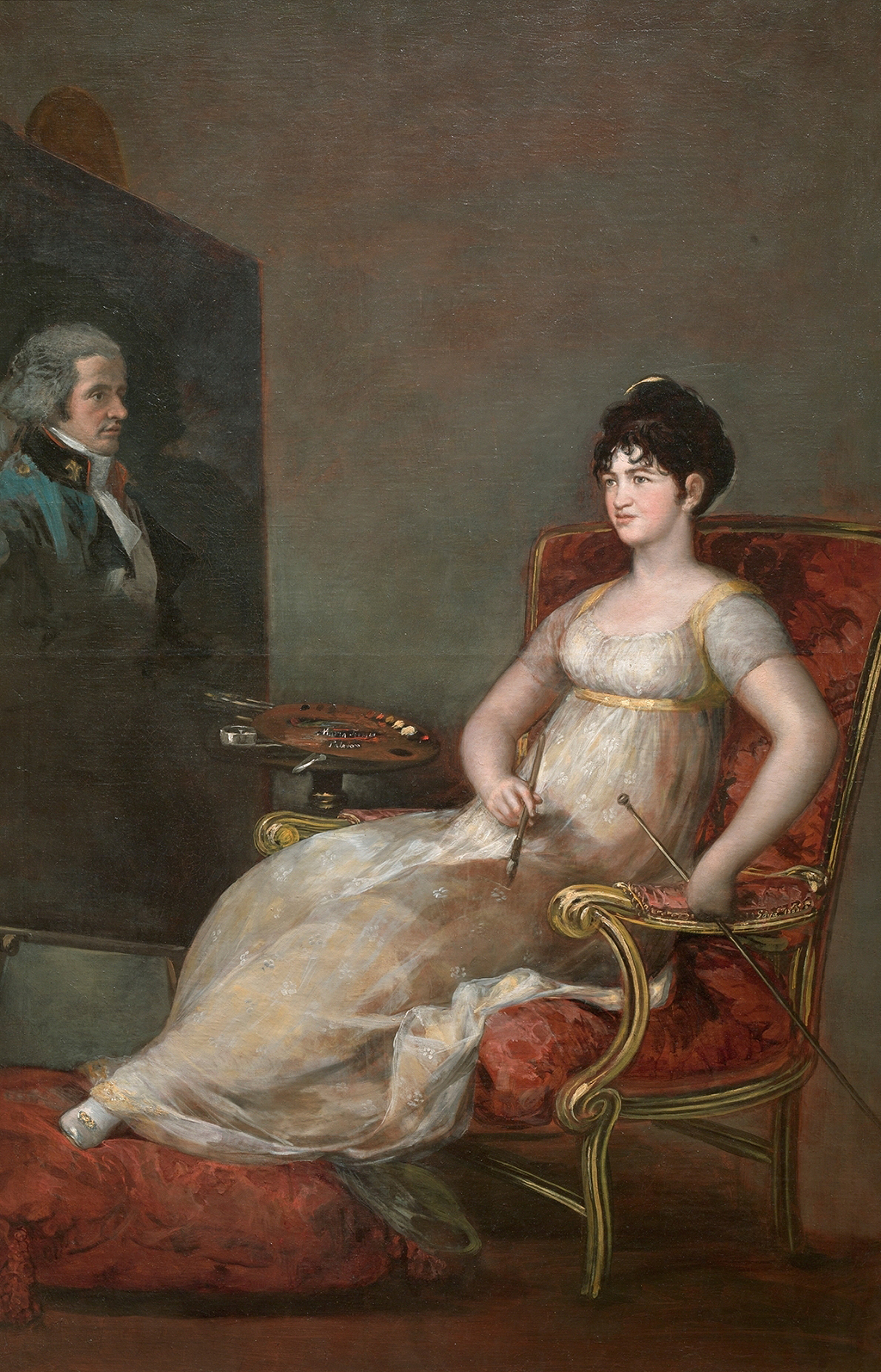
María Tomasa Palafox holds her brush over her lap, its tip pointing down at the folds of her dress. At the left edge of Goya’s painting, her husband appears on the canvas she is working on. His face has already emerged from the dark ground, while his uniform dissolves into broader patches of colour below the chest. Between the two figures, small heaps of paint line the edge of a palette. Goya has caught the marchioness during a pause, when her tools are still in her hands and she has time to look up. [1] [2]
The Prado calls the portrait The Twelfth Marchioness of Villafranca Painting Her Husband. Goya signed and dated it in 1804, the year before the Royal Academy of Fine Arts of San Fernando admitted Palafox as an academician of merit in painting. A canvas she painted in 1801 survives in the Academy’s collection. Her portrait places the work of making a likeness at the centre of a life-size depiction of an aristocratic sitter. [1] [2] [3] [4]
At a Glance
- ArtistFrancisco de Goya y Lucientes
- TitleThe Twelfth Marchioness of Villafranca Painting Her Husband
- SitterMaría Tomasa Palafox y Portocarrero (1780–1835), Marchioness of Villafranca and Duchess of Medina Sidonia
- Date1804, inscribed on the chair arm
- Medium and dimensionsOil on canvas, 195 × 126 cm (height × width)
- CollectionMuseo Nacional del Prado, Madrid, P002448. [1] [2] [3]
Works across Goya’s career
The Parasol
1777The Nude Maja
1795–1800Saturn Devouring His Son
c. 1820–23The Dog
c. 1820–23A portrait taking shape at the easel
The left edge of Goya’s picture cuts through the canvas on the easel. We see its right edge nearly upright, with the upper edge slanting away. A rounded piece of the easel rises behind it. The position of this second canvas allows the viewer to see the likeness, even though the marchioness is seated to one side of it. Behind her, the wall has few features of its own. Its broad expanse keeps our attention on the painting, the chair and the distance between her face and the face she is making. [1] [2]
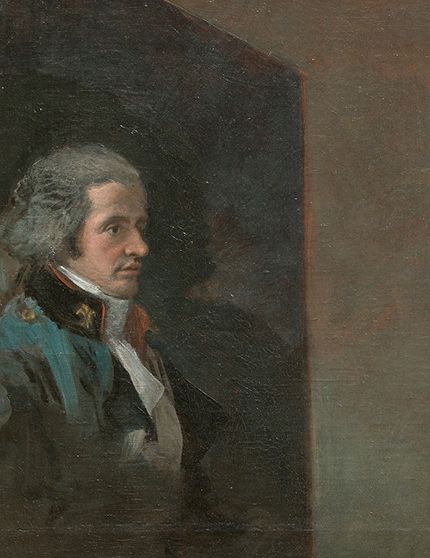
The face on the easel belongs to Francisco de Borja Álvarez de Toledo y Gonzaga. He succeeded his elder brother José, the Duke of Alba by marriage, as Marquis of Villafranca. He wears the uniform of a line infantry officer. The white neckcloth has a crisp edge where it meets his dark collar, and touches of gold stand out near his neck and shoulder. Lower down, the outline of the coat becomes hard to follow and the dark ground takes over. Goya makes the likeness look as though it is being built up unevenly, with the features and the upper part of the uniform established before the figure below. [1] [2] [5]
The marquis’s painted eyes seem to look towards his wife. She looks across the room to our left. The Prado suggests that her husband may be sitting somewhere beyond the edge of the picture. If so, her gaze takes us from the painter to the person she is studying, while his likeness looks back at her from the easel. The angle of the painted head and the position of her eyes make this reading possible. They also give the pair a relationship that can be understood through the composition alone. [1] [5] [6]
Annotated Details from María Tomasa Palafox y Portocarrero
Look from the painting on the easel to the palette, the brushes and the chair.
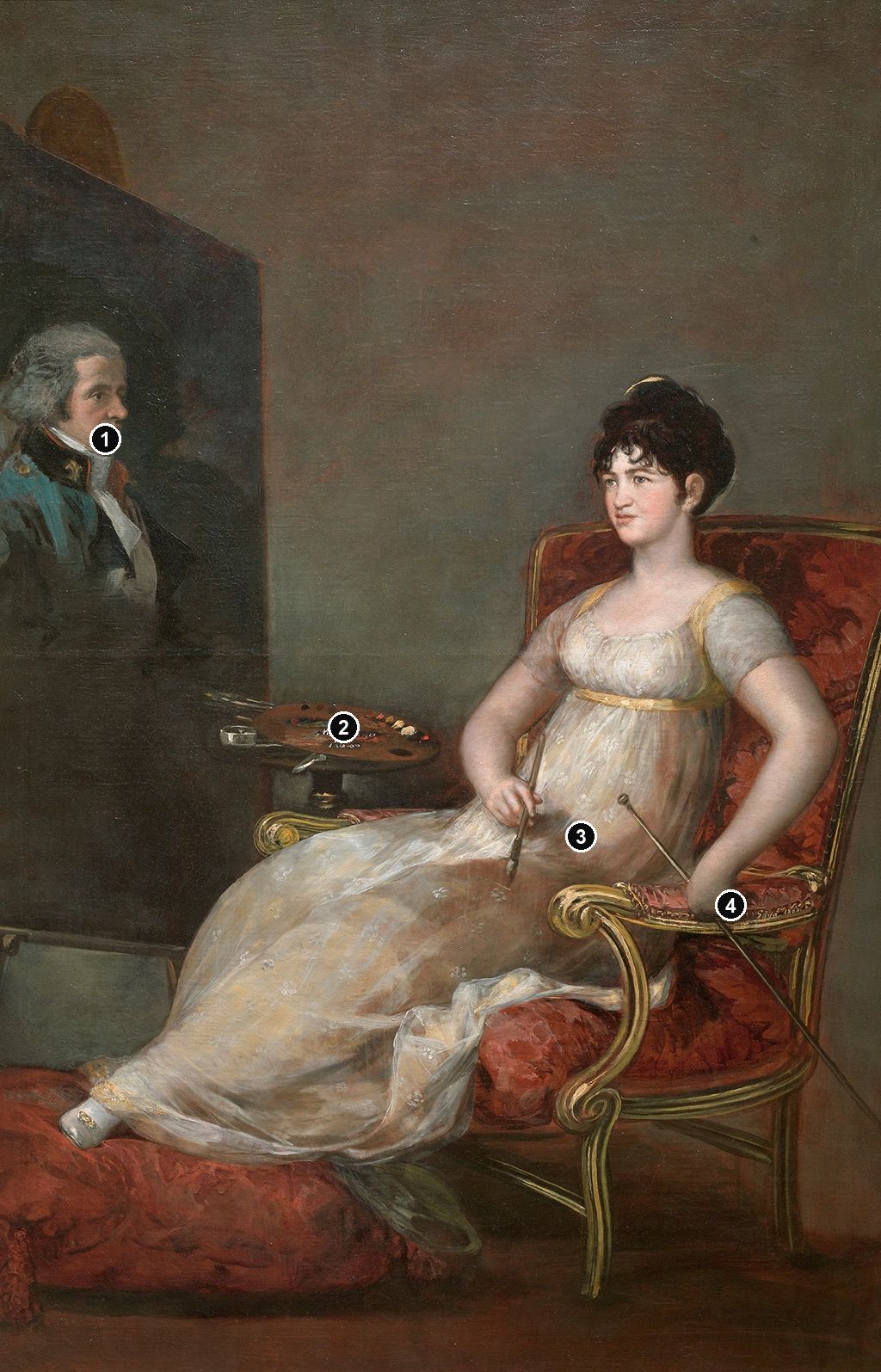
Details from MARÍA TOMASA PALAFOX Y PORTOCARRERO
Details from the Prado portrait (P002448).
The likeness on the easel
The husband's profile faces towards the figure painting it.
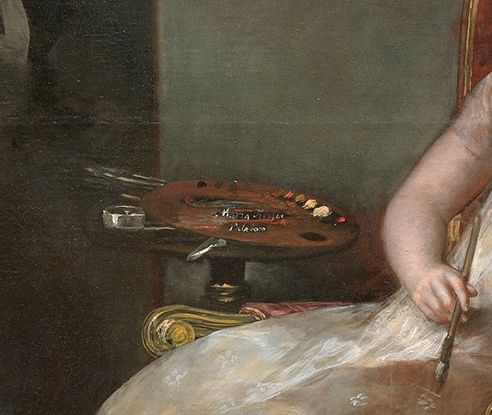
The palette
Small spots of colour sit around the edge of the palette.
The working brush and mahlstick
A brush points into the lap while a separate long stick crosses the dress.
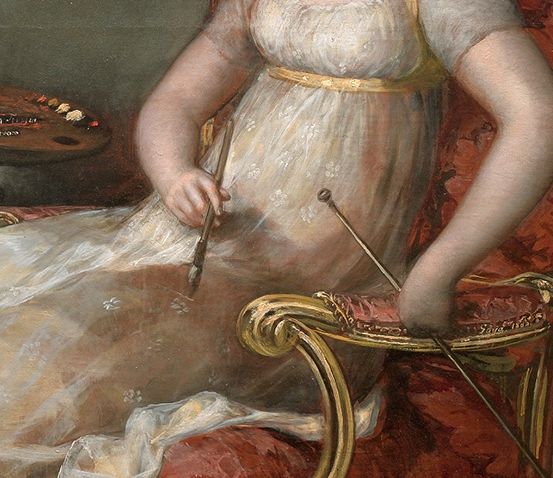
The chair arm
The curved chair arm catches the light beside the sitter's hand.
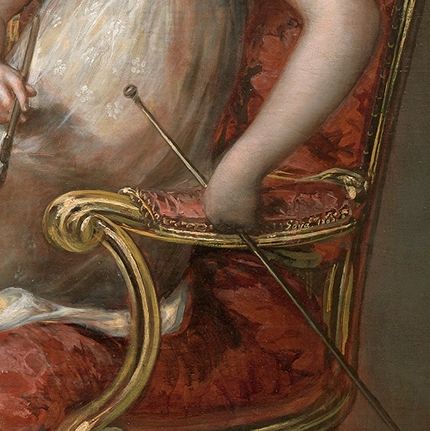
The brush, the mahlstick and the palette
The tools explain how the marchioness might resume work. In her right hand is a brush, held near the middle of its shaft. A far longer rod runs diagonally across the front of the chair and has a round tip. This is a mahlstick, a painter’s support for steadying the brush hand during fine work. Its padded end can rest against the edge of the painting or another stable point. Goya lets the two shafts cross the light dress at different angles so that each has an outline of its own. The low position of her brush and the weight she gives to the armrest suggest a pause between strokes. [1] [5] [7]
The palette lies on a small stand at the marchioness’s right, to our left. Pale yellow and white paint catch the light at one end of the row, with warmer reds and darker touches nearby. Several spare brushes and a small metal vessel are within reach. The palette sits just below the partly painted uniform. Its small daubs look thick and distinct beside the thin dark sweep of colour on the easel. We can see the paint as a material ready to be picked up on a brush, and a few inches higher we see what it can do when spread out over a canvas. [1] [2] [5]
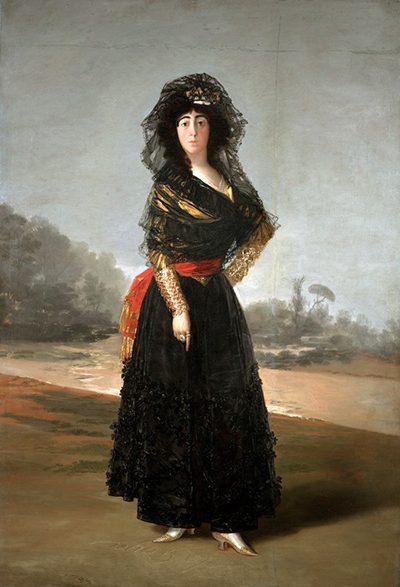
Goya gives both artists a place to be named. Palafox’s name appears on the palette in two lines. The armrest carries Goya’s signature and the date 1804. Both inscriptions follow objects in the room, so they reward a close look at the working area and the sitter’s resting arm. In Goya’s portrait of the Duchess of Alba in black, the duchess points towards writing on the ground. Here a hand resting near the arm of a chair and a palette waiting to be used bring the inscriptions into view more quietly. [1] [2] [8]
Goya on film
Five films explore Goya’s portraits, prints, Black Paintings and painting techniques.
The Duke of Wellington by Goya
The portrait, its military decorations and its later theft.
Watch on YouTubeA white dress in a red chair
The skirt is the brightest continuous passage in the painting. It runs from the high waist over the sitter’s knees and down to the red foot cushion. Near the hem, the outer layer blurs the edge of the lighter fabric underneath. Goya lets warm tones from the chair and cushion show through the gauze where it falls across them. At the upper arm the sleeve has a related translucency, with skin colour visible through short strokes of grey and white. Gold trim follows the neckline and waist, picking up the brighter edges of the chair’s curved frame. Near her left wrist, the gilt frame scrolls out into the foreground. Goya uses a sharp bright line to establish the hard edge of the wood, then lets the light break up again as it falls on the patterned upholstery. [1] [2] [7]
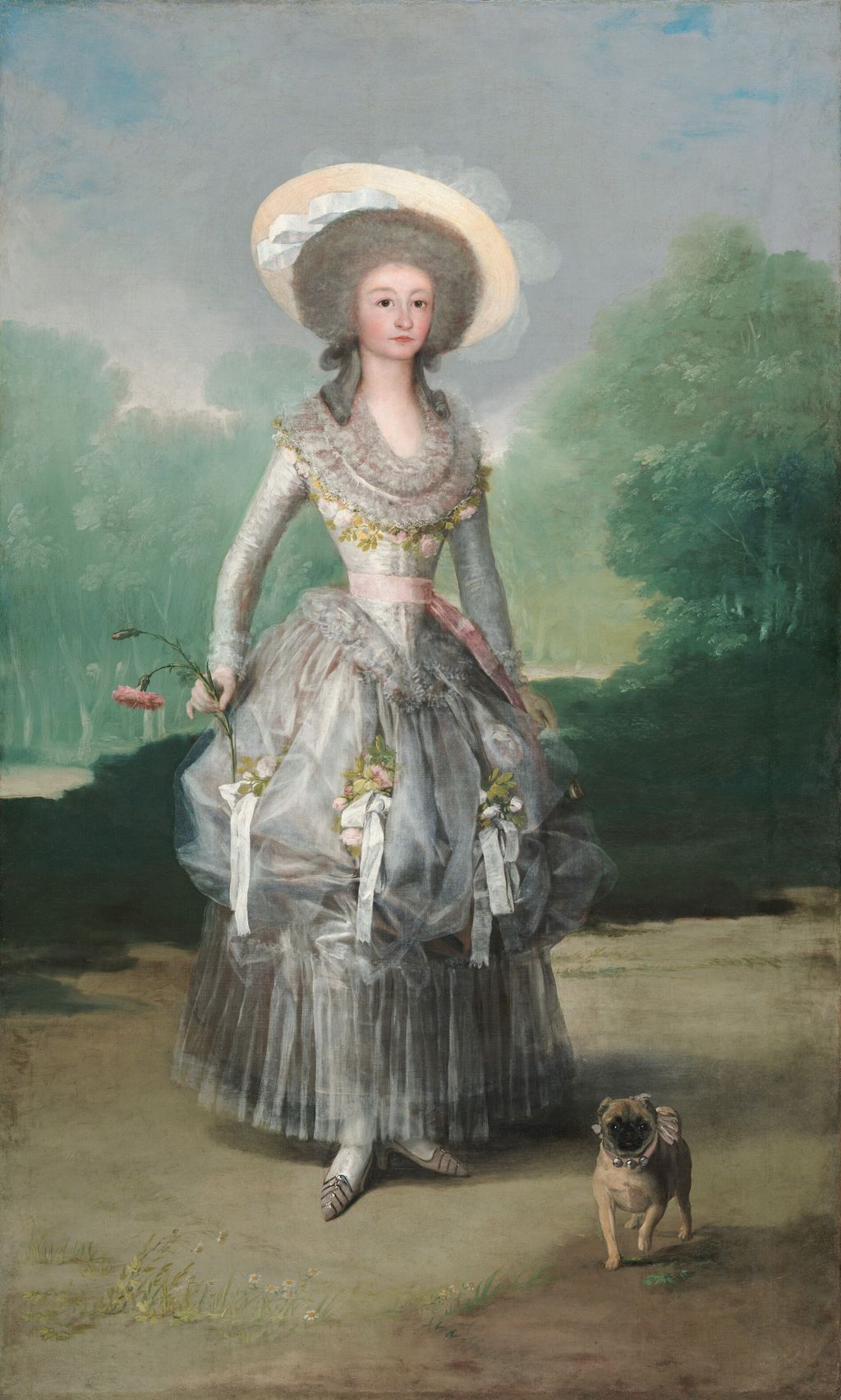
In The Marquesa de Pontejos, painted about eighteen years earlier, flowers and ribbons mark the layers of a dress whose broad skirt occupies much of the picture. Palafox’s gown falls from just below the bust and takes its shape from a seated body. The direction of its folds leads from the brush across the lap to the shoe on the cushion. Goya’s marks range from the little flecks that suggest embroidery to strokes that sweep across the folds. Looking at these passages explains the Fundación Goya catalogue’s emphasis on the breadth and visibility of his brushwork in the later portrait. [1] [2] [9]
What Palafox painted
Palafox was born in Madrid in 1780 and died in Naples in 1835. Her mother, the Countess of Montijo, took care over her education. Her surviving Holy Family in the Carpenter’s Workshop measures 53 × 66 cm and is painted in oil on canvas after Alonso Cano. An inscription on its reverse records that she made the copy in 1801, at the age of twenty-one. The Academy’s early inventories record the work, and its printed catalogue of 1817 places it among paintings by professors and academicians of merit. This small, horizontal scene of the Holy Family gives us a documented example of the skills Goya represents in a different genre. [2] [3] [4]
On 25 July 1805 the Academy admitted Palafox as an academician of merit in painting. María Ángeles Pérez Martín’s study of the proceedings identifies two works presented at that meeting, a crucifix and the copy after Cano. Goya’s portrait was also exhibited at the Academy in 1805, according to the catalogue of Goya: Images of Women. The Academy’s records and the surviving copy give us a way to see how her painting reached an audience beyond the family. Goya’s portrait, shown in the same institution, gives that audience a view of the activity itself. [3] [4] [6] [10] [11]
The Academy later gave Palafox a role in art education. In July 1818 she was among the women selected for the board overseeing the drawing and ornament schools for girls. María Josefa Pimentel, Duchess of Osuna, was chosen as president. She appears with her husband and children in Goya’s earlier portrait of the Osuna family. The board’s schools began teaching in January 1819. Palafox’s involvement links the Academy that had assessed her own work to a programme that gave girls access to drawing instruction. [11] [13]
The portrait on public view
Goya had exhibited his portrait of the painter Francisco Bayeu at the Academy in 1795. Bayeu sits holding a brush, a compact sign of his profession. In Palafox’s portrait Goya includes enough of the equipment and enough of the unfinished likeness for us to follow an artist’s decisions. We can see where the paint is laid out and how far the work has advanced, and can look in the direction of the sitter she may be studying. [6] [12]
The portrait passed to the Prado by the bequest of Alonso Álvarez de Toledo, Count of Niebla and Marquis of los Vélez. His widow retained use of it during her lifetime, and it entered the museum in May 1926. More recently it travelled to Washington for Goya: Images of Women, presented at the Prado in 2001–02 and the National Gallery of Art in 2002. The exhibition catalogue placed Palafox’s portrait alongside Goya’s other images of women, from formal aristocratic likenesses to figures whose work and daily activities he recorded. [2] [6]
Artworks directory
| Name | Date | Medium |
|---|---|---|
| And There’s No Help for It, Plate 15 | Printed 1863 | |
| Asmodea | c. 1820–23 | Wall painting transferred to canvas |
| Boys Inflating a Bladder | 1777–78 | Tapestry cartoon |
| Boys Picking Fruit | 1778 | Tapestry cartoon |
| Bullfight in a Divided Ring | 1825 | Lithograph |
| Card Players | 1777–78 | Tapestry cartoon |
| Card Players (sketch) | 1777–78 | Painted sketch |
| Dance on the Banks of the Manzanares | 1777 | Tapestry cartoon |
| Duel with Cudgels | c. 1820–23 | Wall painting transferred to canvas |
| Heads in a Landscape | c. 1820–23 | Easel painting |
| Judith and Holofernes | c. 1820–23 | Wall painting transferred to canvas |
| Leocadia | c. 1820–23 | Wall painting transferred to canvas |
| Maja and Cloaked Men | 1777 | Tapestry cartoon |
| Maja and Cloaked Men (sketch) | 1777 | Painted sketch |
| Majo Clapping in Time to the Music | 1777 | Drawing |
| Men Reading | c. 1820–23 | Wall painting transferred to canvas |
| Out Hunting for Teeth, Plate 12 | 1799 | Etching, burnished aquatint and burin |
| Picnic in the Countryside (sketch) | 1776–78 | Painted sketch |
| Picnic on the Banks of the Manzanares | 1776 | Tapestry cartoon |
| Pilgrimage to San Isidro | c. 1820–23 | Wall painting transferred to canvas |
| Preparatory study for The Sleep of Reason Produces Monsters | c. 1796–97 | Drawing |
| Procession of the Holy Office | c. 1820–23 | Wall painting transferred to canvas |
| Quarrel at the Cockerel Inn (sketch) | 1777 | Painted sketch |
| Quarrel in the New Tavern | 1777 | Tapestry cartoon |
| Saturn Devouring His Son | c. 1820–23 | Wall painting transferred to canvas |
| Seated Majo Smoking | c. 1776 | Drawing |
| The Dog | c. 1820–23 | Wall painting transferred to canvas |
| The Drinker | 1777 | Tapestry cartoon |
| The Fates | c. 1820–23 | Wall painting transferred to canvas |
| The Great He-Goat | c. 1820–23 | Wall painting transferred to canvas |
| The Kite | 1777–78 | Tapestry cartoon |
| The Parasol | 1777 | Oil on canvas, tapestry cartoon |
| The Second of May 1808 | 1814 | Oil on canvas |
| The Sleep of Reason Produces Monsters, Plate 43 | 1799 | Etching and aquatint |
| The Third of May 1808 | 1814 | Oil on canvas |
| Thou Who Canst Not, Plate 42 | 1799 | Etching and burnished aquatint |
| Three Figures | 1776 | Drawing (lost) |
| Two Old Men | c. 1820–23 | Wall painting transferred to canvas |
| Two Old Men Eating Soup | c. 1820–23 | Wall painting transferred to canvas |
| Two Women and a Man | c. 1820–23 | Wall painting transferred to canvas |
| Universal Language: The Author Dreaming | 1797 | Drawing |
| The Family of Charles IV | 1800 | Oil on canvas |
| Witches’ Sabbath (Osuna painting) | 1797–98 | Oil on canvas |
| The Nude Maja | 1795–1800 | Oil on canvas |
| The Clothed Maja | 1800–07 | Oil on canvas |
| Self-Portrait (Drawing) | c. 1796 | Brush and carbon black ink on laid paper |
| The Swing, Madrid Album B.21 | 1795–97 | Brush and carbon black washes |
| Majas Fighting, a Majo Observing, Madrid Album B.15 | 1796–97 | Brush, grey and black washes on laid paper |
| Majos and Majas Conversing, Madrid Album B.16 | c. 1794–97 | Ink wash on paper |
| Weeping Woman and Three Men, Madrid Album B.17 | 1795–97 | Brush, carbon black washes and black chalk |
| Maja Seated on a Chair and Two Companions Behind, Madrid Album B.18 | 1795–97 | Brush and carbon black washes |
| Girl and Bull, Madrid Album B.23 | 1796–97 | Brush and carbon black washes |
| Lovers Sitting on a Rock, Madrid Album B.24 | 1796–97 | Brush and carbon black washes |
| Mariano Ceballos Riding a Bull | 1825 | Crayon lithograph and scraper |
| Landscape (lifetime impression) | c. 1807–10 | Etching and aquatint |
| Self-Portrait (1815), Prado canvas | 1815 | Oil on canvas |
| Self-Portrait (1815), Academy panel | 1815 | Oil on panel |
| Self-Portrait with Dr Arrieta | 1820 | Oil on canvas |
| Christ Crucified | 1780 | Oil on canvas |
| The Last Communion of Saint Joseph of Calasanz | 1819 | Oil on canvas |
| Christ on the Mount of Olives | 1819 | Oil on panel |
| The Flower Girls, or Spring | 1786–87 | Oil on canvas |
| The Grape Harvest, or Autumn | 1786–87 | Oil on canvas |
| The Snowstorm, or Winter | 1786–87 | Oil on canvas |
| The Threshing Ground, or Summer | 1786–87 | Oil on canvas |
| Picnic on the Banks of the Manzanares | 1776 | Oil on canvas |
| The Kite | 1777–78 | Oil on canvas |
| Dance on the Banks of the Manzanares | 1777 | Oil on canvas |
| A Fight at the Venta Nueva | 1777 | Oil on canvas |
| Blind Man’s Bluff | 1788 | Oil on canvas |
| Dogs on a Lead | 1775 | Oil on canvas |
| Hunting with a Decoy | 1775 | Oil on canvas |
| Hunter Loading His Rifle | 1775 | Oil on canvas |
| The Angler | 1775 | Oil on canvas |
| The Hermitage of San Isidro on His Feast Day | 1788 | Oil on canvas |
| The Meadow of San Isidro | 1788 | Oil on canvas |
| The Straw Manikin | 1791–92 | Oil on canvas |
| Witches’ Flight | c. 1797–98 | Oil on canvas |
| A Scene from ‘The Forcibly Bewitched’ | 1798 | Oil on canvas |
| The Duchess of Alba in Black | 1797 | Oil on canvas |
| The Duchess of Alba in White | 1795 | Oil on canvas |
| Charles III in Hunting Dress | c. 1786 | Oil on canvas |
| The Duke and Duchess of Osuna and Their Children | 1787–88 | Oil on canvas |
| Manuel Osorio Manrique de Zúñiga | 1787–88 | Oil on canvas |
| The Marquesa de Pontejos | c. 1786 | Oil on canvas |
| Equestrian Portrait of the 1st Duke of Wellington | 1812 | Oil on canvas |
| The Duke of Wellington | 1812–14 | Oil on wood |
| Portrait of Ferdinand VII of Spain | 1814 | Oil on canvas |
| Gaspar Melchor de Jovellanos | 1798 | Oil on canvas |
| María Tomasa Palafox y Portocarrero | 1804 | Oil on canvas |
| Señora Sabasa García | c. 1806–11 | Oil on canvas |
| Don Juan Bautista de Muguiro | 1827 | Oil on canvas |
| Doña Isabel de Porcel | Before 1805 | Oil on canvas |
| The Colossus | After 1808 | Oil on canvas |
| The Burial of the Sardine | 1808–12 | Oil on panel |
| The Madhouse | 1808–12 | Oil on panel |
| A Procession of Flagellants | 1808–12 | Oil on panel |
| Portrait of Jacques Galos | 1826 | Oil on canvas |
| Portrait of Mariano Goya, the Artist’s Grandson | 1827 | Oil on canvas |
| Milkmaid of Bordeaux | c. 1827 | Oil on canvas |
| Portrait of Don Juan Antonio Cuervo | 1819 | Oil on canvas |
| María Luisa of Parma (Naples version) | c. 1800 | Oil on canvas |
| The Countess of Baena | 1819 | Oil on canvas |
| The Family of the Infante Don Luis | 1783–84 | Oil on canvas |
| The Holy Family | c. 1787 | Oil on canvas |
| Saint Barbara | c. 1773 | Oil on canvas |
| Saints Justa and Rufina | 1817 | Oil on canvas |
| El Tío Paquete | c. 1819–20 | Oil on canvas |
| The Forge | c. 1815–20 | Oil on canvas |
| Majas on a Balcony (Metropolitan Museum version) | c. 1800–10 | Oil on canvas |
| Maja and Celestina on a Balcony | c. 1808–12 | Oil on canvas |
| The Water Bearer | 1808–12 | Oil on canvas |
| Time and the Old Women | c. 1810 | Oil on canvas |
Frequently Asked Questions
Discussion
Look again at the images and ideas explored in María Tomasa Palafox y Portocarrero. These editorial prompts invite your observations.
Follow the painted marquis’s eyes, the marchioness’s gaze and the angle of her lowered brush. Where do you imagine her husband is sitting, and where on the unfinished canvas might she work next?
Reader Insights
Where can you see the practical work of making a portrait?
How do the sitter’s tools and furniture share the space?
Join the Conversation
Share a detail, comparison or question about María Tomasa Palafox y Portocarrero below.
References
- Museo Nacional del Prado, The Twelfth Marchioness of Villafranca Painting Her Husband, collection record P002448. View source.
- Fundación Goya en Aragón, María Tomasa Palafox y Portocarrero, marquesa de Villafranca, catalogue entry 250. View source.
- Real Academia de Bellas Artes de San Fernando, Relación general de académicos, March 2025, entries for the Marchioness and the Marquis of Villafranca. View source.
- Real Academia de Bellas Artes de San Fernando, María Tomasa Palafox y Portocarrero, Sagrada Familia en el taller del carpintero, after Alonso Cano, collection record 0181, including historical inventory entries. View source.
- Museo Nacional del Prado, ‘Commented Works: The 12th Marchioness of Villafranca painting her Husband’, 2019. View source.
- Museo Nacional del Prado and National Gallery of Art, Goya: Images of Women, exhibition catalogue, pp. 183–184, cat. 35. View source.
- Javier Gimeno Martínez, ‘La moda política. Un análisis del Retrato de María Luisa de Parma en traje de corte (1799) de Francisco de Goya’, Archivo Español de Arte, fig. 14 and accompanying text. View source.
- Hispanic Society Museum & Library, The Duchess of Alba, in the Main Court gallery guide. View source.
- National Gallery of Art, The Marquesa de Pontejos, collection record 1937.1.85. View source.
- Real Academia de Bellas Artes de San Fernando, Actas del año 1805, session of 25 July, fols. 188–189, digitised by Biblioteca Virtual Miguel de Cervantes. View source.
- María Ángeles Pérez Martín, Ilustres e ilustradas. Académicas de Bellas Artes en España (ss. XVIII–XIX), Universitat de València, 2019, pp. 91–94. View source.
- Fundación Goya en Aragón, Francisco Bayeu y Subías, catalogue entry 238, Museo Nacional del Prado P000721. View source.
- Museo Nacional del Prado, Los duques de Osuna y sus hijos, collection record P000739. View source.







