


 by Tom Gurney
Tom Gurney BSc (Hons) is an art history expert with over 20 years experience
Published on June 19, 2020 / Updated on November 20, 2026
Email: tomgurney1@gmail.com / Phone: +44 7429 011000
Introduction
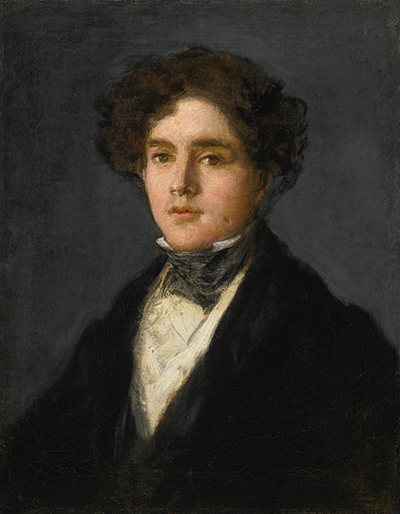
Mariano Goya looks out from a small canvas, his head turned a little towards our left and his eyes meeting ours. The pale shirt opens a narrow space between his dark lapels. At the top of that opening, a thick cravat comes almost to his chin. A small mark on his left cheek survives among the broad strokes of colour Goya used to paint the face. This is the portrait Goya made on his final visit to Madrid in 1827, now in the Meadows Museum in Dallas. On the back he recorded his own age, 81, and addressed the painting to his grandson. [1] [2]
At a Glance
- ArtistFrancisco de Goya y Lucientes
- TitlePortrait of Mariano Goya, the Artist’s Grandson
- SitterPío Mariano de Goya y Goicoechea, son of Javier Goya and Gumersinda Goicoechea. [3]
- Date and place1827, Madrid. [2] [4]
- Medium and dimensionsOil on canvas, 52.1 × 41.3 cm (height × width). [1]
- CollectionMeadows Museum, Southern Methodist University, Dallas, MM.2013.08. [1]
Works across Goya’s career
The Parasol
1777The Nude Maja
1795–1800Saturn Devouring His Son
c. 1820–23The Dog
c. 1820–23A dark coat against a grey ground
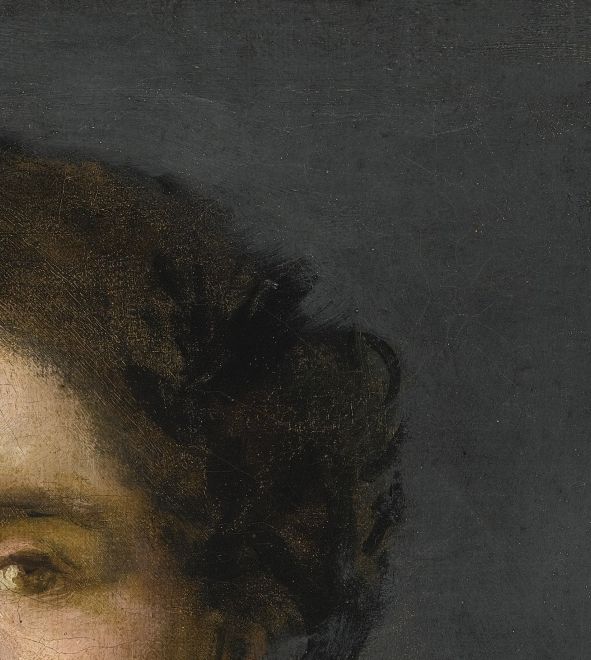
The shoulders spread towards both edges of the painting, while the head is held within a generous area of grey. The uneven brushwork there gives the background a little movement, especially beside the hair. Some curls have a definite outline against that grey. Others gather into a dark mass around the temples and seem to merge with it. The sitter’s right shoulder slopes out of the picture at the left. The shoulder on the right fills more of the canvas, making the short turn of the head easier to register. With the hands outside the frame and the setting left open, the movement of the eyes carries the encounter. [1] [2]
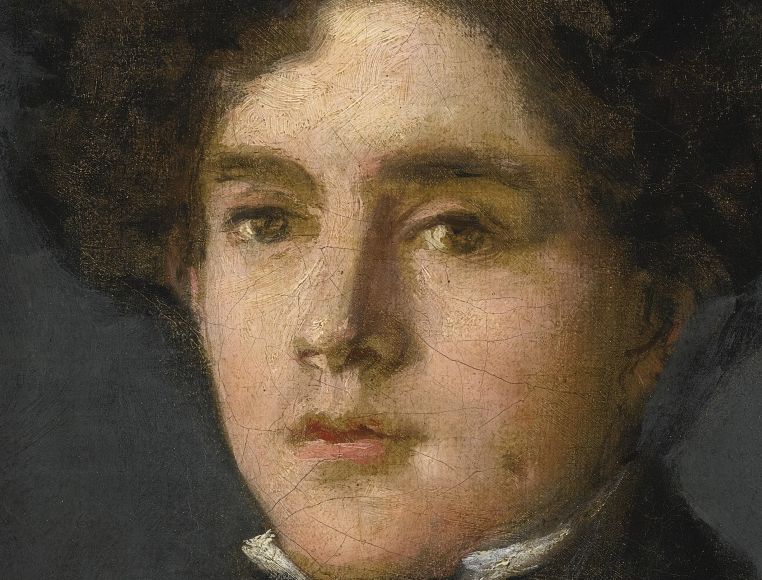
Look along the bridge of the nose and across the cheeks. Light draws out the width of the forehead and the roundness of the cheek at our right. Goya leaves places where the olive-brown preparation shows through the flesh paint. Warm strokes give the cheek and mouth their colour, while the darker passages beneath the eyebrows make the eyes distinct even at this small scale. The Meadows Museum’s study of the painting also points to a grey-blue stroke that appears to adjust the outline of an ear. The mark is at the edge of our attention, where hair meets background. It reads as a quick revision, made with a single movement of the brush. [1] [2]
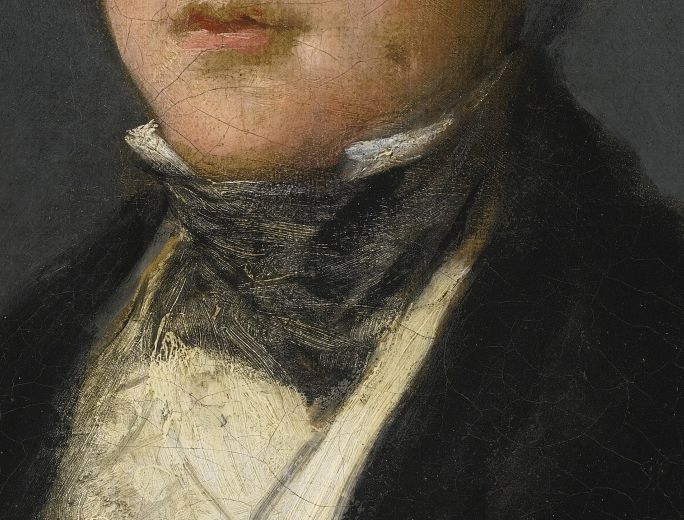
The strongest light below the face is the point of the shirt between the lapels. Follow it upwards and the clean edge breaks into slanting strokes at the neck. Pale paint shows through the dark of the cravat and catches on its folds. Two small tips of white collar separate the fabric from the chin. Goya lets the coat fall into broad areas of black and uses these few changes in tone to show how the layers sit around the neck. The slight pink at the mouth and the little mark on the cheek can consequently hold their own against the brightest passage of clothing. The museum leaves the nature of the mark open. [1] [2]
Annotated Details from Portrait of Mariano Goya
Follow the contrast of face, hair, collar and coat in the Meadows Museum portrait.
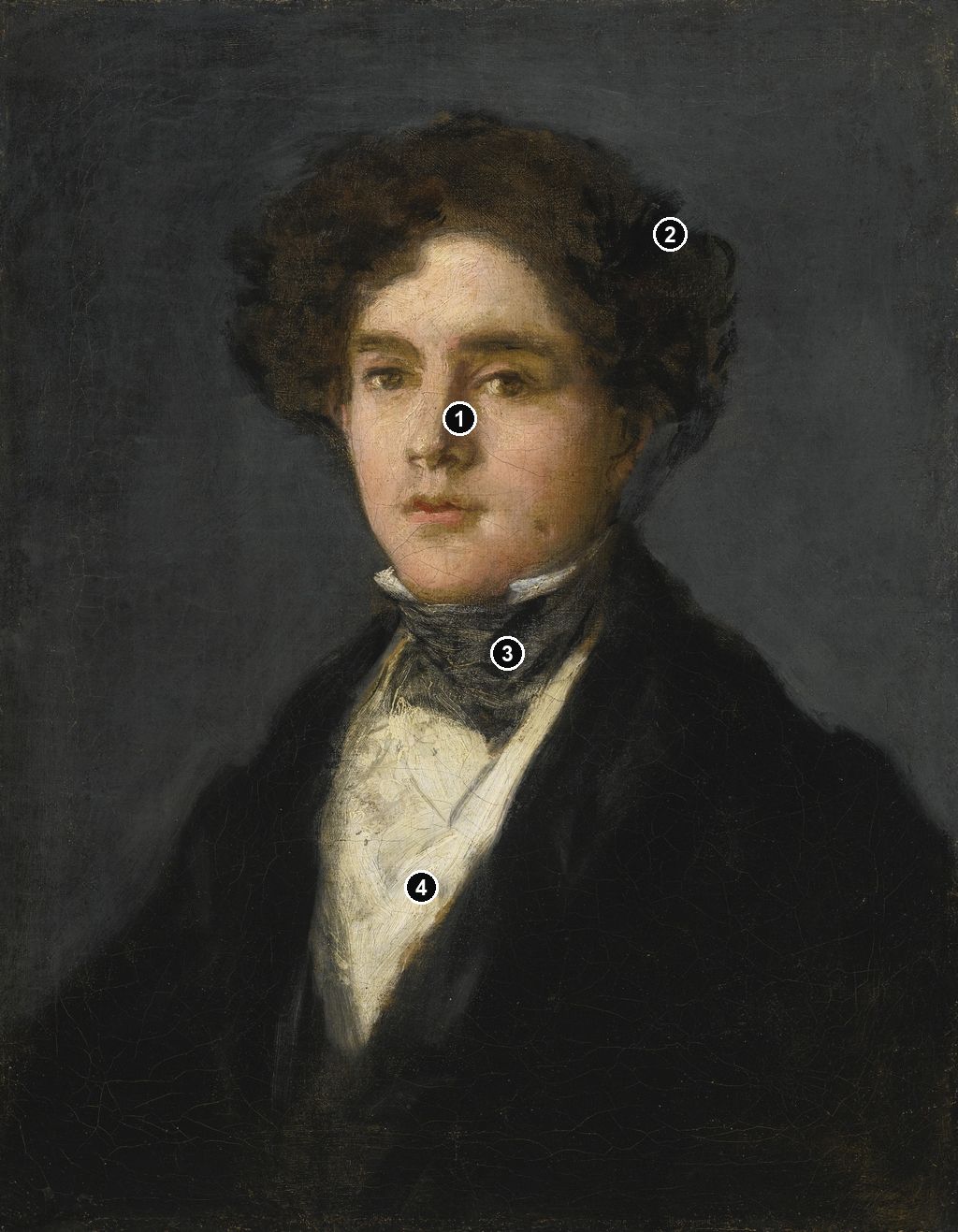
Details from PORTRAIT OF MARIANO GOYA
Details from the 1827 Meadows Museum painting (MM.2013.08).
The eyes
The eyes are set slightly below the sweep of the hair.
The mass of hair
Dark curls merge into the grey around the edge of the head.
The narrow collar
A narrow light edge separates the face from the dark neckcloth.
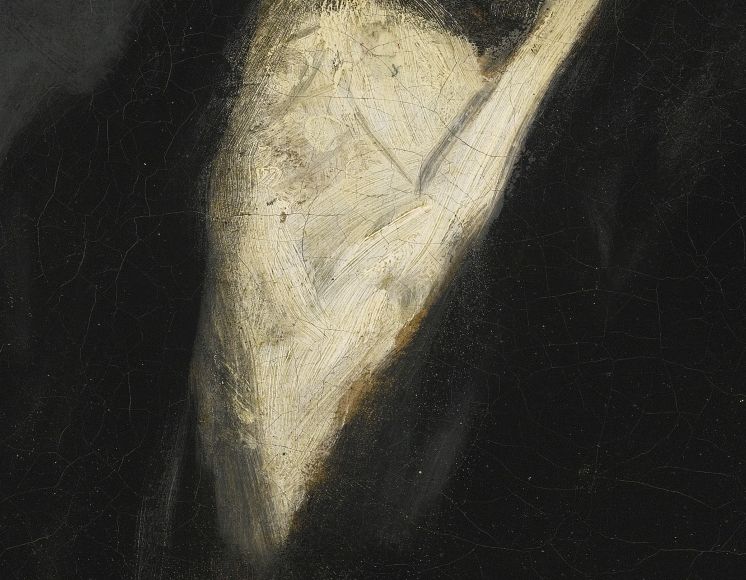
Light fabric at the chest
A pale triangle of fabric interrupts the broad dark shape of the coat.
A gift recorded on the back
Goya’s words on the reverse can be translated as ‘Goya to his grandson, in 1827, at the age of 81’. They run over several short lines in dilute paint. An old lining once concealed them. The conservation report published for the 2013 sale records that removing the lining and its adhesive brought the inscription back into view. The Meadows Museum later published photographs of both sides. The front gives no title or date. The writing on the back supplies the year and identifies the relationship in Goya’s own hand. It describes the act of giving as well as the act of painting. [2] [5]
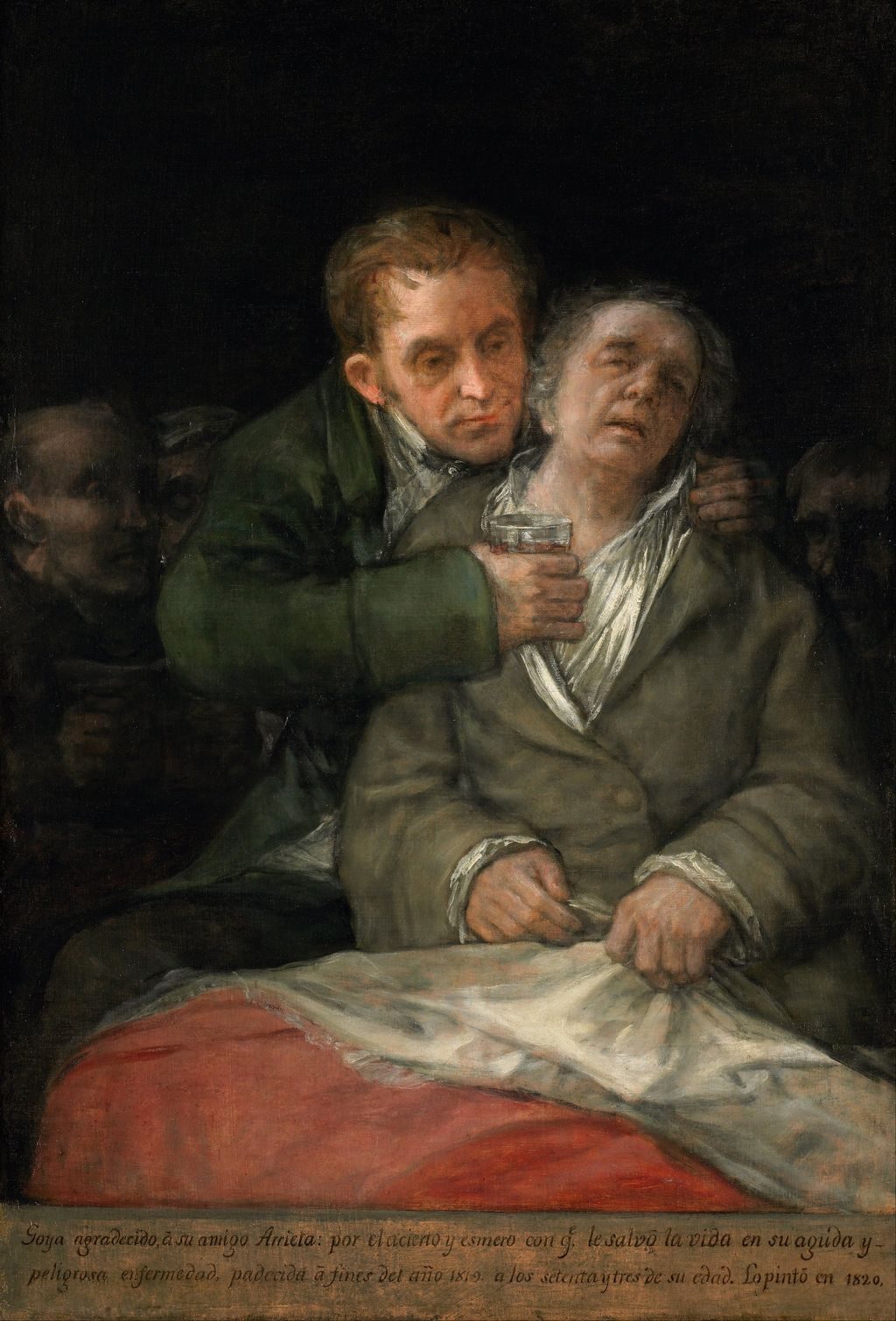
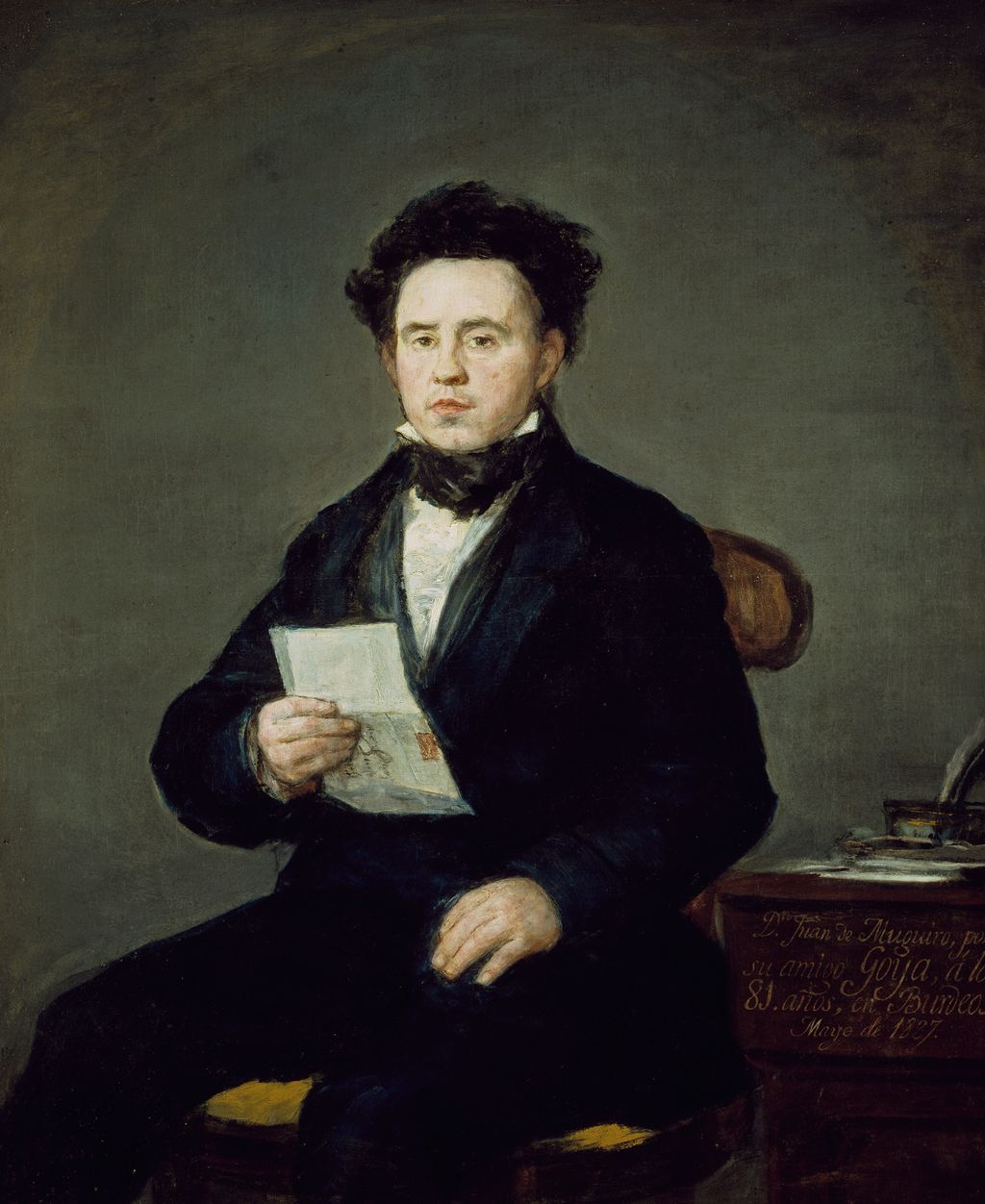
Earlier that year, Goya painted Don Juan Bautista de Muguiro in Bordeaux. He recorded his age there too, calling himself the sitter’s friend. Muguiro’s dedication is legible on the front, at the edge of a desk where there are writing implements and correspondence. Goya had also placed a dedication across the foot of his Self-Portrait with Dr Arrieta in 1820, where he thanked his doctor for the care he had received during a serious illness. Each painting preserves a particular relationship in writing. With Mariano, that acknowledgement sits on the back of a canvas small enough for the recipient to turn over and read. [2] [5] [6]
Goya on film
Five films explore Goya’s portraits, prints, Black Paintings and painting techniques.
The Duke of Wellington by Goya
The portrait, its military decorations and its later theft.
Watch on YouTubeFrom Bordeaux to Madrid
Goya had been living in Bordeaux since 1824. A letter to Leocadia Zorrilla, preserved at the Fondation Custodia and dated to before 30 July 1827, confirms that he had reached Madrid and been well received there. He tells Leocadia he is waiting to hear from her and asks after her and Rosario. The foundation places the journey in the context of Goya’s business over his court pension. The letter gives independent evidence of the visit during which the Meadows Museum and Fundación Goya en Aragón place the sitting. Mariano, born in 1806, was about 21 that summer. [2] [3] [4] [7]
The handover of a much larger possession had already put the grandfather’s affection into writing. In 1823, Goya gave the Quinta del Sordo, his house and estate outside Madrid, to the seventeen-year-old Mariano. The deed, preserved in the Archivo Histórico de Protocolos de Madrid, describes the gift as a sign of his affection for his grandson. An 1830 document lists the Quinta among the assets Mariano brought to his marriage to Concepción Mariátegui. The house is where Goya painted his Black Paintings on the walls. The notarial records establish Mariano’s part in the property’s history. Four years after the first deed, the family relationship would appear again in the few lines on the back of his portrait. [2] [8] [9]
Two childhood portraits and a later copy
In the full-length portrait dated about 1810, Mariano stands with a cord in his left hand that leads down to a toy carriage. He was about four. The collar frames his face, and gold-coloured buttons stand out on his little jacket. The toy makes sense of the gesture and gives the painter a reason to carry the composition down to the floor. The Fundación Goya en Aragón catalogues it as a documented work in a private collection, previously owned by Mariano’s father Javier and then by Mariano himself. Its canvas is 113 cm high, more than twice the height of the Dallas portrait. [1] [3]
A second childhood likeness, dated about 1813–15, shows Mariano in a top hat and wide white lace collar. He sits beside a musical score with his left hand at his waist. In his right, he raises a roll of paper like a conductor’s baton. This is the portrait catalogued by the Museo Goya in Zaragoza as P-Pin-001972. The Fundación Goya en Aragón traces it from Mariano’s collection through several owners to the ducal family of Alburquerque, whose heirs lent it to the museum. The museum presents it under Francisco de Goya’s name, while the foundation’s entry classifies it as attributed to him. The score, rolled paper and top hat distinguish it at a glance from the small Dallas portrait. [10] [11]
The anonymous copy on deposit at the Musée Goya in Castres is closer in appearance to the Dallas painting. It repeats the young man’s head and shoulders, which makes the collection details especially helpful in a reproduction. Paul Cosson left the copy to the Louvre in 1926, and the Louvre placed it in Castres in 1984. The French national museum catalogue records its earlier attribution to Lucas Velázquez and explains why the copy was returned to anonymity. Its numbers are RF 2539 for the Louvre and D 84-1-2 for the deposit in Castres. [12]
How the painting reached Dallas
The sale catalogue traces the 1827 canvas through Eduardo Cano, Manuel Ussel and Manuel de Urzaiz, with Urzaiz listed by 1887. Precisely when the painting left Mariano’s possession is undocumented. The catalogue also marks a possible later owner, D. Zubina, as uncertain. George Embiricos acquired the painting from Knoedler in 1954. It was offered as lot 103 at Sotheby’s in New York in January 2013 and went unsold. The Meadows Museum announced its purchase that October with funds from The Meadows Foundation and a gift from Mrs Eugene McDermott. [4] [5] [13]
Artworks directory
| Name | Date | Medium |
|---|---|---|
| And There’s No Help for It, Plate 15 | Printed 1863 | |
| Asmodea | c. 1820–23 | Wall painting transferred to canvas |
| Boys Inflating a Bladder | 1777–78 | Tapestry cartoon |
| Boys Picking Fruit | 1778 | Tapestry cartoon |
| Bullfight in a Divided Ring | 1825 | Lithograph |
| Card Players | 1777–78 | Tapestry cartoon |
| Card Players (sketch) | 1777–78 | Painted sketch |
| Dance on the Banks of the Manzanares | 1777 | Tapestry cartoon |
| Duel with Cudgels | c. 1820–23 | Wall painting transferred to canvas |
| Heads in a Landscape | c. 1820–23 | Easel painting |
| Judith and Holofernes | c. 1820–23 | Wall painting transferred to canvas |
| Leocadia | c. 1820–23 | Wall painting transferred to canvas |
| Maja and Cloaked Men | 1777 | Tapestry cartoon |
| Maja and Cloaked Men (sketch) | 1777 | Painted sketch |
| Majo Clapping in Time to the Music | 1777 | Drawing |
| Men Reading | c. 1820–23 | Wall painting transferred to canvas |
| Out Hunting for Teeth, Plate 12 | 1799 | Etching, burnished aquatint and burin |
| Picnic in the Countryside (sketch) | 1776–78 | Painted sketch |
| Picnic on the Banks of the Manzanares | 1776 | Tapestry cartoon |
| Pilgrimage to San Isidro | c. 1820–23 | Wall painting transferred to canvas |
| Preparatory study for The Sleep of Reason Produces Monsters | c. 1796–97 | Drawing |
| Procession of the Holy Office | c. 1820–23 | Wall painting transferred to canvas |
| Quarrel at the Cockerel Inn (sketch) | 1777 | Painted sketch |
| Quarrel in the New Tavern | 1777 | Tapestry cartoon |
| Saturn Devouring His Son | c. 1820–23 | Wall painting transferred to canvas |
| Seated Majo Smoking | c. 1776 | Drawing |
| The Dog | c. 1820–23 | Wall painting transferred to canvas |
| The Drinker | 1777 | Tapestry cartoon |
| The Fates | c. 1820–23 | Wall painting transferred to canvas |
| The Great He-Goat | c. 1820–23 | Wall painting transferred to canvas |
| The Kite | 1777–78 | Tapestry cartoon |
| The Parasol | 1777 | Oil on canvas, tapestry cartoon |
| The Second of May 1808 | 1814 | Oil on canvas |
| The Sleep of Reason Produces Monsters, Plate 43 | 1799 | Etching and aquatint |
| The Third of May 1808 | 1814 | Oil on canvas |
| Thou Who Canst Not, Plate 42 | 1799 | Etching and burnished aquatint |
| Three Figures | 1776 | Drawing (lost) |
| Two Old Men | c. 1820–23 | Wall painting transferred to canvas |
| Two Old Men Eating Soup | c. 1820–23 | Wall painting transferred to canvas |
| Two Women and a Man | c. 1820–23 | Wall painting transferred to canvas |
| Universal Language: The Author Dreaming | 1797 | Drawing |
| The Family of Charles IV | 1800 | Oil on canvas |
| Witches’ Sabbath (Osuna painting) | 1797–98 | Oil on canvas |
| The Nude Maja | 1795–1800 | Oil on canvas |
| The Clothed Maja | 1800–07 | Oil on canvas |
| Self-Portrait (Drawing) | c. 1796 | Brush and carbon black ink on laid paper |
| The Swing, Madrid Album B.21 | 1795–97 | Brush and carbon black washes |
| Majas Fighting, a Majo Observing, Madrid Album B.15 | 1796–97 | Brush, grey and black washes on laid paper |
| Majos and Majas Conversing, Madrid Album B.16 | c. 1794–97 | Ink wash on paper |
| Weeping Woman and Three Men, Madrid Album B.17 | 1795–97 | Brush, carbon black washes and black chalk |
| Maja Seated on a Chair and Two Companions Behind, Madrid Album B.18 | 1795–97 | Brush and carbon black washes |
| Girl and Bull, Madrid Album B.23 | 1796–97 | Brush and carbon black washes |
| Lovers Sitting on a Rock, Madrid Album B.24 | 1796–97 | Brush and carbon black washes |
| Mariano Ceballos Riding a Bull | 1825 | Crayon lithograph and scraper |
| Landscape (lifetime impression) | c. 1807–10 | Etching and aquatint |
| Self-Portrait (1815), Prado canvas | 1815 | Oil on canvas |
| Self-Portrait (1815), Academy panel | 1815 | Oil on panel |
| Self-Portrait with Dr Arrieta | 1820 | Oil on canvas |
| Christ Crucified | 1780 | Oil on canvas |
| The Last Communion of Saint Joseph of Calasanz | 1819 | Oil on canvas |
| Christ on the Mount of Olives | 1819 | Oil on panel |
| The Flower Girls, or Spring | 1786–87 | Oil on canvas |
| The Grape Harvest, or Autumn | 1786–87 | Oil on canvas |
| The Snowstorm, or Winter | 1786–87 | Oil on canvas |
| The Threshing Ground, or Summer | 1786–87 | Oil on canvas |
| Picnic on the Banks of the Manzanares | 1776 | Oil on canvas |
| The Kite | 1777–78 | Oil on canvas |
| Dance on the Banks of the Manzanares | 1777 | Oil on canvas |
| A Fight at the Venta Nueva | 1777 | Oil on canvas |
| Blind Man’s Bluff | 1788 | Oil on canvas |
| Dogs on a Lead | 1775 | Oil on canvas |
| Hunting with a Decoy | 1775 | Oil on canvas |
| Hunter Loading His Rifle | 1775 | Oil on canvas |
| The Angler | 1775 | Oil on canvas |
| The Hermitage of San Isidro on His Feast Day | 1788 | Oil on canvas |
| The Meadow of San Isidro | 1788 | Oil on canvas |
| The Straw Manikin | 1791–92 | Oil on canvas |
| Witches’ Flight | c. 1797–98 | Oil on canvas |
| A Scene from ‘The Forcibly Bewitched’ | 1798 | Oil on canvas |
| The Duchess of Alba in Black | 1797 | Oil on canvas |
| The Duchess of Alba in White | 1795 | Oil on canvas |
| Charles III in Hunting Dress | c. 1786 | Oil on canvas |
| The Duke and Duchess of Osuna and Their Children | 1787–88 | Oil on canvas |
| Manuel Osorio Manrique de Zúñiga | 1787–88 | Oil on canvas |
| The Marquesa de Pontejos | c. 1786 | Oil on canvas |
| Equestrian Portrait of the 1st Duke of Wellington | 1812 | Oil on canvas |
| The Duke of Wellington | 1812–14 | Oil on wood |
| Portrait of Ferdinand VII of Spain | 1814 | Oil on canvas |
| Gaspar Melchor de Jovellanos | 1798 | Oil on canvas |
| María Tomasa Palafox y Portocarrero | 1804 | Oil on canvas |
| Señora Sabasa García | c. 1806–11 | Oil on canvas |
| Don Juan Bautista de Muguiro | 1827 | Oil on canvas |
| Doña Isabel de Porcel | Before 1805 | Oil on canvas |
| The Colossus | After 1808 | Oil on canvas |
| The Burial of the Sardine | 1808–12 | Oil on panel |
| The Madhouse | 1808–12 | Oil on panel |
| A Procession of Flagellants | 1808–12 | Oil on panel |
| Portrait of Jacques Galos | 1826 | Oil on canvas |
| Portrait of Mariano Goya, the Artist’s Grandson | 1827 | Oil on canvas |
| Milkmaid of Bordeaux | c. 1827 | Oil on canvas |
| Portrait of Don Juan Antonio Cuervo | 1819 | Oil on canvas |
| María Luisa of Parma (Naples version) | c. 1800 | Oil on canvas |
| The Countess of Baena | 1819 | Oil on canvas |
| The Family of the Infante Don Luis | 1783–84 | Oil on canvas |
| The Holy Family | c. 1787 | Oil on canvas |
| Saint Barbara | c. 1773 | Oil on canvas |
| Saints Justa and Rufina | 1817 | Oil on canvas |
| El Tío Paquete | c. 1819–20 | Oil on canvas |
| The Forge | c. 1815–20 | Oil on canvas |
| Majas on a Balcony (Metropolitan Museum version) | c. 1800–10 | Oil on canvas |
| Maja and Celestina on a Balcony | c. 1808–12 | Oil on canvas |
| The Water Bearer | 1808–12 | Oil on canvas |
| Time and the Old Women | c. 1810 | Oil on canvas |
Frequently Asked Questions
It belongs to the Meadows Museum at Southern Methodist University in Dallas. The museum’s accession number is MM.2013.08. [1]
Discussion
Look again at the images and ideas explored in Mariano Goya, the Artist’s Grandson. These editorial prompts invite your observations.
Start with the sweep of the dark coat, then follow the lit edge of the shirt up to the cravat, cheek and eyes. Which brushstrokes make you pause at the face? How does reading Goya’s dedication change the way you see Mariano’s direct gaze?
Reader Insights
How does the bright collar change the way you see Mariano’s face?
Compare what the two dedications say about the sitters’ relationships to Goya.
Join the Conversation
Share a detail, comparison or question about Mariano Goya, the Artist’s Grandson below.
References
- Meadows Museum, Portrait of Mariano Goya, the Artist’s Grandson, collection record MM.2013.08. View source.
- Meadows Museum, At the Meadows, spring 2014, pp. 11–13, with the full painting, reverse and detail. View source.
- Fundación Goya en Aragón, Mariano Goya, about 1810, catalogue entry 306, including the sitter’s family and provenance. View source.
- Fundación Goya en Aragón, Mariano Goya, 1827, catalogue entry 188, with the dedication, Madrid dating and acquisition history. View source.
- Sotheby’s, Portrait of Mariano Goya, the artist’s grandson, New York, January 2013, lot 103, with the provenance and Simon Parkes’s conservation report. View source.
- Fundación Goya en Aragón, Juan Bautista Muguiro, catalogue entry 189 and dedication transcription. View source.
- Fondation Custodia, ‘La Fondation Custodia acquiert une lettre inconnue de Goya’, with Goya’s letter from Madrid to Leocadia Zorrilla from before 30 July 1827. View source.
- Comunidad de Madrid, Documentos en la onda, summaries of the 1823 deed of gift and the 1830 deed recording property brought to Mariano’s marriage. View source.
- Museo Nacional del Prado, La Quinta del Sordo. Philippe Parreno, exhibition text on the house and its paintings. View source.
- Museo Goya, Colección Ibercaja, Mariano Goya, collection record P-Pin-001972. View source.
- Fundación Goya en Aragón, Mariano Goya, about 1813–15, catalogue entry 412, with attribution and provenance. View source.
- Ministère de la Culture, Portrait de Mariano Goya, Joconde record for the Castres copy, D 84-1-2 and RF 2539. View source.
- Meadows Museum, ‘Major Goya Painting Acquired by Meadows Museum’, 9 October 2013. View source.







