


 Francisco de Goya.jpg)
 by Tom Gurney
Tom Gurney BSc (Hons) is an art history expert with over 20 years experience
Published on June 19, 2020 / Updated on November 20, 2026
Email: tomgurney1@gmail.com / Phone: +44 7429 011000
Introduction
A woman carries a large earthenware jug against her right hip and holds a small basket in her left hand. Francisco de Goya places us low enough that her head and shoulders are framed by sky. At ground level, a dark bank leaves just enough room for her planted feet to catch the light. The Museum of Fine Arts in Budapest dates the painting to 1808–1812, during the Peninsular War. A household inventory links it to another painting, traditionally identified as Budapest’s The Knife-Grinder. Side by side, the two works give people engaged in ordinary labour the space and attention usually reserved for more elevated subjects. [1] [3] [4]
At a Glance
- ArtistFrancisco de Goya y Lucientes. [1]
- TitlesThe Water Bearer, The Water Carrier, La aguadora and, in the Budapest museum’s Hungarian catalogue, A korsós lány. [1] [2] [3]
- Date1808–1812. [1]
- Medium and dimensionsOil on canvas, 68 × 50.5 cm (height by width), following the museum’s measurement. [1] [2]
- CollectionMuseum of Fine Arts, Budapest (Szépművészeti Múzeum), Old Master Paintings, inventory 760. [1] [2]
- CompanionThe Knife-Grinder (El afilador), Budapest, inventory 763. [3] [4] [5]
Works across Goya’s career
The Parasol
1777The Nude Maja
1795–1800The Water Bearer
1808–12Saturn Devouring His Son
c. 1820–23The Dog
c. 1820–23How Goya paints the weight of the jug
Start with the hand on the left of the picture. The fingers curl around the jug below its neck, still visible where the vessel meets the dark cuff. A thin highlight follows the rim. From there the clay broadens into a roughly oval mass marked by warm orange and darker, broken strokes. The jug tilts across her body with its mouth held high. Its base disappears into the folded yellow cloth at her waist. The hand steadies it high up, while the cloth and hip take the weight lower down. The arrangement tells us what carrying the vessel requires before we have time to wonder where she is taking it. [1] [3]
The basket makes the balance of the pose easier to see. Her right elbow bends out beside the jug, while her left arm drops almost straight. The little handle rises into a fist and the shallow basket hangs beside her knee. Its horizontal rim and flecks of light keep it distinct from the red-brown skirt behind it. In the lower half of the painting, the skirt drops in broad folds, leaving the pale lower legs and shoes visible. One shoe points to the left, while the other presents more of its toe. The width of that stance steadies the figure, even as the diagonal jug suggests the effort it would take to move off again. [1] [3]
Colour helps us follow that transfer of weight. The brightest yellow is bunched at the waist and trails down the side below the jug. The shawl crossing the chest has a different character. Its pale folds catch the light in broken strokes, especially over the shoulder on the right of the canvas. The light returns in smaller patches on the face, hand and shoes. Meanwhile, the warm clay and reddish skirt hold their own against the cool grey-blue of the sky. Goya gives the vessel an emphatic colour and recognisable shape while letting the landscape remain indistinct. Our eye keeps returning to the point where the jug presses into the sash. [1] [3]
Annotated Details from The Water Bearer
Look from the face to the vessel, the basket and the worker’s footing.
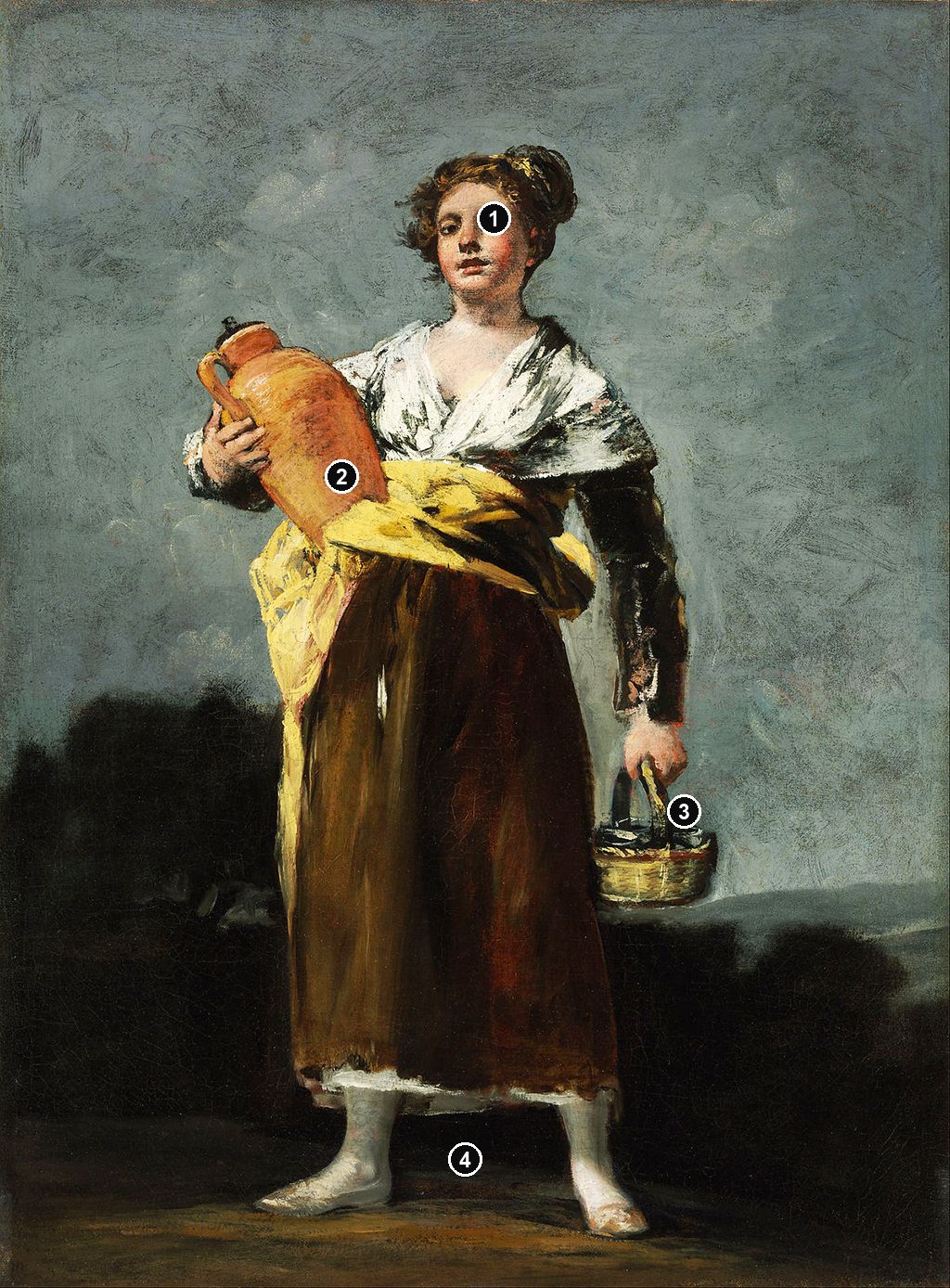
Details from THE WATER BEARER
Details from the Budapest painting (760).
The head against the sky
The low viewpoint puts the head against open sky.
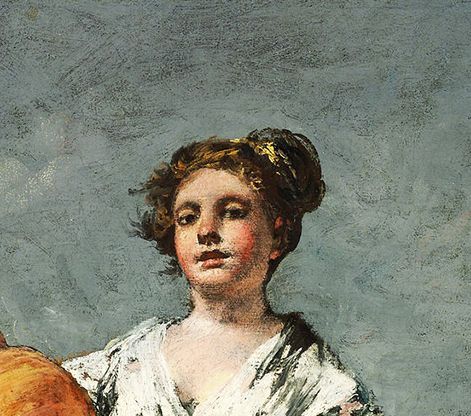
The jug and yellow cloth
The hand grips the warm-coloured jug, which rests against the folded cloth.
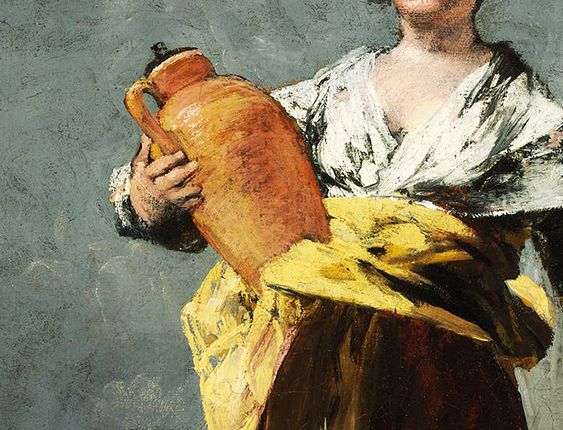
The suspended basket
The basket hangs low in the other hand.
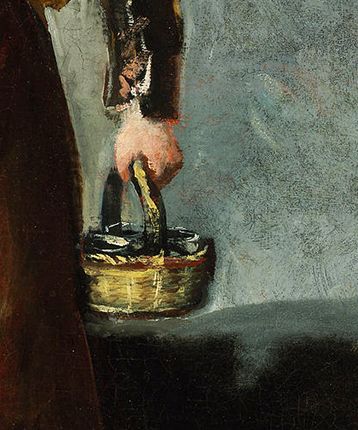
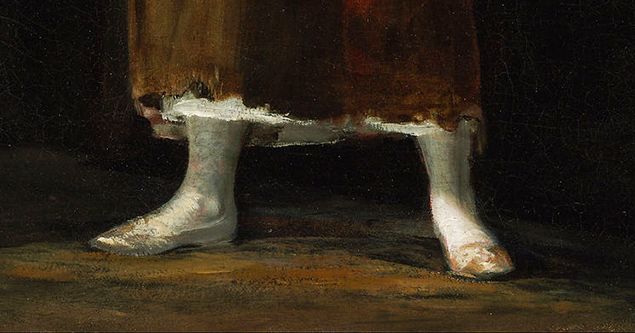
The widely placed shoes
The pale shoes catch light where the figure stands on the uneven ground.
A figure seen from below
The dark landscape stays close to the bottom of the canvas, rising higher on the left behind the skirt. On the right, a low strip of land shows beyond the basket. Goya gives the woman’s head a broad area of sky, and the tilted jug and raised elbow also break cleanly into it. The shallow space makes her seem near enough to pass us. At the same time, the low viewpoint gives her the commanding outline of a figure set above eye level. The effect depends on the relationship between the figure and the horizon, even though the canvas itself is well under a metre high. [1] [2]
The face changes the pace after the brisk marks in the sash and shawl. Her chin is lifted slightly and her gaze extends past the foreground. Nothing in the field of view identifies what she sees. The face therefore has room to register as a person attending to something outside the painting. That makes the small practical details especially important. We can trace how she carries a load and see where she has set her feet even while her destination stays open. Axel Vécsey, writing for the Budapest museum, compares the stature Goya gives her to that of a public monument to everyday courage. [1] [2]
Goya on film
Five films explore Goya’s portraits, prints, Black Paintings and painting techniques.
The Duke of Wellington by Goya
The portrait, its military decorations and its later theft.
Watch on YouTubeThe Knife-Grinder and the household inventory
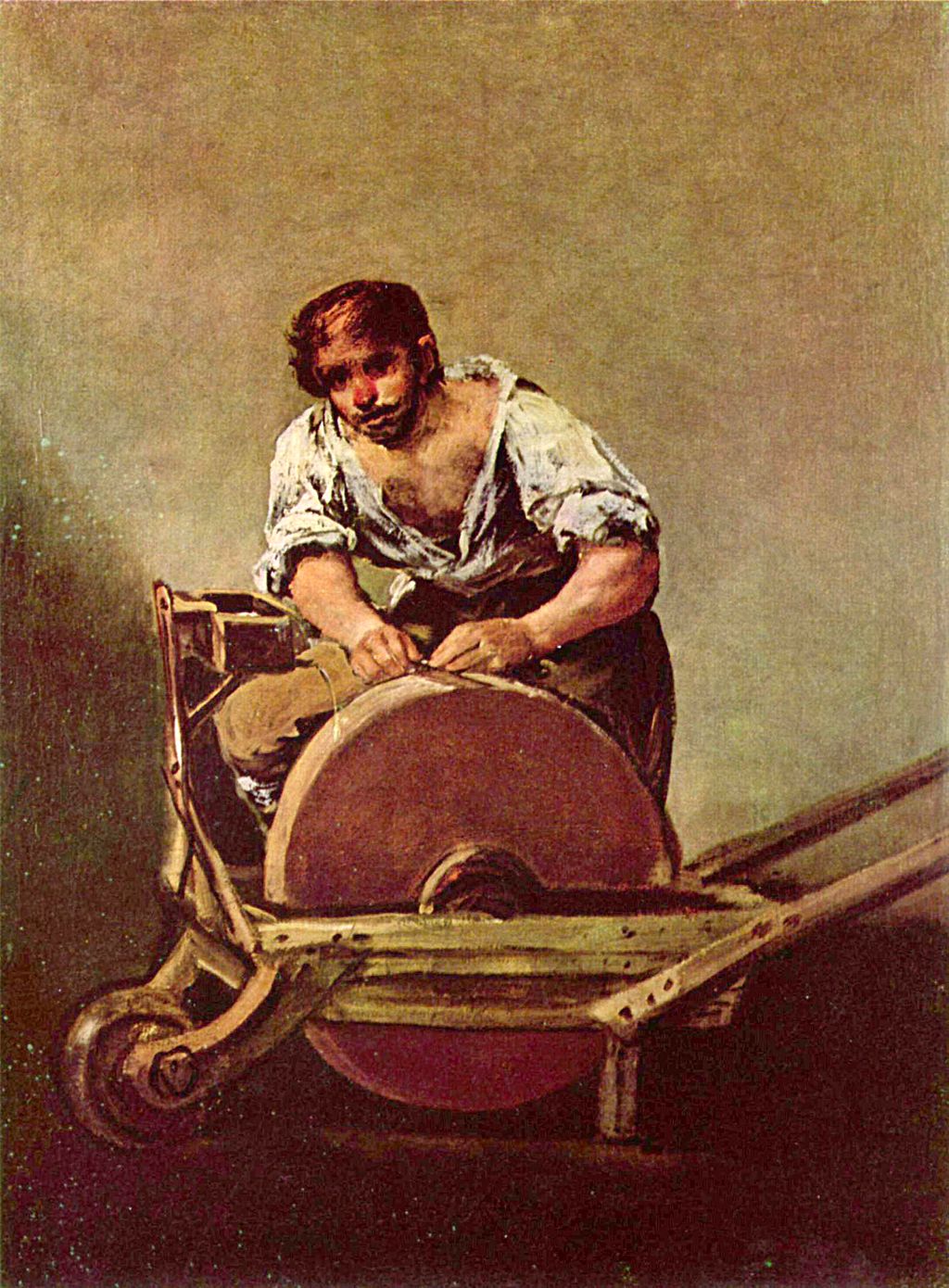
The Knife-Grinder also puts a worker near the front of a narrow upright canvas, against an unobtrusive background. The man bends over a portable grinding wheel, bringing the knife up to it, and raises his head towards the viewer. His open shirt and rolled sleeves show the working posture of his shoulders and arms. The grinder and his equipment occupy much of the bottom half of the picture. Goya gives both workers tools that determine the pose, but the two kinds of effort register differently. The carrier straightens to keep the load at her hip. The grinder folds himself over the wheel and looks up from his work. [1] [4] [5]
The case for pairing the paintings goes beyond those visual parallels. In the inventory drawn up in 1812 after the death of Goya’s wife Josefa Bayeu, a water carrier and its companion appear together under number 13, valued jointly at 300 reales. The inventory describes the water carrier and leaves the companion unnamed. The Fundación Goya en Aragón identifies the latter with the Budapest Knife-Grinder, the traditional identification. Budapest catalogues both paintings at 68 × 50.5 cm. The works passed through the collections of Alois Wenzel von Kaunitz-Rietberg and Nicolas Esterházy before entering the museum. [1] [3] [4] [5]
According to the Fundación, X-rays revealed that both paintings were made on previously used canvases. That finding and their appearance in the household inventory support its suggestion that Goya made them for himself. Juliet Wilson-Bareau proposed that they might originally have hung above doors in Goya’s house on Calle Valverde in Madrid. An elevated hanging position would make sense of the low viewpoint in each painting. The inventory supplies a pairing and a valuation, while the proposed placement rests on the way the figures are painted. [3]
The Peninsular War and the water carrier
The museum’s dating puts the pair in the years of resistance to Napoleon’s occupation of Spain. Vécsey reads the water carrier as a civilian bringing supplies to the defenders of Zaragoza. The Fundación offers a related reading of both pictures as tributes to people whose work kept the resistance going. Carrying water and sharpening blades are plausible parts of that labour. They are also familiar tasks in peacetime. Goya shows a jug, a basket and a woman who knows how to carry them. The painting and inventory leave the woman’s name, the intended recipients of the water and the place of the scene open. [1] [2] [3] [5]
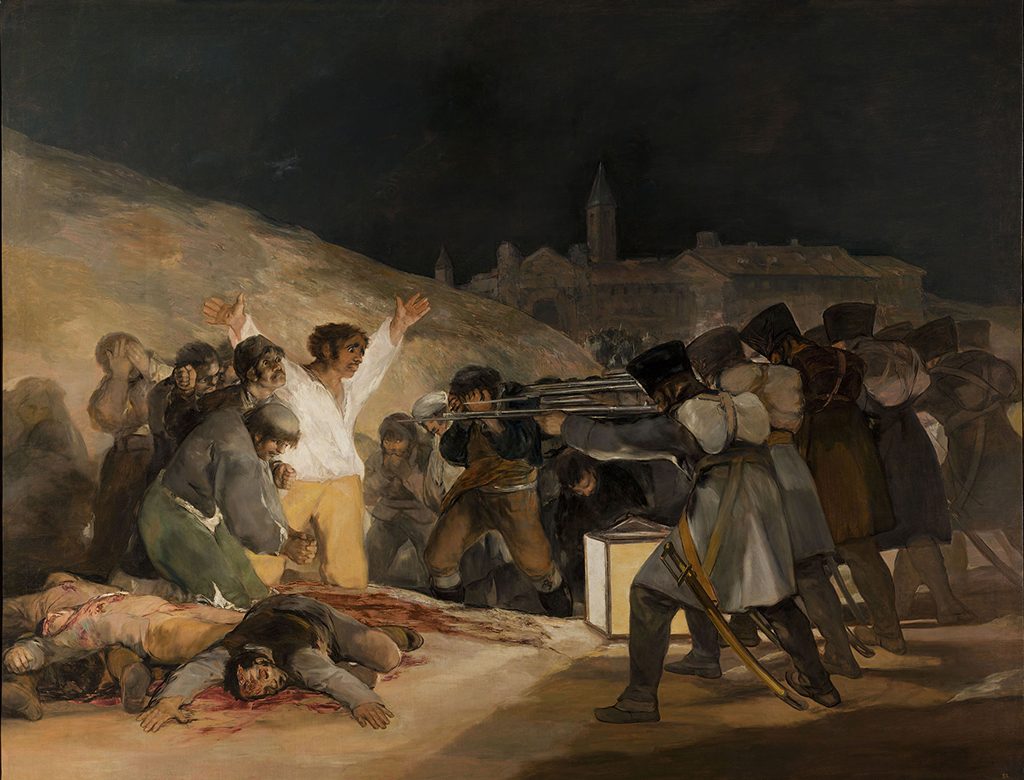
Vécsey’s comparison with The Disasters of War shows what is unusual about the possible wartime reading. The prints often confront the viewer with what has happened to the people in the image. Here the upright figure carries what others might need, and the recipient is outside our view. The effect differs again from The Third of May 1808, in which a firing squad, its victims and a lantern occupy the same foreground. That painting gives the viewer a specific historical event and stages it as an encounter between groups. In The Water Bearer, Goya makes the mechanics of a single person’s work the focus. The association with Zaragoza gives that action a possible historical setting. [1] [2] [6]
Water carriers in Goya’s earlier work
In Young Women with Pitchers, a tapestry cartoon of 1791–1792 now in the Prado, Goya gives the task a setting and several participants. Two young women balance pitchers on their heads, a boy holds smaller vessels, and an older woman stands between the two carriers. The fountain and its masonry give the group a place to gather. The painting was a design for a tapestry for the king’s office at El Escorial. In the smaller Budapest canvas, the single jug is held at the hip, and the sky takes the place of much of the setting. The earlier picture lets the viewer follow several people at once. The Budapest work gives one carrier the full height of the composition. [1] [7]
The Fundación also mentions a drawing from Goya’s Album C that is sometimes associated with the painting, the Getty’s It’s a pity you don’t have something else to do. In the drawing, the woman carries water jugs and the artist’s handwritten remark adds a voice to the scene. Getty’s exhibition note suggests that the words may carry a sexual innuendo, a reading distinct from the Budapest museum’s emphasis on the resolve of the painted figure. The Fundación treats the drawing as a related subject and also sees a connection to the tapestry cartoon. A figure carrying earthenware was a motif Goya could return to and adapt through the arrangement of the body, the setting and, in the drawing, the caption. [3] [7] [8]
 in Detail Francisco de Goya.jpg)
Artworks directory
| Name | Date | Medium |
|---|---|---|
| And There’s No Help for It, Plate 15 | Printed 1863 | |
| Asmodea | c. 1820–23 | Wall painting transferred to canvas |
| Boys Inflating a Bladder | 1777–78 | Tapestry cartoon |
| Boys Picking Fruit | 1778 | Tapestry cartoon |
| Bullfight in a Divided Ring | 1825 | Lithograph |
| Card Players | 1777–78 | Tapestry cartoon |
| Card Players (sketch) | 1777–78 | Painted sketch |
| Dance on the Banks of the Manzanares | 1777 | Tapestry cartoon |
| Duel with Cudgels | c. 1820–23 | Wall painting transferred to canvas |
| Heads in a Landscape | c. 1820–23 | Easel painting |
| Judith and Holofernes | c. 1820–23 | Wall painting transferred to canvas |
| Leocadia | c. 1820–23 | Wall painting transferred to canvas |
| Maja and Cloaked Men | 1777 | Tapestry cartoon |
| Maja and Cloaked Men (sketch) | 1777 | Painted sketch |
| Majo Clapping in Time to the Music | 1777 | Drawing |
| Men Reading | c. 1820–23 | Wall painting transferred to canvas |
| Out Hunting for Teeth, Plate 12 | 1799 | Etching, burnished aquatint and burin |
| Picnic in the Countryside (sketch) | 1776–78 | Painted sketch |
| Picnic on the Banks of the Manzanares | 1776 | Tapestry cartoon |
| Pilgrimage to San Isidro | c. 1820–23 | Wall painting transferred to canvas |
| Preparatory study for The Sleep of Reason Produces Monsters | c. 1796–97 | Drawing |
| Procession of the Holy Office | c. 1820–23 | Wall painting transferred to canvas |
| Quarrel at the Cockerel Inn (sketch) | 1777 | Painted sketch |
| Quarrel in the New Tavern | 1777 | Tapestry cartoon |
| Saturn Devouring His Son | c. 1820–23 | Wall painting transferred to canvas |
| Seated Majo Smoking | c. 1776 | Drawing |
| The Dog | c. 1820–23 | Wall painting transferred to canvas |
| The Drinker | 1777 | Tapestry cartoon |
| The Fates | c. 1820–23 | Wall painting transferred to canvas |
| The Great He-Goat | c. 1820–23 | Wall painting transferred to canvas |
| The Kite | 1777–78 | Tapestry cartoon |
| The Parasol | 1777 | Oil on canvas, tapestry cartoon |
| The Second of May 1808 | 1814 | Oil on canvas |
| The Sleep of Reason Produces Monsters, Plate 43 | 1799 | Etching and aquatint |
| The Third of May 1808 | 1814 | Oil on canvas |
| Thou Who Canst Not, Plate 42 | 1799 | Etching and burnished aquatint |
| Three Figures | 1776 | Drawing (lost) |
| Two Old Men | c. 1820–23 | Wall painting transferred to canvas |
| Two Old Men Eating Soup | c. 1820–23 | Wall painting transferred to canvas |
| Two Women and a Man | c. 1820–23 | Wall painting transferred to canvas |
| Universal Language: The Author Dreaming | 1797 | Drawing |
| The Family of Charles IV | 1800 | Oil on canvas |
| Witches’ Sabbath (Osuna painting) | 1797–98 | Oil on canvas |
| The Nude Maja | 1795–1800 | Oil on canvas |
| The Clothed Maja | 1800–07 | Oil on canvas |
| Self-Portrait (Drawing) | c. 1796 | Brush and carbon black ink on laid paper |
| The Swing, Madrid Album B.21 | 1795–97 | Brush and carbon black washes |
| Majas Fighting, a Majo Observing, Madrid Album B.15 | 1796–97 | Brush, grey and black washes on laid paper |
| Majos and Majas Conversing, Madrid Album B.16 | c. 1794–97 | Ink wash on paper |
| Weeping Woman and Three Men, Madrid Album B.17 | 1795–97 | Brush, carbon black washes and black chalk |
| Maja Seated on a Chair and Two Companions Behind, Madrid Album B.18 | 1795–97 | Brush and carbon black washes |
| Girl and Bull, Madrid Album B.23 | 1796–97 | Brush and carbon black washes |
| Lovers Sitting on a Rock, Madrid Album B.24 | 1796–97 | Brush and carbon black washes |
| Mariano Ceballos Riding a Bull | 1825 | Crayon lithograph and scraper |
| Landscape (lifetime impression) | c. 1807–10 | Etching and aquatint |
| Self-Portrait (1815), Prado canvas | 1815 | Oil on canvas |
| Self-Portrait (1815), Academy panel | 1815 | Oil on panel |
| Self-Portrait with Dr Arrieta | 1820 | Oil on canvas |
| Christ Crucified | 1780 | Oil on canvas |
| The Last Communion of Saint Joseph of Calasanz | 1819 | Oil on canvas |
| Christ on the Mount of Olives | 1819 | Oil on panel |
| The Flower Girls, or Spring | 1786–87 | Oil on canvas |
| The Grape Harvest, or Autumn | 1786–87 | Oil on canvas |
| The Snowstorm, or Winter | 1786–87 | Oil on canvas |
| The Threshing Ground, or Summer | 1786–87 | Oil on canvas |
| Picnic on the Banks of the Manzanares | 1776 | Oil on canvas |
| The Kite | 1777–78 | Oil on canvas |
| Dance on the Banks of the Manzanares | 1777 | Oil on canvas |
| A Fight at the Venta Nueva | 1777 | Oil on canvas |
| Blind Man’s Bluff | 1788 | Oil on canvas |
| Dogs on a Lead | 1775 | Oil on canvas |
| Hunting with a Decoy | 1775 | Oil on canvas |
| Hunter Loading His Rifle | 1775 | Oil on canvas |
| The Angler | 1775 | Oil on canvas |
| The Hermitage of San Isidro on His Feast Day | 1788 | Oil on canvas |
| The Meadow of San Isidro | 1788 | Oil on canvas |
| The Straw Manikin | 1791–92 | Oil on canvas |
| Witches’ Flight | c. 1797–98 | Oil on canvas |
| A Scene from ‘The Forcibly Bewitched’ | 1798 | Oil on canvas |
| The Duchess of Alba in Black | 1797 | Oil on canvas |
| The Duchess of Alba in White | 1795 | Oil on canvas |
| Charles III in Hunting Dress | c. 1786 | Oil on canvas |
| The Duke and Duchess of Osuna and Their Children | 1787–88 | Oil on canvas |
| Manuel Osorio Manrique de Zúñiga | 1787–88 | Oil on canvas |
| The Marquesa de Pontejos | c. 1786 | Oil on canvas |
| Equestrian Portrait of the 1st Duke of Wellington | 1812 | Oil on canvas |
| The Duke of Wellington | 1812–14 | Oil on wood |
| Portrait of Ferdinand VII of Spain | 1814 | Oil on canvas |
| Gaspar Melchor de Jovellanos | 1798 | Oil on canvas |
| María Tomasa Palafox y Portocarrero | 1804 | Oil on canvas |
| Señora Sabasa García | c. 1806–11 | Oil on canvas |
| Don Juan Bautista de Muguiro | 1827 | Oil on canvas |
| Doña Isabel de Porcel | Before 1805 | Oil on canvas |
| The Colossus | After 1808 | Oil on canvas |
| The Burial of the Sardine | 1808–12 | Oil on panel |
| The Madhouse | 1808–12 | Oil on panel |
| A Procession of Flagellants | 1808–12 | Oil on panel |
| Portrait of Jacques Galos | 1826 | Oil on canvas |
| Portrait of Mariano Goya, the Artist’s Grandson | 1827 | Oil on canvas |
| Milkmaid of Bordeaux | c. 1827 | Oil on canvas |
| Portrait of Don Juan Antonio Cuervo | 1819 | Oil on canvas |
| María Luisa of Parma (Naples version) | c. 1800 | Oil on canvas |
| The Countess of Baena | 1819 | Oil on canvas |
| The Family of the Infante Don Luis | 1783–84 | Oil on canvas |
| The Holy Family | c. 1787 | Oil on canvas |
| Saint Barbara | c. 1773 | Oil on canvas |
| Saints Justa and Rufina | 1817 | Oil on canvas |
| El Tío Paquete | c. 1819–20 | Oil on canvas |
| The Forge | c. 1815–20 | Oil on canvas |
| Majas on a Balcony (Metropolitan Museum version) | c. 1800–10 | Oil on canvas |
| Maja and Celestina on a Balcony | c. 1808–12 | Oil on canvas |
| The Water Bearer | 1808–12 | Oil on canvas |
| Time and the Old Women | c. 1810 | Oil on canvas |
Frequently Asked Questions
The painting is in the Old Master Paintings collection of the Museum of Fine Arts in Budapest, inventory 760. The museum’s English catalogue calls it The Water Carrier (“La Aguadora”). [1]
Discussion
Look again at the images and ideas explored in The Water Bearer. These editorial prompts invite your observations.
Trace the line from the mouth of the jug through the folds in the sash to the woman’s feet. Where does Goya make the vessel feel heaviest? Compare the angle of the jug with the hanging basket, then look at the grinder’s bent back and lifted head. How does the low viewpoint affect the impression each worker makes?
Reader Insights
Compare the stance with the weight of the jug and basket.
How does the low viewpoint change your impression of the figure?
Join the Conversation
Share a detail, comparison or question about The Water Bearer below.
References
- Museum of Fine Arts, Budapest, The Water Carrier (“La Aguadora”), collection record and image, with commentary by Axel Vécsey. View source.
- Szépművészeti Múzeum, A korsós lány, Hungarian collection record and Axel Vécsey’s commentary. View source.
- Fundación Goya en Aragón, La aguadora, catalogue entry, including the 1812 inventory, provenance, X-ray findings and interpretation. Its listed width of 52 cm differs from the museum’s 50.5 cm. View source.
- Museum of Fine Arts, Budapest, The Knife-Grinder (“El Afilador”), collection record and image, inventory 763. See also the Hungarian record, A köszörűs. View source 1. View source 2.
- Fundación Goya en Aragón, El afilador, catalogue entry and analysis. View source.
- Fundación Goya en Aragón, Third of May 1808, catalogue entry and image. View source.
- Fundación Goya en Aragón, Young Women with Pitchers (Las mozas del cántaro), catalogue entry for the Prado tapestry cartoon, P00800. View source.
- J. Paul Getty Museum, Window onto Spain: Drawings and Prints from Ribera to Goya, exhibition note on It’s a pity you don’t have something else to do. View source.







