


 by Tom Gurney
Tom Gurney BSc (Hons) is an art history expert with over 20 years experience
Published on June 19, 2020 / Updated on November 20, 2026
Email: tomgurney1@gmail.com / Phone: +44 7429 011000
Introduction
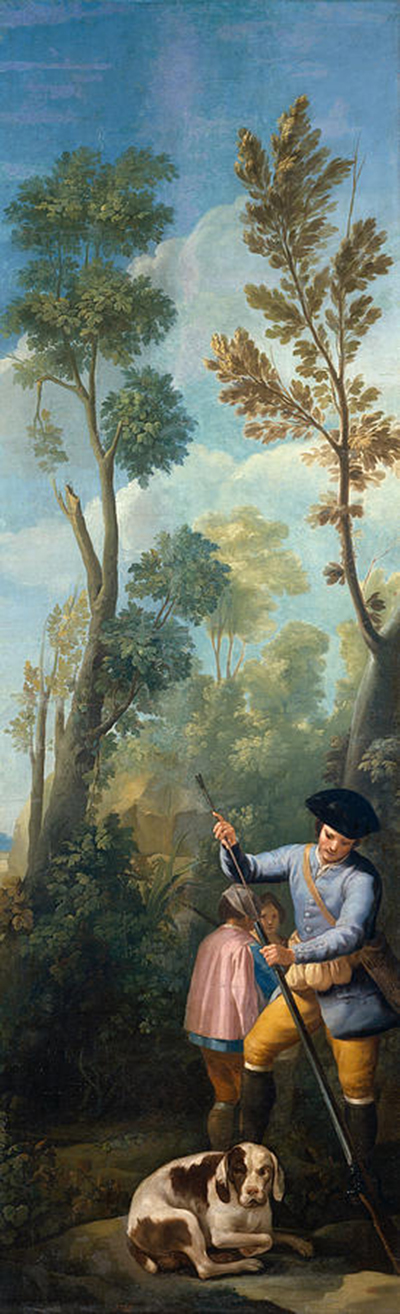
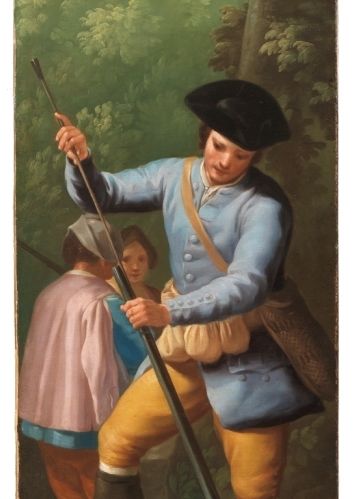
A hunter bows his head over a long gun while a brown-and-white dog rests at his feet. Two men talk behind him, partly hidden by his sleeve and bent knee. Above them a tree rises through most of the canvas. Francisco de Goya painted Hunter Loading His Rifle, or Cazador cargando su escopeta, in 1775 as a full-size design for a tapestry at El Escorial. The Museo Nacional del Prado holds the surviving oil painting. It measures 292 centimetres high and just 50 wide following the removal of a strip from another painting that had once been joined to it. [1] [2] [3]
At a Glance
- ArtistFrancisco José de Goya y Lucientes.
- Date1775. [1]
- MediumOil on canvas, painted as a tapestry cartoon. [1] [2]
- Size292 × 50 cm, height by width, in its restored state. [1]
- CommissionA corner hanging for the dining room of the Prince and Princess of Asturias at the Royal Palace of El Escorial. [2] [4]
- CollectionMuseo Nacional del Prado, Madrid, P005539. [1] [3]
Works across Goya’s career
The Parasol
1777The Nude Maja
1795–1800Saturn Devouring His Son
c. 1820–23The Dog
c. 1820–23The hunter and his dog
The hunter sets his boots at different heights. One knee projects towards the other men and the other leg drops towards the bottom edge of the painting. His upper body tips forward, but the weight of his blue coat hangs back from his hip. The yellow breeches pick out the bend of the legs against the darker ground. Above them, his cap tilts over his eyes and his face catches the light. His attention is directed down to his hands, where the rising line of the slender ramrod meets the thicker line of the gun. That diagonal carries the eye past his knee and down to the gunstock at ground level. [1] [3] [5]
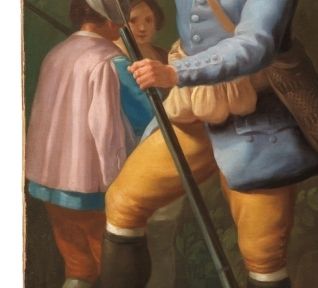
The strap crossing his chest and the pale gathered pouch below his waist help distinguish his figure from the glimpses of clothing behind him. One of the other hunters wears a rose-coloured outer garment with blue showing beneath it and turns his back towards us. His companion's face is visible in the gap alongside the hunter's blue sleeve. They are close enough for their outlines to overlap, and Goya sets their conversation at about the height of the foreground man's elbow. The task in front and the talk behind it can be read together within a few inches of painted width. [2] [3] [5]
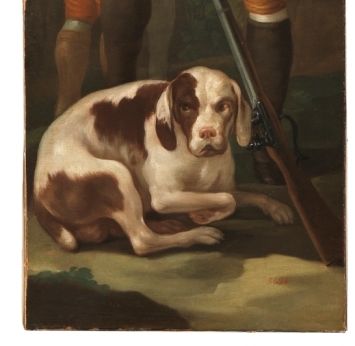
At the bottom, the dog's folded legs and lowered body give the eye somewhere to settle after the oblique line of the gun. Its head stays up, with the dark ears hanging down either side of the face. The eyes seem to meet ours. The hunter's face, by comparison, is turned inwards towards the work at his hands. This small difference in where the figures look makes the dog an unusually direct presence. Goya places the resting dog in the foreground in his written account, and the Boston study of the hunter makes clear what that placement does. The dog's body interrupts the view of a foot that is visible in the drawing. [2] [5] [6]
A landscape for a corner
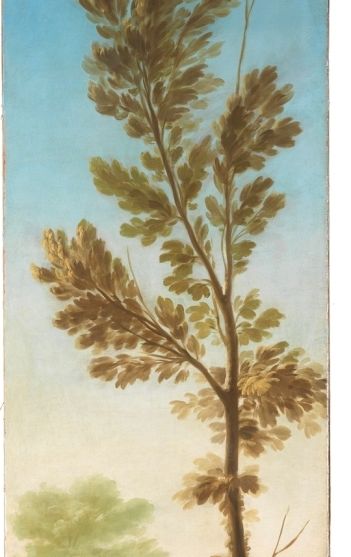
Much of the surviving canvas is given to the tree that rises on the right. Its trunk bends inwards above the hunter's cap. Sprays of warm brown foliage reach left and upwards into the blue, with finer stems visible where they cross the light sky. Pale green treetops recede beyond the men. The tall tree fills the space over the hunters and makes the figures feel low in a landscape that continues above their heads. It also connects two very different densities of paint, from the crowded ground to the open sky near the top. [3] [5]
Goya called the design a rinconera, a hanging for a corner or an equivalent narrow stretch of wall. In his account to the royal architect Francisco Sabatini, dated 24 May 1775, he names the resting dog and the two hunters talking further back and values the design at 1,500 reales de vellón. The entry places it alongside Hunter with His Dogs, another corner design valued at the same amount. Jesús López Ortega and Carlos Sanz de Miguel, reconstructing the arrangement of the dining room under Charles III, propose that the loading scene hung near the southern end of the eastern wall, where there was enough room for a relatively wide corner hanging. Their reconstruction places its companion across the room on the west wall. [2] [4] [7]
Goya on film
Five films explore Goya’s portraits, prints, Black Paintings and painting techniques.
The Duke of Wellington by Goya
The portrait, its military decorations and its later theft.
Watch on YouTubeFrom the drawing to the dining room
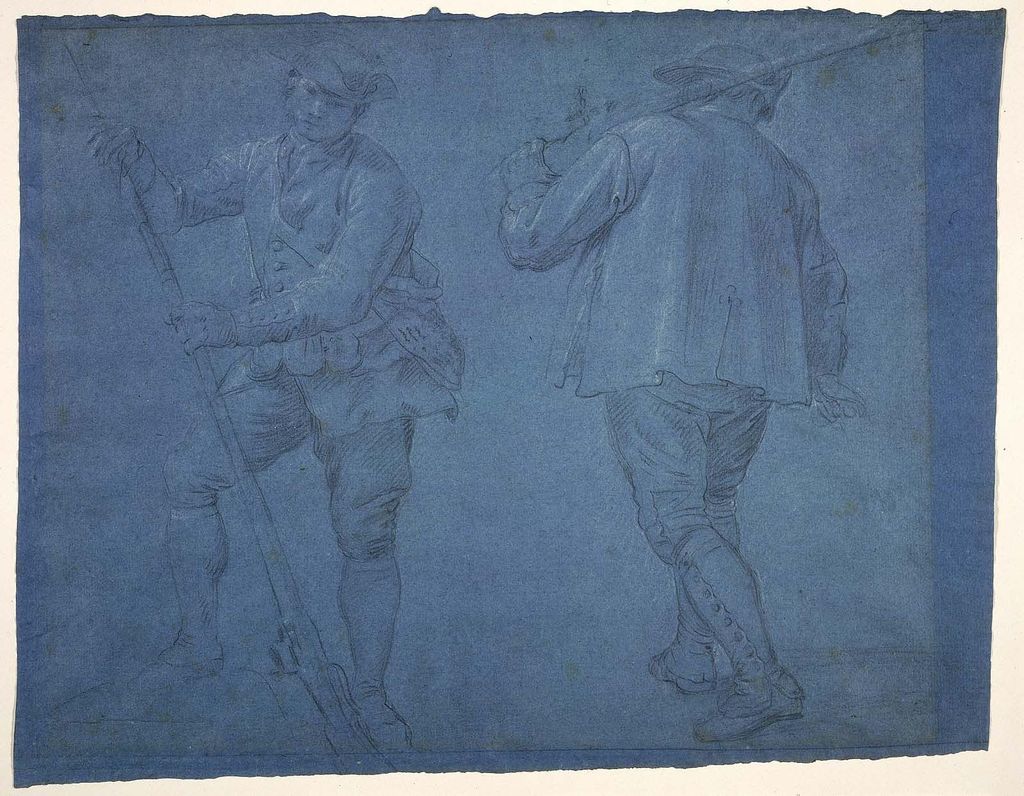
A study from about 1775 in the Museum of Fine Arts, Boston, shows the two principal hunters for the corner hangings on a single sheet of bluish paper. The man occupied with his gun appears on the left. Next to him stands the figure who turns his back to the viewer in Hunter with His Dogs. The Fundación Goya en Aragón suggests that Goya may have drawn the two poses from life. On paper the figures can be studied alongside each other. In the finished designs Goya gave each man a different relationship to his animals. The dog beside the loading hunter is settled and looks out, while the man in the other cartoon grips the leads of two dogs. His turned shoulders suit a scene about moving away through the landscape. [6] [7]
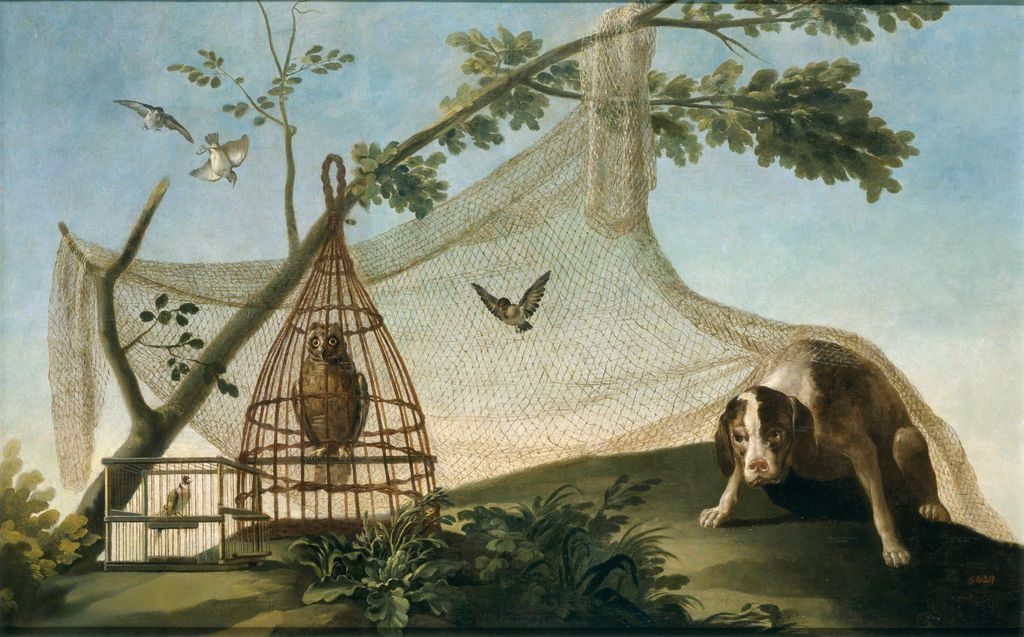
The corner scenes belonged to a wider decoration made for the future Charles IV and María Luisa of Parma. Goya's first delivery to the Royal Tapestry Factory of Santa Bárbara in May 1775 comprised five cartoons. Besides the two corner pieces, it included the principal scene Wild Boar Hunt and the horizontal Dogs on a Leash and Hunting with a Decoy. Goya delivered four more designs in October, completing his nine contributions to a room for which Ramón Bayeu had also prepared cartoons, under Francisco Bayeu's direction. In Goya's own description, the boar is hemmed in by dogs as four hunters close in. That design had room to spread the action across the width of a central hanging. The narrower spaces accommodated individual figures, dogs and quieter moments in the same pursuit. [2] [4] [8]
Weavers could adapt a design to the space they had to fill. The Fundación describes two additional dogs' heads in the woven version of Hunter Loading His Rifle, together with a tree. It sees a correspondence with the right side of Hunter with His Dogs. The Boston drawing shows Goya developing two poses together for separate canvases. The tapestry shows a different kind of exchange between the designs, in which parts of a companion composition helped fill out the woven landscape. [6] [7] [9]
Why older reproductions look wider
The cartoons spent decades at the tapestry factory before moving to the Royal Palace in Madrid in the 1850s. Hunter Loading His Rifle entered the Prado in 1870 under an attribution to Ramón Bayeu. The record of the series had already shifted between members of the Bayeu family and Goya in factory inventories. The signed account to Sabatini documents Goya's work on the group, and Valentín de Sambricio established the attribution of the nine cartoons to Goya in his 1946 study of the tapestries. [2] [8] [9] [10]
The reproduction at the top of this page shows the canvas before the 2014 treatment, with two large trees framing the sky and a broader stretch of ground to the left of the figures. The early twentieth-century restorer Jerónimo Seisdedos cut away a damaged portion of Goya's canvas at the right and widened the picture on the left by joining it to part of another tapestry cartoon. That material came from A Wolf Caught by the Paw in a Trap, a work by Matías Téllez for the separate tapestry scheme in the royal couple's bedroom. The older catalogue's dimensions of 289 × 90 cm describe this wider state. [4] [5] [9] [10] [11]
The Prado completed its treatment of the painting in 2014. Restorer Almudena Sánchez separated the joined canvases, and the museum displayed radiographs and infrared photographs to explain the work in its exhibition Goya in Madrid. In the restored image the group sits more tightly between the left edge and the dark trunk to the right. The outer edge of the canvas is evidence of what survives after two interventions. The woven version and Goya's written description each offer a separate record of how the design once fitted into a larger whole. [1] [3] [5] [9] [11]
Annotated Details from Hunter Loading His Shotgun
Follow the height of the restored strip from the tree to the figure and dog below.

Details from HUNTER LOADING HIS SHOTGUN
Details from the restored tapestry cartoon in the Museo Nacional del Prado (P005539).
The tree
The tree’s long trunk and sparse branches occupy much of the upper canvas.
The hunter
Pale blue clothing and an angled hat give the small figure a distinct outline against the woodland.
The cloth at left
A patch of pink catches the light beside the blue coat, close to the restored left edge.
The curled dog
The dog occupies the lower foreground, where light marks its back and face.
Artworks directory
| Name | Date | Medium |
|---|---|---|
| And There’s No Help for It, Plate 15 | Printed 1863 | |
| Asmodea | c. 1820–23 | Wall painting transferred to canvas |
| Boys Inflating a Bladder | 1777–78 | Tapestry cartoon |
| Boys Picking Fruit | 1778 | Tapestry cartoon |
| Bullfight in a Divided Ring | 1825 | Lithograph |
| Card Players | 1777–78 | Tapestry cartoon |
| Card Players (sketch) | 1777–78 | Painted sketch |
| Dance on the Banks of the Manzanares | 1777 | Tapestry cartoon |
| Duel with Cudgels | c. 1820–23 | Wall painting transferred to canvas |
| Heads in a Landscape | c. 1820–23 | Easel painting |
| Judith and Holofernes | c. 1820–23 | Wall painting transferred to canvas |
| Leocadia | c. 1820–23 | Wall painting transferred to canvas |
| Maja and Cloaked Men | 1777 | Tapestry cartoon |
| Maja and Cloaked Men (sketch) | 1777 | Painted sketch |
| Majo Clapping in Time to the Music | 1777 | Drawing |
| Men Reading | c. 1820–23 | Wall painting transferred to canvas |
| Out Hunting for Teeth, Plate 12 | 1799 | Etching, burnished aquatint and burin |
| Picnic in the Countryside (sketch) | 1776–78 | Painted sketch |
| Picnic on the Banks of the Manzanares | 1776 | Tapestry cartoon |
| Pilgrimage to San Isidro | c. 1820–23 | Wall painting transferred to canvas |
| Preparatory study for The Sleep of Reason Produces Monsters | c. 1796–97 | Drawing |
| Procession of the Holy Office | c. 1820–23 | Wall painting transferred to canvas |
| Quarrel at the Cockerel Inn (sketch) | 1777 | Painted sketch |
| Quarrel in the New Tavern | 1777 | Tapestry cartoon |
| Saturn Devouring His Son | c. 1820–23 | Wall painting transferred to canvas |
| Seated Majo Smoking | c. 1776 | Drawing |
| The Dog | c. 1820–23 | Wall painting transferred to canvas |
| The Drinker | 1777 | Tapestry cartoon |
| The Fates | c. 1820–23 | Wall painting transferred to canvas |
| The Great He-Goat | c. 1820–23 | Wall painting transferred to canvas |
| The Kite | 1777–78 | Tapestry cartoon |
| The Parasol | 1777 | Oil on canvas, tapestry cartoon |
| The Second of May 1808 | 1814 | Oil on canvas |
| The Sleep of Reason Produces Monsters, Plate 43 | 1799 | Etching and aquatint |
| The Third of May 1808 | 1814 | Oil on canvas |
| Thou Who Canst Not, Plate 42 | 1799 | Etching and burnished aquatint |
| Three Figures | 1776 | Drawing (lost) |
| Two Old Men | c. 1820–23 | Wall painting transferred to canvas |
| Two Old Men Eating Soup | c. 1820–23 | Wall painting transferred to canvas |
| Two Women and a Man | c. 1820–23 | Wall painting transferred to canvas |
| Universal Language: The Author Dreaming | 1797 | Drawing |
| The Family of Charles IV | 1800 | Oil on canvas |
| Witches’ Sabbath (Osuna painting) | 1797–98 | Oil on canvas |
| The Nude Maja | 1795–1800 | Oil on canvas |
| The Clothed Maja | 1800–07 | Oil on canvas |
| Self-Portrait (Drawing) | c. 1796 | Brush and carbon black ink on laid paper |
| The Swing, Madrid Album B.21 | 1795–97 | Brush and carbon black washes |
| Majas Fighting, a Majo Observing, Madrid Album B.15 | 1796–97 | Brush, grey and black washes on laid paper |
| Majos and Majas Conversing, Madrid Album B.16 | c. 1794–97 | Ink wash on paper |
| Weeping Woman and Three Men, Madrid Album B.17 | 1795–97 | Brush, carbon black washes and black chalk |
| Maja Seated on a Chair and Two Companions Behind, Madrid Album B.18 | 1795–97 | Brush and carbon black washes |
| Girl and Bull, Madrid Album B.23 | 1796–97 | Brush and carbon black washes |
| Lovers Sitting on a Rock, Madrid Album B.24 | 1796–97 | Brush and carbon black washes |
| Mariano Ceballos Riding a Bull | 1825 | Crayon lithograph and scraper |
| Landscape (lifetime impression) | c. 1807–10 | Etching and aquatint |
| Self-Portrait (1815), Prado canvas | 1815 | Oil on canvas |
| Self-Portrait (1815), Academy panel | 1815 | Oil on panel |
| Self-Portrait with Dr Arrieta | 1820 | Oil on canvas |
| Christ Crucified | 1780 | Oil on canvas |
| The Last Communion of Saint Joseph of Calasanz | 1819 | Oil on canvas |
| Christ on the Mount of Olives | 1819 | Oil on panel |
| The Flower Girls, or Spring | 1786–87 | Oil on canvas |
| The Grape Harvest, or Autumn | 1786–87 | Oil on canvas |
| The Snowstorm, or Winter | 1786–87 | Oil on canvas |
| The Threshing Ground, or Summer | 1786–87 | Oil on canvas |
| Picnic on the Banks of the Manzanares | 1776 | Oil on canvas |
| The Kite | 1777–78 | Oil on canvas |
| Dance on the Banks of the Manzanares | 1777 | Oil on canvas |
| A Fight at the Venta Nueva | 1777 | Oil on canvas |
| Blind Man’s Bluff | 1788 | Oil on canvas |
| Dogs on a Lead | 1775 | Oil on canvas |
| Hunting with a Decoy | 1775 | Oil on canvas |
| Hunter Loading His Rifle | 1775 | Oil on canvas |
| The Angler | 1775 | Oil on canvas |
| The Hermitage of San Isidro on His Feast Day | 1788 | Oil on canvas |
| The Meadow of San Isidro | 1788 | Oil on canvas |
| The Straw Manikin | 1791–92 | Oil on canvas |
| Witches’ Flight | c. 1797–98 | Oil on canvas |
| A Scene from ‘The Forcibly Bewitched’ | 1798 | Oil on canvas |
| The Duchess of Alba in Black | 1797 | Oil on canvas |
| The Duchess of Alba in White | 1795 | Oil on canvas |
| Charles III in Hunting Dress | c. 1786 | Oil on canvas |
| The Duke and Duchess of Osuna and Their Children | 1787–88 | Oil on canvas |
| Manuel Osorio Manrique de Zúñiga | 1787–88 | Oil on canvas |
| The Marquesa de Pontejos | c. 1786 | Oil on canvas |
| Equestrian Portrait of the 1st Duke of Wellington | 1812 | Oil on canvas |
| The Duke of Wellington | 1812–14 | Oil on wood |
| Portrait of Ferdinand VII of Spain | 1814 | Oil on canvas |
| Gaspar Melchor de Jovellanos | 1798 | Oil on canvas |
| María Tomasa Palafox y Portocarrero | 1804 | Oil on canvas |
| Señora Sabasa García | c. 1806–11 | Oil on canvas |
| Don Juan Bautista de Muguiro | 1827 | Oil on canvas |
| Doña Isabel de Porcel | Before 1805 | Oil on canvas |
| The Colossus | After 1808 | Oil on canvas |
| The Burial of the Sardine | 1808–12 | Oil on panel |
| The Madhouse | 1808–12 | Oil on panel |
| A Procession of Flagellants | 1808–12 | Oil on panel |
| Portrait of Jacques Galos | 1826 | Oil on canvas |
| Portrait of Mariano Goya, the Artist’s Grandson | 1827 | Oil on canvas |
| Milkmaid of Bordeaux | c. 1827 | Oil on canvas |
| Portrait of Don Juan Antonio Cuervo | 1819 | Oil on canvas |
| María Luisa of Parma (Naples version) | c. 1800 | Oil on canvas |
| The Countess of Baena | 1819 | Oil on canvas |
| The Family of the Infante Don Luis | 1783–84 | Oil on canvas |
| The Holy Family | c. 1787 | Oil on canvas |
| Saint Barbara | c. 1773 | Oil on canvas |
| Saints Justa and Rufina | 1817 | Oil on canvas |
| El Tío Paquete | c. 1819–20 | Oil on canvas |
| The Forge | c. 1815–20 | Oil on canvas |
| Majas on a Balcony (Metropolitan Museum version) | c. 1800–10 | Oil on canvas |
| Maja and Celestina on a Balcony | c. 1808–12 | Oil on canvas |
| The Water Bearer | 1808–12 | Oil on canvas |
| Time and the Old Women | c. 1810 | Oil on canvas |
Frequently Asked Questions
Goya used the Spanish word escopeta, translated by the Fundación Goya en Aragón as “shotgun”. The Prado has used Hunter Loading His Rifle in English. The painting shows a long hunting gun and a ramrod. The English title alone gives little basis for identifying the internal construction of the gun. [2] [3] [9]
Yes. Cazador cargando su escopeta (F.104) is a brown-ink drawing from Notebook F, dated about 1812–20 and recorded in a private collection. The men behind that hunter are stretched out on the ground, one drinking and the other apparently eating. The 1775 preparatory drawing for the painting is the sheet in Boston titled Two Hunters. [6] [12]
Discussion
Look again at the images and ideas explored in Hunter Loading His Rifle. These editorial prompts invite your observations.
Follow the line from the hunter's raised hand towards the dog, then look back up to the top of the tree. Where does the narrow canvas feel most crowded? How does the larger space above change the way you see the group below?
Reader Insights
What changes when you see the restored strip beside the older reproduction?
How do the tree and the figures use the tall format?
Join the Conversation
Share a detail, comparison or question about Hunter Loading His Rifle below.
References
- Boletín Oficial del Estado, Goya y la Corte Ilustrada, exhibition list, Prado loan P05539, date, medium and restored measurements. View source.
- Francisco de Goya, account to Francisco Sabatini, 24 May 1775, in Francisco de Goya. Diplomatario, Institución Fernando el Católico, document 6, pp. 206–207. View source.
- Museo Nacional del Prado, Restoration: Hunter Loading His Rifle, by Francisco de Goya, with curator Gudrun Maurer and restorer Almudena Sánchez, and reproduced collection record, P05539. View source 1. View source 2.
- Jesús López Ortega and Carlos Sanz de Miguel, study of the tapestries for the apartments of the Prince and Princess of Asturias at El Escorial, Librosdelacorte.es 27 (2023), pp. 80–84 and 89–90. View source.
- Photographs of Prado P005539 before restoration and after restoration, Wikimedia Commons. View source 1. View source 2.
- Fundación Goya en Aragón, Two Hunters (Dos cazadores), and Prado exhibition list, no. 14, preparatory drawing in the Museum of Fine Arts, Boston, 33.1018. View source 1. View source 2.
- Fundación Goya en Aragón, Hunter and His Dogs (Cazador con sus perros), companion corner design. View source.
- Fundación Goya en Aragón, Wild Boar Hunt (La caza del jabalí), chronology, inventories and first two deliveries. View source.
- Fundación Goya en Aragón, Hunter Loading His Shotgun (Cazador cargando su escopeta), description of the earlier composite and comparison with the woven hanging. View source.
- Museo del Prado, printed collection catalogue, no. 5539, pre-restoration measurements and accession. View source.
- Museo Nacional del Prado, Memoria de actividades 2014, pp. 124–125 and 319, exhibition and treatment records. View source.
- Fundación Goya en Aragón, Cazador cargando su escopeta (F.104), Notebook F drawing. View source.







