



 by Tom Gurney
Tom Gurney BSc (Hons) is an art history expert with over 20 years experience
Published on June 19, 2020 / Updated on November 20, 2026
Email: tomgurney1@gmail.com / Phone: +44 7429 011000
Introduction
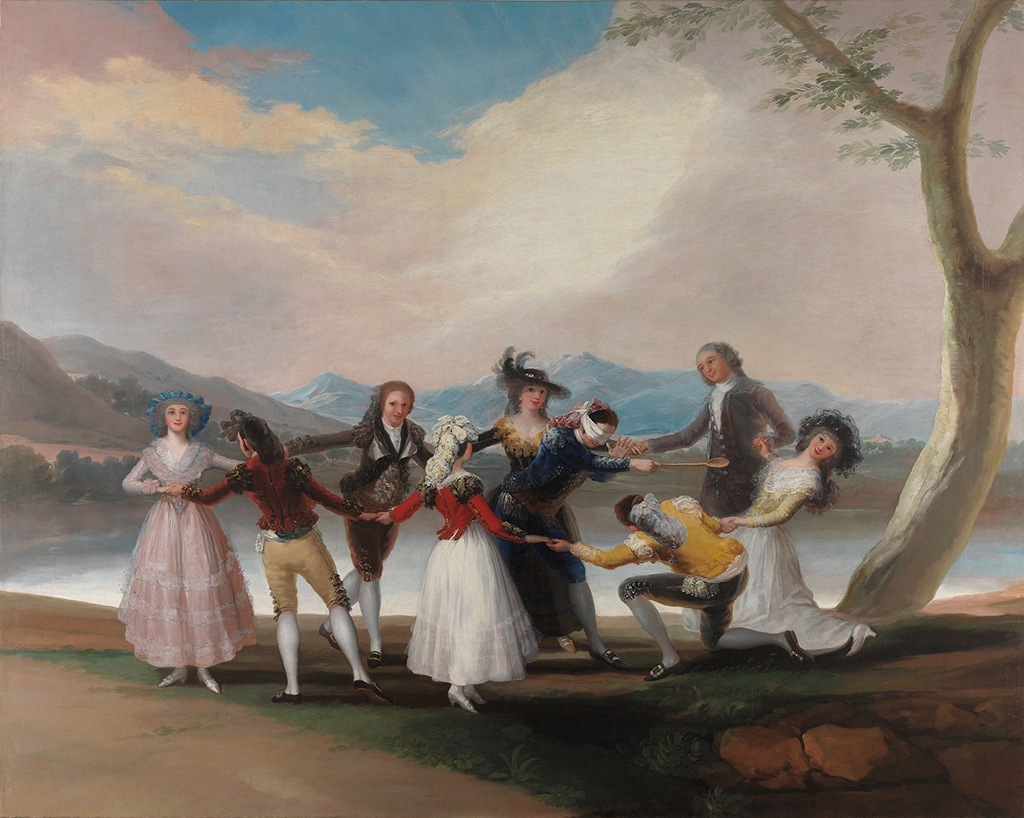
A blindfolded man leans into a circle of players and tries to touch one of them with a wooden ladle. To his right, a man in yellow crouches and a woman sways back towards a tree, her pale skirt trailing along the ground. Francisco de Goya painted Blind Man’s Bluff, or La gallina ciega, in 1788 as a full-size model for a tapestry intended for the royal children’s quarters at El Pardo. An oil sketch for the design and the finished cartoon are both in the Museo Nacional del Prado in Madrid. The woven hanging belongs to Spain’s royal collections. [1] [2] [3] [4]
At a Glance
- ArtistFrancisco José de Goya y Lucientes.
- Date1788. [1]
- MediumOil on canvas, painted as a tapestry cartoon. [1] [2]
- Size269 × 350 cm, height by width. [1] [2]
- CommissionA tapestry for a bedchamber at the Royal Palace of El Pardo, usually identified with the Infantas. [2] [4]
- CollectionMuseo Nacional del Prado, Madrid, P000804. The separate oil sketch is P002781. [1] [3]
Works across Goya’s career
The Parasol
1777The Nude Maja
1795–1800Saturn Devouring His Son
c. 1820–23The Dog
c. 1820–23The players and the ladle
Eight people join hands around the ninth, who wears the blindfold. He has to reach someone with the wooden ladle while the others can watch his movements and slip out of range. Goya has caught the game at the point when several bodies have to adjust at once. The man in the centre bends forward, the man in yellow ducks and twists, and the woman beside the tree pulls away without breaking the chain. The ladle gave the picture an earlier title, El juego del cucharón, or The Ladle Game. The name La gallina ciega, literally ‘the blind hen’, was used by the nineteenth-century scholar Gregorio Cruzada Villaamil. [1] [2]
Follow the circle from the left. The woman in pink stands nearly upright while the man next to her turns his back towards us, his white stockings apart and his arms reaching in opposite directions. He links her to the woman in the red jacket and white skirt, whose back also faces us. The stretch of white skirt makes her one of the easiest figures to pick out from across the room. Her outstretched hand leads towards the low figure in yellow. Hands do the work of connecting the different poses, even when the players look towards different people. Across the far side of the ring, the upright man in a grey coat and the woman in a dark plumed hat rise above the nearer shoulders. [1]
The woman’s pink skirt at the left, the pale yellow bodice at the right and the bright touches of red and blue keep individual figures distinct where their arms and clothes overlap. The Prado’s description distinguishes several players in the dress of majos and majas, associated with popular Madrid fashions, alongside a man and woman dressed in French style. They take part in the same game. The art historian Janis A. Tomlinson, as cited by the Fundación Goya en Aragón, reads the blindfold as a possible metaphor for blind love. The glances and physical closeness give that interpretation something to work with, and the uneven steps and bent knees remain recognisable as the practical business of avoiding the ladle. [1] [2]
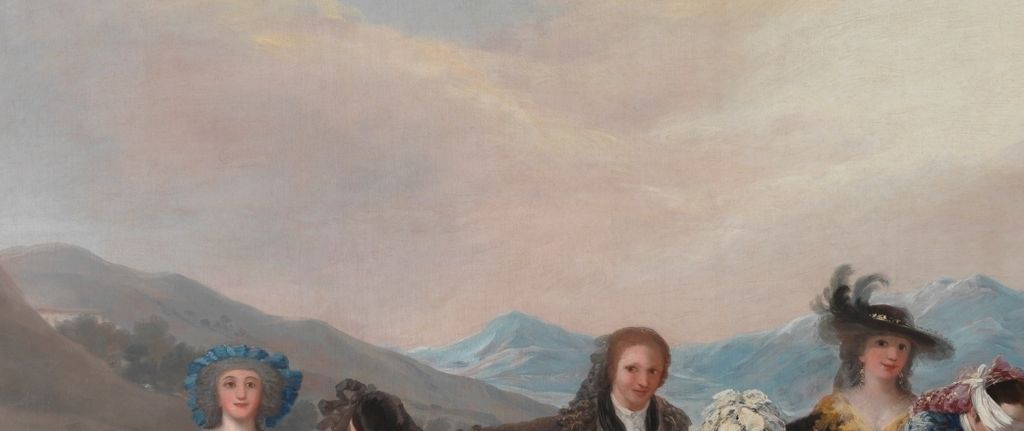
Goya set the whole ring low in the landscape, with the players’ faces just above or below the distant mountain ridge. At the far right, the strong curve of the tree trunk follows the outward sweep of the figures, while its branches take the eye up and out of the group. Below, the pale strip of water is visible between the bodies and on either side. Even at the densest point in the ring, where sleeves and hands cross, those glimpses of water make it possible to sense how much open ground there is around the players. [1]
Annotated Details from Blind Man’s Bluff
Follow the spoon and the chain of hands that marks the ring.
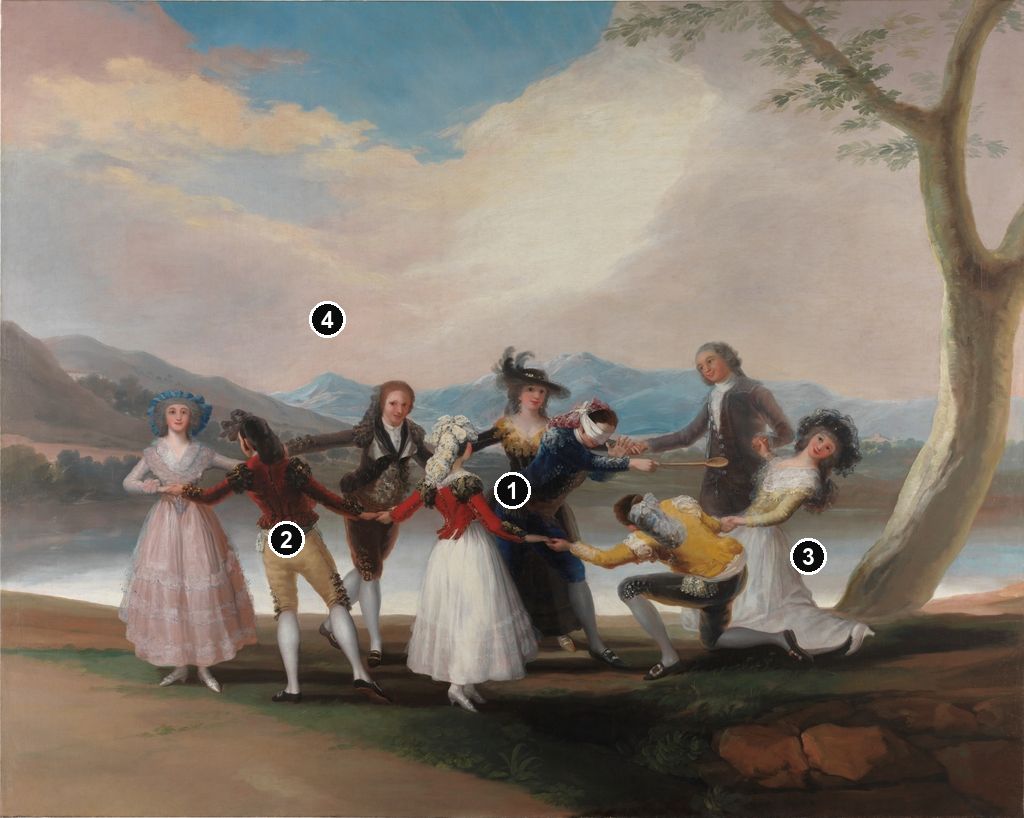
Details from BLIND MAN’S BLUFF
Details from the restored tapestry cartoon in the Museo Nacional del Prado (P000804).
The blindfolded player
The cloth over the player’s eyes and the extended ladle define the rules of the scene.
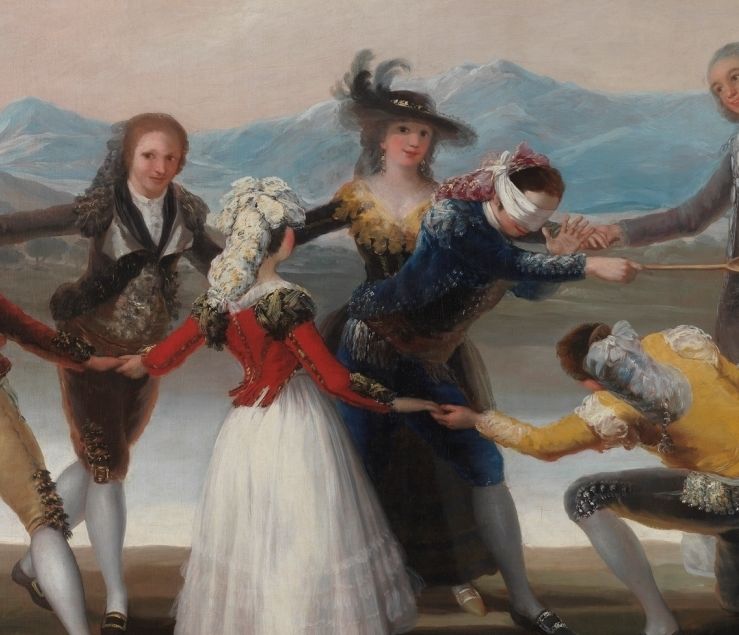
The clasped hands
Linked arms hold together the figures on the left of the ring.
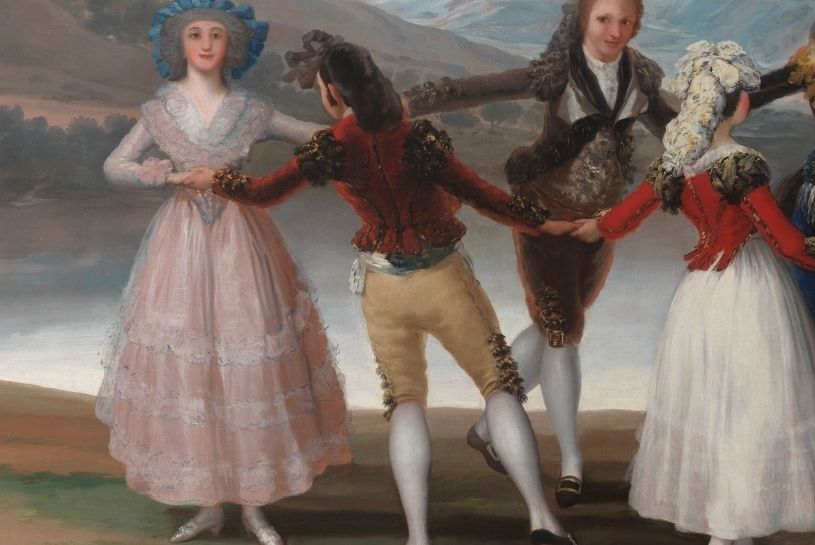
The leaning players
The players at right pull away as they keep the chain of hands.
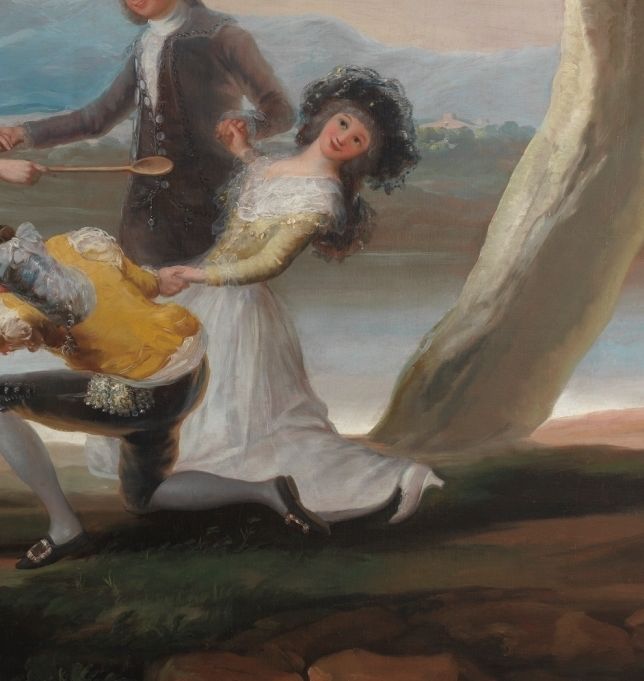
The open background
Paler distant slopes leave space above the group.
Goya on film
Five films explore Goya’s portraits, prints, Black Paintings and painting techniques.
The Duke of Wellington by Goya
The portrait, its military decorations and its later theft.
Watch on YouTubeWhat Goya changed in the sketch
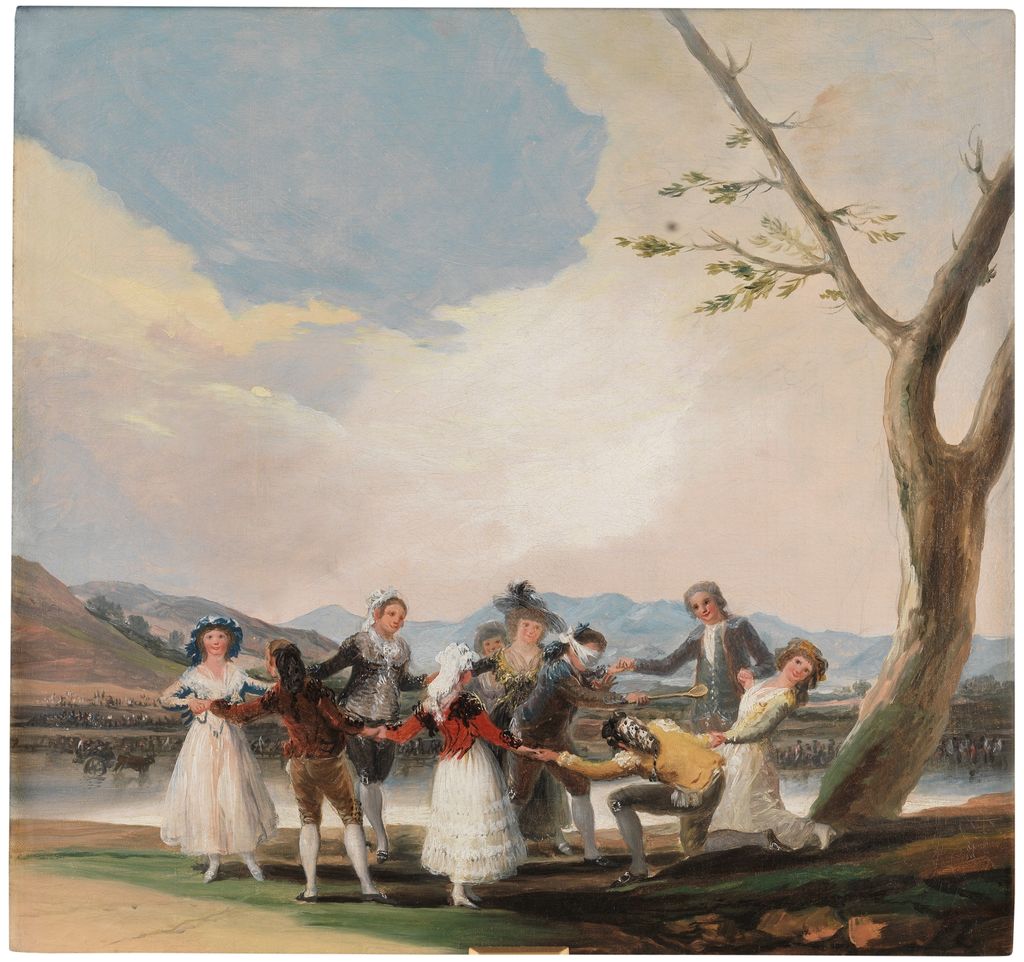
The preparatory oil sketch measures 41 × 44 cm. It already contains the hand-linked group, the bend of the river and the tree on the right. Its near-square shape gives the sky and the upper branches more space. A stream of tiny people and carriages extends along the opposite bank. The Fundación connects these distant figures with the festivities for San Isidro, Madrid’s patron saint, on the west bank of the Manzanares. In the wider cartoon the far bank is quiet. The blue ridgeline and water are still visible, leaving fewer interruptions behind the faces and hands of the players. The Fundación finds a stronger rhythm in the revised group and links the simplification of the landscape to the demands of weaving. [1] [2] [3]
One change survives as a trace in the big canvas. In the sketch an onlooker appears beyond the ring next to the woman with the tall hat. The Prado’s account identifies a faint face in the corresponding area of the cartoon, behind the hatted woman, where traces of the eyes and hair remain visible. The extra face records a change Goya made while working on the large composition. It also explains why a close inspection can turn up more faces than there are active players. [1] [3]
A tapestry for El Pardo
The Fundación dates the commission to late 1787. An April 1788 account records expenses for the work, including stretchers for the designs. In a letter to Martín Zapater dated 31 May 1788, Goya identifies the destination as the Infantas’ bedchamber and describes the pressure of preparing work the king and the royal family would see. He singles out the difficulty of painting the meadow on San Isidro’s feast day with all the bustle he associated with the occasion. That description belongs to the companion design The Meadow of San Isidro, where the tiny people and carriages spread across much of the broad canvas. The sketch for Blind Man’s Bluff brings a pocket of that larger celebration into view beyond the players. [2] [3] [5] [6]
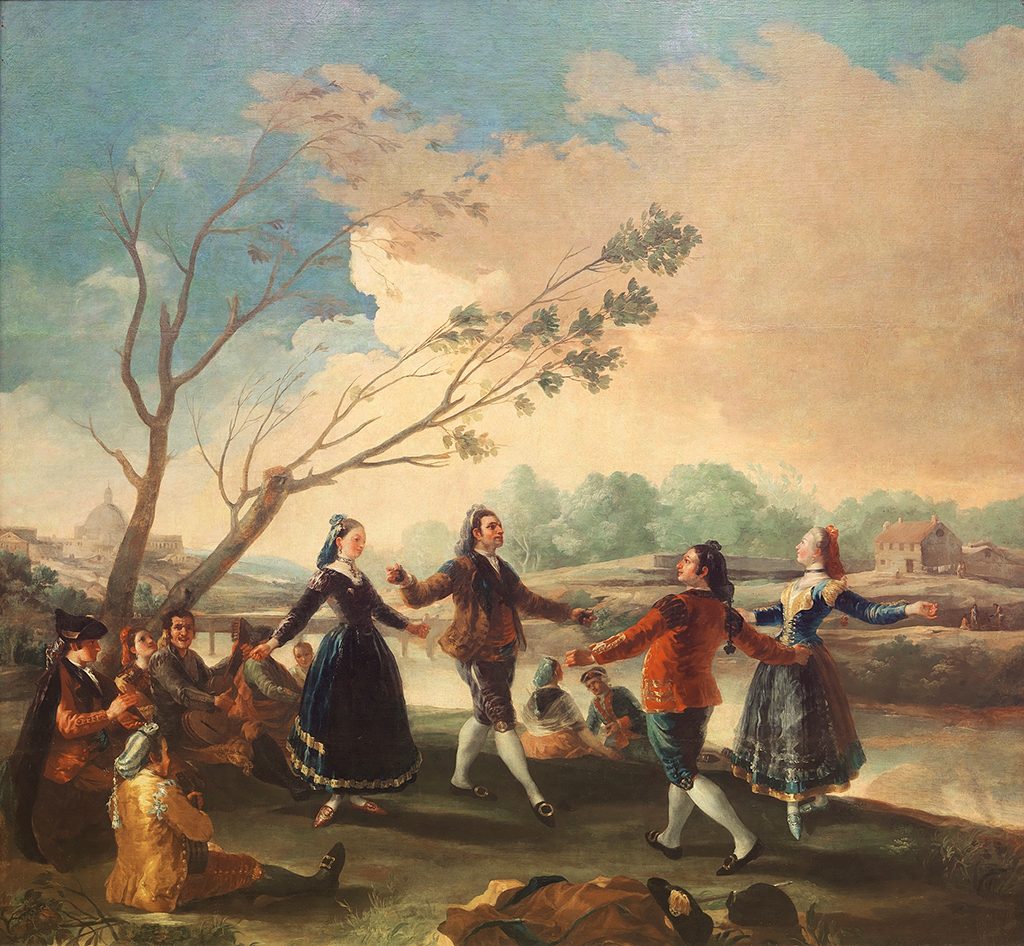
An earlier tapestry design, Dance on the Banks of the Manzanares, offers another way to read the movements in Blind Man’s Bluff. Goya painted the dance for the dining room at El Pardo in 1777. His account describes dancers performing seguidillas, accompanied by musicians. The figures’ raised arms and extended feet make the beat visible even before the eye reaches the instruments on the left. In Blind Man’s Bluff, a similar variety of stances follows the action of one player. The people at the edge of the ring have to respond both to the blindfolded man and to their neighbours. [1] [7]
Charles III died in December 1788 and the series was interrupted. Blind Man’s Bluff was the only design in the set that Goya carried through to a full-size cartoon, and the only one that reached the loom. The tapestry historian Concha Herrero Carretero dates the weaving to 1789. She explains that the distant scenes in the sketch relied on flecks of paint, translucent layers and small shifts between light and shade that were difficult to reproduce with adjacent areas of thread. The weavers used white, green and blue silks to suggest the river and distant slopes, preserving the sense of space behind the ring of players. [2] [4] [8]
How the two paintings reached the Prado
The full-size canvas remained with the Royal Tapestry Factory until about 1856 or 1857, when it was transferred to the Royal Palace in Madrid. It entered the Prado in 1870. The small study took a different route. The Duke and Duchess of Osuna bought it from Goya in 1798, and it stayed in the duchess’s cabinet at La Alameda until the sale of the family’s collection in 1896. Pedro Fernández Durán bought the sketch at that sale and bequeathed it to the Prado, where it entered the collection in September 1931. [1] [2] [3]
Artworks directory
| Name | Date | Medium |
|---|---|---|
| And There’s No Help for It, Plate 15 | Printed 1863 | |
| Asmodea | c. 1820–23 | Wall painting transferred to canvas |
| Boys Inflating a Bladder | 1777–78 | Tapestry cartoon |
| Boys Picking Fruit | 1778 | Tapestry cartoon |
| Bullfight in a Divided Ring | 1825 | Lithograph |
| Card Players | 1777–78 | Tapestry cartoon |
| Card Players (sketch) | 1777–78 | Painted sketch |
| Dance on the Banks of the Manzanares | 1777 | Tapestry cartoon |
| Duel with Cudgels | c. 1820–23 | Wall painting transferred to canvas |
| Heads in a Landscape | c. 1820–23 | Easel painting |
| Judith and Holofernes | c. 1820–23 | Wall painting transferred to canvas |
| Leocadia | c. 1820–23 | Wall painting transferred to canvas |
| Maja and Cloaked Men | 1777 | Tapestry cartoon |
| Maja and Cloaked Men (sketch) | 1777 | Painted sketch |
| Majo Clapping in Time to the Music | 1777 | Drawing |
| Men Reading | c. 1820–23 | Wall painting transferred to canvas |
| Out Hunting for Teeth, Plate 12 | 1799 | Etching, burnished aquatint and burin |
| Picnic in the Countryside (sketch) | 1776–78 | Painted sketch |
| Picnic on the Banks of the Manzanares | 1776 | Tapestry cartoon |
| Pilgrimage to San Isidro | c. 1820–23 | Wall painting transferred to canvas |
| Preparatory study for The Sleep of Reason Produces Monsters | c. 1796–97 | Drawing |
| Procession of the Holy Office | c. 1820–23 | Wall painting transferred to canvas |
| Quarrel at the Cockerel Inn (sketch) | 1777 | Painted sketch |
| Quarrel in the New Tavern | 1777 | Tapestry cartoon |
| Saturn Devouring His Son | c. 1820–23 | Wall painting transferred to canvas |
| Seated Majo Smoking | c. 1776 | Drawing |
| The Dog | c. 1820–23 | Wall painting transferred to canvas |
| The Drinker | 1777 | Tapestry cartoon |
| The Fates | c. 1820–23 | Wall painting transferred to canvas |
| The Great He-Goat | c. 1820–23 | Wall painting transferred to canvas |
| The Kite | 1777–78 | Tapestry cartoon |
| The Parasol | 1777 | Oil on canvas, tapestry cartoon |
| The Second of May 1808 | 1814 | Oil on canvas |
| The Sleep of Reason Produces Monsters, Plate 43 | 1799 | Etching and aquatint |
| The Third of May 1808 | 1814 | Oil on canvas |
| Thou Who Canst Not, Plate 42 | 1799 | Etching and burnished aquatint |
| Three Figures | 1776 | Drawing (lost) |
| Two Old Men | c. 1820–23 | Wall painting transferred to canvas |
| Two Old Men Eating Soup | c. 1820–23 | Wall painting transferred to canvas |
| Two Women and a Man | c. 1820–23 | Wall painting transferred to canvas |
| Universal Language: The Author Dreaming | 1797 | Drawing |
| The Family of Charles IV | 1800 | Oil on canvas |
| Witches’ Sabbath (Osuna painting) | 1797–98 | Oil on canvas |
| The Nude Maja | 1795–1800 | Oil on canvas |
| The Clothed Maja | 1800–07 | Oil on canvas |
| Self-Portrait (Drawing) | c. 1796 | Brush and carbon black ink on laid paper |
| The Swing, Madrid Album B.21 | 1795–97 | Brush and carbon black washes |
| Majas Fighting, a Majo Observing, Madrid Album B.15 | 1796–97 | Brush, grey and black washes on laid paper |
| Majos and Majas Conversing, Madrid Album B.16 | c. 1794–97 | Ink wash on paper |
| Weeping Woman and Three Men, Madrid Album B.17 | 1795–97 | Brush, carbon black washes and black chalk |
| Maja Seated on a Chair and Two Companions Behind, Madrid Album B.18 | 1795–97 | Brush and carbon black washes |
| Girl and Bull, Madrid Album B.23 | 1796–97 | Brush and carbon black washes |
| Lovers Sitting on a Rock, Madrid Album B.24 | 1796–97 | Brush and carbon black washes |
| Mariano Ceballos Riding a Bull | 1825 | Crayon lithograph and scraper |
| Landscape (lifetime impression) | c. 1807–10 | Etching and aquatint |
| Self-Portrait (1815), Prado canvas | 1815 | Oil on canvas |
| Self-Portrait (1815), Academy panel | 1815 | Oil on panel |
| Self-Portrait with Dr Arrieta | 1820 | Oil on canvas |
| Christ Crucified | 1780 | Oil on canvas |
| The Last Communion of Saint Joseph of Calasanz | 1819 | Oil on canvas |
| Christ on the Mount of Olives | 1819 | Oil on panel |
| The Flower Girls, or Spring | 1786–87 | Oil on canvas |
| The Grape Harvest, or Autumn | 1786–87 | Oil on canvas |
| The Snowstorm, or Winter | 1786–87 | Oil on canvas |
| The Threshing Ground, or Summer | 1786–87 | Oil on canvas |
| Picnic on the Banks of the Manzanares | 1776 | Oil on canvas |
| The Kite | 1777–78 | Oil on canvas |
| Dance on the Banks of the Manzanares | 1777 | Oil on canvas |
| A Fight at the Venta Nueva | 1777 | Oil on canvas |
| Blind Man’s Bluff | 1788 | Oil on canvas |
| Dogs on a Lead | 1775 | Oil on canvas |
| Hunting with a Decoy | 1775 | Oil on canvas |
| Hunter Loading His Rifle | 1775 | Oil on canvas |
| The Angler | 1775 | Oil on canvas |
| The Hermitage of San Isidro on His Feast Day | 1788 | Oil on canvas |
| The Meadow of San Isidro | 1788 | Oil on canvas |
| The Straw Manikin | 1791–92 | Oil on canvas |
| Witches’ Flight | c. 1797–98 | Oil on canvas |
| A Scene from ‘The Forcibly Bewitched’ | 1798 | Oil on canvas |
| The Duchess of Alba in Black | 1797 | Oil on canvas |
| The Duchess of Alba in White | 1795 | Oil on canvas |
| Charles III in Hunting Dress | c. 1786 | Oil on canvas |
| The Duke and Duchess of Osuna and Their Children | 1787–88 | Oil on canvas |
| Manuel Osorio Manrique de Zúñiga | 1787–88 | Oil on canvas |
| The Marquesa de Pontejos | c. 1786 | Oil on canvas |
| Equestrian Portrait of the 1st Duke of Wellington | 1812 | Oil on canvas |
| The Duke of Wellington | 1812–14 | Oil on wood |
| Portrait of Ferdinand VII of Spain | 1814 | Oil on canvas |
| Gaspar Melchor de Jovellanos | 1798 | Oil on canvas |
| María Tomasa Palafox y Portocarrero | 1804 | Oil on canvas |
| Señora Sabasa García | c. 1806–11 | Oil on canvas |
| Don Juan Bautista de Muguiro | 1827 | Oil on canvas |
| Doña Isabel de Porcel | Before 1805 | Oil on canvas |
| The Colossus | After 1808 | Oil on canvas |
| The Burial of the Sardine | 1808–12 | Oil on panel |
| The Madhouse | 1808–12 | Oil on panel |
| A Procession of Flagellants | 1808–12 | Oil on panel |
| Portrait of Jacques Galos | 1826 | Oil on canvas |
| Portrait of Mariano Goya, the Artist’s Grandson | 1827 | Oil on canvas |
| Milkmaid of Bordeaux | c. 1827 | Oil on canvas |
| Portrait of Don Juan Antonio Cuervo | 1819 | Oil on canvas |
| María Luisa of Parma (Naples version) | c. 1800 | Oil on canvas |
| The Countess of Baena | 1819 | Oil on canvas |
| The Family of the Infante Don Luis | 1783–84 | Oil on canvas |
| The Holy Family | c. 1787 | Oil on canvas |
| Saint Barbara | c. 1773 | Oil on canvas |
| Saints Justa and Rufina | 1817 | Oil on canvas |
| El Tío Paquete | c. 1819–20 | Oil on canvas |
| The Forge | c. 1815–20 | Oil on canvas |
| Majas on a Balcony (Metropolitan Museum version) | c. 1800–10 | Oil on canvas |
| Maja and Celestina on a Balcony | c. 1808–12 | Oil on canvas |
| The Water Bearer | 1808–12 | Oil on canvas |
| Time and the Old Women | c. 1810 | Oil on canvas |
Frequently Asked Questions
Discussion
Look again at the images and ideas explored in Blind Man’s Bluff. These editorial prompts invite your observations.
Start with the crouching player in yellow and follow the joined hands around the ring. Where does the movement of one player seem to pull the next along? Compare that passage with the same figures in the sketch.
Reader Insights
Which figures change the shape of the ring as the blindfolded player reaches?
Which differences in the small oil change how quickly you read the game?
Join the Conversation
Share a detail, comparison or question about Blind Man’s Bluff below.
References
- Museo Nacional del Prado, La gallina ciega, P000804 and printed collection catalogue, no. 804. See also the Prado description reproduced by Modernalia. View source 1. View source 2. View source 3.
- Fundación Goya en Aragón, La gallina ciega, catalogue entry on the cartoon, commission and interpretation. View source.
- Museo Nacional del Prado, La gallina ciega, P002781, and Fundación Goya en Aragón, La gallina ciega (boceto), catalogue entries on the sketch. View source 1. View source 2.
- Galería de las Colecciones Reales, La gallina ciega, catalogue entry on the tapestry and its commission. View source.
- Francisco de Goya, account to the Royal Tapestry Factory of 30 April 1788, in Francisco de Goya. Diplomatario, Institución Fernando el Católico, document 145, pp. 289–90, and letter to Martín Zapater of 31 May 1788, in Diplomatario de Goya. Addenda. View source 1. View source 2.
- Fundación Goya en Aragón, La pradera de San Isidro (boceto), companion sketch, Prado P000750. View source.
- Fundación Goya en Aragón, El baile a orillas del Manzanares, Prado P000769, and Francisco de Goya, account of 3 March 1777, in Francisco de Goya. Diplomatario, document 12. View source 1. View source 2.
- Concha Herrero Carretero, ‘Goya, cartonista de tapices’, pp. 231–32, on the woven design and its landscape. View source.







