


 by Tom Gurney
Tom Gurney BSc (Hons) is an art history expert with over 20 years experience
Published on June 19, 2020 / Updated on November 20, 2026
Email: tomgurney1@gmail.com / Phone: +44 7429 011000
Introduction
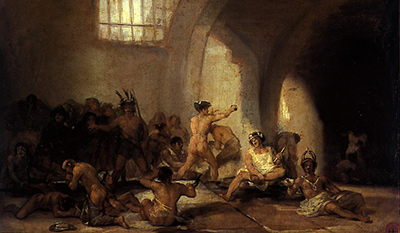
A barred window high above the figures lets daylight into Goya’s The Madhouse. A man near the centre stands with his back to us and makes a gesture towards the far side of the room. His tricorn still signals a military role even though he wears nothing else. Elsewhere a figure in a feathered crown puts out his hand and a seated man wears a makeshift mitre. Their gestures are expansive. The only window visible in the room is far above any hand that could reach it. [1] [2]
At a Glance
- ArtistFrancisco de Goya y Lucientes
- TitleThe Madhouse (La casa de locos)
- Date1808–1812 in the Academy’s catalogue. The Fundación Goya en Aragón proposes about 1814–1816. [1] [2]
- Medium and dimensionsOil on wood panel, 45 × 72 cm (height × width). [1]
- CollectionReal Academia de Bellas Artes de San Fernando, Madrid, inventory 0672. [1]
Works across Goya’s career
The Parasol
1777The Nude Maja
1795–1800The Madhouse
1808–12Saturn Devouring His Son
c. 1820–23The Dog
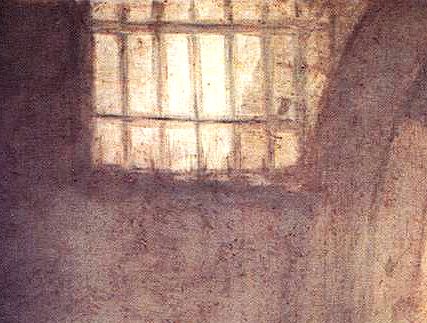
c. 1820–23A window above the crowd
Goya gives the room about as much claim on the eye as the people inside it. The strong curve of the vault moves up from the left and disappears into shadow. Smaller curves and angles near the floor are harder to follow because the figures interrupt them. A few lines in the stone paving give the crowd somewhere to stand, sit and lie down. With so little furniture to establish scale, it takes the size of the standing man beneath the opening to show us just how high the window is. The bars are easy to see. Beyond them there is little to tell us about the world outside. [1]
The light from above falls unevenly. It brings out a pale back, catches shoulders and knees, and leaves nearby faces in brown shadow. The people along the floor often read as separate parts before they come together as whole figures. A bent limb can be clearer than the person to whom it belongs. The standing man in the tricorn has a recognisable outline almost at once. The feathered figure takes longer to untangle from the group around him. There are several places to stop and look, so following the light down from the window gives only one route through the painting. [1]
The picture’s width lets Goya distribute the action along the floor. A standing figure can dominate one patch of space while someone seated or crouching holds our attention in the next. Up above, the area of bare wall is continuous. Down below, the eye keeps having to find its way round the next bit of a body or a scrap of clothing. Goya creates the sense of confinement in part by keeping these two areas in view together. We can see how much space there is overhead and how little of it the people can use. [1]
Annotated Details from The Madhouse
Trace the light through the architecture, then look at the poses and costumes below.
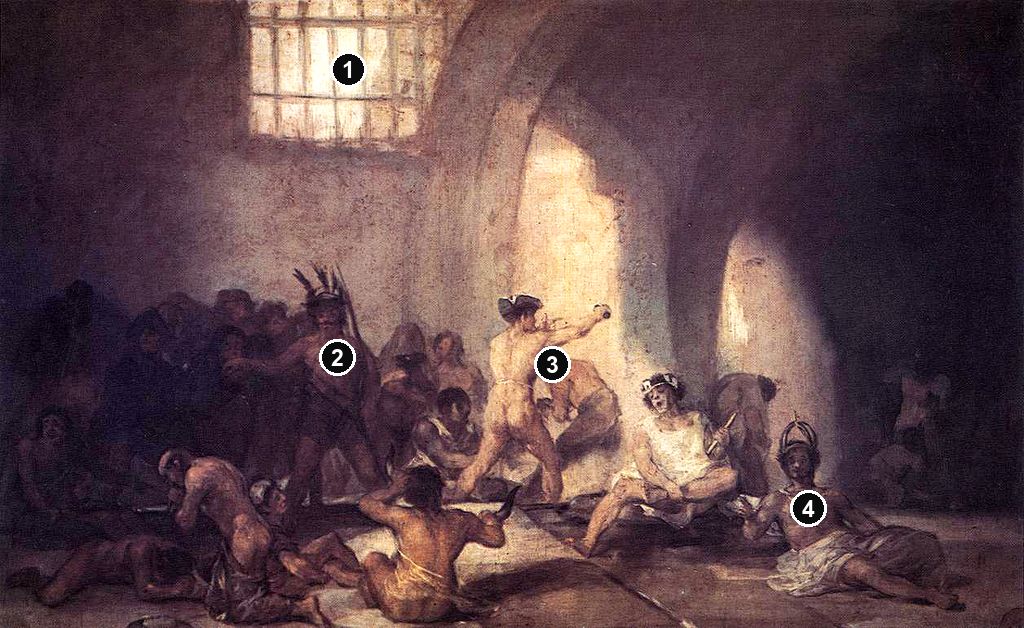
Details from THE MADHOUSE
Details from the Academy painting (0672).
The barred window
Pale light crosses the bars near the top of the wall.
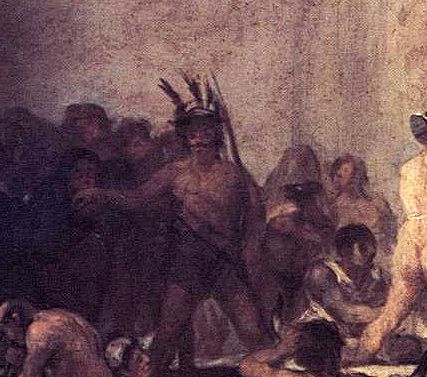
The figure in a feathered headdress
A feathered silhouette rises above the dark group beneath the window.
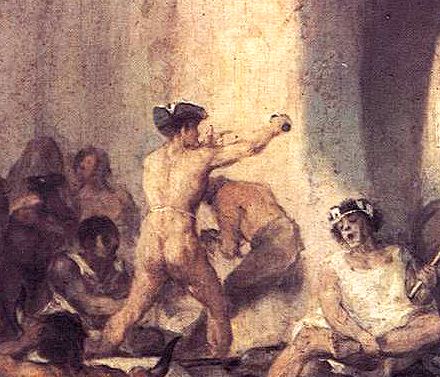
The standing figure
A raised arm crosses the bright patch beneath the arch.
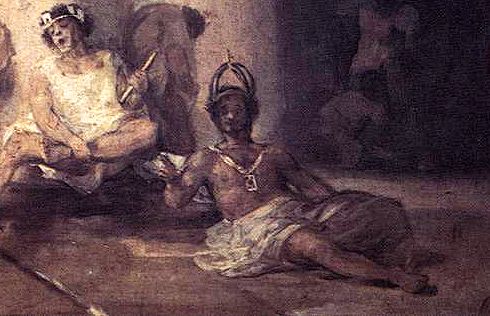
The figures seated on the right
The light catches the foreground figures unevenly near the dark arch.
Hats, hands and borrowed authority
The tricorn is a small patch of dark paint against the wall. Because it survives as the figure’s only item of dress, it has to establish his role by itself. The Academy reads his motion as an imitation of firing, while the Fundación sees the start of an attack. Both readings depend on how the lifted arm and the angle of the head work together. We look in the direction he indicates and find other people occupied with gestures of their own. Goya has given him the stance of someone who expects his movement to have a consequence elsewhere in the room. [1] [2]
On the right, a seated figure raises his hand in a gesture the Fundación reads as a blessing. The same catalogue sees a playing card in the religious emblem on his chest and a makeshift tiara on his head. Nearby, a figure with a crown and something like a sceptre suggests another kind of rank. The man in the feathered crown extends his hand towards someone close by. The Academy takes the gesture as an offer to have the hand kissed. The distance between those hands is much smaller than the distance implied by the man in the tricorn. The gesture can find a recipient in the crowd. [1] [2]
A crown, an officer’s hat and the gesture of a blessing are all quick ways of telling a viewer who is entitled to act. The clothes, poses and makeshift objects in The Madhouse allow us to read those signs even though the authority they suggest goes largely unacknowledged. The Fundación treats the costumes as a satire on social and institutional rank and suggests that the feathered figure may parody the Spanish king. That is one reading of the scene. The painting also allows us to concentrate on the people around that figure and the little audience they make for him. [1] [2]
Goya on film
Five films explore Goya’s portraits, prints, Black Paintings and painting techniques.
The Duke of Wellington by Goya
The portrait, its military decorations and its later theft.
Watch on YouTubeThe earlier yard in Dallas
The Meadows Museum in Dallas holds Goya’s Corral de locos, catalogued there as Yard with Madmen and also known as Yard with Lunatics. It is a narrow, upright painting in oil on tin-plated iron, dated 1794. In a letter to Bernardo de Iriarte dated 7 January that year, Goya describes two naked men fighting, an attendant striking them and other people dressed in sacks. He says he had witnessed such a scene in Zaragoza and would send the painting once he had finished it. His description supplies a place and a date for the earlier picture and helps account for the cluster of bodies at its centre. [3] [4] [5]
In the Dallas picture the violence gives the surrounding figures a shared point of reference. The narrow format holds the fight close to the centre and gives the wall room to rise sharply above it. The Academy panel spreads separate activities across the breadth of the room. Its incidents overlap and compete, from the hand extended in ceremony to the man in the tricorn. The Madrid picture also lacks a comparable letter identifying what Goya saw. That difference matters when deciding how precisely the setting can be placed. [1] [4] [5]
Zaragoza’s Hospital de Nuestra Señora de Gracia gives the earlier letter a historical setting. The archival research of Asunción Fernández Doctor and Antonio Seva Díaz traces the construction in the 1760s of separate departments for men and women. Records they cite describe places for people to walk or sit outdoors, as well as locked isolation rooms. A report from 1791 describes both outdoor access and very different accommodation according to the person’s circumstances. Some people slept on straw, while people of social distinction could be lodged in rooms with a fireplace. These records show how care, confinement and social privilege could operate in the same institution. The room Goya painted on the Madrid panel remains unidentified. [1] [5] [6]
Four small panels and a fifth painting
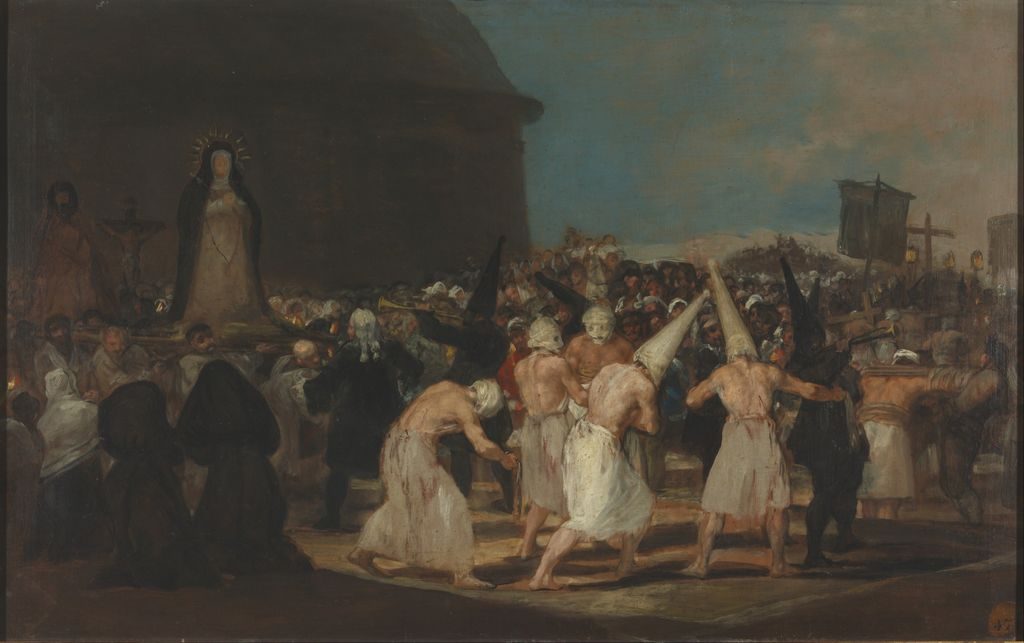
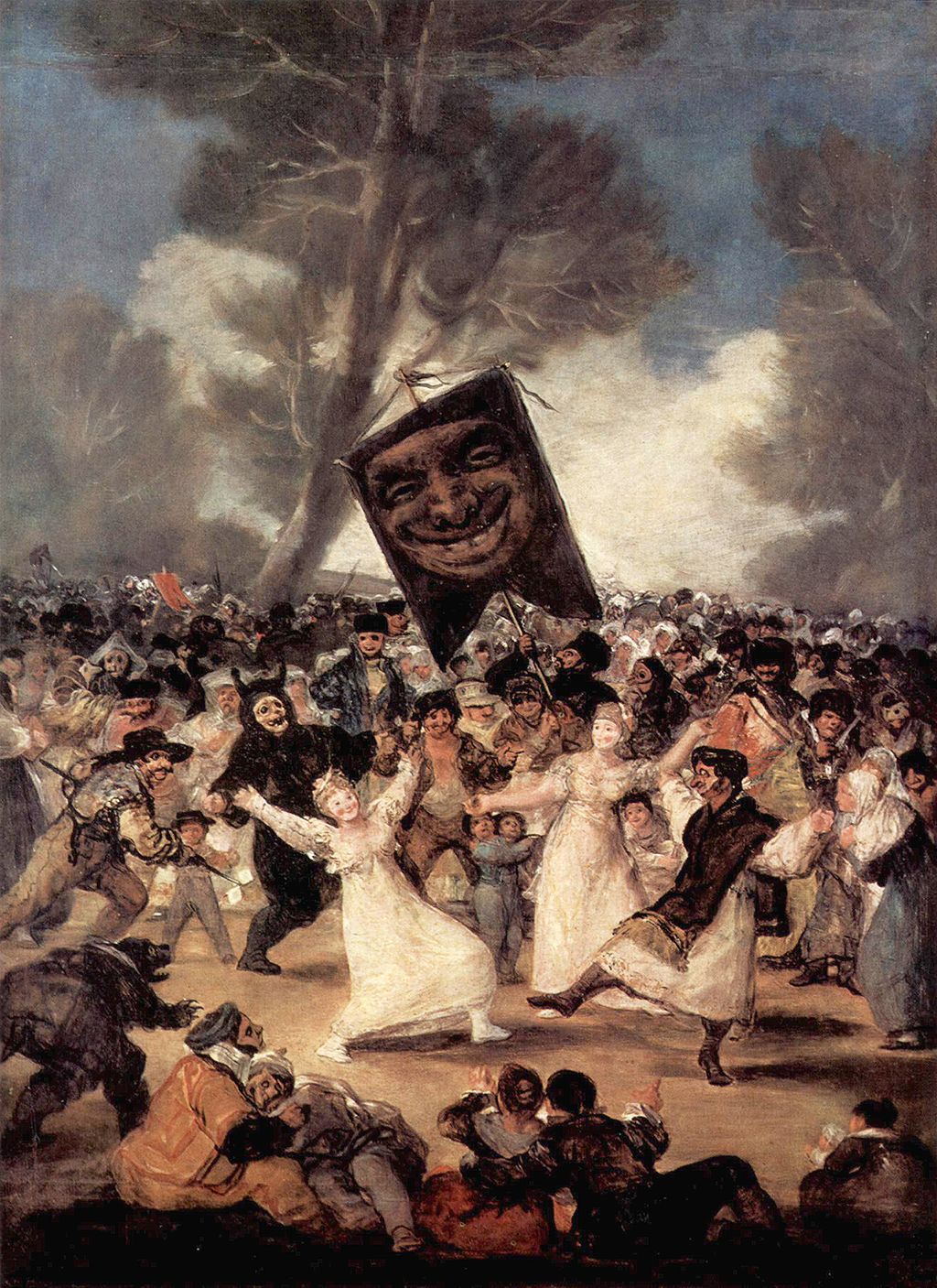
Manuel García de la Prada named five paintings by Goya in his 1836 bequest to the Academy. They entered its collection in 1839. Four of them are horizontal panels of almost the same size, usually grouped as cabinet paintings, works of a scale suitable for close viewing. Alongside The Madhouse were A Procession of Flagellants, The Inquisition Scene and The Bullfight. The fifth painting, The Burial of the Sardine, is taller than it is wide. The Fundación notes that an inventory compiled after Goya’s death mentions four small paintings of festivities and customs. That entry may refer to the four horizontal pictures. Exactly how García de la Prada acquired them remains uncertain. [2] [7] [8]
Look across the panels and the details of dress take on different kinds of force. In the Inquisition scene, pointed hats single out the people brought before the tribunal. In the procession, religious costume marks a public act of penitence. In the bullfight, spectators gather around an event with recognised participants and roles. The Fundación also sees a mock bullfight among the figures in The Madhouse. Across that room, a hat can win someone a little attention or a gesture can secure a moment’s recognition. Whether we read these details chiefly as satire or as the small dramas of people shut in together, the room itself stays in view. [1] [2] [8]
What the wood reveals
The similarity of the four panels extends to the wood beneath the paint. María Dolores Fúster Sabater examined samples from the group and identified the wood as belonging to the genus Cedrela, often called Spanish cedar. The microscopic study includes a sample from The Madhouse. Its features are consistent with Cuban cedar, although the origin is uncertain. The Academy had long passed down a story that Goya obtained the boards through a relative in the import trade and that they came from shipping cases for Cuban cigars. Fúster Sabater presents this as a possibility. Cedar was used for large tobacco shipping cases in Goya’s lifetime. [9]
The grain in each of the four panels runs vertically even though the pictures are wider than they are tall. On the backs and at the edges, breaks in the pattern of the grain reveal separate boards joined edge to edge. X-rays helped the researcher trace the joins. The construction lets Goya lay out a wide room across a surface assembled from narrower pieces, and gives the four pictures a physical connection independent of any common theme we might see in them. [9]
Artworks directory
| Name | Date | Medium |
|---|---|---|
| And There’s No Help for It, Plate 15 | Printed 1863 | |
| Asmodea | c. 1820–23 | Wall painting transferred to canvas |
| Boys Inflating a Bladder | 1777–78 | Tapestry cartoon |
| Boys Picking Fruit | 1778 | Tapestry cartoon |
| Bullfight in a Divided Ring | 1825 | Lithograph |
| Card Players | 1777–78 | Tapestry cartoon |
| Card Players (sketch) | 1777–78 | Painted sketch |
| Dance on the Banks of the Manzanares | 1777 | Tapestry cartoon |
| Duel with Cudgels | c. 1820–23 | Wall painting transferred to canvas |
| Heads in a Landscape | c. 1820–23 | Easel painting |
| Judith and Holofernes | c. 1820–23 | Wall painting transferred to canvas |
| Leocadia | c. 1820–23 | Wall painting transferred to canvas |
| Maja and Cloaked Men | 1777 | Tapestry cartoon |
| Maja and Cloaked Men (sketch) | 1777 | Painted sketch |
| Majo Clapping in Time to the Music | 1777 | Drawing |
| Men Reading | c. 1820–23 | Wall painting transferred to canvas |
| Out Hunting for Teeth, Plate 12 | 1799 | Etching, burnished aquatint and burin |
| Picnic in the Countryside (sketch) | 1776–78 | Painted sketch |
| Picnic on the Banks of the Manzanares | 1776 | Tapestry cartoon |
| Pilgrimage to San Isidro | c. 1820–23 | Wall painting transferred to canvas |
| Preparatory study for The Sleep of Reason Produces Monsters | c. 1796–97 | Drawing |
| Procession of the Holy Office | c. 1820–23 | Wall painting transferred to canvas |
| Quarrel at the Cockerel Inn (sketch) | 1777 | Painted sketch |
| Quarrel in the New Tavern | 1777 | Tapestry cartoon |
| Saturn Devouring His Son | c. 1820–23 | Wall painting transferred to canvas |
| Seated Majo Smoking | c. 1776 | Drawing |
| The Dog | c. 1820–23 | Wall painting transferred to canvas |
| The Drinker | 1777 | Tapestry cartoon |
| The Fates | c. 1820–23 | Wall painting transferred to canvas |
| The Great He-Goat | c. 1820–23 | Wall painting transferred to canvas |
| The Kite | 1777–78 | Tapestry cartoon |
| The Parasol | 1777 | Oil on canvas, tapestry cartoon |
| The Second of May 1808 | 1814 | Oil on canvas |
| The Sleep of Reason Produces Monsters, Plate 43 | 1799 | Etching and aquatint |
| The Third of May 1808 | 1814 | Oil on canvas |
| Thou Who Canst Not, Plate 42 | 1799 | Etching and burnished aquatint |
| Three Figures | 1776 | Drawing (lost) |
| Two Old Men | c. 1820–23 | Wall painting transferred to canvas |
| Two Old Men Eating Soup | c. 1820–23 | Wall painting transferred to canvas |
| Two Women and a Man | c. 1820–23 | Wall painting transferred to canvas |
| Universal Language: The Author Dreaming | 1797 | Drawing |
| The Family of Charles IV | 1800 | Oil on canvas |
| Witches’ Sabbath (Osuna painting) | 1797–98 | Oil on canvas |
| The Nude Maja | 1795–1800 | Oil on canvas |
| The Clothed Maja | 1800–07 | Oil on canvas |
| Self-Portrait (Drawing) | c. 1796 | Brush and carbon black ink on laid paper |
| The Swing, Madrid Album B.21 | 1795–97 | Brush and carbon black washes |
| Majas Fighting, a Majo Observing, Madrid Album B.15 | 1796–97 | Brush, grey and black washes on laid paper |
| Majos and Majas Conversing, Madrid Album B.16 | c. 1794–97 | Ink wash on paper |
| Weeping Woman and Three Men, Madrid Album B.17 | 1795–97 | Brush, carbon black washes and black chalk |
| Maja Seated on a Chair and Two Companions Behind, Madrid Album B.18 | 1795–97 | Brush and carbon black washes |
| Girl and Bull, Madrid Album B.23 | 1796–97 | Brush and carbon black washes |
| Lovers Sitting on a Rock, Madrid Album B.24 | 1796–97 | Brush and carbon black washes |
| Mariano Ceballos Riding a Bull | 1825 | Crayon lithograph and scraper |
| Landscape (lifetime impression) | c. 1807–10 | Etching and aquatint |
| Self-Portrait (1815), Prado canvas | 1815 | Oil on canvas |
| Self-Portrait (1815), Academy panel | 1815 | Oil on panel |
| Self-Portrait with Dr Arrieta | 1820 | Oil on canvas |
| Christ Crucified | 1780 | Oil on canvas |
| The Last Communion of Saint Joseph of Calasanz | 1819 | Oil on canvas |
| Christ on the Mount of Olives | 1819 | Oil on panel |
| The Flower Girls, or Spring | 1786–87 | Oil on canvas |
| The Grape Harvest, or Autumn | 1786–87 | Oil on canvas |
| The Snowstorm, or Winter | 1786–87 | Oil on canvas |
| The Threshing Ground, or Summer | 1786–87 | Oil on canvas |
| Picnic on the Banks of the Manzanares | 1776 | Oil on canvas |
| The Kite | 1777–78 | Oil on canvas |
| Dance on the Banks of the Manzanares | 1777 | Oil on canvas |
| A Fight at the Venta Nueva | 1777 | Oil on canvas |
| Blind Man’s Bluff | 1788 | Oil on canvas |
| Dogs on a Lead | 1775 | Oil on canvas |
| Hunting with a Decoy | 1775 | Oil on canvas |
| Hunter Loading His Rifle | 1775 | Oil on canvas |
| The Angler | 1775 | Oil on canvas |
| The Hermitage of San Isidro on His Feast Day | 1788 | Oil on canvas |
| The Meadow of San Isidro | 1788 | Oil on canvas |
| The Straw Manikin | 1791–92 | Oil on canvas |
| Witches’ Flight | c. 1797–98 | Oil on canvas |
| A Scene from ‘The Forcibly Bewitched’ | 1798 | Oil on canvas |
| The Duchess of Alba in Black | 1797 | Oil on canvas |
| The Duchess of Alba in White | 1795 | Oil on canvas |
| Charles III in Hunting Dress | c. 1786 | Oil on canvas |
| The Duke and Duchess of Osuna and Their Children | 1787–88 | Oil on canvas |
| Manuel Osorio Manrique de Zúñiga | 1787–88 | Oil on canvas |
| The Marquesa de Pontejos | c. 1786 | Oil on canvas |
| Equestrian Portrait of the 1st Duke of Wellington | 1812 | Oil on canvas |
| The Duke of Wellington | 1812–14 | Oil on wood |
| Portrait of Ferdinand VII of Spain | 1814 | Oil on canvas |
| Gaspar Melchor de Jovellanos | 1798 | Oil on canvas |
| María Tomasa Palafox y Portocarrero | 1804 | Oil on canvas |
| Señora Sabasa García | c. 1806–11 | Oil on canvas |
| Don Juan Bautista de Muguiro | 1827 | Oil on canvas |
| Doña Isabel de Porcel | Before 1805 | Oil on canvas |
| The Colossus | After 1808 | Oil on canvas |
| The Burial of the Sardine | 1808–12 | Oil on panel |
| The Madhouse | 1808–12 | Oil on panel |
| A Procession of Flagellants | 1808–12 | Oil on panel |
| Portrait of Jacques Galos | 1826 | Oil on canvas |
| Portrait of Mariano Goya, the Artist’s Grandson | 1827 | Oil on canvas |
| Milkmaid of Bordeaux | c. 1827 | Oil on canvas |
| Portrait of Don Juan Antonio Cuervo | 1819 | Oil on canvas |
| María Luisa of Parma (Naples version) | c. 1800 | Oil on canvas |
| The Countess of Baena | 1819 | Oil on canvas |
| The Family of the Infante Don Luis | 1783–84 | Oil on canvas |
| The Holy Family | c. 1787 | Oil on canvas |
| Saint Barbara | c. 1773 | Oil on canvas |
| Saints Justa and Rufina | 1817 | Oil on canvas |
| El Tío Paquete | c. 1819–20 | Oil on canvas |
| The Forge | c. 1815–20 | Oil on canvas |
| Majas on a Balcony (Metropolitan Museum version) | c. 1800–10 | Oil on canvas |
| Maja and Celestina on a Balcony | c. 1808–12 | Oil on canvas |
| The Water Bearer | 1808–12 | Oil on canvas |
| Time and the Old Women | c. 1810 | Oil on canvas |
Frequently Asked Questions
It belongs to the Real Academia de Bellas Artes de San Fernando in Madrid. The collection record lists it as La casa de locos, inventory 0672. It measures 45 × 72 cm and is painted in oil on a wooden panel. [1]
The Academy catalogues the painting as 1808–1812. The Fundación Goya en Aragón proposes about 1814–1816 based on the dress depicted in the series and the way it is painted. The dated reference to a painting of a yard in Goya’s January 1794 letter refers to the earlier work in Dallas. [1] [2] [4] [5]
Goya gave Zaragoza as the setting for the event he painted in Yard with Lunatics. The precise setting of the Madrid panel is uncertain. Its vaulted room, barred window and costumes support interpretations of confinement and social roles without identifying the place or the people depicted. [1] [2] [5] [6]
Discussion
Look again at the images and ideas explored in The Madhouse. These editorial prompts invite your observations.
Which figure do you notice first? Follow the raised hand or the direction of the tricorn wearer’s gesture. Does it lead you to a person who seems to respond? Compare what you see around the feathered figure.
Reader Insights
Which details come into view after you follow the light?
Look for the relationship between the figures and the walls.
Join the Conversation
Share a detail, comparison or question about The Madhouse below.
References
- Real Academia de Bellas Artes de San Fernando, La casa de locos, collection record 0672. View source.
- Fundación Goya en Aragón, Casa de locos, catalogue entry 463. View source.
- Meadows Museum, Southern Methodist University, Yard with Madmen, collection record MM.67.01. View source.
- Fundación Goya en Aragón, Corral de locos, catalogue entry 536. View source.
- Francisco de Goya, letter to Bernardo de Iriarte, 7 January 1794, transcribed in Ángel Canellas López, ed., Francisco de Goya. Diplomatario, no. 189, pp. 314–315. View source.
- Asunción Fernández Doctor and Antonio Seva Díaz, ‘La familia de Goya y la locura’, Institución Fernando el Católico, pp. 83–85 for the Zaragoza hospital records and the 1791 report. View source.
- Real Academia de Bellas Artes de San Fernando, ‘Histórico de mecenas y donantes’, entry for Manuel García de la Prada. View source.
- Real Academia de Bellas Artes de San Fernando, collection records for Escena de Inquisición, Los disciplinantes, La corrida de toros and El entierro de la sardina. View source 1. View source 2. View source 3. View source 4.
- María Dolores Fúster Sabater, ‘Los soportes de madera en las obras de Goya. Materiales y técnicas’, Academia 118 (2016), pp. 147–154, especially fig. 36C for the sample from The Madhouse. View source.







