by Tom Gurney
Tom Gurney BSc (Hons) is an art history expert with over 20 years experience
Published on June 19, 2020 / Updated on November 20, 2026
Email: tomgurney1@gmail.com / Phone: +44 7429 011000
Introduction
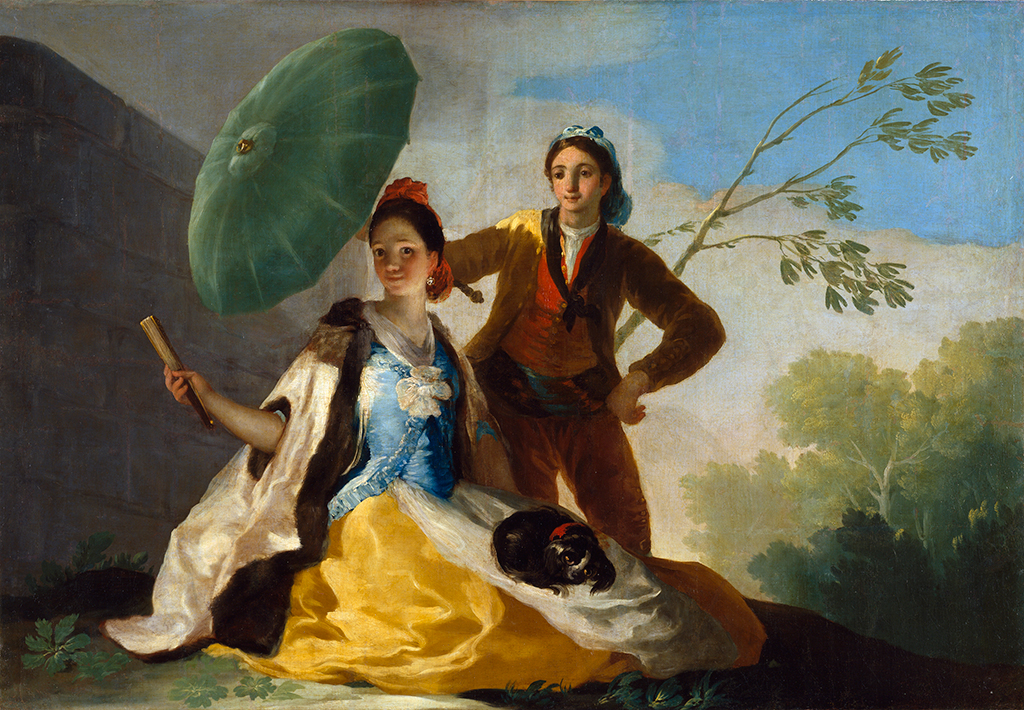
The brightest yellow in Francisco de Goya’s The Parasol is at ground level. It spreads from the seated woman’s lap across the grass, where the dark shape of a small dog makes the fabric look brighter still. Above her blue bodice, a green parasol casts a soft shade over her face. The young man holding it leans in from behind her. His head rises higher than hers, but it is her face we look at first, and her eyes that meet ours. Goya painted the scene in 1777 as a model for a tapestry that would hang high in a royal dining room. The oil on canvas, now in the Museo Nacional del Prado, measures 104 × 152 centimetres. [1]
At a Glance
- Artist and titleFrancisco de Goya, The Parasol (El quitasol). [1]
- Date and medium1777, oil on canvas. [1]
- Size and collection104 × 152 cm. Museo Nacional del Prado, Madrid, inventory P00773. [1]
- Original purposeA design for a woven overdoor in the dining room of the Prince and Princess of Asturias at El Pardo, paired with The Drinker. [1] [3] [5]
- Documented woven exampleRoyal Collections inventory 10005013 (TA-91/7), silk and wool, 118 × 161 cm, dated 1777–1801 in the collection’s inventory. [10]
Works across Goya’s career
The Parasol
1777The Nude Maja
1795–1800Saturn Devouring His Son
c. 1820–23The Dog
c. 1820–23Milkmaid of Bordeaux
c. 1827Looking up at two figures on a bank
The parasol gives the picture its largest, clearest curve. A thin strip along its rim catches the light, while the lower part of the canopy is darker. The shaft runs down on a slant to the young man’s hand. Follow his sleeve towards his shoulder and you find how close he has to lean to hold the shade where it falls. The woman’s skirt opens in the opposite direction. The breadth of the fabric gives the group a firm base, while the man’s head and the lifted canopy carry the eye back up. The Fundación Goya en Aragón describes the arrangement as pyramidal and relates it to the classical principles Goya learnt from Anton Raphael Mengs. The triangle is easy to feel in the picture because the gestures and the weight of the dress give it a practical shape. [1]
The two people occupy different levels. The woman sits in the foreground. Behind her, a rise in the ground cuts across the young man’s lower body and largely hides his legs. Farther back, the sloping top of the wall at left and the tree at right frame the heads against the sky. The man’s hand projects into a much more open passage of colour than his legs do. Goya can make the act of shading someone legible even while leaving most of the standing figure’s footing out of sight. The bank also lets the seated woman appear closer to us without having to shrink the person behind her. [1]
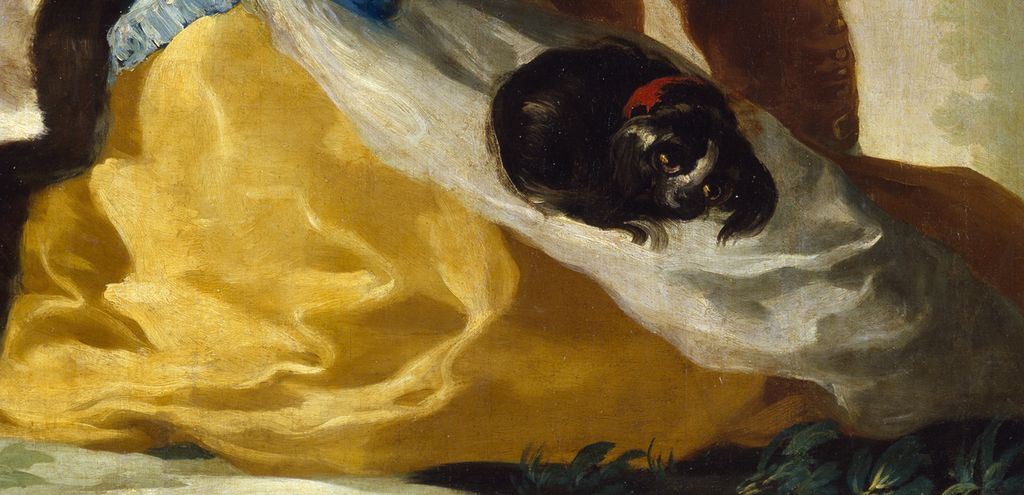
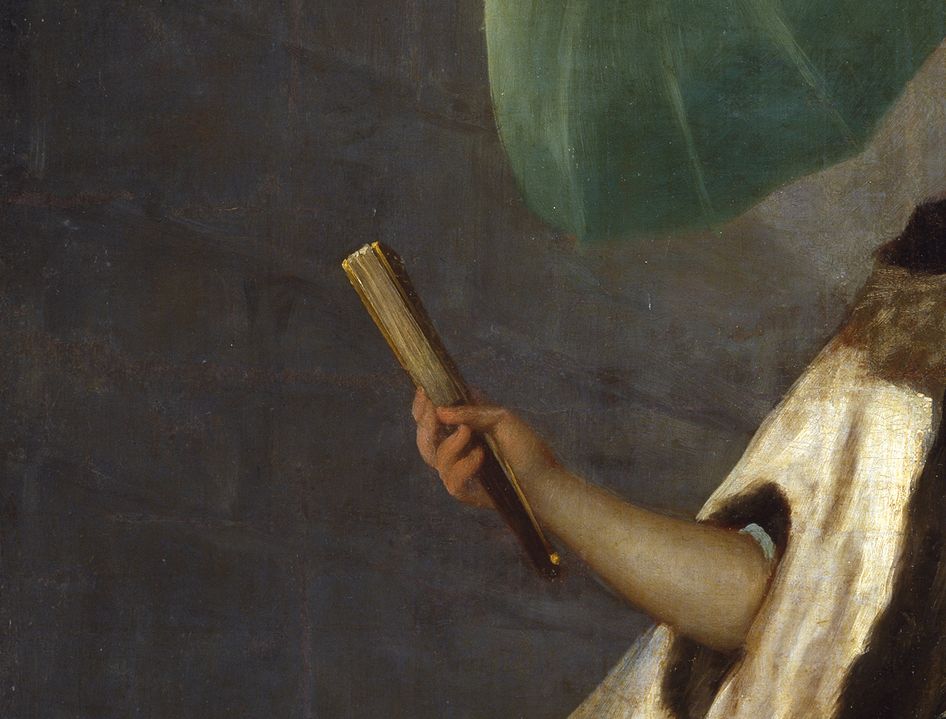
Look for other shifts in scale. The flower at the woman’s neckline and the folded fan in her hand take up very little room. The dog, settled against the skirt, is a dark patch before it resolves into an animal, with lighter markings that help separate head and body from its surroundings. At a distance the yellow folds, patch of blue and open green canopy establish the scene. Up close, the net over the man’s hair and the small changes in the woman’s expression become easier to see. Her face is gently shaded and her skirt brightly lit, so the shade does not swallow up the gaze that makes her so immediately present. [1]
The tree at the right makes another connection between the near figures and the background. Its leaves recall the green of the canopy, with the blue and clouded sky leaving room between the two. The curving branch on one side and the man’s lean on the other give the picture some movement. Their silhouettes and the tilt of the canopy are enough to suggest the feel of being outdoors. A viewer can sense a breeze without needing to decide what weather will come next or why the woman sat down. [1] [2]
Annotated Details from The Parasol
Look from the parasol and the face beneath it to the two figures, the bright skirt and the wall.
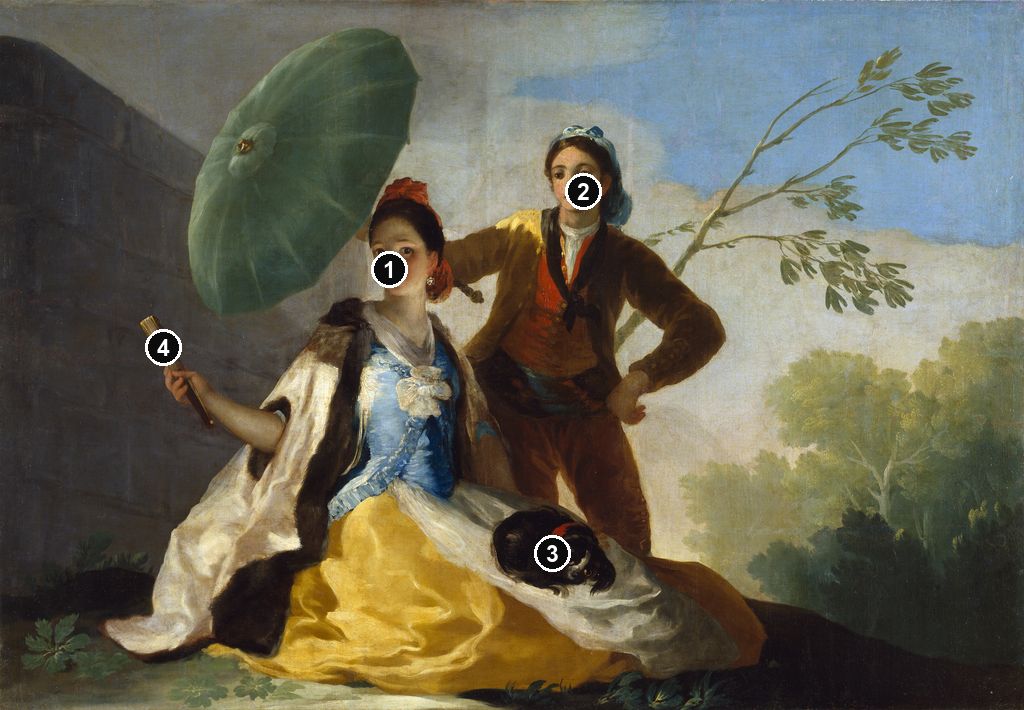
Details from THE PARASOL
The details are from Goya’s painted cartoon in the Museo Nacional del Prado (P00773).
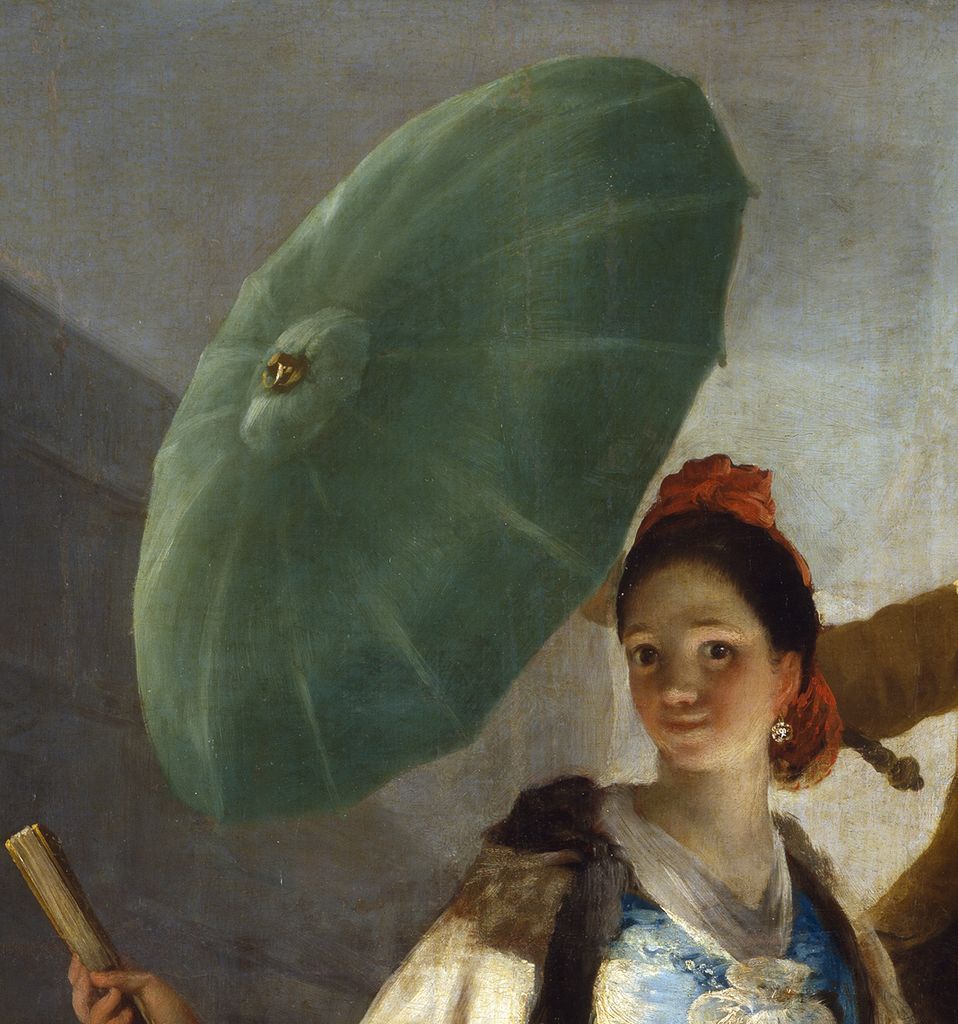
Shade from the parasol
The green canopy interrupts the sky near the young woman’s head. Look at the passage from shade across her forehead into light on her cheek.
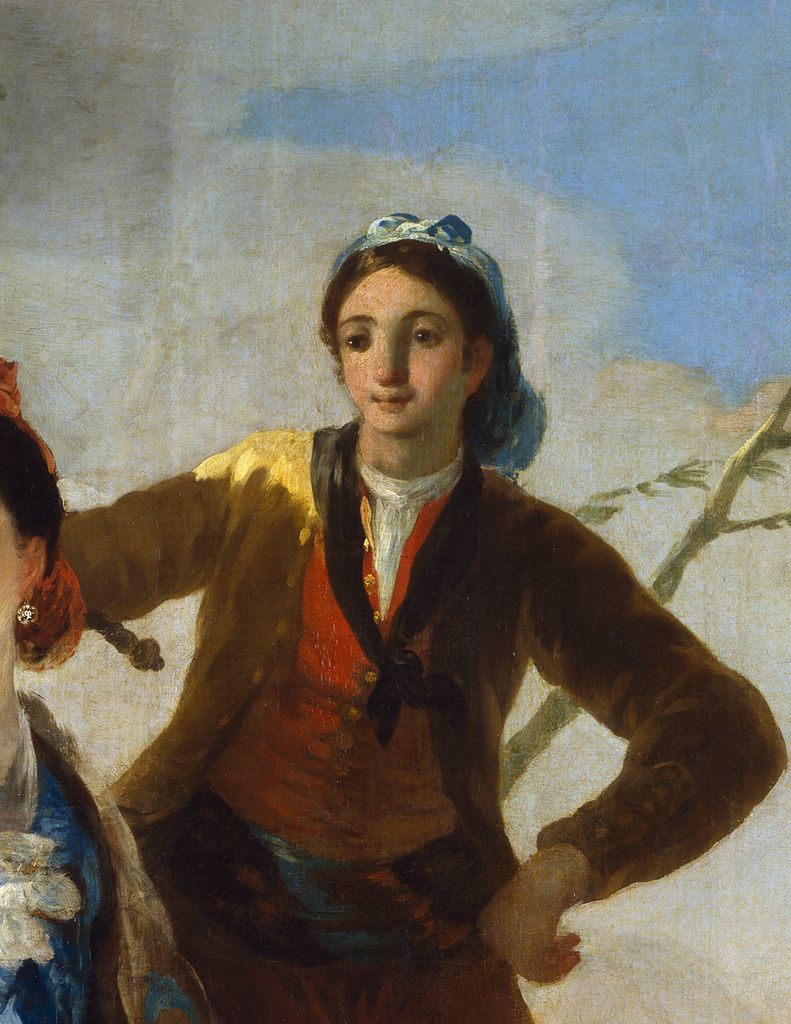
The standing figure
The young man rises behind his companion. His bent arms give his body width, while the slope lets his head appear much higher than hers.
Colour and a resting dog
The dark dog makes a small, firm shape against the pale drapery. Below it, the yellow folds gather the strongest colour in the lower half.
The wall and the fan
The shape of the hand and the fan is easy to pick out against the darker wall. The simple backdrop gives the small gesture its clarity.
A design for the dining room at El Pardo
The tapestry was intended for the dining room of the Prince and Princess of Asturias at the Royal Palace of El Pardo, outside Madrid. They were the future Charles IV and María Luisa of Parma. A cartoon in this setting is the painter’s working design for the weavers. Goya delivered an oil painting to the Royal Tapestry Factory of Santa Bárbara, and the textile made from it was the object intended for the palace wall. The Fundación Goya en Aragón places The Parasol and The Drinker above the doors on the room’s east side. The two cartoons survive, and the royal collections also hold woven versions of the designs. [1] [2] [3] [4]
An account signed by Goya in Madrid on 12 August 1777 identifies the destination and describes four paintings for the dining room. In the fourth, he describes a girl sitting on a bank, a small dog in her skirt and a boy standing beside her to give her shade. He records the width and height in feet and fingerbreadths and values the painting at 1,500 reales de vellón. In the same document, his description of The Drinker gives it the same recorded width. Those entries pin the painting’s date to a specific delivery and show the dimensions mattered enough to record alongside each scene and its valuation. The girl, boy and dog are described by their positions and actions. The account supplies no personal names for the figures. [5]
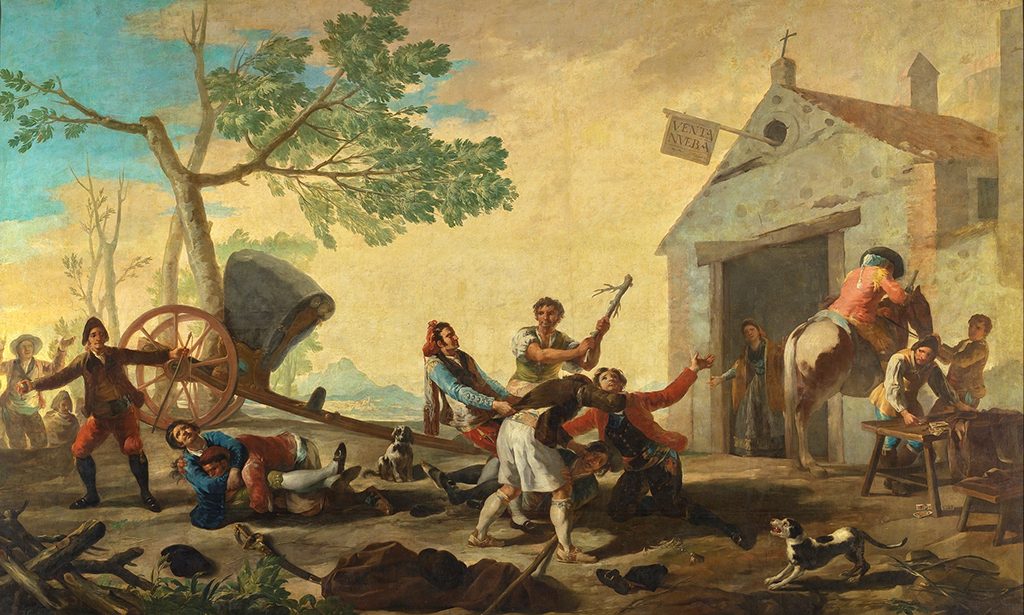
The four cartoons delivered together also included A Walk in Andalusia and Quarrel in the New Tavern. The dining-room commission ultimately comprised ten cartoons delivered between 1776 and 1778. The catalogue groups them with associated studies, so the number of works listed for the series is larger than the number of finished designs for the room. A quarrel, an outing, a drinking scene and a quiet exchange of shade can belong to the same decorative programme. Their different shapes are another reason to read them as parts of a furnished interior. The surrounding architecture set out spaces of different sizes for different kinds of picture. [5] [6] [7]
The east-side pairing gives the low viewpoint a purpose. Someone on the dining-room floor would raise their eyes to see the tapestry. Inside the composition, the bank makes the standing man appear to rise out of the ground behind the woman, and the tilt of the canopy lets the viewer see its underside. Looking up at the woven panel would reinforce that impression. The figure nearer the floor of the depicted scene is the one closest to the viewer, with her gaze directed out towards the room. These effects can be read from the design and its recorded destination. The exact impression would vary with where someone stood and how far away they were. [1] [3]
Goya on film
Five films explore Goya’s portraits, prints, Black Paintings and painting techniques.
The Duke of Wellington by Goya
The portrait, its military decorations and its later theft.
Watch on YouTubeFrom brushwork to tapestry
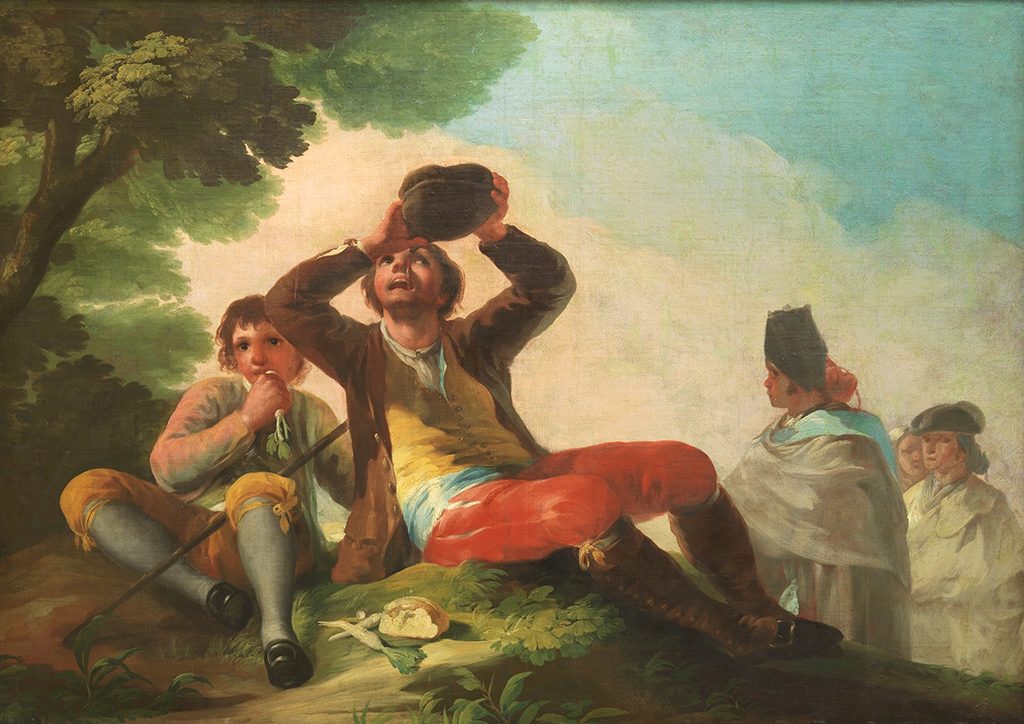
The pair shares more than an architectural purpose. In The Drinker, a man raises a wineskin above his face and tips his head back. His profile and the vessel are outlined against the sky. Beside him, a boy attends to his food, and three smaller figures appear farther away. In The Parasol, the object held aloft is broader, and the woman’s attention reaches out of the scene. Both compositions make a raised arm and a familiar object carry the action. Someone who saw them across the dining room could follow what the figures were doing from the silhouette and the angle of the gesture. In one, the upward reach ends in a drink. In the other, it creates a pool of shade. [1] [3] [5]
Goya’s August account calls the four designs works of his own invention and says they were executed on the order of the royal architect Francisco Sabatini. Concha Herrero Carretero’s study of the factory explains the range of work involved after the painter delivered his design. On the loom, the warp is the set of threads held under tension. The coloured weft passes over and under them, building the image as the weaver works. A design could be traced to guide the placement of outlines. Translating a change of tone might involve alternating threads of different colours where a painter could make a gradual transition with a brush. The factory could keep models and patterns for replacement hangings and later weavings. The painter, the architect and the loom workers each shaped what would appear above the door. [5] [8]
The outline of the canopy and the meeting of yellow skirt and dark dog give a weaver clear boundaries between colour areas. The soft shading of the woman’s face poses a different problem. Anna Reuter, writing on the cartoon, points out passages where the red preparation remains visible and where light touches are applied with lead-white paint. From close up the sense of light can depend on the thickness of a stroke or the warmth of the colour beneath it. In woven silk and wool the same form has to emerge from the placement and colour of threads. A comparison of canvas and tapestry can start with something as small as the bright rim of the canopy, where each maker had to convey the turn of the fabric towards the light. [2] [8]
A later example shows how far such changes could go. In the woven version of Blind Man’s Bluff, Herrero Carretero notes that distant details in the cartoon relying on patches of paint, glazes and light and shade were left out. The principal figures and their game still hold the scene together. That is evidence of how the weavers handled that design. With The Parasol, the broad yellow of the skirt and the green canopy are places to start looking for what remains recognisable across different weavings. The smaller features, such as the dog’s markings and the modelling of the face, are places to look for decisions made at the loom. [8] [9]
Herrero Carretero recorded three royal-collection tapestries made after The Parasol in the catalogue Goya: Images of Women. One documented example in the Royal Collections inventory is 10005013 (TA-91/7), panel 7 of the Cuadros de costumbres. Goya series. The collection’s 2017 display-planning inventory identifies it as a silk-and-wool weaving of the Royal Tapestry Factory in Madrid, dates it to 1777–1801 and gives its dimensions as 118 × 161 centimetres, height by width. In 2026 Patrimonio Nacional lent a woven Parasol and a woven Drinker to Solo Goya. El arte de ver at the Museo Goya in Zaragoza. The public loan announcement identifies the design and the lender. The inventory number and dimensions above refer specifically to the panel in the 2017 record. [4] [10] [11]
Reading the design from across a furnished room
Clarity at a distance is one of the design’s practical strengths. The parasol opens as a broad shape whose edge remains intelligible when facial details are too small to see. The large areas of yellow and blue clothing make the seated woman easy to pick out. The dark area beside her registers first as a contrast and only afterwards as an animal. Those changes of emphasis matter in a room where furniture might interrupt the view and people might approach a hanging from different directions. The cartoon preserves an arrangement that can survive that kind of fragmentary attention. [14] [15]
The comparison with the group in Picnic in the Country puts the design problem in proportion. In the larger gathering, bodies and intervals between them have to carry several exchanges at once. In The Parasol, the staff, the open canopy and the upward position of the standing figure are enough to link the pair. In each case colour separates important masses, but a viewer in front of The Parasol can reconstruct the action by following one object through the image. That is a practical consequence of the difference between the cartoon’s small scene and a longer composition. [14] [15]
Material translation adds another change. Oil paint can vary the edge between a highlight and a shadow within the width of a brushstroke. A web of wool and silk has to build those transitions on a visible structure. A seated figure’s dress still has to read clearly when much of its painterly modelling has been broken into steps of colour. One can therefore look for the visual decisions that hold the composition together under both conditions. That exercise puts the humour of the woman’s look back into a design that also had work to do at the scale of an architectural interior. [14] [15]
The Prado’s account of the royal commissions puts the tapestry cartoons into a sequence of decorative work. This lets us recover the kind of companion image a hanging could have had without reconstructing its entire wall. A horizontal gathering such as Picnic in the Country invites the eye to travel from one exchange to another. The compact figures of The Parasol can hold attention in a much smaller area. In woven form those differences help several subjects work together at unequal sizes. From a close view in a museum, a viewer can instead compare the painter’s handling of shade and sunlight within each separate design. [14] [15]
Fashion and the way the woman looks back
Reuter describes the young woman as a petimetra, a fashionable figure associated with French dress and manners. The fur-lined sleeveless cloak, delicate shawl and folded fan give that reading something specific to go on. The man’s hairnet and differently cut clothes give the couple contrasting profiles. It is easy to infer a social difference from the clothes and the fact that he holds the shade for her. His gesture establishes his role in the scene, while his occupation and the relationship between the two people remain open. Janis A. Tomlinson’s reading, reported by the Fundación Goya en Aragón, goes further and sees pride or vanity in the woman’s self-presentation. The same open gaze can also feel like an invitation to acknowledge her. The fan remains folded while the figure in shade takes the most active part in meeting the viewer. [1] [2] [5]
A French painting sometimes brought into the discussion is Jean Ranc’s Vertumnus and Pomona, now at the Musée Fabre in Montpellier. In Ranc’s mythological scene, Vertumnus takes the appearance of an old woman to approach Pomona. A parasol helps frame that encounter. Goya gives the accessory a prominent place in a scene of contemporary dress and puts it to work in the fall of light. The comparison shows how a device from an established pictorial tradition can help organise a scene of everyday leisure. Goya’s own account describes the people through the small action they perform on the bank. [2] [5] [12]
The cartoon in the museum
The painting passed from the Royal Tapestry Factory to the Royal Palace in Madrid in 1856–57, entered the Prado in 1870 and was listed in the museum catalogue by 1876, according to Reuter’s provenance. Herrero Carretero describes the rediscovery in 1869 of rolls of cartoons in the palace basement during Gregorio Cruzada Villaamil’s work on the royal inventory. Paintings once kept available as working models became objects that a museum could catalogue, hang and display for their own sake. The tapestry history remains legible through the painted format even after the transfer of custody. The dimensions still tell us about a stretch of wall that had to be filled. [2] [8]
In the Prado’s 2014–15 exhibition Goya en Madrid. Cartones para tapices (1775–1794), curators Manuela Mena and Gudrun Maurer brought Goya’s designs into conversation with works by other painters who supplied the factory and with sources for the subjects he developed. At gallery viewing height, the eye can linger over transitions from the cool shade on the forehead to the warmer cheeks and follow the paint in a way that an overdoor would seldom allow. Taking a few steps back gives a different experience. The green canopy and the two levels of the figures come into view together, and the woman's gaze reaches across the space again. That shift from close inspection to distance brings back one of the practical demands Goya faced when he painted the model. [1] [13]
For examples of how Goya worked at other scales and for other patrons, see the paintings overview. A return to The Drinker gives the most direct comparison. Its nearly matching width is a trace of the two places these designs were meant to occupy, while the unrelated actions give each scene its own pace. [3] [5]
Artworks directory
| Name | Date | Medium |
|---|---|---|
| And There’s No Help for It, Plate 15 | Printed 1863 | |
| Asmodea | c. 1820–23 | Wall painting transferred to canvas |
| Boys Inflating a Bladder | 1777–78 | Tapestry cartoon |
| Boys Picking Fruit | 1778 | Tapestry cartoon |
| Bullfight in a Divided Ring | 1825 | Lithograph |
| Card Players | 1777–78 | Tapestry cartoon |
| Card Players (sketch) | 1777–78 | Painted sketch |
| Dance on the Banks of the Manzanares | 1777 | Tapestry cartoon |
| Duel with Cudgels | c. 1820–23 | Wall painting transferred to canvas |
| Heads in a Landscape | c. 1820–23 | Easel painting |
| Judith and Holofernes | c. 1820–23 | Wall painting transferred to canvas |
| Leocadia | c. 1820–23 | Wall painting transferred to canvas |
| Maja and Cloaked Men | 1777 | Tapestry cartoon |
| Maja and Cloaked Men (sketch) | 1777 | Painted sketch |
| Majo Clapping in Time to the Music | 1777 | Drawing |
| Men Reading | c. 1820–23 | Wall painting transferred to canvas |
| Out Hunting for Teeth, Plate 12 | 1799 | Etching, burnished aquatint and burin |
| Picnic in the Countryside (sketch) | 1776–78 | Painted sketch |
| Picnic on the Banks of the Manzanares | 1776 | Tapestry cartoon |
| Pilgrimage to San Isidro | c. 1820–23 | Wall painting transferred to canvas |
| Preparatory study for The Sleep of Reason Produces Monsters | c. 1796–97 | Drawing |
| Procession of the Holy Office | c. 1820–23 | Wall painting transferred to canvas |
| Quarrel at the Cockerel Inn (sketch) | 1777 | Painted sketch |
| Quarrel in the New Tavern | 1777 | Tapestry cartoon |
| Saturn Devouring His Son | c. 1820–23 | Wall painting transferred to canvas |
| Seated Majo Smoking | c. 1776 | Drawing |
| The Dog | c. 1820–23 | Wall painting transferred to canvas |
| The Drinker | 1777 | Tapestry cartoon |
| The Fates | c. 1820–23 | Wall painting transferred to canvas |
| The Great He-Goat | c. 1820–23 | Wall painting transferred to canvas |
| The Kite | 1777–78 | Tapestry cartoon |
| The Parasol | 1777 | Oil on canvas, tapestry cartoon |
| The Second of May 1808 | 1814 | Oil on canvas |
| The Sleep of Reason Produces Monsters, Plate 43 | 1799 | Etching and aquatint |
| The Third of May 1808 | 1814 | Oil on canvas |
| Thou Who Canst Not, Plate 42 | 1799 | Etching and burnished aquatint |
| Three Figures | 1776 | Drawing (lost) |
| Two Old Men | c. 1820–23 | Wall painting transferred to canvas |
| Two Old Men Eating Soup | c. 1820–23 | Wall painting transferred to canvas |
| Two Women and a Man | c. 1820–23 | Wall painting transferred to canvas |
| Universal Language: The Author Dreaming | 1797 | Drawing |
| The Family of Charles IV | 1800 | Oil on canvas |
| Witches’ Sabbath (Osuna painting) | 1797–98 | Oil on canvas |
| The Nude Maja | 1795–1800 | Oil on canvas |
| The Clothed Maja | 1800–07 | Oil on canvas |
| Self-Portrait (Drawing) | c. 1796 | Brush and carbon black ink on laid paper |
| The Swing, Madrid Album B.21 | 1795–97 | Brush and carbon black washes |
| Majas Fighting, a Majo Observing, Madrid Album B.15 | 1796–97 | Brush, grey and black washes on laid paper |
| Majos and Majas Conversing, Madrid Album B.16 | c. 1794–97 | Ink wash on paper |
| Weeping Woman and Three Men, Madrid Album B.17 | 1795–97 | Brush, carbon black washes and black chalk |
| Maja Seated on a Chair and Two Companions Behind, Madrid Album B.18 | 1795–97 | Brush and carbon black washes |
| Girl and Bull, Madrid Album B.23 | 1796–97 | Brush and carbon black washes |
| Lovers Sitting on a Rock, Madrid Album B.24 | 1796–97 | Brush and carbon black washes |
| Mariano Ceballos Riding a Bull | 1825 | Crayon lithograph and scraper |
| Landscape (lifetime impression) | c. 1807–10 | Etching and aquatint |
| Self-Portrait (1815), Prado canvas | 1815 | Oil on canvas |
| Self-Portrait (1815), Academy panel | 1815 | Oil on panel |
| Self-Portrait with Dr Arrieta | 1820 | Oil on canvas |
| Christ Crucified | 1780 | Oil on canvas |
| The Last Communion of Saint Joseph of Calasanz | 1819 | Oil on canvas |
| Christ on the Mount of Olives | 1819 | Oil on panel |
| The Flower Girls, or Spring | 1786–87 | Oil on canvas |
| The Grape Harvest, or Autumn | 1786–87 | Oil on canvas |
| The Snowstorm, or Winter | 1786–87 | Oil on canvas |
| The Threshing Ground, or Summer | 1786–87 | Oil on canvas |
| Picnic on the Banks of the Manzanares | 1776 | Oil on canvas |
| The Kite | 1777–78 | Oil on canvas |
| Dance on the Banks of the Manzanares | 1777 | Oil on canvas |
| A Fight at the Venta Nueva | 1777 | Oil on canvas |
| Blind Man’s Bluff | 1788 | Oil on canvas |
| Dogs on a Lead | 1775 | Oil on canvas |
| Hunting with a Decoy | 1775 | Oil on canvas |
| Hunter Loading His Rifle | 1775 | Oil on canvas |
| The Angler | 1775 | Oil on canvas |
| The Hermitage of San Isidro on His Feast Day | 1788 | Oil on canvas |
| The Meadow of San Isidro | 1788 | Oil on canvas |
| The Straw Manikin | 1791–92 | Oil on canvas |
| Witches’ Flight | c. 1797–98 | Oil on canvas |
| A Scene from ‘The Forcibly Bewitched’ | 1798 | Oil on canvas |
| The Duchess of Alba in Black | 1797 | Oil on canvas |
| The Duchess of Alba in White | 1795 | Oil on canvas |
| Charles III in Hunting Dress | c. 1786 | Oil on canvas |
| The Duke and Duchess of Osuna and Their Children | 1787–88 | Oil on canvas |
| Manuel Osorio Manrique de Zúñiga | 1787–88 | Oil on canvas |
| The Marquesa de Pontejos | c. 1786 | Oil on canvas |
| Equestrian Portrait of the 1st Duke of Wellington | 1812 | Oil on canvas |
| The Duke of Wellington | 1812–14 | Oil on wood |
| Portrait of Ferdinand VII of Spain | 1814 | Oil on canvas |
| Gaspar Melchor de Jovellanos | 1798 | Oil on canvas |
| María Tomasa Palafox y Portocarrero | 1804 | Oil on canvas |
| Señora Sabasa García | c. 1806–11 | Oil on canvas |
| Don Juan Bautista de Muguiro | 1827 | Oil on canvas |
| Doña Isabel de Porcel | Before 1805 | Oil on canvas |
| The Colossus | After 1808 | Oil on canvas |
| The Burial of the Sardine | 1808–12 | Oil on panel |
| The Madhouse | 1808–12 | Oil on panel |
| A Procession of Flagellants | 1808–12 | Oil on panel |
| Portrait of Jacques Galos | 1826 | Oil on canvas |
| Portrait of Mariano Goya, the Artist’s Grandson | 1827 | Oil on canvas |
| Milkmaid of Bordeaux | c. 1827 | Oil on canvas |
| Portrait of Don Juan Antonio Cuervo | 1819 | Oil on canvas |
| María Luisa of Parma (Naples version) | c. 1800 | Oil on canvas |
| The Countess of Baena | 1819 | Oil on canvas |
| The Family of the Infante Don Luis | 1783–84 | Oil on canvas |
| The Holy Family | c. 1787 | Oil on canvas |
| Saint Barbara | c. 1773 | Oil on canvas |
| Saints Justa and Rufina | 1817 | Oil on canvas |
| El Tío Paquete | c. 1819–20 | Oil on canvas |
| The Forge | c. 1815–20 | Oil on canvas |
| Majas on a Balcony (Metropolitan Museum version) | c. 1800–10 | Oil on canvas |
| Maja and Celestina on a Balcony | c. 1808–12 | Oil on canvas |
| The Water Bearer | 1808–12 | Oil on canvas |
| Time and the Old Women | c. 1810 | Oil on canvas |
Frequently Asked Questions
Discussion
Look again at the images and ideas explored in The Parasol. These editorial prompts invite your observations.
Imagine first seeing the design high above a doorway. Where would your eye go first, to the green canopy, the yellow skirt or the face in shade? Try the same experiment with The Drinker. Where does your attention go when the figure under the raised object looks up instead of out?
Reader Insights
How does imagining the design above a doorway change the direction of your gaze?
What do the patches of shadow contribute to how the people appear to look at us?
Join the Conversation
Share a detail, comparison or question about The Parasol below.
References
- Fundación Goya en Aragón, El quitasol, catalogue entry for the painting, P00773. View source.
- Anna Reuter and Concha Herrero Carretero, entries for The Parasol, in Janis A. Tomlinson (ed.), Goya: Images of Women, National Gallery of Art, 2002, nos. 3 and 4, pp. 107–111. View source.
- Fundación Goya en Aragón, El bebedor, catalogue entry for the painting, P00772. View source.
- Patrimonio Nacional, announcement of the El bebedor and El quitasol tapestry loans to Solo Goya, 2026. View source.
- Francisco de Goya, account addressed to Francisco Sabatini, Madrid, 12 August 1777, in Ángel Canellas López (ed.), Diplomatario de Francisco de Goya, Institución Fernando el Católico, Zaragoza, 1981, doc. 16, printed pp. 211–212. View source.
- Fundación Goya en Aragón, Tapestry Cartoons: Types of Spain, series catalogue for the El Pardo dining room. View source.
- Fundación Goya en Aragón, Quarrel in the New Tavern (La riña en la Venta Nueva), catalogue entry and delivery history. View source.
- Concha Herrero Carretero, ‘An Introduction to Goya’s Cartoons and Tapestries’, in Janis A. Tomlinson (ed.), Goya: Images of Women, National Gallery of Art, 2002, pp. 89–95. View source.
- Galería de las Colecciones Reales, La gallina ciega, catalogue entry for the woven Blind Man’s Bluff. View source.
- Museo de las Colecciones Reales, Selección inaugural de piezas, 22 June 2017, Sala 11, sheet 5, object T 18, El quitasol. View source.
- Fundación Ibercaja, press announcement for Solo Goya. El arte de ver, 2026. View source.
- Musée Fabre, Jean Ranc, Vertumne et Pomone, collection entry. View source.
- Museo Nacional del Prado, Memoria de actividades 2014, account of the exhibition Goya en Madrid. Cartones para tapices (1775–1794), pp. 124–126. View source.
- Museo Nacional del Prado, The Prado in Jerez and the royal tapestry commissions. View source.
- Museo Nacional del Prado, Picnic in the Country. View source.