


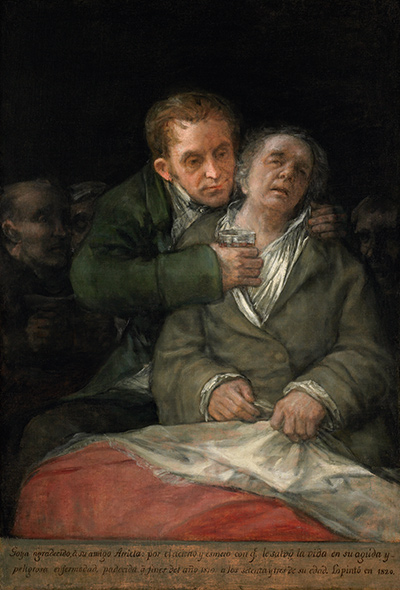
 by Tom Gurney
Tom Gurney BSc (Hons) is an art history expert with over 20 years experience
Published on June 19, 2020 / Updated on November 20, 2026
Email: tomgurney1@gmail.com / Phone: +44 7429 011000
Introduction
“There are no rules in painting” is one of Francisco de Goya’s best-known lines. He wrote it in 1792 as a teacher answering a request from the Royal Academy of San Fernando. In the same report, he discussed when pupils should learn perspective and how a teacher could correct their work. Years earlier, writing to his friend Martín Zapater, he had imagined the two of them passing the time drinking chocolate, with twenty-three reales in his pocket. The report and the letter were written in Spanish for readers who knew Goya in very different capacities. [1] [2] [3]
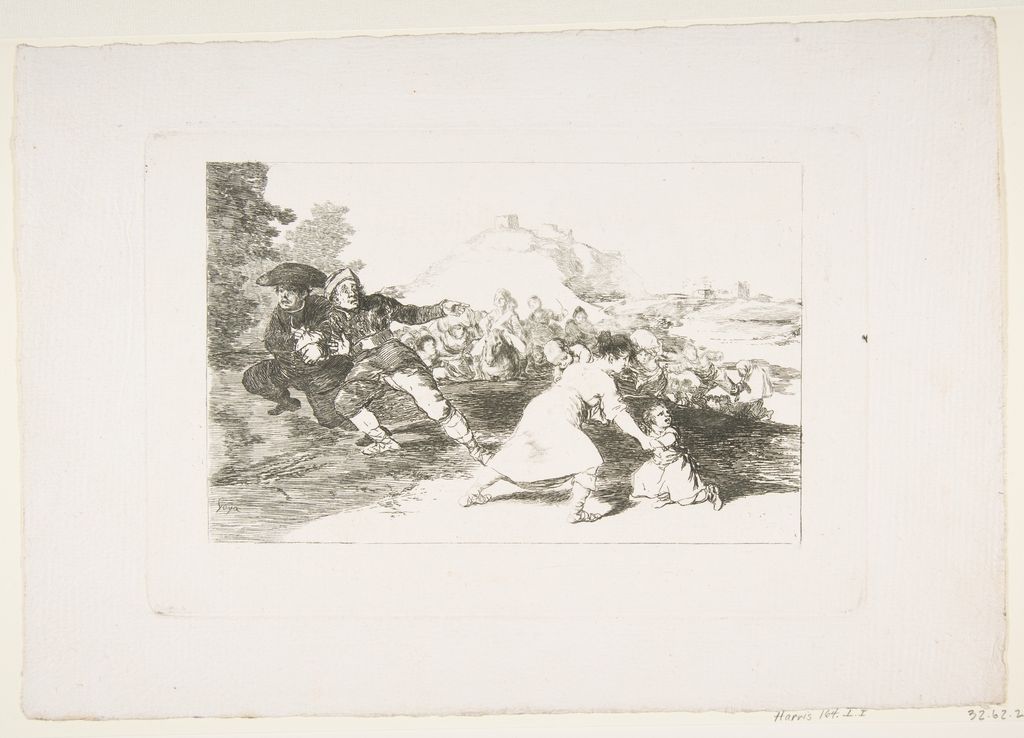
There are also words that Goya gave his prints. In The Sleep of Reason Produces Monsters, the inscription takes up the front of the desk on which the sleeper rests his head. In I Saw It, a caption beneath the image asks us to read a scene of people fleeing as something a witness could have seen. The paper, the position of the words and the date of the impression help establish what each phrase could have meant to its first readers. English translations of the historical excerpts below were prepared for this article. [4] [5]
At a Glance
- “I am as contented as the happiest man on earth.”Private letter from Madrid to Martín Zapater, 11 March 1786. [1]
- “There are no rules in painting.”Report on teaching for the Royal Academy of San Fernando, 14 October 1792. [1] [3]
- “Caprice and invention”Letter accompanying a set of cabinet pictures sent to Bernardo de Iriarte, 4 January 1794. [1]
- “The Sleep of Reason Produces Monsters”Text printed within the design of Plate 43 of Los Caprichos, published in 1799. [4]
- “I Saw It”Caption on Plate 44 of The Disasters of War, first published in 1863. [5]
Letters to Martín Zapater
“More powerful enemies”
In a letter dated to 9 January 1779, Goya told Zapater that he had shown four pictures to the king, the prince and the princess. Their pleasure in the work allowed him to kiss their hands, an honour he told his friend he had never had before. Then he turned the letter back towards the pleasures of the countryside. He was beginning, he wrote, to have “enemigos mayores y con mayor encono”, or “more powerful enemies, and more bitter ones too”. The letter gives us his apprehension on the heels of the success he had just described, without naming the people he had in mind. Its opening is more dismissive. Asked about a small sketch Zapater owned, Goya credited Francisco Bayeu with the invention and himself with the execution, then made a joke about how little it was worth. [1]
The Museo de Zaragoza preserves an autograph letter from July 1780 in which Goya needed Zapater’s help with a house. He was moving his family to Zaragoza to paint the Regina Martyrum dome at El Pilar. His household list included a print of Our Lady of the Pillar, five chairs, a frying pan, a wineskin, a small guitar, a roasting spit and a lamp. He was discussing where he would live and what he would need, and he ended by asking Zapater to pass on greetings to their friend Goicoechea. The letter shows the kind of practical arrangements these friends could make by post. At the Museo Lázaro Galdiano, letters from a later group, dated between 1783 and 1789 (inv. 15648-6), preserve drawings among the handwritten lines. Some refer to the two men’s interest in hunting. [6] [7]
Chocolate and twenty-three reales
On 20 October 1781, Goya told Zapater that his friend’s letters made him want to leave and join him. He imagined drinking chocolate together, spending his twenty-three reales in peace and finding in that company “la mayor dicha del mundo”, or “the greatest happiness in the world”. Then he imagined the two of them turning into idlers and admitted that twenty-three reales might be rather little for such happiness. The Prado preserves the letter, written with a pen in iron-gall ink on laid paper. Its account identifies the picture keeping Goya in Madrid with his work for San Francisco el Grande. Goya also mentioned a picture of the Virgin that Zapater had commissioned, and regretted that the expense of hunting kept him from going out himself. [1] [2]
Portraits and hunting at Arenas
“I have just returned from Arenas and am very tired,” Goya wrote on 20 September 1783. The place was Arenas de San Pedro, where he had been staying with the Infante Don Luis, brother of Charles III. Goya told Zapater that His Highness had heaped honours on him and that he had painted portraits of Don Luis, his wife, their son and their daughter to unexpected acclaim. He also reported a joke the infante had made about how keen this painter was on hunting. By the end of the account, an invitation to return and the exhausting speed of the carriage home have joined the news about the portraits. The letter describes the 1783 visit. The large family group painting now at the Fondazione Magnani Rocca is associated with his return the following year. [1] [8]
“As contented as the happiest man on earth”
On 11 March 1786, Goya wrote to Zapater from the Academy. After mentioning a possible trip to Valencia and the gun that remained with the gunsmith, he urged his friend to take care of himself. For all his work, and counting his bank shares and Academy income, Goya said he had only twelve or thirteen thousand reales a year. Then came “estoy tan contento como el más feliz”, or “I am as contented as the happiest man on earth”. Immediately afterwards he said that so many people were calling him over to correct work that he scarcely knew how he was managing to write. The exact sum makes the line sound like an account of his finances. The interruptions and his concern for Zapater make it an account of what his life felt like on a working day. [1]
“I had established an enviable way of life for myself,” he wrote on 1 August 1786. He recalled that he had stopped waiting in antechambers. People who wanted his work came to him, and he said he accepted commissions from people of high standing or at a friend’s request. His choice of tense matters. He was describing his position before the news of his appointment as a painter to the king, which he reported had come as a surprise. The new duties included supplying paintings for the tapestry factory and undertaking other royal work. What sounds on its own like a declaration of independence appears in the middle of a letter about how his obligations had just changed. The letter begins with an overturned carriage and a swollen ankle. [1]
What survives when a letter is quoted
The letter of 20 October 1781 has an addressee, a date and a physical existence in the Prado collection. Those details can be as consequential as an unusual run of words. Knowing that Goya was writing to Zapater helps a reader decide how much of a remark makes sense as shorthand between two people. The surviving sheet can also help distinguish Goya’s spelling from a modern editor’s normalised version. English quotations often come through translation, where small differences in the implied person or tone can make a brief line seem more or less like a general maxim. [2] [16]
Compare this form of writing with the inscription on the Prado’s drawing called Los Zanganos de las Brujas. The words join a pictorial invention and can be examined in place. They address somebody who has the scene in front of them. A line of that kind can survive independently in a list of sayings, but the image supplies some of the relationships that make the joke or disturbance intelligible. On the drawing, marks of handwriting and marks of representation are physically near one another. A transcription separates them for convenience. [2] [16]
A practical reading of a quotation begins by allowing for those different uses. A dated letter is read against the relationship with the recipient. An album inscription is read against the scene and the surrounding drawings where their order is recoverable. Testament and petition belong to still different conventions. The words Goya was willing to put to a public authority can carry a different kind of emphasis from the words to a friend. Each record puts narrower, more useful limits on what a short English sentence can tell us about his views. [2] [16]
The inscription of a living or named person can reach a reader differently from a publication title chosen after Goya’s death. Printed inscriptions form unusually good points of reference when they can be checked on a securely identified impression. Modern translations of a series title have their own history and may prioritise search or recognition. The same is true of catalogue expansions that identify a scene formerly known by one or two words. For a usable quotation, it is worth asking whether the wording was supplied by the hand, the first publisher or a later cataloguer. Each possibility establishes a different relationship to the artist’s voice. [2] [16]
Goya on film
Five films explore Goya’s portraits, prints, Black Paintings and painting techniques.
The Duke of Wellington by Goya
The portrait, its military decorations and its later theft.
Watch on YouTube“There are no rules in painting”
Goya dated his report on the teaching of art 14 October 1792. The Academy had asked its members to say how study could be improved. “No hay reglas en la Pintura” means “there are no rules in painting”. The sentence goes on to specify the obstacle he had in mind. Compelling young painters to study or follow a single path could hinder them in an already difficult art. He objected to mechanical prescriptions and to fixing in advance when students should learn geometry and perspective. Difficulties encountered in drawing would give a pupil a reason to learn them. [1] [3]
Goya’s example was the Italian painter Annibale Carracci. He credited Carracci with allowing pupils of very different dispositions to develop their own styles, while still offering corrections directed towards truthful representation. When he challenged the ranking of Greek statues above nature, he asked where even the finest statue got its forms. He thought that a pupil who relied on plaster models at the expense of observation risked producing monotonous work. The report closes with tasks for the Academy. It can recognise able teachers, give promising artists protection and opportunities, and let students develop in the direction their gifts suggest. Goya had become an academician in 1780 after submitting Christ Crucified. The biography follows his work within the institution before and after the report. [1] [3]
“Caprice and invention” after illness
On 4 January 1794, Goya addressed Bernardo de Iriarte, the Academy’s vice-protector, with all the formality the position called for. Recovering from a serious illness, Goya had been painting a group of small cabinet pictures. He said that the work occupied his imagination while he was preoccupied with his suffering and could help recover some of the expense of his illness. It also gave him a chance to make observations for which commissioned work ordinarily offered little scope. His words for what needed room were “el capricho y la invención”, or “caprice and invention”. He asked Iriarte to look first and lend the pictures his protection when they went before the Academy’s painters. [1] [9]
The Academy’s minutes for 5 January record eleven pictures of various subjects. On 7 January, Goya thanked Iriarte for the reception and described a picture still in progress. It showed two naked men fighting in the yard of an institution while their keeper struck them. Goya said he had witnessed the scene in Zaragoza and intended to send the finished picture to complete the group. That description helped identify the painting now known as Yard with Lunatics in the Meadows Museum. The two letters supply different evidence. The first explains why he painted the group and what it gave him room to try. The second singles out a particular subject and says where he had seen it. [1] [9]
Words on the prints
The sleep of reason and the work of imagination
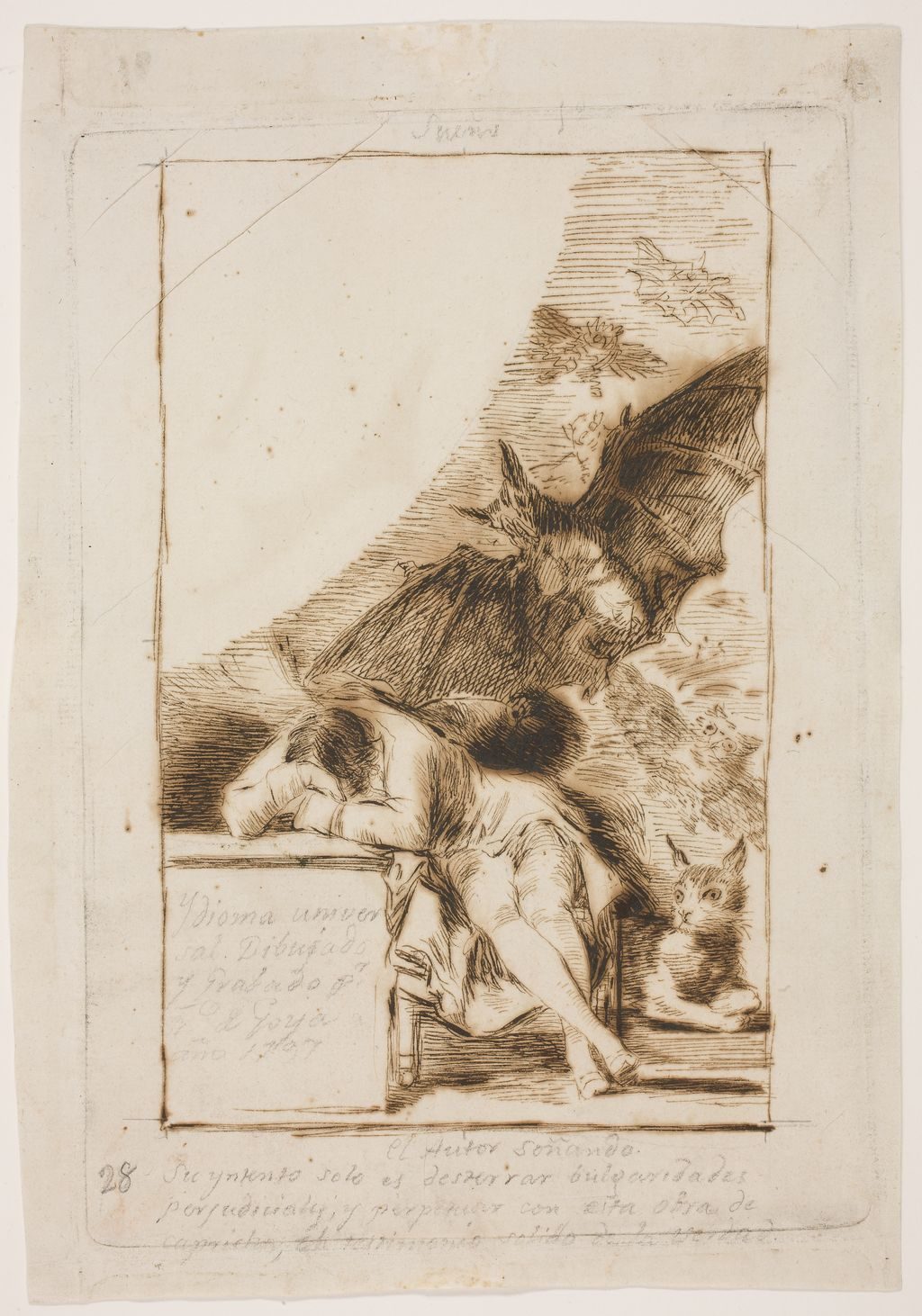
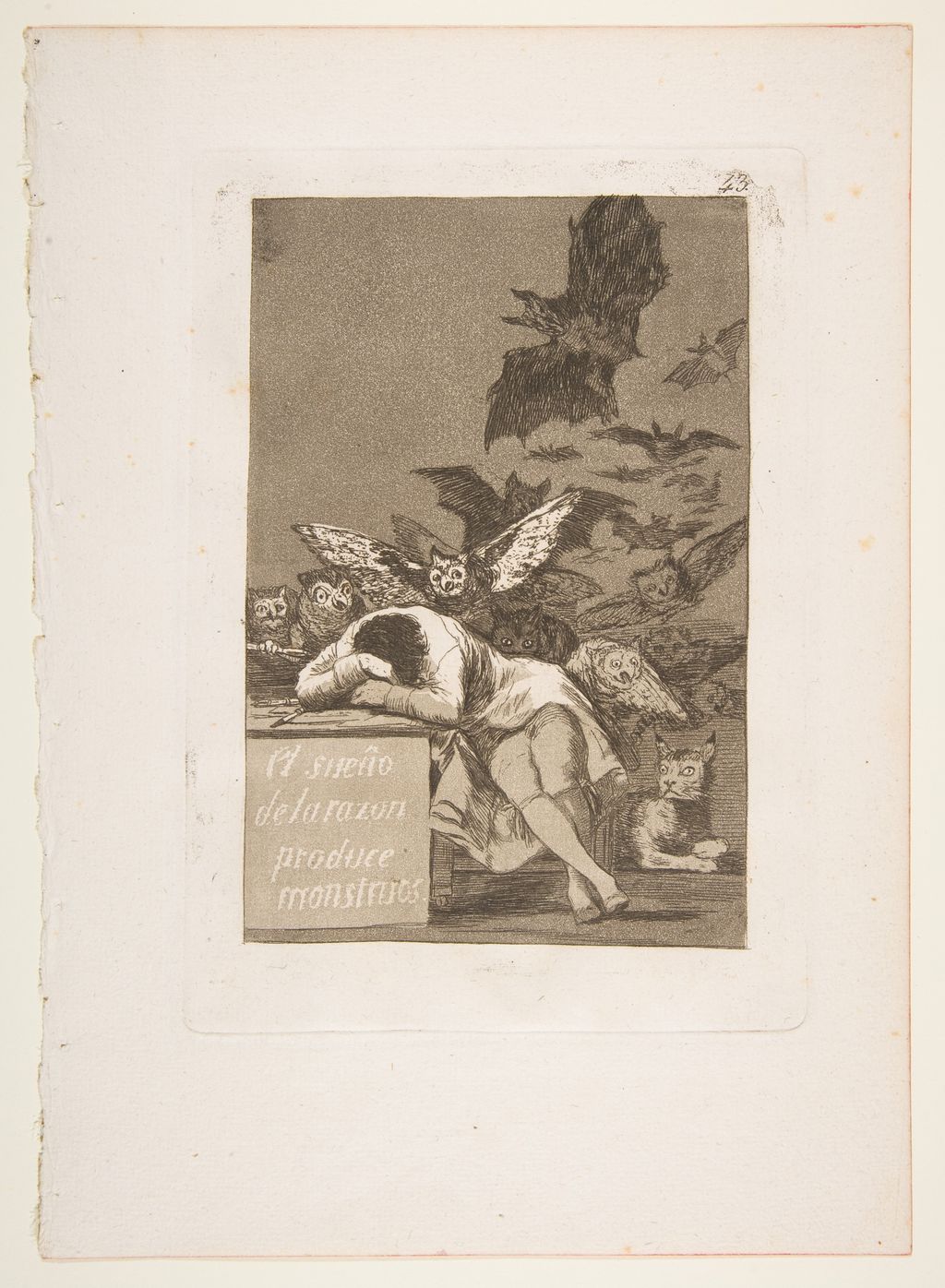
On the Met’s impression 18.64(43), “El sueño de la razon produce monstruos” runs across the front of the desk. The line is part of the scene, sharing the space below the sleeping figure with the folds of his clothes and the animals pressing towards him. In Spanish, sueño can mean sleep or a dream. “The Sleep of Reason Produces Monsters” makes the line sound like a warning about reason going dormant. The picture leaves open the possibility that the creatures also belong to the sleeper’s dream. In the preparatory drawing known as Universal Language, the handwritten inscription explicitly presented the figure as the dreaming author. The printed image became Plate 43, while a self-portrait opened the published Los Caprichos. [4] [10]
The longer saying about fantasy abandoned by reason comes from the manuscript commentary held at the Prado. It says that imagination abandoned by reason produces impossible monsters and that, joined to reason, imagination is the mother of the arts and the source of marvels. The Ayala commentary offers a shorter version, while the Biblioteca Nacional manuscript reads the scene as what happens when people fail to heed reason. In the Prado version, imagination makes art possible when it works with reason. The printed phrase has room for that reading, and readers who see only the plate have to arrive at it through the relation between the sleeper, the inscription and the creatures. [11]
“La pintura (como la poesía)”, or “Painting, like poetry”, opens a passage in a different document, the notice advertising the series in the Diario de Madrid of 6 February 1799. The Spanish heading identifies the prints as Goya’s, and the announcement describes how a painter might assemble traits scattered among many people into a single invented character. It is an explanation that readers could have seen at the time of publication. The notice speaks of the artist in the third person and has no signature. The Museo de Huesca suggests someone in Goya’s circle may have composed it. The passage belongs to the public announcement for the prints, with its precise authorship open. [12] [13]
“I saw it”
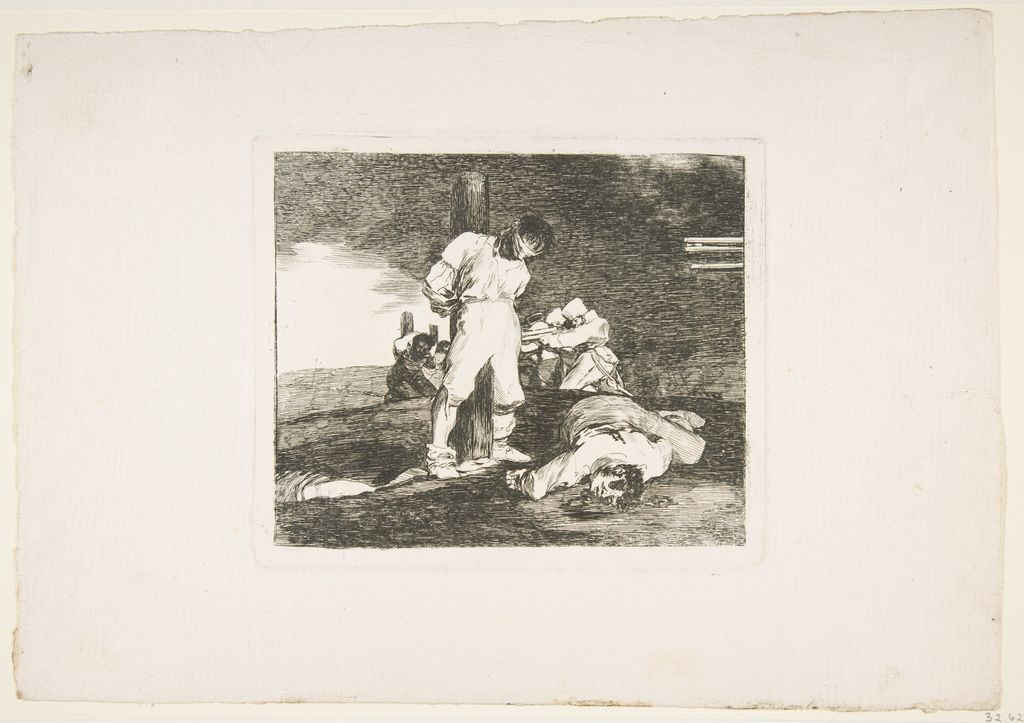
On the Academy’s 1863 first-edition impression R-3550-1, the line “Yo lo vi” appears under a scene of civilians fleeing. Spanish can leave the subject pronoun out of a sentence. Here yo gives “I” particular emphasis. The Metropolitan Museum of Art holds a proof before lettering, 32.62.2. A viewer of that sheet sees the haste of the people crossing it, while a reader of the printed caption also hears a first-person claim. There is no place name or date in the caption, and the museum describes possible occasions when Goya could have encountered such a flight. The first edition of The Disasters of War appeared decades after his death. The force of the first person survives that separation between the events, the making of the plate and the arrival of a public edition. [5] [14]
Artworks directory
| Name | Date | Medium |
|---|---|---|
| And There’s No Help for It, Plate 15 | Printed 1863 | |
| Asmodea | c. 1820–23 | Wall painting transferred to canvas |
| Boys Inflating a Bladder | 1777–78 | Tapestry cartoon |
| Boys Picking Fruit | 1778 | Tapestry cartoon |
| Bullfight in a Divided Ring | 1825 | Lithograph |
| Card Players | 1777–78 | Tapestry cartoon |
| Card Players (sketch) | 1777–78 | Painted sketch |
| Dance on the Banks of the Manzanares | 1777 | Tapestry cartoon |
| Duel with Cudgels | c. 1820–23 | Wall painting transferred to canvas |
| Heads in a Landscape | c. 1820–23 | Easel painting |
| Judith and Holofernes | c. 1820–23 | Wall painting transferred to canvas |
| Leocadia | c. 1820–23 | Wall painting transferred to canvas |
| Maja and Cloaked Men | 1777 | Tapestry cartoon |
| Maja and Cloaked Men (sketch) | 1777 | Painted sketch |
| Majo Clapping in Time to the Music | 1777 | Drawing |
| Men Reading | c. 1820–23 | Wall painting transferred to canvas |
| Out Hunting for Teeth, Plate 12 | 1799 | Etching, burnished aquatint and burin |
| Picnic in the Countryside (sketch) | 1776–78 | Painted sketch |
| Picnic on the Banks of the Manzanares | 1776 | Tapestry cartoon |
| Pilgrimage to San Isidro | c. 1820–23 | Wall painting transferred to canvas |
| Preparatory study for The Sleep of Reason Produces Monsters | c. 1796–97 | Drawing |
| Procession of the Holy Office | c. 1820–23 | Wall painting transferred to canvas |
| Quarrel at the Cockerel Inn (sketch) | 1777 | Painted sketch |
| Quarrel in the New Tavern | 1777 | Tapestry cartoon |
| Saturn Devouring His Son | c. 1820–23 | Wall painting transferred to canvas |
| Seated Majo Smoking | c. 1776 | Drawing |
| The Dog | c. 1820–23 | Wall painting transferred to canvas |
| The Drinker | 1777 | Tapestry cartoon |
| The Fates | c. 1820–23 | Wall painting transferred to canvas |
| The Great He-Goat | c. 1820–23 | Wall painting transferred to canvas |
| The Kite | 1777–78 | Tapestry cartoon |
| The Parasol | 1777 | Oil on canvas, tapestry cartoon |
| The Second of May 1808 | 1814 | Oil on canvas |
| The Sleep of Reason Produces Monsters, Plate 43 | 1799 | Etching and aquatint |
| The Third of May 1808 | 1814 | Oil on canvas |
| Thou Who Canst Not, Plate 42 | 1799 | Etching and burnished aquatint |
| Three Figures | 1776 | Drawing (lost) |
| Two Old Men | c. 1820–23 | Wall painting transferred to canvas |
| Two Old Men Eating Soup | c. 1820–23 | Wall painting transferred to canvas |
| Two Women and a Man | c. 1820–23 | Wall painting transferred to canvas |
| Universal Language: The Author Dreaming | 1797 | Drawing |
| The Family of Charles IV | 1800 | Oil on canvas |
| Witches’ Sabbath (Osuna painting) | 1797–98 | Oil on canvas |
| The Nude Maja | 1795–1800 | Oil on canvas |
| The Clothed Maja | 1800–07 | Oil on canvas |
| Self-Portrait (Drawing) | c. 1796 | Brush and carbon black ink on laid paper |
| The Swing, Madrid Album B.21 | 1795–97 | Brush and carbon black washes |
| Majas Fighting, a Majo Observing, Madrid Album B.15 | 1796–97 | Brush, grey and black washes on laid paper |
| Majos and Majas Conversing, Madrid Album B.16 | c. 1794–97 | Ink wash on paper |
| Weeping Woman and Three Men, Madrid Album B.17 | 1795–97 | Brush, carbon black washes and black chalk |
| Maja Seated on a Chair and Two Companions Behind, Madrid Album B.18 | 1795–97 | Brush and carbon black washes |
| Girl and Bull, Madrid Album B.23 | 1796–97 | Brush and carbon black washes |
| Lovers Sitting on a Rock, Madrid Album B.24 | 1796–97 | Brush and carbon black washes |
| Mariano Ceballos Riding a Bull | 1825 | Crayon lithograph and scraper |
| Landscape (lifetime impression) | c. 1807–10 | Etching and aquatint |
| Self-Portrait (1815), Prado canvas | 1815 | Oil on canvas |
| Self-Portrait (1815), Academy panel | 1815 | Oil on panel |
| Self-Portrait with Dr Arrieta | 1820 | Oil on canvas |
| Christ Crucified | 1780 | Oil on canvas |
| The Last Communion of Saint Joseph of Calasanz | 1819 | Oil on canvas |
| Christ on the Mount of Olives | 1819 | Oil on panel |
| The Flower Girls, or Spring | 1786–87 | Oil on canvas |
| The Grape Harvest, or Autumn | 1786–87 | Oil on canvas |
| The Snowstorm, or Winter | 1786–87 | Oil on canvas |
| The Threshing Ground, or Summer | 1786–87 | Oil on canvas |
| Picnic on the Banks of the Manzanares | 1776 | Oil on canvas |
| The Kite | 1777–78 | Oil on canvas |
| Dance on the Banks of the Manzanares | 1777 | Oil on canvas |
| A Fight at the Venta Nueva | 1777 | Oil on canvas |
| Blind Man’s Bluff | 1788 | Oil on canvas |
| Dogs on a Lead | 1775 | Oil on canvas |
| Hunting with a Decoy | 1775 | Oil on canvas |
| Hunter Loading His Rifle | 1775 | Oil on canvas |
| The Angler | 1775 | Oil on canvas |
| The Hermitage of San Isidro on His Feast Day | 1788 | Oil on canvas |
| The Meadow of San Isidro | 1788 | Oil on canvas |
| The Straw Manikin | 1791–92 | Oil on canvas |
| Witches’ Flight | c. 1797–98 | Oil on canvas |
| A Scene from ‘The Forcibly Bewitched’ | 1798 | Oil on canvas |
| The Duchess of Alba in Black | 1797 | Oil on canvas |
| The Duchess of Alba in White | 1795 | Oil on canvas |
| Charles III in Hunting Dress | c. 1786 | Oil on canvas |
| The Duke and Duchess of Osuna and Their Children | 1787–88 | Oil on canvas |
| Manuel Osorio Manrique de Zúñiga | 1787–88 | Oil on canvas |
| The Marquesa de Pontejos | c. 1786 | Oil on canvas |
| Equestrian Portrait of the 1st Duke of Wellington | 1812 | Oil on canvas |
| The Duke of Wellington | 1812–14 | Oil on wood |
| Portrait of Ferdinand VII of Spain | 1814 | Oil on canvas |
| Gaspar Melchor de Jovellanos | 1798 | Oil on canvas |
| María Tomasa Palafox y Portocarrero | 1804 | Oil on canvas |
| Señora Sabasa García | c. 1806–11 | Oil on canvas |
| Don Juan Bautista de Muguiro | 1827 | Oil on canvas |
| Doña Isabel de Porcel | Before 1805 | Oil on canvas |
| The Colossus | After 1808 | Oil on canvas |
| The Burial of the Sardine | 1808–12 | Oil on panel |
| The Madhouse | 1808–12 | Oil on panel |
| A Procession of Flagellants | 1808–12 | Oil on panel |
| Portrait of Jacques Galos | 1826 | Oil on canvas |
| Portrait of Mariano Goya, the Artist’s Grandson | 1827 | Oil on canvas |
| Milkmaid of Bordeaux | c. 1827 | Oil on canvas |
| Portrait of Don Juan Antonio Cuervo | 1819 | Oil on canvas |
| María Luisa of Parma (Naples version) | c. 1800 | Oil on canvas |
| The Countess of Baena | 1819 | Oil on canvas |
| The Family of the Infante Don Luis | 1783–84 | Oil on canvas |
| The Holy Family | c. 1787 | Oil on canvas |
| Saint Barbara | c. 1773 | Oil on canvas |
| Saints Justa and Rufina | 1817 | Oil on canvas |
| El Tío Paquete | c. 1819–20 | Oil on canvas |
| The Forge | c. 1815–20 | Oil on canvas |
| Majas on a Balcony (Metropolitan Museum version) | c. 1800–10 | Oil on canvas |
| Maja and Celestina on a Balcony | c. 1808–12 | Oil on canvas |
| The Water Bearer | 1808–12 | Oil on canvas |
| Time and the Old Women | c. 1810 | Oil on canvas |
Frequently Asked Questions
Laurent Matheron’s 1858 biography quotes Goya in the French words “Je n’ai eu d’autres maîtres […] que la nature, Velazquez et Rembrandt.” In English, “I had no other masters than nature, Velázquez and Rembrandt.” Matheron says he saw a note written for a catalogue. His published account is evidence for the history of the saying, with the original note and its date still unverified here. It is safest to credit the wording to Goya as reported by Matheron. [15]
The Prado and the Museo de Zaragoza catalogue individual handwritten letters. The Museo Lázaro Galdiano catalogues a group addressed to Zapater. Ángel Canellas López’s Diplomatario gathers transcripts of writings by Goya and documents concerning him. Its entry numbers let a reader locate individual letters even when the originals are in separate collections. [1] [2] [6] [7]
Discussion
Look again at the images and ideas explored in Goya’s words. These editorial prompts invite your observations.
How does “there are no rules in painting” sound once you know that Goya wrote it in response to a question about teaching? Which detail changes your reading more, his account of one painter correcting his students or the moment when he turns to the difficulties a pupil encounters in drawing?
Reader Insights
Which statement changes most when you read it in its original setting?
How does reading the phrase on a print differ from reading it in a letter?
Join the Conversation
Share a detail, comparison or question about Goya’s words below.
References
- Ángel Canellas López, ed., Francisco de Goya. Diplomatario. Registro nos. 25, 54, 72, 106, 109, 184, 188–189 and Cartulario no. LXXIV. View source.
- Museo Nacional del Prado, autograph letter to Martín Zapater, 20 October 1781. View source.
- Museo Nacional del Prado, ¿Solo Goya?, section 3.1, excerpts from the report on teaching. See also La Academia y Goya, Real Academia de Bellas Artes de San Fernando. View source 1. View source 2.
- The Metropolitan Museum of Art, The Sleep of Reason Produces Monsters, 18.64(43). View source.
- Calcografía Nacional, Yo lo vi, first-edition impression R-3550-1. View source.
- Museo de Zaragoza, autograph letter to Martín Zapater, July 1780, facsimile and transcription. View source.
- Museo Lázaro Galdiano, autograph letters to Martín Zapater, inv. 15648-6. View source.
- Banco de España, 2328 reales de vellón. Goya y los orígenes de la Colección Banco de España, on the visits to Arenas in 1783 and 1784. View source.
- Fundación Goya en Aragón, Yard with Lunatics, identification from the letter of 7 January 1794. View source.
- Fundación Goya en Aragón, Universal Language (First Dream), preparatory drawing, Prado D03923. View source.
- Fundación Goya en Aragón, El sueño de la razón produce monstruos, with the Ayala, Prado and Biblioteca Nacional manuscript readings. View source.
- Museo Lázaro Galdiano, first edition of Los Caprichos, transcribing the notice of 6 February 1799. View source.
- Museo de Huesca, Goya en el Museo de Huesca, on Los Caprichos and authorship of the notice. View source.
- The Metropolitan Museum of Art, I Saw It, proof before lettering, 32.62.2. View source.
- Laurent Matheron, Goya (1858), University of Michigan copy. View source.
- Museo Nacional del Prado, Los Zanganos de las Brujas. View source.







