


 by Tom Gurney
Tom Gurney BSc (Hons) is an art history expert with over 20 years experience
Published on June 19, 2020 / Updated on November 20, 2026
Email: tomgurney1@gmail.com / Phone: +44 7429 011000
Introduction
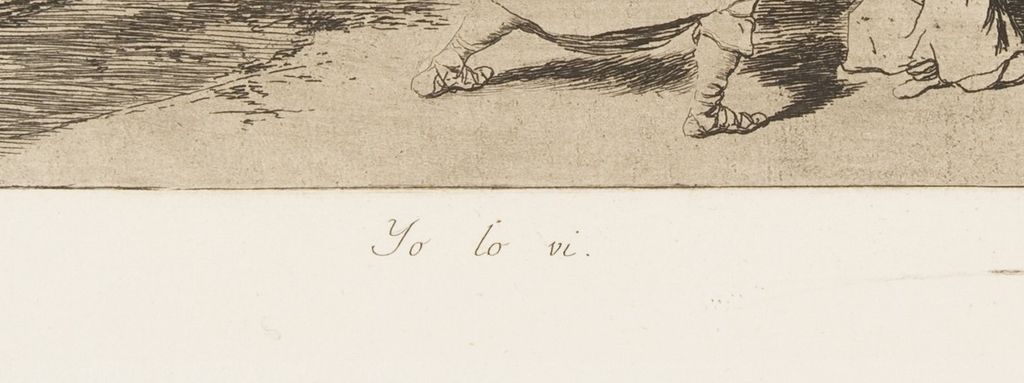
People are fleeing in Yo lo vi, Plate 44 of Francisco de Goya’s The Disasters of War. A man in the foreground moves away and turns his head back. A woman bends to gather a child close, while the people further away have already dwindled into a crowd. The threat itself lies beyond the frame. The title means ‘I saw it’, but in the Metropolitan Museum of Art’s proof, the space below the image is still free of printed lettering. A reader of the published print meets both an image of flight and a voice that insists on having been there. [1]
The Peninsular War lasted from 1808 to 1814. The invasion and occupation by Napoleonic France, the conflict within Spain and the return of Ferdinand VII supplied Goya with subjects that outlasted the fighting. The National Gallery of Victoria and Prado exhibition dates the series to around 1810–15, while the National Museum of Western Art in Tokyo allows for work up to around 1820. Tokyo’s catalogue notes dated plates from 1810 and considers whether some later images respond to political developments as late as 1820. The war, the making and arrangement of the prints, and their public appearance belong to three different timelines. [2] [3] [4]
The Royal Academy of Fine Arts of San Fernando published Los desastres de la guerra in Madrid in 1863, thirty-five years after Goya’s death. That first edition contained eighty numbered prints. The lifetime proof album associated with Goya’s friend Juan Agustín Ceán Bermúdez also includes two additional compositions, now known as Plates 81 and 82, and three small etchings of prisoners. The two additional compositions belong to the eighty-two ordinarily discussed as the series today. The prisoners have a place in the history of the album as related prints. [3] [4] [5] [6]
A way into the series is to follow where Goya puts the reader. In Plate 44 we are among those trying to get away. Elsewhere a few rifle barrels enter the frame beside a bound man, or a person holds a cup to the lips of somebody too weak to sit up. Late in the series we find ourselves at the burial of a woman called Truth. The distance between these situations makes sense when the prints are read in order. The immediate threat to a body gives way to what happens when a city goes hungry, then to what people can say or hope for after a war ends. [1] [7] [6] [8]
At a Glance
- ArtistFrancisco de Goya (1746–1828). [1]
- Working datesBegun by 1810. The NGV–Prado dating is about 1810–15, while some catalogues extend the range to about 1820. [2] [3]
- SubjectThe Peninsular War of 1808–14, the Madrid famine of 1811–12 and the political and religious reaction after the war. [5] [6]
- MediumIntaglio prints from copperplates, generally made with etching and a varying combination of aquatint, lavis, drypoint, burin or burnishing. [6] [9]
- First editionEighty prints, published by the Royal Academy of Fine Arts of San Fernando in Madrid in 1863. [5]
- Lifetime albumProofs now at the British Museum, 1975,1025.421.1–87, including the compositions numbered 81 and 82 and the three related prisoner etchings. [4] [6]
Violence and the limits of witnessing
‘I saw it’ says remarkably little about the people in Plate 44. It gives them no names and leaves the place, the danger and the outcome unstated. The Met describes the sheet it holds as a proof before lettering and treats the eventual caption as a claim to the authenticity of the scene. The museum suggests that Goya might have witnessed comparable flight around the time of the second French assault on Zaragoza in late 1808 or while living outside Madrid in 1812. The print puts the reader in the company of civilians, where information about the danger is as incomplete as the bits of luggage they have managed to carry. The man looking back makes us curious about what remains behind them. The cluster of adults and children makes their difficulty in getting away more pressing than the identity of the pursuers. [1]
The next print, Plate 45, is Y esto también (‘And this too’). The words sound like a response from the same person who has just spoken. Both captions ask the reader to act on very little information. The first puts an ‘I’ into the encounter and the second asks us to establish what ‘this’ refers to by looking again, at a different scene. The second caption needs the first for its full effect. Matilla observes that related images and titles sometimes form short runs within the broader groups, and that even the two sets of numbers on the plates leave Goya’s full criteria for ordering them uncertain. [12] [27]
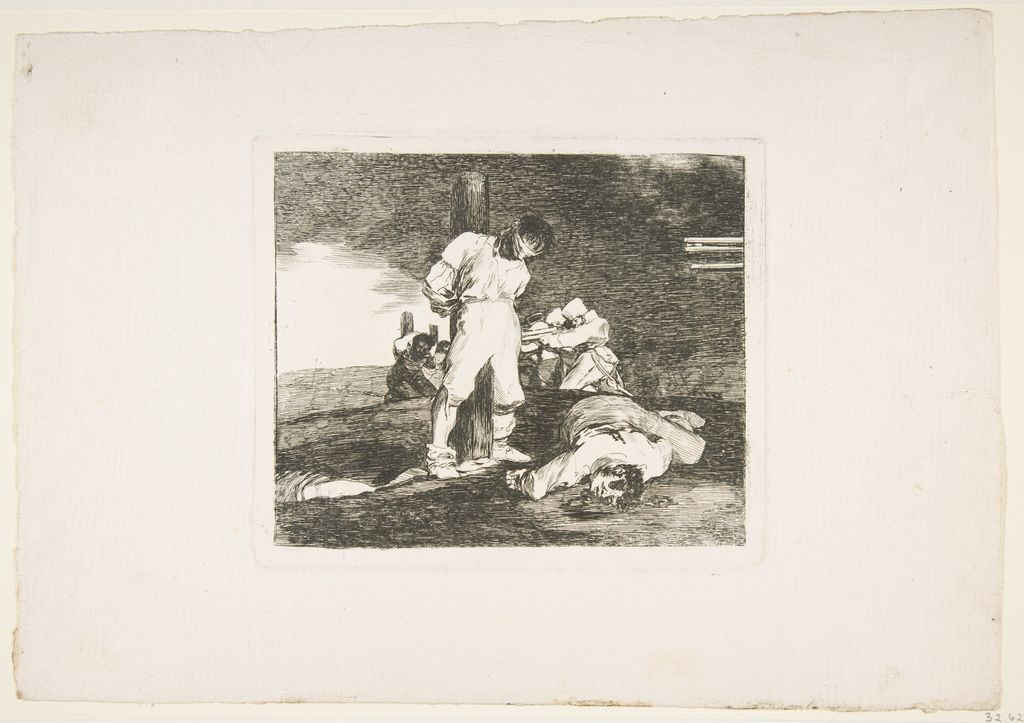
Plate 15, Y no hay remedio (‘And there is no remedy’), puts that uncertainty to a different use. A blindfolded man stands tied to a post. The muzzles of the guns enter from the right, though the men holding them are beyond the edge. A fallen figure lies in the foreground. Small figures and guns in the distance show another execution taking place. The near man, isolated against a largely open area, has nowhere to go, while the gap between him and the background action measures the repetition of the same procedure. The figure at ground level leaves little doubt about the outcome for the man at the post. The initial ‘And’ makes the caption sound like the continuation of an earlier thought, even if this is the first print the reader has opened. [7] [10]
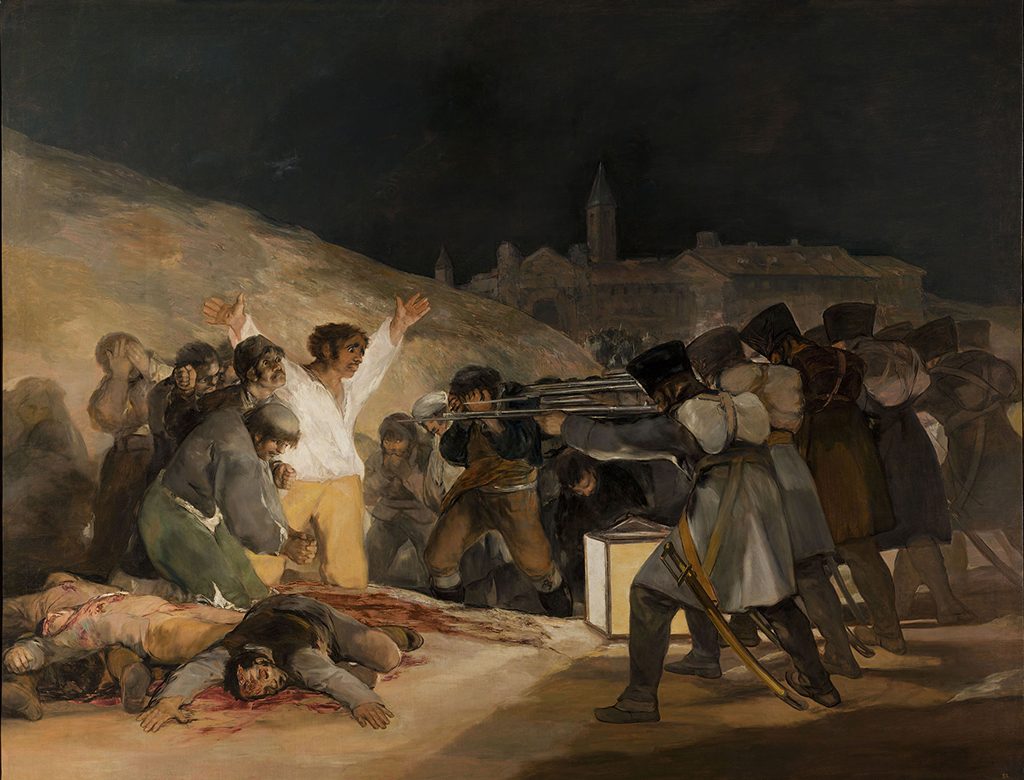
In The Third of May 1808, Goya gives the firing squad a substantial part of the canvas. The soldiers’ backs and shoulders make a mass behind the tightly aligned rifles. As in Plate 15, the victim and the viewer receive little access to individual soldiers’ faces. The painting’s lantern lights a cluster of waiting men and bodies already on the ground. The print achieves a comparable compression of events by repeating the execution on a smaller scale at the back and cutting off the nearest riflemen. Turning to The Second of May 1808 brings another change of scale and direction. Combatants in the street canvas press against each other and spill towards the edges. Plate 44 gives the space to people making their way out. Together these views show how much depends on whether Goya positions us amid a fight, before a gun or in the path of a frightened crowd. [10] [11] [1]
Atrocity in the series has agents. José Manuel Matilla points to violence perpetrated across the conflict, and to Goya’s decision to bypass the repertory of recognised military and popular heroes. In Plate 7, Que valor! (‘What courage!’), a woman has climbed over fallen men and reaches for the cannon. The NGV–Prado exhibition catalogue associates the figure with Agustina de Aragón, remembered for defending Zaragoza. Her back is turned and the bodies at her feet occupy much of the foreground. Even when a viewer recognises a celebrated episode, the foreground makes the cost of the action physically present. That relationship between action and injury carries over to prints whose subjects remain anonymous. [11] [12] [4]
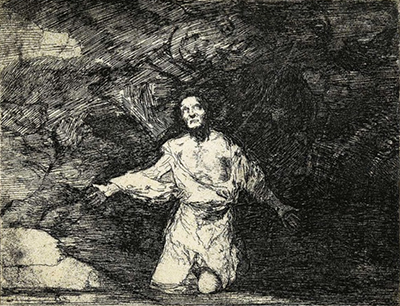
The chronology of composition crosses the printed order from the outset. The Met dates the making of Plate 1, Tristes presentimientos de lo que ha de acontecer, to around 1815 and its own impression to 1863. The man kneeling with open hands occupies the foreground alone. The Met relates the pose to Christ in Gethsemane and the sheet’s gathering darkness to the dread of what is about to happen. Someone beginning at Plate 1 encounters that dread before the violence of Plates 2 to 47, even though the Met relates its design and technique to the late allegories. The opening gives the reader an expectation the subsequent plates can repeatedly fulfil in different ways. [12] [29]
Annotated Details from I Saw It, Plate 44 from The Disasters of War
Follow the people moving across Plate 44, then look below the image at the handwritten caption. This is the Met impression, 22.60.25(44).
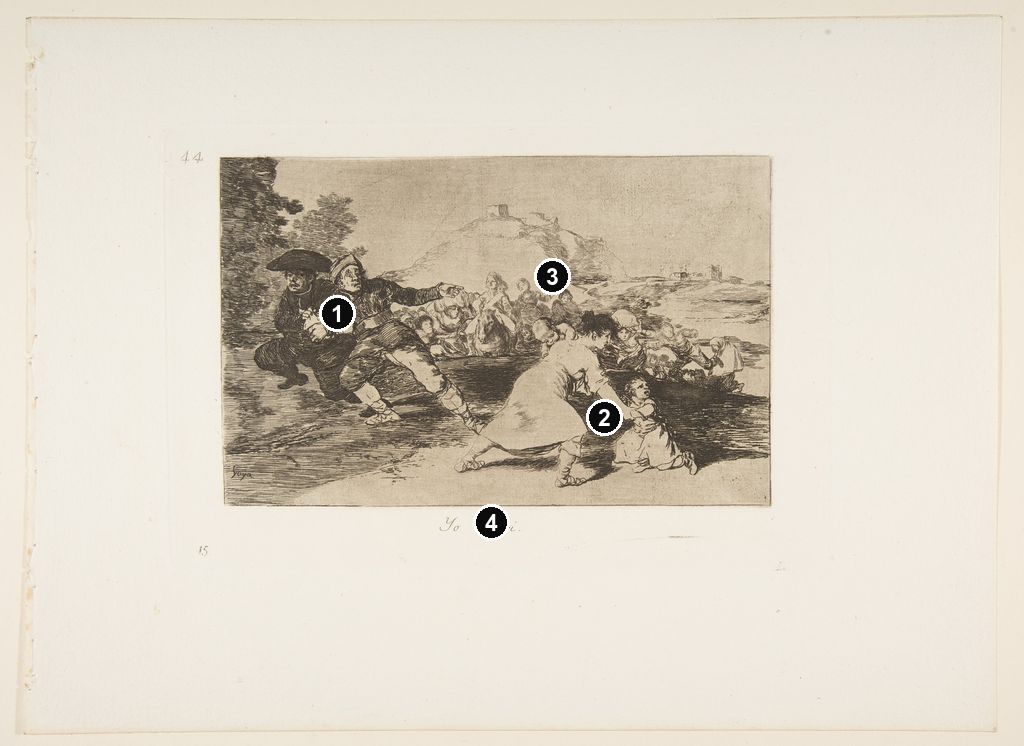
Details from I SAW IT, PLATE 44 FROM THE DISASTERS OF WAR
Every detail uses the same sheet. The full view retains its margins, including the numbers and handwritten caption.
Figures below the trees
The thick marks near the trees darken the figures at the left edge. Clearer ground beside them lets their steps and gestures read against the crowd.
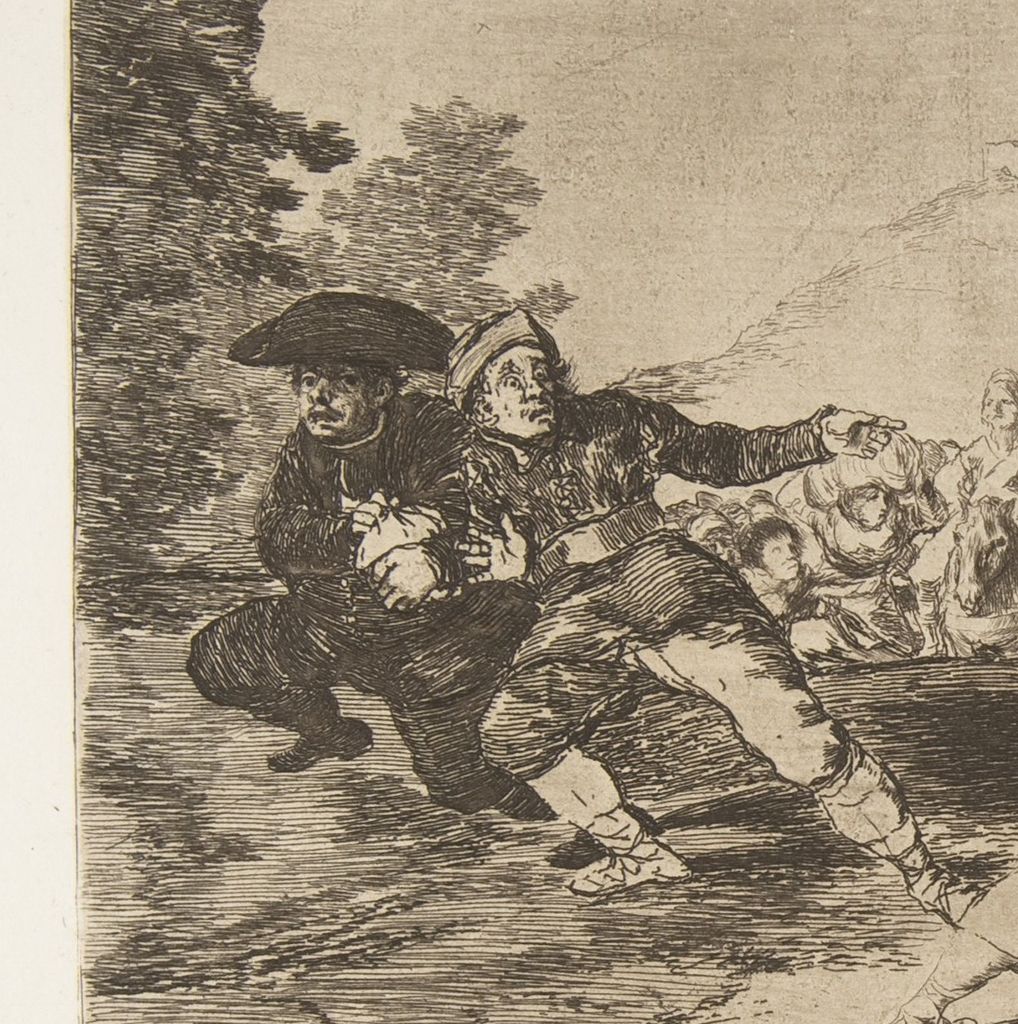
Figures in the foreground
The two nearer figures are larger and more distinct than the crowd behind them. The adult’s stretch toward the smaller figure links their movements across the slope.
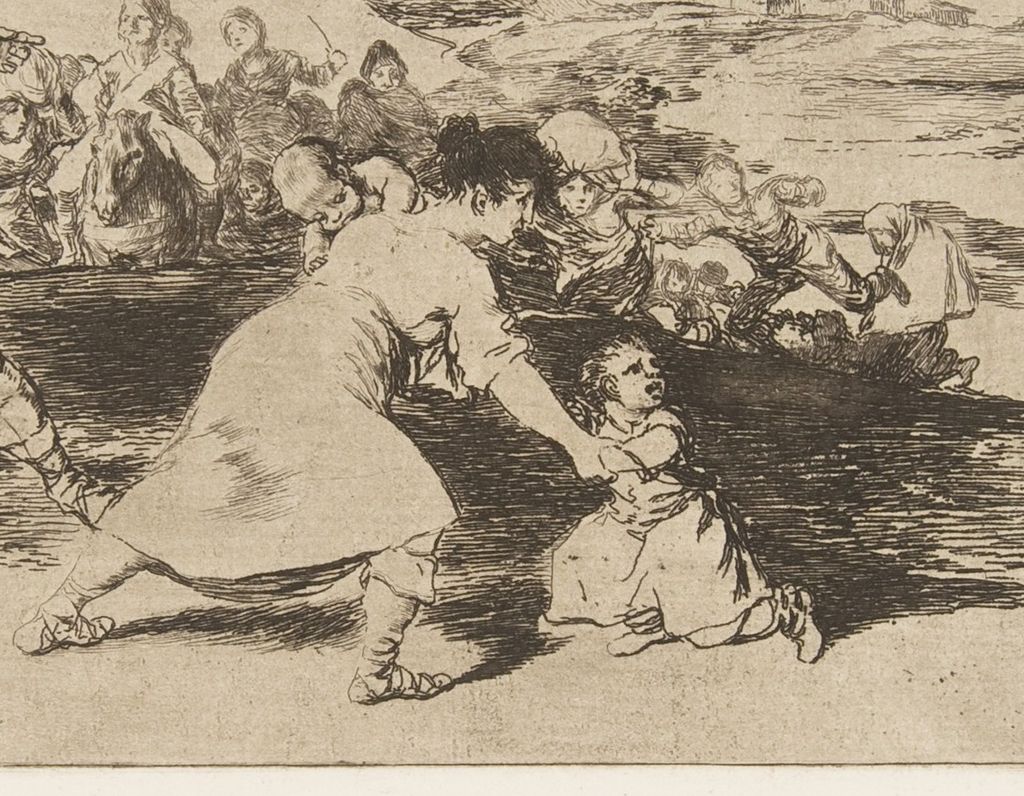
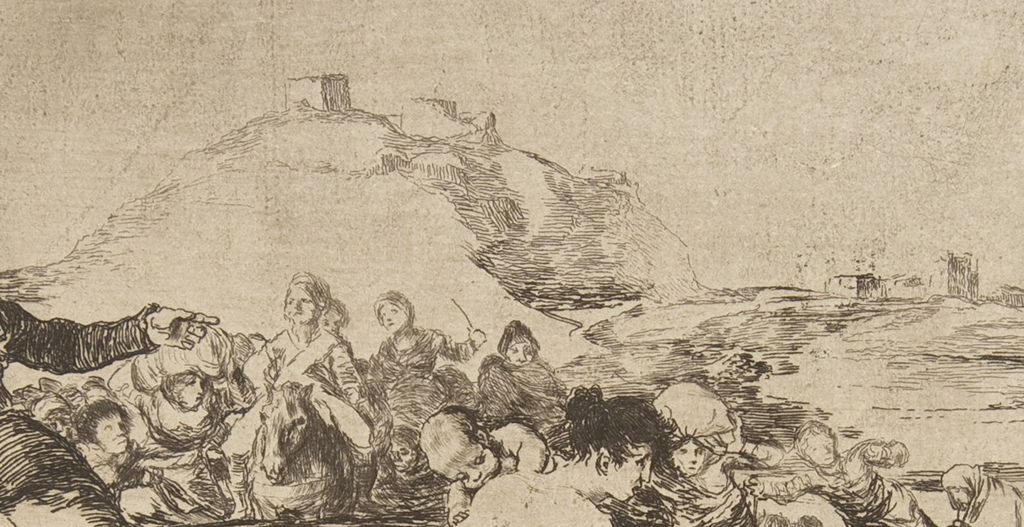
From the crowd to the distant hill
Marks thin and lighten towards the hill. The nearer and farther groups remain connected even as the print leaves more space between them.
What the sheet says below the image
The words Yo lo vi sit beneath the image. The margin makes the space between the pictured action and the handwritten claim visible.
What a cup can do
In the Madrid famine of 1811–12, the injuries of war became visible in places where there was no battle. Plates 48 to 64 concentrate on hunger and its consequences, following people through begging, illness and burial. These are often urban scenes, but architecture can be reduced to a few edges or a background division. The foreground is for people waiting for something to eat, trying to help somebody else or approaching others who have the means to pass them by. The Met attributes the Madrid famine to failed crops, abandoned fields and breaks in the food supply. [28] Recent experience gave those situations a setting. The prints give many of their inhabitants only a garment, a posture or a gesture by which to recognise them. [5] [6] [12]
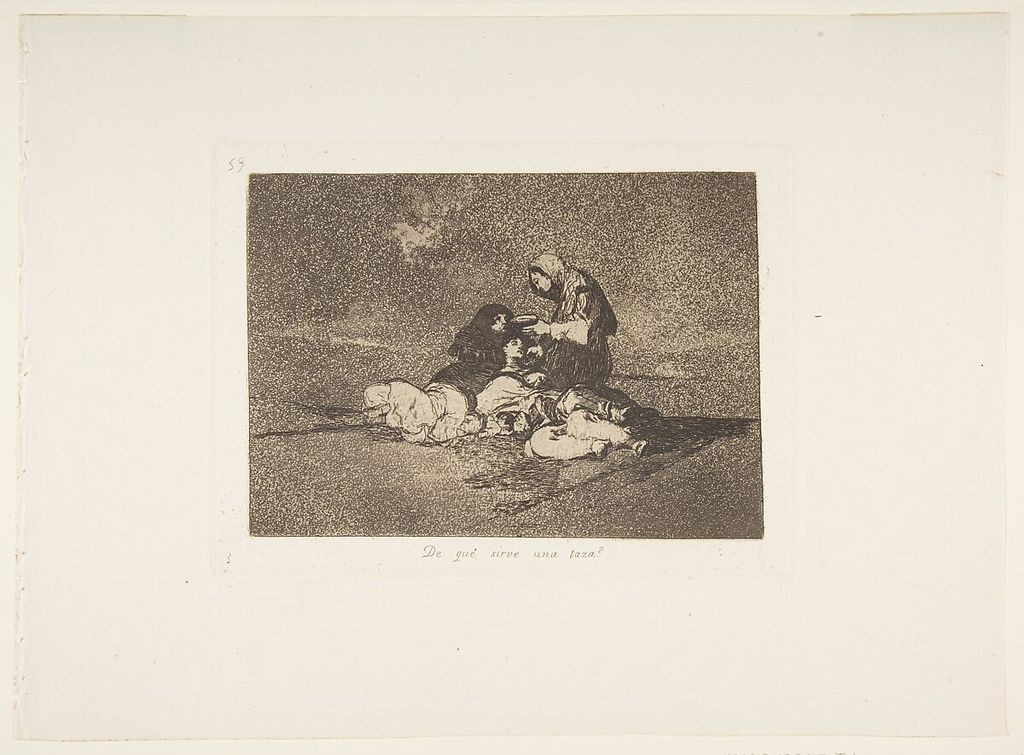
¿De qué sirve una taza? (‘What good is a single cup?’), Plate 59, puts a small object between a kneeling woman and two people on the ground. Her arm stretches across towards the face of the woman nearest her. The gesture is tentative enough that we look first at the cup and then for some response in the recipient’s face or hands. The back of the person giving help is broad compared with the thin forms beside her. We can see the effort involved in bringing the cup within reach, and how little evidence there is that the person receiving it can use it. By letting the title ask about one cup, Goya keeps the act of charity in view and makes its adequacy doubtful at the same time. [6]
The first-edition impression at Museum Boijmans Van Beuningen, DN 529/92 (PK), is an etching with aquatint, lavis and burnishing, with plate tone on wove paper. The museum singles the plate out for its working sequence. Goya treated the plate with aquatint before adding the etched lines and making highlights through burnishing. The broad field of tone belongs to the way the picture was made. Against it, the cup and the contact between the figures occupy a modest area of the sheet. A line can carry the eye from shoulder to hand, but the grey around that line lets us register how isolated the group is. This is one reason to look at a complete impression, where the hesitation of that small gesture survives in relation to the rest of the picture. [6] [26]
An appeal takes a different shape in Plate 54, Clamores en vano (‘Appeals are in vain’). Compare the Banco de España’s first-edition impression, G_2754_54. Figures on the ground and a woman pleading from low down are set against people equipped to remain upright and move on. The Fundación Goya en Aragón identifies the departing couple as a French official and a young woman, reading their bearing as indifference to the starving people. Their place on the far side of the encounter matters even before we try to identify them. The print makes physical distance available to those who have the strength and means to walk past. The cup-bearer in Plate 59 closes a gap the upright figures in Plate 54 can maintain. [12] [13]
There is an interval between harm and visible effect in these plates. An execution image can put the source of danger and its victim in the same view, even if the riflemen barely feature. The famine prints can show someone too weak to lift a cup while leaving the economic and military conditions that brought her there outside the frame. Plate 54 restores a kind of agency to the setting through the decision to pass by. Plate 59 puts capacity and need in the same small space. Read together, the images turn the question ‘Who did this?’ towards the choices available to people who still have something to give. [6] [12] [13]
Goya on film
Five films explore Goya’s portraits, prints, Black Paintings and painting techniques.
The Duke of Wellington by Goya
The portrait, its military decorations and its later theft.
Watch on YouTubeThe emphatic caprices
With Plate 65 the album moves into a sustained run of images in which Goya gives political and moral questions visible bodies. Scholars commonly call them the ‘emphatic caprices’, a phrase that appears on the manuscript title page. Ferdinand VII’s return in 1814 brought the repudiation of the liberal Constitution of 1812, the restoration of absolutist rule and the reinstatement of the Inquisition. The exhibition organised by the NGV and the Prado reads the later images in relation to that repression. These compositions often preserve the bodily weight and cramped spaces of the earlier scenes, even when the participants now include animals, monsters or personifications. [2] [4] [5]
The corpse in Plate 69 props itself up enough to write Nada (‘Nothing’). Shadow crowds around the body, with faces and what may be a figure of Justice holding scales difficult to make out. The Fundación Goya en Aragón describes how the scales and their bearer are clearer in an early proof, then become harder to distinguish as Goya adds aquatint. The altered visibility affects what the reader has to go on. In Yo lo vi a person claims to have seen an event and the scene is legible even with its cause out of view. Here the figure who gives evidence is dead and the surroundings take time to make out. The word within the image seems unusually plain for a scene that makes so much of what we can barely see. [1] [14] [15]
The Biblioteca Nacional de España transcribes the manuscript caption on the Ceán proof as Nada. Ello lo dice (‘Nothing. It says so’), while the Fundación Goya en Aragón gives the slightly different transcription Nada. Ello dice…. Both records distinguish the present tense of the manuscript from the Academy edition’s Nada. Ello dirá (‘Nothing. It will tell’), which can be seen on the Met’s published impression. The word written within the image stays the same. Underneath it, a statement about what the evidence now says becomes a statement about what will be known later. The change permits a different reading of the same scene. The Fundación discusses readings that range from disillusion with the political settlement to scepticism about an afterlife. The body and its testimony sustain more than one of those questions. [14] [15] [16]
The light becomes conspicuously brighter around a woman in Plate 79, Murió la verdad (‘Truth has died’). The caption gives a name to the young woman being buried. A mitred figure towers above her and the mourner near her feet holds a hand to her face. Compare this sheet with Plate 80, Si resucitará? (‘Will she rise again?’). The Met reads the images as successive moments in one scene, with the woman showing signs of life in the second print as those around her react. The published sequence leaves us with the question. Even the burst of light around her may seem precarious when we look at who still surrounds her. There is a change of voice between the two captions as well as a change in the picture, since a declaration about the past gives way to a question about the future. [8] [17] [18]
The Ceán album lets the reader turn two more times. Plate 81, ¡Fiero monstruo! (‘Fierce monster!’), piles human bodies beneath the open jaws of an enormous beast. Plate 82, Esto es lo verdadero (‘This is the true thing’), brings a woman and a man together in a rural setting where a tool and the produce of the land are part of what the eye registers. The University of Zaragoza discusses the importance of agriculture in the image. The last sheet can suggest a future in which people have the means to live, especially after the images of hunger. A reader of the Academy’s 1863 edition would have put the book down at a different point, with the fate of Truth still formulated as a question. [5] [6] [19] [20]
Reading an early plate beside a plate from the ending
Try reading the first design and the concluding group as parts of a single object. The man kneeling in the first picture seems to address an event still to come. His body is low and the gestures of appeal are legible before there is any certainty about what has produced them. There are later prints where a group gathers around a recumbent figure identified with Truth. The body can be looked at or awaited, but it gives the people around it little power of action. The sequence starts by having somebody foresee events and reaches an ending in which the possibility of restoration remains open. [31] [29]
A numbered album also gives the reader the chance to return. A head bent beside a motionless body may first recall a particular execution or episode of famine. In the later images such postures can operate without a fully specified event. The succession of plates has already taught the eye how to recognise exposure, exhaustion or grief before the allegorical captions call on it again. The direction goes both ways. After the last group, the opening kneeling figure can look less like a witness to one occurrence than like an introduction to the act of awaiting disaster itself. [31] [29]
The 1863 album record is important here because it puts ownership of an edition, rather than a single work of art, into view. Museums also hold individual sheets which a reader may encounter outside this order. The album lets the reader test visual echoes at a distance of many pages. Individual impressions allow much closer scrutiny of a single scratched line or a passage of tone. Both formats can illuminate Goya’s decisions as long as the titles and numbering on a particular group of sheets are kept distinct from the order in which the copperplates were made. [31] [29]
The numbering itself can carry an argument. An impression of the opener gives access to what survived on that sheet, including its title and place at the head of a series. The National Gallery’s entry for an album records the order as an edition. A reader can use the headings, numbers and published titles to move between bodies of work that might otherwise simply be called Goya’s war images. Those controls matter especially for the last plates, where personification gives an image of truth or revival a place after images tied more directly to the deprivation of particular people. [31] [29]
From drawing to proof to edition
Goya began many compositions on paper before working on copper. The Prado’s preparatory drawing for Plate 57, Sanos y enfermos (‘The healthy and the sick’), D004258, is in red chalk on bluish laid paper. It measures 166 by 218 millimetres and bears the number 24 at the lower left. The Fundación Goya en Aragón describes the left of the sheet as more fully worked than the right. Much of the distinction between near and far is already present as a difference in how much attention the figures receive from the chalk. In the printed composition the contrast becomes more specific. The cloaked figure bends towards a child, a seated figure’s ribs are visible and the people behind them are given less definition. The caption lends the bodies a distinction that the room itself may render temporary. [21] [22]
The Academy’s catalogue identifies British Museum 1975,1025.421.59, the impression in the Ceán album, as a state before the lettering. The Fundación records the caption as handwritten on the album impression. A comparable pre-lettering proof catalogued by the Bibliothèque nationale de France is separately identified as being before the number as well. The BnF lists its medium as etching, burnished aquatint, burin and burnisher, and measures the printed area at 157 by 206 millimetres. Each record describes its own piece of paper. A title written by hand below one impression is evidence of a decision about the words. It also shows a stage at which they could still be changed without touching the copper. [22] [23] [24]
On the Academy’s first-edition impression, R-3563-1, the caption is printed below the image. The sheet is wove paper with a José García Oseñalde watermark, and the plate mark measures 157 by 209 millimetres. The catalogue records the technique there as etching, aquatint, burin and burnishing. It also records both the number 57 and the smaller number 5. It provisionally associates the lower numbering with Goya and the upper numbering with Ceán Bermúdez. The 24 on the Prado drawing is a separate mark on a different object. Even within this small group of objects, we can encounter three numbers attached to what we recognise as the same composition. The upper-left 57 identifies its position in the sequence published in 1863. [21] [23]
The copperplate, catalogue M-3563, is the matrix that could be inked and pressed against paper many times. When a printmaker changes the matrix, subsequent impressions show a new state. The same state can yield impressions on different papers, with variation in inking, wiping and condition. Etching produces lines where acid bites through exposed areas in a protective ground. Aquatint uses a grain to create areas of tone, and lavis can give tonal effects through the direct application of acid. Drypoint and burin put marks into the copper with tools, while a burnisher can lighten a passage by smoothing the worked metal. Goya could combine several of these operations on a single plate. He could also work both sides of the copper. The Met connects its impression of Amarga presencia (Plate 13) with a separate print, Landscape with Buildings and Trees. The landscape plate was cut in two, and one of the pieces was worked on the back to make Plate 13. The Met suggests copper shortage as a possible reason. [30] Plate 59 begins with tone, and the darker later state of Plate 69 shows how further work on tone could also subdue a figure already present. See Goya’s etchings and Goya’s prints for the wider context of those choices. [3] [6] [14] [23]
Plate 15 shows how an image and its caption can have different histories too. The Fundación records additions to its early state in drypoint and burin. It also identifies the proof caption in the Ceán album as handwritten. In Princeton’s first-edition impression, 2011-86, the title appears in its printed historical spelling, Y no hai remedio. The small change readers see in a modern catalogue title, from hai to hay, belongs to transcription or modernisation. For a question about what a particular sheet says, the letterforms under the image count for more than the standard name at the top of the catalogue page. [7] [10]
How the series reached its readers
The manuscript title in the Ceán album begins Fatales consequencias de la sangrienta guerra en España con Buonaparte and continues with Y otros caprichos enfáticos. It names Bonaparte, describes a bloody war in Spain and makes room in the same volume for another kind of image. The title page itself announces eighty prints, even though the album preserves the additional two compositions and the three related prisoner etchings. Giving the set to Ceán made it possible for someone else to read across those different subjects in an arranged sequence during Goya’s lifetime. The survival of the album gives us evidence for that circulation and for the wording of individual captions. [4] [5] [6]
The NGV–Prado catalogue suggests that the political force of the concluding satires may help explain the absence of a lifetime edition. Boijmans also points to the political situation. With the liberals repressed and the role of the Church and state questioned in several plates, there is a plausible reason for caution. The album documents a gift to a friend. The evidence for why Goya took the work as far as proofing and arrangement without issuing a public edition is less direct. [4] [5] [6]
The Calcografía Nacional traces the matrices to Goya’s Quinta del Sordo after his departure for France. The Academy acquired eighty copperplates in 1862 and published their impressions in 1863. The shorter title, Los desastres de la guerra, appeared on the Academy’s printed title page, with its name and emblem. The publishers broadly followed the order and captions preserved in the Ceán album, with specific changes such as the wording on Plate 69. The Museo de Bellas Artes de Álava’s first-edition set, inventory 3435, represents the issue after corrections to some of the engraved lettering. The wording and impressions can therefore differ even among sheets labelled ‘first edition’. [5] [6] [9] [16]
In 1870 the French print scholar Paul Lefort donated the copperplates for 81 and 82 to the Academy. In his catalogue he described finding the missing plates and explained why he considered Plate 82 a philosophical conclusion to the later images. His reading is evidence of how much the newly recovered ending mattered to one nineteenth-century reader. The first edition, the lifetime album and later impressions from the recovered coppers consequently tell related histories. When a museum brings the plates together in facsimile or on screen, checking the date and accession number below each image lets us see which part of that history the displayed impression represents. [6] [9] [25]
Artworks directory
| Name | Date | Medium |
|---|---|---|
| And There’s No Help for It, Plate 15 | Printed 1863 | |
| Asmodea | c. 1820–23 | Wall painting transferred to canvas |
| Boys Inflating a Bladder | 1777–78 | Tapestry cartoon |
| Boys Picking Fruit | 1778 | Tapestry cartoon |
| Bullfight in a Divided Ring | 1825 | Lithograph |
| Card Players | 1777–78 | Tapestry cartoon |
| Card Players (sketch) | 1777–78 | Painted sketch |
| Dance on the Banks of the Manzanares | 1777 | Tapestry cartoon |
| Duel with Cudgels | c. 1820–23 | Wall painting transferred to canvas |
| Heads in a Landscape | c. 1820–23 | Easel painting |
| Judith and Holofernes | c. 1820–23 | Wall painting transferred to canvas |
| Leocadia | c. 1820–23 | Wall painting transferred to canvas |
| Maja and Cloaked Men | 1777 | Tapestry cartoon |
| Maja and Cloaked Men (sketch) | 1777 | Painted sketch |
| Majo Clapping in Time to the Music | 1777 | Drawing |
| Men Reading | c. 1820–23 | Wall painting transferred to canvas |
| Out Hunting for Teeth, Plate 12 | 1799 | Etching, burnished aquatint and burin |
| Picnic in the Countryside (sketch) | 1776–78 | Painted sketch |
| Picnic on the Banks of the Manzanares | 1776 | Tapestry cartoon |
| Pilgrimage to San Isidro | c. 1820–23 | Wall painting transferred to canvas |
| Preparatory study for The Sleep of Reason Produces Monsters | c. 1796–97 | Drawing |
| Procession of the Holy Office | c. 1820–23 | Wall painting transferred to canvas |
| Quarrel at the Cockerel Inn (sketch) | 1777 | Painted sketch |
| Quarrel in the New Tavern | 1777 | Tapestry cartoon |
| Saturn Devouring His Son | c. 1820–23 | Wall painting transferred to canvas |
| Seated Majo Smoking | c. 1776 | Drawing |
| The Dog | c. 1820–23 | Wall painting transferred to canvas |
| The Drinker | 1777 | Tapestry cartoon |
| The Fates | c. 1820–23 | Wall painting transferred to canvas |
| The Great He-Goat | c. 1820–23 | Wall painting transferred to canvas |
| The Kite | 1777–78 | Tapestry cartoon |
| The Parasol | 1777 | Oil on canvas, tapestry cartoon |
| The Second of May 1808 | 1814 | Oil on canvas |
| The Sleep of Reason Produces Monsters, Plate 43 | 1799 | Etching and aquatint |
| The Third of May 1808 | 1814 | Oil on canvas |
| Thou Who Canst Not, Plate 42 | 1799 | Etching and burnished aquatint |
| Three Figures | 1776 | Drawing (lost) |
| Two Old Men | c. 1820–23 | Wall painting transferred to canvas |
| Two Old Men Eating Soup | c. 1820–23 | Wall painting transferred to canvas |
| Two Women and a Man | c. 1820–23 | Wall painting transferred to canvas |
| Universal Language: The Author Dreaming | 1797 | Drawing |
| The Family of Charles IV | 1800 | Oil on canvas |
| Witches’ Sabbath (Osuna painting) | 1797–98 | Oil on canvas |
| The Nude Maja | 1795–1800 | Oil on canvas |
| The Clothed Maja | 1800–07 | Oil on canvas |
| Self-Portrait (Drawing) | c. 1796 | Brush and carbon black ink on laid paper |
| The Swing, Madrid Album B.21 | 1795–97 | Brush and carbon black washes |
| Majas Fighting, a Majo Observing, Madrid Album B.15 | 1796–97 | Brush, grey and black washes on laid paper |
| Majos and Majas Conversing, Madrid Album B.16 | c. 1794–97 | Ink wash on paper |
| Weeping Woman and Three Men, Madrid Album B.17 | 1795–97 | Brush, carbon black washes and black chalk |
| Maja Seated on a Chair and Two Companions Behind, Madrid Album B.18 | 1795–97 | Brush and carbon black washes |
| Girl and Bull, Madrid Album B.23 | 1796–97 | Brush and carbon black washes |
| Lovers Sitting on a Rock, Madrid Album B.24 | 1796–97 | Brush and carbon black washes |
| Mariano Ceballos Riding a Bull | 1825 | Crayon lithograph and scraper |
| Landscape (lifetime impression) | c. 1807–10 | Etching and aquatint |
| Self-Portrait (1815), Prado canvas | 1815 | Oil on canvas |
| Self-Portrait (1815), Academy panel | 1815 | Oil on panel |
| Self-Portrait with Dr Arrieta | 1820 | Oil on canvas |
| Christ Crucified | 1780 | Oil on canvas |
| The Last Communion of Saint Joseph of Calasanz | 1819 | Oil on canvas |
| Christ on the Mount of Olives | 1819 | Oil on panel |
| The Flower Girls, or Spring | 1786–87 | Oil on canvas |
| The Grape Harvest, or Autumn | 1786–87 | Oil on canvas |
| The Snowstorm, or Winter | 1786–87 | Oil on canvas |
| The Threshing Ground, or Summer | 1786–87 | Oil on canvas |
| Picnic on the Banks of the Manzanares | 1776 | Oil on canvas |
| The Kite | 1777–78 | Oil on canvas |
| Dance on the Banks of the Manzanares | 1777 | Oil on canvas |
| A Fight at the Venta Nueva | 1777 | Oil on canvas |
| Blind Man’s Bluff | 1788 | Oil on canvas |
| Dogs on a Lead | 1775 | Oil on canvas |
| Hunting with a Decoy | 1775 | Oil on canvas |
| Hunter Loading His Rifle | 1775 | Oil on canvas |
| The Angler | 1775 | Oil on canvas |
| The Hermitage of San Isidro on His Feast Day | 1788 | Oil on canvas |
| The Meadow of San Isidro | 1788 | Oil on canvas |
| The Straw Manikin | 1791–92 | Oil on canvas |
| Witches’ Flight | c. 1797–98 | Oil on canvas |
| A Scene from ‘The Forcibly Bewitched’ | 1798 | Oil on canvas |
| The Duchess of Alba in Black | 1797 | Oil on canvas |
| The Duchess of Alba in White | 1795 | Oil on canvas |
| Charles III in Hunting Dress | c. 1786 | Oil on canvas |
| The Duke and Duchess of Osuna and Their Children | 1787–88 | Oil on canvas |
| Manuel Osorio Manrique de Zúñiga | 1787–88 | Oil on canvas |
| The Marquesa de Pontejos | c. 1786 | Oil on canvas |
| Equestrian Portrait of the 1st Duke of Wellington | 1812 | Oil on canvas |
| The Duke of Wellington | 1812–14 | Oil on wood |
| Portrait of Ferdinand VII of Spain | 1814 | Oil on canvas |
| Gaspar Melchor de Jovellanos | 1798 | Oil on canvas |
| María Tomasa Palafox y Portocarrero | 1804 | Oil on canvas |
| Señora Sabasa García | c. 1806–11 | Oil on canvas |
| Don Juan Bautista de Muguiro | 1827 | Oil on canvas |
| Doña Isabel de Porcel | Before 1805 | Oil on canvas |
| The Colossus | After 1808 | Oil on canvas |
| The Burial of the Sardine | 1808–12 | Oil on panel |
| The Madhouse | 1808–12 | Oil on panel |
| A Procession of Flagellants | 1808–12 | Oil on panel |
| Portrait of Jacques Galos | 1826 | Oil on canvas |
| Portrait of Mariano Goya, the Artist’s Grandson | 1827 | Oil on canvas |
| Milkmaid of Bordeaux | c. 1827 | Oil on canvas |
| Portrait of Don Juan Antonio Cuervo | 1819 | Oil on canvas |
| María Luisa of Parma (Naples version) | c. 1800 | Oil on canvas |
| The Countess of Baena | 1819 | Oil on canvas |
| The Family of the Infante Don Luis | 1783–84 | Oil on canvas |
| The Holy Family | c. 1787 | Oil on canvas |
| Saint Barbara | c. 1773 | Oil on canvas |
| Saints Justa and Rufina | 1817 | Oil on canvas |
| El Tío Paquete | c. 1819–20 | Oil on canvas |
| The Forge | c. 1815–20 | Oil on canvas |
| Majas on a Balcony (Metropolitan Museum version) | c. 1800–10 | Oil on canvas |
| Maja and Celestina on a Balcony | c. 1808–12 | Oil on canvas |
| The Water Bearer | 1808–12 | Oil on canvas |
| Time and the Old Women | c. 1810 | Oil on canvas |
Frequently Asked Questions
The Met interprets the words Yo lo vi as an assertion that the scene is rooted in actual events and identifies occasions on which Goya could have seen comparable civilian flight. The caption establishes a witness’s voice within the series. The surviving evidence leaves the precise occasion open. [1]
A plate is the worked matrix, in this case copper. Its number can also refer to the composition in the series. An impression is a sheet printed from that matrix. Look at the catalogue’s printing date and the presence of lettering, plate marks or watermarks when distinguishing a lifetime proof from an impression from a published edition. [6] [9] [23]
Discussion
Look again at the images and ideas explored in The Disasters of War. These editorial prompts invite your observations.
Look at Yo lo vi and ¿De qué sirve una taza? in published impressions before reading the words under either image. Find the detail in each that first makes you wonder about something beyond the scene. Then read the captions. Does ‘I saw it’ make you want to look where the man is looking, and does the question about the cup change where your eye rests in the second print? [27] [26]
Reader Insights
How do two captions change the way you read figures with a similar gesture?
Which visual detail in Plate 44 gives you the strongest sense of people fleeing?
Join the Conversation
Share a detail, comparison or question about The Disasters of War below.
References
- The Metropolitan Museum of Art, Yo lo vi, Plate 44, proof before lettering, 32.62.2, View source.
- National Gallery of Victoria and Museo Nacional del Prado, Goya: Drawings from the Prado Museum, exhibition overview, View source.
- National Museum of Western Art, Tokyo, What courage!, G.1993-0009, with the museum’s discussion of chronology and technique, View source.
- National Gallery of Victoria and Museo Nacional del Prado, Goya: Drawings from the Prado Museum, exhibition catalogue, sections on The Disasters of War and reading Goya, View source.
- Museo de Bellas Artes de Álava, Museotik, Los desastres de la guerra, first edition, inventory 3435, View source.
- Museum Boijmans Van Beuningen, Goya’s ‘Disasters of War’, collection essay with impressions and technical discussion, View source.
- Fundación Goya en Aragón, Y no hay remedio, Plate 15, catalogue of the composition and states, View source.
- The Metropolitan Museum of Art, Murió la verdad, Plate 79, 22.60.25(79), with commentary on Plates 79 and 80, View source.
- Calcografía Nacional, Real Academia de Bellas Artes de San Fernando, Francisco de Goya, history of the copperplate collection, View source.
- Princeton University Art Museum, Y no hai remedio, Plate 15, 2011-86, View source.
- Fundación Goya en Aragón, records of the paired paintings, The Second of May 1808 and The Third of May 1808.
- José Manuel Matilla, Banco de España, Goya: Some Reflections on Fear and Death, View essay. See also the Banco de España record for its first-edition impression of Plate 54, G_2754_54, View collection record.
- Fundación Goya en Aragón, Clamores en vano, Plate 54, catalogue and interpretation, View source.
- Fundación Goya en Aragón, Nada. Ello dirá, Plate 69, catalogue of states and interpretations, View source.
- The Metropolitan Museum of Art, Nada. Ello dirá, Plate 69, 1863 impression, View source.
- Biblioteca Nacional de España, Nada. Ello lo dice, Plate 69, catalogue entry identifying the Ceán inscription and the changed first-edition caption, View source.
- Hood Museum of Art, Dartmouth, Murio la Verdad., Plate 79, PR.991.50.1.79, View source.
- Museum Boijmans Van Beuningen, Si resucitará?, Plate 80, collection record and reproduction, View source.
- Universidad de Zaragoza, Fiero monstruo, Plate 81, BI-183, View source.
- Universidad de Zaragoza, Esto es lo verdadero, Plate 82, BI-184, View source.
- Fundación Goya en Aragón, Sanos y enfermos, catalogue record for the Prado preparatory drawing D004258, View source.
- Fundación Goya en Aragón, Sanos y enfermos, Plate 57, print catalogue and evidence for the manuscript caption, View source.
- Calcografía Nacional, Real Academia de Bellas Artes de San Fernando, Sanos y enfermos, Plate 57, first-edition impression R-3563-1, with the linked drawing, proofs and matrix, View source.
- Bibliothèque nationale de France, Sanos y enfermos, Plate 57, proof before lettering and number, FRBNF42427871, View source.
- Paul Lefort, Francisco Goya. Étude biographique et critique, suivie de l’essai d’un catalogue raisonné de son œuvre gravé et lithographié (1877), section on Les Malheurs de la guerre, View digitised book.
- Museum Boijmans Van Beuningen, De qué sirve una taza?, Plate 59, collection record and reproduction, View source.
- Banco de España, Yo lo vi, Plate 44, first edition, G_2754_44, with commentary on the adjacent Plate 45, View source.
- The Metropolitan Museum of Art, Carretadas al cementerio, Plate 64, with commentary on the 1811–12 famine, View source.
- The Metropolitan Museum of Art, Tristes presentimientos de lo que ha de acontecer, Plate 1, first edition, 22.60.25(1), View source.
- The Metropolitan Museum of Art, Amarga presencia, Plate 13, View collection record. See also Mark McDonald’s entry on Landscape with Buildings and Trees, in Recent Acquisitions: A Selection, 2014–2016, p. 53, View catalogue.
- National Gallery of Art, Los Desastres de la Guerra, 1863 edition. View source.







