


 by Tom Gurney
Tom Gurney BSc (Hons) is an art history expert with over 20 years experience
Published on June 19, 2020 / Updated on November 20, 2026
Email: tomgurney1@gmail.com / Phone: +44 7429 011000
Introduction
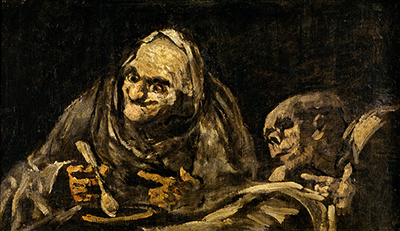
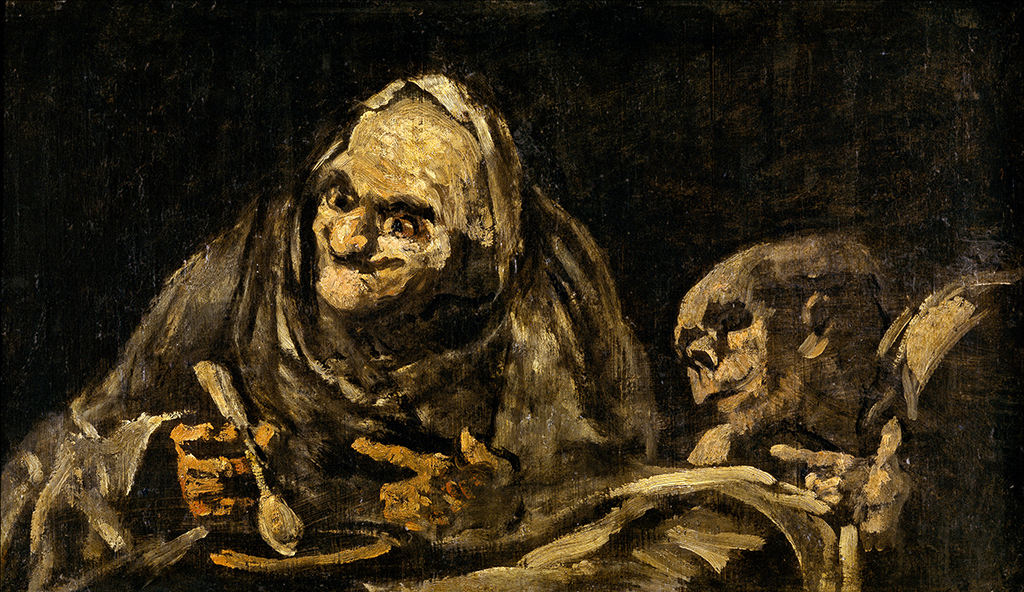
A spoon hangs over a shallow bowl. The figure holding it has turned towards something beyond the left edge of the painting, and a second face peers out from lower down on the right. There is scarcely room beneath them for the meal. Goya painted this small horizontal scene on a wall of the Quinta del Sordo, the house he owned outside Madrid. The narrow format has led several scholars to place it over a doorway. In Jean Laurent’s photograph of the mural, the diners are still surrounded by the decoration of the house. Their encounter with a visitor would have depended on which way that visitor was walking and when they looked up. [1] [2] [3]
At a Glance
Works across Goya’s career
The Parasol
1777The Nude Maja
1795–1800Saturn Devouring His Son
c. 1820–23The Dog
c. 1820–23Two Old Men Eating Soup
c. 1820–23A meal interrupted
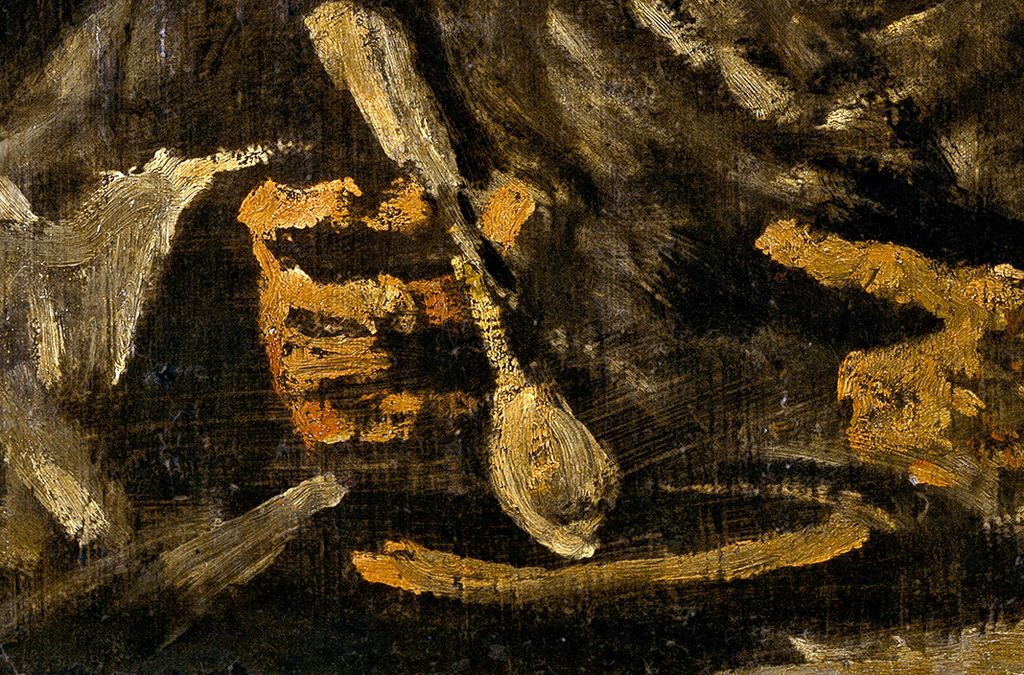
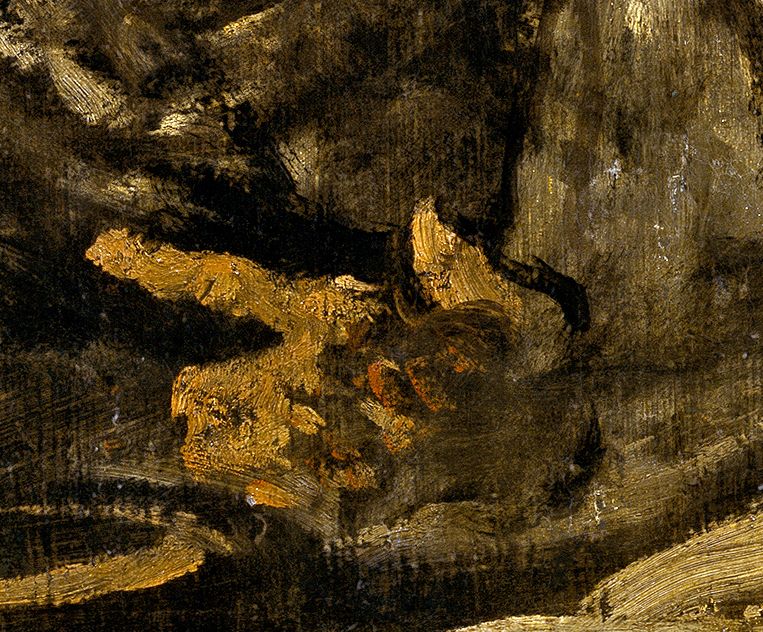
The bowl occupies a strip along the lower left, and a thin streak of ochre picks out its rim. Above it the spoon cuts diagonally through the dark. Follow the handle up and to the left to find a clenched hand, then look across to the other hand, where a finger seems to point left. The eye travels from the bowl to a face that has already turned away from it. The spoon and the finger consequently suggest two actions at once. One could finish with a mouthful, while the other directs attention out of the picture. Nothing in the painted space identifies what prompted the gesture. [1] [4]
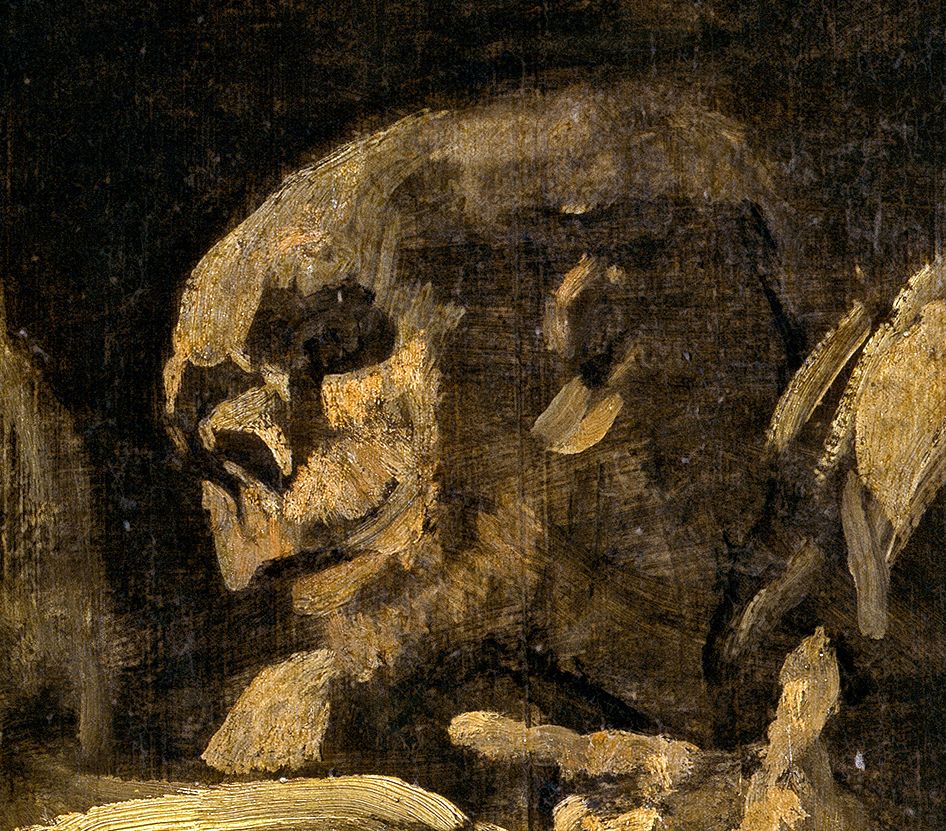
The left-hand figure fills the panel vertically. The back bends in a long slope towards the corner, and dark folds close in around the forehead and chin. The smaller head to the right barely rises above the other figure’s shoulder. A few light strokes catch its brow, cheek and jaw, with hollows at the eye and mouth that make it look skull-like. Both faces are built from patches of light and darkness, but their lighting brings out different features. The broad, high forehead and raised cheek on the left give the mouth the appearance of a grin. On the right, the gaping dark marks make the face seem less fleshy. Goya gives the pair different heights, different angles and different ways of occupying the same little space. [1] [4]
Pale, curved strokes spread across the lower right, where the Fundación Goya en Aragón reads papers in the second figure’s hands. Their marks are too loose to make out writing. If these are pages, they offer a reason for the companion to be leaning in so close. The face appears to address the diner, while the diner’s glance and gesture lead to the left. That moment leaves the relationship open. The second figure may be sharing news, intruding on the meal or drawing attention to the papers. The spoon gives the action a recognisable starting point, and the uncertain response makes it harder to tell where the action is going. [1]
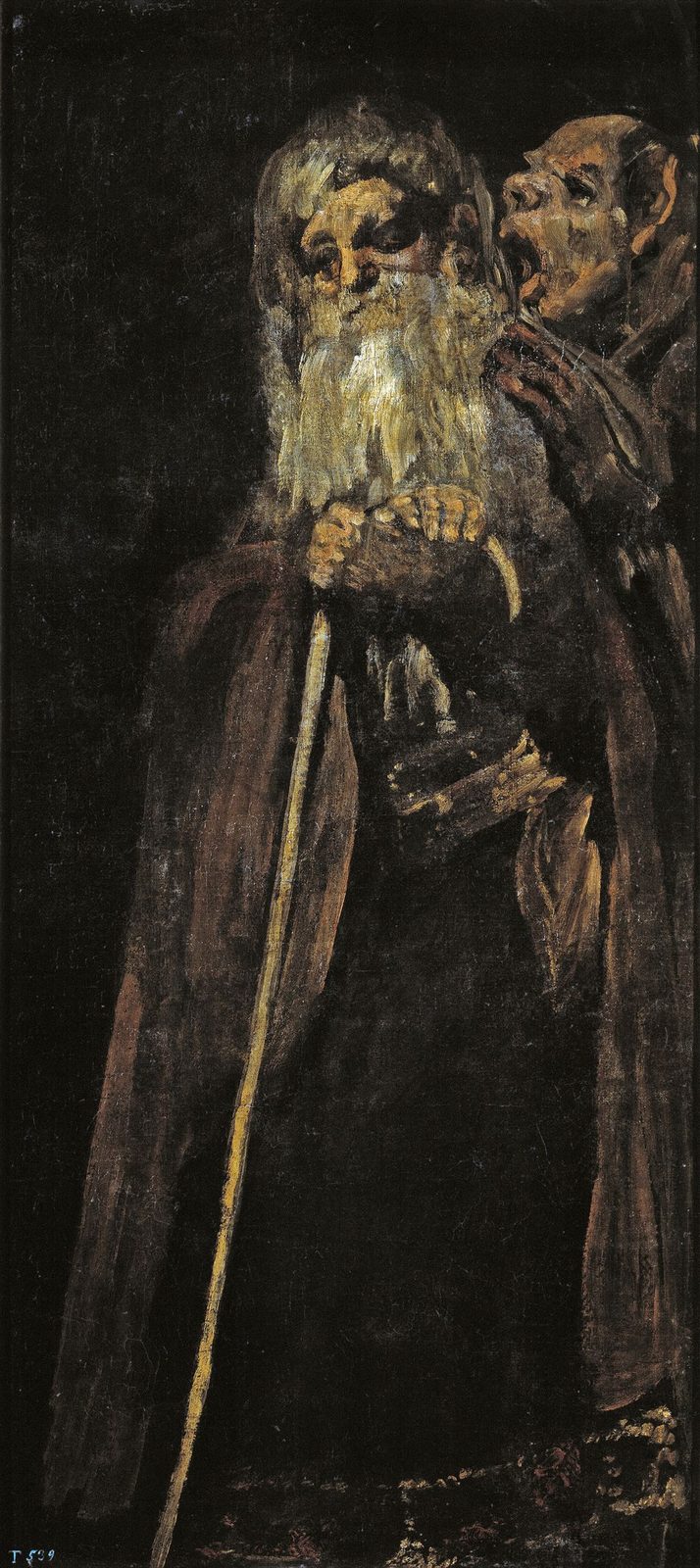
The compressed format matters as much as the expressions. A sweep of fabric reaches the lower left edge, and pale strokes near the other figure come close to the right edge. The dark area above the smaller head is almost the only part of the scene that gives the figures any breathing space. With little visible furniture and no distinct room behind them, their closeness dominates. In the tall Two Old Men, the Prado’s P000759, Goya also places one face close to another, but gives the foremost figure’s body and staff space to extend downwards. Here the spoon and bowl anchor the exchange to a shared foreground, and the two faces can be taken in almost at once. [4] [5]
Annotated Details from Two Old Ones Eating Soup
Look at the two faces and the small gestures around the bowl.
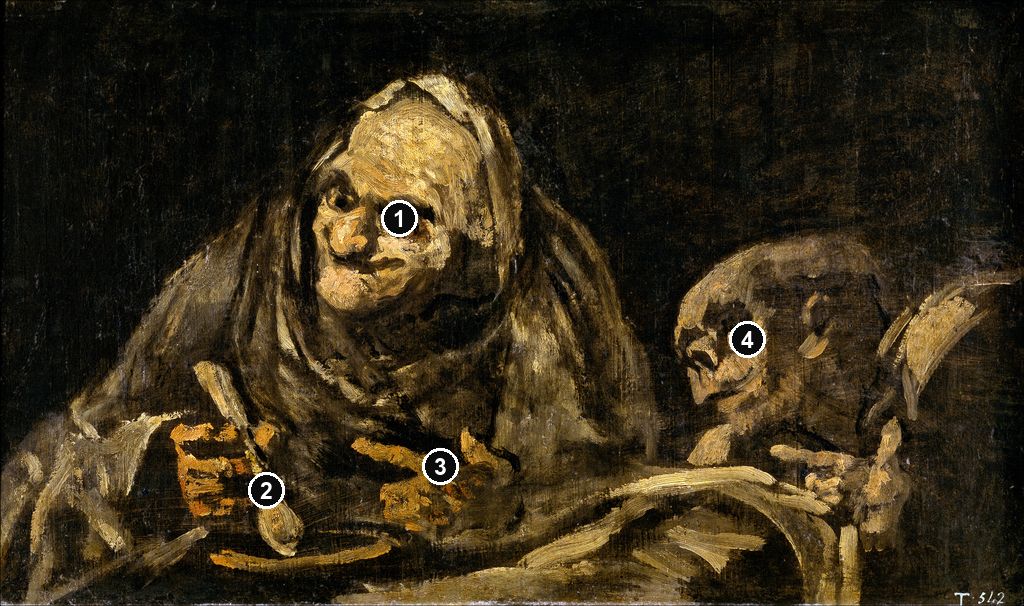
Details from TWO OLD ONES EATING SOUP
Details from the transferred canvas in the Museo Nacional del Prado (P000762).
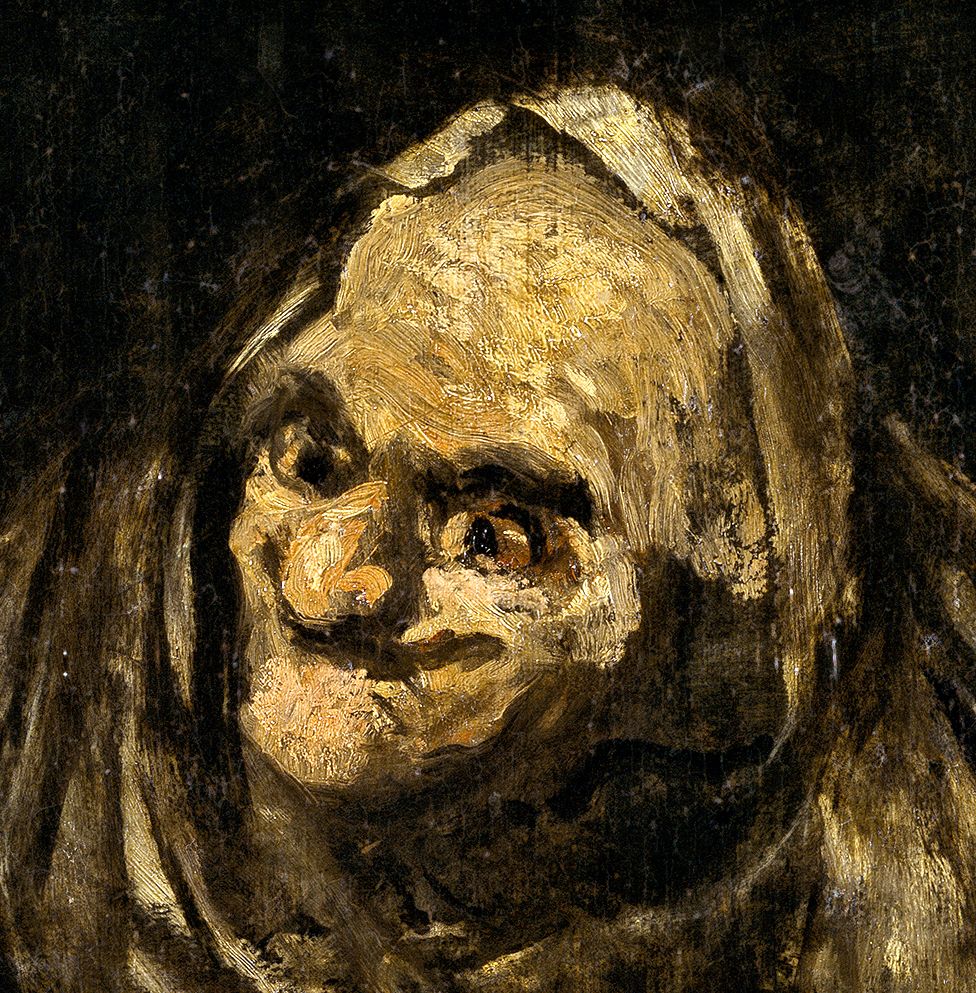
The lit face
The light picks out the brow, cheek and tip of the nose. The eyes stay in comparatively dark sockets.
Spoon and bowl
The handle leans back from the bowl. Short highlights mark the fingers holding it and a small part of the rim.
A hand between the figures
The projecting finger is set against darkness. Its line leads left across the small space above the bowl.
The face in profile
At right, a sliver of light catches the nose and mouth. The rounded back of the head nearly disappears into the dark behind it.
Two women, two witches or two diners?
The early names tell us what different viewers noticed. The inventory associated with Antonio Brugada records Dos mujeres (Two Women) among the works downstairs. In 1867 Charles Yriarte described two old women eating from a bowl in the catalogue at the back of his monograph. Pierre Léonce Imbert, who visited the Quinta in 1873, took the right-hand figure to be Death dining with a witch. The later label on Laurent’s negative calls the figures sorcerers preparing a brew. By 1900 the Prado catalogue recorded titles describing the diners as old women or old people eating. A bowl remains recognisable across those accounts, whether its contents are imagined as supper or something sinister. [2] [3] [4] [6]
Evidence of age comes chiefly from the modelling of the faces and from the positions of the two bodies. Their sex is harder to infer from the features or clothes. The skull-like appearance of the companion has encouraged more specific readings. As the Fundación Goya recounts, Folke Nordström took the papers to be a register of souls and the figure holding them to be Death. Under that reading the meal continues in the presence of a visitor who has business with the diner. The things that make the interpretation imaginable are visible, especially the pale face and the page-like strokes. The idea of a register depends on how a viewer interprets them. [1]
Goya on film
Five films explore Goya’s portraits, prints, Black Paintings and painting techniques.
The Duke of Wellington by Goya
The portrait, its military decorations and its later theft.
Watch on YouTubeWhere could it have been in the Quinta?
Yriarte gives six compositions in his account of the ground-floor room, then lists seven in his catalogue, including the soup scene. Jutta Held returned to that discrepancy in 1965. She pointed to the agreement between the catalogue and the placement of Dos mujeres downstairs in the Brugada list. She also reviewed earlier proposals for the specific opening. Valerian von Loga suggested a door or window above ordinary sightlines, and Nordström considered the outer face of the door, where the panel would have been outside Yriarte’s account of the room. Gassier and Wilson placed it inside. Xavier de Salas and F. J. Sánchez Cantón placed it upstairs in their reconstruction, and Priscilla E. Muller entertained an original upstairs position followed by a move downstairs. [1] [3] [6] [7]
Carlos Foradada used the decoration in Laurent’s photograph to test those proposals. In the surviving negative, a band of small beads borders the scene, with a broader ornamental surround and a strip of wallpaper visible below. Foradada compared the vine-like pattern in that strip and the width of the mouldings with Laurent’s other views. The pattern matches that visible beside other paintings assigned to the ground floor. His reading brings the photograph into agreement with Imbert’s description of the picture among the downstairs murals. For his reconstruction of the room he also used period plans and León Gil de Palacio’s scale model of Madrid, which includes the house and shows the distribution of exterior openings. [2] [3]
Foradada saw the photograph brighten towards its lower right corner and darken towards the upper left. He suggested light could have reached a high panel from a window, from Laurent’s electric lamp or from both. That fits an overdoor, and his reconstruction renders the panel inside the entrance to the dining room. He also considered the hall side of the same doorway and the opening to the staircase, drawing on Valentín Carderera’s 1838 account of painted walls around the stairs. The negative ends before it shows the architectural opening, and the photographer could have placed a lamp at an angle to a panel at any of several heights. The wallpaper is therefore stronger evidence for the floor in Laurent’s day than the direction of the light is for the exact doorway. [2] [3]
Technical analysis has also entered the debate about the floor. Foradada discusses Carmen Garrido’s finding that this mural and The Dog both retain a grey-violet layer beneath the white preparation. The shared layer has been used to suggest that the two belonged on the same upstairs wall. Garrido allowed that the method used to remove these two murals may have preserved more of the underlying wall than the technique used elsewhere. The same layer might once have occurred beneath other paintings. The surviving material tells us something about how these two works came off the wall, while the wallpaper remains a more direct clue to the setting in which Laurent saw the diners. [3]
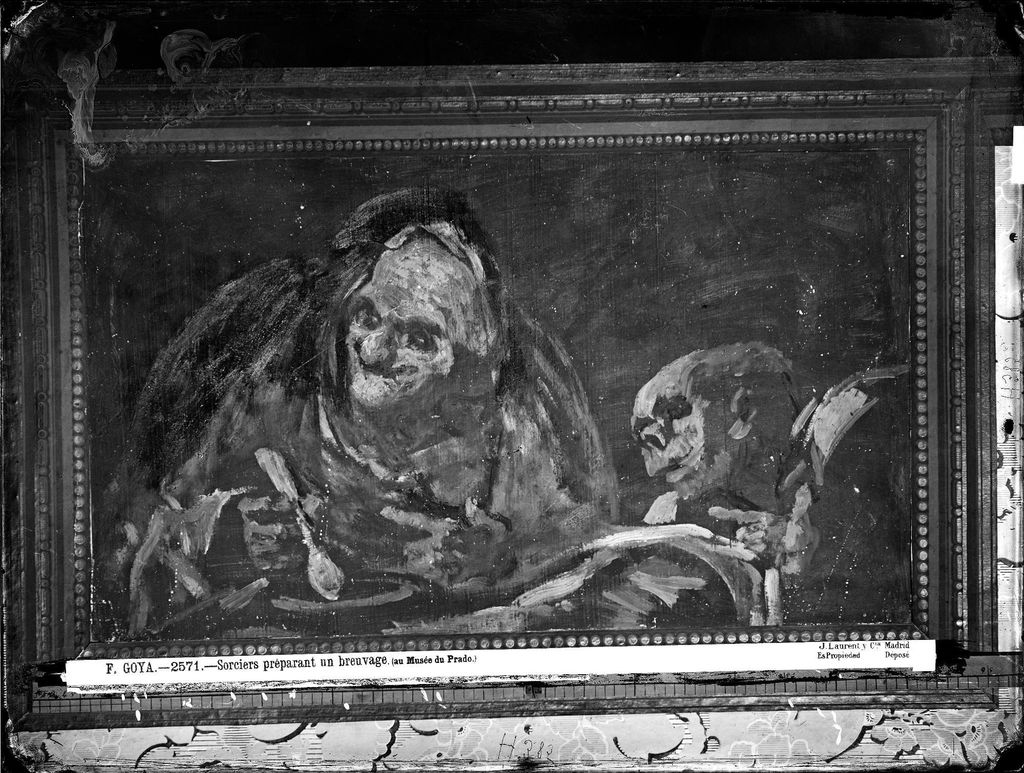
From the wall to the Prado
Laurent’s negative fixes the scene before transfer to canvas. The beaded inner edge encloses a picture already recognisable by the sloping shoulders, spoon, bowl and low set of the second head. The brighter curved strokes still sit close to the lower edge. Above the left figure’s forehead, the photograph shows a pale band with a dark mass around and above it. In the present painting that area reads as a light-edged hood. The photograph suggests a covering was already present before transfer. The Fundación Goya also notes that Muller saw a hood in Eduardo Gimeno’s copy, which she dated to 1869. The exact contours and expression that may have been altered in restoration remain open to question. Differences in detail between a monochrome negative and a colour reproduction can also come from lighting, exposure and reproduction. The disappearance of the surrounding wall decoration from the museum image is plain. [1] [2] [4]
The provenance begins with the house. Goya gave the Quinta to his grandson Mariano in 1823, and it later passed out of the family with the murals still attached to its walls. Baron Émile d’Erlanger acquired the property in 1873 and commissioned Salvador Martínez Cubells to transfer the paintings to canvas. The transferred group was exhibited at the Paris Universal Exhibition of 1878, and the Fundación Goya lists the soup scene among the works shown there. D’Erlanger gave the paintings to the Spanish State in 1881, which assigned them to the Prado. The museum’s records place their display from 1889 and inclusion in its printed catalogue in 1900. The Fundación Goya also lists this particular canvas as catalogue number 6 in Goya in the Prado, the eight-painting exhibition held at the National Gallery of Art in Washington in 1976. [1] [4] [8]
Artworks directory
| Name | Date | Medium |
|---|---|---|
| And There’s No Help for It, Plate 15 | Printed 1863 | |
| Asmodea | c. 1820–23 | Wall painting transferred to canvas |
| Boys Inflating a Bladder | 1777–78 | Tapestry cartoon |
| Boys Picking Fruit | 1778 | Tapestry cartoon |
| Bullfight in a Divided Ring | 1825 | Lithograph |
| Card Players | 1777–78 | Tapestry cartoon |
| Card Players (sketch) | 1777–78 | Painted sketch |
| Dance on the Banks of the Manzanares | 1777 | Tapestry cartoon |
| Duel with Cudgels | c. 1820–23 | Wall painting transferred to canvas |
| Heads in a Landscape | c. 1820–23 | Easel painting |
| Judith and Holofernes | c. 1820–23 | Wall painting transferred to canvas |
| Leocadia | c. 1820–23 | Wall painting transferred to canvas |
| Maja and Cloaked Men | 1777 | Tapestry cartoon |
| Maja and Cloaked Men (sketch) | 1777 | Painted sketch |
| Majo Clapping in Time to the Music | 1777 | Drawing |
| Men Reading | c. 1820–23 | Wall painting transferred to canvas |
| Out Hunting for Teeth, Plate 12 | 1799 | Etching, burnished aquatint and burin |
| Picnic in the Countryside (sketch) | 1776–78 | Painted sketch |
| Picnic on the Banks of the Manzanares | 1776 | Tapestry cartoon |
| Pilgrimage to San Isidro | c. 1820–23 | Wall painting transferred to canvas |
| Preparatory study for The Sleep of Reason Produces Monsters | c. 1796–97 | Drawing |
| Procession of the Holy Office | c. 1820–23 | Wall painting transferred to canvas |
| Quarrel at the Cockerel Inn (sketch) | 1777 | Painted sketch |
| Quarrel in the New Tavern | 1777 | Tapestry cartoon |
| Saturn Devouring His Son | c. 1820–23 | Wall painting transferred to canvas |
| Seated Majo Smoking | c. 1776 | Drawing |
| The Dog | c. 1820–23 | Wall painting transferred to canvas |
| The Drinker | 1777 | Tapestry cartoon |
| The Fates | c. 1820–23 | Wall painting transferred to canvas |
| The Great He-Goat | c. 1820–23 | Wall painting transferred to canvas |
| The Kite | 1777–78 | Tapestry cartoon |
| The Parasol | 1777 | Oil on canvas, tapestry cartoon |
| The Second of May 1808 | 1814 | Oil on canvas |
| The Sleep of Reason Produces Monsters, Plate 43 | 1799 | Etching and aquatint |
| The Third of May 1808 | 1814 | Oil on canvas |
| Thou Who Canst Not, Plate 42 | 1799 | Etching and burnished aquatint |
| Three Figures | 1776 | Drawing (lost) |
| Two Old Men | c. 1820–23 | Wall painting transferred to canvas |
| Two Old Men Eating Soup | c. 1820–23 | Wall painting transferred to canvas |
| Two Women and a Man | c. 1820–23 | Wall painting transferred to canvas |
| Universal Language: The Author Dreaming | 1797 | Drawing |
| The Family of Charles IV | 1800 | Oil on canvas |
| Witches’ Sabbath (Osuna painting) | 1797–98 | Oil on canvas |
| The Nude Maja | 1795–1800 | Oil on canvas |
| The Clothed Maja | 1800–07 | Oil on canvas |
| Self-Portrait (Drawing) | c. 1796 | Brush and carbon black ink on laid paper |
| The Swing, Madrid Album B.21 | 1795–97 | Brush and carbon black washes |
| Majas Fighting, a Majo Observing, Madrid Album B.15 | 1796–97 | Brush, grey and black washes on laid paper |
| Majos and Majas Conversing, Madrid Album B.16 | c. 1794–97 | Ink wash on paper |
| Weeping Woman and Three Men, Madrid Album B.17 | 1795–97 | Brush, carbon black washes and black chalk |
| Maja Seated on a Chair and Two Companions Behind, Madrid Album B.18 | 1795–97 | Brush and carbon black washes |
| Girl and Bull, Madrid Album B.23 | 1796–97 | Brush and carbon black washes |
| Lovers Sitting on a Rock, Madrid Album B.24 | 1796–97 | Brush and carbon black washes |
| Mariano Ceballos Riding a Bull | 1825 | Crayon lithograph and scraper |
| Landscape (lifetime impression) | c. 1807–10 | Etching and aquatint |
| Self-Portrait (1815), Prado canvas | 1815 | Oil on canvas |
| Self-Portrait (1815), Academy panel | 1815 | Oil on panel |
| Self-Portrait with Dr Arrieta | 1820 | Oil on canvas |
| Christ Crucified | 1780 | Oil on canvas |
| The Last Communion of Saint Joseph of Calasanz | 1819 | Oil on canvas |
| Christ on the Mount of Olives | 1819 | Oil on panel |
| The Flower Girls, or Spring | 1786–87 | Oil on canvas |
| The Grape Harvest, or Autumn | 1786–87 | Oil on canvas |
| The Snowstorm, or Winter | 1786–87 | Oil on canvas |
| The Threshing Ground, or Summer | 1786–87 | Oil on canvas |
| Picnic on the Banks of the Manzanares | 1776 | Oil on canvas |
| The Kite | 1777–78 | Oil on canvas |
| Dance on the Banks of the Manzanares | 1777 | Oil on canvas |
| A Fight at the Venta Nueva | 1777 | Oil on canvas |
| Blind Man’s Bluff | 1788 | Oil on canvas |
| Dogs on a Lead | 1775 | Oil on canvas |
| Hunting with a Decoy | 1775 | Oil on canvas |
| Hunter Loading His Rifle | 1775 | Oil on canvas |
| The Angler | 1775 | Oil on canvas |
| The Hermitage of San Isidro on His Feast Day | 1788 | Oil on canvas |
| The Meadow of San Isidro | 1788 | Oil on canvas |
| The Straw Manikin | 1791–92 | Oil on canvas |
| Witches’ Flight | c. 1797–98 | Oil on canvas |
| A Scene from ‘The Forcibly Bewitched’ | 1798 | Oil on canvas |
| The Duchess of Alba in Black | 1797 | Oil on canvas |
| The Duchess of Alba in White | 1795 | Oil on canvas |
| Charles III in Hunting Dress | c. 1786 | Oil on canvas |
| The Duke and Duchess of Osuna and Their Children | 1787–88 | Oil on canvas |
| Manuel Osorio Manrique de Zúñiga | 1787–88 | Oil on canvas |
| The Marquesa de Pontejos | c. 1786 | Oil on canvas |
| Equestrian Portrait of the 1st Duke of Wellington | 1812 | Oil on canvas |
| The Duke of Wellington | 1812–14 | Oil on wood |
| Portrait of Ferdinand VII of Spain | 1814 | Oil on canvas |
| Gaspar Melchor de Jovellanos | 1798 | Oil on canvas |
| María Tomasa Palafox y Portocarrero | 1804 | Oil on canvas |
| Señora Sabasa García | c. 1806–11 | Oil on canvas |
| Don Juan Bautista de Muguiro | 1827 | Oil on canvas |
| Doña Isabel de Porcel | Before 1805 | Oil on canvas |
| The Colossus | After 1808 | Oil on canvas |
| The Burial of the Sardine | 1808–12 | Oil on panel |
| The Madhouse | 1808–12 | Oil on panel |
| A Procession of Flagellants | 1808–12 | Oil on panel |
| Portrait of Jacques Galos | 1826 | Oil on canvas |
| Portrait of Mariano Goya, the Artist’s Grandson | 1827 | Oil on canvas |
| Milkmaid of Bordeaux | c. 1827 | Oil on canvas |
| Portrait of Don Juan Antonio Cuervo | 1819 | Oil on canvas |
| María Luisa of Parma (Naples version) | c. 1800 | Oil on canvas |
| The Countess of Baena | 1819 | Oil on canvas |
| The Family of the Infante Don Luis | 1783–84 | Oil on canvas |
| The Holy Family | c. 1787 | Oil on canvas |
| Saint Barbara | c. 1773 | Oil on canvas |
| Saints Justa and Rufina | 1817 | Oil on canvas |
| El Tío Paquete | c. 1819–20 | Oil on canvas |
| The Forge | c. 1815–20 | Oil on canvas |
| Majas on a Balcony (Metropolitan Museum version) | c. 1800–10 | Oil on canvas |
| Maja and Celestina on a Balcony | c. 1808–12 | Oil on canvas |
| The Water Bearer | 1808–12 | Oil on canvas |
| Time and the Old Women | c. 1810 | Oil on canvas |
Frequently Asked Questions
The Fundación Goya catalogues a small oil on canvas of the same subject in a private collection. Some scholars have treated it as a study by Goya. Others have considered it a reduced copy. Its relationship to the mural is uncertain. [9]
Discussion
Look again at the images and ideas explored in Two Old Ones Eating Soup. These editorial prompts invite your observations.
If you first saw this painting above a doorway, which detail would catch your eye from across the room? Would the lowered spoon or the companion’s face change how you read the left-hand figure’s gesture once you stood closer?
Reader Insights
What do the hands suggest about the relation between the two people?
How might seeing the picture high on a wall change what you notice first?
Join the Conversation
Share a detail, comparison or question about Two Old Ones Eating Soup below.
References
- Fundación Goya en Aragón, Dos viejos comiendo, catalogue record and exhibition history. View source.
- Jean Laurent, Sorciers préparant un breuvage, photograph of the mural at the Quinta del Sordo, 1874. Archivo Ruiz Vernacci, Instituto del Patrimonio Cultural de España, glass negative VN-a-006585 P, digitised from the original. View source.
- Carlos Foradada, ‘El interior de la Quinta del Sordo’, AACA Digital, especially section 4 and figures 8, 10 and 12. Journal version. View source 1. View source 2.
- Museo Nacional del Prado, Dos viejos comiendo, P000762. Archived record text. View source 1. View source 2.
- Fundación Goya en Aragón, Black Paintings series catalogue, including the vertical Two Old Men. View source.
- Charles Yriarte, Goya. Sa vie, son œuvre, Paris, Henri Plon, 1867, pp. 91–96 and p. 140. View source.
- Jutta Held, ‘Francisco de Goya. Die Gemälde’, Zeitschrift für Kunstgeschichte, 28 (1965), pp. 229–257, especially pp. 243–244. View source.
- National Gallery of Art, Washington, Goya in the Prado, exhibition record, 6–31 May 1976. View source.
- Fundación Goya en Aragón, Dos viejos comiendo (boceto), catalogue record for the attributed study. View source.








