


 by Tom Gurney
Tom Gurney BSc (Hons) is an art history expert with over 20 years experience
Published on June 19, 2020 / Updated on November 20, 2026
Email: tomgurney1@gmail.com / Phone: +44 7429 011000
Introduction
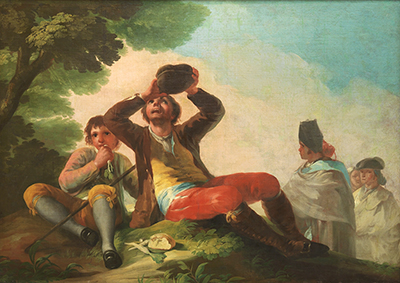
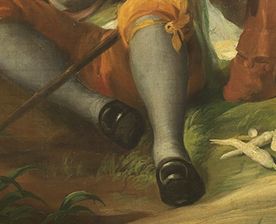
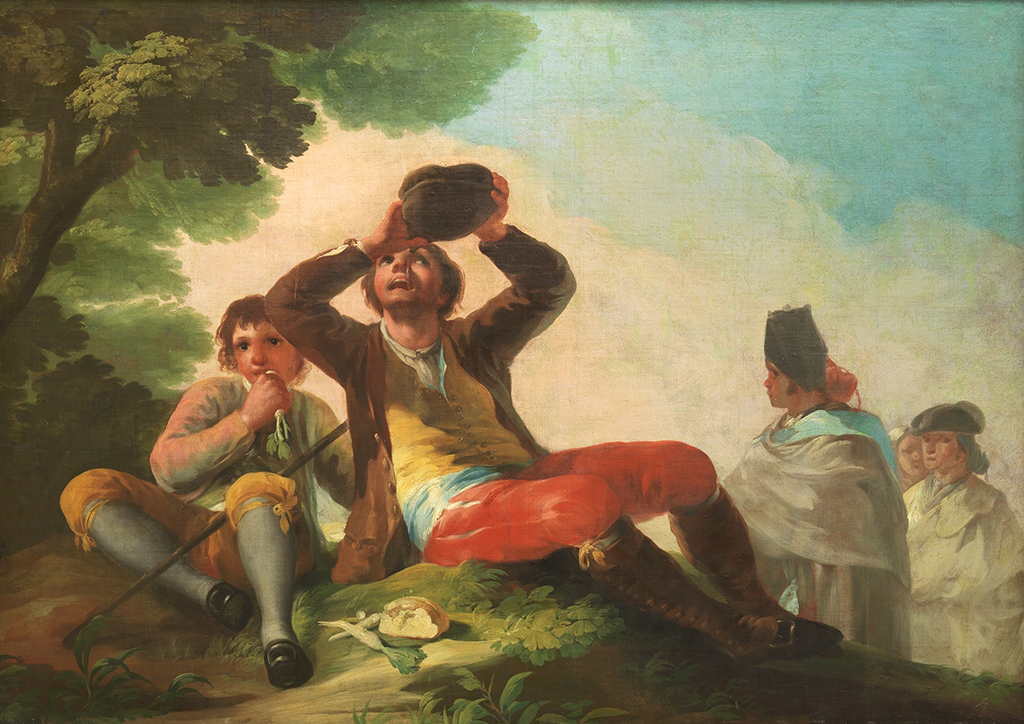
A man seated on a bank tips his head back and holds a dark wineskin over his open mouth. Beside him a boy lifts a bite of food to his lips. Francisco de Goya lets us see the sole of the boy’s shoe almost straight on, as if the ground on which the pair sit were higher than our own. He painted The Drinker in 1777 as a working design for a tapestry that would hang above a door. The oil on canvas measures 107 × 151 centimetres and belongs to the Museo Nacional del Prado in Madrid, where it is catalogued as P00772. [1]
At a Glance
- Artist and dateFrancisco de Goya, 1777. [1]
- PaintingOil on canvas, 107 × 151 centimetres, Museo Nacional del Prado, Madrid (P00772). [1]
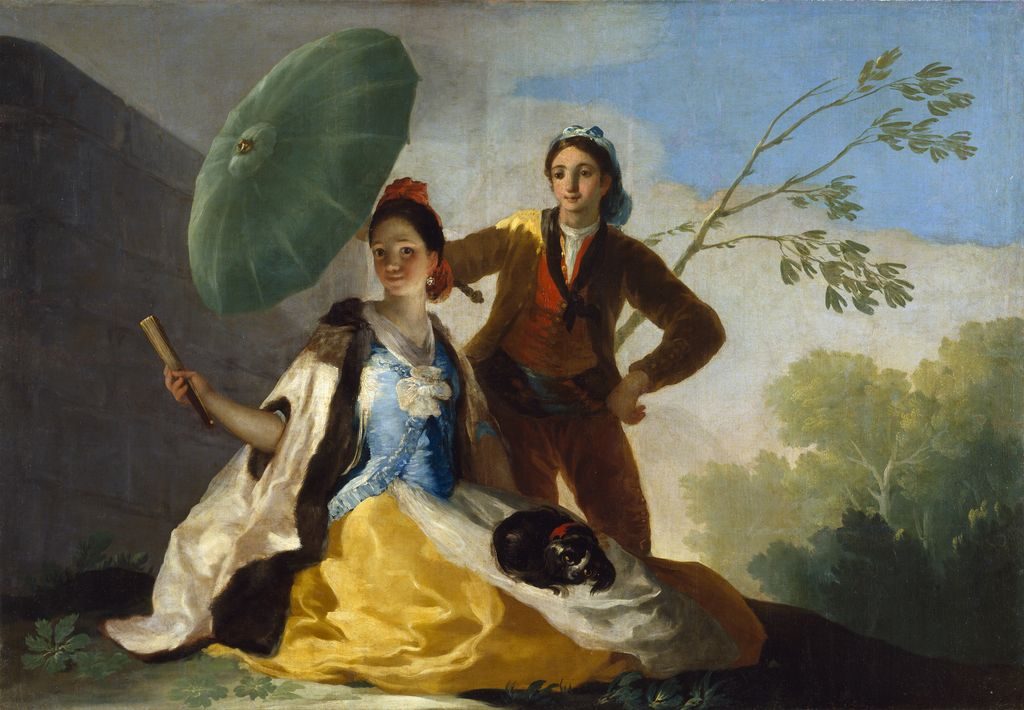
- Original purposeA design for an overdoor tapestry in the dining room of the Prince and Princess of Asturias at El Pardo, paired with The Parasol. [1] [2] [3]
- A surviving tapestryPatrimonio Nacional, 10078862 (TA-91/3), made by the Royal Tapestry Factory in Madrid after Goya’s design. [7]
Works across Goya’s career
The Drinker
1777The Parasol
1777The Nude Maja
1795–1800Saturn Devouring His Son
c. 1820–23The Dog
c. 1820–23A wineskin held against the sky
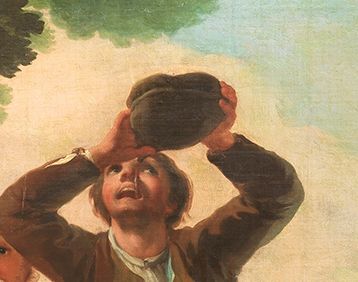
Look at the drinker’s hands. One encloses the end of the skin close to his face, while the other lifts its rounded body. The two hands hold it on a tilt, leaving a narrow gap above his mouth. From a few steps away the position of his head and the weight carried by his arms are enough to tell us what is happening. The dark sleeves make a rough circle with the wineskin at its top and the man’s face in its opening. His elbows are widely spaced, so the pose takes up far more room than the object that sets it in motion. [1]
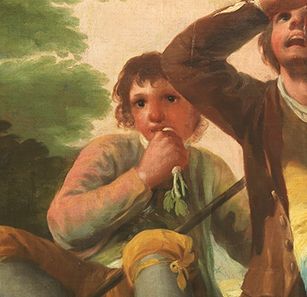
The boy’s movements are more compact. His hand conceals part of his mouth and the greens trail below his fingers. On the ground between the two figures lie a piece of bread and pale roots. Goya’s account describes a radish and half a small loaf. The boy sits close enough for his head to slip under the outline of the man’s raised elbow, yet the two have separate occupations. There is a similar difference in the two figures’ footing. The boy’s stockinged legs jut towards us, while the drinker’s bright red breeches turn across the picture towards his dark boots at the right. Their legs span the lower part of the painting and the wineskin brings the group to a point above them. [1] [2]
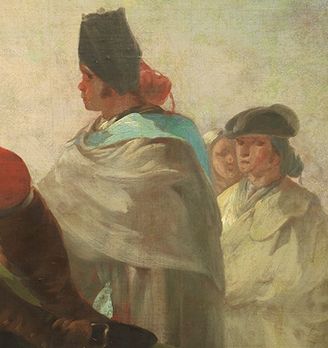
The picture gives us a close, low view of the bank. A tree is cut off by the left and top edges, and the farthest walkers are crowded against the right. Their lower bodies disappear behind the rising ground. The nearest walker wears a pale cloak and tall dark hat, with two smaller heads beyond. Their smaller scale and more upright bearing make the seated figures feel unusually large and close. Goya left a broad stretch of sky between the tree and the walkers, so that the drinker’s arms are easy to pick out despite the earth colours in his coat. His bright sash and breeches pull the eye back down to the bank. [1]
A diagonal stick crosses in front of the boy’s knees. The art historian Janis A. Tomlinson, whose reading is reported by the Fundación Goya en Aragón, has suggested that the stick and the drinker’s averted gaze recall the blind man and his young guide in Lazarillo de Tormes. The relationship in the novel offers a possible way to read the gap between the boy with his modest food and the man who has the wine to himself. The boy’s fixed gaze in the painting and the drinker’s absorption make that suggestion worth testing against the image. In his account Goya describes what the pair are doing, leaving their relationship and the question of a literary source open. [1] [2]
Annotated Details from The Drinker
Look at the lifted wineskin, the boy’s meal and the figures beyond the bank.
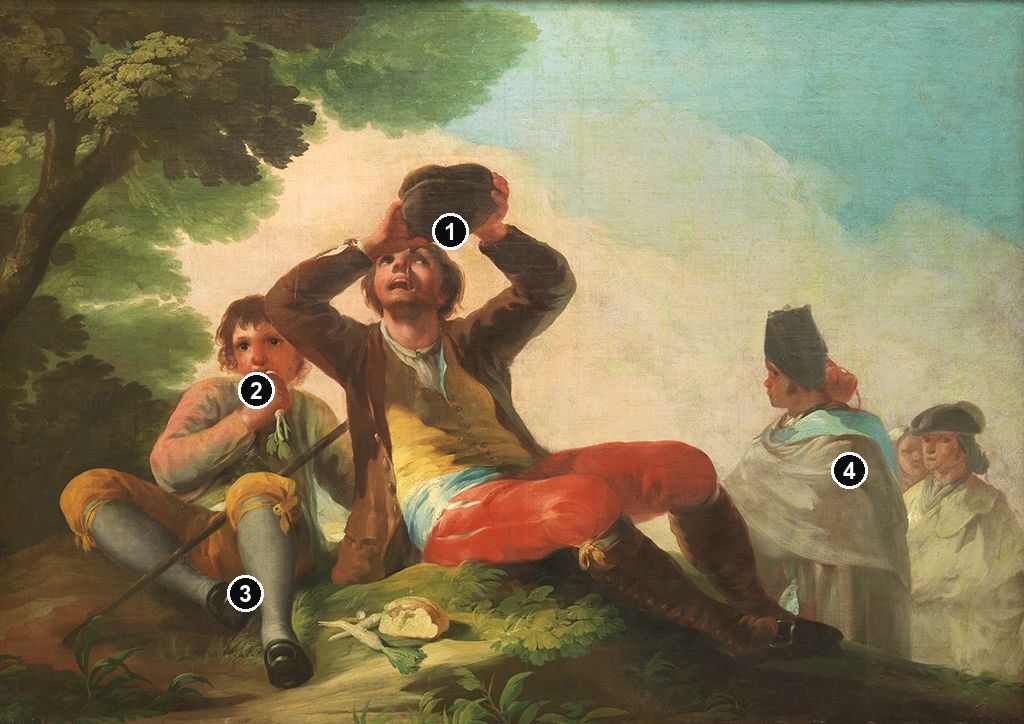
Details from THE DRINKER
Details from the Prado tapestry cartoon (P00772).
The raised wineskin
The wineskin makes a dark shape against the brighter sky.
The boy eating
The boy holds his food close to his mouth.
The boy’s shoe
The sole turns out towards the viewer.
The group beyond the bank
The distant figures are worked more softly than the pair in front.
Goya’s August account
Goya signed an account for four cartoons in Madrid on 12 August 1777. He described them as designs of his own invention executed for the king on the orders of Francisco Sabatini, the king’s first architect. The account specifies where the woven works were to go, in the room where the Prince and Princess of Asturias ate at the Royal Palace of El Pardo. The patrons who would use the room were the future Charles IV and María Luisa of Parma. Goya describes the drinking figure with the phrase bota a la catalana. In the account that phrase sits alongside the boy’s food and three figures who appear to be walking along a path. The description identifies the wineskin through a familiar term and gives the composition a practical identity in a list of work delivered. [2] [3]
The entry values The Drinker at 1,500 reales de vellón and gives its size as five feet and seven fingerbreadths wide by three feet and eleven fingerbreadths high. The Parasol follows with the same stated width and valuation. The four entries add to 18,000 reales, of which the much bigger A Fight at the Venta Nueva alone accounts for 10,000. A factory register transcribed in the Diplomatario records Cornelio Vandergotten’s receipt of the four works on 12 August and a net payment to Goya of 17,000 reales, included in a larger sum authorised by royal order on 3 October 1777. The individual figure of 1,500 is Goya’s valuation for the cartoon. The payment record accounts for the four as a group. [2] [4]
The other entries in August cover A Fight at the Venta Nueva, A Walk in Andalusia and The Parasol. The dining-room series eventually comprised ten finished cartoons. Goya’s earlier work for the royal tapestry factory had included hunting scenes for El Escorial. For the El Pardo dining room he turned to pastimes and encounters that might take place outside Madrid, from dancing on the banks of the Manzanares to flying a kite. Concha Herrero Carretero draws attention to the claim of invention in Goya’s account. She cites the court painter Andrés de la Calleja’s assessment of the four August designs, which takes into account their size, the nature of the work and the time he thought original compositions demanded. The court’s regular demand for tapestries had previously been met in part with designs copied from older Flemish scenes. Here a form of leisure as ordinary as stopping for a drink could furnish a royal room. [2] [5] [6]
Goya on film
Five films explore Goya’s portraits, prints, Black Paintings and painting techniques.
The Duke of Wellington by Goya
The portrait, its military decorations and its later theft.
Watch on YouTubeTwo overdoors at El Pardo
The Fundación Goya en Aragón identifies The Drinker and The Parasol as companions designed for overdoors on the east side of the dining room. An overdoor occupies the wall directly above a doorway. The space gives the weavers a shallow rectangle to fill and sets the image above a standing viewer’s normal line of sight. In The Drinker, the near edge of the bank and the exposed sole of a shoe make that upward view credible. The dark shape of the wineskin remains readable against the sky, even if details such as the green leaves in the boy’s hand would have been harder to make out from across a room. [1] [3]
Compare where each picture puts its brightest colour. The red breeches in The Drinker carry the eye sideways from the man’s waist to his bent knee, above the shadow of the bank. In The Parasol, the woman’s yellow skirt spreads out towards the viewer and the small dark dog lies against it. Both pictures begin with a broad patch of colour low in the foreground, then lead up to an arm and an object against the sky. The parasol is a wide arc held on a slant, while the wineskin is small enough to clasp between two hands. The shadow under the parasol falls across the woman’s face, from which she looks directly out. The drinker looks up into the space between his hands. The boy is the figure whose face comes closest to meeting ours. [1] [3]
Hung high, both scenes would have needed to work in glimpses as people used the room. The raised object makes each activity readable quickly. The Parasol figures cooperate to create a patch of shade, while the two seated figures in The Drinker are occupied with their own food or drink. Even the walkers have a different pace, suggested by the nearest man’s upright profile as he comes level with the drinker’s long diagonal leg. A pair of tapestry panels could make use of the same economy of design and still encourage different kinds of attention. [1] [3]
From painted canvas to woven panel
For the tapestry weavers, the cartoon supplied the arrangement of forms and colours. A loom held threads called the warp under tension. Weavers passed coloured weft across them to build the picture. In her study of the Royal Tapestry Factory, Herrero Carretero describes how weavers could trace outlines from designs and use neighbouring colours to build effects of shading. In The Drinker, the outlines of the hands and the dark skin give the action clear edges. The shift from a warm patch of light on the man’s waistcoat to the brown of his coat is a different challenge. The painter could vary how much colour the brush laid down and let one tone shade into the next. A woven version had to create that change through thread. Details such as the sliver of shirt at his wrist and the narrow gap between his chin and collar give a viewer specific places to compare the two media. [1] [6]
Patrimonio Nacional’s loan register identifies a woven El bebedor from the Royal Tapestry Factory in Madrid as inventory 10078862 (TA-91/3). It was lent to the Museo de Historia de Madrid for Carlos III y el Madrid de las luces, which opened in December 2016. In 2026 Patrimonio Nacional announced the loan of woven versions of The Drinker and The Parasol to Solo Goya. El arte de ver at the Museo Goya in Zaragoza. The later announcement identifies both designs but gives no inventory numbers for the two loans. Herrero Carretero records three royal-collection weavings after the cartoon of The Parasol, a reminder that the same design could furnish more than one textile. The inventory number in the earlier record identifies a particular textile, while P00772 identifies the painted design in the Prado. The two records also give the maker credit at different stages of production. The painting is Goya’s work. The tapestry is the work of the factory from his design. [1] [6] [7] [8] [9] [10]
Looking at the cartoon in its own right
The Fundación’s entry for The Drinker refers readers to the provenance of A Fight at the Venta Nueva. That entry records the transfer of the cartoon from the tapestry factory to the Royal Palace in Madrid around 1856 or 1857 and its entry into the Prado in 1870. The Fundación also records exhibitions of The Drinker at the Nationalmuseum in Stockholm in 1994–95 and at the Prado’s 250th-anniversary Goya exhibition in 1996. In 2014 the Prado included it in Goya en Madrid. Cartones para tapices 1775–1794. That sequence belongs to the life of the painted design. The loan of a woven panel is another chapter in the history of the composition. [1] [11]
Janis A. Tomlinson has also proposed that the drinking scene could represent gluttony within a moral reading of the series. That reading draws force from the man’s extravagant reach and his concentration on the wine. Concha Herrero Carretero’s account of the changing tastes of the court offers a different emphasis, placing Goya’s El Pardo series in the development of tapestry scenes of recognisable local life and pastimes. The detail that serves both readings is the familiar action itself. A viewer can see how awkward it is to drink from a bag with both elbows in the air. The boy beside him can finish his mouthful with just one hand. The difference is comic, and the design gives it room to register across a dining room. Explore more of Goya’s work for the court in the paintings guide. [1] [6]
Artworks directory
| Name | Date | Medium |
|---|---|---|
| And There’s No Help for It, Plate 15 | Printed 1863 | |
| Asmodea | c. 1820–23 | Wall painting transferred to canvas |
| Boys Inflating a Bladder | 1777–78 | Tapestry cartoon |
| Boys Picking Fruit | 1778 | Tapestry cartoon |
| Bullfight in a Divided Ring | 1825 | Lithograph |
| Card Players | 1777–78 | Tapestry cartoon |
| Card Players (sketch) | 1777–78 | Painted sketch |
| Dance on the Banks of the Manzanares | 1777 | Tapestry cartoon |
| Duel with Cudgels | c. 1820–23 | Wall painting transferred to canvas |
| Heads in a Landscape | c. 1820–23 | Easel painting |
| Judith and Holofernes | c. 1820–23 | Wall painting transferred to canvas |
| Leocadia | c. 1820–23 | Wall painting transferred to canvas |
| Maja and Cloaked Men | 1777 | Tapestry cartoon |
| Maja and Cloaked Men (sketch) | 1777 | Painted sketch |
| Majo Clapping in Time to the Music | 1777 | Drawing |
| Men Reading | c. 1820–23 | Wall painting transferred to canvas |
| Out Hunting for Teeth, Plate 12 | 1799 | Etching, burnished aquatint and burin |
| Picnic in the Countryside (sketch) | 1776–78 | Painted sketch |
| Picnic on the Banks of the Manzanares | 1776 | Tapestry cartoon |
| Pilgrimage to San Isidro | c. 1820–23 | Wall painting transferred to canvas |
| Preparatory study for The Sleep of Reason Produces Monsters | c. 1796–97 | Drawing |
| Procession of the Holy Office | c. 1820–23 | Wall painting transferred to canvas |
| Quarrel at the Cockerel Inn (sketch) | 1777 | Painted sketch |
| Quarrel in the New Tavern | 1777 | Tapestry cartoon |
| Saturn Devouring His Son | c. 1820–23 | Wall painting transferred to canvas |
| Seated Majo Smoking | c. 1776 | Drawing |
| The Dog | c. 1820–23 | Wall painting transferred to canvas |
| The Drinker | 1777 | Tapestry cartoon |
| The Fates | c. 1820–23 | Wall painting transferred to canvas |
| The Great He-Goat | c. 1820–23 | Wall painting transferred to canvas |
| The Kite | 1777–78 | Tapestry cartoon |
| The Parasol | 1777 | Oil on canvas, tapestry cartoon |
| The Second of May 1808 | 1814 | Oil on canvas |
| The Sleep of Reason Produces Monsters, Plate 43 | 1799 | Etching and aquatint |
| The Third of May 1808 | 1814 | Oil on canvas |
| Thou Who Canst Not, Plate 42 | 1799 | Etching and burnished aquatint |
| Three Figures | 1776 | Drawing (lost) |
| Two Old Men | c. 1820–23 | Wall painting transferred to canvas |
| Two Old Men Eating Soup | c. 1820–23 | Wall painting transferred to canvas |
| Two Women and a Man | c. 1820–23 | Wall painting transferred to canvas |
| Universal Language: The Author Dreaming | 1797 | Drawing |
| The Family of Charles IV | 1800 | Oil on canvas |
| Witches’ Sabbath (Osuna painting) | 1797–98 | Oil on canvas |
| The Nude Maja | 1795–1800 | Oil on canvas |
| The Clothed Maja | 1800–07 | Oil on canvas |
| Self-Portrait (Drawing) | c. 1796 | Brush and carbon black ink on laid paper |
| The Swing, Madrid Album B.21 | 1795–97 | Brush and carbon black washes |
| Majas Fighting, a Majo Observing, Madrid Album B.15 | 1796–97 | Brush, grey and black washes on laid paper |
| Majos and Majas Conversing, Madrid Album B.16 | c. 1794–97 | Ink wash on paper |
| Weeping Woman and Three Men, Madrid Album B.17 | 1795–97 | Brush, carbon black washes and black chalk |
| Maja Seated on a Chair and Two Companions Behind, Madrid Album B.18 | 1795–97 | Brush and carbon black washes |
| Girl and Bull, Madrid Album B.23 | 1796–97 | Brush and carbon black washes |
| Lovers Sitting on a Rock, Madrid Album B.24 | 1796–97 | Brush and carbon black washes |
| Mariano Ceballos Riding a Bull | 1825 | Crayon lithograph and scraper |
| Landscape (lifetime impression) | c. 1807–10 | Etching and aquatint |
| Self-Portrait (1815), Prado canvas | 1815 | Oil on canvas |
| Self-Portrait (1815), Academy panel | 1815 | Oil on panel |
| Self-Portrait with Dr Arrieta | 1820 | Oil on canvas |
| Christ Crucified | 1780 | Oil on canvas |
| The Last Communion of Saint Joseph of Calasanz | 1819 | Oil on canvas |
| Christ on the Mount of Olives | 1819 | Oil on panel |
| The Flower Girls, or Spring | 1786–87 | Oil on canvas |
| The Grape Harvest, or Autumn | 1786–87 | Oil on canvas |
| The Snowstorm, or Winter | 1786–87 | Oil on canvas |
| The Threshing Ground, or Summer | 1786–87 | Oil on canvas |
| Picnic on the Banks of the Manzanares | 1776 | Oil on canvas |
| The Kite | 1777–78 | Oil on canvas |
| Dance on the Banks of the Manzanares | 1777 | Oil on canvas |
| A Fight at the Venta Nueva | 1777 | Oil on canvas |
| Blind Man’s Bluff | 1788 | Oil on canvas |
| Dogs on a Lead | 1775 | Oil on canvas |
| Hunting with a Decoy | 1775 | Oil on canvas |
| Hunter Loading His Rifle | 1775 | Oil on canvas |
| The Angler | 1775 | Oil on canvas |
| The Hermitage of San Isidro on His Feast Day | 1788 | Oil on canvas |
| The Meadow of San Isidro | 1788 | Oil on canvas |
| The Straw Manikin | 1791–92 | Oil on canvas |
| Witches’ Flight | c. 1797–98 | Oil on canvas |
| A Scene from ‘The Forcibly Bewitched’ | 1798 | Oil on canvas |
| The Duchess of Alba in Black | 1797 | Oil on canvas |
| The Duchess of Alba in White | 1795 | Oil on canvas |
| Charles III in Hunting Dress | c. 1786 | Oil on canvas |
| The Duke and Duchess of Osuna and Their Children | 1787–88 | Oil on canvas |
| Manuel Osorio Manrique de Zúñiga | 1787–88 | Oil on canvas |
| The Marquesa de Pontejos | c. 1786 | Oil on canvas |
| Equestrian Portrait of the 1st Duke of Wellington | 1812 | Oil on canvas |
| The Duke of Wellington | 1812–14 | Oil on wood |
| Portrait of Ferdinand VII of Spain | 1814 | Oil on canvas |
| Gaspar Melchor de Jovellanos | 1798 | Oil on canvas |
| María Tomasa Palafox y Portocarrero | 1804 | Oil on canvas |
| Señora Sabasa García | c. 1806–11 | Oil on canvas |
| Don Juan Bautista de Muguiro | 1827 | Oil on canvas |
| Doña Isabel de Porcel | Before 1805 | Oil on canvas |
| The Colossus | After 1808 | Oil on canvas |
| The Burial of the Sardine | 1808–12 | Oil on panel |
| The Madhouse | 1808–12 | Oil on panel |
| A Procession of Flagellants | 1808–12 | Oil on panel |
| Portrait of Jacques Galos | 1826 | Oil on canvas |
| Portrait of Mariano Goya, the Artist’s Grandson | 1827 | Oil on canvas |
| Milkmaid of Bordeaux | c. 1827 | Oil on canvas |
| Portrait of Don Juan Antonio Cuervo | 1819 | Oil on canvas |
| María Luisa of Parma (Naples version) | c. 1800 | Oil on canvas |
| The Countess of Baena | 1819 | Oil on canvas |
| The Family of the Infante Don Luis | 1783–84 | Oil on canvas |
| The Holy Family | c. 1787 | Oil on canvas |
| Saint Barbara | c. 1773 | Oil on canvas |
| Saints Justa and Rufina | 1817 | Oil on canvas |
| El Tío Paquete | c. 1819–20 | Oil on canvas |
| The Forge | c. 1815–20 | Oil on canvas |
| Majas on a Balcony (Metropolitan Museum version) | c. 1800–10 | Oil on canvas |
| Maja and Celestina on a Balcony | c. 1808–12 | Oil on canvas |
| The Water Bearer | 1808–12 | Oil on canvas |
| Time and the Old Women | c. 1810 | Oil on canvas |
Frequently Asked Questions
The stick and the older figure’s gaze prompted Tomlinson to suggest a connection with the blind man and his guide. The novel’s first chapter includes a struggle over wine, with the boy secretly drinking from the man’s jar. The painting shows a man drinking from a skin and a boy eating beside him. The proposed connection rests on the pairing of figures and the importance of wine to the story. [1] [12]
Discussion
Look again at the images and ideas explored in The Drinker. These editorial prompts invite your observations.
Imagine seeing The Drinker above a doorway from the far side of a room. Which detail would tell you first what the man is doing? Try the same with The Parasol. How does each picture use sky and shadow to make the raised object easy to read?
Reader Insights
Where does your eye go first when you look up at the scene?
How do the boy’s gesture and the drinker’s lifted arm relate to one another?
Join the Conversation
Share a detail, comparison or question about The Drinker below.
References
- Fundación Goya en Aragón, El bebedor and The Drinker, object records. View source 1. View source 2.
- Francisco de Goya, account to Francisco Sabatini, Madrid, 12 August 1777, in Ángel Canellas López, ed., Francisco de Goya. Diplomatario, document 16, pp. 211–12. View source.
- Fundación Goya en Aragón, El quitasol, object record. View source.
- Cargo que se le forma de las pinturas existentes y que se le entregan para diseños en la Real tapicería, to Cornelio Vandergotten, Madrid, 1780, in Ángel Canellas López, ed., Francisco de Goya. Diplomatario, appendix document XXVI, pp. 418–19, entries 197–200. View source.
- Fundación Goya en Aragón, Tapestry Cartoons: Types of Spain, 1776–1778, series catalogue. View source.
- Concha Herrero Carretero, ‘An Introduction to Goya’s Cartoons and Tapestries’, in Janis A. Tomlinson, ed., Goya: Images of Women, National Gallery of Art, 2002, pp. 89–95 and catalogue entry 4, pp. 108–09. View source.
- Patrimonio Nacional, Préstamos, entry for Carlos III y el Madrid de las luces, inventory 10078862 (TA-91/3). View source.
- Ayuntamiento de Madrid, Carlos III y el Madrid de las Luces, 13 December 2016, opening announcement. View source.
- Patrimonio Nacional, loan announcement for Solo Goya, statement on the woven El bebedor and El quitasol. View source.
- Fundación Ibercaja, Solo Goya. El arte de ver, exhibition page. View source.
- Fundación Goya en Aragón, La riña en la Venta Nueva, object record cross-referenced in El bebedor. View source.
- Anonymous, La vida de Lazarillo de Tormes, first treatise, Biblioteca Virtual Miguel de Cervantes. View source.







