


 by Tom Gurney
Tom Gurney BSc (Hons) is an art history expert with over 20 years experience
Published on June 19, 2020 / Updated on November 20, 2026
Email: tomgurney1@gmail.com / Phone: +44 7429 011000
Introduction
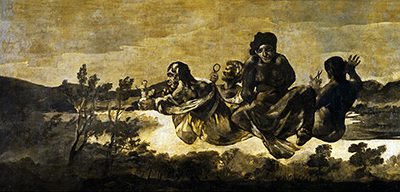
Four figures hang above a pale stretch of country in Francisco de Goya’s Atropos or The Fates. One holds up a tiny human likeness, another raises a ring to her eye, and a third turns away with a pair of scissors. The fourth figure lifts his face towards us. His elbows draw back and his hands disappear behind him. He shares the Fates’ flight, though there is little in his posture to suggest he has chosen it. [1]
Goya painted the scene on an upstairs wall of the Quinta del Sordo, his country house near Madrid. It is now one of the fourteen transferred murals in the Prado that make up the Black Paintings. A photograph taken before the transfer shows the width of the scene as it appeared on the wall and preserves details of the fourth figure’s face that are harder to read on the canvas. The two versions give the viewer different grounds for deciding what is happening to him. [1] [2] [3]
At a Glance
- ArtistFrancisco de Goya y Lucientes
- DateAbout 1820–1823
- Also known asLas Parcas (The Fates) and El Destino (Fate)
- MediumOil on plaster, transferred to canvas
- Dimensions123 × 266 cm, as catalogued by the Fundación Goya en Aragón
- CollectionMuseo Nacional del Prado, Madrid, P000757
- Original locationUpper floor of the Quinta del Sordo [1] [2]
Works across Goya’s career
The Parasol
1777The Nude Maja
1795–1800Saturn Devouring His Son
c. 1820–23The Dog
c. 1820–23The Fates
c. 1820–23From the treetops to the scissors
Begin at the left edge, where a hill slopes down towards a stand of thin trees. A light expanse opens beyond them and reappears between darker banks on the right. It has the look of water catching the light, although the terrain offers few clues to its location. A line of smaller trees runs below the figures. Between the dark foliage and the hem of the long drapery is a narrow space of pale paint. That gap makes the bodies seem to hang clear of the ground even where their knees nearly meet the tops of the trees. Ochre in the sky and yellow in the fabric warm a landscape that the Fundación Goya catalogue reads as moonlit. The catalogue also identifies the figures as additions over an earlier painted landscape. [1]
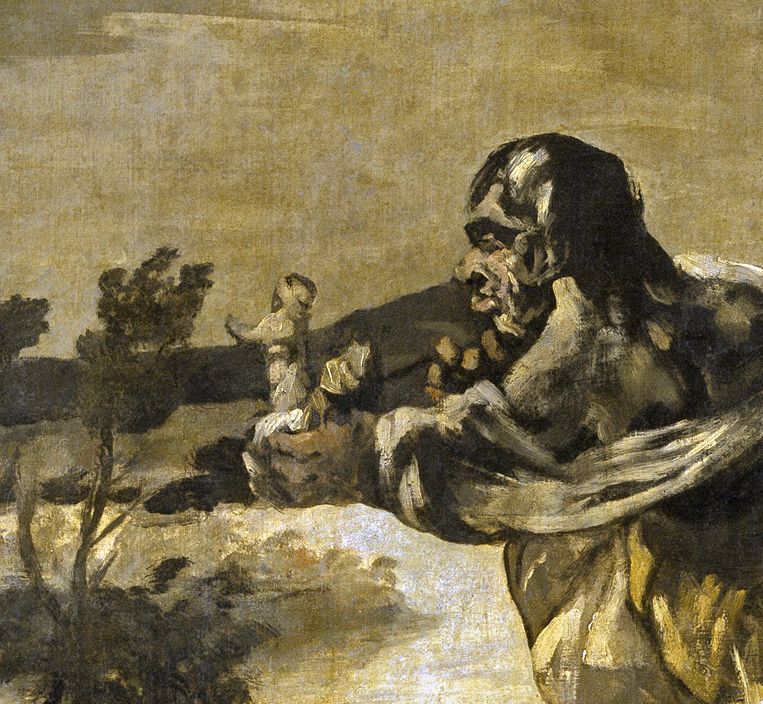
The leftmost Fate, usually identified as Clotho, leans forwards. Her nose and chin project in profile. A broad fold of cloth sweeps around her arm towards the small form she holds out. The little figure is upright and has an arm lifted, a posture that can register as a gesture even at its diminutive scale. Its body is paler than the hills behind it. The Fundación Goya describes it as a doll, possibly a votive figure, and reads a thread running towards Clotho’s other hand. Charles Yriarte, writing while the scene was still on the wall, understood the figure as an unborn child whom the Fate was about to send down to earth. In both readings the tiny likeness puts a body where one might expect the spinner’s equipment. [1] [4]
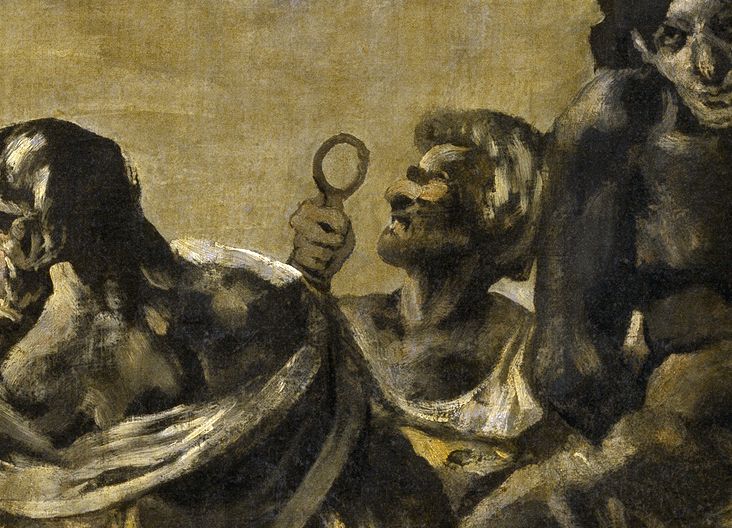
Behind Clotho, the figure generally identified as Lachesis lifts her chin and holds up a small loop. The yellowish sky shows through or within its outline. Her head is angled towards it, and her wrist turns the circle towards us. The Fundación Goya records several possibilities for the object. A lens would make the gesture an act of inspecting the thread. A mirror would introduce the idea of passing time, while a serpent biting its tail would evoke eternity. The Prado also raises the possibility that a mirror could stand for prudence, associating the Fates with judgement. Yriarte took the object for an eyeglass and understood Lachesis to be looking at the tiny figure. Her lifted face establishes a direction for the gaze. Its object depends on how one reads that small circle. [1] [4] [6]
At the right, the open points of a pair of scissors stand out beside a dark head. They identify the figure as Atropos. Her back and shoulder turn towards us, and the other hand rises beside her head with fingers spread against the sky. For José Manuel Arnáiz, as reported by the Fundación Goya, the arrangement of the fingers suggested a rude gesture and a possible joke at death’s expense. The scissors alone carry much of the familiar myth, and their blades are still apart. Even at this end of the group, where a viewer might expect the action to resolve, Goya leaves it in suspense. [1]
Annotated Details from Atropos or The Fates
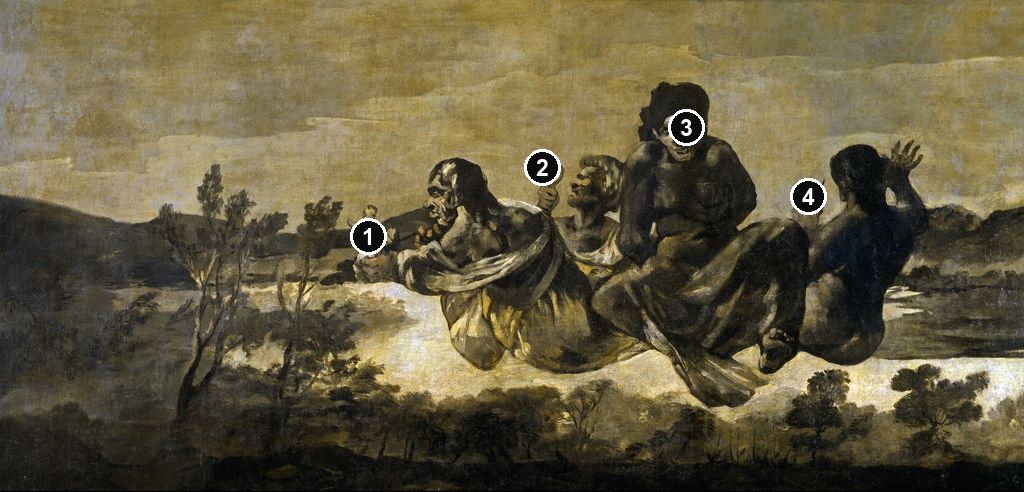
Trace the small objects in the figures’ hands from left to right across the suspended group.
Details from ATROPOS OR THE FATES
Details from the canvas in the Museo Nacional del Prado (P000757).
A small human form
The object held at left has a small head and limbs. Its upright shape stands out above the pale edge of the landscape.
A raised circular object
A thin circular outline shows against the light sky between the two faces. The face on the right tilts back towards it.
The figure who looks out
The central face looks out of the image. Its lighter features are surrounded by darkness in the head covering and shoulders.
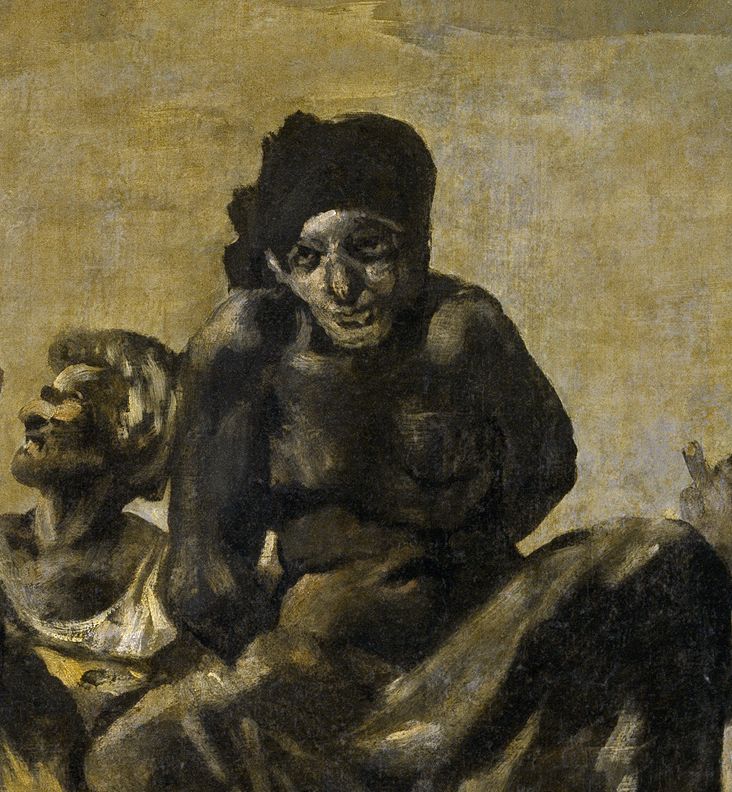
Scissors against the hillside
The open blades rise just left of the turned head. A second hand emerges behind the same figure’s shoulder.
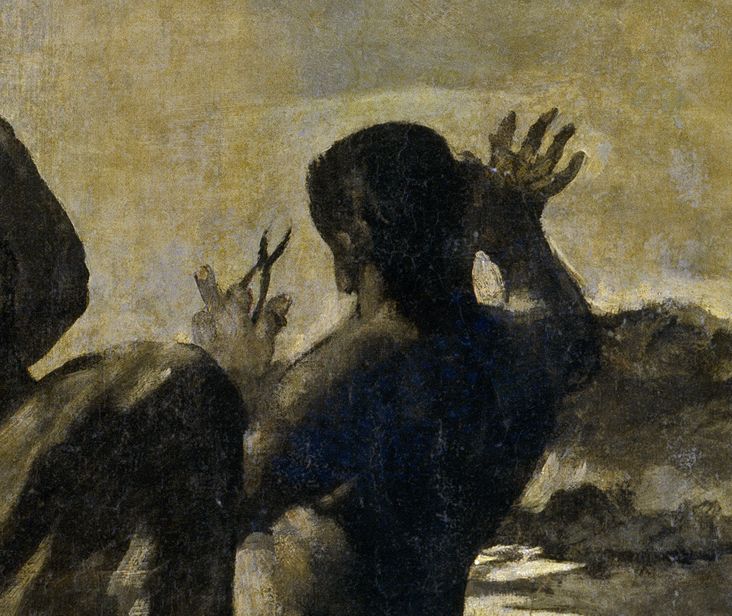
Three Fates and a fourth face
Hesiod names Clotho, Lachesis and Atropos in the Theogony and describes them as apportioning good and evil to mortals at birth. In the familiar image of their work, Clotho spins the thread of a person’s life, Lachesis allots or measures it and Atropos cuts it. A depiction centred on the thread lets the eye follow the work from one hand to the next. Goya offers three separate objects to examine and places the largest head between the ring and the scissors. The myth identifies the figures attending to those objects and leaves an open question about the man among them. [1] [5] [6]
The man sits high in the group, his head nearly a full face above the others. The light picks out his forehead, cheeks and the rim of one shoulder. His torso leans forwards while his arms appear held back, and the wrists are hidden from view. The position suggests a captive. Around him, Clotho bends over the little figure, Lachesis looks towards her circle, and Atropos turns away. The others have tools or objects to handle. His form is defined in part by what his hands are prevented from doing. [1]
The art historian Diego Angulo Íñiguez saw the small figure and the captive as the same person at opposite ends of a life. On that reading, the distance between Clotho’s hands and the man’s face contains all the years in which the infant has grown into a person subject to his fate. Other scholars have proposed Prometheus, as Carlos Foradada records. The captive posture explains the attraction of a myth about punishment, though the painting gives the man no clear attribute that would settle the identification. Foradada proposes a different kind of captivity, reading the figure as a victim of the repression that followed the defeat of the Spanish constitutional liberals in 1823. In his argument, the photographed face and the paintings elsewhere in the room supply the political context. The forward gaze also works on its own as a detail to which any viewer can respond. [7]
Goya on film
Five films explore Goya’s portraits, prints, Black Paintings and painting techniques.
The Duke of Wellington by Goya
The portrait, its military decorations and its later theft.
Watch on YouTubeAn upstairs wall at the Quinta del Sordo
The surviving names belong to the nineteenth-century record of the mural. In an inventory of works in the possession of Goya’s son, drawn up at an uncertain date by the painter Antonio Brugada, the entry was Atropos. Yriarte used Les Parques in the catalogue to his 1867 book, focusing on the three figures as a group. In his account of the house he also suggested Dans les nuages, or In the Clouds, and described four crouching witches. That shift within a single book shows how differently the scene can read when a viewer starts with the airborne bodies instead of the objects in their hands. [4] [8]
In the measured reconstruction by Carlos Foradada and his colleagues, Atropos was on the wall to the left as one entered the upstairs room. A window divided that wall, with Fight with Cudgels occupying the other expanse. Across the room, Asmodea and Procession of the Holy Office hung on either side of another window. The room allowed a viewer to turn from two fighters whose attention is fixed on each other to a man who faces out from among figures absorbed in their own tasks. Turning again brought a second scene of flight into view. In Asmodea, a pointing arm links the airborne couple to a distant fortified rock, and men with guns occupy the foreground. In Atropos, the country opens beneath the flying group and the decisive gestures are all up in the air. Foradada’s reconstruction makes the comparison a matter of looking across a room as well as between two images. [9] [10]
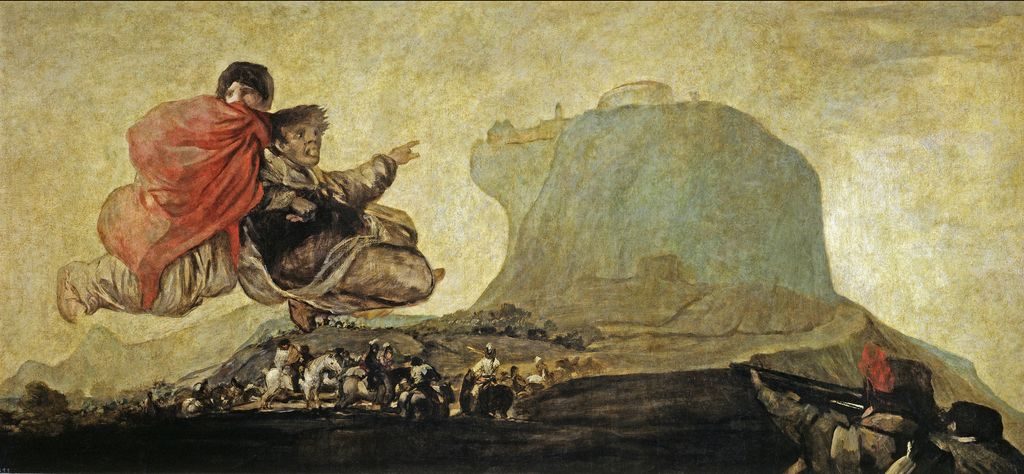
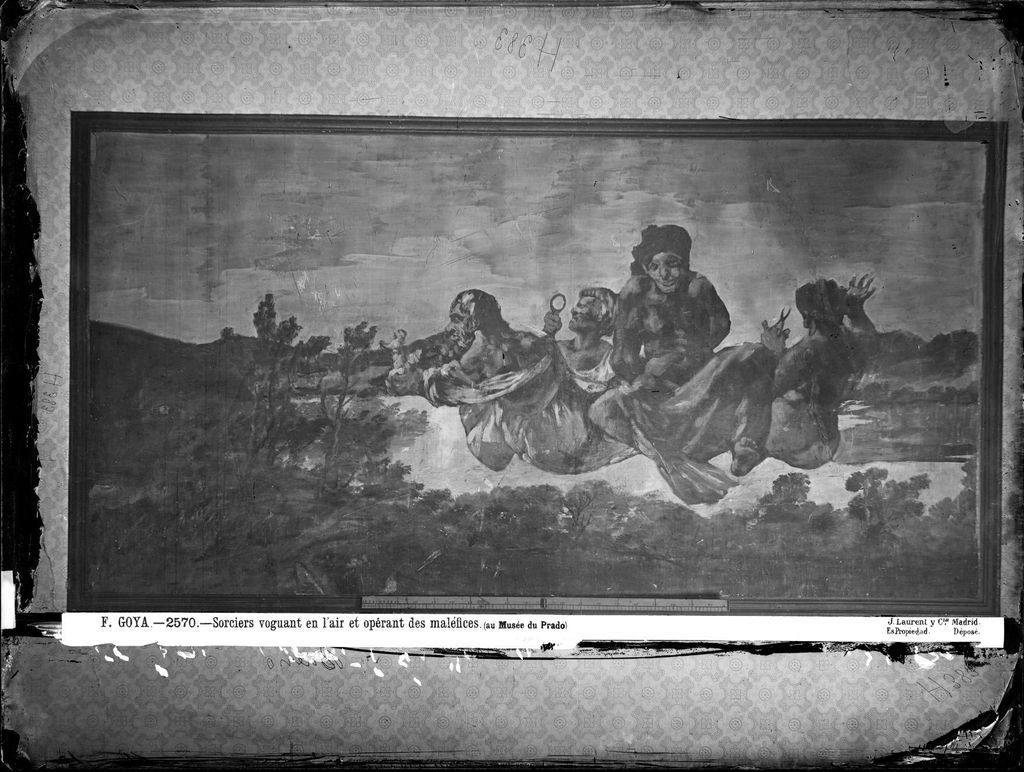
What Laurent photographed
Jean Laurent’s view of the mural survives as a wet-collodion glass negative, VN-06582, in the Archivo Ruiz Vernacci at Spain’s Instituto del Patrimonio Cultural. The archive credit accompanying the digital reproduction dates the exposure to 1874. The photograph includes a patterned expanse of wallpaper above and below the dark border and a measuring rule along the mural’s lower edge. A white caption strip reads Sorciers voguant en l’air et opérant des maléfices, describing sorcerers flying and casting spells, followed by au Musée du Prado. Laurent’s successors added the Prado label around 1890, after the transfer and donation. The digital image reproduces that layered photographic record. The room and mural belong to the exposure, and the strip gives the photograph’s later caption. [3] [11]
Compare the tall tree on the left in the photograph and on the canvas. Its crown sits among the same sequence of hills and smaller trees in both, but the surviving landscape reaches farther left before it meets the boundary. Foradada and his colleagues use the ruler visible in Laurent’s view to estimate a mural width of about 243 cm, compared with 266 cm for the canvas. They identify added painting along the left end that continues the landscape. The stretch of country now preceding the tree changes how far the eye travels before it reaches the first figure. [1] [3] [9]
The fourth figure’s face changes at a smaller scale. In the enlarged photograph published by Foradada, the eye on the viewer’s right lies under a broad dark patch. The eye on the same side of the canvas has a more distinct dark opening. Foradada reads the photographed eye as swollen and shut, interprets the marks as injuries, and attributes the change to repainting by Salvador Martínez Cubells. That comparison makes the difference around the eye visible. The cause of the marks and the identity of the captive remain matters of interpretation. The photograph records the wall roughly half a century after Goya painted it, with the effects of that interval already present. [1] [3] [7] [11]
The baron Émile d’Erlanger commissioned Martínez Cubells to detach the wall paintings and transfer them to canvas. The restorer’s registers document work on the group from 1874 to 1876, with another entry for the fourteen canvases in 1881. The Fates was shown at the Paris Universal Exhibition in 1878, and the Spanish state accepted d’Erlanger’s donation by royal order on 20 December 1881. More than a century later, the Prado and Factum Arte brought colour photography and three-dimensional surface records of the canvases together with X-rays and Laurent’s photographs. The old and new records capture different physical stages of the same object, down to the damaged passages that may explain some of the changes. The Fundación Goya, for instance, reports a possible tear beneath repainting in the area of Atropos, indicated by radiography. [1] [11] [12]
Artworks directory
| Name | Date | Medium |
|---|---|---|
| And There’s No Help for It, Plate 15 | Printed 1863 | |
| Asmodea | c. 1820–23 | Wall painting transferred to canvas |
| Boys Inflating a Bladder | 1777–78 | Tapestry cartoon |
| Boys Picking Fruit | 1778 | Tapestry cartoon |
| Bullfight in a Divided Ring | 1825 | Lithograph |
| Card Players | 1777–78 | Tapestry cartoon |
| Card Players (sketch) | 1777–78 | Painted sketch |
| Dance on the Banks of the Manzanares | 1777 | Tapestry cartoon |
| Duel with Cudgels | c. 1820–23 | Wall painting transferred to canvas |
| Heads in a Landscape | c. 1820–23 | Easel painting |
| Judith and Holofernes | c. 1820–23 | Wall painting transferred to canvas |
| Leocadia | c. 1820–23 | Wall painting transferred to canvas |
| Maja and Cloaked Men | 1777 | Tapestry cartoon |
| Maja and Cloaked Men (sketch) | 1777 | Painted sketch |
| Majo Clapping in Time to the Music | 1777 | Drawing |
| Men Reading | c. 1820–23 | Wall painting transferred to canvas |
| Out Hunting for Teeth, Plate 12 | 1799 | Etching, burnished aquatint and burin |
| Picnic in the Countryside (sketch) | 1776–78 | Painted sketch |
| Picnic on the Banks of the Manzanares | 1776 | Tapestry cartoon |
| Pilgrimage to San Isidro | c. 1820–23 | Wall painting transferred to canvas |
| Preparatory study for The Sleep of Reason Produces Monsters | c. 1796–97 | Drawing |
| Procession of the Holy Office | c. 1820–23 | Wall painting transferred to canvas |
| Quarrel at the Cockerel Inn (sketch) | 1777 | Painted sketch |
| Quarrel in the New Tavern | 1777 | Tapestry cartoon |
| Saturn Devouring His Son | c. 1820–23 | Wall painting transferred to canvas |
| Seated Majo Smoking | c. 1776 | Drawing |
| The Dog | c. 1820–23 | Wall painting transferred to canvas |
| The Drinker | 1777 | Tapestry cartoon |
| The Fates | c. 1820–23 | Wall painting transferred to canvas |
| The Great He-Goat | c. 1820–23 | Wall painting transferred to canvas |
| The Kite | 1777–78 | Tapestry cartoon |
| The Parasol | 1777 | Oil on canvas, tapestry cartoon |
| The Second of May 1808 | 1814 | Oil on canvas |
| The Sleep of Reason Produces Monsters, Plate 43 | 1799 | Etching and aquatint |
| The Third of May 1808 | 1814 | Oil on canvas |
| Thou Who Canst Not, Plate 42 | 1799 | Etching and burnished aquatint |
| Three Figures | 1776 | Drawing (lost) |
| Two Old Men | c. 1820–23 | Wall painting transferred to canvas |
| Two Old Men Eating Soup | c. 1820–23 | Wall painting transferred to canvas |
| Two Women and a Man | c. 1820–23 | Wall painting transferred to canvas |
| Universal Language: The Author Dreaming | 1797 | Drawing |
| The Family of Charles IV | 1800 | Oil on canvas |
| Witches’ Sabbath (Osuna painting) | 1797–98 | Oil on canvas |
| The Nude Maja | 1795–1800 | Oil on canvas |
| The Clothed Maja | 1800–07 | Oil on canvas |
| Self-Portrait (Drawing) | c. 1796 | Brush and carbon black ink on laid paper |
| The Swing, Madrid Album B.21 | 1795–97 | Brush and carbon black washes |
| Majas Fighting, a Majo Observing, Madrid Album B.15 | 1796–97 | Brush, grey and black washes on laid paper |
| Majos and Majas Conversing, Madrid Album B.16 | c. 1794–97 | Ink wash on paper |
| Weeping Woman and Three Men, Madrid Album B.17 | 1795–97 | Brush, carbon black washes and black chalk |
| Maja Seated on a Chair and Two Companions Behind, Madrid Album B.18 | 1795–97 | Brush and carbon black washes |
| Girl and Bull, Madrid Album B.23 | 1796–97 | Brush and carbon black washes |
| Lovers Sitting on a Rock, Madrid Album B.24 | 1796–97 | Brush and carbon black washes |
| Mariano Ceballos Riding a Bull | 1825 | Crayon lithograph and scraper |
| Landscape (lifetime impression) | c. 1807–10 | Etching and aquatint |
| Self-Portrait (1815), Prado canvas | 1815 | Oil on canvas |
| Self-Portrait (1815), Academy panel | 1815 | Oil on panel |
| Self-Portrait with Dr Arrieta | 1820 | Oil on canvas |
| Christ Crucified | 1780 | Oil on canvas |
| The Last Communion of Saint Joseph of Calasanz | 1819 | Oil on canvas |
| Christ on the Mount of Olives | 1819 | Oil on panel |
| The Flower Girls, or Spring | 1786–87 | Oil on canvas |
| The Grape Harvest, or Autumn | 1786–87 | Oil on canvas |
| The Snowstorm, or Winter | 1786–87 | Oil on canvas |
| The Threshing Ground, or Summer | 1786–87 | Oil on canvas |
| Picnic on the Banks of the Manzanares | 1776 | Oil on canvas |
| The Kite | 1777–78 | Oil on canvas |
| Dance on the Banks of the Manzanares | 1777 | Oil on canvas |
| A Fight at the Venta Nueva | 1777 | Oil on canvas |
| Blind Man’s Bluff | 1788 | Oil on canvas |
| Dogs on a Lead | 1775 | Oil on canvas |
| Hunting with a Decoy | 1775 | Oil on canvas |
| Hunter Loading His Rifle | 1775 | Oil on canvas |
| The Angler | 1775 | Oil on canvas |
| The Hermitage of San Isidro on His Feast Day | 1788 | Oil on canvas |
| The Meadow of San Isidro | 1788 | Oil on canvas |
| The Straw Manikin | 1791–92 | Oil on canvas |
| Witches’ Flight | c. 1797–98 | Oil on canvas |
| A Scene from ‘The Forcibly Bewitched’ | 1798 | Oil on canvas |
| The Duchess of Alba in Black | 1797 | Oil on canvas |
| The Duchess of Alba in White | 1795 | Oil on canvas |
| Charles III in Hunting Dress | c. 1786 | Oil on canvas |
| The Duke and Duchess of Osuna and Their Children | 1787–88 | Oil on canvas |
| Manuel Osorio Manrique de Zúñiga | 1787–88 | Oil on canvas |
| The Marquesa de Pontejos | c. 1786 | Oil on canvas |
| Equestrian Portrait of the 1st Duke of Wellington | 1812 | Oil on canvas |
| The Duke of Wellington | 1812–14 | Oil on wood |
| Portrait of Ferdinand VII of Spain | 1814 | Oil on canvas |
| Gaspar Melchor de Jovellanos | 1798 | Oil on canvas |
| María Tomasa Palafox y Portocarrero | 1804 | Oil on canvas |
| Señora Sabasa García | c. 1806–11 | Oil on canvas |
| Don Juan Bautista de Muguiro | 1827 | Oil on canvas |
| Doña Isabel de Porcel | Before 1805 | Oil on canvas |
| The Colossus | After 1808 | Oil on canvas |
| The Burial of the Sardine | 1808–12 | Oil on panel |
| The Madhouse | 1808–12 | Oil on panel |
| A Procession of Flagellants | 1808–12 | Oil on panel |
| Portrait of Jacques Galos | 1826 | Oil on canvas |
| Portrait of Mariano Goya, the Artist’s Grandson | 1827 | Oil on canvas |
| Milkmaid of Bordeaux | c. 1827 | Oil on canvas |
| Portrait of Don Juan Antonio Cuervo | 1819 | Oil on canvas |
| María Luisa of Parma (Naples version) | c. 1800 | Oil on canvas |
| The Countess of Baena | 1819 | Oil on canvas |
| The Family of the Infante Don Luis | 1783–84 | Oil on canvas |
| The Holy Family | c. 1787 | Oil on canvas |
| Saint Barbara | c. 1773 | Oil on canvas |
| Saints Justa and Rufina | 1817 | Oil on canvas |
| El Tío Paquete | c. 1819–20 | Oil on canvas |
| The Forge | c. 1815–20 | Oil on canvas |
| Majas on a Balcony (Metropolitan Museum version) | c. 1800–10 | Oil on canvas |
| Maja and Celestina on a Balcony | c. 1808–12 | Oil on canvas |
| The Water Bearer | 1808–12 | Oil on canvas |
| Time and the Old Women | c. 1810 | Oil on canvas |
Frequently Asked Questions
Atropos is the figure at the right with her back towards the viewer. The scissors identify her as the Fate associated with cutting the thread of life. [1]
Discussion
Look again at the images and ideas explored in Atropos or The Fates. These editorial prompts invite your observations.
Look at the fourth figure’s shoulders and face in the photograph and the canvas. Which detail most shapes your reading of him as a captive?
Reader Insights
How do the small objects guide your eye through the group?
How does the painted group look different when you see it with its original surround?
Join the Conversation
Share a detail, comparison or question about Atropos or The Fates below.
References
- Fundación Goya en Aragón, Las Parcas, Spanish catalogue entry with colour reproduction. View source.
- Museo Nacional del Prado, Atropos or The Fates, P000757. View source.
- Jean Laurent, Atropos or The Fates at the Quinta del Sordo, negative VN-06582, Archivo Ruiz Vernacci, Fototeca del Instituto del Patrimonio Cultural de España. Digital reproduction with archive credit. View source.
- Charles Yriarte, Goya. Sa vie, son œuvre, Paris, Henri Plon, 1867, ‘La maison de Goya’ and the catalogue entry ‘Les Parques’. View source.
- Hesiod, Theogony, lines 211–225 and 901–906, Center for Hellenic Studies. View source.
- Museo Nacional del Prado, ¿Solo Goya?, pp. 35–36, on the traditional roles of the Fates and Goya’s treatment of their attributes. View source.
- Carlos Foradada, ‘La tortura en el rostro: Las Parcas de Goya en las fotografías de Laurent’, AACA Digital, especially fig. 3. View source.
- RTVE, Mirar un cuadro: El destino o Las parcas (Goya), with Darío Villalba and a synopsis recording Brugada’s title. View source.
- Carlos Foradada, Carlos Narbaiza, José Javier Luis and Alfonso Burgos, ‘Las medidas de la casa de Goya y sus Pinturas negras en su entorno original’, ASRI, no. 20 (2021), pp. 53–82, especially figs. 28–29. View source.
- Fundación Goya en Aragón, Asmodea Duelo a garrotazos and La Leocadia, Spanish catalogue entries, including the group’s room history under La Leocadia. View source 1. View source 2. View source 3.
- Raquel Esteban Vega, ‘Las fotografías de J. Laurent de las Pinturas negras de Goya’, in Goya en la Literatura, en la Música y en las Creaciones Audiovisuales, pp. 413–426. View source.
- Factum Arte, ‘3D and colour recording of Francisco de Goya’s Black Paintings’, documentation of the Prado recording project. View source.








