


 Francisco de Goya.jpg)
 by Tom Gurney
Tom Gurney BSc (Hons) is an art history expert with over 20 years experience
Published on June 19, 2020 / Updated on November 20, 2026
Email: tomgurney1@gmail.com / Phone: +44 7429 011000
Introduction
A black goat faces a crowd. Its horns rise above a row of tilted heads, white caps and open mouths. At the other end of the gathering, a woman in dark clothes sits just apart from the rest. She appears to be on the very edge of the action in the canvas at the Prado. A photograph taken while the painting was still on the wall of Goya’s house shows that she once had a broad stretch of dark ground beside her. That space was part of the painting, and its disappearance changed the balance of the whole scene. [1] [2] [3]
At a Glance
- ArtistFrancisco de Goya
- DateAbout 1820–1823
- Spanish titlesEl aquelarre or El gran cabrón
- MediumOil paint on wall plaster, transferred to canvas
- Dimensions140.5 × 435.7 cm, height before width
- CollectionMuseo Nacional del Prado, Madrid, P000761
- Original settingGround floor of the Quinta del Sordo, across from Pilgrimage to San Isidro
- Related workA separate Witches’ Sabbath, painted in 1797–1798 and now at the Museo Lázaro Galdiano, Madrid
Works across Goya’s career
The Parasol
1777The Nude Maja
1795–1800Saturn Devouring His Son
c. 1820–23The Dog
c. 1820–23The Great He-Goat
c. 1820–23From the goat to the woman at the edge
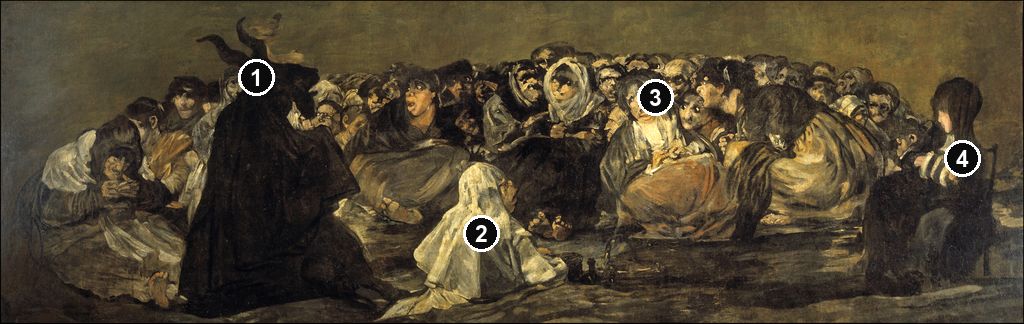
The goat is well to the left of the canvas’s midpoint. Its head is in profile, the muzzle aimed towards the right. Below it, the shape is broad enough to suggest a person wrapped in dark clothing. An upright horn and the line of the muzzle are easier to pick out than the eye. The body becomes hard to separate from the ground at its base. A few faces show behind it and to the left, so that its dark bulk interrupts the gathering even as the turn of its head invites the eye to follow the people farther to the right. The Fundación Goya en Aragón identifies a figure beside the goat as a possible attendant. That suggests a hierarchy within the gathering, though the scene gives few clues to the duties of any such figure. [1] [4]
The crowd makes a low arc across the painting. Several of the nearest figures sit or stoop, so that only a few heads rise into the grey space above them. In front, a figure in pale fabric has turned largely away from us. Its shoulders stand out against the ground and help establish the space in which the goat and the faces confront each other. Farther back, cheek, brow and chin often appear as disconnected strokes. Where a white cap catches the eye, it can be hard to trace the shoulders of the person wearing it. Across that bank of faces many heads turn towards the goat, some lift or crane, and others are only partially visible from behind their neighbours. The effect of a crowd comes as much from these interruptions as from the number of people. [1] [4]
Look also at the uneven band of ground beneath the gathering. Thin ochre and grey marks travel along it, and some recall the edges of garments. There is little elevation between the front figures and those behind them. The painting makes depth through overlapping heads and shoulders, a bent body here and an exposed face farther back. Muted flesh colours give way to very dark browns, blacks and greens. A white head covering or a pale sleeve can hold the eye for a moment and then release it as the surrounding dark takes over. Above the assembly there is enough tonal variation to suggest outdoor space. The source of the light is left open. [1] [4]
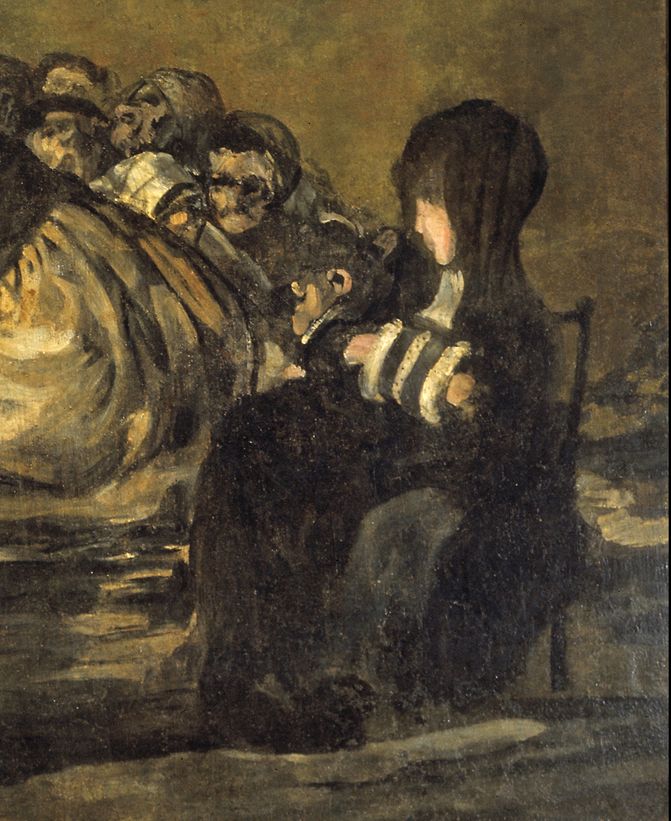
The seated woman to the right pulls that pattern of movement up short. She faces back towards the goat, and her head and torso make a more continuous shape than the profiles and fragments of clothing alongside her. The bright marks near her shoulders and chest are separated from the other pale accents. This combination of isolation, upright posture and a line of sight into the company has encouraged the reading that she is a young woman about to be initiated. The Fundación presents her in that role. We can see how Goya distinguishes her from the people beside her. Whatever takes place before or after this moment is left to the viewer to imagine. [1] [4]
Annotated Details from Witches’ Sabbath or The Great He-Goat
Move from the goat’s silhouette through the group to the woman at the far right.
Details from WITCHES’ SABBATH OR THE GREAT HE-GOAT
Details from the transferred canvas in the Museo Nacional del Prado (P000761).
Horns against the background
The horns, muzzle and shoulder form a dense silhouette. Nearby faces are picked out in much smaller shapes.
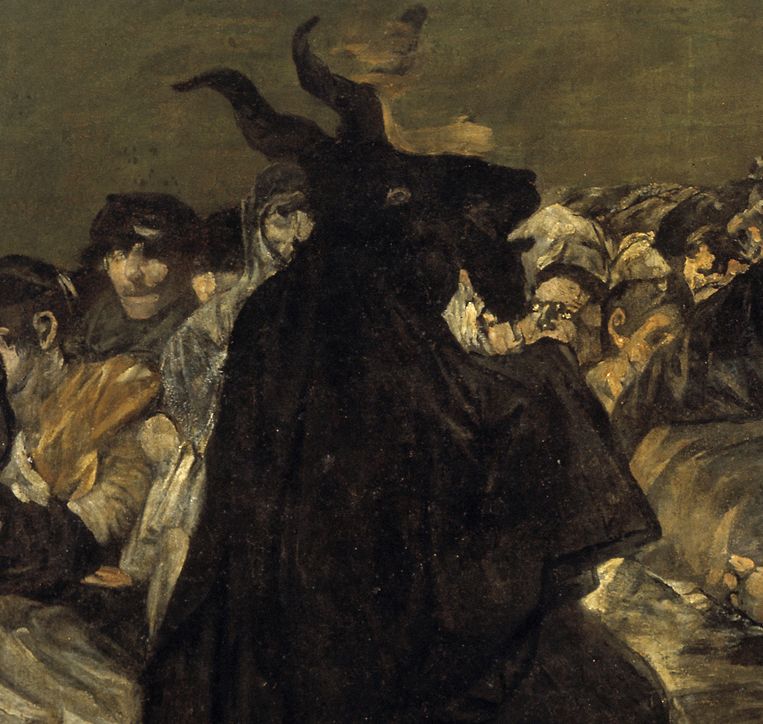
The light cloth
In the foreground, the pale fabric widens from the head down to the ground. The light surface stands between two dark groups.
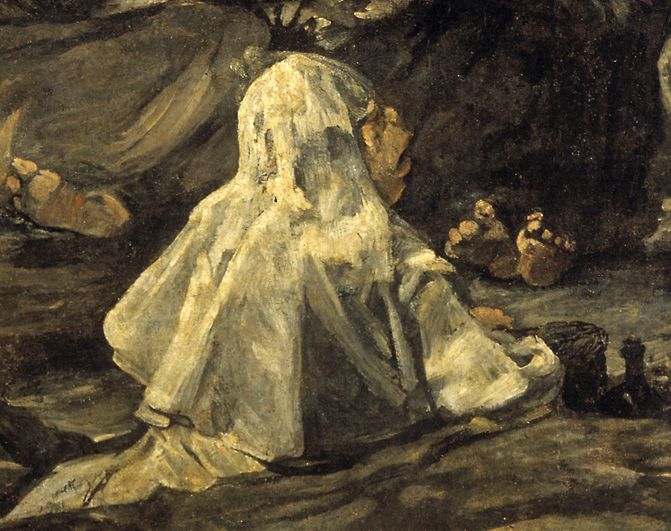
A close row of faces
Heads overlap, showing very little of the space between them. A few light strokes are enough to suggest the direction of a gaze.
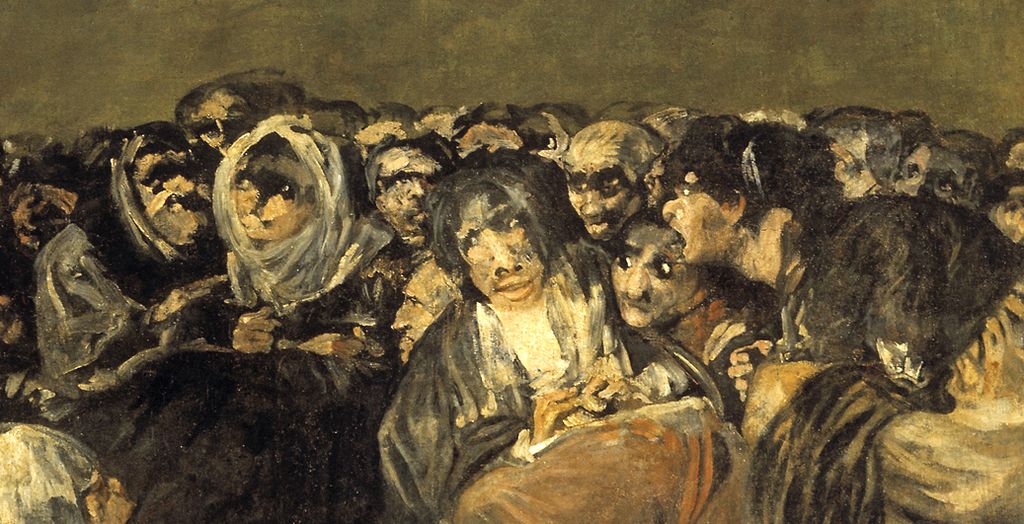
The woman at right
The woman looks back across the gathering. Her sleeve is striped and dark fabric spreads below it.
A gathering on the wall of the Quinta
Goya bought the Quinta del Sordo on the outskirts of Madrid in 1819. Its surviving murals are known as the Black Paintings. Several scenes on the ground floor ask to be looked at almost as closely as an easel painting. The Sabbath, at nearly six metres wide in the nineteenth-century photographs, invited someone in the room to follow it along a wall. The works acquired familiar names after Goya’s lifetime. Charles Yriarte’s French book of 1867 gives the goat a prominent place in its catalogue title and discusses the subject as a witches’ assembly in the account of the room. The two names still offer distinct ways into the painting. One picks out the figure commanding the gathering, and the other makes the listeners part of the subject. [4] [6] [7]
In his description of entering the ground-floor room, Yriarte places the Sabbath on the left and Pilgrimage to San Isidro on the right. Carlos Teixidor and F. Javier Laguna use his separate catalogue list and the model of Madrid made by León Gil de Palacio to reconstruct the bearing of the long walls. Their plan puts the Sabbath along the wall facing an inner courtyard and proposes that a doorway was closed to provide a continuous surface. They cite the lack of an identifiable earlier landscape beneath this painting in the radiographic study as evidence consistent with fresh preparation of that wall. Foradada and his colleagues give the opposite wall to the Pilgrimage and situate it between the garden doors. They question the closed-doorway proposal, pointing to the opening shown on the scale model and to the width the paintings would have required. The two crowds face one another in both plans. The disagreement concerns which way the room opened and which destinations lay behind those walls. [4] [6] [7] [8]
In the Pilgrimage, near faces give way to a line of people receding into the distance. In the Sabbath, heads lead back towards a dark figure within the gathering. Standing between the two long walls would have meant turning from one kind of collective activity to another, with different cues about where to look. Just as importantly, the two crowds once had different stretches of space around them. The length of the Prado’s Sabbath gives a sense of that encounter, while its apparently abrupt finish by the woman depends on a much later change. [2] [5] [7]
Goya on film
Five films explore Goya’s portraits, prints, Black Paintings and painting techniques.
The Duke of Wellington by Goya
The portrait, its military decorations and its later theft.
Watch on YouTubeThe two photographs and the lost width
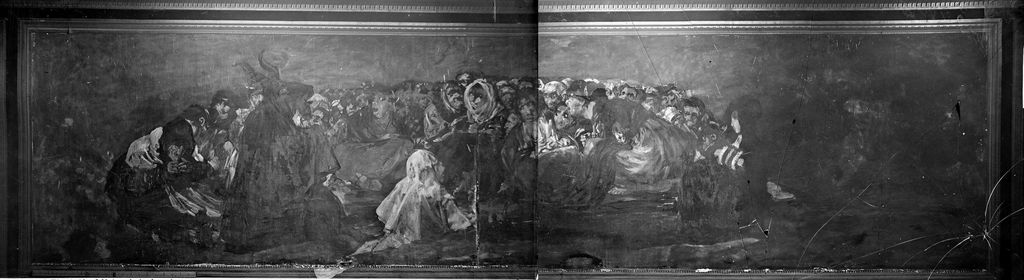
Jean Laurent photographed the Sabbath while its painted surface was still attached to the wall. Research by Teixidor and Raquel Esteban Vega places the campaign in 1874, in the period after Baron d’Erlanger acquired the house and before or at the beginning of work to remove the murals. Laurent made two overlapping exposures, preserved as glass negatives in the Archivo Ruiz Vernacci of the Instituto del Patrimonio Cultural de España (IPCE). The firm’s 1896 catalogue uses a single number, A-2566, for the pair. The plates record different stretches of the same continuous surface. This accounts for the two images sometimes reproduced as the first and second fragments. [2] [3] [9] [10]
The left exposure, VN-a-008125 P, includes the goat and the figures directly around it. The light drapery on the nearer figure and the rising mass of heads give bearings when comparing it with the canvas. The right exposure, identifiable by the inscription Goya – 2566 – 2do trozo del Sábado, picks up the crowd through the overlap. The Fototeca’s Carlos Teixidor identifies that negative as 9217 and records that its glass broke into 18 pieces. [9] There it carries on past the seated woman and into a dark area with indistinct variations of tone. Glendinning reproduces both views together as his figure 52. Even in that cropped publication, the woman is some distance from the right limit of the photograph. In the copies Glendinning consulted, the painted edging confirms that this expanse lay within the composition. It is possible to see darker lines continuing across the field and much harder to assign the patches a subject. [2] [3] [11]
Laurent included a metre rule, letting researchers relate the proportions of the recorded picture to a physical scale. Nigel Glendinning calculated an overall mural width between 577 and 585.4 centimetres and quoted 438 centimetres for the transferred canvas. Corinne Cristini gives an estimated width of 583.5 centimetres for the mural. Foradada and colleagues give approximately 579 centimetres for the painted field, and 625 centimetres including the mouldings. The 435.7 centimetres in the Fundación catalogue refers to the canvas in the museum and differs only slightly from the older published canvas measurement. Put the two kinds of dimensions together and the difference is roughly a metre and a half, chiefly at the right. Reconstructing a width from two photographs requires locating the painted edges, allowing for the overlap and establishing the scale of each image. The figures establish the size of the change much more closely than the distance from the woman’s profile to the old edge can be read off a cropped reproduction. [2] [4] [8] [11]
The photographs and canvas also differ in smaller ways. Glendinning pointed to the shading around eyes, the treatment of the goat’s horns and folds in its dark cape. Differences in the definition of the seated woman’s chair contribute to what she seems to be doing in the present canvas. The plates are monochrome and were exposed under conditions that could favour one area of the wall over another. Esteban Vega makes the case that Laurent used electric lighting in the house. Details such as the outline of a painted border or the placement of a head give firmer grounds for comparison than the exact brightness of a patch of ground. The wall had also already had decades to deteriorate. The photographs record a nineteenth-century state of the painted surface that predates its removal. [2] [10]
D’Erlanger entrusted the transfer to the restorer Salvador Martínez Cubells. Esteban Vega uses his register to date the start of work on the group to 1874. A report in the Madrid newspaper El Globo in July 1875 describes seeing a canvas of an assembly of witches and warlocks more than five metres wide. If that approximate measurement is reliable, more of the width survived the initial transfer than remains today. The newspaper gives no indication of exactly how much of the right-hand ground had been lifted or at which stage the canvas reached its present width. It establishes a further point between Laurent’s photographs and the museum object, and favours some reduction after the paint had reached canvas. [7] [10]
By 1878 photographs of the Paris Universal Exhibition show the Sabbath and the Pilgrimage hanging as separate pictures at the Trocadéro. The retained canvas makes the coven visually more dominant, and the woman’s figure becomes a boundary to the group. Cristini raises the possibility that the missing stretch was too damaged to reconstruct and also considers whether it was judged expendable because it had so little identifiable subject matter. The timing and reason for the cut remain open. Modern recording by Factum Arte and the Prado adds views of the surviving painting in colour, surface relief, infrared and X-ray. Laurent’s right-hand exposure still supplies the visible record of the space beyond the woman. [7] [10] [11] [12]
The right-hand photograph also changes how we might read the separation between the woman and the group. In the Prado canvas her upright form stops the movement of the people’s heads towards the border. In the photograph, the eye can continue beyond her into the dim field. She is then a person sitting near the gathering with room on the other side, and the crowd itself seems concentrated towards one end of a much longer picture. Reading across the wall would have involved passing from figures and clothing that can still be distinguished into a passage whose small dark variations are harder to make sense of. [2] [11]
Where the group used to end
The two Laurent exposures make it possible to look beyond what the surviving right edge now says about the young woman. An image cropped close to her can make her feel like a counterweight to the goat at the far end. If the field extends beyond her, her distance from the rest of the figures becomes an interval inside a broader image, and the dark area around her has more time to register. The early photographs therefore affect the way one can read the composition even without supplying every detail of colour or brushwork from the missing portion. [10] [7]
Esteban Vega’s examination of the photographic campaign helps explain why the two exposures can be used together. The interest in these plates lies partly in the relation between a large painted field and what could be recorded from inside a room. An overlap can fix two views beside one another through recognisable passages. Differences in illumination give darker areas a less secure value as evidence of the actual surface colour. It is the continuity of shapes and intervals that lets the photographs say most directly how much larger the painting once appeared. [10] [7]
A reconstruction of the room also changes the imagined route through that field. A visitor could have seen the audience from one end as a broad mass of faces before picking out the figure who seems to address them. The painter could use the much quieter area near the isolated woman to open a pause in that reading. The canvas now allows a fuller view from a museum floor while altering the proportions of that pause. Comparing the surviving object and the early photographs makes those two viewing conditions part of the work’s history. [10] [7]
Near the woman, the present edge can become an unintended cue to the meaning of the scene. A museum viewer may treat the space around her as the painter’s measure of how thoroughly she is excluded from the gathering. The early views make it possible to separate that inference from the surviving interval on the wall. They retain evidence of an extended field and the disposition of the figure within it. Establishing the extent of that field makes the contrast between the gathering’s scale and the single figure more precise, even if the viewer has no way to recover the missing paint. [10] [7]
Goya’s earlier Witches’ Sabbath
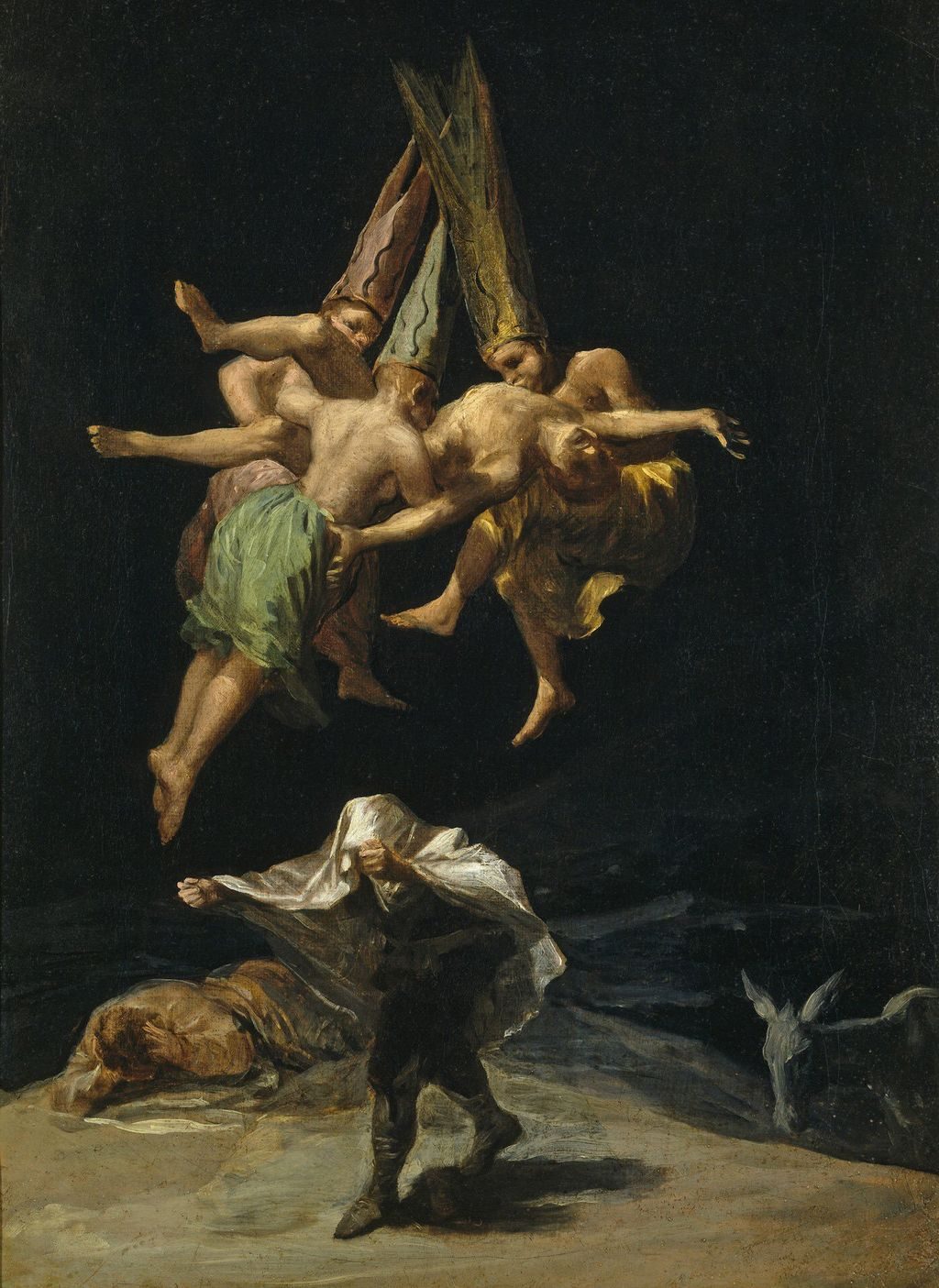
About a quarter of a century earlier Goya put a goat and a gathering of witches in a very different setting. The Museo Lázaro Galdiano dates its El Aquelarre, inventory 02006, to 1797–1798 and records it as an upright oil on canvas measuring 43 by 30 centimetres without its frame. The Duke and Duchess of Osuna acquired it in 1798 as one of six paintings commissioned for their country estate, El Capricho, at La Alameda outside Madrid. The museum associates the set with the room later called the library. Witches’ Flight belonged to the same commission. [13] [14]
In the Osuna painting the goat’s wide eyes, horned head and crown of leaves are legible, and the bodies of the people around it form a more distinct circle. Women of different ages bring children forward. One child is conspicuously thin. The sky leaves room for a moon and flying bats, giving the little canvas a recognisable night setting even though the distant terrain gives little away about the place. The Lázaro Galdiano catalogue connects the offering with images of the witches’ sabbath and discusses the possibility of a satirical treatment of superstition. Its account mentions the 1610 Logroño proceedings as one possible source within a wider range of written and popular traditions. Moratín’s reprint appeared in 1811, after the Osuna painting was made. [13] [14]
In the later mural the horns still make the presiding figure readily identifiable, but the head is turned into profile and the body absorbs the low light. The small canvas allows viewers to inspect visible offerings and follow distinct gestures. The mural makes us reckon with the sheer number of people who have gathered and with the difficulty of separating their expressions. It is easy to look at an open mouth as a sign of terror because it has been painted in a company of other wide eyes and parted lips. The same face alone might suggest a cry, eager attention or speech. The different arrangements make the works a study in how much a surrounding group can determine what a single gesture seems to mean. [1] [4] [13]
The Fundación Goya also notes Folke Nordström’s interpretation of the mural. He links the male goat with Capricorn, a sign traditionally ruled by Saturn, and reads that association in relation to melancholy. The presence of Saturn Devouring His Son in the same room gives this proposal a setting in which the two images could be read together. The links between the goat, listeners and apparent newcomer also sustain a more immediate reading about authority within the gathering. The bowed bodies, heightened expressions and compressed depth can make attention to the goat seem like something experienced collectively, even as the woman at the side gives the eye a place from which to look back at the crowd. [4] [6] [7]
 in Detail Francisco de Goya.jpg)
Artworks directory
| Name | Date | Medium |
|---|---|---|
| And There’s No Help for It, Plate 15 | Printed 1863 | |
| Asmodea | c. 1820–23 | Wall painting transferred to canvas |
| Boys Inflating a Bladder | 1777–78 | Tapestry cartoon |
| Boys Picking Fruit | 1778 | Tapestry cartoon |
| Bullfight in a Divided Ring | 1825 | Lithograph |
| Card Players | 1777–78 | Tapestry cartoon |
| Card Players (sketch) | 1777–78 | Painted sketch |
| Dance on the Banks of the Manzanares | 1777 | Tapestry cartoon |
| Duel with Cudgels | c. 1820–23 | Wall painting transferred to canvas |
| Heads in a Landscape | c. 1820–23 | Easel painting |
| Judith and Holofernes | c. 1820–23 | Wall painting transferred to canvas |
| Leocadia | c. 1820–23 | Wall painting transferred to canvas |
| Maja and Cloaked Men | 1777 | Tapestry cartoon |
| Maja and Cloaked Men (sketch) | 1777 | Painted sketch |
| Majo Clapping in Time to the Music | 1777 | Drawing |
| Men Reading | c. 1820–23 | Wall painting transferred to canvas |
| Out Hunting for Teeth, Plate 12 | 1799 | Etching, burnished aquatint and burin |
| Picnic in the Countryside (sketch) | 1776–78 | Painted sketch |
| Picnic on the Banks of the Manzanares | 1776 | Tapestry cartoon |
| Pilgrimage to San Isidro | c. 1820–23 | Wall painting transferred to canvas |
| Preparatory study for The Sleep of Reason Produces Monsters | c. 1796–97 | Drawing |
| Procession of the Holy Office | c. 1820–23 | Wall painting transferred to canvas |
| Quarrel at the Cockerel Inn (sketch) | 1777 | Painted sketch |
| Quarrel in the New Tavern | 1777 | Tapestry cartoon |
| Saturn Devouring His Son | c. 1820–23 | Wall painting transferred to canvas |
| Seated Majo Smoking | c. 1776 | Drawing |
| The Dog | c. 1820–23 | Wall painting transferred to canvas |
| The Drinker | 1777 | Tapestry cartoon |
| The Fates | c. 1820–23 | Wall painting transferred to canvas |
| The Great He-Goat | c. 1820–23 | Wall painting transferred to canvas |
| The Kite | 1777–78 | Tapestry cartoon |
| The Parasol | 1777 | Oil on canvas, tapestry cartoon |
| The Second of May 1808 | 1814 | Oil on canvas |
| The Sleep of Reason Produces Monsters, Plate 43 | 1799 | Etching and aquatint |
| The Third of May 1808 | 1814 | Oil on canvas |
| Thou Who Canst Not, Plate 42 | 1799 | Etching and burnished aquatint |
| Three Figures | 1776 | Drawing (lost) |
| Two Old Men | c. 1820–23 | Wall painting transferred to canvas |
| Two Old Men Eating Soup | c. 1820–23 | Wall painting transferred to canvas |
| Two Women and a Man | c. 1820–23 | Wall painting transferred to canvas |
| Universal Language: The Author Dreaming | 1797 | Drawing |
| The Family of Charles IV | 1800 | Oil on canvas |
| Witches’ Sabbath (Osuna painting) | 1797–98 | Oil on canvas |
| The Nude Maja | 1795–1800 | Oil on canvas |
| The Clothed Maja | 1800–07 | Oil on canvas |
| Self-Portrait (Drawing) | c. 1796 | Brush and carbon black ink on laid paper |
| The Swing, Madrid Album B.21 | 1795–97 | Brush and carbon black washes |
| Majas Fighting, a Majo Observing, Madrid Album B.15 | 1796–97 | Brush, grey and black washes on laid paper |
| Majos and Majas Conversing, Madrid Album B.16 | c. 1794–97 | Ink wash on paper |
| Weeping Woman and Three Men, Madrid Album B.17 | 1795–97 | Brush, carbon black washes and black chalk |
| Maja Seated on a Chair and Two Companions Behind, Madrid Album B.18 | 1795–97 | Brush and carbon black washes |
| Girl and Bull, Madrid Album B.23 | 1796–97 | Brush and carbon black washes |
| Lovers Sitting on a Rock, Madrid Album B.24 | 1796–97 | Brush and carbon black washes |
| Mariano Ceballos Riding a Bull | 1825 | Crayon lithograph and scraper |
| Landscape (lifetime impression) | c. 1807–10 | Etching and aquatint |
| Self-Portrait (1815), Prado canvas | 1815 | Oil on canvas |
| Self-Portrait (1815), Academy panel | 1815 | Oil on panel |
| Self-Portrait with Dr Arrieta | 1820 | Oil on canvas |
| Christ Crucified | 1780 | Oil on canvas |
| The Last Communion of Saint Joseph of Calasanz | 1819 | Oil on canvas |
| Christ on the Mount of Olives | 1819 | Oil on panel |
| The Flower Girls, or Spring | 1786–87 | Oil on canvas |
| The Grape Harvest, or Autumn | 1786–87 | Oil on canvas |
| The Snowstorm, or Winter | 1786–87 | Oil on canvas |
| The Threshing Ground, or Summer | 1786–87 | Oil on canvas |
| Picnic on the Banks of the Manzanares | 1776 | Oil on canvas |
| The Kite | 1777–78 | Oil on canvas |
| Dance on the Banks of the Manzanares | 1777 | Oil on canvas |
| A Fight at the Venta Nueva | 1777 | Oil on canvas |
| Blind Man’s Bluff | 1788 | Oil on canvas |
| Dogs on a Lead | 1775 | Oil on canvas |
| Hunting with a Decoy | 1775 | Oil on canvas |
| Hunter Loading His Rifle | 1775 | Oil on canvas |
| The Angler | 1775 | Oil on canvas |
| The Hermitage of San Isidro on His Feast Day | 1788 | Oil on canvas |
| The Meadow of San Isidro | 1788 | Oil on canvas |
| The Straw Manikin | 1791–92 | Oil on canvas |
| Witches’ Flight | c. 1797–98 | Oil on canvas |
| A Scene from ‘The Forcibly Bewitched’ | 1798 | Oil on canvas |
| The Duchess of Alba in Black | 1797 | Oil on canvas |
| The Duchess of Alba in White | 1795 | Oil on canvas |
| Charles III in Hunting Dress | c. 1786 | Oil on canvas |
| The Duke and Duchess of Osuna and Their Children | 1787–88 | Oil on canvas |
| Manuel Osorio Manrique de Zúñiga | 1787–88 | Oil on canvas |
| The Marquesa de Pontejos | c. 1786 | Oil on canvas |
| Equestrian Portrait of the 1st Duke of Wellington | 1812 | Oil on canvas |
| The Duke of Wellington | 1812–14 | Oil on wood |
| Portrait of Ferdinand VII of Spain | 1814 | Oil on canvas |
| Gaspar Melchor de Jovellanos | 1798 | Oil on canvas |
| María Tomasa Palafox y Portocarrero | 1804 | Oil on canvas |
| Señora Sabasa García | c. 1806–11 | Oil on canvas |
| Don Juan Bautista de Muguiro | 1827 | Oil on canvas |
| Doña Isabel de Porcel | Before 1805 | Oil on canvas |
| The Colossus | After 1808 | Oil on canvas |
| The Burial of the Sardine | 1808–12 | Oil on panel |
| The Madhouse | 1808–12 | Oil on panel |
| A Procession of Flagellants | 1808–12 | Oil on panel |
| Portrait of Jacques Galos | 1826 | Oil on canvas |
| Portrait of Mariano Goya, the Artist’s Grandson | 1827 | Oil on canvas |
| Milkmaid of Bordeaux | c. 1827 | Oil on canvas |
| Portrait of Don Juan Antonio Cuervo | 1819 | Oil on canvas |
| María Luisa of Parma (Naples version) | c. 1800 | Oil on canvas |
| The Countess of Baena | 1819 | Oil on canvas |
| The Family of the Infante Don Luis | 1783–84 | Oil on canvas |
| The Holy Family | c. 1787 | Oil on canvas |
| Saint Barbara | c. 1773 | Oil on canvas |
| Saints Justa and Rufina | 1817 | Oil on canvas |
| El Tío Paquete | c. 1819–20 | Oil on canvas |
| The Forge | c. 1815–20 | Oil on canvas |
| Majas on a Balcony (Metropolitan Museum version) | c. 1800–10 | Oil on canvas |
| Maja and Celestina on a Balcony | c. 1808–12 | Oil on canvas |
| The Water Bearer | 1808–12 | Oil on canvas |
| Time and the Old Women | c. 1810 | Oil on canvas |
Frequently Asked Questions
The historic mural was roughly 5.8 metres wide. About 1.4–1.5 metres of width disappeared by the time it took its present form, chiefly from the area to the right of the seated woman. Small differences between published measurements reflect different records and the estimation of the mural’s width from photographs. [2] [4] [11]
Discussion
Look again at the images and ideas explored in Witches’ Sabbath or The Great He-Goat. These editorial prompts invite your observations.
Compare the Prado canvas with the right-hand fragment in Glendinning’s figure 52. Follow the seated woman’s line of sight back towards the goat, then look at the stretch of wall beside her in the photograph. How does that extra space affect your sense of whether she is part of the assembly or watching it from outside? [1] [2]
Reader Insights
Where does the pale figure in the foreground draw your gaze?
How does the space to the right of the last figure affect the arrangement of the group?
Join the Conversation
Share a detail, comparison or question about Witches’ Sabbath or The Great He-Goat below.
References
- Museo Nacional del Prado, El aquelarre o El gran cabrón, P000761. View source.
- Nigel Glendinning, ‘The Strange Translation of Goya’s “Black Paintings”’, The Burlington Magazine 117, no. 868 (1975), pp. 464–479, figs. 52–53. Figure 52 reproduces the two Laurent views published by Calleja in 1924. View source.
- Jean Laurent, El Aquelarre, left-hand exposure, glass negative VN-a-008125 P, Archivo Ruiz Vernacci, IPCE. Digitised record reproduced on Wikimedia Commons. View source.
- Fundación Goya en Aragón, Witches’ Sabbath (El aquelarre), catalogue entry 659. View source.
- Fundación Goya en Aragón, The Pilgrimage to San Isidro, catalogue entry 662. View source.
- Charles Yriarte, Goya. Sa vie, son œuvre, Paris, Henri Plon, 1867, ‘La maison de Goya’, pp. 91–96, and the catalogue on p. 140. View source.
- Carlos Teixidor Cadenas and F. Javier Laguna, ‘Las Pinturas negras en la Quinta de Goya. Reconstrucción de la planta baja, con las fotografías de J. Laurent de 1874’, in Goya en la Literatura, en la Música y en las Creaciones Audiovisuales, pp. 401–412. View source.
- Carlos Foradada, Carlos Narbaiza, José Javier Luis and Alfonso Burgos, ‘Las medidas de la casa de Goya y sus Pinturas negras en su entorno original’, ASRI, no. 20 (2021), pp. 53–82. View source.
- Carlos Teixidor Cadenas, ‘Aragón y Goya en la Fototeca del Instituto del Patrimonio Cultural de España’, Artigrama, no. 27 (2012), pp. 209–226, especially p. 218, note 20, on the A-2566 pair, and p. 220, note 22, on the right negative. View source.
- Raquel Esteban Vega, ‘Las fotografías de J. Laurent de las Pinturas negras de Goya’, in Goya en la Literatura, en la Música y en las Creaciones Audiovisuales, pp. 413–426. View source.
- Corinne Cristini, ‘D’un support à un autre. L’apport des photographies de Jean Laurent dans la mise en lumière des Pinturas Negras de Francisco de Goya’, L’Âge d’Or, no. 4, especially sections 1–3 on the plates, inscriptions and lost painted area. View source.
- Factum Arte and Museo Nacional del Prado, 3D and Colour Recording of Francisco de Goya’s Black Paintings, 2014–2015 project report and technical views. View source.
- Museo Lázaro Galdiano, El Aquelarre, inventory 02006, with the object and commission history and Carmen Espinosa’s catalogue discussion. View source.
- Fundación Goya en Aragón, Witches’ Sabbath (El aquelarre), catalogue entry 526 for the Osuna canvas. View source.








