


 by Tom Gurney
Tom Gurney BSc (Hons) is an art history expert with over 20 years experience
Published on June 19, 2020 / Updated on November 20, 2026
Email: tomgurney1@gmail.com / Phone: +44 7429 011000
Introduction
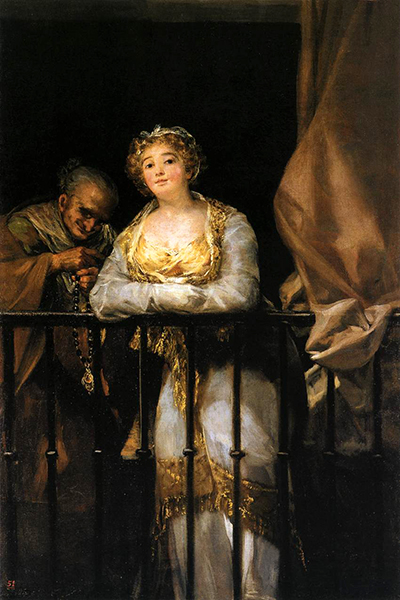
A young woman rests both forearms on an iron balcony rail. The light reaches her face, crosses the gold edging at her neckline and catches again in the folds of her skirt below the bars. To the left, an older woman bends forward out of the darkness, holding a rosary that hangs down into the lower half of the painting. A heavy curtain takes up much of the right side. Francisco de Goya gives these two women little space to move in, yet makes their positions count. One stands squarely where she can be seen. The other keeps back far enough that the eye has to adjust to see what she is holding. [1] [2]
Maja and Celestina on a Balcony, or Maja y celestina al balcón, is an oil on canvas dating from about 1808–12. It belongs to a private collection. The painting shares its balcony setting and an 1812 inventory entry with Goya’s Majas on a Balcony, a composition with two young women and two figures behind them. In this canvas the difference in age, dress and position between just two women carries the scene. The older woman’s title comes from a Spanish literary character whose occupation, arranging sexual encounters, gives the situation some of its tension. [1] [2] [3]
At a Glance
- ArtistFrancisco de Goya y Lucientes. [1]
- Spanish titleMaja y celestina al balcón.
- DateAbout 1808–12. [1] [2]
- Medium and dimensionsOil on canvas, 166 × 108 cm. [1]
- CollectionPrivate collection. The historical inventory entry is no. 24. [1]
- Related paintingMajas on a Balcony, a separate composition, represented by works in a private collection and the Metropolitan Museum of Art. [5] [9]
Works across Goya’s career
The Parasol
1777The Nude Maja
1795–1800Maja and Celestina on a Balcony
c. 1808–12Saturn Devouring His Son
c. 1820–23The Dog
c. 1820–23The view from below
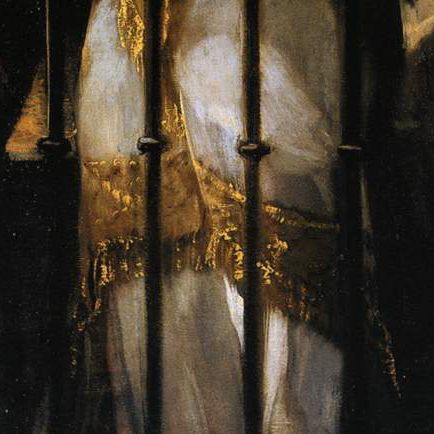
The railing divides the tall canvas almost in half. Above it the warm light on the young woman’s upper body picks her out against the room. Below it the bars cut her pale skirt into narrow strips. It takes a moment to join up the folds on either side of each bar, even though the angle of the gold trimming helps carry the eye from one strip to the next. Her forearms give the top of the rail its most evident purpose as a support. Lower down, the iron keeps the fabric at a distance. The same object that allows her to lean towards us is also the most substantial physical boundary in the picture. [1] [2]
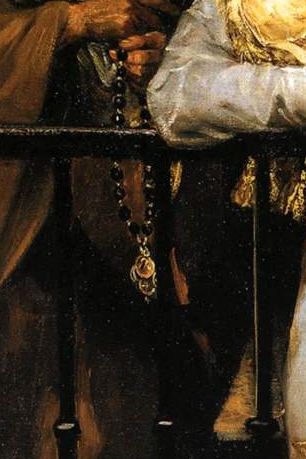
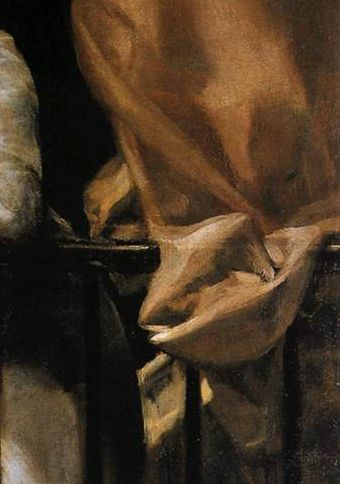
Look at the gold around the woman’s face and shoulders, then down at the little gleams in the older woman’s hands. The gilded look of the younger woman’s gown comes from a concentration of warmer marks near the neckline and along the edges of the fabric. The rosary catches the light very differently. At first it is a small detail by the older woman’s fingers. Follow the beads below the handrail and a small cross becomes visible against the darkness. The brightest and quietest details in the picture belong to the two figures’ different ways of occupying the same space. [1]
The curtain lets Goya show the opening without giving a view into the room. Its outer folds are broad and angular, with a sharp change of direction near the rail. Behind the women there is hardly anything to establish the room’s depth. The opening therefore feels shallow even though the dark passage behind them might extend well into the building. No street is shown either. The sense of being outside comes from the frontal ironwork and from the way the young woman’s head and eyes are set above us. The spectator has a place in the arrangement long before the setting offers any clue to where the building might be. [1] [2]
Annotated Details from Maja and Celestina on a Balcony
Follow the lit shoulders down to the rosary and along the balcony bars.
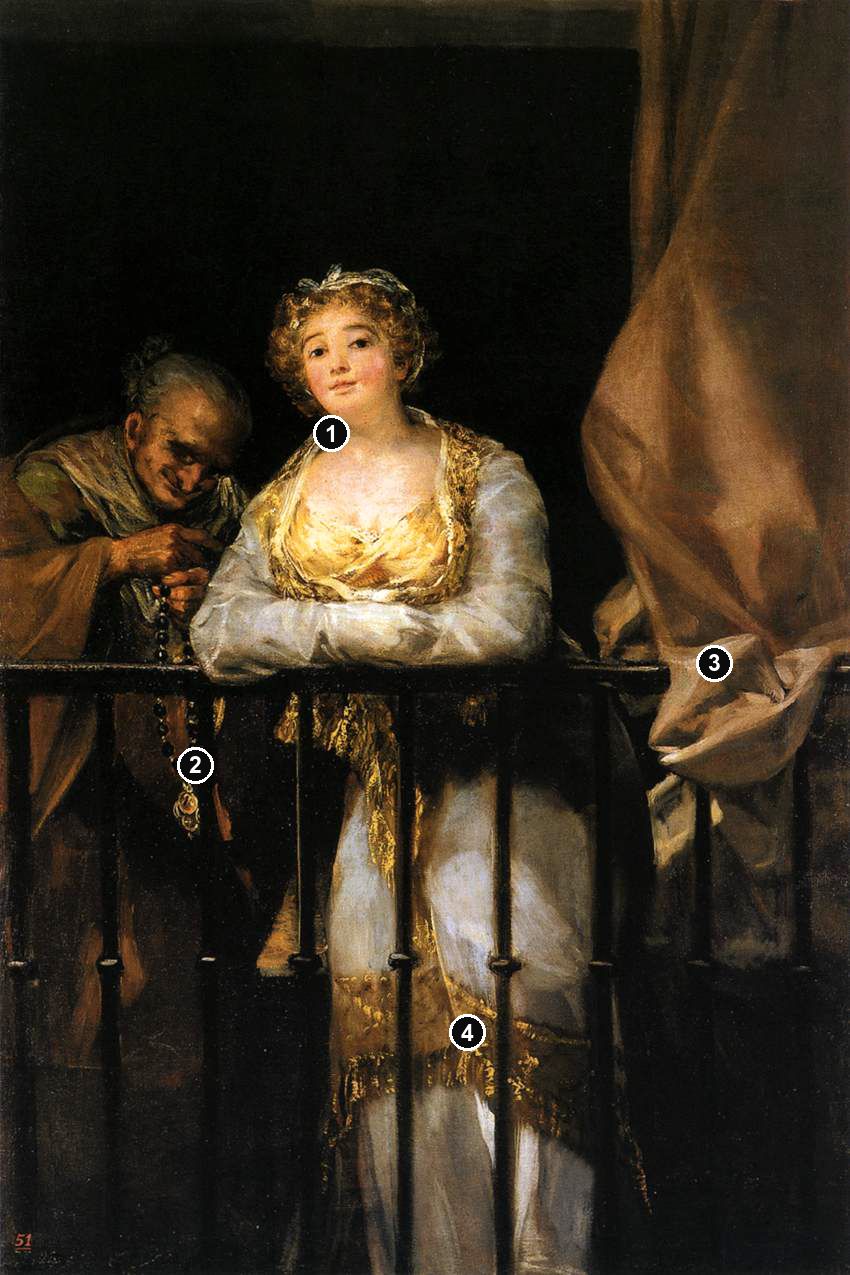
Details from MAJA AND CELESTINA ON A BALCONY
Details from the privately held canvas recorded in Fundación Goya catalogue 182.
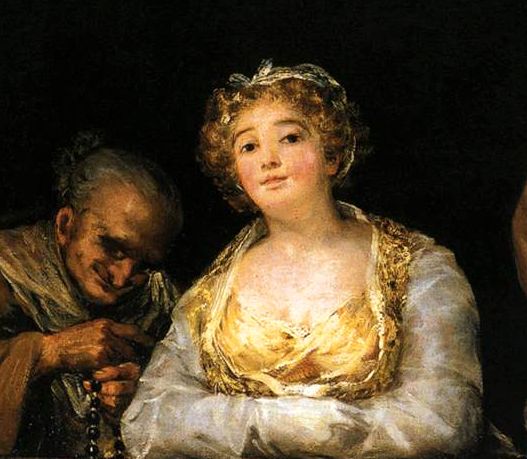
The faces and neckline
The younger woman’s lit face and gold trim stand out beside the older figure.
The rosary below the rail
A thread of beads hangs against the darkness and ends in a small cross.
The hanging curtain
The curtain folds forwards around the right end of the rail.
The skirt behind the bars
The straight black bars cross the illuminated fabric and trim.
What Celestina brings to the scene
In the work associated with Fernando de Rojas, first titled the Comedia and later the Tragicomedia de Calisto y Melibea, Calisto turns to a go-between in his pursuit of Melibea. His servant Sempronio directs him to Celestina. She is called an alcahueta in the list of characters, a term for a procuress or go-between. An early sixteenth-century Seville edition held by the Biblioteca Nacional de España gives her a prominent place in the full title. By that century the work was already known as La Celestina. Her part is central to a plot in which desire gives people leverage over one another and the pursuit of personal advantage ends disastrously. [3] [4]
The Fondation Beyeler’s exhibition guide reads the older woman in the painting as a matchmaker, amused at the effect the girl could have on men outside. That interpretation gives a particular meaning to the young woman’s position at the rail and the older woman’s place in the shadows. The relationship between the two is still largely left to the viewer. The young woman looks outward, the older woman has her hands together, and no other person is visible. The title evokes a familiar role without establishing that the young woman is Melibea or that this is a particular episode in the story. An alternative title recorded by the Fundación, Celestina y su hija (Celestina and Her Daughter), likewise supplies a relationship that the image alone cannot verify. [1] [2] [3]
A maja was a recognisable figure in Spanish popular culture, associated with distinctive dress and bearing. The title describes the younger woman in those terms. In the painting, the broad trim and pale cloth draw the eye as much as the neckline. Goya uses dress just as conspicuously in The Clothed Maja, where the reclining figure’s jacket and sash break up a long sweep of white. Here the colour is concentrated around the standing woman’s face and hands before it reappears between the bars. The separate paintings place their figures in different relations to the spectator. The reclining woman has a divan to herself. The woman at the balcony has company, and her companion’s proximity affects how we read her public appearance. [1] [5] [6]
Goya on film
Five films explore Goya’s portraits, prints, Black Paintings and painting techniques.
The Duke of Wellington by Goya
The portrait, its military decorations and its later theft.
Watch on YouTubeAn earlier encounter in Los Caprichos
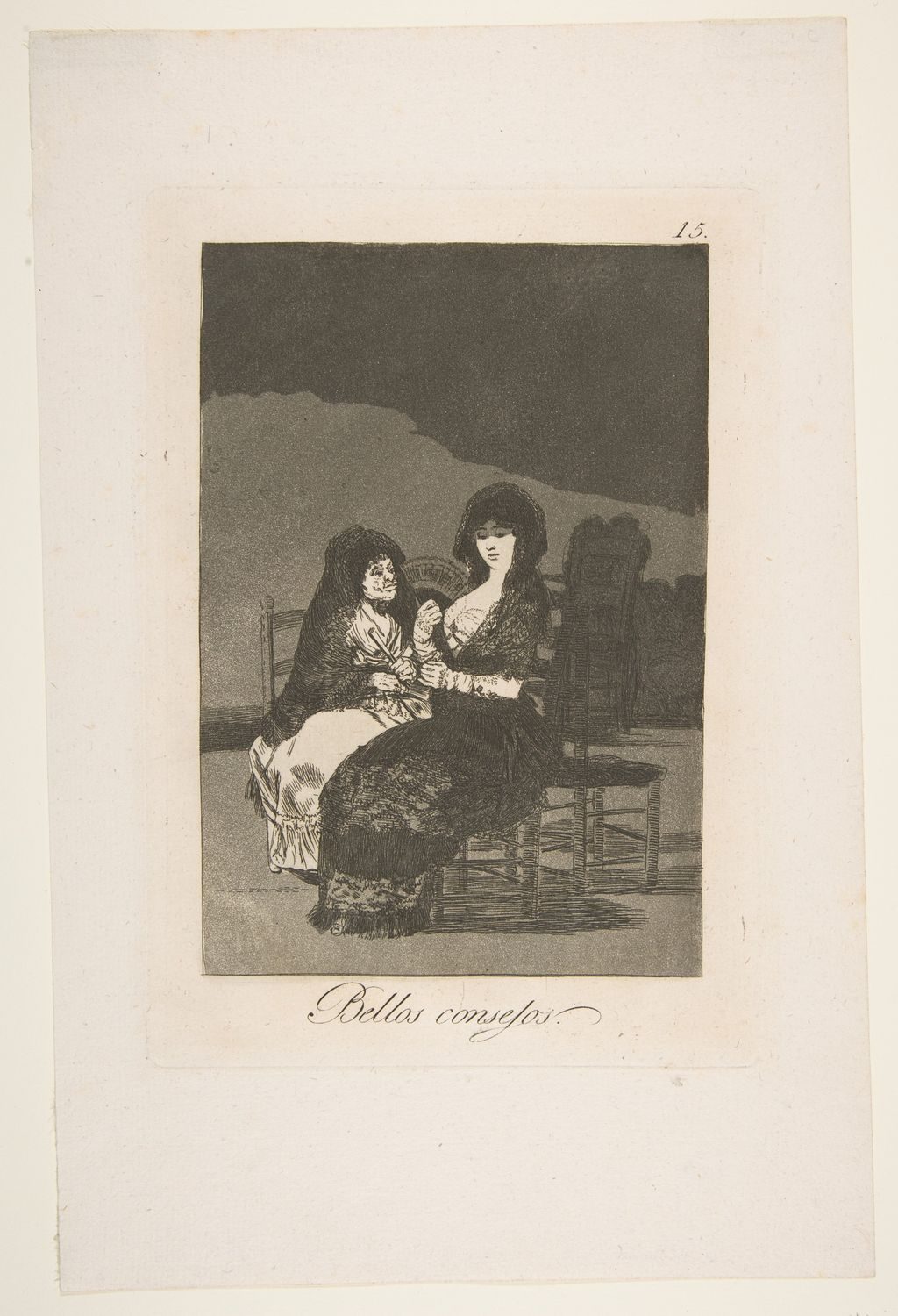
Look for the contrast between the two ages in Bellos consejos (Fine Advice), plate 15 of Los Caprichos. An older woman inclines towards a young woman seated in the foreground. The print has a caption, and the Fundación reads its apparent praise as ironic, explaining that the advice can usher a young woman into prostitution. The National Gallery of Victoria traces the seated figure’s pose back to a drawing in Goya’s Sanlúcar Album. The print places the two women close enough to suggest conversation. In the balcony painting, the young woman’s elbows and outward gaze leave the impression that her attention is somewhere beyond the rail. The similar pairing leaves room for a different sort of exchange. [7] [8]
Print and painting also give the older woman different kinds of visibility. Etched lines in Bellos consejos pick her profile out as she leans towards her companion. In the painting, the bright area around the young woman’s shoulders delays the moment when we make out the older face to the left. The beads offer a separate trail back to her hands. The age contrast carries a social suggestion in both works, but the oil painting makes that suggestion develop gradually as the viewer notices the darker half of the group. [1] [7]
Two canvases in the 1812 inventory
When Goya’s wife Josefa Bayeu died in 1812, an inventory was drawn up to divide property between the painter and their son Javier. Entry 24 lists two pictures of young women on a balcony, collectively valued at 400 reales. The Fundación identifies those pictures as this canvas and the privately held Majas on a Balcony. It records that the lower left of the Celestina canvas once carried the property inscription ‘X 24’, which is no longer visible. The inventory gives the two paintings an early documented connection. It also shows how little information a brief record needed to identify them to the family. The figures’ roles, the differences in the compositions and the literary associations go unmentioned. [1] [9]
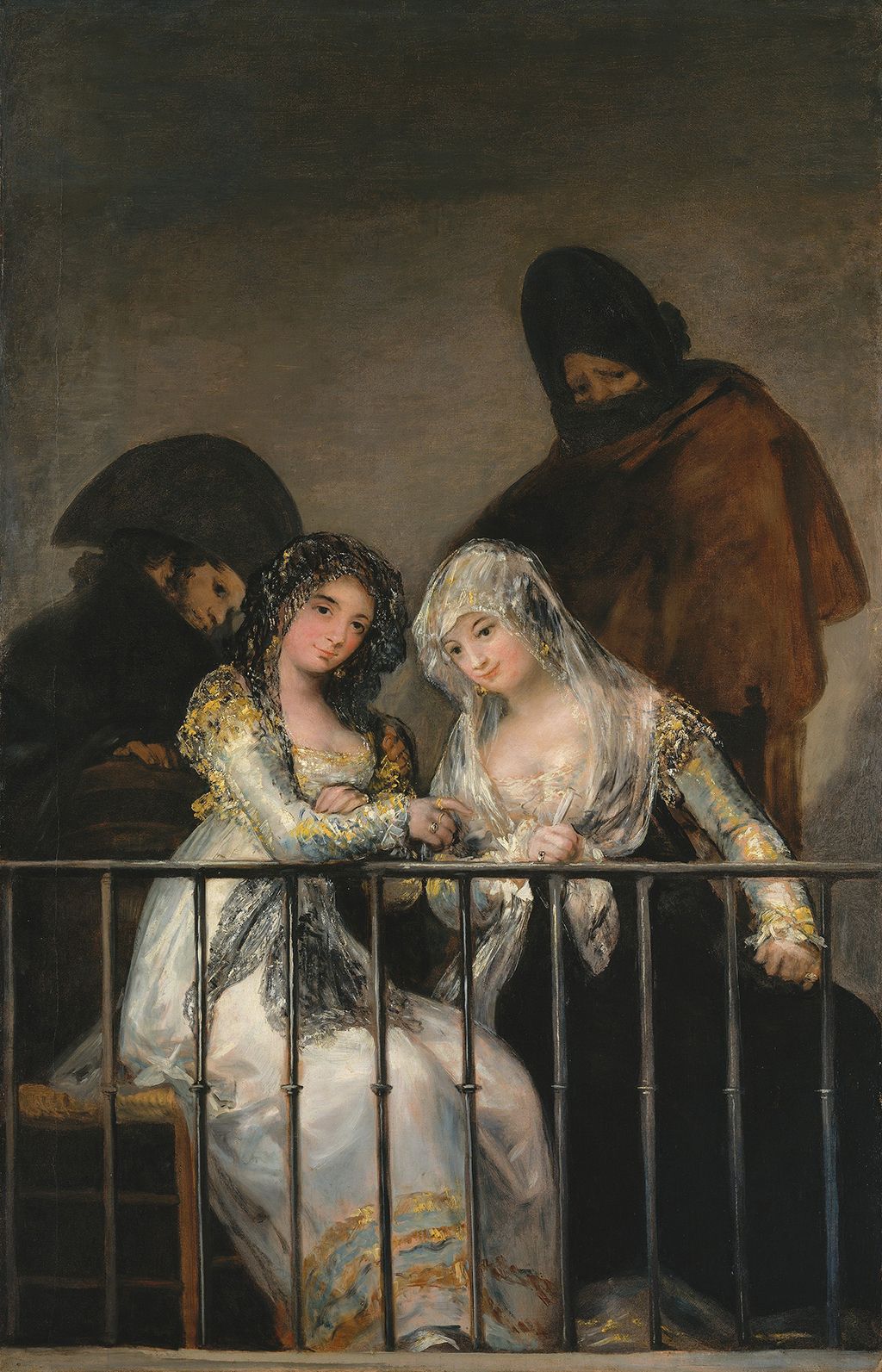
Their common subject was clear when the Fondation Beyeler hung the two privately held paintings side by side in its 2021–22 exhibition organised with the Museo Nacional del Prado. In the two-maja picture, the two women lean towards each other in front of two shadowed figures. Our attention moves between the women at the front and then towards the men behind. In the Celestina picture the strongest relationship runs diagonally back and to the left, from the upright woman at the railing to the older figure behind her. The shared device of the balcony can stage a group encounter in one canvas and throw the different roles of two people into relief in the other. [2] [9]
There is a further version of the two-maja composition in New York. The Metropolitan Museum of Art catalogues its own Majas on a Balcony, accession 29.100.10, as attributed to Goya. Its curators allow for a variant painted by Goya himself or a work by a close follower. The picture in this article is the one with the older woman and rosary. The Fundación catalogues this canvas as a documented work by Goya. The Metropolitan Museum’s accession and attribution apply to its separate painting. [1] [5]
From Javier Goya to private collections
The Fundación traces the Celestina canvas from Javier Goya to Francisco de Acebal y Arratia and then to his heir Luis Mac-Crohon. Juan March bought it in 1942. It passed to Bartolomé March in 1962 and was sold to another private owner in 2003. The historical March association helps explain why the family name appears in accounts of the painting. The Fundación’s current catalogue identifies the holding simply as a private collection. It gives a record for the work but no modern public accession number. [1]
Exhibitions have made the canvas intermittently accessible. The Fundación records its inclusion in the Prado’s 1928 Goya exhibition, its showing in Tokyo and Kyoto in 1971–72 and its appearance in the Beyeler exhibition. With both paintings in the same room, visitors could compare the height of the heads, the distance of each figure from the rail and how much of the interior Goya lets the eye see. [1] [2]
Artworks directory
| Name | Date | Medium |
|---|---|---|
| And There’s No Help for It, Plate 15 | Printed 1863 | |
| Asmodea | c. 1820–23 | Wall painting transferred to canvas |
| Boys Inflating a Bladder | 1777–78 | Tapestry cartoon |
| Boys Picking Fruit | 1778 | Tapestry cartoon |
| Bullfight in a Divided Ring | 1825 | Lithograph |
| Card Players | 1777–78 | Tapestry cartoon |
| Card Players (sketch) | 1777–78 | Painted sketch |
| Dance on the Banks of the Manzanares | 1777 | Tapestry cartoon |
| Duel with Cudgels | c. 1820–23 | Wall painting transferred to canvas |
| Heads in a Landscape | c. 1820–23 | Easel painting |
| Judith and Holofernes | c. 1820–23 | Wall painting transferred to canvas |
| Leocadia | c. 1820–23 | Wall painting transferred to canvas |
| Maja and Cloaked Men | 1777 | Tapestry cartoon |
| Maja and Cloaked Men (sketch) | 1777 | Painted sketch |
| Majo Clapping in Time to the Music | 1777 | Drawing |
| Men Reading | c. 1820–23 | Wall painting transferred to canvas |
| Out Hunting for Teeth, Plate 12 | 1799 | Etching, burnished aquatint and burin |
| Picnic in the Countryside (sketch) | 1776–78 | Painted sketch |
| Picnic on the Banks of the Manzanares | 1776 | Tapestry cartoon |
| Pilgrimage to San Isidro | c. 1820–23 | Wall painting transferred to canvas |
| Preparatory study for The Sleep of Reason Produces Monsters | c. 1796–97 | Drawing |
| Procession of the Holy Office | c. 1820–23 | Wall painting transferred to canvas |
| Quarrel at the Cockerel Inn (sketch) | 1777 | Painted sketch |
| Quarrel in the New Tavern | 1777 | Tapestry cartoon |
| Saturn Devouring His Son | c. 1820–23 | Wall painting transferred to canvas |
| Seated Majo Smoking | c. 1776 | Drawing |
| The Dog | c. 1820–23 | Wall painting transferred to canvas |
| The Drinker | 1777 | Tapestry cartoon |
| The Fates | c. 1820–23 | Wall painting transferred to canvas |
| The Great He-Goat | c. 1820–23 | Wall painting transferred to canvas |
| The Kite | 1777–78 | Tapestry cartoon |
| The Parasol | 1777 | Oil on canvas, tapestry cartoon |
| The Second of May 1808 | 1814 | Oil on canvas |
| The Sleep of Reason Produces Monsters, Plate 43 | 1799 | Etching and aquatint |
| The Third of May 1808 | 1814 | Oil on canvas |
| Thou Who Canst Not, Plate 42 | 1799 | Etching and burnished aquatint |
| Three Figures | 1776 | Drawing (lost) |
| Two Old Men | c. 1820–23 | Wall painting transferred to canvas |
| Two Old Men Eating Soup | c. 1820–23 | Wall painting transferred to canvas |
| Two Women and a Man | c. 1820–23 | Wall painting transferred to canvas |
| Universal Language: The Author Dreaming | 1797 | Drawing |
| The Family of Charles IV | 1800 | Oil on canvas |
| Witches’ Sabbath (Osuna painting) | 1797–98 | Oil on canvas |
| The Nude Maja | 1795–1800 | Oil on canvas |
| The Clothed Maja | 1800–07 | Oil on canvas |
| Self-Portrait (Drawing) | c. 1796 | Brush and carbon black ink on laid paper |
| The Swing, Madrid Album B.21 | 1795–97 | Brush and carbon black washes |
| Majas Fighting, a Majo Observing, Madrid Album B.15 | 1796–97 | Brush, grey and black washes on laid paper |
| Majos and Majas Conversing, Madrid Album B.16 | c. 1794–97 | Ink wash on paper |
| Weeping Woman and Three Men, Madrid Album B.17 | 1795–97 | Brush, carbon black washes and black chalk |
| Maja Seated on a Chair and Two Companions Behind, Madrid Album B.18 | 1795–97 | Brush and carbon black washes |
| Girl and Bull, Madrid Album B.23 | 1796–97 | Brush and carbon black washes |
| Lovers Sitting on a Rock, Madrid Album B.24 | 1796–97 | Brush and carbon black washes |
| Mariano Ceballos Riding a Bull | 1825 | Crayon lithograph and scraper |
| Landscape (lifetime impression) | c. 1807–10 | Etching and aquatint |
| Self-Portrait (1815), Prado canvas | 1815 | Oil on canvas |
| Self-Portrait (1815), Academy panel | 1815 | Oil on panel |
| Self-Portrait with Dr Arrieta | 1820 | Oil on canvas |
| Christ Crucified | 1780 | Oil on canvas |
| The Last Communion of Saint Joseph of Calasanz | 1819 | Oil on canvas |
| Christ on the Mount of Olives | 1819 | Oil on panel |
| The Flower Girls, or Spring | 1786–87 | Oil on canvas |
| The Grape Harvest, or Autumn | 1786–87 | Oil on canvas |
| The Snowstorm, or Winter | 1786–87 | Oil on canvas |
| The Threshing Ground, or Summer | 1786–87 | Oil on canvas |
| Picnic on the Banks of the Manzanares | 1776 | Oil on canvas |
| The Kite | 1777–78 | Oil on canvas |
| Dance on the Banks of the Manzanares | 1777 | Oil on canvas |
| A Fight at the Venta Nueva | 1777 | Oil on canvas |
| Blind Man’s Bluff | 1788 | Oil on canvas |
| Dogs on a Lead | 1775 | Oil on canvas |
| Hunting with a Decoy | 1775 | Oil on canvas |
| Hunter Loading His Rifle | 1775 | Oil on canvas |
| The Angler | 1775 | Oil on canvas |
| The Hermitage of San Isidro on His Feast Day | 1788 | Oil on canvas |
| The Meadow of San Isidro | 1788 | Oil on canvas |
| The Straw Manikin | 1791–92 | Oil on canvas |
| Witches’ Flight | c. 1797–98 | Oil on canvas |
| A Scene from ‘The Forcibly Bewitched’ | 1798 | Oil on canvas |
| The Duchess of Alba in Black | 1797 | Oil on canvas |
| The Duchess of Alba in White | 1795 | Oil on canvas |
| Charles III in Hunting Dress | c. 1786 | Oil on canvas |
| The Duke and Duchess of Osuna and Their Children | 1787–88 | Oil on canvas |
| Manuel Osorio Manrique de Zúñiga | 1787–88 | Oil on canvas |
| The Marquesa de Pontejos | c. 1786 | Oil on canvas |
| Equestrian Portrait of the 1st Duke of Wellington | 1812 | Oil on canvas |
| The Duke of Wellington | 1812–14 | Oil on wood |
| Portrait of Ferdinand VII of Spain | 1814 | Oil on canvas |
| Gaspar Melchor de Jovellanos | 1798 | Oil on canvas |
| María Tomasa Palafox y Portocarrero | 1804 | Oil on canvas |
| Señora Sabasa García | c. 1806–11 | Oil on canvas |
| Don Juan Bautista de Muguiro | 1827 | Oil on canvas |
| Doña Isabel de Porcel | Before 1805 | Oil on canvas |
| The Colossus | After 1808 | Oil on canvas |
| The Burial of the Sardine | 1808–12 | Oil on panel |
| The Madhouse | 1808–12 | Oil on panel |
| A Procession of Flagellants | 1808–12 | Oil on panel |
| Portrait of Jacques Galos | 1826 | Oil on canvas |
| Portrait of Mariano Goya, the Artist’s Grandson | 1827 | Oil on canvas |
| Milkmaid of Bordeaux | c. 1827 | Oil on canvas |
| Portrait of Don Juan Antonio Cuervo | 1819 | Oil on canvas |
| María Luisa of Parma (Naples version) | c. 1800 | Oil on canvas |
| The Countess of Baena | 1819 | Oil on canvas |
| The Family of the Infante Don Luis | 1783–84 | Oil on canvas |
| The Holy Family | c. 1787 | Oil on canvas |
| Saint Barbara | c. 1773 | Oil on canvas |
| Saints Justa and Rufina | 1817 | Oil on canvas |
| El Tío Paquete | c. 1819–20 | Oil on canvas |
| The Forge | c. 1815–20 | Oil on canvas |
| Majas on a Balcony (Metropolitan Museum version) | c. 1800–10 | Oil on canvas |
| Maja and Celestina on a Balcony | c. 1808–12 | Oil on canvas |
| The Water Bearer | 1808–12 | Oil on canvas |
| Time and the Old Women | c. 1810 | Oil on canvas |
Frequently Asked Questions
She holds a rosary. Follow the beads down from her hands towards the narrow space between the bars. A little cross hangs below. [1]
Discussion
Look again at the images and ideas explored in Maja and Celestina on a Balcony. These editorial prompts invite your observations.
Try looking first at the young woman’s face, then at the hands holding the beads. How does the older woman’s presence change the way you read the pose at the rail? Compare how the figures share space with Majas on a Balcony and the seated pair in Bellos consejos from Los Caprichos.
Reader Insights
Find the rosary and follow it down through the rail.
Where does the light distinguish the two women?
Join the Conversation
Share a detail, comparison or question about Maja and Celestina on a Balcony below.
References
- Fundación Goya en Aragón, Maja y celestina al balcón, catalogue record 182, for the reproduction, object data, 1812 inventory, historical inscription and provenance. View source.
- Fondation Beyeler, Goya exhibition guide, room 4, entry 11, 2021–22, for the joint display and curatorial interpretation of the two compositions. View source.
- Fernando de Rojas, La Celestina, argument and list of characters, Biblioteca Virtual Miguel de Cervantes. View source.
- Spanish Ministry of Culture, Biblioteca Nacional de España, catalogue entry 16, for the history of the title and the Seville edition, BNE R/26575(4). View source.
- Metropolitan Museum of Art, Majas on a Balcony, 29.100.10, for the New York canvas, its attribution and dress context. View source.
- Fundación Goya en Aragón, La maja vestida, Museo Nacional del Prado P000741. View source.
- Fundación Goya en Aragón, Bellos consejos, for the engraving and interpretation of its title. View source.
- National Gallery of Victoria, Goya’s Caprichos: First edition of eighty etchings, for the comparison of the Sanlúcar Album drawing and plate 15. View source.
- Fundación Goya en Aragón, Majas al balcón, private collection, for the composition, provenance and the shared 1812 inventory entry. View source.
- Real Academia Española and Asociación de Academias de la Lengua Española, celestina, for the common noun derived from the literary character. View source.







