


 Francisco de Goya.jpg)
 by Tom Gurney
Tom Gurney BSc (Hons) is an art history expert with over 20 years experience
Published on June 19, 2020 / Updated on November 20, 2026
Email: tomgurney1@gmail.com / Phone: +44 7429 011000
Introduction
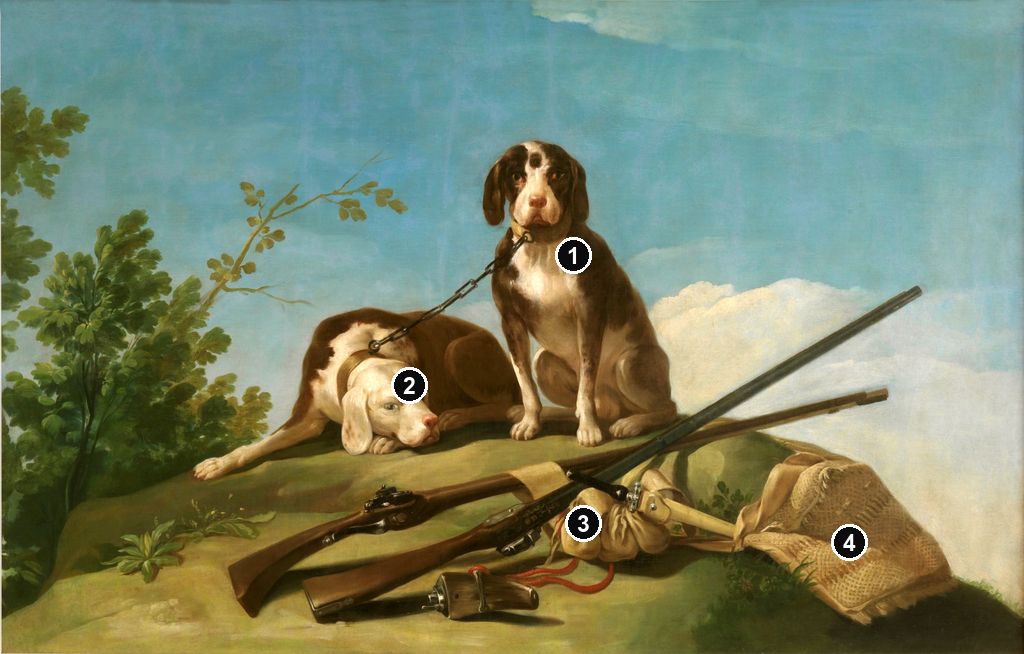
Two dogs occupy the crest of a grassy bank. One sits upright and looks out of the picture, while the other lies with its muzzle close to the earth. Beneath them, two guns lie beside the hunting bags. Francisco de Goya painted this scene in 1775 as a model for a tapestry intended for the dining room of the Prince and Princess of Asturias at El Escorial. The Museo Nacional del Prado catalogues the canvas as Perros en traílla, or Dogs on a Lead. It is also known as Perros y útiles de caza, meaning Dogs and Hunting Gear. [1] [2] [3] [4]
At a Glance
- ArtistFrancisco José de Goya y Lucientes.
- Date1775. Goya's account for the first five cartoons is dated 24 May. [1] [3]
- MediumOil on canvas, painted as a tapestry cartoon. [2]
- Size112 × 174 cm, height by width. [1] [2]
- CommissionA design for a hanging above a window in the royal dining room at San Lorenzo de El Escorial. [3] [5]
- CollectionMuseo Nacional del Prado, Madrid, P000753. [1] [5]
Works across Goya’s career
Dogs on a Lead
1775The Parasol
1777The Nude Maja
1795–1800Saturn Devouring His Son
c. 1820–23The Dog
c. 1820–23Two dogs on a rise
Goya gives the dogs the highest ground. The sitting animal has a white blaze down its face and a broad patch of white down its chest. Its front paws are planted just at the point where the ground begins to fall away. The eye goes to its face first because the dark ears stand out against the blue sky. The other dog is stretched along the bank with one foreleg reaching down the slope. Its pale face and drooping ears bring the eye back to ground level. The two bodies fit together in a triangle, with the sitting dog's head at the top and the extended paw forming one end of the base. [2]
The dark lead runs down across the resting dog's back. See how little paint Goya needs to show that the animals are tethered. The narrow line is distinct where it crosses a pale patch of coat, then becomes difficult to follow against the darker parts. The poses supply much of the feeling of the scene. The dog's chest and closely planted paws suggest alertness even in a seated position, while the animal beside it lets its weight settle into the bank. Goya's description of the dogs as tied helps explain the physical bond between them, although each keeps its own posture and direction of attention. [2] [3]
The low viewpoint gives the pair some of the stature of figures on a ridge. Trees and bushes fill the left edge, then a slender branch reaches into the sky behind the dogs. Its leaves are spaced far enough apart for the blue to show through. To the right, where the tree cover falls away, a pale cloud lies behind the sitting dog's flank. The foreground is almost all browns and greens, and the most conspicuous white shapes around the crest belong to the dogs. A viewer looking up at the woven version would have been able to pick out their silhouettes even before seeing the details of the gear. [2] [3]
Annotated Details from Dogs on the Leash
Compare the two dogs and trace the diagonals through the equipment at their feet.
Details from DOGS ON THE LEASH
Details from the tapestry cartoon in the Museo Nacional del Prado (P000753).
The upright dog
The upright dog lifts its head against a clear patch of sky.
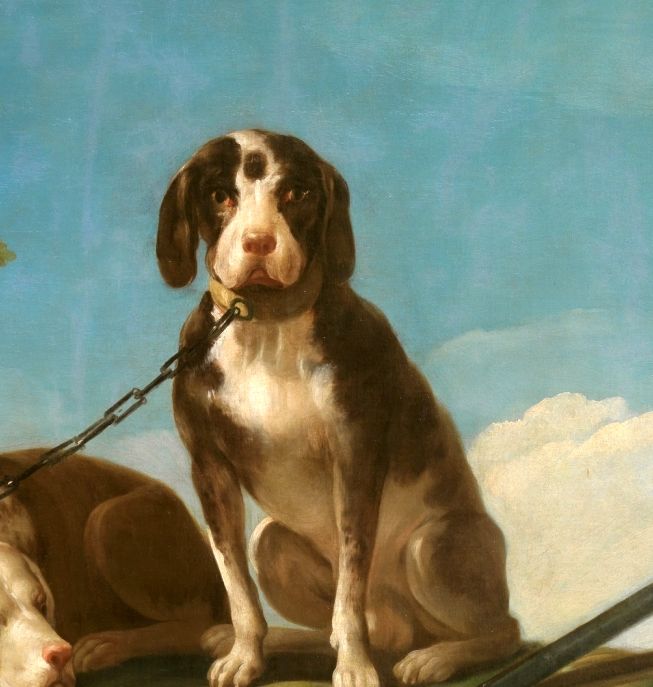
The resting dog
The second dog lowers its head close to the ground.
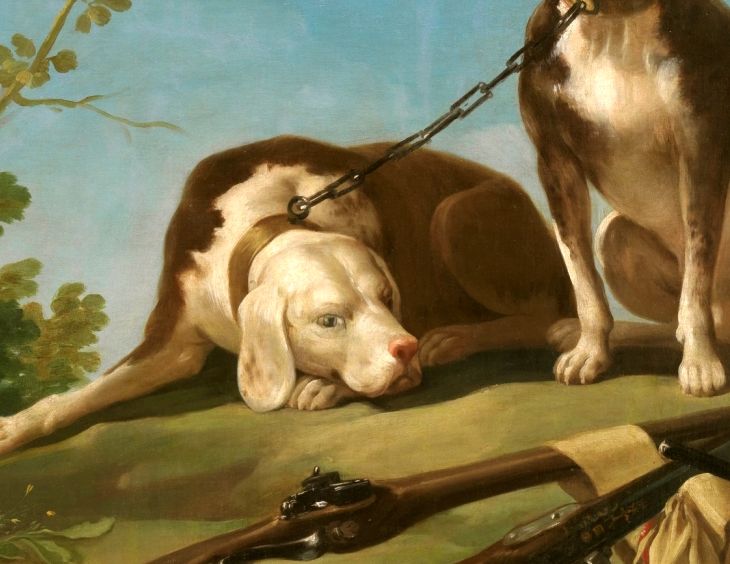
The crossed guns
The long lines of the guns cross the light on the slope.
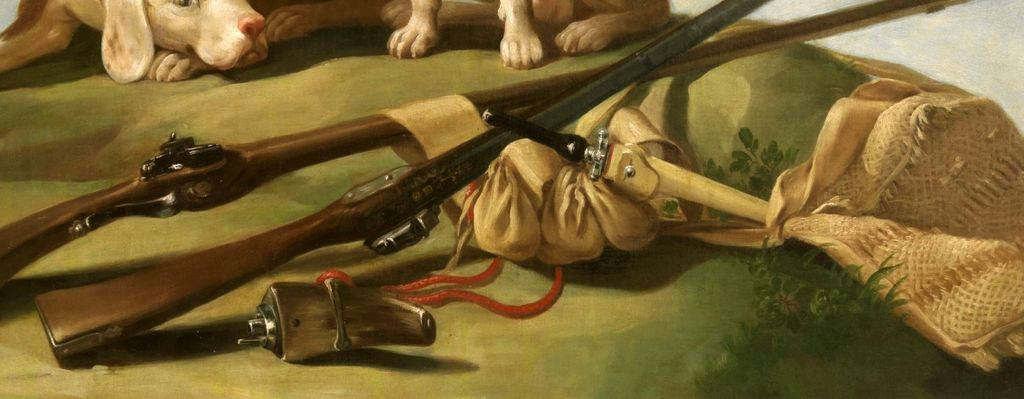
The bag and its straps
Folds and straps gather beside the stocks and continue into shadow.
Guns, pouches and a game bag
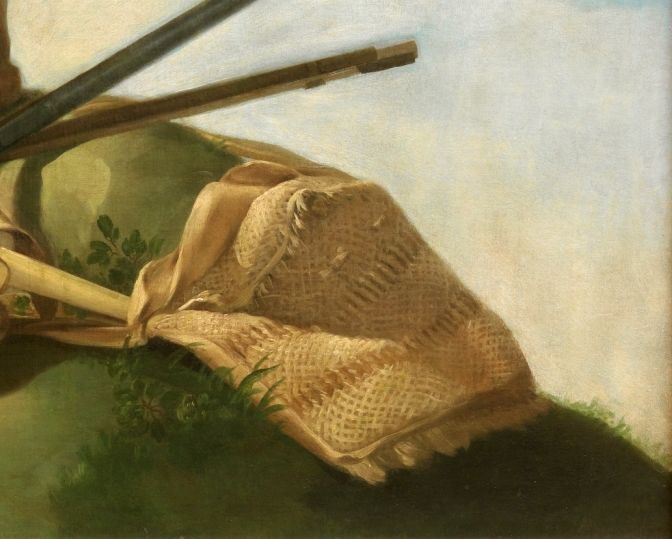
The position of the guns leads the eye in the opposite direction to the falling ground. Their dark stocks start close together at lower left and their barrels spread apart as they rise to the right. The thick stocks take up considerably more space than the barrels, and a few highlights make the metal fittings visible against the darker wood. Their straight lines run past the soft folds of the pouches and the bend of a reddish strap. At the far right the game bag rests against the slope, its lighter fabric and open weave catching the light. Goya lists two guns, pouches, a flask and a game bag in his account of the picture. The Prado's printed catalogue also identifies a powder horn among the gear. [1] [2] [3]
Even without a hunter in view, the equipment suggests how recently people have been here. The bags rest almost where they would fall if laid down beside the guns, but the rising barrels and the lead direct attention back to the dogs. The arrangement brings a still life of hunting gear into the open air. In The Boar Hunt, made for the same room, the dogs lunge at a boar and one is already on the ground. Their bodies take their direction from the quarry. Here the dogs' bodies follow the contours of the bank, and the equipment on the ground gives the scene its strongest diagonals. [2] [3] [6]
Goya on film
Five films explore Goya’s portraits, prints, Black Paintings and painting techniques.
The Duke of Wellington by Goya
The portrait, its military decorations and its later theft.
Watch on YouTubeA pair for the windows at El Escorial
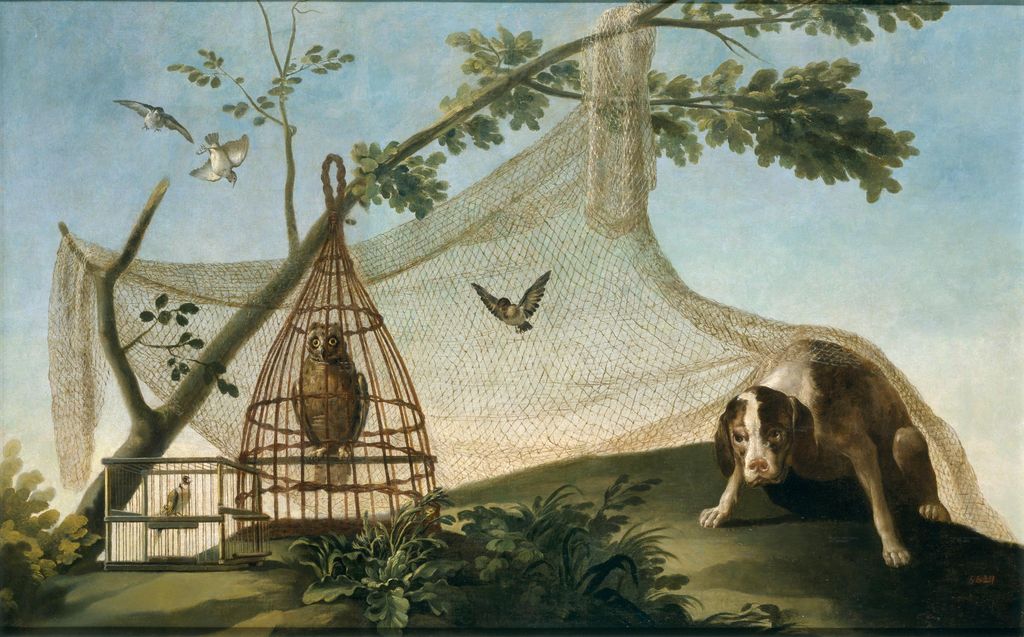
Goya's signed account to royal architect Francisco Sabatini names the room where the future Charles IV and María Luisa of Parma dined at El Escorial. He describes five cartoons from the first delivery. The Boar Hunt was a large central panel. Hunter Loading his Rifle and Hunter with his Dogs were narrow corner pieces. Goya lists the two remaining designs together as sobre ventanas, hangings for above windows, and values them jointly at 2,500 reales de vellón. These are Dogs on a Lead and Hunting with a Decoy (Caza con reclamo, Prado P002856). The two canvases are both 112 cm high and differ by only five centimetres in width. [3] [4] [5] [6]
In Hunting with a Decoy a tree supports a suspended net. A dog emerges beneath it and birds fly towards the caged owl described in Goya's account. The net gives the composition its main diagonal, much as the two barrels do in Dogs on a Lead. The small shapes of the flying birds make the open sky part of the action, while in Dogs on a Lead the sky sets off the head of the sitting dog. The two designs use the wide format to gather a distinct set of animals and implements into a single scene with silhouettes legible at a distance. [2] [3] [7]
Art historians Jesús López Ortega and Carlos Sanz de Miguel reconstruct the intended east wall with The Fisherman with his Rod between the balcony openings and the paired hunting pieces above the openings. The fisherman came in Goya's second delivery on 30 October. Their reconstruction uses the architecture and the documented dimensions to suggest how the different shapes worked together. They also trace a later arrangement in which seven tapestries from the scheme were recorded in the princess's antechamber. Goya's bill establishes which room the pair was made for, while the placement on the east wall is a scholarly reconstruction of the intended scheme. [3] [5] [6]

From the tapestry workshop to the Prado
At the Royal Tapestry Factory of Santa Bárbara the canvas served as a full-size guide for the weavers. These early commissions brought Goya to Madrid in 1775 through the recommendation of his brother-in-law Francisco Bayeu, who supervised the series. Goya's nine designs supplemented cartoons already painted by Ramón Bayeu, Francisco's brother. That shared commission helps explain why several painters' names appear in the history of the cartoons. Vicente López recorded the dogs as a work of Antonio González Velázquez in the 1834 inventory for Ferdinand VII's estate, while Gregorio Cruzada Villaamil attributed it to Ramón Bayeu in 1870. Valentín de Sambricio subsequently established Goya's authorship through documents including the account that identifies the paired window designs. [1] [2] [3] [6]
The cartoon was transferred from the factory to the Royal Palace in Madrid around 1856 or 1857. It was among the cartoons reported missing from the palace in 1869. The painter Raimundo de Madrazo bought it in Paris and donated it to the Museo del Prado in 1895, when it still carried the attribution to Ramón Bayeu. The survival of the canvas and the account lets us see the painting both as a study of two animals at rest and as one part of a commission whose subjects and dimensions were planned around a room. [1] [2] [3]
Artworks directory
| Name | Date | Medium |
|---|---|---|
| And There’s No Help for It, Plate 15 | Printed 1863 | |
| Asmodea | c. 1820–23 | Wall painting transferred to canvas |
| Boys Inflating a Bladder | 1777–78 | Tapestry cartoon |
| Boys Picking Fruit | 1778 | Tapestry cartoon |
| Bullfight in a Divided Ring | 1825 | Lithograph |
| Card Players | 1777–78 | Tapestry cartoon |
| Card Players (sketch) | 1777–78 | Painted sketch |
| Dance on the Banks of the Manzanares | 1777 | Tapestry cartoon |
| Duel with Cudgels | c. 1820–23 | Wall painting transferred to canvas |
| Heads in a Landscape | c. 1820–23 | Easel painting |
| Judith and Holofernes | c. 1820–23 | Wall painting transferred to canvas |
| Leocadia | c. 1820–23 | Wall painting transferred to canvas |
| Maja and Cloaked Men | 1777 | Tapestry cartoon |
| Maja and Cloaked Men (sketch) | 1777 | Painted sketch |
| Majo Clapping in Time to the Music | 1777 | Drawing |
| Men Reading | c. 1820–23 | Wall painting transferred to canvas |
| Out Hunting for Teeth, Plate 12 | 1799 | Etching, burnished aquatint and burin |
| Picnic in the Countryside (sketch) | 1776–78 | Painted sketch |
| Picnic on the Banks of the Manzanares | 1776 | Tapestry cartoon |
| Pilgrimage to San Isidro | c. 1820–23 | Wall painting transferred to canvas |
| Preparatory study for The Sleep of Reason Produces Monsters | c. 1796–97 | Drawing |
| Procession of the Holy Office | c. 1820–23 | Wall painting transferred to canvas |
| Quarrel at the Cockerel Inn (sketch) | 1777 | Painted sketch |
| Quarrel in the New Tavern | 1777 | Tapestry cartoon |
| Saturn Devouring His Son | c. 1820–23 | Wall painting transferred to canvas |
| Seated Majo Smoking | c. 1776 | Drawing |
| The Dog | c. 1820–23 | Wall painting transferred to canvas |
| The Drinker | 1777 | Tapestry cartoon |
| The Fates | c. 1820–23 | Wall painting transferred to canvas |
| The Great He-Goat | c. 1820–23 | Wall painting transferred to canvas |
| The Kite | 1777–78 | Tapestry cartoon |
| The Parasol | 1777 | Oil on canvas, tapestry cartoon |
| The Second of May 1808 | 1814 | Oil on canvas |
| The Sleep of Reason Produces Monsters, Plate 43 | 1799 | Etching and aquatint |
| The Third of May 1808 | 1814 | Oil on canvas |
| Thou Who Canst Not, Plate 42 | 1799 | Etching and burnished aquatint |
| Three Figures | 1776 | Drawing (lost) |
| Two Old Men | c. 1820–23 | Wall painting transferred to canvas |
| Two Old Men Eating Soup | c. 1820–23 | Wall painting transferred to canvas |
| Two Women and a Man | c. 1820–23 | Wall painting transferred to canvas |
| Universal Language: The Author Dreaming | 1797 | Drawing |
| The Family of Charles IV | 1800 | Oil on canvas |
| Witches’ Sabbath (Osuna painting) | 1797–98 | Oil on canvas |
| The Nude Maja | 1795–1800 | Oil on canvas |
| The Clothed Maja | 1800–07 | Oil on canvas |
| Self-Portrait (Drawing) | c. 1796 | Brush and carbon black ink on laid paper |
| The Swing, Madrid Album B.21 | 1795–97 | Brush and carbon black washes |
| Majas Fighting, a Majo Observing, Madrid Album B.15 | 1796–97 | Brush, grey and black washes on laid paper |
| Majos and Majas Conversing, Madrid Album B.16 | c. 1794–97 | Ink wash on paper |
| Weeping Woman and Three Men, Madrid Album B.17 | 1795–97 | Brush, carbon black washes and black chalk |
| Maja Seated on a Chair and Two Companions Behind, Madrid Album B.18 | 1795–97 | Brush and carbon black washes |
| Girl and Bull, Madrid Album B.23 | 1796–97 | Brush and carbon black washes |
| Lovers Sitting on a Rock, Madrid Album B.24 | 1796–97 | Brush and carbon black washes |
| Mariano Ceballos Riding a Bull | 1825 | Crayon lithograph and scraper |
| Landscape (lifetime impression) | c. 1807–10 | Etching and aquatint |
| Self-Portrait (1815), Prado canvas | 1815 | Oil on canvas |
| Self-Portrait (1815), Academy panel | 1815 | Oil on panel |
| Self-Portrait with Dr Arrieta | 1820 | Oil on canvas |
| Christ Crucified | 1780 | Oil on canvas |
| The Last Communion of Saint Joseph of Calasanz | 1819 | Oil on canvas |
| Christ on the Mount of Olives | 1819 | Oil on panel |
| The Flower Girls, or Spring | 1786–87 | Oil on canvas |
| The Grape Harvest, or Autumn | 1786–87 | Oil on canvas |
| The Snowstorm, or Winter | 1786–87 | Oil on canvas |
| The Threshing Ground, or Summer | 1786–87 | Oil on canvas |
| Picnic on the Banks of the Manzanares | 1776 | Oil on canvas |
| The Kite | 1777–78 | Oil on canvas |
| Dance on the Banks of the Manzanares | 1777 | Oil on canvas |
| A Fight at the Venta Nueva | 1777 | Oil on canvas |
| Blind Man’s Bluff | 1788 | Oil on canvas |
| Dogs on a Lead | 1775 | Oil on canvas |
| Hunting with a Decoy | 1775 | Oil on canvas |
| Hunter Loading His Rifle | 1775 | Oil on canvas |
| The Angler | 1775 | Oil on canvas |
| The Hermitage of San Isidro on His Feast Day | 1788 | Oil on canvas |
| The Meadow of San Isidro | 1788 | Oil on canvas |
| The Straw Manikin | 1791–92 | Oil on canvas |
| Witches’ Flight | c. 1797–98 | Oil on canvas |
| A Scene from ‘The Forcibly Bewitched’ | 1798 | Oil on canvas |
| The Duchess of Alba in Black | 1797 | Oil on canvas |
| The Duchess of Alba in White | 1795 | Oil on canvas |
| Charles III in Hunting Dress | c. 1786 | Oil on canvas |
| The Duke and Duchess of Osuna and Their Children | 1787–88 | Oil on canvas |
| Manuel Osorio Manrique de Zúñiga | 1787–88 | Oil on canvas |
| The Marquesa de Pontejos | c. 1786 | Oil on canvas |
| Equestrian Portrait of the 1st Duke of Wellington | 1812 | Oil on canvas |
| The Duke of Wellington | 1812–14 | Oil on wood |
| Portrait of Ferdinand VII of Spain | 1814 | Oil on canvas |
| Gaspar Melchor de Jovellanos | 1798 | Oil on canvas |
| María Tomasa Palafox y Portocarrero | 1804 | Oil on canvas |
| Señora Sabasa García | c. 1806–11 | Oil on canvas |
| Don Juan Bautista de Muguiro | 1827 | Oil on canvas |
| Doña Isabel de Porcel | Before 1805 | Oil on canvas |
| The Colossus | After 1808 | Oil on canvas |
| The Burial of the Sardine | 1808–12 | Oil on panel |
| The Madhouse | 1808–12 | Oil on panel |
| A Procession of Flagellants | 1808–12 | Oil on panel |
| Portrait of Jacques Galos | 1826 | Oil on canvas |
| Portrait of Mariano Goya, the Artist’s Grandson | 1827 | Oil on canvas |
| Milkmaid of Bordeaux | c. 1827 | Oil on canvas |
| Portrait of Don Juan Antonio Cuervo | 1819 | Oil on canvas |
| María Luisa of Parma (Naples version) | c. 1800 | Oil on canvas |
| The Countess of Baena | 1819 | Oil on canvas |
| The Family of the Infante Don Luis | 1783–84 | Oil on canvas |
| The Holy Family | c. 1787 | Oil on canvas |
| Saint Barbara | c. 1773 | Oil on canvas |
| Saints Justa and Rufina | 1817 | Oil on canvas |
| El Tío Paquete | c. 1819–20 | Oil on canvas |
| The Forge | c. 1815–20 | Oil on canvas |
| Majas on a Balcony (Metropolitan Museum version) | c. 1800–10 | Oil on canvas |
| Maja and Celestina on a Balcony | c. 1808–12 | Oil on canvas |
| The Water Bearer | 1808–12 | Oil on canvas |
| Time and the Old Women | c. 1810 | Oil on canvas |
Frequently Asked Questions
Hunting Dogs, or Perros en traílla, is the wide design with two dogs alone beside their gear. Hunter with his Dogs (Cazador con sus perros, Prado P000805) shows a man leading two dogs through a wooded landscape. Goya called it a corner piece and described a mounted hunter further away. The figure on horseback is now largely obscured by painted brushwood. [3] [5] [8]
Discussion
Look again at the images and ideas explored in Hunting Dogs. These editorial prompts invite your observations.
Try following the lead from the upright dog towards the resting one, then look along the two barrels. Where does your eye settle when you step back far enough for the smaller details to disappear?
Reader Insights
Which lines direct attention from the gear to the dogs?
What does the open sky do in each of the two window designs?
Join the Conversation
Share a detail, comparison or question about Hunting Dogs below.
References
- Museo Nacional del Prado, printed painting catalogue, Perros en traílla, no. 753, measurements, delivery, attribution and donation. View source.
- Fundación Goya en Aragón, Perros en traílla, catalogue entry and reproduction. View source.
- Francisco de Goya, account to Francisco Sabatini, 24 May 1775, in Francisco de Goya. Diplomatario, Institución Fernando el Católico, document 6, pp. 207–08. View source.
- Ministerio de Hacienda, Caza, on the Prado cartoon P002856 and its companion. View source.
- Jesús López Ortega and Carlos Sanz de Miguel, «Los primeros que se pintaron de trajes nuestros», Librosdelacorte.es, 27 (2023), pp. 81–85, especially fig. 4. View source.
- Galería de las Colecciones Reales, La caza del jabalí, 10010069, by Javier Jordán de Urríes de la Colina. View source.
- Fundación Goya en Aragón, Caza con reclamo, account of the composition and reproduction. View source.
- Fundación Goya en Aragón, Cazador con sus perros, catalogue entry and reproduction. View source.







