


 by Tom Gurney
Tom Gurney BSc (Hons) is an art history expert with over 20 years experience
Published on June 19, 2020 / Updated on November 20, 2026
Email: tomgurney1@gmail.com / Phone: +44 7429 011000
Introduction
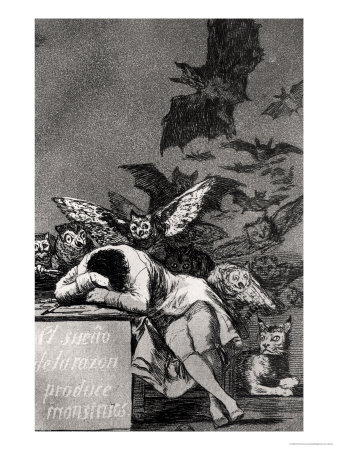
The pale front of a table is the place to begin looking at Francisco de Goya’s The Sleep of Reason Produces Monsters. Four lines of lettering emerge from its grey surface, just below the arms of a man who has buried his face in his sleeves. His eyes are hidden, yet around him other eyes remain open. Above, wings expand into the upper part of the sheet. The small number 43 in the opposite corner places this private-looking scene within a work intended for readers to encounter in sequence. [1] [2]
At a Glance
- ArtistFrancisco de Goya y Lucientes. [1]
- Spanish titleEl sueño de la razón produce monstruos. [2]
- PublicationPlate 43 of the eighty prints in Los Caprichos, published in 1799. [1]
- MediumEtching and aquatint. [1]
- Impression discussed hereThe Metropolitan Museum of Art, New York, first edition, 18.64(43). The object record gives a plate mark of 21.2 × 15.1 cm on a sheet of 29.5 × 21 cm. [1] [16]
Works across Goya’s career
The Parasol
1777The Nude Maja
1795–1800Saturn Devouring His Son
c. 1820–23The Dog
c. 1820–23The sleeper and his visitors
The man’s body occupies the lower half of the print, drawn into a tight curve from his shoulders to his knees. One hand lies across the opposite arm, and the head sinks into the space framed by both sleeves. A few loose sheets lie on the work surface. Follow the table edge towards his elbows and then look down at the writing. Although the words are built into the pictured furniture, they address the person holding the print. The sleeper has closed himself off from the activity behind him. The reader is in a position to see it. [1] [3]
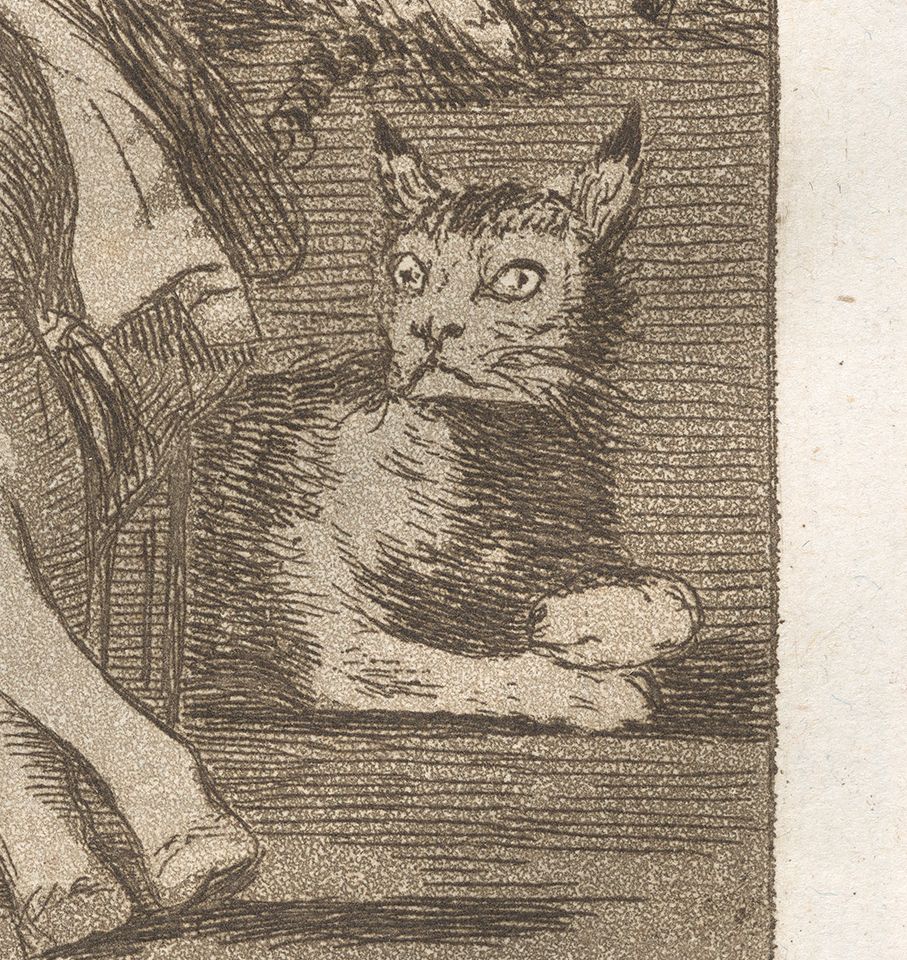
From there, the eye can pick out distinct animals before it has to contend with the swarm. The Metropolitan Museum identifies bats and owls overhead and a lynx at the lower right. Observe how the foreground animal settles low with its head raised. Its sharply drawn face and open eyes make it a point of stillness opposite the folded man. A separate dark face peers out from just behind his back. The Hamburger Kunsthalle reads this face as a cat looking towards the viewer. Where the shapes overlap, the shared vocabulary of pricked ears, bright eyes and shadow makes it easy to see why a quick glance can merge one animal into the next. [1] [3]
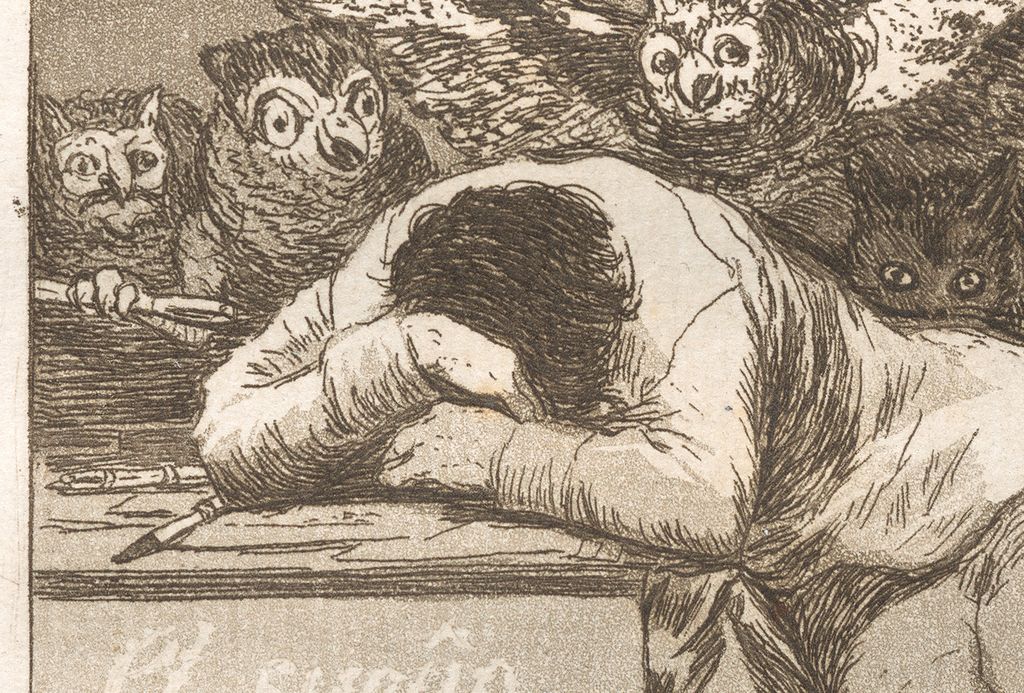
An owl edges into the space behind the man’s arms. The Hamburg curators describe it as holding out a piece of chalk. On that reading the bird is close enough to offer something the sleeper could use if he raised his head. Its gesture gives the cluster an unexpected relationship to the worktable. The creatures may threaten the artist, yet one appears to put a tool of his own trade within reach. Higher up, the largest dark wings occupy a broad stretch of the space above the little arrangement of chair, body and tabletop. Smaller forms follow at irregular intervals, making the depth of the swarm difficult to judge. [1] [3]
Notice where the outlines begin to disappear. The folds of the man’s coat and breeches are small and legible. Among the wings overhead, only a few continuous edges are easy to follow. As the animals become less individually readable, they become more formidable as a group. The figure’s identity works in the opposite way. His face is the least accessible part of his body, but the tools, the posture at the table and the earlier drawings give him a particular role. The Metropolitan Museum identifies him as the artist. In the drawings, Goya tried out several ways of showing the relationship between the artist and his visions before giving the published figure so little to do with his face. [1] [4] [5]
Annotated Details from The Sleep of Reason Produces Monsters
Follow the sweep from the bats above to the bowed figure, then look at the lettering on the table and the animal beside the chair. This impression is in the National Gallery of Art, Rosenwald Collection (1943.3.4711.qq).
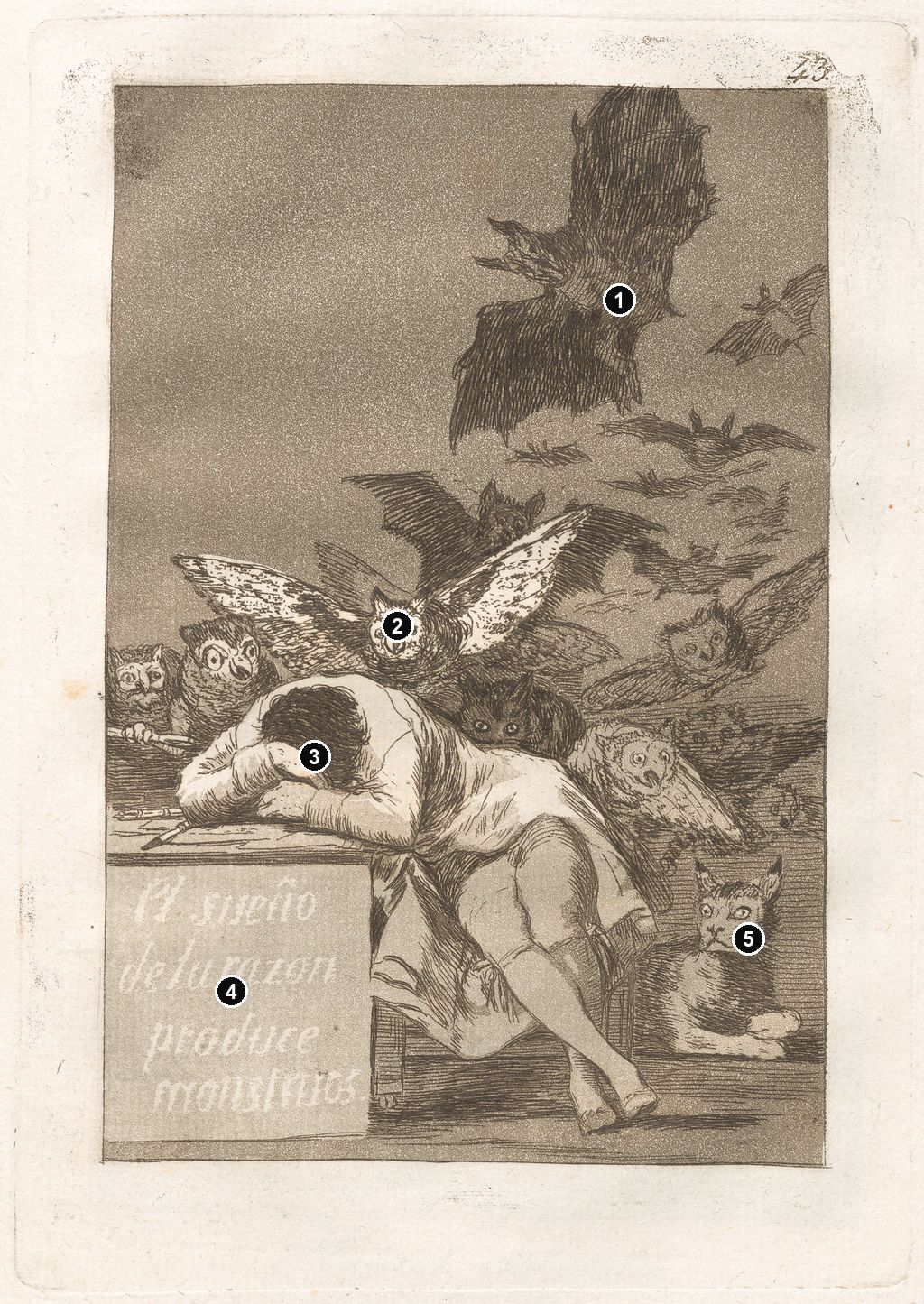
Details from THE SLEEP OF REASON PRODUCES MONSTERS
The details come from the same National Gallery of Art impression.
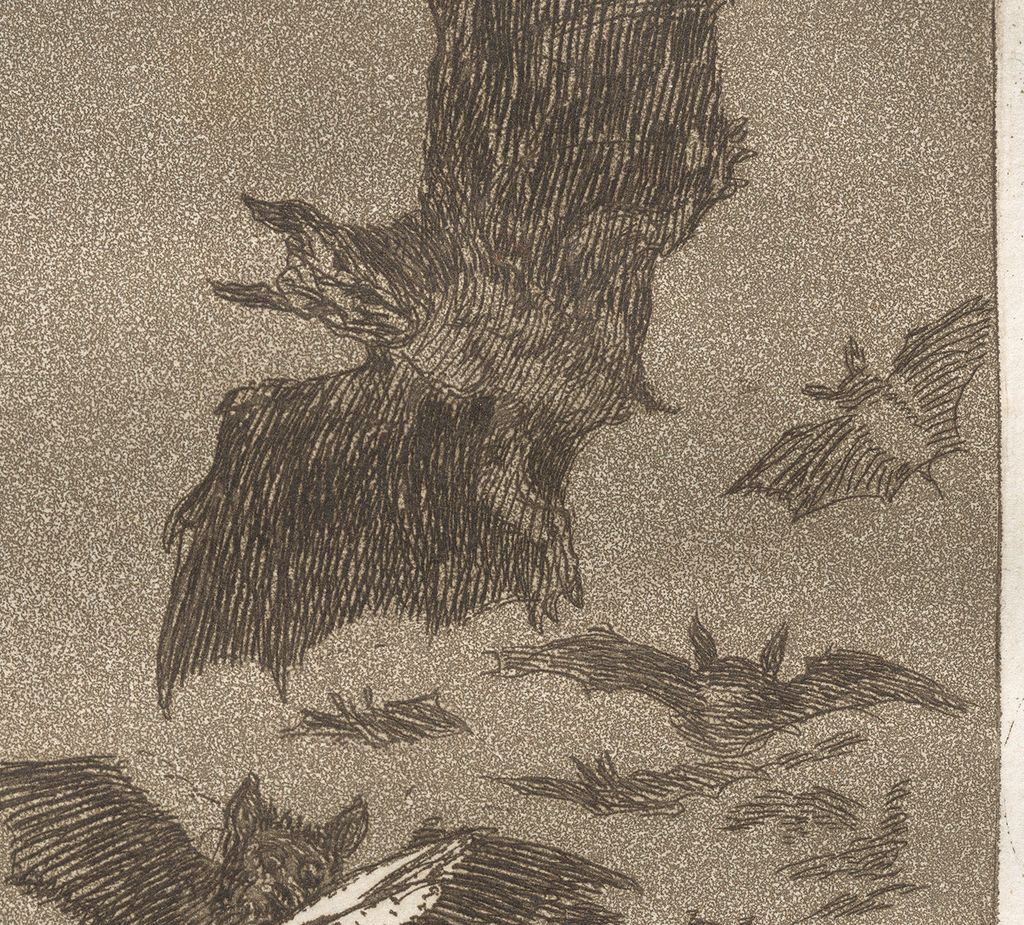
Bats and the dark field
Hatched wings pass across a grainy field. The largest bat is sharply legible, while several of the farther shapes are little more than marks interrupting the tone.
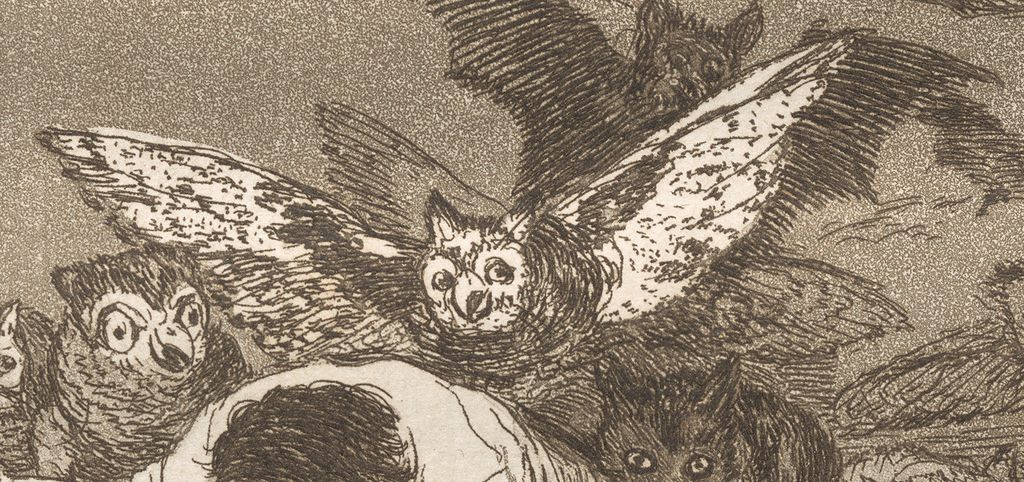
An owl with spread wings
This bird spreads its pale wings just above the sleeper. Light areas in the wings and around the eyes give the owl a clarity the circling creatures above it lack.
The hidden face
The head has sunk into the folded arms. Narrow lines in the sleeve and the dense marks of the hair keep the curled figure legible against the cluster of animals.
Letters on the table
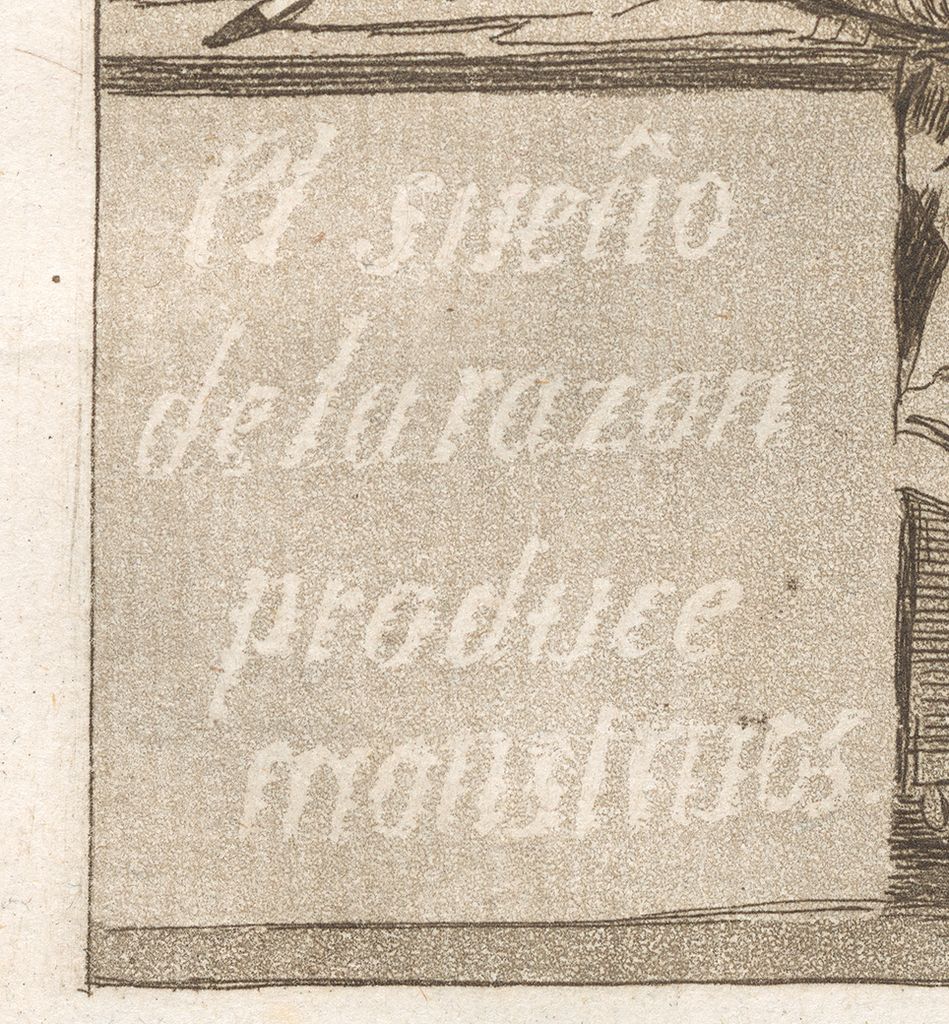
The caption is part of the image. Pale letters interrupt the aquatint on the front of the table, below the horizontal edge that supports the sleeper’s arms.
The lynx at the chair
The animal lies close to the chair with its eyes open. Its compact, grounded body gives the eye a place to rest after the repeated wings above.
Two drawings and a proposed opening
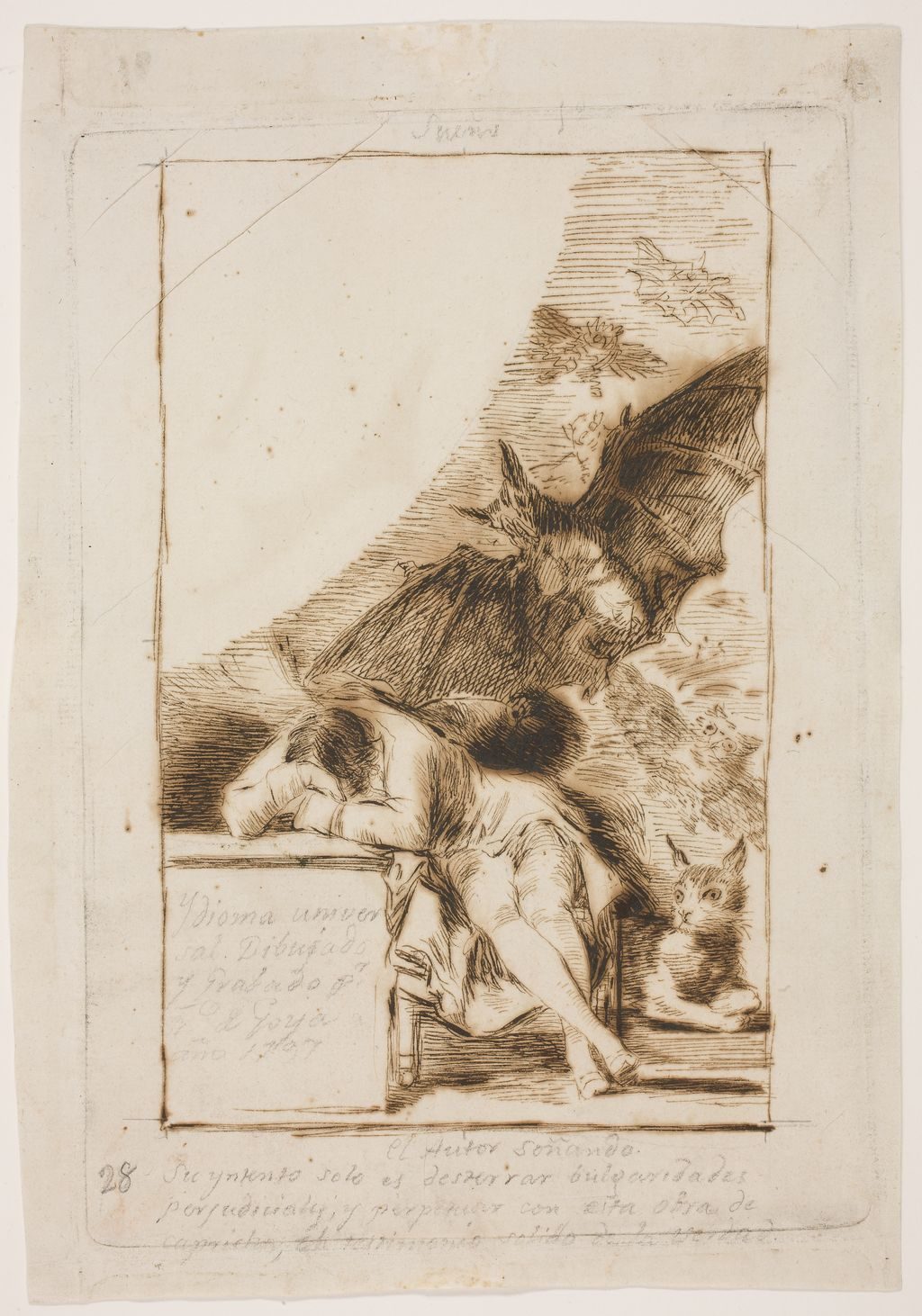
The two preparatory sheets, both in the Museo del Prado, make it possible to follow Goya’s revisions. The Fundación Goya en Aragón places the undated study (D4162) first, around 1796–97. The other, Ydioma universal. El Autor soñando (D3923), bears the year 1797. Both use pen and iron gall ink over black chalk on laid paper. The two sheets show how much the setting could change while the folded pose remained intact. [4] [5] [6]
In the earlier study the supporting furniture has mouldings and the top is bare. The National Gallery of Victoria reads it as an etching press. The Fundación describes it as a table and notes an object leaning nearby that appears to be a copper printing plate. It tentatively identifies the design on it with Goya’s print after Velázquez’s equestrian portrait of Margaret of Austria. On either account, the sheet offers unusually explicit clues to an artist’s working environment. A sliver of the sleeper’s face remains visible. Other faces, some distorted and one identified as Goya’s own, emerge higher up amid rays, bats and hints of a dog and donkey. A faint lynx is already present. The drawing distributes traces of the artist through both the workshop and the apparitions. [5] [6]
In the dated sheet, Goya gives the furniture a simpler outline and leaves out the leaning plate, the dog, the donkey and the human faces. An arc of light rises near the bowed head, and a bat with outspread wings commands attention above. The lynx is still there, while the dark cat of the published image has yet to appear. The revised design lets the gaze travel more directly from the sleeper to the airborne creatures. Goya also gives words a more prominent place. “Sueño 1º” appears at the top. Across the front of the table, “Ydioma universal” is followed by his name and the date. Below the image, he names the figure “El Autor soñando” and describes the work’s purpose as dispelling harmful common beliefs and bearing witness to truth. [4] [6]
The first number, the signature and the statement of purpose establish the sheet’s role as a proposed opening to the Sueños, or Dreams. They also give the disorder above the table a task. Goya names himself as maker on the table and casts himself as the sleeping author in the line below. His claim to address shared errors gives the reader a reason to consider what the fantastic scene might bring into view. The short printed caption eventually assumes that work by itself, within the picture. The table keeps its function as a place for words, even as what it says changes. [4] [6] [7]
The 1797 sheet also preserves traces of transfer to copper. The National Gallery of Victoria explains how marks left by the plate on drawings in the group reveal a practical method. Goya could lay a drawing face down on the plate and pass both through the press, transferring outlines as a guide. The transfer established positions for the main outlines and left Goya free to revise the image as he worked the metal. Compare the expanse of dark around the wings in the published print with the area of light in the dated study. The claim of a “universal language” has gone, but the space above the writer has become more insistent. The transfer connects the sheet to the manufacture of the print even where the resulting image departs from it. [1] [4] [7]
Goya’s drawings make the case for calling the print a self-portrait in an unusual sense. An identifiable face once appeared among the visions, and the surviving frontispiece study explicitly casts the sleeper as the author. In the finished print the papers and the outstretched bird recall that earlier emphasis on the artist’s work. His face can stay hidden while the things he works with identify his part in the scene. [1] [5] [6]
The work done by the writing beside the sleeper
In the Prado drawing the words form part of the object a reader is meant to examine. The designation of the author as the dreamer gives that person a role before the viewer has to decide what the flying creatures represent. The reference to a universal language also asks that a scene with an individual at its centre be understood beyond the circumstances of his sleep. Line and handwriting coexist on a sheet whose meaning is still being developed. The sheet records a planned relation between an introductory image and words that could help an audience begin the series. [17] [18]
In the published print the succinct phrase on the side of the desk takes over much of that work. Because it lies in the depicted space, a reader moves from the sloping surface and the sleeper’s arms down to the inscription as if it were part of the furniture. The position gives the words the firmness of a label without resolving the ambiguity in sueño. It also changes the relative attention given to the human figure and the animals. The dreaming author identified in the drawing becomes someone a reader can approach without a name, while the creatures are given the large, dark field of the picture. [17] [18]
The two objects give different answers to the question of where a series should start speaking in its own voice. With the drawing as an opening, the artist’s stated purpose would have preceded many scenes drawn from ordinary social life. At plate 43, the reader has already encountered people disguising their intentions or surrendering judgment. The change of position allows the dream to be read in light of those encounters. The possibility that it introduces the darker images still matters, but its position also makes it a commentary on behaviour seen earlier in the book. [17] [18]
The desk remains an anchor across the designs. Start with the sloping surface, then trace where the viewer has to look to read the words. On the published plate the side of the desk sits low relative to much of the action, holding the inscription in a clear area while the bats and owls spread above it. The object that supports the weight of the sleeping man thus also holds a stable reading surface. The arrangement makes it possible to grasp the title after sensing the darkness, or to read it first and then look into that darkness for an explanation. [17] [18]
Goya on film
Five films explore Goya’s portraits, prints, Black Paintings and painting techniques.
The Duke of Wellington by Goya
The portrait, its military decorations and its later theft.
Watch on YouTubeHow Goya printed the darkness
The sleeve creases and the spaces between the birds call for different kinds of mark. In line etching, a needle exposes metal through a protective ground and acid bites into the exposed lines. Those grooves hold ink when the surface is wiped. Aquatint creates a more widely distributed texture. Acid bites tiny channels around hardened resin grains. Once inked and printed, a mass of those channels reads to the eye as an area of shade. In the finished impression, precise edges can sit beside stretches of tone that suggest a wash drawing. The two techniques are central to Goya’s etchings. [7] [8]
On Plate 43, look from the light, closely worked breeches to the space immediately behind the man’s shoulders. The etched detail keeps the body legible where the tones begin to crowd it. Farther up, aquatint helps bind the wings to the darkness. The larger bats stand out across a more open ground, while the forms packed nearer the sleeper are easier to cross with the eye than to count. Neither effect requires a depicted source of light. Goya can give a cuff, a bat’s wing or a bird’s face the degree of visibility the composition needs. [1] [8]
The caption is another use of tone. Japan’s National Museum of Western Art records that the lettering was made by stopping out the aquatint. In this process an acid-resistant material protects the areas that are to stay lighter. Each letter reads by the difference between its pale stroke and the surrounding, ink-bearing texture. Goya makes the reader look for the words within the same tonal field that gives the desk its shape. In the upper-right margin the number 43 is much smaller and serves as an instruction about where the image goes in the set. Cropping just above the bats can leave the image apparently complete while removing that instruction. [1] [2] [7]
The copperplate survives in the Calcografía Nacional, which catalogues it separately from its printed impressions. Its recorded electrolytic coating belongs to the history of the surviving plate. The Academy’s record for an impression on laid paper, R-3469-1, is more specific about the printed surface, describing etched lines and burnished aquatint. Burnishing smooths the bitten texture so that it holds less ink. The Academy also records a working proof in Boston printed before Goya added more etched lines. Taking a proof at that stage allowed him to see how the design was developing and decide where to add more lines. [7] [9] [10]
An impression is a particular sheet printed from the plate. A state describes a stage in the working history of that plate, such as the stage represented by the Boston proof. The National Gallery of Victoria specifies sepia ink for its own first-edition impression. The Rijksmuseum records a collector’s mark for its sheet, an identifying trace of that impression’s later history. These are details to check against individual objects. The brightness of a photograph can change the apparent force of the shadows and the surrounding paper, so use the museum’s record to identify what you are looking at before comparing the two. [7] [9] [11]
What is sleeping?
The Spanish word sueño can mean sleep or dream. English normally asks the translator to choose. The Sleep of Reason Produces Monsters makes the title a warning about what can happen when judgement lapses. The recumbent body makes that reading immediate. In The Dream of Reason Produces Monsters, the activity of dreaming comes to the fore. The monsters may be forms that the mind produces in sleep. The dated preparatory sheet, which explicitly describes an author dreaming, makes the second possibility hard to dismiss. The published print brings a sleeping body and what might be its dream into the same space. [3] [4]
The manuscript commentary held at the Prado adds another possibility. It treats imagination left to itself as a producer of impossible monsters, and imagination working with reason as a source of art. The National Gallery of Victoria’s catalogue attributes the commentary to Goya. Calcografía Nacional’s account of the manuscript tradition cautions that authorship across the surviving explanations is contested. The commentary is therefore worth distinguishing from the wording that Goya placed directly on the drawing and print. As a reading, it accounts for the double role of the creatures. They can embody what judgement must confront and still provide the artist with the material of invention. Even the owl’s possible offer of a drawing tool finds a place in that account. [3] [6] [10]
The short caption gives no account of what happens when the man wakes. It says that the sleep or dream produces something, an active verb beside such an inactive body. The difference between the figure’s stillness and the birds’ flight makes that act of production visible. The turn to nocturnal forms also gives a concern associated with the Enlightenment, the fragility of judgement in the face of fear and superstition, an immediate physical setting. The image forces the reader to exercise judgement about the very things it can only show through fantasy. [1] [3]
Why Plate 43 is in the middle
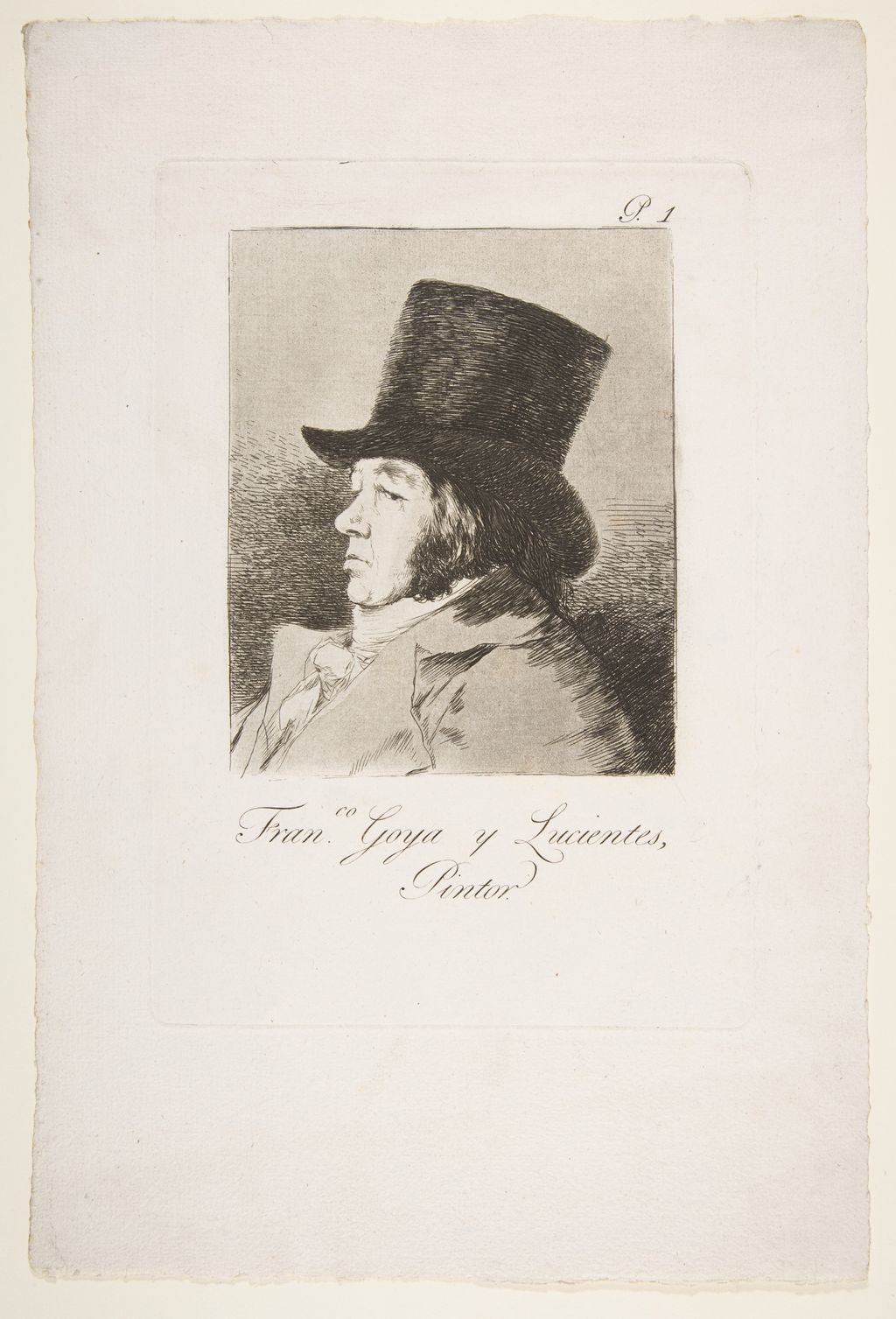
The face Goya actually placed at the entrance to Los Caprichos is awake and recognisable. In Plate 1 his profile, high hat and formal coat give him a public presence. The caption identifies him by name and profession. The Metropolitan Museum interprets his expression as that of a satirical observer. A reader who starts there meets a clearly identified maker with an appraising glance. At Plate 43, the same reader has to infer the maker from his situation and the creatures around him. The introduction asks readers to notice how the artist looks at society, while Plate 43 asks what can be seen when his eyes are closed. [1] [12]
Gonzalo M. Borrás Gualis reads the move into the series in light of the potential repercussions of public satire. He draws on a manuscript in the Biblioteca Nacional de España that describes the design as an opening for the work, and on the wording of the 1797 study. Those sources establish the earlier role more securely than they establish the reason for changing it. What readers can test directly is the difference made by placement. At the front, a sleeping author would have introduced the images to come as the inventions of a dreamer. Inside the published sequence, he can also prompt a second look at the images the reader has already passed. [4] [13]
The neighbours show how the change works. Just before the sleeper, Plate 42, Tú que no puedes, shows men carrying donkeys, a reversal that makes a human burden visible through an animal fable. Just after him, Plate 44, Hilan delgado, shows three figures spinning. The National Gallery of Victoria identifies them with witches and also draws attention to the social satire directed at exploitation. Plate 43 sits between an absurd use of recognisable animals and a scene in which superstition itself becomes a subject. The shift is real, while the habits of reading carry across it. Each picture asks what human behaviour might look like when seen through an invention. [7] [14]
The print in an album and in later hands
The Metropolitan Museum’s impression belongs to a complete first edition that entered the museum as a bound set. The Fitzwilliam Museum’s first edition, P.1-1986, offers a comparison. Its eighty prints and six pages of manuscript notes were bound in the early nineteenth century. The museum tentatively identifies the binding as German and describes the explanations as drawing on the Prado text, with some identifications derived from the Ayala manuscript tradition. The notes show how readers could bring one set of explanations into contact with another in a single volume. The little 43 on the print still directs the eye to the sequence, while the additional writing opens a second way through it. [15] [16]
A bound volume also changes the pace at which the image can be seen. The familiar view of Plate 43 on its own lets the reader go straight to the sleeping man. In an album the experience includes the passing of other faces and other captions before his appearance. The caption momentarily interrupts the sequence. The viewer searches the picture for its words, then looks back up at the creatures in light of what the words say. In the Fitzwilliam copy, the manuscript supplies yet another reason to return to an image whose meaning might have appeared settled on the first encounter. [1] [15]
An artist can take up the same question by altering the picture. In 1996, the Aragonese printmaker Natalio Bayo made an etching and aquatint with the same Spanish title as part of Según Los Caprichos. Borrás Gualis points out that a deformed creature takes the place occupied by Goya’s sleeping author. Strange forms still issue from the area of the head. Bayo keeps that relation between a central figure and what appears to emerge from it, while changing who or what sits at the centre. In Goya there is still a body at an everyday table against which to measure the swarm. Bayo puts one of the possible products of the dream in its place. [13]
Artworks directory
| Name | Date | Medium |
|---|---|---|
| And There’s No Help for It, Plate 15 | Printed 1863 | |
| Asmodea | c. 1820–23 | Wall painting transferred to canvas |
| Boys Inflating a Bladder | 1777–78 | Tapestry cartoon |
| Boys Picking Fruit | 1778 | Tapestry cartoon |
| Bullfight in a Divided Ring | 1825 | Lithograph |
| Card Players | 1777–78 | Tapestry cartoon |
| Card Players (sketch) | 1777–78 | Painted sketch |
| Dance on the Banks of the Manzanares | 1777 | Tapestry cartoon |
| Duel with Cudgels | c. 1820–23 | Wall painting transferred to canvas |
| Heads in a Landscape | c. 1820–23 | Easel painting |
| Judith and Holofernes | c. 1820–23 | Wall painting transferred to canvas |
| Leocadia | c. 1820–23 | Wall painting transferred to canvas |
| Maja and Cloaked Men | 1777 | Tapestry cartoon |
| Maja and Cloaked Men (sketch) | 1777 | Painted sketch |
| Majo Clapping in Time to the Music | 1777 | Drawing |
| Men Reading | c. 1820–23 | Wall painting transferred to canvas |
| Out Hunting for Teeth, Plate 12 | 1799 | Etching, burnished aquatint and burin |
| Picnic in the Countryside (sketch) | 1776–78 | Painted sketch |
| Picnic on the Banks of the Manzanares | 1776 | Tapestry cartoon |
| Pilgrimage to San Isidro | c. 1820–23 | Wall painting transferred to canvas |
| Preparatory study for The Sleep of Reason Produces Monsters | c. 1796–97 | Drawing |
| Procession of the Holy Office | c. 1820–23 | Wall painting transferred to canvas |
| Quarrel at the Cockerel Inn (sketch) | 1777 | Painted sketch |
| Quarrel in the New Tavern | 1777 | Tapestry cartoon |
| Saturn Devouring His Son | c. 1820–23 | Wall painting transferred to canvas |
| Seated Majo Smoking | c. 1776 | Drawing |
| The Dog | c. 1820–23 | Wall painting transferred to canvas |
| The Drinker | 1777 | Tapestry cartoon |
| The Fates | c. 1820–23 | Wall painting transferred to canvas |
| The Great He-Goat | c. 1820–23 | Wall painting transferred to canvas |
| The Kite | 1777–78 | Tapestry cartoon |
| The Parasol | 1777 | Oil on canvas, tapestry cartoon |
| The Second of May 1808 | 1814 | Oil on canvas |
| The Sleep of Reason Produces Monsters, Plate 43 | 1799 | Etching and aquatint |
| The Third of May 1808 | 1814 | Oil on canvas |
| Thou Who Canst Not, Plate 42 | 1799 | Etching and burnished aquatint |
| Three Figures | 1776 | Drawing (lost) |
| Two Old Men | c. 1820–23 | Wall painting transferred to canvas |
| Two Old Men Eating Soup | c. 1820–23 | Wall painting transferred to canvas |
| Two Women and a Man | c. 1820–23 | Wall painting transferred to canvas |
| Universal Language: The Author Dreaming | 1797 | Drawing |
| The Family of Charles IV | 1800 | Oil on canvas |
| Witches’ Sabbath (Osuna painting) | 1797–98 | Oil on canvas |
| The Nude Maja | 1795–1800 | Oil on canvas |
| The Clothed Maja | 1800–07 | Oil on canvas |
| Self-Portrait (Drawing) | c. 1796 | Brush and carbon black ink on laid paper |
| The Swing, Madrid Album B.21 | 1795–97 | Brush and carbon black washes |
| Majas Fighting, a Majo Observing, Madrid Album B.15 | 1796–97 | Brush, grey and black washes on laid paper |
| Majos and Majas Conversing, Madrid Album B.16 | c. 1794–97 | Ink wash on paper |
| Weeping Woman and Three Men, Madrid Album B.17 | 1795–97 | Brush, carbon black washes and black chalk |
| Maja Seated on a Chair and Two Companions Behind, Madrid Album B.18 | 1795–97 | Brush and carbon black washes |
| Girl and Bull, Madrid Album B.23 | 1796–97 | Brush and carbon black washes |
| Lovers Sitting on a Rock, Madrid Album B.24 | 1796–97 | Brush and carbon black washes |
| Mariano Ceballos Riding a Bull | 1825 | Crayon lithograph and scraper |
| Landscape (lifetime impression) | c. 1807–10 | Etching and aquatint |
| Self-Portrait (1815), Prado canvas | 1815 | Oil on canvas |
| Self-Portrait (1815), Academy panel | 1815 | Oil on panel |
| Self-Portrait with Dr Arrieta | 1820 | Oil on canvas |
| Christ Crucified | 1780 | Oil on canvas |
| The Last Communion of Saint Joseph of Calasanz | 1819 | Oil on canvas |
| Christ on the Mount of Olives | 1819 | Oil on panel |
| The Flower Girls, or Spring | 1786–87 | Oil on canvas |
| The Grape Harvest, or Autumn | 1786–87 | Oil on canvas |
| The Snowstorm, or Winter | 1786–87 | Oil on canvas |
| The Threshing Ground, or Summer | 1786–87 | Oil on canvas |
| Picnic on the Banks of the Manzanares | 1776 | Oil on canvas |
| The Kite | 1777–78 | Oil on canvas |
| Dance on the Banks of the Manzanares | 1777 | Oil on canvas |
| A Fight at the Venta Nueva | 1777 | Oil on canvas |
| Blind Man’s Bluff | 1788 | Oil on canvas |
| Dogs on a Lead | 1775 | Oil on canvas |
| Hunting with a Decoy | 1775 | Oil on canvas |
| Hunter Loading His Rifle | 1775 | Oil on canvas |
| The Angler | 1775 | Oil on canvas |
| The Hermitage of San Isidro on His Feast Day | 1788 | Oil on canvas |
| The Meadow of San Isidro | 1788 | Oil on canvas |
| The Straw Manikin | 1791–92 | Oil on canvas |
| Witches’ Flight | c. 1797–98 | Oil on canvas |
| A Scene from ‘The Forcibly Bewitched’ | 1798 | Oil on canvas |
| The Duchess of Alba in Black | 1797 | Oil on canvas |
| The Duchess of Alba in White | 1795 | Oil on canvas |
| Charles III in Hunting Dress | c. 1786 | Oil on canvas |
| The Duke and Duchess of Osuna and Their Children | 1787–88 | Oil on canvas |
| Manuel Osorio Manrique de Zúñiga | 1787–88 | Oil on canvas |
| The Marquesa de Pontejos | c. 1786 | Oil on canvas |
| Equestrian Portrait of the 1st Duke of Wellington | 1812 | Oil on canvas |
| The Duke of Wellington | 1812–14 | Oil on wood |
| Portrait of Ferdinand VII of Spain | 1814 | Oil on canvas |
| Gaspar Melchor de Jovellanos | 1798 | Oil on canvas |
| María Tomasa Palafox y Portocarrero | 1804 | Oil on canvas |
| Señora Sabasa García | c. 1806–11 | Oil on canvas |
| Don Juan Bautista de Muguiro | 1827 | Oil on canvas |
| Doña Isabel de Porcel | Before 1805 | Oil on canvas |
| The Colossus | After 1808 | Oil on canvas |
| The Burial of the Sardine | 1808–12 | Oil on panel |
| The Madhouse | 1808–12 | Oil on panel |
| A Procession of Flagellants | 1808–12 | Oil on panel |
| Portrait of Jacques Galos | 1826 | Oil on canvas |
| Portrait of Mariano Goya, the Artist’s Grandson | 1827 | Oil on canvas |
| Milkmaid of Bordeaux | c. 1827 | Oil on canvas |
| Portrait of Don Juan Antonio Cuervo | 1819 | Oil on canvas |
| María Luisa of Parma (Naples version) | c. 1800 | Oil on canvas |
| The Countess of Baena | 1819 | Oil on canvas |
| The Family of the Infante Don Luis | 1783–84 | Oil on canvas |
| The Holy Family | c. 1787 | Oil on canvas |
| Saint Barbara | c. 1773 | Oil on canvas |
| Saints Justa and Rufina | 1817 | Oil on canvas |
| El Tío Paquete | c. 1819–20 | Oil on canvas |
| The Forge | c. 1815–20 | Oil on canvas |
| Majas on a Balcony (Metropolitan Museum version) | c. 1800–10 | Oil on canvas |
| Maja and Celestina on a Balcony | c. 1808–12 | Oil on canvas |
| The Water Bearer | 1808–12 | Oil on canvas |
| Time and the Old Women | c. 1810 | Oil on canvas |
Frequently Asked Questions
Discussion
Look again at the images and ideas explored in The Sleep of Reason Produces Monsters. These editorial prompts invite your observations.
Start at the table, then follow the winged forms upwards. Which detail most makes the creatures feel like visitors from outside the room, and which makes them feel like creations of the sleeping artist?
Reader Insights
How does the owl nearest the sleeper differ from the silhouettes at the top of the print?
How does discovering the lettering beneath the sleeper change how you read the scene?
Join the Conversation
Share a detail, comparison or question about The Sleep of Reason Produces Monsters below.
References
- The Metropolitan Museum of Art, The Sleep of Reason Produces Monsters, 18.64(43). View source.
- National Museum of Western Art, Tokyo, The Sleep of Reason Produces Monsters, G.1984-0057. View source.
- Hamburger Kunsthalle, Art Around 1800, exhibition booklet, “Dreams”. View source.
- Fundación Goya en Aragón, Universal Language (First Dream), Museo del Prado D3923. View source.
- Fundación Goya en Aragón, preliminary study for El sueño de la razón produce monstruos, Museo del Prado D4162. View source.
- National Gallery of Victoria, Goya: Drawings from the Prado Museum, Petra Kayser, “Dream, Allegory and Truth”, and object list. View source.
- National Gallery of Victoria, Goya: Drawings from the Prado Museum, artwork labels and printmaking notes. View source.
- Colta Feller Ives, “The Printed Image in the West: Aquatint”, The Metropolitan Museum of Art. View source.
- Real Academia de Bellas Artes de San Fernando, first-edition impression R-3469-1. View source.
- Calcografía Nacional, Francisco de Goya en Calcografía Nacional, catalogue entry 3813 and essay on Los Caprichos. View source.
- Rijksmuseum, De slaap van de rede brengt monsters voort, RP-P-1921-2064. View source.
- The Metropolitan Museum of Art, Self-Portrait, Plate 1, 50.558.33. View source.
- Gonzalo M. Borrás Gualis, “Sobre la modernidad de Goya grabador”, Artigrama 32 (2017), pp. 181–193. View source.
- The Metropolitan Museum of Art, Thou Who Canst Not, Plate 42, 18.64(42). View source.
- The Fitzwilliam Museum, The Sleep of Reason Produces Monsters and bound Los Caprichos, P.1-1986. View source.
- Colta Ives and Susan Alyson Stein, Goya in The Metropolitan Museum of Art, fig. 8 and collection history. View source.
- Museo Nacional del Prado, Ydioma universal. El Autor soñando, D03923. View source.
- Metropolitan Museum of Art, A Virtual Tour of Goya’s Graphic Imagination. View source.







