


 by Tom Gurney
Tom Gurney BSc (Hons) is an art history expert with over 20 years experience
Published on June 19, 2020 / Updated on November 20, 2026
Email: tomgurney1@gmail.com / Phone: +44 7429 011000
Introduction
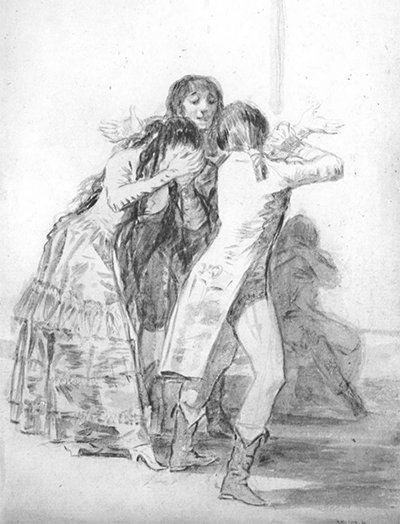
A young woman bends forward and presses her hands to her face. Two men crowd around her, and a third figure sits in grey shadow beside a doorway. In Weeping Woman and Three Men, Francisco de Goya gives the woman an elaborately trimmed dress and makes one of the men turn his back to us. Their clothes and gestures are easy to see. What has brought them together is harder to tell. Turn the leaf over and another woman looks out from under a dark veil, her face as visible as the first woman’s is hidden. Goya drew both scenes on the same narrow sheet in his Madrid Album. [1] [2] [3]
At a Glance
- ArtistFrancisco de Goya y Lucientes (1746–1828). [1]
- Date1795–97, following the Metropolitan Museum of Art. [1]
- MediumBrush and point of brush, carbon black washes and black chalk on the recto. The Met records brush and carbon black washes for the verso. [1] [2]
- Dimensions23.5 × 14.61 cm for the leaf. [1] [2]
- Album and collectionMadrid Album B.17 (recto) and B.18 (verso). Metropolitan Museum of Art, New York, 35.103.4 and 35.103.5, Harris Brisbane Dick Fund, 1935. [1] [2]
Works across Goya’s career
The Parasol
1777The Nude Maja
1795–1800Saturn Devouring His Son
c. 1820–23The Dog
c. 1820–23The woman and the men around her
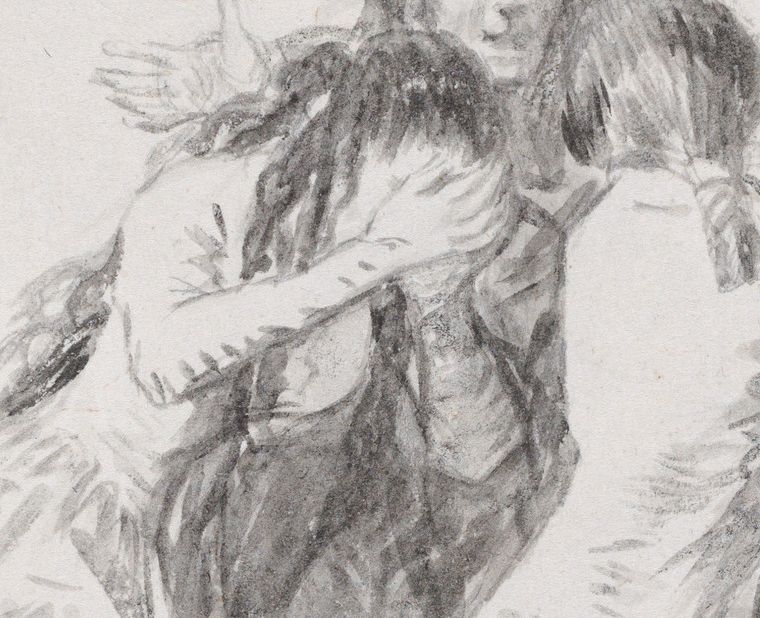
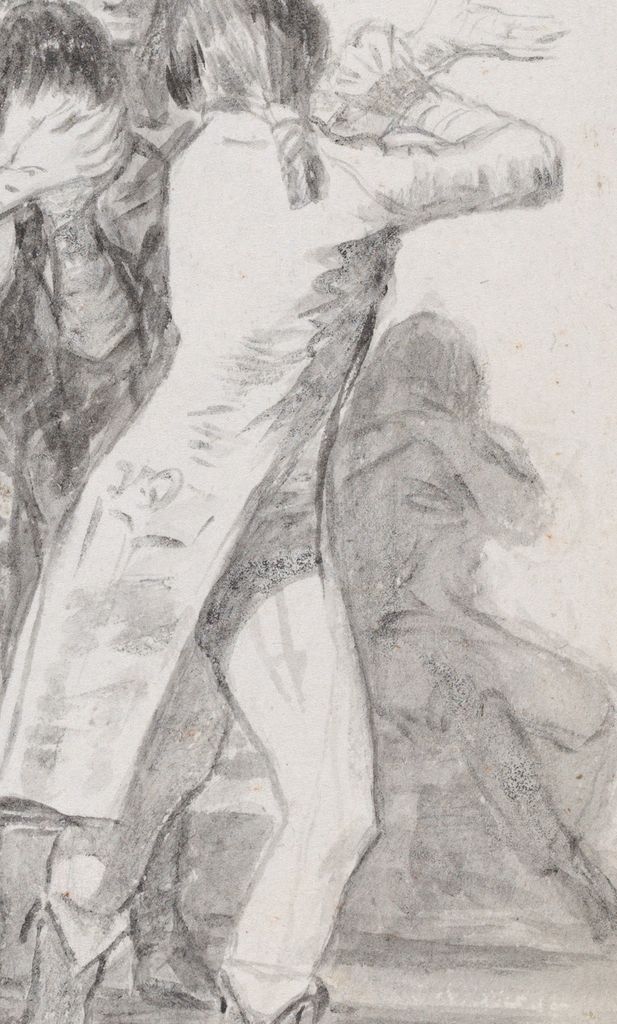
The strongest diagonal on the recto runs from the woman’s skirt at the lower left, through her bent upper body, towards the hands at her face. The long skirt has a band of gathered trim and a second strip of ornament nearer the hem. Loose strokes follow the creases and leave light patches between them. A line of dark marks runs down the sleeve, which ends where her hand meets her cheek. Hair hangs forward beside the fingers. Goya gives us two ways to follow the movement, through the sleeve as it rises and through the hair as it falls. Both lead to the place where her face disappears. [1]
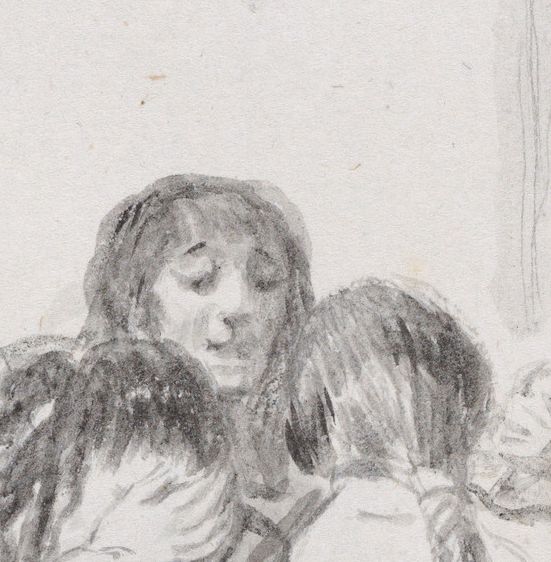
Immediately behind her, a man’s face rises above the group. His mouth appears open and his dark clothing runs down behind the woman’s lighter sleeve. The other foreground man stands at the right, with his back towards the viewer. His hair is tied at the nape and his pale coat tapers to long tails. Its light surface picks him out from the darker man in the middle. One of his boots reaches towards the lower right corner, giving him the widest stance in the group. Above, open hands extend to either side at roughly the same height. The arms overlap in the drawing, but the breadth of the gestures comes through. The woman folds inwards while the space taken up by the men opens out around her. [1] [3]
The figure farther back can be missed on a first look. At the right, below the outline of the doorway, he appears to sit with his head lowered and his hands close to his face. The Fundación Goya en Aragón identifies him as the third man. His pose echoes the woman’s even though his place in the drawing is quite different. Her light sleeve and the dark marks around her hair give the eye several distinct edges to follow. His upper body and hands are drawn together in a quieter range of greys. The back of the man in the pale coat partly obscures him. His presence enlarges the scene beyond the three figures who first catch the eye. [1] [3]
The 1995 Met catalogue uses the familiar title Weeping Woman and Three Men. The museum’s current heading describes a young woman covering her face as she weeps, with men beside her. The title describes an action that the hands and shoulders make recognisable. The Met suggests an upset in love as a possibility. The Fundación reads the standing men as quarrelling. What they might be arguing about, whom they might blame and whether anyone is trying to console her all remain open. There is no narrative caption beside the group. The hands show different ways of responding to an event whose details are out of sight. [1] [3] [4]
Annotated Details from Young Woman Weeping with Three Men
Look at the hands and heads in the crowded foreground before following the lighter wash behind them.
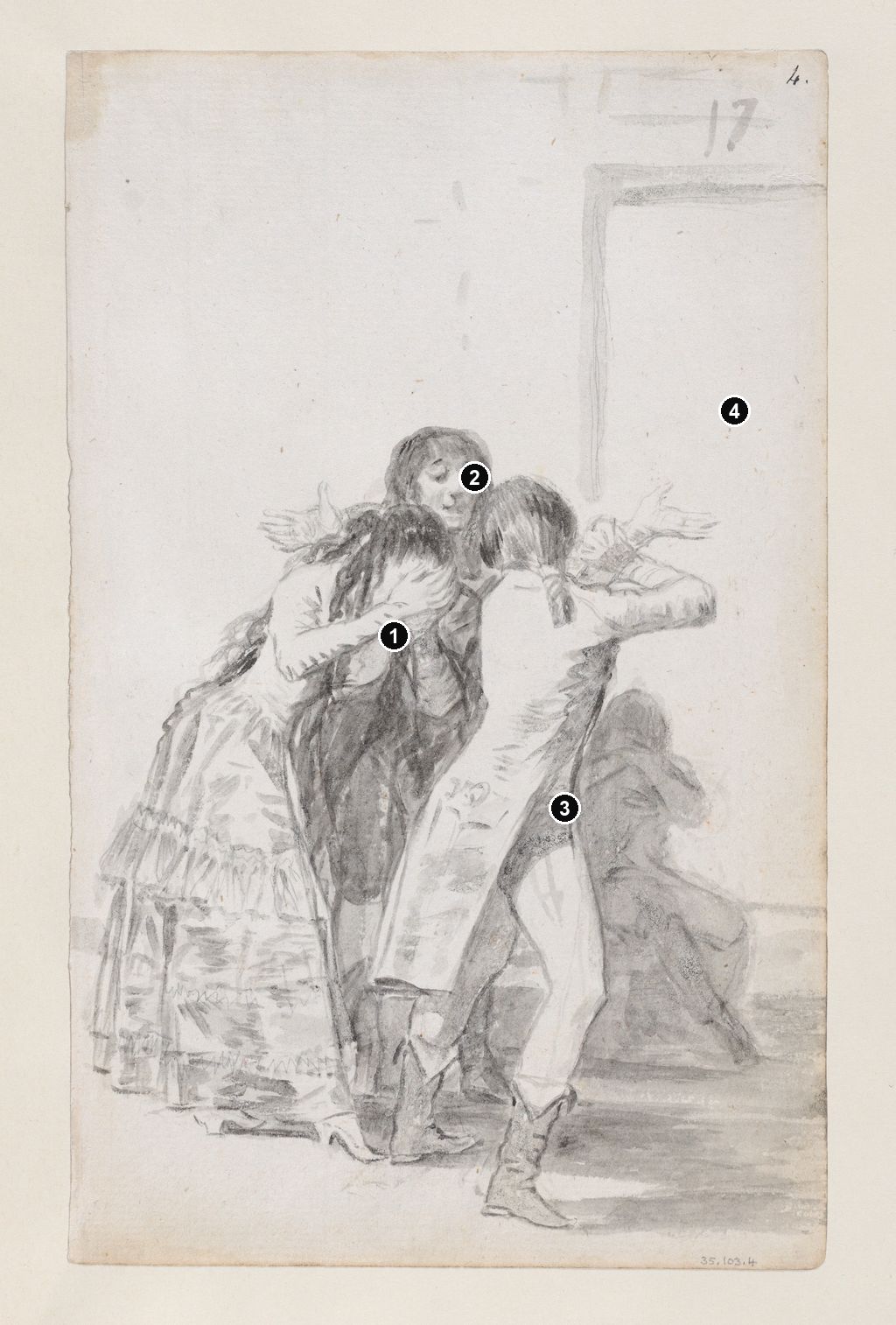
Details from YOUNG WOMAN WEEPING WITH THREE MEN
Details from Madrid Album B.17 in the Metropolitan Museum of Art (35.103.4).
The covered face
The woman presses her hands over her face as she bends towards the group.
The head above the group
A face appears between the other overlapping heads and shoulders.
The light coat
The light diagonal of the foreground coat separates several darker passages of wash.
The quieter space at right
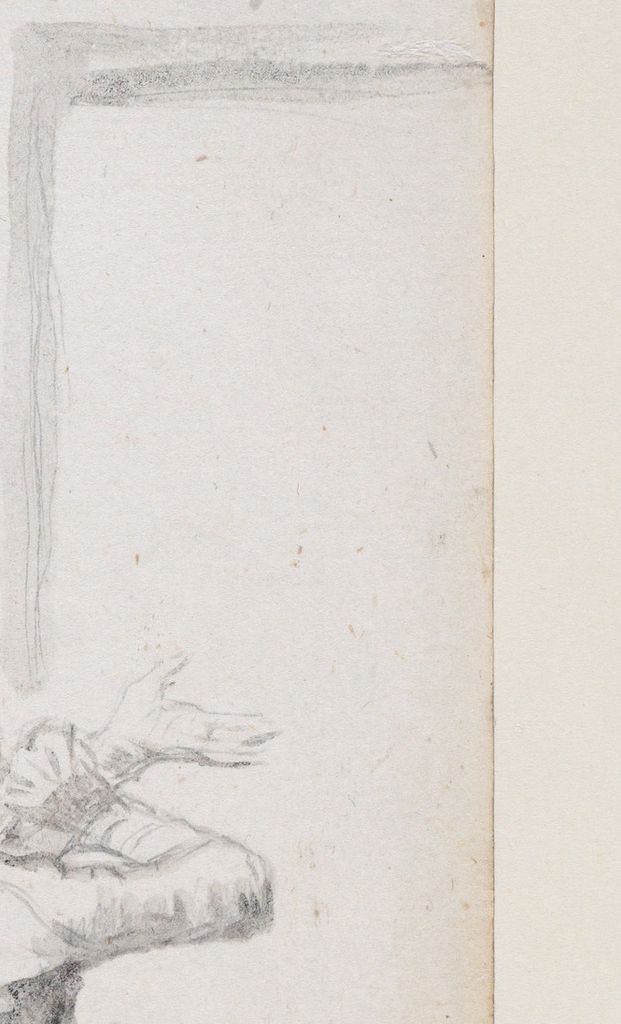
The straight lines near the right edge leave much of the paper clear above the figures.
Ink, paper and the suggestion of a room
The doorway consists mainly of a vertical and a horizontal that meet near the upper right. Together with the floor lines and the areas of grey near the ground, it gives the figures somewhere to stand without supplying much information about the room. Look at where the outline of the doorway stops. It reaches towards the gesturing men, but an expanse of almost empty paper remains above the cluster. With little furniture or decoration to look at, the eye moves readily from the upright of the doorway to the heads below. The opening also gives the seated figure a place at the edge of the encounter. [1] [3]
Carbon black ink can produce shades from grey to nearly black when applied in washes of different strengths. Here a broad sweep of grey is sufficient to put the figures on a common floor. The finer marks around the woman’s fingers and the coat’s edge do almost the opposite. They distinguish forms that would otherwise merge where bodies touch. The Met records black chalk on this side as well. Fine marks in a reproduction can look alike, so the catalogue’s distinction between materials is more reliable than assigning every visible stroke to either chalk or brush. What shows up even at a small scale is the difference between the narrow marks that articulate hands and dress and the broad marks that place the group in space. [1]
Goya on film
Five films explore Goya’s portraits, prints, Black Paintings and painting techniques.
The Duke of Wellington by Goya
The portrait, its military decorations and its later theft.
Watch on YouTubeThe seated woman on the other side
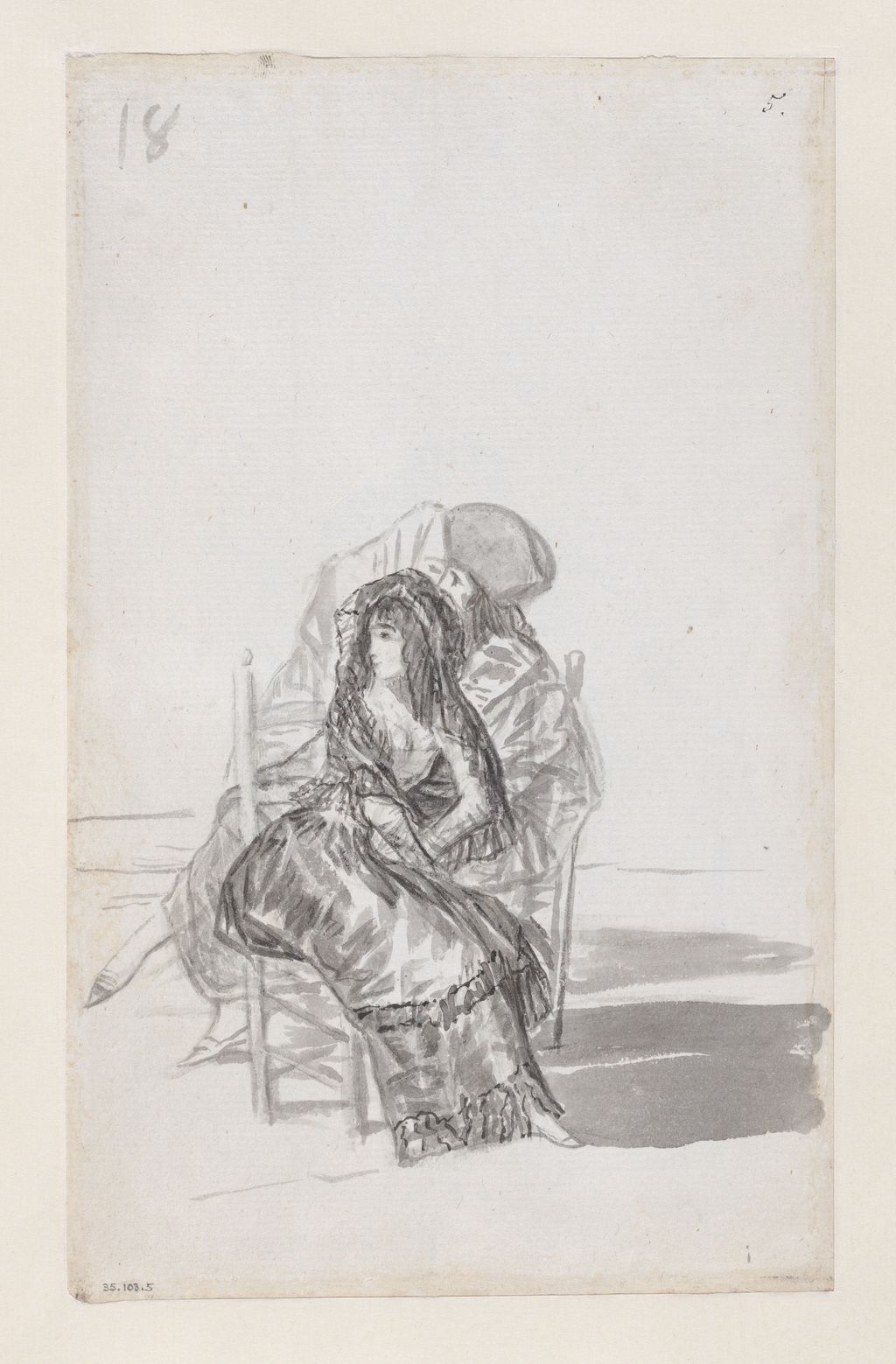
On B.18, the woman in the foreground has a chair of her own. Its uprights and crossbars remain visible around her skirt. She turns her torso and looks to her right, towards the left of the picture. Dark strokes run from the top of her veil down past her shoulders, while light breaks up the broad sweep of the skirt. A line of small loop-like marks follows its trim. At the bottom of the skirt a pointed shoe emerges. The turn is pronounced enough that the line of her face and the fall of her clothes seem to lead the eye in different directions. On the previous page the hand and hair draw attention to a hidden face. Here the dark surround makes a visible face easier to pick out. [1] [2] [5]
The companions behind the chair are drawn more lightly, and their bodies overlap. The Fundación points to three roughly parallel shadows on the ground as clues to the positions of the people in the cluster. It also records a disagreement. José López-Rey thought the second woman sat on the man’s lap, while Pierre Gassier questioned that arrangement and considered the drawing reworked and incomplete. The Met suggests the woman behind may be leaning in to whisper. At the scale of the leaf, a pale area can be easy to read as a person leaning close and difficult to read as a precise account of where that person sits. The change in wash density gives the foreground woman definition and leaves room for uncertainty behind her. [1] [2] [5]
How the leaf fits into Album B
The larger ink numbers sit near opposite top corners. The 17 is at the right on the front and the 18 at the left on the back. The Fundación also identifies the smaller 4 and 5 as later pen inscriptions associated with Madrazo. The Met’s current numbers, 35.103.4 and 35.103.5, identify the two drawings in its collection. They share a credit line and sheet dimensions. The two sides also share a place in the history of the album, where one would have met the weeping woman before turning the page to see the seated maja. Janis Tomlinson’s study of the folds of Album B proposes that sheets were arranged, numbered and bound after drawing began. The ink sequence can therefore show how the pages were ordered without settling which of the two drawings Goya made first. [1] [2] [3] [5] [6]
The previous leaf in the sequence survives at the Hispanic Society of America. On B.15, Majo Laughing at Two Girls Fighting, a reclining spectator watches two women come to blows. One uses a shoe against the other. Turn that leaf and B.16, Majos and Majas Conversing, is a scene of small groups sitting in conversation. Seen in numbered order, B.15 to B.18 alternate scenes of overt disturbance with quieter arrangements of figures. The woman who raises a shoe gives the viewer a specific action to follow. The woman who bends behind her hands offers much less certainty about what preceded the moment. B.16 and B.18 likewise give different weight to a social group. In the former, attention can pass from one set of companions to another. In the latter, the darker wash on a single woman makes us notice how little we know about what absorbs the others. [1] [2] [7] [8]
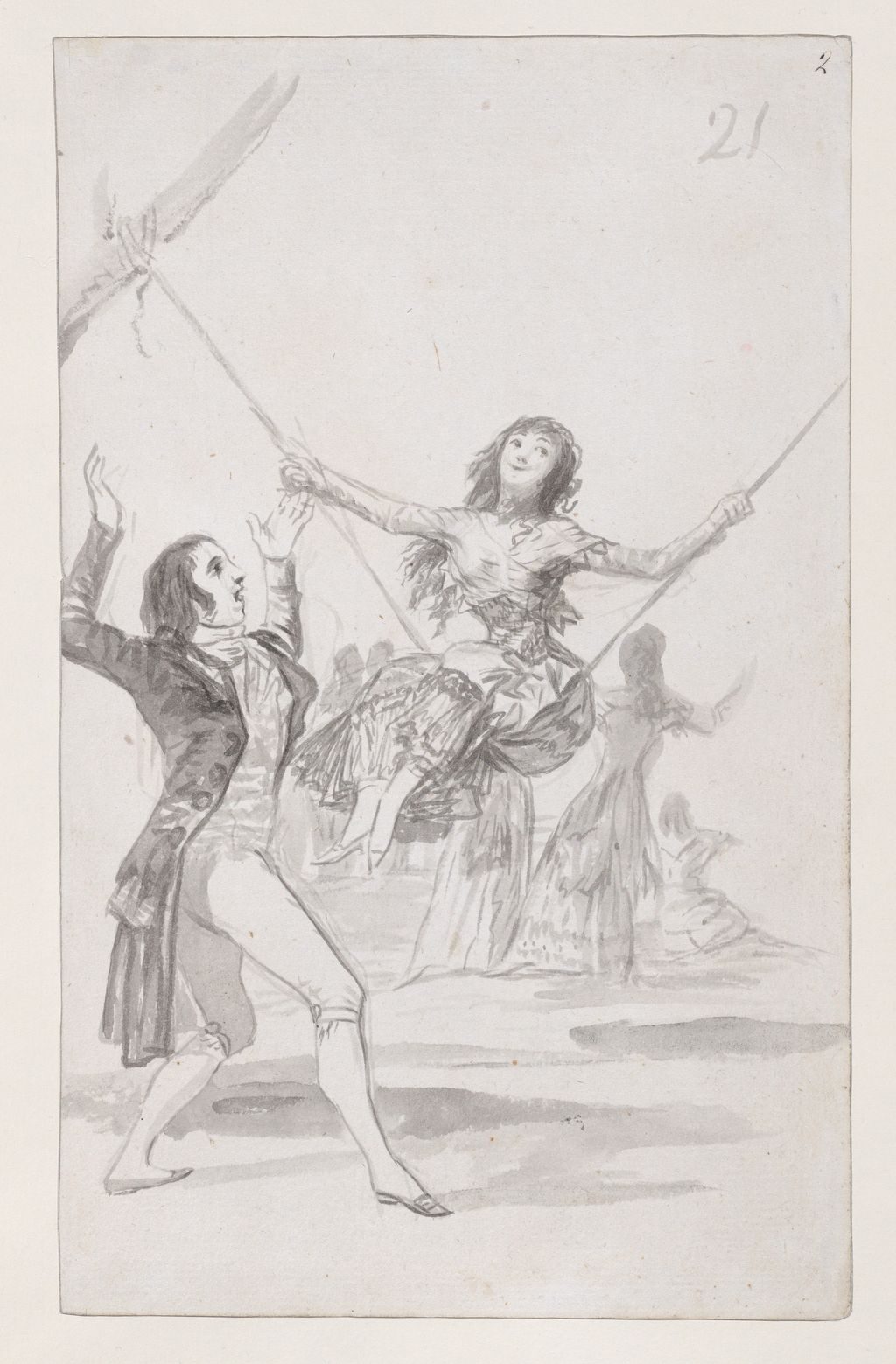
Those successive pages now belong to two different collections. The Met records that the group it bought in 1935 was mounted on rose-coloured scrapbook pages. The catalogue attributes the assembly tentatively to Goya’s son Javier and traces the volume through Federico de Madrazo and his grandson Mariano Fortuny y Madrazo. The scrapbook brought together drawings from four albums. In the Met’s acquisition order the leaf bearing The Swing, Album B.21 and B.22, is numbered 35.103.2 and 35.103.3 and comes before B.17 and B.18. The album numbers on the paper restore the earlier relationship. The guide to Goya’s drawings follows similar evidence across the surviving albums. [1] [2] [4]
Artworks directory
| Name | Date | Medium |
|---|---|---|
| And There’s No Help for It, Plate 15 | Printed 1863 | |
| Asmodea | c. 1820–23 | Wall painting transferred to canvas |
| Boys Inflating a Bladder | 1777–78 | Tapestry cartoon |
| Boys Picking Fruit | 1778 | Tapestry cartoon |
| Bullfight in a Divided Ring | 1825 | Lithograph |
| Card Players | 1777–78 | Tapestry cartoon |
| Card Players (sketch) | 1777–78 | Painted sketch |
| Dance on the Banks of the Manzanares | 1777 | Tapestry cartoon |
| Duel with Cudgels | c. 1820–23 | Wall painting transferred to canvas |
| Heads in a Landscape | c. 1820–23 | Easel painting |
| Judith and Holofernes | c. 1820–23 | Wall painting transferred to canvas |
| Leocadia | c. 1820–23 | Wall painting transferred to canvas |
| Maja and Cloaked Men | 1777 | Tapestry cartoon |
| Maja and Cloaked Men (sketch) | 1777 | Painted sketch |
| Majo Clapping in Time to the Music | 1777 | Drawing |
| Men Reading | c. 1820–23 | Wall painting transferred to canvas |
| Out Hunting for Teeth, Plate 12 | 1799 | Etching, burnished aquatint and burin |
| Picnic in the Countryside (sketch) | 1776–78 | Painted sketch |
| Picnic on the Banks of the Manzanares | 1776 | Tapestry cartoon |
| Pilgrimage to San Isidro | c. 1820–23 | Wall painting transferred to canvas |
| Preparatory study for The Sleep of Reason Produces Monsters | c. 1796–97 | Drawing |
| Procession of the Holy Office | c. 1820–23 | Wall painting transferred to canvas |
| Quarrel at the Cockerel Inn (sketch) | 1777 | Painted sketch |
| Quarrel in the New Tavern | 1777 | Tapestry cartoon |
| Saturn Devouring His Son | c. 1820–23 | Wall painting transferred to canvas |
| Seated Majo Smoking | c. 1776 | Drawing |
| The Dog | c. 1820–23 | Wall painting transferred to canvas |
| The Drinker | 1777 | Tapestry cartoon |
| The Fates | c. 1820–23 | Wall painting transferred to canvas |
| The Great He-Goat | c. 1820–23 | Wall painting transferred to canvas |
| The Kite | 1777–78 | Tapestry cartoon |
| The Parasol | 1777 | Oil on canvas, tapestry cartoon |
| The Second of May 1808 | 1814 | Oil on canvas |
| The Sleep of Reason Produces Monsters, Plate 43 | 1799 | Etching and aquatint |
| The Third of May 1808 | 1814 | Oil on canvas |
| Thou Who Canst Not, Plate 42 | 1799 | Etching and burnished aquatint |
| Three Figures | 1776 | Drawing (lost) |
| Two Old Men | c. 1820–23 | Wall painting transferred to canvas |
| Two Old Men Eating Soup | c. 1820–23 | Wall painting transferred to canvas |
| Two Women and a Man | c. 1820–23 | Wall painting transferred to canvas |
| Universal Language: The Author Dreaming | 1797 | Drawing |
| The Family of Charles IV | 1800 | Oil on canvas |
| Witches’ Sabbath (Osuna painting) | 1797–98 | Oil on canvas |
| The Nude Maja | 1795–1800 | Oil on canvas |
| The Clothed Maja | 1800–07 | Oil on canvas |
| Self-Portrait (Drawing) | c. 1796 | Brush and carbon black ink on laid paper |
| The Swing, Madrid Album B.21 | 1795–97 | Brush and carbon black washes |
| Majas Fighting, a Majo Observing, Madrid Album B.15 | 1796–97 | Brush, grey and black washes on laid paper |
| Majos and Majas Conversing, Madrid Album B.16 | c. 1794–97 | Ink wash on paper |
| Weeping Woman and Three Men, Madrid Album B.17 | 1795–97 | Brush, carbon black washes and black chalk |
| Maja Seated on a Chair and Two Companions Behind, Madrid Album B.18 | 1795–97 | Brush and carbon black washes |
| Girl and Bull, Madrid Album B.23 | 1796–97 | Brush and carbon black washes |
| Lovers Sitting on a Rock, Madrid Album B.24 | 1796–97 | Brush and carbon black washes |
| Mariano Ceballos Riding a Bull | 1825 | Crayon lithograph and scraper |
| Landscape (lifetime impression) | c. 1807–10 | Etching and aquatint |
| Self-Portrait (1815), Prado canvas | 1815 | Oil on canvas |
| Self-Portrait (1815), Academy panel | 1815 | Oil on panel |
| Self-Portrait with Dr Arrieta | 1820 | Oil on canvas |
| Christ Crucified | 1780 | Oil on canvas |
| The Last Communion of Saint Joseph of Calasanz | 1819 | Oil on canvas |
| Christ on the Mount of Olives | 1819 | Oil on panel |
| The Flower Girls, or Spring | 1786–87 | Oil on canvas |
| The Grape Harvest, or Autumn | 1786–87 | Oil on canvas |
| The Snowstorm, or Winter | 1786–87 | Oil on canvas |
| The Threshing Ground, or Summer | 1786–87 | Oil on canvas |
| Picnic on the Banks of the Manzanares | 1776 | Oil on canvas |
| The Kite | 1777–78 | Oil on canvas |
| Dance on the Banks of the Manzanares | 1777 | Oil on canvas |
| A Fight at the Venta Nueva | 1777 | Oil on canvas |
| Blind Man’s Bluff | 1788 | Oil on canvas |
| Dogs on a Lead | 1775 | Oil on canvas |
| Hunting with a Decoy | 1775 | Oil on canvas |
| Hunter Loading His Rifle | 1775 | Oil on canvas |
| The Angler | 1775 | Oil on canvas |
| The Hermitage of San Isidro on His Feast Day | 1788 | Oil on canvas |
| The Meadow of San Isidro | 1788 | Oil on canvas |
| The Straw Manikin | 1791–92 | Oil on canvas |
| Witches’ Flight | c. 1797–98 | Oil on canvas |
| A Scene from ‘The Forcibly Bewitched’ | 1798 | Oil on canvas |
| The Duchess of Alba in Black | 1797 | Oil on canvas |
| The Duchess of Alba in White | 1795 | Oil on canvas |
| Charles III in Hunting Dress | c. 1786 | Oil on canvas |
| The Duke and Duchess of Osuna and Their Children | 1787–88 | Oil on canvas |
| Manuel Osorio Manrique de Zúñiga | 1787–88 | Oil on canvas |
| The Marquesa de Pontejos | c. 1786 | Oil on canvas |
| Equestrian Portrait of the 1st Duke of Wellington | 1812 | Oil on canvas |
| The Duke of Wellington | 1812–14 | Oil on wood |
| Portrait of Ferdinand VII of Spain | 1814 | Oil on canvas |
| Gaspar Melchor de Jovellanos | 1798 | Oil on canvas |
| María Tomasa Palafox y Portocarrero | 1804 | Oil on canvas |
| Señora Sabasa García | c. 1806–11 | Oil on canvas |
| Don Juan Bautista de Muguiro | 1827 | Oil on canvas |
| Doña Isabel de Porcel | Before 1805 | Oil on canvas |
| The Colossus | After 1808 | Oil on canvas |
| The Burial of the Sardine | 1808–12 | Oil on panel |
| The Madhouse | 1808–12 | Oil on panel |
| A Procession of Flagellants | 1808–12 | Oil on panel |
| Portrait of Jacques Galos | 1826 | Oil on canvas |
| Portrait of Mariano Goya, the Artist’s Grandson | 1827 | Oil on canvas |
| Milkmaid of Bordeaux | c. 1827 | Oil on canvas |
| Portrait of Don Juan Antonio Cuervo | 1819 | Oil on canvas |
| María Luisa of Parma (Naples version) | c. 1800 | Oil on canvas |
| The Countess of Baena | 1819 | Oil on canvas |
| The Family of the Infante Don Luis | 1783–84 | Oil on canvas |
| The Holy Family | c. 1787 | Oil on canvas |
| Saint Barbara | c. 1773 | Oil on canvas |
| Saints Justa and Rufina | 1817 | Oil on canvas |
| El Tío Paquete | c. 1819–20 | Oil on canvas |
| The Forge | c. 1815–20 | Oil on canvas |
| Majas on a Balcony (Metropolitan Museum version) | c. 1800–10 | Oil on canvas |
| Maja and Celestina on a Balcony | c. 1808–12 | Oil on canvas |
| The Water Bearer | 1808–12 | Oil on canvas |
| Time and the Old Women | c. 1810 | Oil on canvas |
Frequently Asked Questions
Goya used both sides of this leaf for compositions. The woman on B.18 is seated and looks sideways, while the woman on B.17 bends forward with her face in her hands. The pair shares a sheet and two consecutive album numbers. The women’s identities and any connection between their stories remain unknown. [1] [2] [5]
Discussion
Look again at the images and ideas explored in Weeping Woman and Three Men. These editorial prompts invite your observations.
Which gesture changes the mood most when you turn from B.17 to B.18? Compare the hands near the faces on the front with the seated woman’s turn on the reverse.
Reader Insights
What can you learn about the scene from the figures’ hands?
How do the stronger and lighter washes separate the overlapping figures?
Join the Conversation
Share a detail, comparison or question about Weeping Woman and Three Men below.
References
- The Metropolitan Museum of Art, Young woman weeping and covering her face with her hands, accompanied by men, Madrid Album B.17, 35.103.4. View source.
- The Metropolitan Museum of Art, Maja seated on a chair and two companions behind, Madrid Album B.18, 35.103.5. View source.
- Fundación Goya en Aragón, Mujer llorando con tres hombres, B.17, inscriptions and analysis. View source.
- Colta Ives and Susan Alyson Stein, Goya in The Metropolitan Museum of Art, 1995, drawings catalogue, Album B, and account of the 1935 acquisition. View source.
- Fundación Goya en Aragón, Maja con dos acompañantes, B.18, inscriptions and analysis. View source.
- Janis Tomlinson, “Re-opening Goya’s Album ‘B’”, research presentation abstract, Spanish Drawings, from the 16th to the 18th Century, Courtauld Institute of Art, 2012. View source.
- Fundación Goya en Aragón, Majo riéndose de dos muchachas que se pegan, B.15, Hispanic Society of America A 3309. View source.
- Fundación Goya en Aragón, Majos y majas conversando, B.16, Hispanic Society of America A 3310. View source.
- Aileen Ribeiro, “Fashioning the Feminine: Dress in Goya’s Portraits of Women”, in Goya: Images of Women, Museo Nacional del Prado and National Gallery of Art, 2001–02, discussion of maja dress. View source.







