


 by Tom Gurney
Tom Gurney BSc (Hons) is an art history expert with over 20 years experience
Published on June 19, 2020 / Updated on November 20, 2026
Email: tomgurney1@gmail.com / Phone: +44 7429 011000
Introduction
In the Museo del Prado, Goya's Saturn is a vertical canvas. In the Quinta del Sordo, the same figure occupied a narrow painted panel across the room from the entrance, with Judith and Holofernes on the other side of an opening. A visitor who turned to look along the room encountered painted crowds that extended across several metres of wall. Upstairs, the broad scenes came in pairs, broken by openings that admitted daylight. Goya's Black Paintings were part of the way two rooms looked and the way people moved through them. Their conversion into canvases saved much of the painting and changed almost everything about that encounter. [1] [2] [3]
At a Glance
- Artist and dateFrancisco de Goya, c. 1820–1823 in the Prado catalogue. [1]
- Surviving groupFourteen murals transferred to canvas, now in the Museo Nacional del Prado, Madrid. [1] [4]
- Original settingTwo rooms on successive floors of the Quinta del Sordo, a country house across the Manzanares from Madrid. [1] [2]
- MediumMixed technique including oil on dry prepared walls, subsequently transferred to canvas. [1] [5]
- Evidence for the roomsA list associated with Antonio Brugada, Charles Yriarte's 1867 description, Jean Laurent's pre-transfer photographs and records of the property. [2] [3] [6]
What are the Black Paintings?
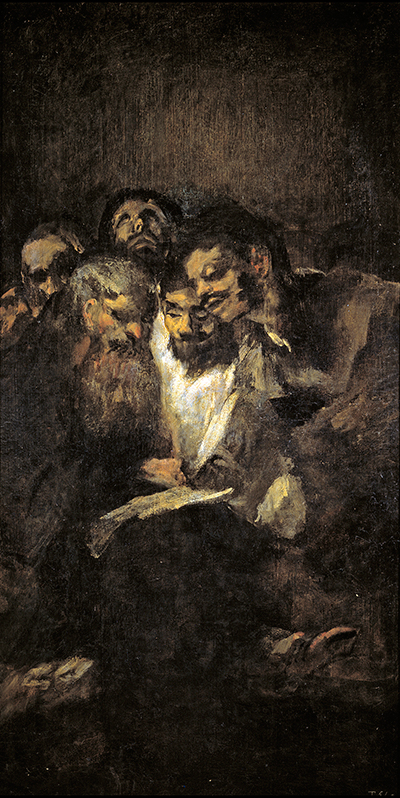
The name Pinturas negras comes from the works' later reception. The Prado associates it with both the prominence of dark pigments and the sombre character of many of the subjects. The title suits the near-black field around Saturn, but it prepares the eye poorly for the extensive ochre of The Dog, the shot of red in Asmodea or the open country in Fight with Cudgels. The individual names also belong to the history of the paintings after Goya. Yriarte remarked that each amateur had to choose the name that seemed most appropriate, and gave the Sabbath as his own suggested title. [3] Brugada's inventory, Yriarte's book and the Prado catalogue sometimes describe the same image in strikingly different ways. The cluster of people around a sheet of paper, for instance, appears in the Prado's account as Brugada's Two Men, Yriarte's The Politicians and, from the 1900 museum catalogue, The Reading. Each title asks the viewer to notice something different, from the number of conspicuous faces to the relationship between the people and the paper. [1] [4]
Fourteen is the count of transferred paintings in the Prado. The Fundación Goya en Aragón's series catalogue has nineteen records because it includes four separately catalogued sketches as well as a disputed associated work. The sketches are compositions related to Two Old Men, Two Old Men Eating, Procession of the Holy Office and Asmodea. The sketch for Asmodea is in Basel. The formats help explain why the catalogue makes the distinction. A small movable study can preserve an idea for a larger picture while the dimensions of the completed mural reflect the wall on which it had to fit. Evidence from an associated sketch may help with a motif or the development of a design. Assigning a painting to a particular wall requires evidence from the house, the photographs or a witness. [4] [2]
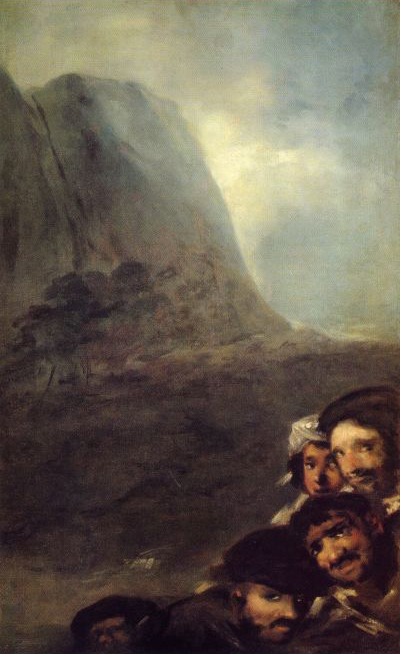
The nineteenth-century descriptions leave room for a fifteenth mural, now missing. Yriarte reports the early removal of a painting and names the Marquis of Salamanca in connection with it. The problem is identifying the work. The Fundación Goya catalogue lists Heads in a Landscape as a 112 by 67 centimetre oil on canvas. It lists Caprice with Five Heads as an alternate title and notes both the suggestion that it hung to the left of the upstairs door and questions about its attribution. Foradada distinguishes that canvas from a similar painting called Caprice with Five Heads, documented by 1846 in the Vista Alegre inventory and photographed by Laurent in the Montpensier collection in Seville in 1866. He considers the relationship between the paintings unresolved. An archival title and a similar photograph establish a comparison, but the present canvas would need to be securely matched to the historic object and its support examined before a Quinta origin or a change in size could be established. The proposed vacant position by the upstairs entrance thus remains a question about an unidentified mural. [3] [7] [8]
The fourteen Black Paintings
A house across the Manzanares
Goya bought the Quinta from Pedro Marcelino Blanco on 27 February 1819. The deeds describe a country property with a garden, wells and ancillary accommodation. The name Quinta del Sordo was in use before Goya bought it. The coincidence with the artist's own deafness has made the name memorable. It also makes it tempting to picture Goya alone in the house. Leocadia Zorrilla and her children formed part of the household, and the property had spaces for work as well as leisure. For the personal and professional events of these years, see the Goya biography. [1] [6] [9]
Goya gave the property to his grandson Mariano on 17 September 1823. The deed refers to improvements and enlargement, leaving room for disagreement over what the painter actually had built. He left for France in 1824. The house remained in the family until its sale in 1859, and further alterations and changes of ownership followed. By the time Émile d'Erlanger acquired it in 1873, the property seen by a visitor included additions made after Goya's occupancy. An exterior view from the middle of the century therefore needs to be read with the same care as a text describing the rooms. The wing that scholars associate with the painted interiors has to be distinguished from the later enlargement visible in nineteenth-century views. [2] [6] [9]
One unusually early witness is León Gil de Palacio's model of Madrid, made in 1828–1830 and held by the Museo de Historia de Madrid. At its outskirts a small model gives the building's approximate massing and shows openings on multiple elevations. It offers an important check on claims that the Quinta only acquired an upper storey in the later nineteenth century. Its craftsmanship and scale limit what can be measured from it. A small groove standing in for a window is relevant evidence for an opening, while the width of that groove cannot yield an interior measurement accurate to the centimetre. A map likewise gives an outline and an orientation more readily than it gives the position of a partition. Foradada and colleagues combined model, maps, deed transcriptions and measurements from Laurent's negatives to propose room dimensions of about ten by five metres downstairs and eight and a half by five upstairs. Other reconstructions use shorter estimates for the long sides. The dimensions are results of the reconstruction, with consequences for which wall spans a broad mural could occupy. [2] [8] [10]
Juan José Junquera used the property documents and the vocabulary of the inventory to question the traditional attribution, arguing for a later date for the upper storey and raising Goya's son Javier as a possible painter. Nigel Glendinning read the earlier deeds alongside the sale to Goya and argued that their references to low accommodation could describe ancillary spaces. He also found earlier usage for language that Junquera treated as an indication of a late date. These details matter because the argument for an alternate author depends in part on dating the physical structure and the records, as well as on interpreting the pictures themselves. The Prado catalogues the fourteen murals as works by Francisco de Goya. The separate question of authorship for Heads in a Landscape rests on its own much less secure connection to the house. [1] [6] [7] [11]
The records bring some of the missing interior back to view. In the 1857 property documents studied by Glendinning and revisited by Foradada and colleagues, one room contained twelve chairs, a solid mahogany dining table with leaves and room for twenty settings, a glazed china cabinet and a chandelier. This is evidence of how the room was furnished when inventoried. Identifying it with the ground-floor room described by Yriarte gives substance to the familiar designation of a dining room, although the source comes from the property's later history. Anyone looking across a furnished room at a wide painting would have shared the view with chairs, doorways and other people. The height of the eye and the distance from the wall changed with the activity in the room. Even a defensible paper plan can tell only part of that story. [2] [3] [6]
A route through the two rooms
The inventory associated with Antonio Brugada distinguishes the floors by grouping the works under short titles. Its date is debated. The Prado describes it as a mid-nineteenth-century inventory of works in Javier's possession, of uncertain date. Glendinning and others consider whether an earlier inventory might have been prepared in 1823, before Goya left Spain. Yriarte's French monograph supplies a firmer date, 1867, and the sequence of someone entering and looking around. Pierre Léonce Imbert visited in 1873 and furnished a further account. These witnesses sometimes apply different names or group entries differently. A match becomes stronger when a text gives a recognisable detail, a place and a format that fit a surviving painting. Laurent's photographic borders can test the proposed floor even where the image fails to show a corner or a door. [1] [2] [3] [6] [8]
The ground floor
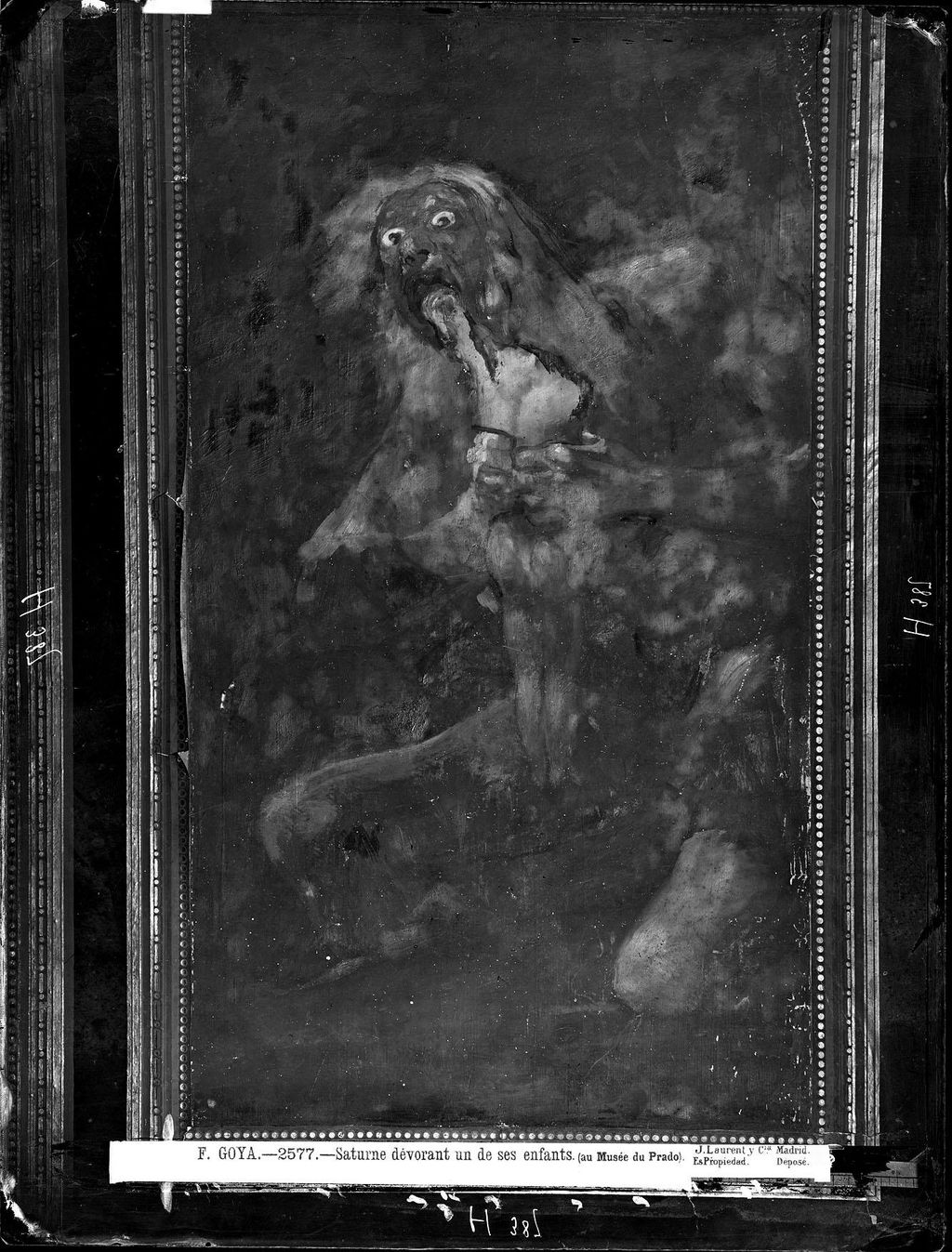
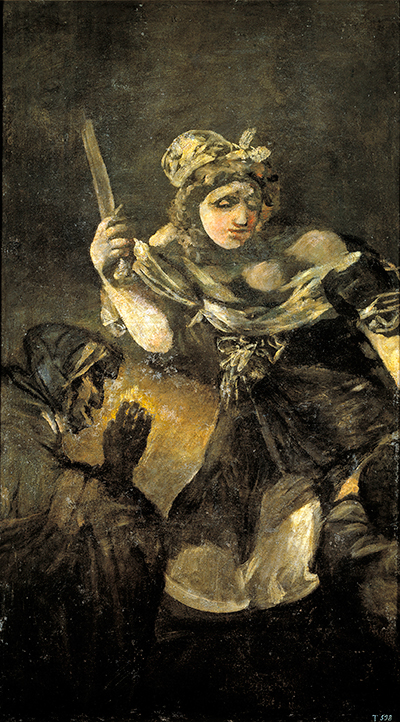
Look first across the room from the entrance. Yriarte's description places Saturn and Judith and Holofernes at the far end, on either side of an opening. Laurent recorded two narrow panels of nearly identical dimensions. Foradada and colleagues estimate each at roughly 143 by 81 or 82 centimetres as a mural. In that placement the opening interrupted a comparison between two scenes in which the hands are unusually prominent. Saturn's fingers close over the body he holds. Judith's raised arm brings the blade into a space occupied mainly by a lit figure and her attendant. Each painting offers a different instant of violent action. From a distance the similar dimensions and the two bright masses at the far end would have been apparent before the hand gestures became clear. The exact proportions of the opening in a modern diagram come from reconstruction. The pairing has firmer support in the descriptions and the measured photographs. [2] [3] [4]
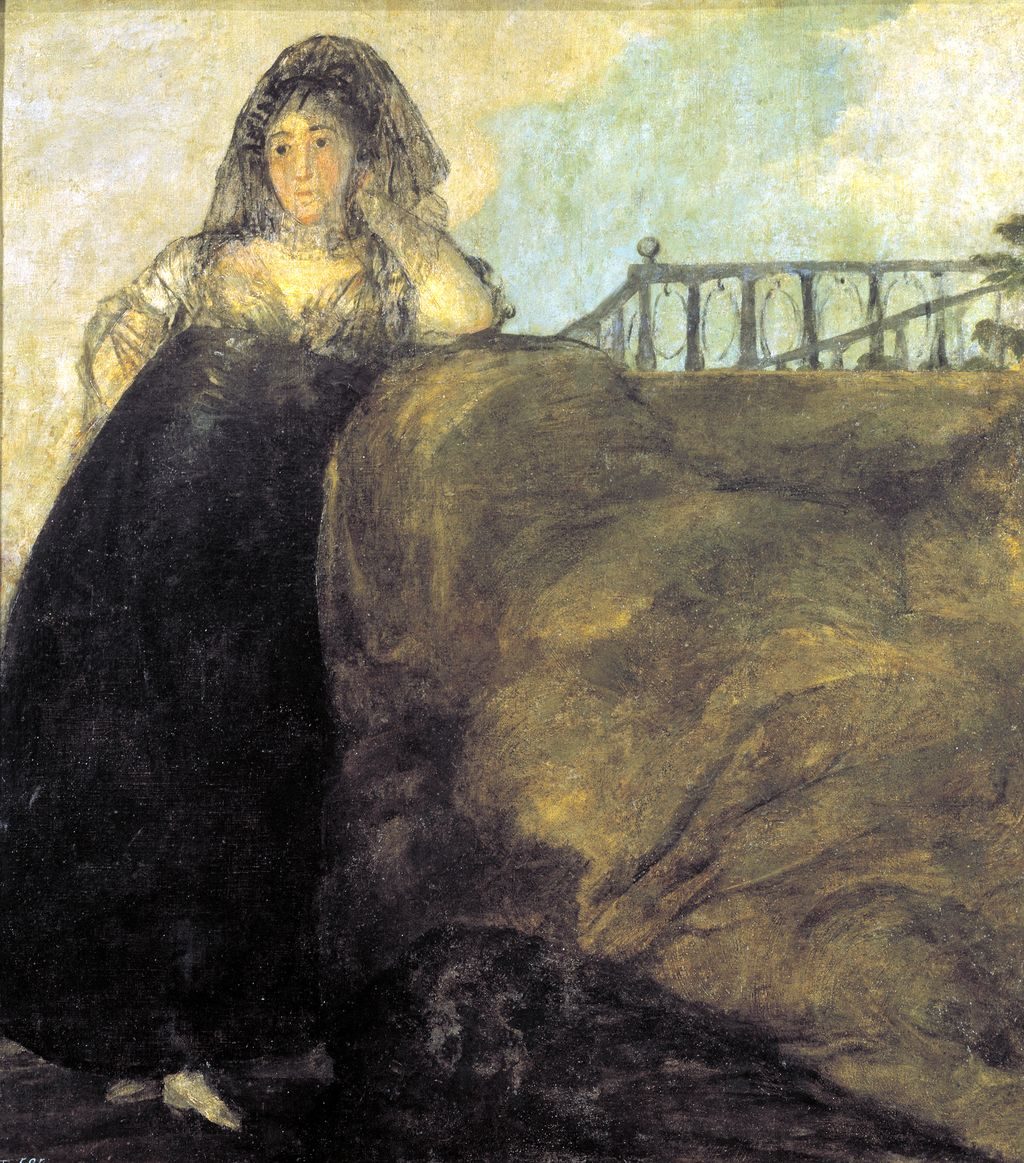
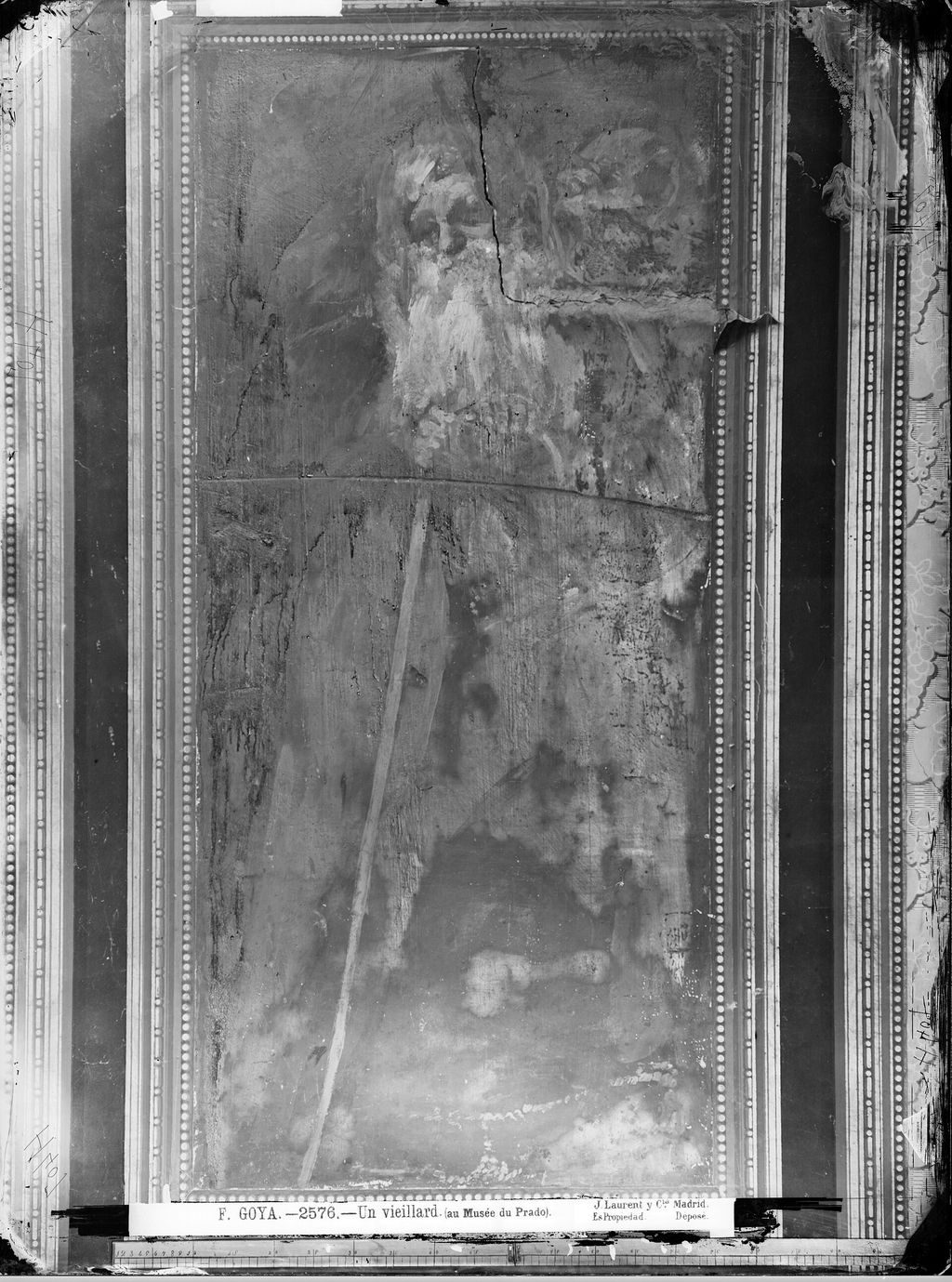
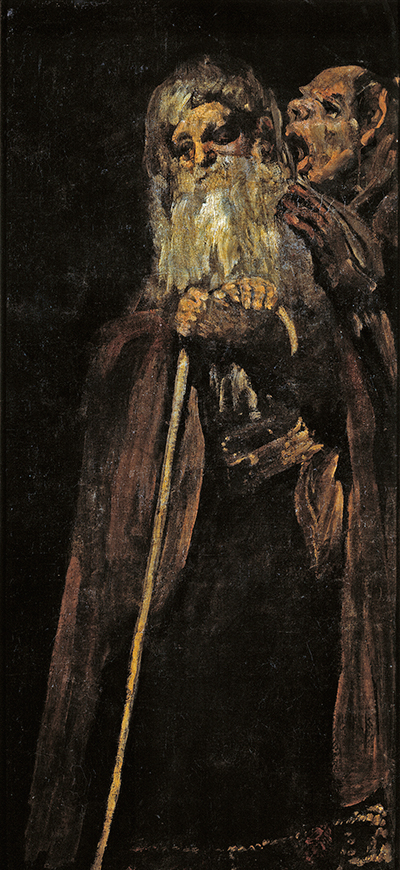
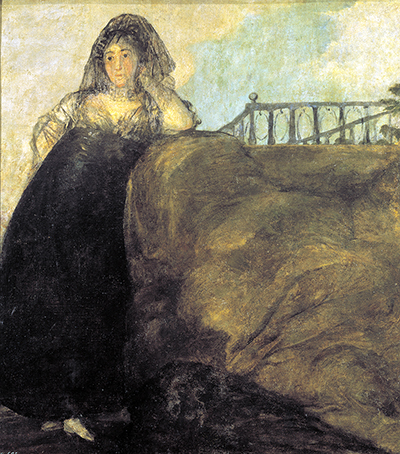
Turning back towards the entrance reverses the light and action. La Leocadia shows a standing woman who leans at her elbow and looks out beyond the painting. The name records a traditional association with Leocadia Zorrilla, and the dark veil and form at her side have encouraged funerary readings. In Two Old Men the foremost man lowers his head above a staff while a second face comes close behind. Foradada and colleagues calculate that La Leocadia was nearly twice as wide as Two Old Men, although their mural heights were similar. The two figures could thus have registered as upright companions before their panels registered as unequal in breadth. Their weight is suggested by different supports, the broad shape beside the woman and the narrow staff in the man's hands. Placed on the entrance wall, they would come fully into view after a visitor had entered and looked back. [2] [3] [4]
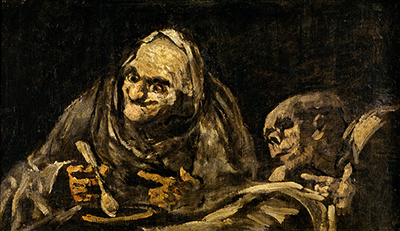
The small horizontal Two Old Men Eating Soup is distinct from that vertical pair of men. Its two heads sit close together above a little area of table and utensils. The probable ground-floor assignment rests in part on the border pattern recorded by Laurent and the way different readings of the inventories account for the seven pictures. A position above the entrance is a widely used reconstruction because the dimensions and format suit an overdoor. Foradada has also considered a location at the opening to the stairs or on the hall side of the door. Earlier scholarship entertained an upstairs location. A photograph with a downward-to-upward gradient of illumination helps to raise the question of height, but it cannot locate the panel by itself when both daylight and artificial lighting may have been involved. [2] [4] [8]
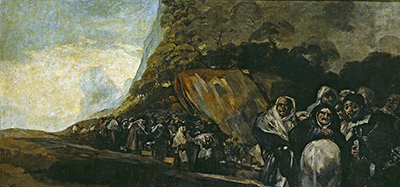
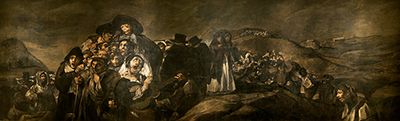
The two broad crowds give the ground floor its strongest contrast of scale. Yriarte describes the Witches' Sabbath on the left upon entering and the Pilgrimage to San Isidro on the right. The assembly around the dark goat pulls attention in towards the figure addressing it. Across the room, the nearest faces in the procession emerge broadly from the shadows, with the succession of heads diminishing into the distance. Both paintings organise a gathering around a line of faces, but the spectator's attention travels differently. In the Sabbath it returns to a figure at one end of the assembled group. In the pilgrimage it can follow a thread of people back into the country. The loss of part of the Sabbath and disagreement about the openings in these long walls complicate a precise plan. Foradada's team places the pilgrimage between two garden doors. Teixidor and Laguna offer a different arrangement of the long wall panels. Their disagreement concerns how the building and route are reconstructed from the surviving evidence, including which openings were usable when the pictures were painted. [2] [3] [4] [10]
The upper floor
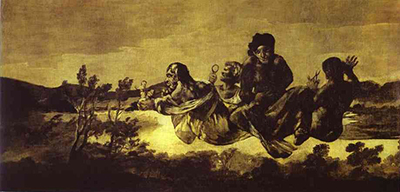
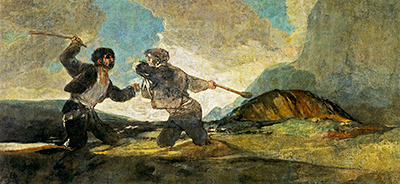
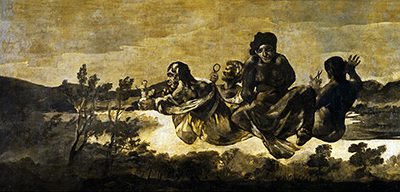
Upstairs Yriarte describes two long walls divided by windows, with a broad painting to either side of each division. This is a different visual rhythm from the long uninterrupted expanse of each downstairs crowd scene. In the reconstruction developed by Foradada and colleagues, The Fates or Atropos and Fight with Cudgels share the left wall. The airborne group of the first painting hangs against a landscape, while the encounter in the second is concentrated in the raised sticks, turns of the shoulders and opposing stances of two men. Moving between the panels means looking across a real opening between two painted tracts of country. Those tracts also differ within their own pictures. The far horizon and the group suspended above it make distance a part of the action in The Fates. The fighters' movements are readable first through the comparatively close, compact silhouette formed by the two bodies. [2] [3] [4]
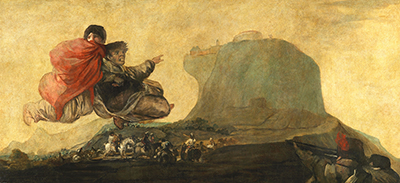
Across the room, Asmodea and Procession of the Holy Office make another pairing. In Asmodea the bright drapery of one of the airborne figures lies well above the armed men in the foreground, and the pointing gesture directs the eye towards the high rock. In the Holy Office the figures at the front are large and close to the frame. The course of the procession and the changing sizes of its figures send attention back and away. The town and the path give these broad paintings a physical depth beyond the house wall. The opening between them in the reconstruction means the two scenes are encountered separately in the same sweep of the eye. Laurent's surviving views of these two paintings include evidence of the moulding near the ceiling. That gives a basis for estimating height on the wall as well as identifying how the images were edged. [2] [3] [4]
The procession has been called Pilgrimage to the Fountain of San Isidro, which accounts for the similar names given to two different murals on the site. In the Prado grouping, Procession of the Holy Office identifies the upstairs painting, while Pilgrimage to San Isidro is the wide downstairs crowd opposite the Sabbath. The Hermitage of San Isidro and The Meadow of San Isidro belong to Goya's earlier work of 1788 connected with a tapestry project. The Meadow opens out across a panoramic view of Madrid. The Black Painting downstairs crowds faces into the foreground and makes the terrain much harder to read. The shared reference to the city's patron saint makes this change in scale, light and access to the landscape especially apparent. [4] [12]
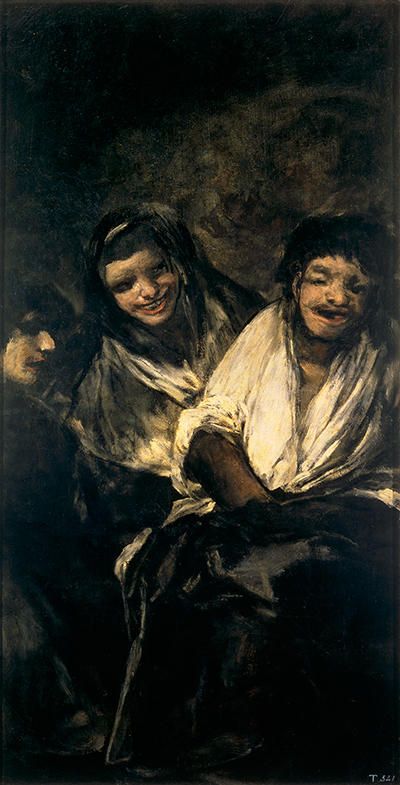
At the far end of the upstairs room in Foradada's reconstruction are Men Reading and Two Women and a Man. The first compresses several faces round a sheet on which the light falls. In the second, laughter is suggested by the open mouths and the incline of the heads. Both panels show figures close enough to share an action whose details are partly withheld from the viewer. Yriarte treats these two as companions at the back of the room. The Prado's entry for The Reading groups the works on the same upper-floor wall but describes it as a lateral wall. The argument for the two panels as neighbours is stronger than the claim for a specific reconstructed direction of view. [1] [2] [3]
The Dog goes by the entrance on the upper floor in Foradada's plan, on the right as one enters. The wording of Yriarte's passage about the doorway is difficult, but the description of the dog and the mention of a missing companion are recognisable. The panel's narrow shape and the photographic evidence for its upstairs surround fit the placement. A person making a circuit of the room would turn back towards the entrance to see it. The surprising change is in the proportion of figure to field. After the flying, fighting and gathering figures elsewhere in the upstairs room, the dog scarcely occupies its picture. Depending on how visitors approached the door, that small head might be the last thing they saw before leaving. The suggested order of encounter gives no firm evidence that it was the last picture Goya painted. [2] [3] [8] [13]
Goya on film
Five films explore Goya’s portraits, prints, Black Paintings and painting techniques.
The Duke of Wellington by Goya
The portrait, its military decorations and its later theft.
Watch on YouTubeWhat Laurent photographed
Jean Laurent's photographs catch the paintings at a particular point in the history of the house, with the painted surfaces still attached to their walls. The Prado dates the campaign to around 1873, while Carlos Teixidor and Raquel Esteban Vega place it in 1874. The working context gives the latter dating a basis in the history of the removals. The date range matters because the photographs are sometimes used to illustrate what the rooms looked like in Goya's day, half a century earlier. For the history of each painting, the images supply a firm relative date. They record the painted surface before its transfer to canvas. The fifteen surviving negatives discussed by Esteban Vega document the fourteen murals then present, including two views of the large Sabbath. Fifteen plates are therefore a different kind of count from fifteen mural entries in an inventory. [1] [10] [14]
In the negative of The Dog (VN-06583 P), the eye can go past the high ochre field and the sloping bank to the narrow border and the repeating pattern of the wall covering. The tall format belongs to a panel within that surround. The image leaves the larger setting largely outside the camera's view. In the negative of Saturn (VN-03194), the painted rectangle is also clearly set off from its surroundings, but the border is broader and the patterned paper beyond it differs. The change of pattern supports the distinction between floors found in the written accounts. It also makes it easier to see why a painting now experienced as a dark rectangle hung on a blank gallery wall had quite a different edge in the Quinta. There its margin divided the painted action from more decoration. [2] [13] [15]
The distinction between the borders of the pictures and the paper on the walls is worth making slowly. The photographs record narrow and wide mouldings that imitate the appearance of frames. In places a fissure continues across both wall and edging, evidence that the moulding participated in the wall's material history. Foradada and colleagues distinguish a foliage pattern downstairs from a more geometric decoration upstairs. Glendinning pointed out that wallpaper was available in Madrid during Goya's occupancy. Availability makes early paper plausible, while the photographs securely date only what was present when Laurent visited. Re-papering and changes to borders were possible in the intervening decades. A modern reconstruction that borrows the photographed pattern recreates a documented stage in the room's appearance, with an open question about how far it reaches back. [2] [6] [8] [14]
The photographer's materials also affect what the viewer can recover. Laurent used glass negatives prepared with wet collodion, which had to be made and processed while the coating was still wet. Esteban Vega uses the uneven light recorded in the photographs and evidence of Laurent's experiments with electricity to make the case for artificial illumination in the Quinta. The bright and dark passages in a single exposure may therefore tell us something about his light source as well as about pigment and condition. Yriarte already mentioned that the then owner Rodolphe Coumont had commissioned photographs, an additional reason for care in identifying which photographic campaign a later reproduction belongs to. [3] The photographs give a particularly strong basis for recognising a painted edge, a crack or the position of a head. A difference in the apparent darkness of a whole background needs more careful treatment. So does the temptation to convert a bright corner in a plate into evidence about the location of a window. [9] [14] [16]
Carmen Torrecillas's work on the Laurent material and Carlos Foradada's examination of the digitised photographs made it possible to return to details that are hard to read in smaller reproductions. A ruler included by Laurent in some views offers a scale. Reading that scale requires attention to the ruler's position and markings and to the edges of the painting. Foradada and colleagues used it to test dimensions that had sometimes been estimated from the canvases. Their study of Atropos estimates a mural width of about 243 centimetres, compared with roughly 266 centimetres for the present canvas. They identify added paint at the left that continues the landscape. Foradada's separate study of the faces compares the configurations and expressions in Laurent's plate with details on the transferred painting. These comparisons operate at quite different scales, from centimetres of painted landscape to small changes in a face. A photograph can help locate the change in both cases. The explanation of each change still depends on the specific evidence. [2] [17] [18]
How a floor can be reconstructed from separate views
The photographs allow a reconstruction because they preserve more than the figures people came to see. A border or the transition between a painted passage and adjacent decoration can carry information about the original dimensions. A surviving canvas has an edge that can be measured directly, but it may mark a decision made during transfer or later treatment. Carlos Teixidor Cadenas and F. Javier Laguna compares the photographed borders and the paintings in his published reconstruction of the lower floor. A hypothesis about the arrangement becomes stronger if it accommodates the visible edge of several paintings together, rather than relying on one resemblance or on which scenes appear to belong together thematically. [10] [14]
The photographs themselves have a history. The date at which the negative recorded the wall, the date at which a positive was made, and the date of a label added for distribution can all diverge. A reproduction bearing a caption referring to the Prado can still transmit an image made inside the Quinta. That distinction changes how a reader should use lettering or a border at the edge of a reproduced view. Some marks are evidence about the photographic object. Others are evidence about the architecture represented in it. Comparison with further views is a way to decide which is which. [10] [14]
The room reconstructions matter for interpretation because they change bodily scale and the order of attention. A small panel beside a doorway has different demands from a field across most of a wall. A seated or approaching visitor would have encountered figures at different angles. The modern exhibition lets viewers follow subjects in a single sequence and compare paint surfaces under consistent conditions. The earlier house placed pictures around bodies, windows and passageways. Reconstructing that experience remains approximate, but comparison with Laurent’s views narrows the range of plausible arrangements. [10] [14]
A reconstruction can begin by marking a feature seen both in a photograph and on a canvas and then measuring the surrounding field in relation to it. With the great Sabbath, a feature visible in both photographs can also locate one view against the other. Any transition between paint and ornament gives an additional point of comparison. Following this chain enables a reader to test a room plan as a geometric proposal. Areas outside both views still have to be recovered from another kind of evidence, such as a written description or a record of the house. [10] [14]
From painted walls to canvases
D'Erlanger commissioned Salvador Martínez Cubells to transfer the murals after acquiring the Quinta. Martínez Cubells already worked as a museum restorer, but the transfer was a private commission from the owner. The restorer's books, now in the Prado archive, record work associated with the project from August 1874 through December 1876. The first entry does not name Goya explicitly, and Esteban Vega notes that its date could refer to detachment or to work in the studio. Later entries identify the work more clearly. It is possible to follow the transfer as a series of jobs over time, with the register's language allowing varying degrees of precision for individual pictures. [9] [14]
The walls were dry when the murals were painted, and the technical studies identify an oil component and a white preparation containing calcium sulphate. The paint was bound into a layered surface over the masonry. Transferring such a surface involves securing the painted face temporarily, detaching it from the wall and mounting it on a support that can carry it independently. Once it was on canvas, a painting could be handled at the back and set on a stretcher. In 1867 Yriarte had described the unfired brick walls as cracking despite their props and doubted that the pictures could be saved. [3] The intervention also created problems to solve at the front. Parts of the surface failed to come away intact, and the objects arrived in the studio with damage and gaps to be made stable or visually coherent. The variation from one mural to another makes each photograph an important companion to the study of what survived. [5] [9] [16] [19]
The most obvious change to a format is the cut at the right of Witches' Sabbath. In Laurent's photographs the young figure at that side has a substantial stretch of painted space beyond her. Foradada and colleagues estimate an original painted width of about 5.79 metres for the Sabbath. The Fundación Goya gives 4.36 metres for the transferred painting. On the canvas the boundary is much closer to the figure. The result is visible without having to settle whether she is watching, waiting or resisting. Her position within the length of the assembly has changed. The altered width also changes how one imagines this painting sharing a room with Pilgrimage to San Isidro. A plan based on the current canvas would make the two expanses more unequal than they appear in the old photographs. By contrast, the added width identified in Atropos illustrates how the transfer and subsequent presentation could extend an edge as well as reduce one. [2] [4] [17] [19]
There was a documented public presentation in Paris during the Universal Exhibition of 1878. The Trocadéro setting put the pictures before an exhibition audience among other examples of historic Spanish art. The audience could encounter them as individual pictures, without the thresholds, furniture or pairs that made them an interior. Yriarte's French readers had already been introduced to the works through an account of moving through the house, so the relationship between a picture and its setting had changed even for viewers who had never been to Madrid. [3] [20] Suggesting d'Erlanger hoped to sell the works is reasonable and appears in the conservation literature. The showing and subsequent donation have a firmer documentary basis. The restorer's register records fourteen Goya canvases back in the workshop on 18 July 1881, after the Paris exhibition and before the state accepted d'Erlanger's gift by royal order of 20 December 1881. That workshop entry is important because evidence of nineteenth-century intervention may belong to more than one campaign. Díez Esteban gives 1889 for the start of display at the Prado. The museum records the works' first inclusion in its printed catalogue in 1900. [1] [9] [14] [20]
What the surfaces can still tell us
In 1983 the Prado obtained new radiographs for technical study, and Carmen Garrido published findings from imaging and paint samples the following year. The radiographs disclosed earlier compositions beneath some of the Black Paintings. In Saturn, for instance, Garrido described a landscape with sky and mountains and a figure in a posture suggestive of dancing. A radiograph can also show where material is missing. The Prado's image of Saturn's head shows losses affecting the very area where his great staring eyes dominate the visible surface. Comparing it with Laurent's photograph gives an idea of how difficult it is to recover an earlier expression from the canvas alone. Garrido's sampled paint layers describe what is present at particular sites in the object. In one red passage she identified vermilion and lead white over a layer containing Prussian blue, lead white and carbon black. The succession of colours in the sample comes from an area in which the visible image gives the impression of a bright mark against darkness. [1] [5] [15] [19]
Fight with Cudgels gives the problem a different shape. The forms of the legs and ground in the current canvas have encouraged viewers to imagine the fighters sunk into the earth. Comparison with the old photograph gives more weight to traces of vegetation and to differences in the lower zones. The region at the feet is precisely where a large claim about the meaning depends on the exact state of the paint. The photographic and technical comparisons justify looking again at the ground and at the fighters' balance. How much of each leg a viewer could make out in the room has to be judged from the particular damaged passages of that image. In The Dog, similarly, the existence of losses and variations in the ochre field leaves open what some of the ambiguous marks in the old negative represent. [5] [13] [17] [19]
Factum Arte and the Prado took a further kind of record in 2014–2015. The project used a non-contact Lucida scanner to measure very small differences in the relief of the surface and made a high-resolution colour record assembled from many photographs. One of the project's examples shows the scanner working over Pilgrimage to San Isidro. The surface data can be rendered without the painted colour, making small changes of slope and texture easier to locate. The assembled colour image can then be matched to the relief, so that a ridge or fissure can be found on the visible picture. This records the condition of a transferred painting at a particular moment. An X-ray supplies information about layers beneath it, and Laurent's camera supplies visible evidence from a time when it was still on the wall. A comparison can situate a feature at one, two or three of those stages. [5] [21]
The paired arrangement also informs some historical interpretations. Foradada reads the pairing of Saturn and Judith against the political tensions around the Liberal Triennium of 1820–1823. He points to the contrast between a ruler who destroys his own offspring and a woman who raises a blade against a commander. He connects the Judith image with the appeal that plays about her victory had held for Spanish liberals. This takes the paintings' visible actions and the likely encounter across the opening seriously. Identifying specific political counterparts for these figures remains an interpretation. There is no surviving explanation from Goya assigning the pair that meaning, and the rooms also held gatherings and figures whose relation to those events is harder to name. [2] [22]
In the Prado, starting with the pairs gives a way to see the works independently and as remnants of the rooms. Let the nearly equal dimensions of Saturn and Judith register before moving closer. Then compare The Fates and Fight with Cudgels, allowing for the interruption of a real opening in their old wall. Notice the sequence of people's heads in the two long downstairs scenes and compare it with the space above the solitary head of The Dog. The museum makes these changes of scale available in a single visit. Laurent's photographs supply some of what the gallery cannot, including the lines of decoration that once went right up to the edges of the pictures. Goya's paintings guide situates the Quinta among the other settings for which the artist worked. [1] [2] [4] [13]


 Francisco de Goya.jpg)
Artworks directory
| Name | Date | Medium |
|---|---|---|
| And There’s No Help for It, Plate 15 | Printed 1863 | |
| Asmodea | c. 1820–23 | Wall painting transferred to canvas |
| Boys Inflating a Bladder | 1777–78 | Tapestry cartoon |
| Boys Picking Fruit | 1778 | Tapestry cartoon |
| Bullfight in a Divided Ring | 1825 | Lithograph |
| Card Players | 1777–78 | Tapestry cartoon |
| Card Players (sketch) | 1777–78 | Painted sketch |
| Dance on the Banks of the Manzanares | 1777 | Tapestry cartoon |
| Duel with Cudgels | c. 1820–23 | Wall painting transferred to canvas |
| Heads in a Landscape | c. 1820–23 | Easel painting |
| Judith and Holofernes | c. 1820–23 | Wall painting transferred to canvas |
| Leocadia | c. 1820–23 | Wall painting transferred to canvas |
| Maja and Cloaked Men | 1777 | Tapestry cartoon |
| Maja and Cloaked Men (sketch) | 1777 | Painted sketch |
| Majo Clapping in Time to the Music | 1777 | Drawing |
| Men Reading | c. 1820–23 | Wall painting transferred to canvas |
| Out Hunting for Teeth, Plate 12 | 1799 | Etching, burnished aquatint and burin |
| Picnic in the Countryside (sketch) | 1776–78 | Painted sketch |
| Picnic on the Banks of the Manzanares | 1776 | Tapestry cartoon |
| Pilgrimage to San Isidro | c. 1820–23 | Wall painting transferred to canvas |
| Preparatory study for The Sleep of Reason Produces Monsters | c. 1796–97 | Drawing |
| Procession of the Holy Office | c. 1820–23 | Wall painting transferred to canvas |
| Quarrel at the Cockerel Inn (sketch) | 1777 | Painted sketch |
| Quarrel in the New Tavern | 1777 | Tapestry cartoon |
| Saturn Devouring His Son | c. 1820–23 | Wall painting transferred to canvas |
| Seated Majo Smoking | c. 1776 | Drawing |
| The Dog | c. 1820–23 | Wall painting transferred to canvas |
| The Drinker | 1777 | Tapestry cartoon |
| The Fates | c. 1820–23 | Wall painting transferred to canvas |
| The Great He-Goat | c. 1820–23 | Wall painting transferred to canvas |
| The Kite | 1777–78 | Tapestry cartoon |
| The Parasol | 1777 | Oil on canvas, tapestry cartoon |
| The Second of May 1808 | 1814 | Oil on canvas |
| The Sleep of Reason Produces Monsters, Plate 43 | 1799 | Etching and aquatint |
| The Third of May 1808 | 1814 | Oil on canvas |
| Thou Who Canst Not, Plate 42 | 1799 | Etching and burnished aquatint |
| Three Figures | 1776 | Drawing (lost) |
| Two Old Men | c. 1820–23 | Wall painting transferred to canvas |
| Two Old Men Eating Soup | c. 1820–23 | Wall painting transferred to canvas |
| Two Women and a Man | c. 1820–23 | Wall painting transferred to canvas |
| Universal Language: The Author Dreaming | 1797 | Drawing |
| The Family of Charles IV | 1800 | Oil on canvas |
| Witches’ Sabbath (Osuna painting) | 1797–98 | Oil on canvas |
| The Nude Maja | 1795–1800 | Oil on canvas |
| The Clothed Maja | 1800–07 | Oil on canvas |
| Self-Portrait (Drawing) | c. 1796 | Brush and carbon black ink on laid paper |
| The Swing, Madrid Album B.21 | 1795–97 | Brush and carbon black washes |
| Majas Fighting, a Majo Observing, Madrid Album B.15 | 1796–97 | Brush, grey and black washes on laid paper |
| Majos and Majas Conversing, Madrid Album B.16 | c. 1794–97 | Ink wash on paper |
| Weeping Woman and Three Men, Madrid Album B.17 | 1795–97 | Brush, carbon black washes and black chalk |
| Maja Seated on a Chair and Two Companions Behind, Madrid Album B.18 | 1795–97 | Brush and carbon black washes |
| Girl and Bull, Madrid Album B.23 | 1796–97 | Brush and carbon black washes |
| Lovers Sitting on a Rock, Madrid Album B.24 | 1796–97 | Brush and carbon black washes |
| Mariano Ceballos Riding a Bull | 1825 | Crayon lithograph and scraper |
| Landscape (lifetime impression) | c. 1807–10 | Etching and aquatint |
| Self-Portrait (1815), Prado canvas | 1815 | Oil on canvas |
| Self-Portrait (1815), Academy panel | 1815 | Oil on panel |
| Self-Portrait with Dr Arrieta | 1820 | Oil on canvas |
| Christ Crucified | 1780 | Oil on canvas |
| The Last Communion of Saint Joseph of Calasanz | 1819 | Oil on canvas |
| Christ on the Mount of Olives | 1819 | Oil on panel |
| The Flower Girls, or Spring | 1786–87 | Oil on canvas |
| The Grape Harvest, or Autumn | 1786–87 | Oil on canvas |
| The Snowstorm, or Winter | 1786–87 | Oil on canvas |
| The Threshing Ground, or Summer | 1786–87 | Oil on canvas |
| Picnic on the Banks of the Manzanares | 1776 | Oil on canvas |
| The Kite | 1777–78 | Oil on canvas |
| Dance on the Banks of the Manzanares | 1777 | Oil on canvas |
| A Fight at the Venta Nueva | 1777 | Oil on canvas |
| Blind Man’s Bluff | 1788 | Oil on canvas |
| Dogs on a Lead | 1775 | Oil on canvas |
| Hunting with a Decoy | 1775 | Oil on canvas |
| Hunter Loading His Rifle | 1775 | Oil on canvas |
| The Angler | 1775 | Oil on canvas |
| The Hermitage of San Isidro on His Feast Day | 1788 | Oil on canvas |
| The Meadow of San Isidro | 1788 | Oil on canvas |
| The Straw Manikin | 1791–92 | Oil on canvas |
| Witches’ Flight | c. 1797–98 | Oil on canvas |
| A Scene from ‘The Forcibly Bewitched’ | 1798 | Oil on canvas |
| The Duchess of Alba in Black | 1797 | Oil on canvas |
| The Duchess of Alba in White | 1795 | Oil on canvas |
| Charles III in Hunting Dress | c. 1786 | Oil on canvas |
| The Duke and Duchess of Osuna and Their Children | 1787–88 | Oil on canvas |
| Manuel Osorio Manrique de Zúñiga | 1787–88 | Oil on canvas |
| The Marquesa de Pontejos | c. 1786 | Oil on canvas |
| Equestrian Portrait of the 1st Duke of Wellington | 1812 | Oil on canvas |
| The Duke of Wellington | 1812–14 | Oil on wood |
| Portrait of Ferdinand VII of Spain | 1814 | Oil on canvas |
| Gaspar Melchor de Jovellanos | 1798 | Oil on canvas |
| María Tomasa Palafox y Portocarrero | 1804 | Oil on canvas |
| Señora Sabasa García | c. 1806–11 | Oil on canvas |
| Don Juan Bautista de Muguiro | 1827 | Oil on canvas |
| Doña Isabel de Porcel | Before 1805 | Oil on canvas |
| The Colossus | After 1808 | Oil on canvas |
| The Burial of the Sardine | 1808–12 | Oil on panel |
| The Madhouse | 1808–12 | Oil on panel |
| A Procession of Flagellants | 1808–12 | Oil on panel |
| Portrait of Jacques Galos | 1826 | Oil on canvas |
| Portrait of Mariano Goya, the Artist’s Grandson | 1827 | Oil on canvas |
| Milkmaid of Bordeaux | c. 1827 | Oil on canvas |
| Portrait of Don Juan Antonio Cuervo | 1819 | Oil on canvas |
| María Luisa of Parma (Naples version) | c. 1800 | Oil on canvas |
| The Countess of Baena | 1819 | Oil on canvas |
| The Family of the Infante Don Luis | 1783–84 | Oil on canvas |
| The Holy Family | c. 1787 | Oil on canvas |
| Saint Barbara | c. 1773 | Oil on canvas |
| Saints Justa and Rufina | 1817 | Oil on canvas |
| El Tío Paquete | c. 1819–20 | Oil on canvas |
| The Forge | c. 1815–20 | Oil on canvas |
| Majas on a Balcony (Metropolitan Museum version) | c. 1800–10 | Oil on canvas |
| Maja and Celestina on a Balcony | c. 1808–12 | Oil on canvas |
| The Water Bearer | 1808–12 | Oil on canvas |
| Time and the Old Women | c. 1810 | Oil on canvas |
Frequently Asked Questions
The Prado's fourteen are the works that were present when the surviving group was removed. Yriarte describes an earlier removal upstairs, and the inventory associated with Brugada has been read as counting fifteen. The identity of the missing mural is disputed. Heads in a Landscape has been proposed, but its association with the house remains unconfirmed. [3] [7] [8]
Discussion
Look again at the images and ideas explored in The Black Paintings. These editorial prompts invite your observations.
Open Laurent's views of Saturn and The Dog. Follow the border around each painting before looking at the figures. Which parts of the encounter might change if the first faced you from across a room and you had to turn back towards a doorway to see the second? Which details in the photographs support that comparison? [13] [15]
Reader Insights
What changes when you see a photograph of a painting on the wall where it was painted?
Which neighbouring works change your reading of the original rooms most?
Join the Conversation
Share a detail, comparison or question about The Black Paintings below.
References
- Museo Nacional del Prado, La lectura, P000766, catalogue entry with the museum's account of the mural group and its early records. View source.
- Carlos Foradada, Carlos Narbaiza, José Javier Luis and Alfonso Burgos, ‘Las medidas de la casa de Goya y sus Pinturas negras en su entorno original’, ASRI, no. 20 (2021), pp. 53–82, especially figs. 20–32. View source.
- Charles Yriarte, Goya. Sa vie, son œuvre, Paris, Henri Plon, 1867, ‘La maison de Goya’, pp. 91–96, and the wall-painting catalogue at the end of the volume. View source.
- Fundación Goya en Aragón, Black Paintings series catalogue. Individual ground-floor records are La Leocadia, Two Old Men, Two Old Men Eating, Witches' Sabbath, Saturn, Judith and Holofernes and The Pilgrimage to San Isidro. Upper-floor records are The Fates, Duel with Cudgels, The Reading, Two Women and a Man, Procession of the Holy Office, Asmodea and Half-Submerged Dog. View source 1. View source 2. View source 3. View source 4. View source 5. View source 6. View source 7. View source 8. View source 9. View source 10. View source 11. View source 12. View source 13. View source 14. View source 15.
- Carmen Garrido Pérez, ‘Algunas consideraciones sobre la técnica de las Pinturas Negras de Goya’, Boletín del Museo del Prado 5, no. 13 (1984), pp. 4–40, especially pp. 22–23, figs. 43–46, on Saturn. Digitised copy. View source 1. View source 2.
- Nigel Glendinning, ‘Las Pinturas Negras de Goya y la Quinta del Sordo. Precisiones sobre las teorías de Juan José Junquera’, Archivo Español de Arte 77, no. 307 (2004), pp. 233–245, with transcriptions of the sale deeds and discussion of the Brugada inventory. View source.
- Fundación Goya en Aragón, Heads in a Landscape (Cabezas en un paisaje), catalogue entry 672. View source.
- Carlos Foradada, ‘El interior de la Quinta del Sordo’, AACA Digital, especially sections 4–6 on the room arrangement, the small panels and the case of Capricho con cinco cabezas. View source.
- Celia Isabel Díez Esteban, ‘La fotografía histórica como fuente de información de la obra de arte: J. Laurent y el perro semihundido de Goya’, Actas XIII Congreso Internacional de Historia del Papel en la Península Ibérica, pp. 153–162. View source.
- Carlos Teixidor Cadenas and F. Javier Laguna, ‘Las Pinturas negras en la Quinta de Goya. Reconstrucción de la planta baja, con las fotografías de J. Laurent de 1874’, in Goya en la Literatura, en la Música y en las Creaciones Audiovisuales, especially the reconstructed ground-floor arrangement on p. 409. View source.
- Juan José Junquera y Mato, ‘La Quinta del Sordo en 1830: respuesta a Nigel Glendinning’, Archivo Español de Arte 78, no. 309 (2005), pp. 83–88. View source.
- Fundación Goya en Aragón, The Chapel of San Isidro on his Feast Day, P002783, and The Meadow of San Isidro, P000750, catalogue entries for the oil sketches of 1788. View source 1. View source 2.
- Jean Laurent, The Dog before transfer, glass negative VN-06583 P, Archivo Ruiz Vernacci, Instituto del Patrimonio Cultural de España. Digitised record reproduced on Wikimedia Commons. View source.
- Raquel Esteban Vega, ‘Las fotografías de J. Laurent de las Pinturas negras de Goya’, in Goya en la Literatura, en la Música y en las Creaciones Audiovisuales, pp. 413–426, with the restoration registers, photograph dating and analysis of the lighting. View source.
- Jean Laurent, Saturn before transfer, glass negative VN-03194, Archivo Ruiz Vernacci, Instituto del Patrimonio Cultural de España. Digitised record reproduced on Wikimedia Commons. View source.
- Corinne Cristini, ‘D’un support à un autre. L’apport des photographies de Jean Laurent dans la mise en lumière des Pinturas Negras de Francisco de Goya’, L’Âge d’Or, no. 4. View source.
- Carlos Foradada, ‘Las Pinturas negras de Goya recuperadas en la digitalización de las fotografías de Laurent’, in Re_visiones sobre arte, patrimonio y tecnología en la era digital. See also the bibliographic record of Foradada's earlier comparative study in Goya, no. 333. View source 1. View source 2.
- Carlos Foradada, ‘La tortura en el rostro: Las Parcas de Goya en las fotografías de Laurent’, AACA Digital. View source.
- Nigel Glendinning, ‘The Strange Translation of Goya’s “Black Paintings”’, The Burlington Magazine 117, no. 868 (1975), pp. 464–479. View source.
- Iberic@l, no. 10 (Autumn 2016), with the account of the 1878 Spanish retrospective display at the Trocadéro and Esteban Vega's study of Laurent's photographs. View source.
- Factum Arte and Museo Nacional del Prado, 3D and Colour Recording of Francisco de Goya’s Black Paintings, project report, 2014–2015. View source.
- Carlos Foradada, ‘El entorno político y social en los contenidos de las Pinturas negras’, in Goya y su contexto, especially pp. 198–201 on Saturn and Judith. View source.







