


 by Tom Gurney
Tom Gurney BSc (Hons) is an art history expert with over 20 years experience
Published on June 19, 2020 / Updated on November 20, 2026
Email: tomgurney1@gmail.com / Phone: +44 7429 011000
Introduction
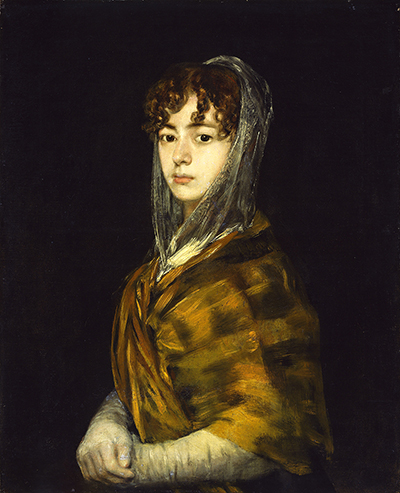
María García Pérez de Castro turns her face towards us while her shoulders angle to our left. A pale veil follows the curve of her head and gathers at her throat, where it meets a shawl streaked with gold and brown. Francisco de Goya keeps the background dark enough for the folds to disappear at the edge of the picture. The face and the gloves remain clear at opposite ends of the figure. Between them, the shawl takes up more of the canvas than any other part of her costume. [1]
The National Gallery of Art dates the portrait to about 1806–1811. The sitter is known as Sabasa, the name by which María was known among those close to her. Her family’s association with the painting helped scholars establish who she was. A story about Goya meeting her while working on a portrait of her uncle has a different history, reaching print more than a century after the likely sitting. [1] [2]
At a Glance
- ArtistFrancisco de Goya y Lucientes
- TitleSeñora Sabasa García
- SitterMaría García Pérez de Castro, known as Sabasa (born 1790)
- DateAbout 1806–1811
- Medium and dimensionsOil on canvas, 71 × 58 cm (height × width)
- CollectionNational Gallery of Art, Washington, DC, Andrew W. Mellon Collection, accession 1937.1.88. [1] [2]
Works across Goya’s career
The Parasol
1777The Nude Maja
1795–1800Señora Sabasa García
c. 1806–11Saturn Devouring His Son
c. 1820–23The Dog
c. 1820–23The turn of the head
The line of the nearer shoulder falls away to our right, while the far shoulder all but vanishes into the shawl. The face turns far enough for both eyes to be clearly visible. Below the chin, the veil hangs at a slant across the throat, marking the space between the direction of the head and the direction of the body. The forearms cross low in the picture, almost level with its bottom edge. In the exhibition catalogue Goya: Images of Women, the arrangement is described as triangular. The head forms the top and the elbow and meeting hands establish the base. The triangle explains how an upright figure can occupy so much of a relatively small canvas, even though there is empty space around the head and down one side. [1] [3]
Goya places small dark accents at the eyelids and nostrils and lets the warm colour at the lips subside into paler skin at their corners. Short brown curls cross the forehead, some of them ending just above the brows. The hair is picked out by tiny touches of ochre, most visible along the side facing the light. Seen from a distance, the pale oval makes the face easy to find. Up close, those small changes of tone give its individual features a precision that the much larger areas of cloth do not share. [1] [2] [3]
Annotated Details from Señora Sabasa García
Follow the line of the mantilla from the sitter's face to the shawl and gloves.
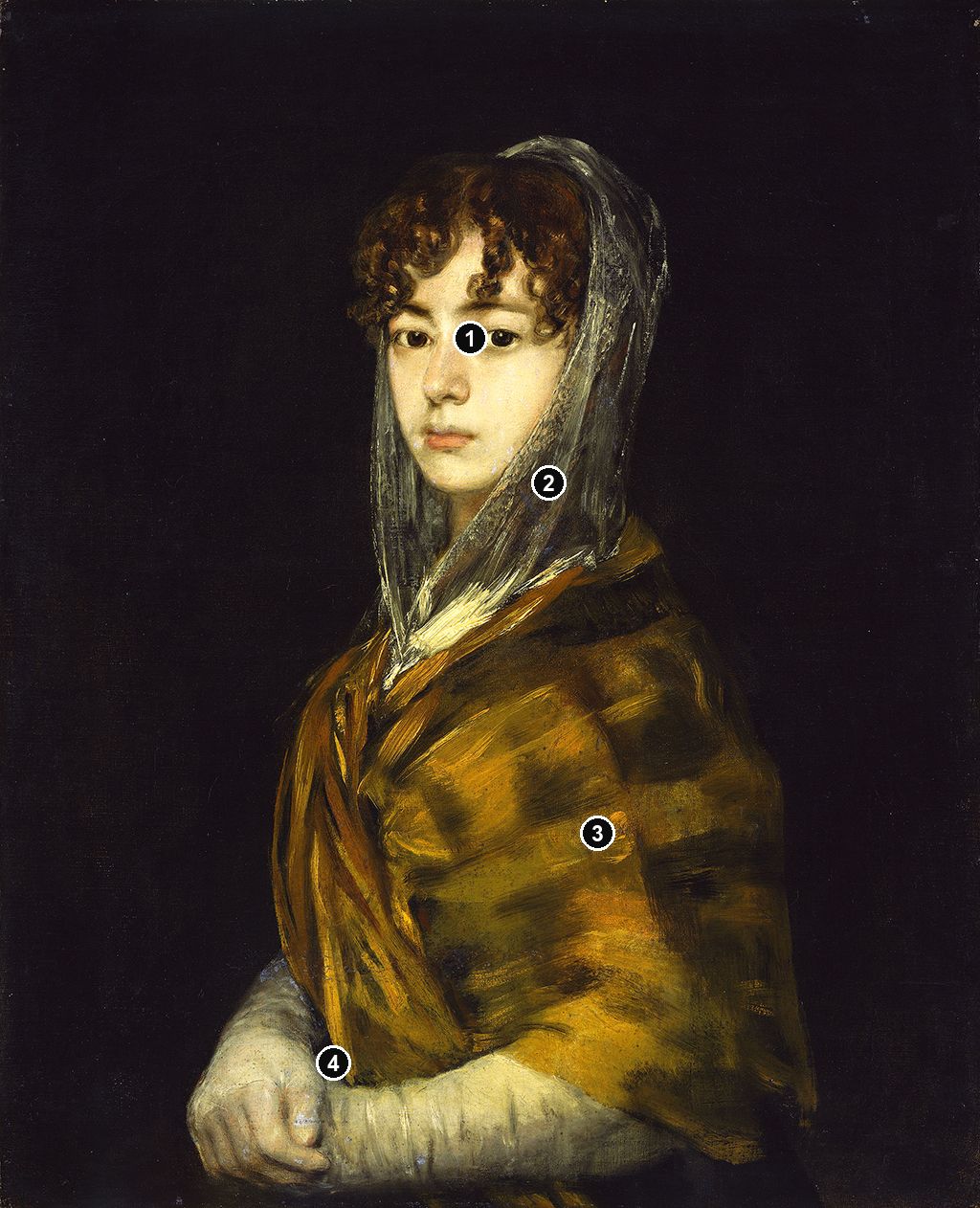
Details from SEÑORA SABASA GARCÍA
Details from the National Gallery of Art portrait (1937.1.88).
The face and curls
Loose curls frame the forehead above the direct gaze.
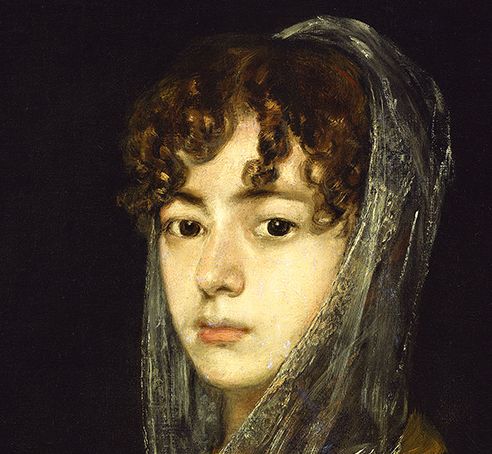
The mantilla
The fine edge of the lace runs down beside the face towards the shoulder.
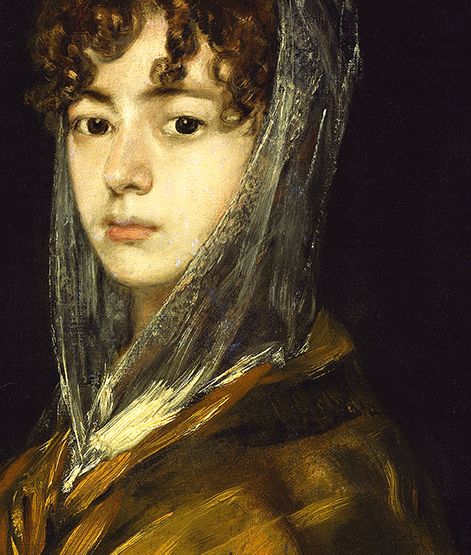
The shawl's folds
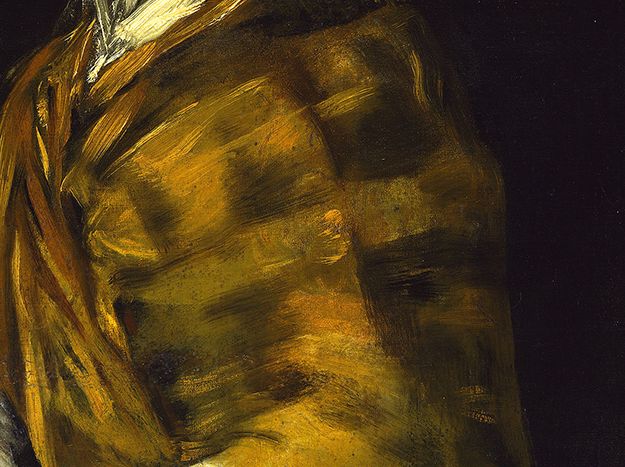
The dark and ochre bands turn with the folds at the shoulder and arm.
The clasped gloves
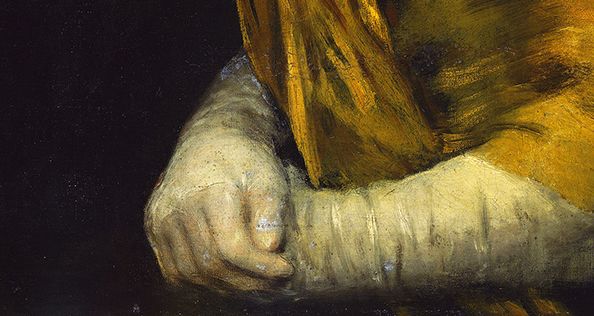
The pale gloves gather at the bottom edge of the shawl.
The mantilla, shawl and gloves
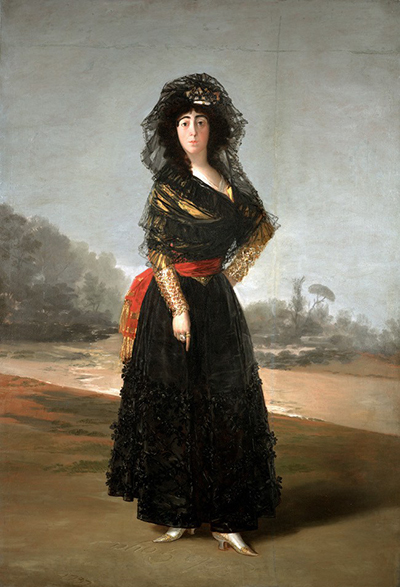
The mantilla is the light veil that covers the back of the hair and falls on either side of the face. Lines of pale paint run down the hanging cloth, with small spots where its edging catches the light. At the side of the head the net is dark enough to let the hair and shadow show through. Lower down, the fabric comes together in a narrower, brighter bundle. In her essay for Goya: Images of Women, dress historian Aileen Ribeiro describes the mantilla as part of Spanish outdoor dress, with different ways of arranging it over the head and shoulders. Here its open front makes the ringlets part of the frame around the face. In Goya’s The Black Duchess of 1797, a black mantilla forms part of a full-length costume that includes a brilliant red sash. The smaller Sabasa portrait lets us follow the pale fabric from its loose edge above her head to the point where it tucks under the shawl. [1] [3] [4]
The shawl covers the shoulders and wraps across the body. The stripes bend where the cloth bunches near the chest and spread into broader bands over the upper arm. Broken touches of mustard and ochre follow the raised folds, leaving darker paint visible between them. Around the elbow, a broad gold stroke swings towards the pale forearm and ends where the shawl hangs free. The National Gallery of Art’s systematic catalogue describes thick, roughly laid paint here and raised white highlights on the veil. The heaviest marks therefore occur in two fabrics that look quite different in weight. The long strokes carry the mass of the shawl. The much smaller raised touches make light appear to catch on the gauze. [1] [2]
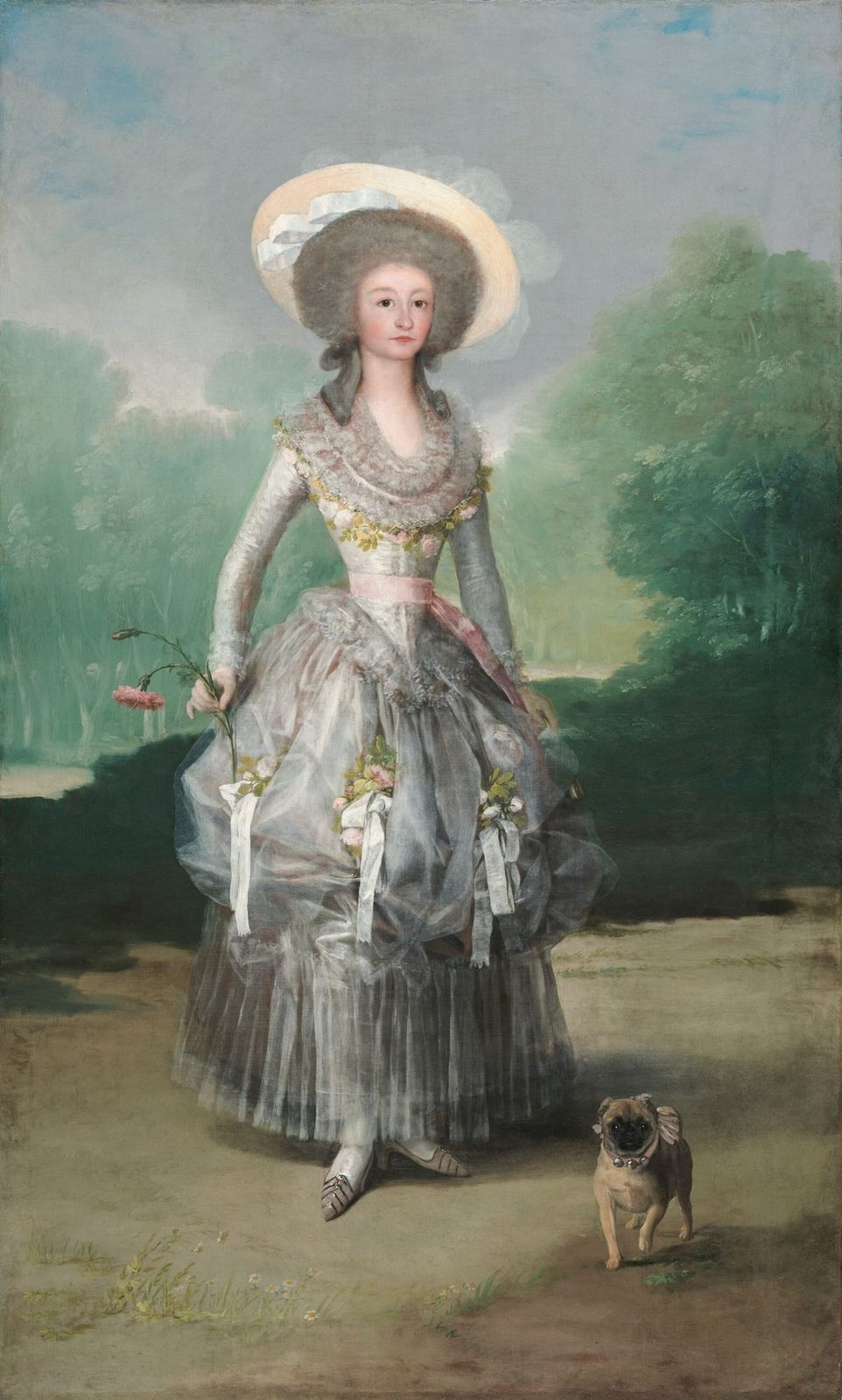
At the foot of the canvas, the pale gloves run almost horizontally across the warmer folds. The exhibition catalogue identifies them as long, fingerless kidskin gloves. Across the wrist the brushwork suggests little ridges and creases, and the hand on our left bends down towards the frame. The crossing gives the portrait a second place to rest the eye after the face. Goya often gave a sitter a fan, as he did in The Marquesa de Pontejos, where it follows the edge of the skirt and a carnation extends from the other hand. Here the hands themselves furnish the gesture, with their overlap tucked into the lowest corner of the composition. [1] [3] [5]
Goya on film
Five films explore Goya’s portraits, prints, Black Paintings and painting techniques.
The Duke of Wellington by Goya
The portrait, its military decorations and its later theft.
Watch on YouTubeWhat the canvas reveals
The systematic catalogue records a plain-weave support, probably linen, subsequently lined with a second fabric. It describes a greyish-white ground beneath the paint. Small raised points in the background probably come from irregularities in the weave, while some old repainting in the face and hands has whitened. These observations matter particularly in a portrait that sets its most delicate passages against an almost uninterrupted dark surface. Some of the minute irregularities visible at close range belong to the support or to the painting’s later history. [2]
The sweep of the shawl is easy to register even at a distance because its brightest folds cross so much of the painting. Under the chin, the painted veil has a much narrower passage to describe: one edge lies against the skin and the other against the dark field. The edge beside the face is easy to trace where the tones differ most. Near the top of the head, it takes only a few pale marks to continue the arc over the curls. [1] [2]
How the sitter was identified
The painting was exhibited in Berlin in 1908–09 under a title simply describing a young girl. Richard G. Mann’s systematic catalogue entry traces the identification to Juan Allende Salazar, who proposed it while the picture was at Duveen Brothers’ New York galleries. Correspondence from 1940 in the National Gallery of Art’s files records the identification, which was published in 1945. Some scholars questioned it in the absence of a contemporary document naming the sitter. The gallery accepts the identification on the strength of the painting’s early ownership, which traces it from María to her goddaughter, Mariana García Soler. The name in the title is thus supported by how the object passed through the family. [1] [2]
Archival research published by José Valverde Madrid in 1983 established that María was born in Madrid in 1790 to José Joaquín García Noriega and Nicasia Pérez de Castro. She married Juan Peñuelas in 1820. Their wills record the income from country property near Iruegas, though the couple lived in Madrid. The last document Richard G. Mann cites for María is her will dated 14 May 1850. Her uncle Evaristo appears as an executor in her wills made before his death, evidence that he occupied a continuing place in her affairs. [2] [3]
The story of the sitting and the date
The anecdote also comes through Allende Salazar. In the account cited in the systematic catalogue, Goya saw María at her uncle’s house and asked to paint her. The gallery’s collection page recounts the version in which her arrival interrupts the uncle’s sitting. The Louvre dates Goya’s Portrait of a Man, traditionally identified as Evaristo Pérez de Castro, to about 1806. The museum traces that sitter identification to the painting’s appearance at a Madrid exhibition in 1900. The family relationship makes an introduction plausible. The account of how it happened rests on a later report, and the man in the Louvre canvas is himself identified by tradition. [1] [2] [6]
The range of about 1806–1811 has two kinds of support. Scholars had already proposed it on stylistic grounds before Valverde Madrid established María’s birth date. A sitter born in 1790 would have been in her later teens or around twenty during those years. The 2002 exhibition catalogue judges her appearance to be closer to twenty, which would favour the later part of the range. The museum’s Young Lady Wearing a Mantilla and Basquina, dated about 1800–1805, has a similarly direct gaze and a plain ground. Its larger format leaves room for a fan and more of the dress. The resemblance shows a compositional approach Goya used around this period, while the format and costume could vary from sitter to sitter. [2] [3] [7]
From Madrid to Washington
After María’s death the portrait passed to her goddaughter. Mariana’s husband, Dr Sota, later sold it to José Joaquín Herrero in Madrid. It was with James Simon in Berlin by 1908, and subsequently passed through the collections of Count Paalen and Heinrich Sklarz. Andrew W. Mellon acquired it from Duveen Brothers on 21 February 1930, deeded it to his educational and charitable trust in 1934, and the trust gave it to the National Gallery of Art in 1937. The portrait returned to Madrid for exhibitions at the Prado in 1996 and 2001–02, the latter part of the exhibition on Goya’s depictions of women that travelled to Washington. [1] [2] [3]
Artworks directory
| Name | Date | Medium |
|---|---|---|
| And There’s No Help for It, Plate 15 | Printed 1863 | |
| Asmodea | c. 1820–23 | Wall painting transferred to canvas |
| Boys Inflating a Bladder | 1777–78 | Tapestry cartoon |
| Boys Picking Fruit | 1778 | Tapestry cartoon |
| Bullfight in a Divided Ring | 1825 | Lithograph |
| Card Players | 1777–78 | Tapestry cartoon |
| Card Players (sketch) | 1777–78 | Painted sketch |
| Dance on the Banks of the Manzanares | 1777 | Tapestry cartoon |
| Duel with Cudgels | c. 1820–23 | Wall painting transferred to canvas |
| Heads in a Landscape | c. 1820–23 | Easel painting |
| Judith and Holofernes | c. 1820–23 | Wall painting transferred to canvas |
| Leocadia | c. 1820–23 | Wall painting transferred to canvas |
| Maja and Cloaked Men | 1777 | Tapestry cartoon |
| Maja and Cloaked Men (sketch) | 1777 | Painted sketch |
| Majo Clapping in Time to the Music | 1777 | Drawing |
| Men Reading | c. 1820–23 | Wall painting transferred to canvas |
| Out Hunting for Teeth, Plate 12 | 1799 | Etching, burnished aquatint and burin |
| Picnic in the Countryside (sketch) | 1776–78 | Painted sketch |
| Picnic on the Banks of the Manzanares | 1776 | Tapestry cartoon |
| Pilgrimage to San Isidro | c. 1820–23 | Wall painting transferred to canvas |
| Preparatory study for The Sleep of Reason Produces Monsters | c. 1796–97 | Drawing |
| Procession of the Holy Office | c. 1820–23 | Wall painting transferred to canvas |
| Quarrel at the Cockerel Inn (sketch) | 1777 | Painted sketch |
| Quarrel in the New Tavern | 1777 | Tapestry cartoon |
| Saturn Devouring His Son | c. 1820–23 | Wall painting transferred to canvas |
| Seated Majo Smoking | c. 1776 | Drawing |
| The Dog | c. 1820–23 | Wall painting transferred to canvas |
| The Drinker | 1777 | Tapestry cartoon |
| The Fates | c. 1820–23 | Wall painting transferred to canvas |
| The Great He-Goat | c. 1820–23 | Wall painting transferred to canvas |
| The Kite | 1777–78 | Tapestry cartoon |
| The Parasol | 1777 | Oil on canvas, tapestry cartoon |
| The Second of May 1808 | 1814 | Oil on canvas |
| The Sleep of Reason Produces Monsters, Plate 43 | 1799 | Etching and aquatint |
| The Third of May 1808 | 1814 | Oil on canvas |
| Thou Who Canst Not, Plate 42 | 1799 | Etching and burnished aquatint |
| Three Figures | 1776 | Drawing (lost) |
| Two Old Men | c. 1820–23 | Wall painting transferred to canvas |
| Two Old Men Eating Soup | c. 1820–23 | Wall painting transferred to canvas |
| Two Women and a Man | c. 1820–23 | Wall painting transferred to canvas |
| Universal Language: The Author Dreaming | 1797 | Drawing |
| The Family of Charles IV | 1800 | Oil on canvas |
| Witches’ Sabbath (Osuna painting) | 1797–98 | Oil on canvas |
| The Nude Maja | 1795–1800 | Oil on canvas |
| The Clothed Maja | 1800–07 | Oil on canvas |
| Self-Portrait (Drawing) | c. 1796 | Brush and carbon black ink on laid paper |
| The Swing, Madrid Album B.21 | 1795–97 | Brush and carbon black washes |
| Majas Fighting, a Majo Observing, Madrid Album B.15 | 1796–97 | Brush, grey and black washes on laid paper |
| Majos and Majas Conversing, Madrid Album B.16 | c. 1794–97 | Ink wash on paper |
| Weeping Woman and Three Men, Madrid Album B.17 | 1795–97 | Brush, carbon black washes and black chalk |
| Maja Seated on a Chair and Two Companions Behind, Madrid Album B.18 | 1795–97 | Brush and carbon black washes |
| Girl and Bull, Madrid Album B.23 | 1796–97 | Brush and carbon black washes |
| Lovers Sitting on a Rock, Madrid Album B.24 | 1796–97 | Brush and carbon black washes |
| Mariano Ceballos Riding a Bull | 1825 | Crayon lithograph and scraper |
| Landscape (lifetime impression) | c. 1807–10 | Etching and aquatint |
| Self-Portrait (1815), Prado canvas | 1815 | Oil on canvas |
| Self-Portrait (1815), Academy panel | 1815 | Oil on panel |
| Self-Portrait with Dr Arrieta | 1820 | Oil on canvas |
| Christ Crucified | 1780 | Oil on canvas |
| The Last Communion of Saint Joseph of Calasanz | 1819 | Oil on canvas |
| Christ on the Mount of Olives | 1819 | Oil on panel |
| The Flower Girls, or Spring | 1786–87 | Oil on canvas |
| The Grape Harvest, or Autumn | 1786–87 | Oil on canvas |
| The Snowstorm, or Winter | 1786–87 | Oil on canvas |
| The Threshing Ground, or Summer | 1786–87 | Oil on canvas |
| Picnic on the Banks of the Manzanares | 1776 | Oil on canvas |
| The Kite | 1777–78 | Oil on canvas |
| Dance on the Banks of the Manzanares | 1777 | Oil on canvas |
| A Fight at the Venta Nueva | 1777 | Oil on canvas |
| Blind Man’s Bluff | 1788 | Oil on canvas |
| Dogs on a Lead | 1775 | Oil on canvas |
| Hunting with a Decoy | 1775 | Oil on canvas |
| Hunter Loading His Rifle | 1775 | Oil on canvas |
| The Angler | 1775 | Oil on canvas |
| The Hermitage of San Isidro on His Feast Day | 1788 | Oil on canvas |
| The Meadow of San Isidro | 1788 | Oil on canvas |
| The Straw Manikin | 1791–92 | Oil on canvas |
| Witches’ Flight | c. 1797–98 | Oil on canvas |
| A Scene from ‘The Forcibly Bewitched’ | 1798 | Oil on canvas |
| The Duchess of Alba in Black | 1797 | Oil on canvas |
| The Duchess of Alba in White | 1795 | Oil on canvas |
| Charles III in Hunting Dress | c. 1786 | Oil on canvas |
| The Duke and Duchess of Osuna and Their Children | 1787–88 | Oil on canvas |
| Manuel Osorio Manrique de Zúñiga | 1787–88 | Oil on canvas |
| The Marquesa de Pontejos | c. 1786 | Oil on canvas |
| Equestrian Portrait of the 1st Duke of Wellington | 1812 | Oil on canvas |
| The Duke of Wellington | 1812–14 | Oil on wood |
| Portrait of Ferdinand VII of Spain | 1814 | Oil on canvas |
| Gaspar Melchor de Jovellanos | 1798 | Oil on canvas |
| María Tomasa Palafox y Portocarrero | 1804 | Oil on canvas |
| Señora Sabasa García | c. 1806–11 | Oil on canvas |
| Don Juan Bautista de Muguiro | 1827 | Oil on canvas |
| Doña Isabel de Porcel | Before 1805 | Oil on canvas |
| The Colossus | After 1808 | Oil on canvas |
| The Burial of the Sardine | 1808–12 | Oil on panel |
| The Madhouse | 1808–12 | Oil on panel |
| A Procession of Flagellants | 1808–12 | Oil on panel |
| Portrait of Jacques Galos | 1826 | Oil on canvas |
| Portrait of Mariano Goya, the Artist’s Grandson | 1827 | Oil on canvas |
| Milkmaid of Bordeaux | c. 1827 | Oil on canvas |
| Portrait of Don Juan Antonio Cuervo | 1819 | Oil on canvas |
| María Luisa of Parma (Naples version) | c. 1800 | Oil on canvas |
| The Countess of Baena | 1819 | Oil on canvas |
| The Family of the Infante Don Luis | 1783–84 | Oil on canvas |
| The Holy Family | c. 1787 | Oil on canvas |
| Saint Barbara | c. 1773 | Oil on canvas |
| Saints Justa and Rufina | 1817 | Oil on canvas |
| El Tío Paquete | c. 1819–20 | Oil on canvas |
| The Forge | c. 1815–20 | Oil on canvas |
| Majas on a Balcony (Metropolitan Museum version) | c. 1800–10 | Oil on canvas |
| Maja and Celestina on a Balcony | c. 1808–12 | Oil on canvas |
| The Water Bearer | 1808–12 | Oil on canvas |
| Time and the Old Women | c. 1810 | Oil on canvas |
Frequently Asked Questions
It belongs to the National Gallery of Art in Washington, DC, in the Andrew W. Mellon Collection. Its accession number is 1937.1.88. [1]
Discussion
Look again at the images and ideas explored in Señora Sabasa García. These editorial prompts invite your observations.
Follow the edge of the mantilla down towards the hands, then look back up along the folds of the shawl. Where does Goya use a few bright touches to define an edge, and where does he let the cloth blend into the background?
Reader Insights
Follow the line of the light at the edge of the mantilla.
Where do you see the paint become broader?
Join the Conversation
Share a detail, comparison or question about Señora Sabasa García below.
References
- National Gallery of Art, Señora Sabasa Garcia, collection record, 1937.1.88. View source.
- Richard G. Mann, ‘Señora Sabasa Garcia’, in Jonathan Brown and Richard G. Mann, Spanish Paintings of the Fifteenth through Nineteenth Centuries, National Gallery of Art systematic catalogue (1990), pp. 9–12. View source.
- Janis A. Tomlinson, ed., Goya: Images of Women, National Gallery of Art (2002), Aileen Ribeiro’s essay ‘Fashioning the Feminine: Dress in Goya’s Portraits of Women’, pp. 81–84, and catalogue no. 43, pp. 201–203. View source.
- The Hispanic Society of America, The Duchess of Alba, collection essay. View source.
- National Gallery of Art, The Marquesa de Pontejos, collection record, 1937.1.85. View source.
- Musée du Louvre, Portrait d’homme, dit aussi Portrait de Don Evaristo Pérez de Castro, collection record, RF 1476. View source.
- National Gallery of Art, Young Lady Wearing a Mantilla and Basquina, collection record, 1963.4.2. View source.







