


 by Tom Gurney
Tom Gurney BSc (Hons) is an art history expert with over 20 years experience
Published on June 19, 2020 / Updated on November 20, 2026
Email: tomgurney1@gmail.com / Phone: +44 7429 011000
Introduction
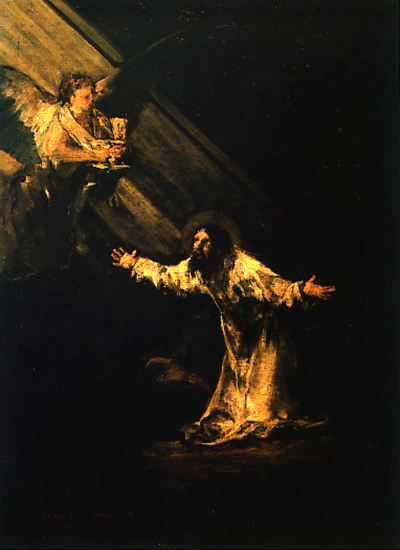
Christ kneels in the dark with his arms spread and his face turned towards an angel. The angel holds a gold chalice, high enough that Christ must raise his eyes to see it. Light falls diagonally from the upper left, catches both figures and leaves most of the garden in shadow. Goya painted this small panel in 1819, the same year that the Piarist fathers of San Antón in Madrid commissioned his large altarpiece of Saint Joseph of Calasanz. In the garden, the object that meets Christ’s gaze makes visible the suffering he has come to pray about. [1] [2] [3]
At a Glance
- ArtistFrancisco de Goya y Lucientes (1746–1828). [1] [4]
- Date1819. The original inscription is painted in red at the lower left. [1]
- Medium and dimensionsOil on panel, 47 × 35 cm. [1]
- SubjectChrist’s prayer before his arrest. The Spanish catalogue title is La oración en el huerto (The Prayer in the Garden). [1] [2]
- CollectionPiarist Fathers (Padres Escolapios), Museo Calasancio, Madrid. [1]
Works across Goya’s career
The Parasol
1777The Nude Maja
1795–1800Saturn Devouring His Son
c. 1820–23The Dog
c. 1820–23A prayer before the arrest
In Luke’s Gospel, Jesus goes to the Mount of Olives with his disciples after the Last Supper. He tells them to pray, then goes some distance apart and kneels. He asks his Father to take away the cup if he is willing, and submits himself to his Father’s will. An angel appears to strengthen him. When Jesus gets up and rejoins the disciples, they are asleep. The group that comes to arrest him arrives soon afterwards. Goya gives most of the panel to the encounter during the prayer. The darkness helps preserve the separation that Luke describes between Christ and the people who came with him. [1] [2]
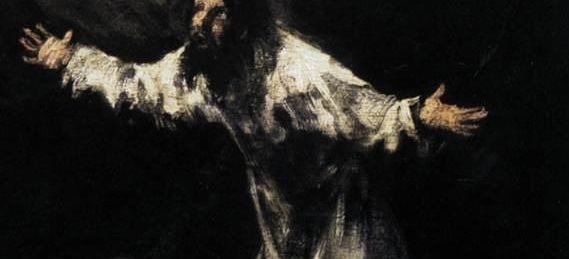
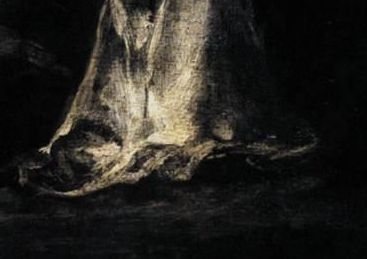
Christ’s body faces out across the lower half of the picture, and his face turns towards the upper left. Follow the lit edge of his nearer sleeve from shoulder to wrist. The hand opens just as the sleeve emerges into the dark, and touches of red at the fingers make the gesture easy to see. The other hand stretches towards the right edge. Both palms are exposed. Below them the robe drops close to the ground, where the bright hem gathers over a narrow patch of earth. The spread of the arms anticipates the Crucifixion, while the folds at the knees keep our attention on someone who has lowered himself to pray. [1]
A faint ring marks the halo around Christ’s head. The face inside it is largely in half-shadow, with small touches of light along the brow, nose and cheek. The turn of his head carries his gaze past his own open hand and up to the angel. In the upper left, light picks out the angel’s bare arm and the pale cloth crossing the shoulder. One wing is blue-grey and white where it meets the edge of the panel, while its counterpart passes into the deep tones above Christ. The angel’s body is harder to follow below the arms. Our eye stops at what the angel holds. [1]
Annotated Details from Christ on the Mount of Olives
Compare the diagonal light with the spread of Christ’s arms below the angel.
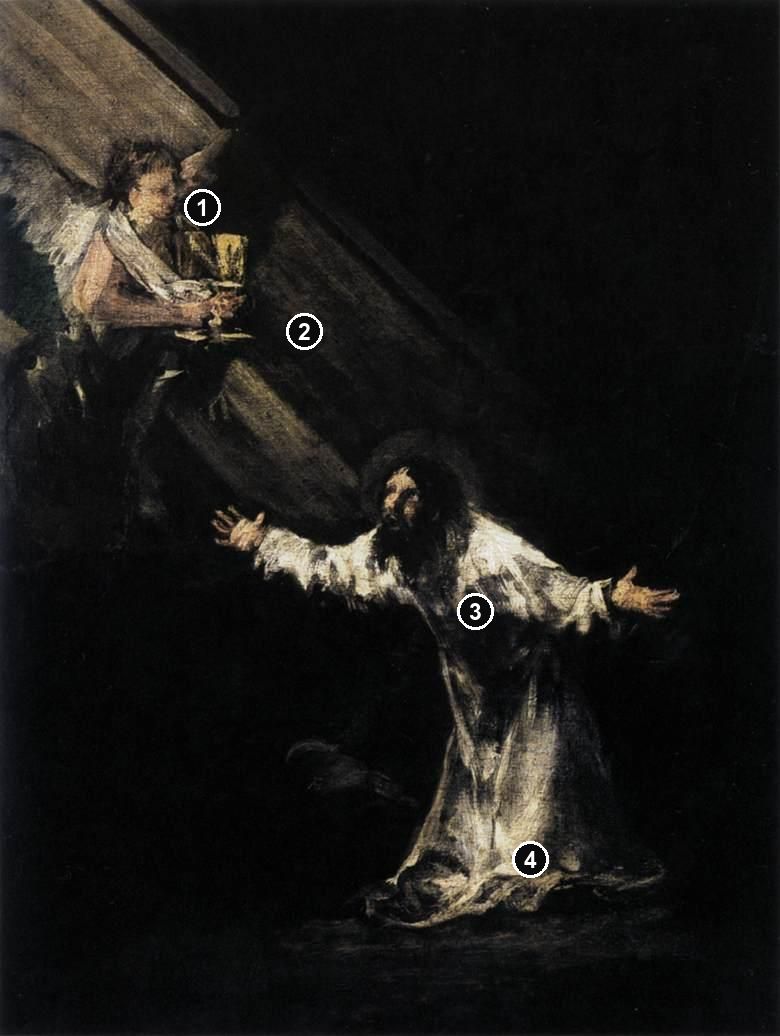
Details from CHRIST ON THE MOUNT OF OLIVES
Details from the 1819 panel in the Escolapios collection, Madrid.
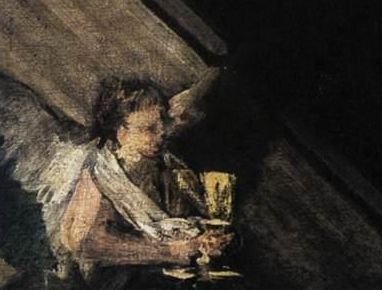
The angel and the chalice
A pale hand and a gold-coloured vessel catch the light beside the angel.
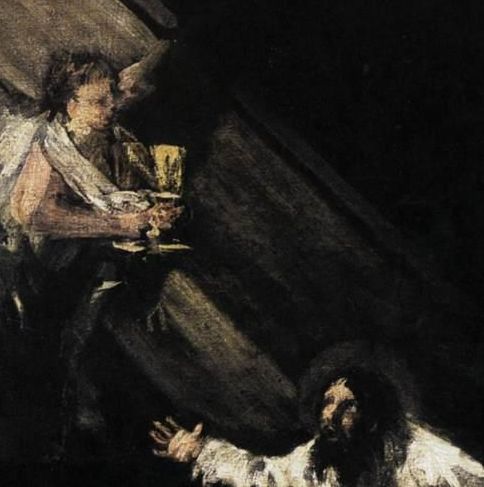
The shaft of light
A diagonal patch of light narrows into the dark between the two figures.
The outstretched arms
White highlights travel along the sleeves towards the open hands.
The lower robe
Small light strokes separate the folds near the knees from the dark ground.
The cup in the light
Broad pale strokes run behind the angel and down towards Christ. They give the whole encounter a direction that can be read even at arm’s length. Up close, smaller marks have distinct jobs. A pale edge runs along the cloth on the angel’s shoulder, yellow catches on the cup, and the flat line beneath it helps separate the vessels from the hands that present them. The Fundación Goya en Aragón identifies the objects as a chalice and a paten, the kind of small plate used to hold the eucharistic bread. The chalice has a distinct stem and bowl. The paten is harder to pick out, especially in a dark reproduction. [1]
The cup connects two episodes in Luke. At the Supper, Jesus offers a cup to his disciples and speaks of blood that will be shed. Later, alone in prayer, he asks that the cup be taken away. The evangelist describes the angel’s appearance without giving the angel a pair of vessels to carry. Goya gives those objects a place between the figures, where the direction of Christ’s gaze and the angel’s gesture meet. The chalice and paten recall the Supper through objects familiar from Mass and give Christ’s words in the garden something we can see. [1] [2]
The angle of the light and the line of Christ’s arms cross near his head. That places his face at the centre of the encounter, even though his robe and the angel’s surroundings contain brighter passages. To the right and behind him, a branching form recedes into the darkness. Low shapes behind his knees are so loosely defined that the garden never supplies a clear view of everyone present in the Gospel account. The gradation from the bright vessels to these barely legible forms makes the act of looking for Christ’s response part of the experience of the painting. [1]
Goya on film
Five films explore Goya’s portraits, prints, Black Paintings and painting techniques.
The Duke of Wellington by Goya
The portrait, its military decorations and its later theft.
Watch on YouTubeThe panel and the San Antón altarpiece
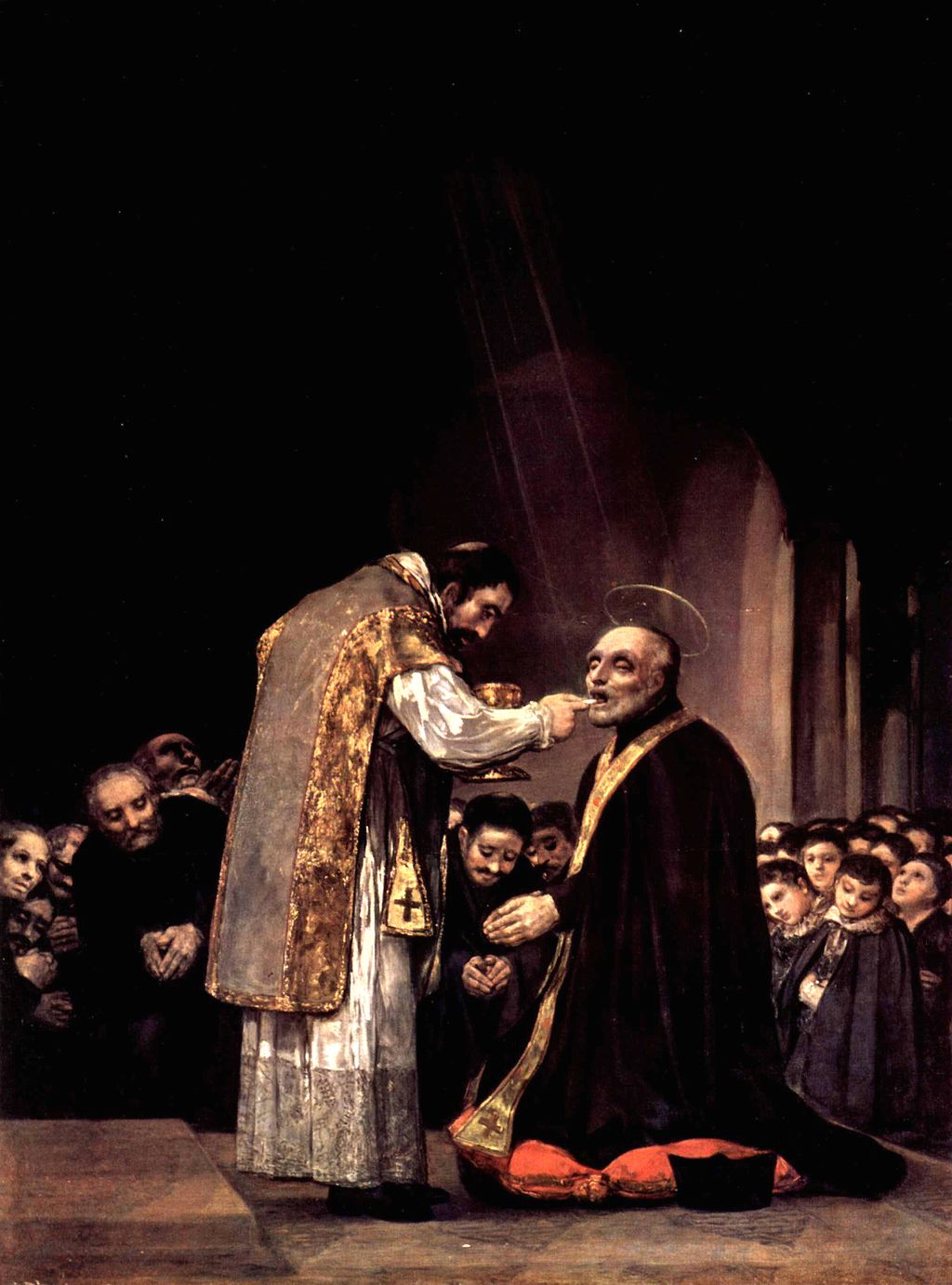
The Piarists commissioned The Last Communion of Saint Joseph of Calasanz on 9 May 1819. Goya’s canvas measures 250 × 180 cm and was installed on a side altar at San Antón on 27 August. It depicts the order’s founder towards the end of his life in 1648. He kneels with his hands joined as a priest brings the host towards his mouth. An arch at the right gives a sense of the church interior, and behind the two principal figures adults and boys wait their turn to receive communion. The altarpiece sets a small gesture within the visible life of a congregation. [3]
Look at what the light enables us to see in the two pictures. In the altarpiece, it falls on the saint’s ageing face and picks out the pale fabric of the priest’s vestments. The distance between the priest’s fingers and the saint’s mouth is small, and the hands joined beneath it gather the figure inwards. In the panel, the angel remains some way above Christ. The white robe carries light across the width of his extended arms, while the chalice and paten stay with the angel. A viewer familiar with the Mass could recognise the vessels in the garden and the act they serve in the church. The difference in distance gives each encounter its own rhythm. [1] [3]
Piarist tradition connects the panel to the altarpiece. The Prado’s 1983 exhibition catalogue relates a story attributed within the community to Father Emilio Latorre. According to that account, Goya returned to San Antón after delivering the larger painting and presented the smaller one to the college rector, Father Pío Peña, as a keepsake for the community. The documented commission and installation dates concern the altarpiece. For the panel, the painted date and the Piarists’ ownership are recorded, and the gift survives in the account handed down by the order. The Fundación describes the panel as a sketch for which a definitive painting is unknown. [1] [3] [5]
The kneeling figure in Goya’s war prints
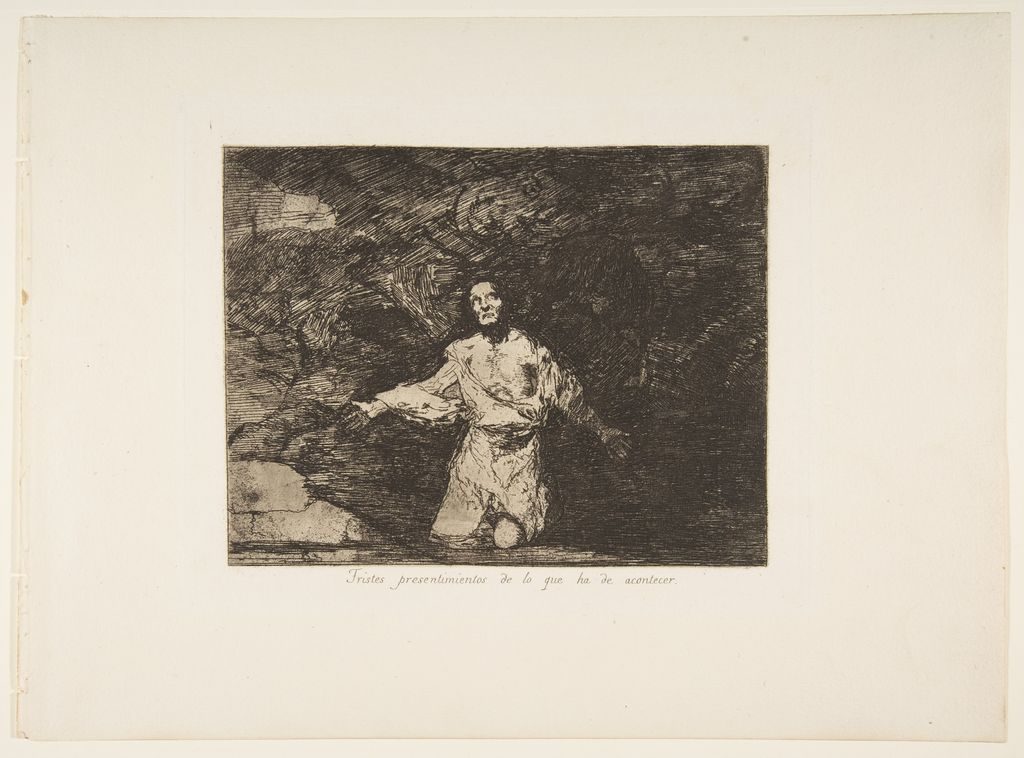
A similar gesture appears in Sad Forebodings of What Is Going to Happen, the first plate of Goya’s Disasters of War, made around 1815 and published in 1863. A solitary man kneels, opens his arms and lifts his face. His light clothing catches the eye against the scratched darkness, and the marks in the sky give little sense of a place where he might find shelter. In the Banco de España’s commentary on the print, Prado curator José Manuel Matilla connects its composition to the Agony in the Garden. The raised face and open hands give the figure an attitude of appeal as the series is about to unfold. In the panel, the angel and cup let us follow Christ’s gaze to a particular object. In the print, the dark space above the man leaves his appeal unanswered. [1] [4] [6]
The signature, exhibitions and other versions
The red inscription near the lower left reads “Goya. fecit. año. 1819”. It sits below the lit ground under Christ and is easy to miss when the lower tones of the painting are reproduced very darkly. The Fundación lists the panel at Madrid’s Goya 1900 exhibition as catalogue no. 111 and at the Prado’s Goya en las colecciones madrileñas in 1983. It was no. 192 in the Prado’s Goya en tiempos de guerra in 2008, and no. 231 in Goya: Order and Disorder at the Museum of Fine Arts, Boston, in 2014–15. Its later loans include the Fondation Beyeler’s Goya exhibition in 2021–22. [1] [5] [7] [8]
The Fundación also records a second version published by August L. Mayer in 1925. It belonged to the Marqués de Zugasti, appeared in a Goya exhibition in Bordeaux in 1951 and passed into the American art market after a London sale at Sotheby’s in 1969. Some writers have attributed that version to Goya, while the Fundación considers it more likely to be a copy. The Bordeaux exhibition and London sale belong to that second version’s history. The signed panel discussed here is the work from the Escolapios collection. [1]
The Louvre holds a related panel, RF 1982 28, which it dates after 1819 and attributes to Goya’s circle. Christ’s torso is more upright, and a dog lies in the foreground. Élisabeth Ravaud compared this panel with a small version of the Last Communion in the Musée Bonnat-Helleu, Bayonne. In the X-rays, the growth rings in the main board of one painting align with those in the other when the panels are placed side by side with their painted surfaces facing in opposite directions. The two supports came from the same piece of walnut and were prepared and painted separately. The study connects the Louvre and Bayonne panels through their materials and gives us a glimpse of how two compositions associated with San Antón circulated in smaller versions. [9] [10]
Artworks directory
| Name | Date | Medium |
|---|---|---|
| And There’s No Help for It, Plate 15 | Printed 1863 | |
| Asmodea | c. 1820–23 | Wall painting transferred to canvas |
| Boys Inflating a Bladder | 1777–78 | Tapestry cartoon |
| Boys Picking Fruit | 1778 | Tapestry cartoon |
| Bullfight in a Divided Ring | 1825 | Lithograph |
| Card Players | 1777–78 | Tapestry cartoon |
| Card Players (sketch) | 1777–78 | Painted sketch |
| Dance on the Banks of the Manzanares | 1777 | Tapestry cartoon |
| Duel with Cudgels | c. 1820–23 | Wall painting transferred to canvas |
| Heads in a Landscape | c. 1820–23 | Easel painting |
| Judith and Holofernes | c. 1820–23 | Wall painting transferred to canvas |
| Leocadia | c. 1820–23 | Wall painting transferred to canvas |
| Maja and Cloaked Men | 1777 | Tapestry cartoon |
| Maja and Cloaked Men (sketch) | 1777 | Painted sketch |
| Majo Clapping in Time to the Music | 1777 | Drawing |
| Men Reading | c. 1820–23 | Wall painting transferred to canvas |
| Out Hunting for Teeth, Plate 12 | 1799 | Etching, burnished aquatint and burin |
| Picnic in the Countryside (sketch) | 1776–78 | Painted sketch |
| Picnic on the Banks of the Manzanares | 1776 | Tapestry cartoon |
| Pilgrimage to San Isidro | c. 1820–23 | Wall painting transferred to canvas |
| Preparatory study for The Sleep of Reason Produces Monsters | c. 1796–97 | Drawing |
| Procession of the Holy Office | c. 1820–23 | Wall painting transferred to canvas |
| Quarrel at the Cockerel Inn (sketch) | 1777 | Painted sketch |
| Quarrel in the New Tavern | 1777 | Tapestry cartoon |
| Saturn Devouring His Son | c. 1820–23 | Wall painting transferred to canvas |
| Seated Majo Smoking | c. 1776 | Drawing |
| The Dog | c. 1820–23 | Wall painting transferred to canvas |
| The Drinker | 1777 | Tapestry cartoon |
| The Fates | c. 1820–23 | Wall painting transferred to canvas |
| The Great He-Goat | c. 1820–23 | Wall painting transferred to canvas |
| The Kite | 1777–78 | Tapestry cartoon |
| The Parasol | 1777 | Oil on canvas, tapestry cartoon |
| The Second of May 1808 | 1814 | Oil on canvas |
| The Sleep of Reason Produces Monsters, Plate 43 | 1799 | Etching and aquatint |
| The Third of May 1808 | 1814 | Oil on canvas |
| Thou Who Canst Not, Plate 42 | 1799 | Etching and burnished aquatint |
| Three Figures | 1776 | Drawing (lost) |
| Two Old Men | c. 1820–23 | Wall painting transferred to canvas |
| Two Old Men Eating Soup | c. 1820–23 | Wall painting transferred to canvas |
| Two Women and a Man | c. 1820–23 | Wall painting transferred to canvas |
| Universal Language: The Author Dreaming | 1797 | Drawing |
| The Family of Charles IV | 1800 | Oil on canvas |
| Witches’ Sabbath (Osuna painting) | 1797–98 | Oil on canvas |
| The Nude Maja | 1795–1800 | Oil on canvas |
| The Clothed Maja | 1800–07 | Oil on canvas |
| Self-Portrait (Drawing) | c. 1796 | Brush and carbon black ink on laid paper |
| The Swing, Madrid Album B.21 | 1795–97 | Brush and carbon black washes |
| Majas Fighting, a Majo Observing, Madrid Album B.15 | 1796–97 | Brush, grey and black washes on laid paper |
| Majos and Majas Conversing, Madrid Album B.16 | c. 1794–97 | Ink wash on paper |
| Weeping Woman and Three Men, Madrid Album B.17 | 1795–97 | Brush, carbon black washes and black chalk |
| Maja Seated on a Chair and Two Companions Behind, Madrid Album B.18 | 1795–97 | Brush and carbon black washes |
| Girl and Bull, Madrid Album B.23 | 1796–97 | Brush and carbon black washes |
| Lovers Sitting on a Rock, Madrid Album B.24 | 1796–97 | Brush and carbon black washes |
| Mariano Ceballos Riding a Bull | 1825 | Crayon lithograph and scraper |
| Landscape (lifetime impression) | c. 1807–10 | Etching and aquatint |
| Self-Portrait (1815), Prado canvas | 1815 | Oil on canvas |
| Self-Portrait (1815), Academy panel | 1815 | Oil on panel |
| Self-Portrait with Dr Arrieta | 1820 | Oil on canvas |
| Christ Crucified | 1780 | Oil on canvas |
| The Last Communion of Saint Joseph of Calasanz | 1819 | Oil on canvas |
| Christ on the Mount of Olives | 1819 | Oil on panel |
| The Flower Girls, or Spring | 1786–87 | Oil on canvas |
| The Grape Harvest, or Autumn | 1786–87 | Oil on canvas |
| The Snowstorm, or Winter | 1786–87 | Oil on canvas |
| The Threshing Ground, or Summer | 1786–87 | Oil on canvas |
| Picnic on the Banks of the Manzanares | 1776 | Oil on canvas |
| The Kite | 1777–78 | Oil on canvas |
| Dance on the Banks of the Manzanares | 1777 | Oil on canvas |
| A Fight at the Venta Nueva | 1777 | Oil on canvas |
| Blind Man’s Bluff | 1788 | Oil on canvas |
| Dogs on a Lead | 1775 | Oil on canvas |
| Hunting with a Decoy | 1775 | Oil on canvas |
| Hunter Loading His Rifle | 1775 | Oil on canvas |
| The Angler | 1775 | Oil on canvas |
| The Hermitage of San Isidro on His Feast Day | 1788 | Oil on canvas |
| The Meadow of San Isidro | 1788 | Oil on canvas |
| The Straw Manikin | 1791–92 | Oil on canvas |
| Witches’ Flight | c. 1797–98 | Oil on canvas |
| A Scene from ‘The Forcibly Bewitched’ | 1798 | Oil on canvas |
| The Duchess of Alba in Black | 1797 | Oil on canvas |
| The Duchess of Alba in White | 1795 | Oil on canvas |
| Charles III in Hunting Dress | c. 1786 | Oil on canvas |
| The Duke and Duchess of Osuna and Their Children | 1787–88 | Oil on canvas |
| Manuel Osorio Manrique de Zúñiga | 1787–88 | Oil on canvas |
| The Marquesa de Pontejos | c. 1786 | Oil on canvas |
| Equestrian Portrait of the 1st Duke of Wellington | 1812 | Oil on canvas |
| The Duke of Wellington | 1812–14 | Oil on wood |
| Portrait of Ferdinand VII of Spain | 1814 | Oil on canvas |
| Gaspar Melchor de Jovellanos | 1798 | Oil on canvas |
| María Tomasa Palafox y Portocarrero | 1804 | Oil on canvas |
| Señora Sabasa García | c. 1806–11 | Oil on canvas |
| Don Juan Bautista de Muguiro | 1827 | Oil on canvas |
| Doña Isabel de Porcel | Before 1805 | Oil on canvas |
| The Colossus | After 1808 | Oil on canvas |
| The Burial of the Sardine | 1808–12 | Oil on panel |
| The Madhouse | 1808–12 | Oil on panel |
| A Procession of Flagellants | 1808–12 | Oil on panel |
| Portrait of Jacques Galos | 1826 | Oil on canvas |
| Portrait of Mariano Goya, the Artist’s Grandson | 1827 | Oil on canvas |
| Milkmaid of Bordeaux | c. 1827 | Oil on canvas |
| Portrait of Don Juan Antonio Cuervo | 1819 | Oil on canvas |
| María Luisa of Parma (Naples version) | c. 1800 | Oil on canvas |
| The Countess of Baena | 1819 | Oil on canvas |
| The Family of the Infante Don Luis | 1783–84 | Oil on canvas |
| The Holy Family | c. 1787 | Oil on canvas |
| Saint Barbara | c. 1773 | Oil on canvas |
| Saints Justa and Rufina | 1817 | Oil on canvas |
| El Tío Paquete | c. 1819–20 | Oil on canvas |
| The Forge | c. 1815–20 | Oil on canvas |
| Majas on a Balcony (Metropolitan Museum version) | c. 1800–10 | Oil on canvas |
| Maja and Celestina on a Balcony | c. 1808–12 | Oil on canvas |
| The Water Bearer | 1808–12 | Oil on canvas |
| Time and the Old Women | c. 1810 | Oil on canvas |
Frequently Asked Questions
Discussion
Look again at the images and ideas explored in Christ on the Mount of Olives. These editorial prompts invite your observations.
Trace the light from the upper left past the angel and down to the kneeling figure. At what point do you notice the chalice? How does seeing it change the meaning of Christ’s outstretched hands?
Reader Insights
What draws your attention from Christ to the angel?
How does the light change between the small panel and the Calasanz altarpiece?
Join the Conversation
Share a detail, comparison or question about Christ on the Mount of Olives below.
References
- Fundación Goya en Aragón, La oración en el huerto (in Spanish), signed panel, illustrated object record, history and exhibitions. View source.
- United States Conference of Catholic Bishops, The Gospel According to Luke, chapter 22, especially verses 14–20 and 39–48. View source.
- Fundación Goya en Aragón, La última comunión de San José de Calasanz (in Spanish), object record, commission, installation and composition. View source.
- The Metropolitan Museum of Art, Sad foreboding of what is going to happen, plate 1 of The Disasters of War, 22.60.25(1), illustrated object record. View source.
- Enrique Lafuente Ferrari, curator, Goya en las colecciones madrileñas, Museo del Prado and Fundación Amigos del Museo del Prado, 1983 (in Spanish), catalogue no. 52, account of the Piarist tradition. View source.
- José Manuel Matilla, Tristes presentimientos de lo que ha de acontecer, Banco de España, catalogue essay comparing the first plate with Christ on the Mount of Olives. View source.
- Museum of Fine Arts, Boston, Goya: Order and Disorder, exhibition record, 12 October 2014–19 January 2015. View source.
- Fondation Beyeler, Goya, exhibition record, 10 October 2021–23 January 2022. View source.
- Musée du Louvre, Le Christ au jardin des oliviers, RF 1982 28, object record, attribution, date and provenance. View source.
- Élisabeth Ravaud, “Étude de deux petits panneaux de l’entourage de Goya : mise en lumière de pratiques d’atelier”, Technè 53 (2022), pp. 86–89 (in French), technical comparison of the Louvre and Bayonne panels, also available in an author-posted copy. View source 1. View source 2.







