


 by Tom Gurney
Tom Gurney BSc (Hons) is an art history expert with over 20 years experience
Published on June 19, 2020 / Updated on November 20, 2026
Email: tomgurney1@gmail.com / Phone: +44 7429 011000
Introduction
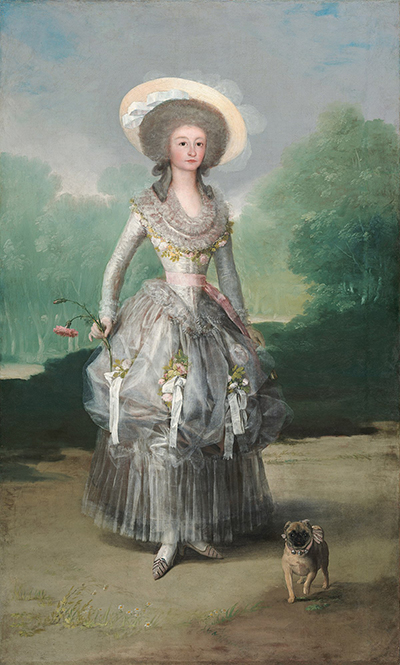
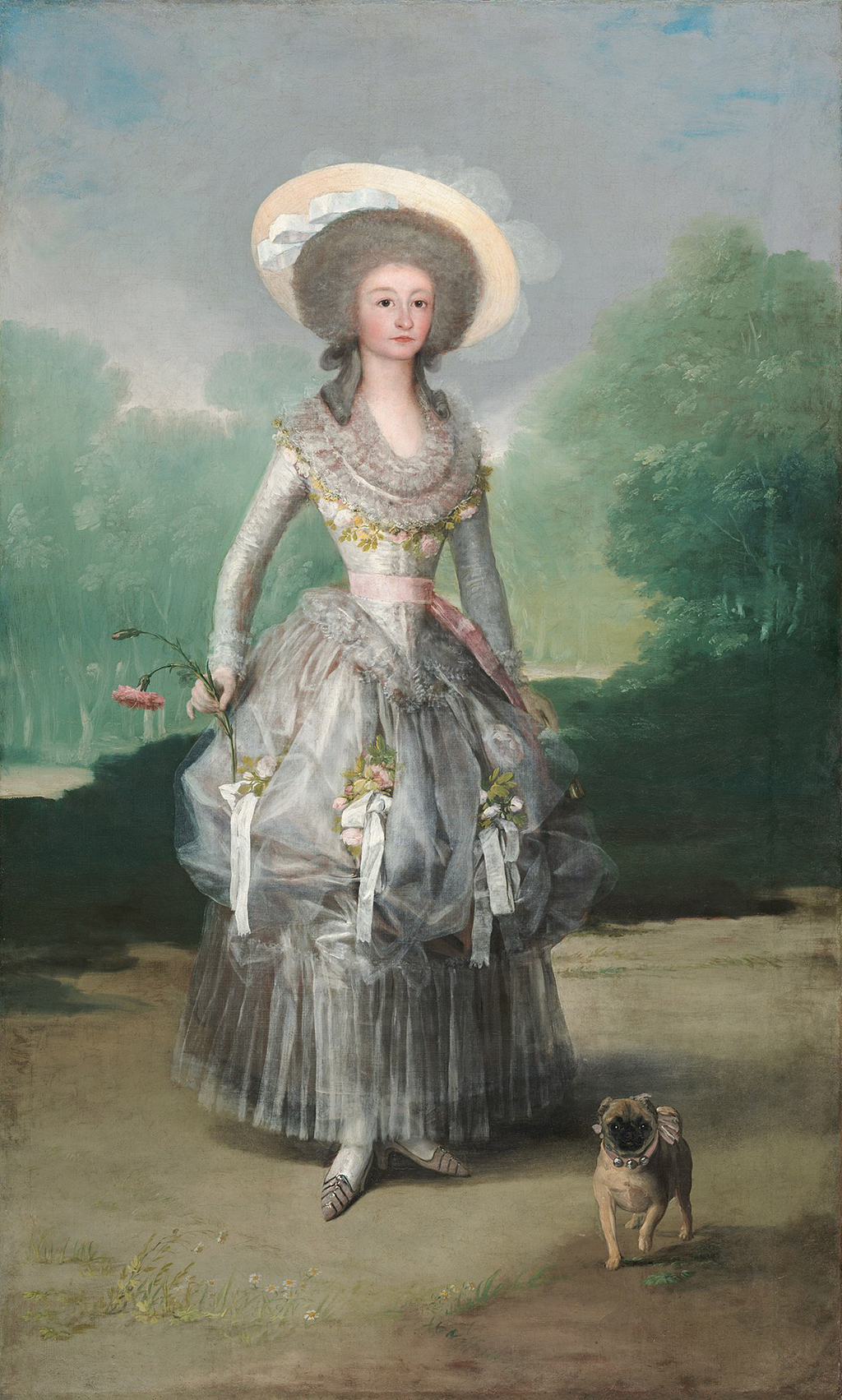
A pink carnation hangs from María Ana de Pontejos’s right hand. Her arm follows the narrow line of her bodice before the skirt swells into broad folds of silvery fabric. At the bottom of the canvas a pug raises one paw, the bells on its collar picking up the light. The marquesa holds her head almost still and looks out from beneath a wide straw hat. Francisco de Goya leaves enough space for the dog to step towards us while the sitter, shown from head to toe, has the height of a person standing before us. [1]
The portrait belongs to the National Gallery of Art in Washington, DC, which dates it to about 1786 and connects it to the sitter’s first marriage. Flowers are everywhere in the portrait, from the bloom in her fingers to the roses edging her neckline and tucked into the folds of her skirt. They belong both to the outdoor setting Goya has created and to the fashion the sitter wears. [1] [2]
At a Glance
- ArtistFrancisco de Goya y Lucientes
- TitleThe Marquesa de Pontejos
- SitterMaría Ana de Pontejos y Sandoval (1762–1834), later fourth Marquesa de Casa Pontejos
- DateAbout 1786, according to the National Gallery of Art
- Medium and dimensionsOil on canvas, 210.3 × 127 cm (height × width)
- CollectionNational Gallery of Art, Washington, DC, Andrew W. Mellon Collection, accession 1937.1.85. [1] [2]
Works across Goya’s career
The Parasol
1777The Marquesa de Pontejos
c. 1786The Nude Maja
1795–1800Saturn Devouring His Son
c. 1820–23The Dog
c. 1820–23A silvery gown dressed with flowers
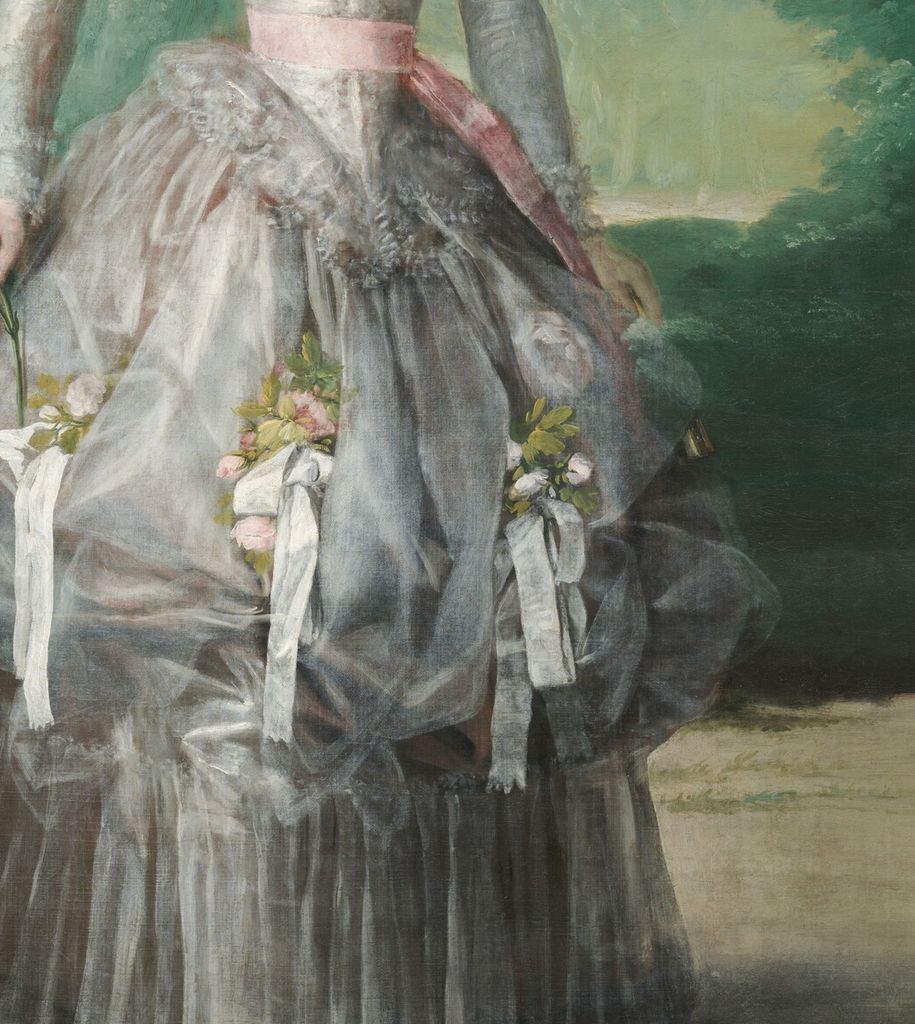
Goya gives the bodice and skirt distinct shapes through the way they catch the light. The narrow sleeves run smoothly down the arms until the lace at the wrist breaks their outlines. Around the waist, a pink ribbon crosses the smooth front of the bodice and trails down over one hip. Below it the overskirt is lifted in rounded swags, with white ribbons falling from the gathered fabric. The vertical folds below those swags show through the sheer outer layer towards the hem, where the sitter’s stockings and pointed shoes come into view. The change from horizontal gathers to vertical pleats makes it possible to follow the construction of the dress, even where individual strokes of paint dissolve into the sheen. [1] [2]
Art historians Javier Martínez Molina and Arturo Ansón Navarro describe the gown as a robe à la polonaise, distinguished here by an overskirt drawn up into puffs. They see an English country note in the trimmings, alongside the elaborate fabrics and ornament of French fashion. The National Gallery of Art relates the ensemble to the aristocratic taste for shepherdess dress associated with Marie Antoinette in the years before the French Revolution. The broad straw brim and roses give the outfit its pastoral character. The tightly shaped waist, layers of lace and careful placement of flowers show the work that went into making a fashionable woman look at home in a garden. [1] [2]
At the neckline, Goya indicates a net of lace with broken touches of pale paint. The marks sit close together where the fabric catches more light and spread out where the ground colour shows through. The roses immediately below have a different weight. Their small knots of cream and pink interrupt the finer pattern. Further down the skirt, the ribbons register at once because their strokes are longer and brighter. Goya could therefore suggest the density of lace, the thickness of a ribbon and the changing transparency of the skirt with variations in the size and spacing of his brushmarks. [1] [2]
Annotated Details from The Marquesa de Pontejos
Follow the arrangement of the figures and the details around them.
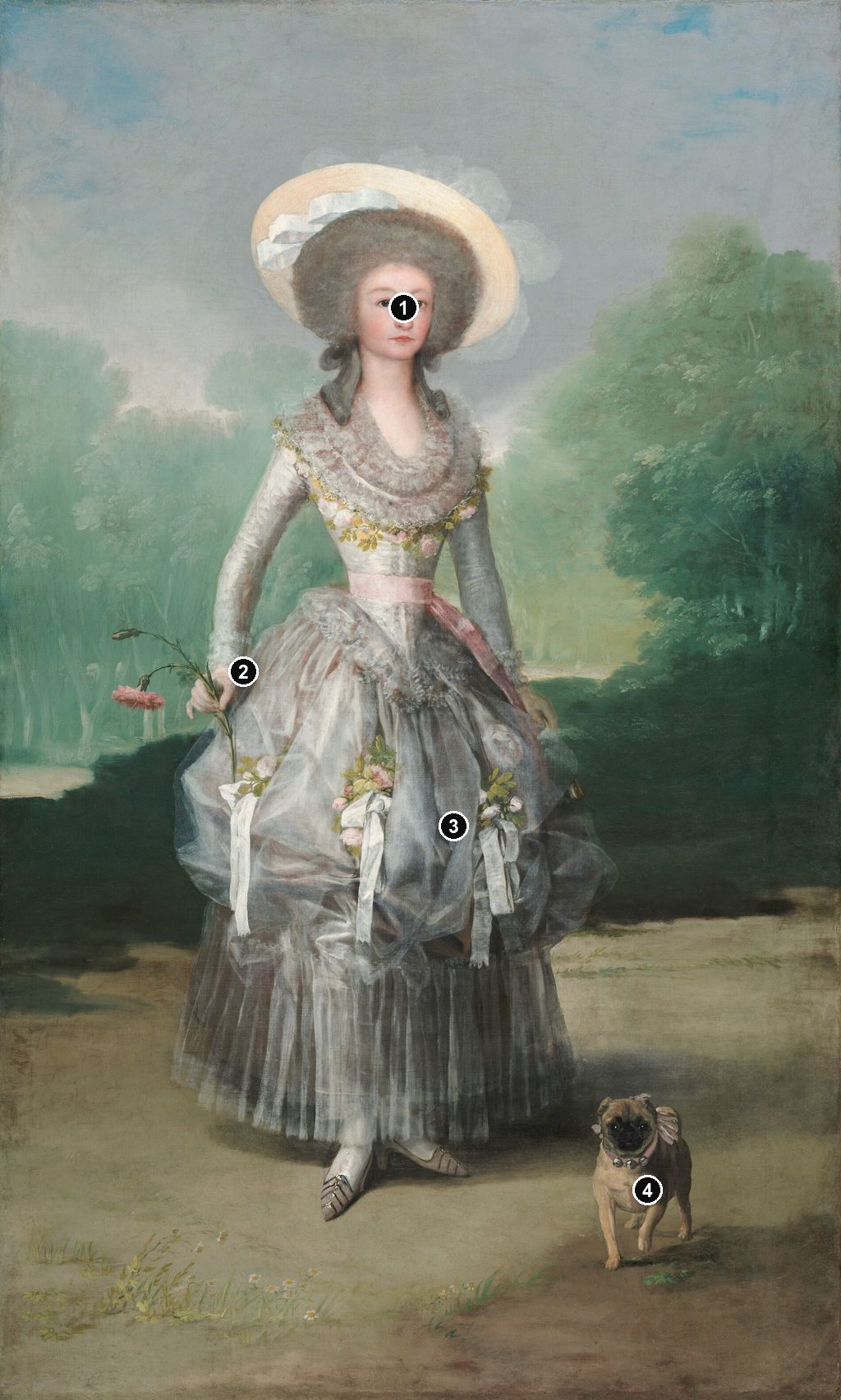
Details from THE MARQUESA DE PONTEJOS
Details from the portrait in the National Gallery of Art (1937.1.85).
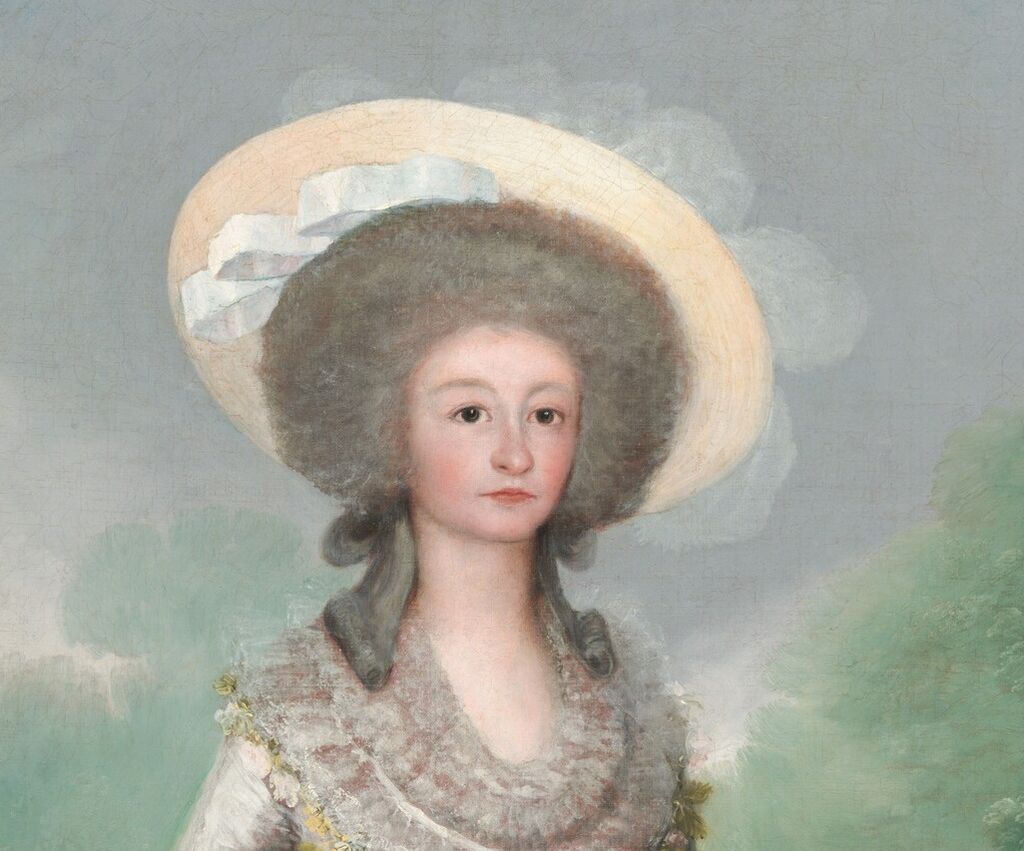
The broad hat
The wide pale brim stands out against the sky.
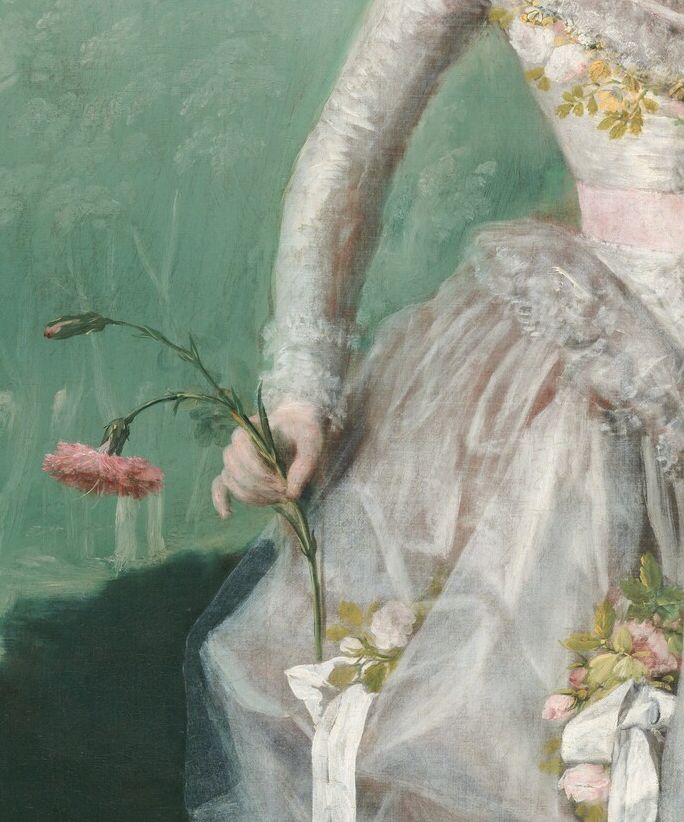
The flower
A small flower sits at the edge of the extended hand.
Flowers and ribbons
Flowers and ribbons break up the pale folds across the skirt.
The dog
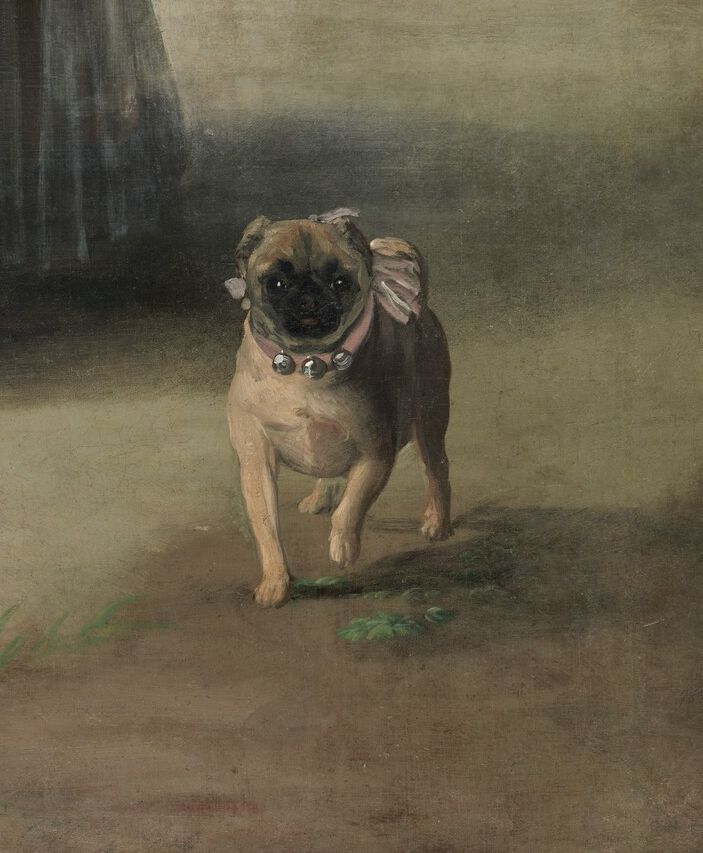
The small dog stands in front of the shadowed garden.
The sitter’s gaze and the green setting
The head is almost frontal, though the body turns a little towards the right of the picture. The hat tilts, and the brim leaves a margin of light around the sitter’s powdered hair. Its wide oval gives the face a setting of its own. The eyes and mouth are small, precisely placed features in an otherwise softly modelled face. Lower down, the hands hold different kinds of object at different angles. On our left the carnation projects towards open space, with a bend in the stem and a blossom that hangs down. On our right a closed fan follows the outline of the skirt and is easy to miss. The long diagonal of the flower stem offers a way into a pose whose feet and shoulders scarcely move. [1] [2]
Dark foliage comes up behind the sides of the skirt and the small rise at the right edge. The middle ground opens into paler greens behind her upper body, and the grey-blue sky leaves most of the brim cleanly outlined. A few blades and small flowers mark the bare ground in front. This is enough to distinguish the foreground from the trees without drawing attention to the layout of the grounds. The National Gallery of Art associates the silvery grey and green palette with Diego Velázquez. Goya had studied his predecessor’s work closely, and his prints after Velázquez offer another record of that study. The museum also compares the wide hat to those in contemporary British portraiture, including Thomas Gainsborough’s. [1] [2]
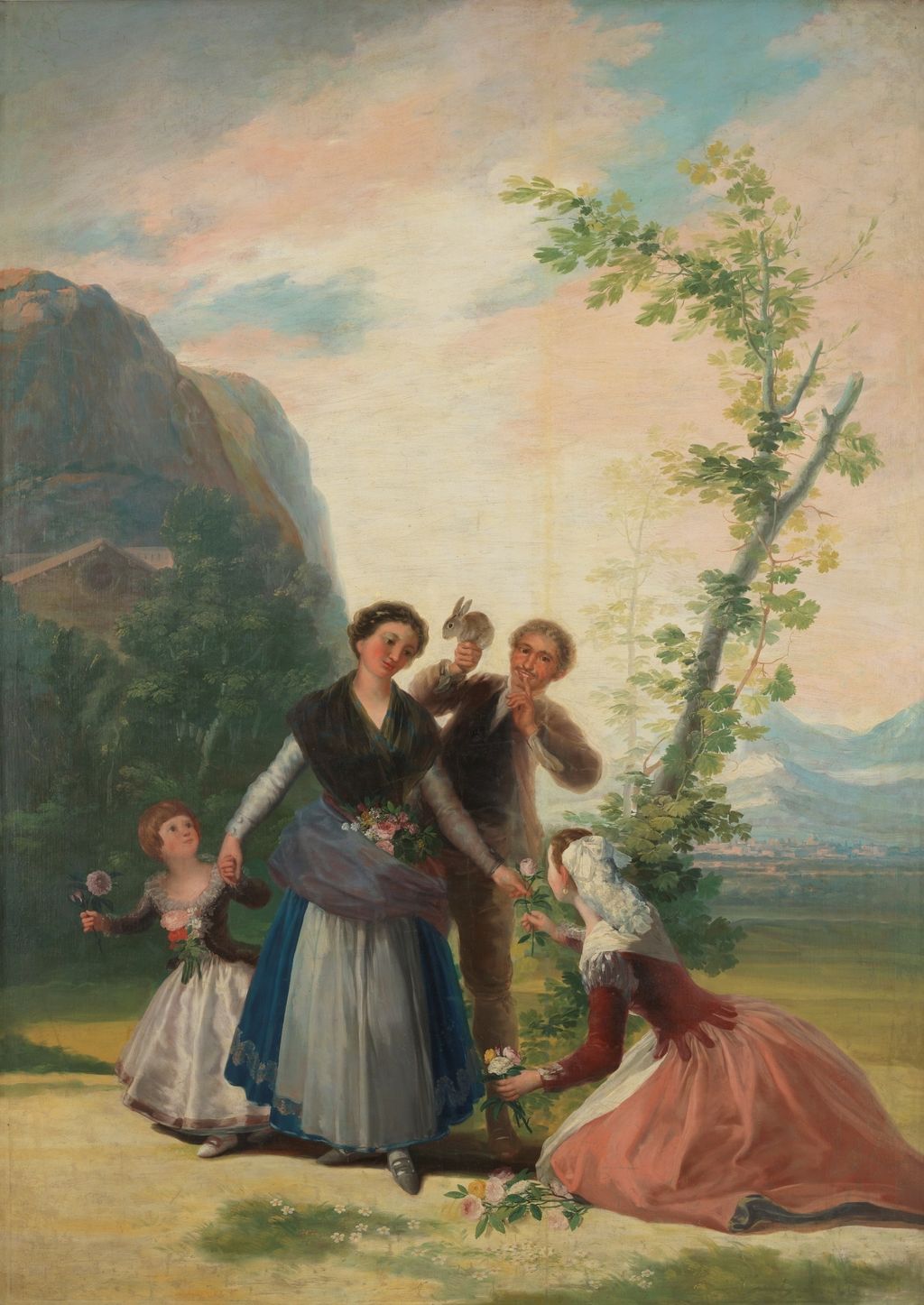
A comparison within Goya’s own work is The Flower Girls, or Spring, a design for a royal tapestry at El Pardo. Martínez Molina and Ansón Navarro draw attention to the similar daisies in the foreground of the two canvases. In the tapestry cartoon an offered flower brings several figures together and gives the scene its action. In the portrait the carnation has a quieter role. Its pink picks up the sash, and it brings the touch of colour that runs through the dress out beyond the silhouette of the figure. [2] [3]
Goya on film
Five films explore Goya’s portraits, prints, Black Paintings and painting techniques.
The Duke of Wellington by Goya
The portrait, its military decorations and its later theft.
Watch on YouTubeThe pug and its bell collar
The dog stands below and to our right of the marquesa, a little ahead of her shoes. Its body is foreshortened, with the head and chest facing us and the rest of the body receding. Goya makes the short, dark muzzle visible against the warm coat and sets three light touches on the pink collar for the bells. The raised paw catches the pug between steps. Both faces meet the viewer, and the pink at the dog’s neck repeats a colour in the sitter’s clothing. That resemblance makes the contrast between the held pose and the small animal’s imminent movement easier to see. [1] [2]
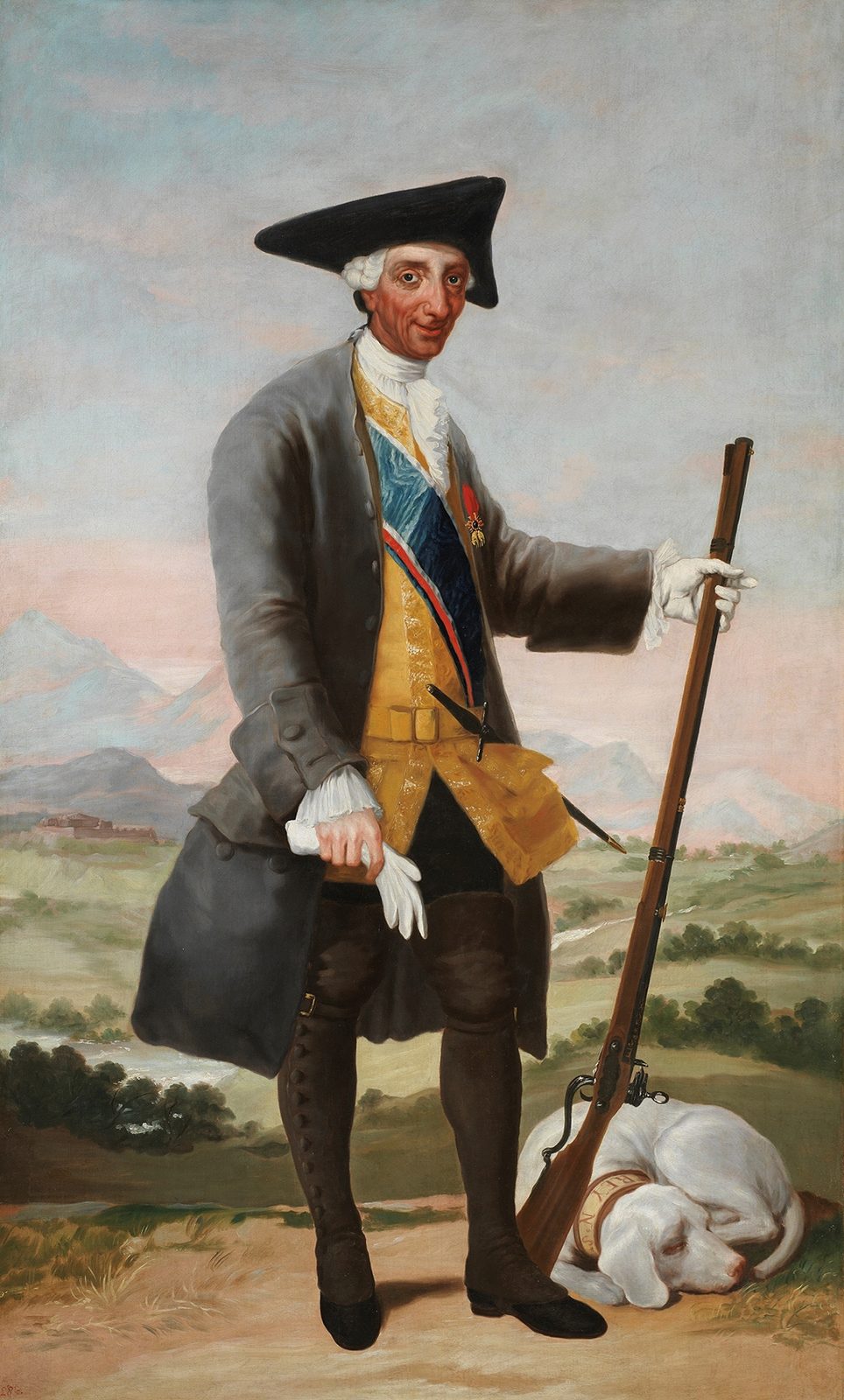
The Fundación Goya en Aragón interprets the dog as an emblem of fidelity, a reading that fits a portrait associated with a marriage. Dogs could do other work in Goya’s portraits. Xavier F. Salomon compares this painting with Charles III in Hunting Dress, where a larger dog rests beside the king, whose gun identifies the activity that brings them outdoors. The tiny bells and raised paw in the Pontejos portrait give the animal a different place in its setting. They bring the eye down from the dress to a figure that appears ready to cross the last stretch of ground in front of the sitter. [4] [5]
The marriage and the date of the portrait
María Ana de Pontejos y Sandoval married Francisco Moñino y Redondo on 23 December 1786 in her family’s house on Madrid’s Carrera de San Jerónimo. She was twenty-four. Her husband, appointed ambassador in Lisbon earlier that year, never took up the post. His brother José Moñino, Count of Floridablanca, was first secretary of state to Charles III. Goya had painted Floridablanca in 1783 in the large canvas now held by the Banco de España. The map at the count’s feet and the figure of Goya holding up a canvas give that portrait a setting shaped by the count’s public office and patronage. The family connection places the marquesa among Goya’s established patrons and their relatives at the time he began to paint aristocratic sitters on this scale. She inherited the title of Marquesa de Casa Pontejos from her father in 1807, two decades after the likely sitting. Spain’s state archives also record her as a member of the Junta de Damas de Honor y Mérito, a Madrid society founded in 1787. [2] [6] [7]
The National Gallery of Art dates the portrait to about 1786 because it was probably made in connection with the marriage. A late-December wedding could also have occasioned a portrait the following year. Martínez Molina and Ansón Navarro favour the first half of 1787, preferably the spring. They point to Goya’s letter of 19 May 1787 to Martín Zapater, in which he mentions that their mutual friend José de Yoldi had seen a portrait. The letter leaves the sitter unnamed, so the scholars present the link as a possibility. The wedding provides a firm date for the change in the sitter’s family circumstances. The garden, flowers and dog help explain why the suggested occasion has appealed to interpreters, while the year of execution remains approximate. [1] [2] [4]
From Madrid to Washington
The National Gallery of Art traces the portrait from the sitter through her third husband, Joaquín Pérez Vizcaíno y Moles, and into the Miraflores family. By 1867 it was recorded with the Marqués de Miraflores, who had married María Ana’s daughter, María Vicenta. The picture was exhibited in Madrid in 1900 and at the Prado in 1928, while it was still in family hands. Andrew W. Mellon bought it in 1931. He deeded it to his educational and charitable trust in 1934, and the trust gave it to the National Gallery of Art in 1937. [1] [2]
Artworks directory
| Name | Date | Medium |
|---|---|---|
| And There’s No Help for It, Plate 15 | Printed 1863 | |
| Asmodea | c. 1820–23 | Wall painting transferred to canvas |
| Boys Inflating a Bladder | 1777–78 | Tapestry cartoon |
| Boys Picking Fruit | 1778 | Tapestry cartoon |
| Bullfight in a Divided Ring | 1825 | Lithograph |
| Card Players | 1777–78 | Tapestry cartoon |
| Card Players (sketch) | 1777–78 | Painted sketch |
| Dance on the Banks of the Manzanares | 1777 | Tapestry cartoon |
| Duel with Cudgels | c. 1820–23 | Wall painting transferred to canvas |
| Heads in a Landscape | c. 1820–23 | Easel painting |
| Judith and Holofernes | c. 1820–23 | Wall painting transferred to canvas |
| Leocadia | c. 1820–23 | Wall painting transferred to canvas |
| Maja and Cloaked Men | 1777 | Tapestry cartoon |
| Maja and Cloaked Men (sketch) | 1777 | Painted sketch |
| Majo Clapping in Time to the Music | 1777 | Drawing |
| Men Reading | c. 1820–23 | Wall painting transferred to canvas |
| Out Hunting for Teeth, Plate 12 | 1799 | Etching, burnished aquatint and burin |
| Picnic in the Countryside (sketch) | 1776–78 | Painted sketch |
| Picnic on the Banks of the Manzanares | 1776 | Tapestry cartoon |
| Pilgrimage to San Isidro | c. 1820–23 | Wall painting transferred to canvas |
| Preparatory study for The Sleep of Reason Produces Monsters | c. 1796–97 | Drawing |
| Procession of the Holy Office | c. 1820–23 | Wall painting transferred to canvas |
| Quarrel at the Cockerel Inn (sketch) | 1777 | Painted sketch |
| Quarrel in the New Tavern | 1777 | Tapestry cartoon |
| Saturn Devouring His Son | c. 1820–23 | Wall painting transferred to canvas |
| Seated Majo Smoking | c. 1776 | Drawing |
| The Dog | c. 1820–23 | Wall painting transferred to canvas |
| The Drinker | 1777 | Tapestry cartoon |
| The Fates | c. 1820–23 | Wall painting transferred to canvas |
| The Great He-Goat | c. 1820–23 | Wall painting transferred to canvas |
| The Kite | 1777–78 | Tapestry cartoon |
| The Parasol | 1777 | Oil on canvas, tapestry cartoon |
| The Second of May 1808 | 1814 | Oil on canvas |
| The Sleep of Reason Produces Monsters, Plate 43 | 1799 | Etching and aquatint |
| The Third of May 1808 | 1814 | Oil on canvas |
| Thou Who Canst Not, Plate 42 | 1799 | Etching and burnished aquatint |
| Three Figures | 1776 | Drawing (lost) |
| Two Old Men | c. 1820–23 | Wall painting transferred to canvas |
| Two Old Men Eating Soup | c. 1820–23 | Wall painting transferred to canvas |
| Two Women and a Man | c. 1820–23 | Wall painting transferred to canvas |
| Universal Language: The Author Dreaming | 1797 | Drawing |
| The Family of Charles IV | 1800 | Oil on canvas |
| Witches’ Sabbath (Osuna painting) | 1797–98 | Oil on canvas |
| The Nude Maja | 1795–1800 | Oil on canvas |
| The Clothed Maja | 1800–07 | Oil on canvas |
| Self-Portrait (Drawing) | c. 1796 | Brush and carbon black ink on laid paper |
| The Swing, Madrid Album B.21 | 1795–97 | Brush and carbon black washes |
| Majas Fighting, a Majo Observing, Madrid Album B.15 | 1796–97 | Brush, grey and black washes on laid paper |
| Majos and Majas Conversing, Madrid Album B.16 | c. 1794–97 | Ink wash on paper |
| Weeping Woman and Three Men, Madrid Album B.17 | 1795–97 | Brush, carbon black washes and black chalk |
| Maja Seated on a Chair and Two Companions Behind, Madrid Album B.18 | 1795–97 | Brush and carbon black washes |
| Girl and Bull, Madrid Album B.23 | 1796–97 | Brush and carbon black washes |
| Lovers Sitting on a Rock, Madrid Album B.24 | 1796–97 | Brush and carbon black washes |
| Mariano Ceballos Riding a Bull | 1825 | Crayon lithograph and scraper |
| Landscape (lifetime impression) | c. 1807–10 | Etching and aquatint |
| Self-Portrait (1815), Prado canvas | 1815 | Oil on canvas |
| Self-Portrait (1815), Academy panel | 1815 | Oil on panel |
| Self-Portrait with Dr Arrieta | 1820 | Oil on canvas |
| Christ Crucified | 1780 | Oil on canvas |
| The Last Communion of Saint Joseph of Calasanz | 1819 | Oil on canvas |
| Christ on the Mount of Olives | 1819 | Oil on panel |
| The Flower Girls, or Spring | 1786–87 | Oil on canvas |
| The Grape Harvest, or Autumn | 1786–87 | Oil on canvas |
| The Snowstorm, or Winter | 1786–87 | Oil on canvas |
| The Threshing Ground, or Summer | 1786–87 | Oil on canvas |
| Picnic on the Banks of the Manzanares | 1776 | Oil on canvas |
| The Kite | 1777–78 | Oil on canvas |
| Dance on the Banks of the Manzanares | 1777 | Oil on canvas |
| A Fight at the Venta Nueva | 1777 | Oil on canvas |
| Blind Man’s Bluff | 1788 | Oil on canvas |
| Dogs on a Lead | 1775 | Oil on canvas |
| Hunting with a Decoy | 1775 | Oil on canvas |
| Hunter Loading His Rifle | 1775 | Oil on canvas |
| The Angler | 1775 | Oil on canvas |
| The Hermitage of San Isidro on His Feast Day | 1788 | Oil on canvas |
| The Meadow of San Isidro | 1788 | Oil on canvas |
| The Straw Manikin | 1791–92 | Oil on canvas |
| Witches’ Flight | c. 1797–98 | Oil on canvas |
| A Scene from ‘The Forcibly Bewitched’ | 1798 | Oil on canvas |
| The Duchess of Alba in Black | 1797 | Oil on canvas |
| The Duchess of Alba in White | 1795 | Oil on canvas |
| Charles III in Hunting Dress | c. 1786 | Oil on canvas |
| The Duke and Duchess of Osuna and Their Children | 1787–88 | Oil on canvas |
| Manuel Osorio Manrique de Zúñiga | 1787–88 | Oil on canvas |
| The Marquesa de Pontejos | c. 1786 | Oil on canvas |
| Equestrian Portrait of the 1st Duke of Wellington | 1812 | Oil on canvas |
| The Duke of Wellington | 1812–14 | Oil on wood |
| Portrait of Ferdinand VII of Spain | 1814 | Oil on canvas |
| Gaspar Melchor de Jovellanos | 1798 | Oil on canvas |
| María Tomasa Palafox y Portocarrero | 1804 | Oil on canvas |
| Señora Sabasa García | c. 1806–11 | Oil on canvas |
| Don Juan Bautista de Muguiro | 1827 | Oil on canvas |
| Doña Isabel de Porcel | Before 1805 | Oil on canvas |
| The Colossus | After 1808 | Oil on canvas |
| The Burial of the Sardine | 1808–12 | Oil on panel |
| The Madhouse | 1808–12 | Oil on panel |
| A Procession of Flagellants | 1808–12 | Oil on panel |
| Portrait of Jacques Galos | 1826 | Oil on canvas |
| Portrait of Mariano Goya, the Artist’s Grandson | 1827 | Oil on canvas |
| Milkmaid of Bordeaux | c. 1827 | Oil on canvas |
| Portrait of Don Juan Antonio Cuervo | 1819 | Oil on canvas |
| María Luisa of Parma (Naples version) | c. 1800 | Oil on canvas |
| The Countess of Baena | 1819 | Oil on canvas |
| The Family of the Infante Don Luis | 1783–84 | Oil on canvas |
| The Holy Family | c. 1787 | Oil on canvas |
| Saint Barbara | c. 1773 | Oil on canvas |
| Saints Justa and Rufina | 1817 | Oil on canvas |
| El Tío Paquete | c. 1819–20 | Oil on canvas |
| The Forge | c. 1815–20 | Oil on canvas |
| Majas on a Balcony (Metropolitan Museum version) | c. 1800–10 | Oil on canvas |
| Maja and Celestina on a Balcony | c. 1808–12 | Oil on canvas |
| The Water Bearer | 1808–12 | Oil on canvas |
| Time and the Old Women | c. 1810 | Oil on canvas |
Frequently Asked Questions
The original canvas is in the National Gallery of Art in Washington, DC, as part of the Andrew W. Mellon Collection. Its accession number is 1937.1.85. [1]
Discussion
Look again at the images and ideas explored in The Marquesa de Pontejos. These editorial prompts invite your observations.
Compare the marquesa’s feet with the pug’s raised paw. Where does Goya make the figures seem most firmly planted, and where do you first sense movement?
Reader Insights
Where does Goya draw your attention first?
How does the companion work handle its figures?
Join the Conversation
Share a detail, comparison or question about The Marquesa de Pontejos below.
References
- National Gallery of Art, The Marquesa de Pontejos, collection record, 1937.1.85. View source.
- Javier Martínez Molina and Arturo Ansón Navarro, ‘Sensibilidad, realismo y moda en los retratos femeninos de Goya del periodo ilustrado (1783–1808)’, pp. 125–130, figs. 21–25. View source.
- Fundación Goya en Aragón, The Flower Girls (Las floreras), catalogue entry 51, Museo Nacional del Prado P000793. View source.
- Fundación Goya en Aragón, Mariana de Pontejos de Sandoval, marquesa de Pontejos, catalogue entry 417. View source.
- Xavier F. Salomon, ‘Goya and the Altamira Family’, The Metropolitan Museum of Art Bulletin, 71, no. 4 (Spring 2014), figs. 22–25. View source.
- Banco de España, José Moñino y Redondo, I Count of Floridablanca, collection record P_324. View source.
- Portal de Archivos Españoles, Junta de Damas de Honor y Mérito (España), authority record 155935. View source.







