


 by Tom Gurney
Tom Gurney BSc (Hons) is an art history expert with over 20 years experience
Published on June 19, 2020 / Updated on November 20, 2026
Email: tomgurney1@gmail.com / Phone: +44 7429 011000
Introduction
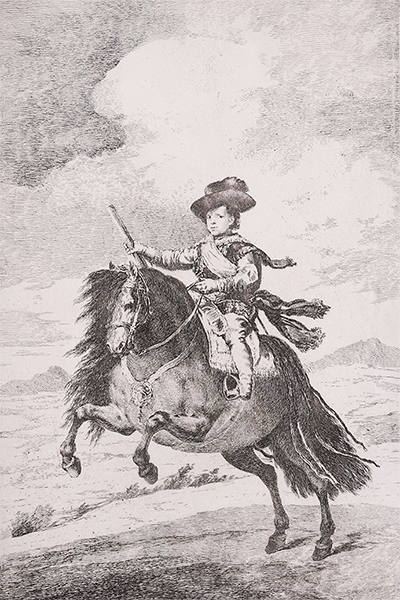
In July 1778, two Madrid booksellers began offering Francisco de Goya’s etchings after paintings by Diego Velázquez in the Royal Palace. Buyers could take home a mounted king, a court minister riding into battle or the figure of an ancient philosopher. Goya gave them images small enough to hold in their hands, with captions identifying works they might never see in the palace. Three surviving examples show the choices involved. The Count-Duke of Olivares keeps his commanding pose against a quieter landscape. The figures in The Triumph of Bacchus acquire different expressions. In the proofs of Las Meninas, Goya worked through the problem of keeping the figures and doorway legible in a dim room. [1] [2] [3] [4]
At a Glance
- Artist and sourceFrancisco de Goya drew and etched compositions after paintings by Diego Velázquez in the Spanish royal collection. [1]
- First documented salesNine subjects were advertised on 28 July 1778, with two more added on 22 December. The July notice offered them together or separately. [1] [5]
- Size of the projectPaula Fayos Pérez catalogues seventeen etchings, including works that survive as proofs. Calcografía Nacional records thirteen copperplates from the project entering its collection. [6] [7]
- TechniquesEtched lines carry much of the work in the early published sheets. Surviving proofs also show Goya trying drypoint, aquatint and other ways of working the copper. [4] [8]
From the Royal Palace to the bookshop
Goya studied the paintings of Diego Velázquez while building his own career in Madrid. He was already making tapestry designs for royal residences, and the project gave him close familiarity with the Velázquez paintings the crown had assembled. The July advertisement credited Velázquez with the life-size originals and Goya with both drawing and etching the small versions. These were two stages patrons might have expected different specialists to carry out. Here the reproduction offered a chance to study how a predecessor handled portraits and to circulate sheets bearing the name of the living artist alongside that of the old master. [1] [8] [9]
The five equestrian subjects were Philip III, Philip IV, Margaret of Austria, Isabel of Bourbon and Gaspar de Guzmán, Count-Duke of Olivares. Aesop and Menippus stood singly in their pictures. The other two sitters were Sebastián de Morra and Diego de Acedo, called El Primo, both associated with the court. At Antonio Sancha’s and Manuel Barco’s shops the mounted figures cost six reales each and the others three. The purchaser of a single picture could choose a courtier, a royal figure or a philosopher. In December, the same shops offered the equestrian Prince Baltasar Carlos and Bacchus crowning one of his companions alongside the earlier sheets. [1] [5] [6]
The notices give a firm count of eleven sheets advertised in 1778. The broader body of work extends into the following years and includes trial impressions from plates that never reached the bookshops. Calcografía Nacional’s archival register separately lists thirteen Velázquez coppers acquired alongside Goya’s Garroted Man and Saint Francis of Paola. A February 1792 account records payment of 6,000 reales for fifteen Goya plates. That number includes the two unrelated subjects. The copperplates, the subjects advertised in 1778 and the subjects scholars can identify from surviving evidence answer three different questions about the scope of the project. [5] [6] [7]
Olivares on horseback
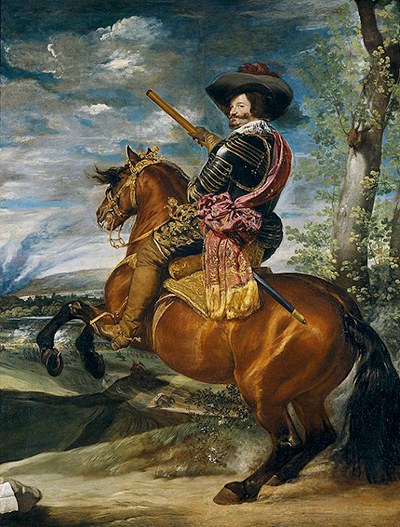
In Velázquez’s equestrian portrait of the Count-Duke of Olivares, painted about 1636, the horse rears towards the left while its rider turns back to look out of the canvas. His baton angles up into the sky. Below it, the colour and movement of the horse lead the eye down towards the landscape and the distant fighting. The Prado canvas measures more than three metres high. Goya took the whole arrangement down to a plate about 37 centimetres high, small enough for the rider’s face, the sash and the marks representing the fighting to be taken in together. [2] [10]
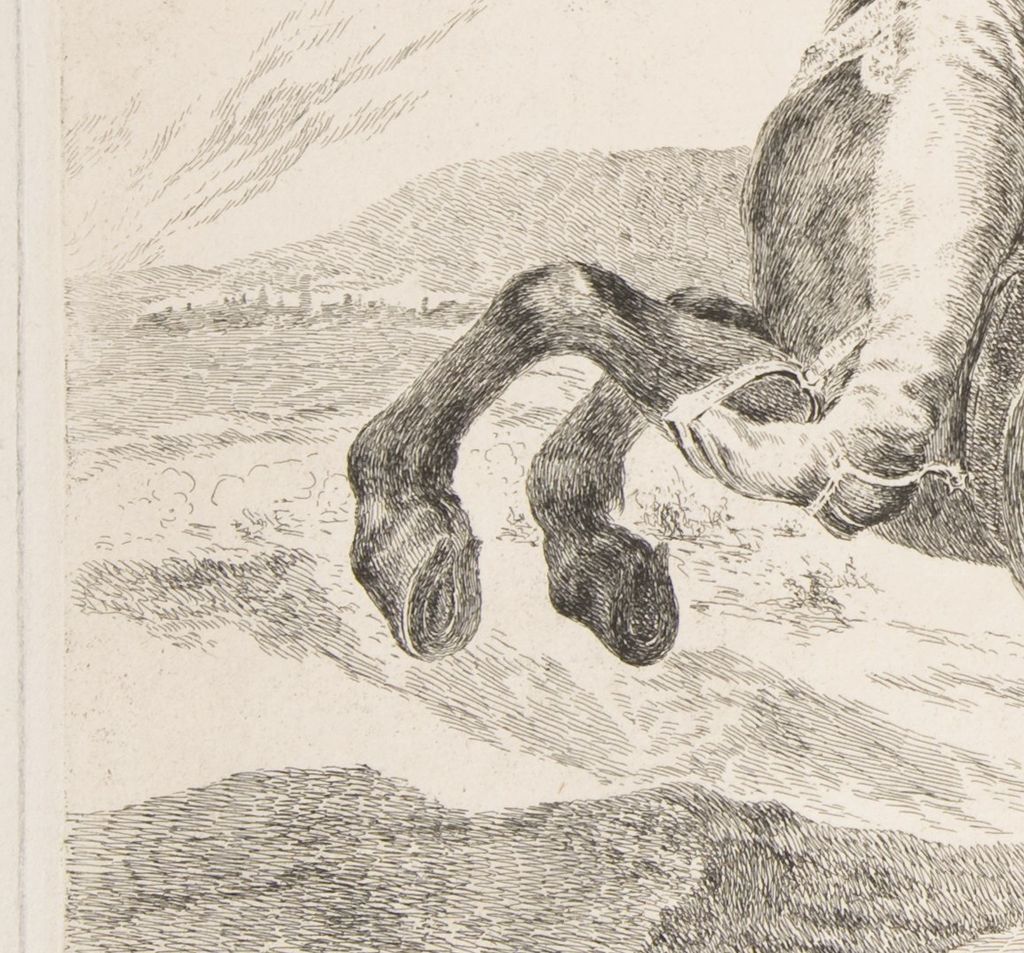
Look at the impression in the Metropolitan Museum of Art (31.31.15). The horse still rears towards the left, with the tree at the right edge. A copperplate prints in reverse, so keeping the painting’s orientation on the sheet means placing the image the other way round on the plate. Goya also rebalanced the image in tone. The gold-brown horse and pink sash in the painted portrait become passages of closely packed lines. The ink makes the horse’s barrel and hindquarters dark, while the lighter marks on the tack and the rider’s clothing keep those forms distinct. Goya shrank the distant action and left stretches of the landscape and sky pale. At this scale the light around the rider’s hat and baton helps preserve the sharp silhouette that Velázquez achieved with paint. [2] [8] [10]
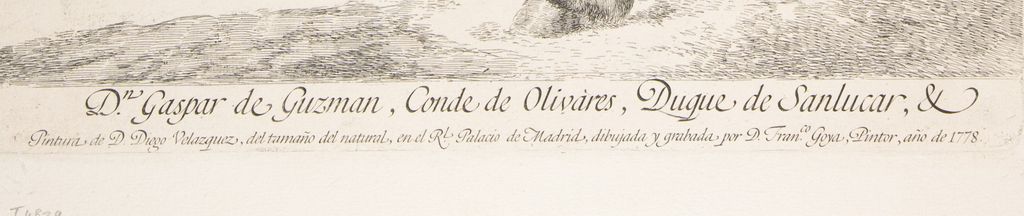
The lower edge is also worth looking at. Within the plate mark, the two lines of lettering name the sitter and his titles and describe the relationship of the print to the painting. The caption communicates facts that the horse, sash and baton on their own would leave open to interpretation. It also tells a buyer where the original could be found. The Met’s collection checklist identifies this sheet as Harris 10, state III, first edition, and records drypoint alongside etching. The online entry gives the shorter medium description of etching. [2] [8] [11]
Annotated Details from The Count-Duke of Olivares in Goya’s etching
Compare the rider, the horse and the landscape with the painting.
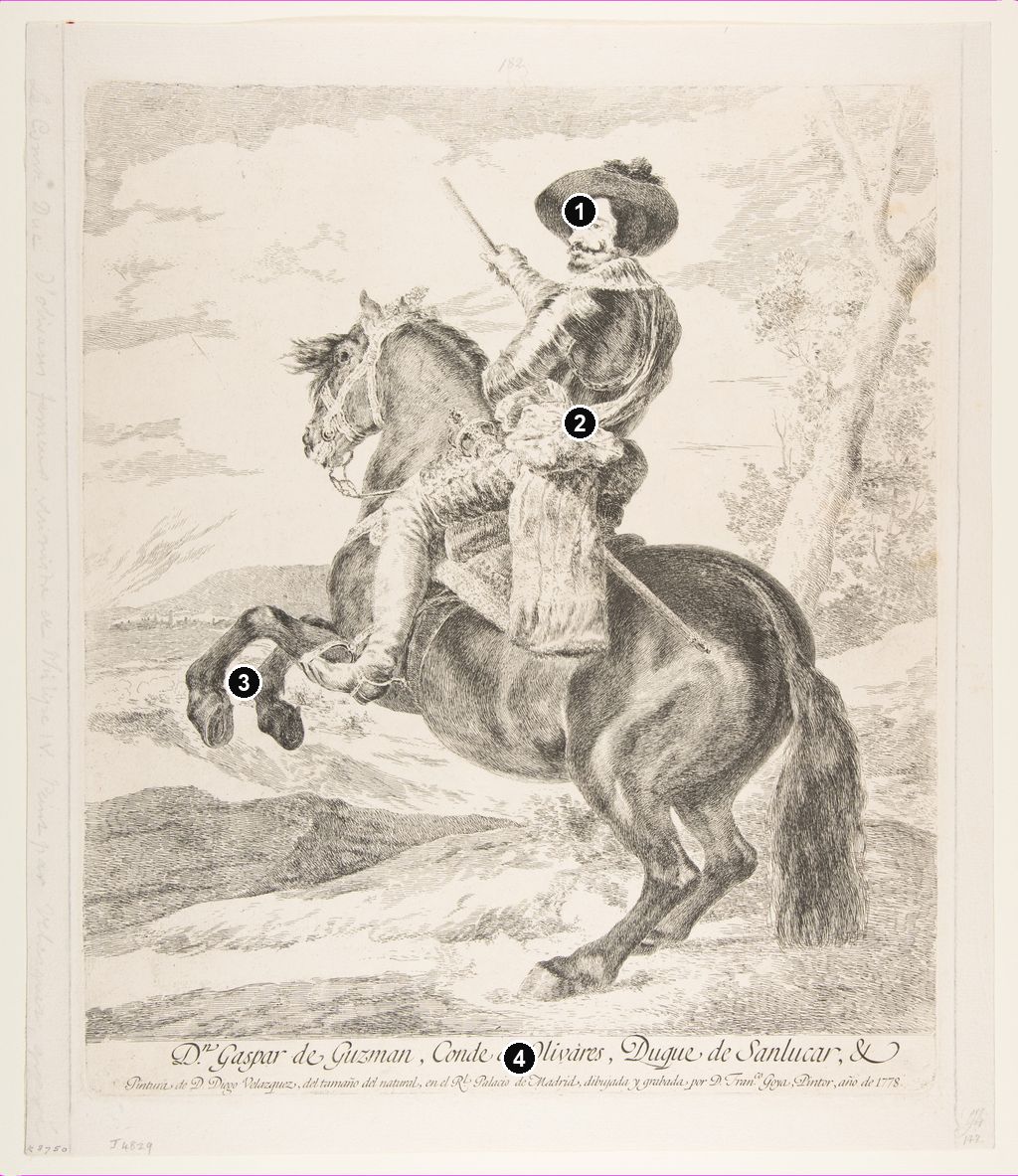
Details from THE COUNT-DUKE OF OLIVARES IN GOYA’S ETCHING
Details from the Metropolitan Museum of Art’s 1778 impression (31.31.15).
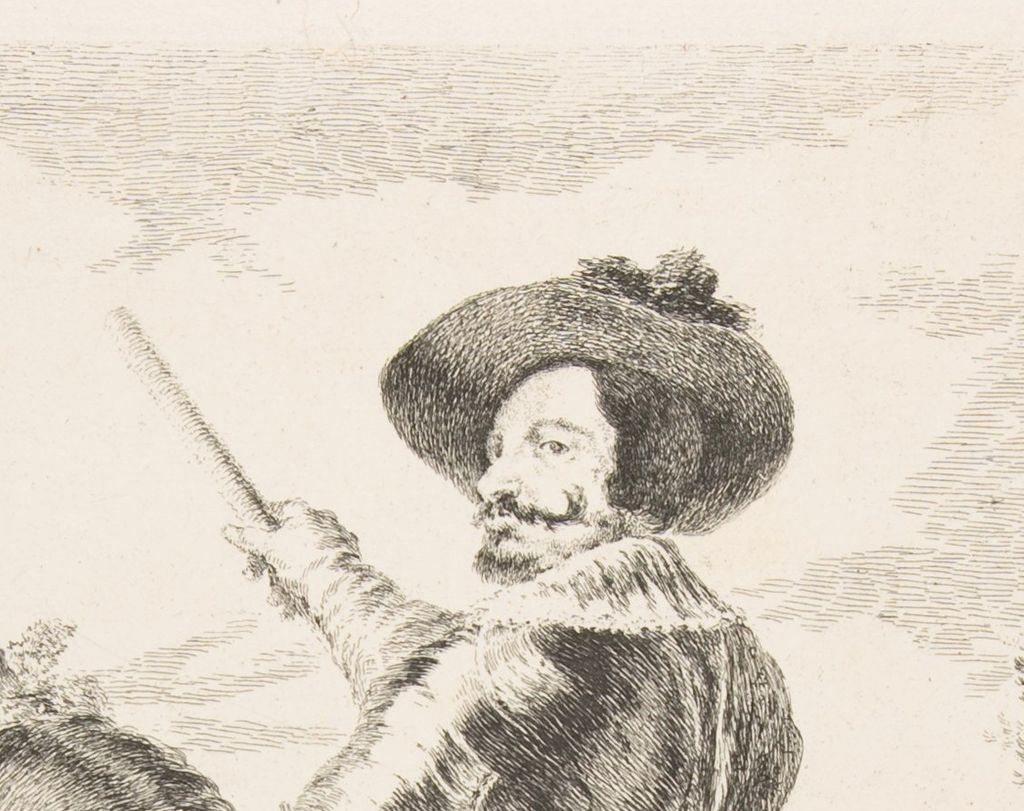
The rider’s face and hat
The pale face turns back towards the viewer below the dark brim.
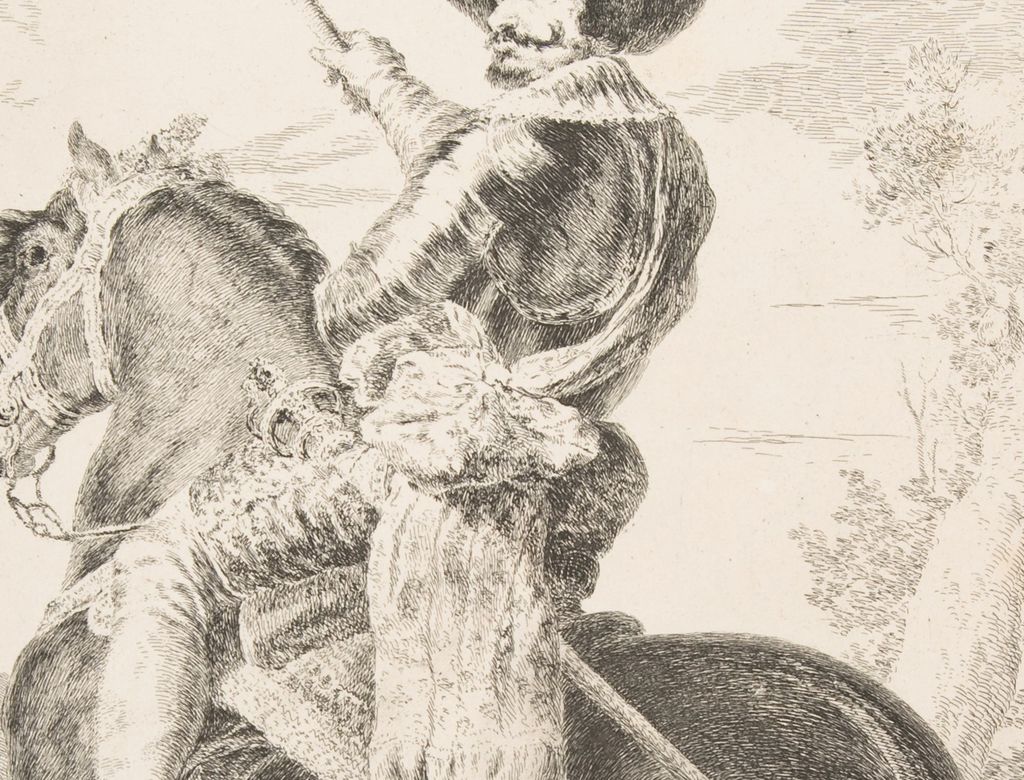
The baton and sash
The baton points left and the sash crosses the closely worked costume.
The lifted forelegs
The horse’s bent forelegs stand out against the pale landscape.
The printed inscription
Lettering below the pictorial frame identifies the rider and credits Velázquez and Goya.
Goya on film
Five films explore Goya’s portraits, prints, Black Paintings and painting techniques.
The Duke of Wellington by Goya
The portrait, its military decorations and its later theft.
Watch on YouTubeFrom a drawing to the Bacchus print
For Velázquez’s The Triumph of Bacchus, the Prado preserves both the 1628–29 canvas and Goya’s preparatory drawing of 1778. The graphite sheet (D004330) measures 322 by 435 millimetres, close to the dimensions of the Met print’s plate. The Fundación Goya en Aragón notes the careful work on the faces and flesh tones, with the fabrics studied less fully. Creases in the paper suggest the drawing served to transfer the design to copper. Goya had already reduced the image to the scale of the plate in the drawing, before he faced the problem of what could be carried by etched lines. [3] [12] [13]
Across the three versions the seated Bacchus crowns a kneeling man and the other drinkers crowd around them. In the drawing Goya could shade the body of Bacchus with soft graphite. In the etching, the light torso is edged with fine lines and framed by the denser marks of leaves, hair and clothing. Compare the treatment of Bacchus’s own drapery. The drawing devotes more attention to the head and body, while the print supplies a network of long strokes that defines the folds over his lap and down towards his bare foot. The print also gives the faces a coarser character. The Met describes a shift from Velázquez’s youthful, distracted god to Goya’s older-looking and more knowing figure. The effect is especially clear when the print is read beside the original and the drawing, with the group still in the same arrangement. [3] [12] [13]
Beneath the scene, the printed caption calls the subject a feigned Bacchus crowning drunkards. It credits Velázquez and locates his life-size painting in the Royal Palace, then names Goya as the person who drew and etched it in 1778. [14] That wording can still be read on the National Gallery of Art’s first-edition sheet, catalogued as Harris 4, state III(1). The Prado also holds impressions pulled in the twentieth century. In a catalogue entry, the date of the image can describe Goya’s original work on the plate even when the paper received its impression many years later. [5] [15] [16]
Aesop’s caption before publication
Aesop was one of the cheaper prints listed in July. The Museum of Fine Arts, Boston, holds a working proof of the subject with the names of the artists added in drypoint and an inscription written by hand in ink. The Norton Simon Museum’s impression has engraved lettering. Juxtaposed, the two sheets show that the line of text under a figure deserves as much attention as the figure itself when identifying a state. The Boston sheet records Goya working on both the image and how it would be identified. On the Norton Simon sheet the lettering can be printed each time the plate is inked, making the identification travel with the portrait. [1] [22] [23]
Las Meninas and the evidence of proofs
The Las Meninas preparatory drawing survives in a private collection. In red chalk with pencil, Goya laid out the group around the Infanta Margarita and the great expanse of room above the figures. The Fundación Goya en Aragón singles out the subtle middle tones and differences of texture in the drawing. Those are difficult to carry into print where soft chalk shading must be made again with the tools available on copper. In the British Museum proof, the doorway at the rear remains a sharp opening in the dark interior, and the light on the Infanta’s dress helps locate the forward group. The ceiling and walls are harder to distinguish. [4] [17] [18] [19]
The proof in the Biblioteca Nacional de España is a second state, before roulette and aquatint, with shading worked on the paper in black pencil. The Met’s 1994 catalogue illustrates a third-state working proof with roulette and aquatint alongside etched and directly incised marks. A state marks a stage in the alteration of the plate. Hand shading on a sheet can show how an artist was testing further changes, while a new state records changes to the copper itself. With no published edition of Goya’s Las Meninas, these sheets preserve the progress of the work. They also have no printed identifying caption beneath the image, unlike the examples of Olivares and Bacchus sold in 1778. [4] [8] [20]
What carried into Goya’s later prints
The Velázquez project shows Goya making working proofs, altering lines and testing ways to build areas of tone. In etching, acid bites the lines he has exposed through a protective ground. Drypoint adds marks scratched directly into the metal. Aquatint makes it possible to print areas of tone with a fine grain. The project gave him room to explore how these marks work together, especially in the denser shadows of Las Meninas. The combination of line and aquatint later gave him a way to place sharply drawn figures against fields of darkness in Los Caprichos. The notices also record a change in how he presented his work. In 1778 the drawings and etchings were after Velázquez. In 1799 Goya advertised satires of his own invention. [1] [7] [8] [21]
Even the lettering became a different kind of tool. Under Olivares it identifies the man whose imposing likeness Goya has reproduced. In The Sleep of Reason Produces Monsters the words give a proposition to consider alongside the human figure, owls and bats. Readers can follow that change across Goya’s prints or use the guide to his etchings to see what editions and proofs reveal about other plates. [8] [9]
Artworks directory
| Name | Date | Medium |
|---|---|---|
| And There’s No Help for It, Plate 15 | Printed 1863 | |
| Asmodea | c. 1820–23 | Wall painting transferred to canvas |
| Boys Inflating a Bladder | 1777–78 | Tapestry cartoon |
| Boys Picking Fruit | 1778 | Tapestry cartoon |
| Bullfight in a Divided Ring | 1825 | Lithograph |
| Card Players | 1777–78 | Tapestry cartoon |
| Card Players (sketch) | 1777–78 | Painted sketch |
| Dance on the Banks of the Manzanares | 1777 | Tapestry cartoon |
| Duel with Cudgels | c. 1820–23 | Wall painting transferred to canvas |
| Heads in a Landscape | c. 1820–23 | Easel painting |
| Judith and Holofernes | c. 1820–23 | Wall painting transferred to canvas |
| Leocadia | c. 1820–23 | Wall painting transferred to canvas |
| Maja and Cloaked Men | 1777 | Tapestry cartoon |
| Maja and Cloaked Men (sketch) | 1777 | Painted sketch |
| Majo Clapping in Time to the Music | 1777 | Drawing |
| Men Reading | c. 1820–23 | Wall painting transferred to canvas |
| Out Hunting for Teeth, Plate 12 | 1799 | Etching, burnished aquatint and burin |
| Picnic in the Countryside (sketch) | 1776–78 | Painted sketch |
| Picnic on the Banks of the Manzanares | 1776 | Tapestry cartoon |
| Pilgrimage to San Isidro | c. 1820–23 | Wall painting transferred to canvas |
| Preparatory study for The Sleep of Reason Produces Monsters | c. 1796–97 | Drawing |
| Procession of the Holy Office | c. 1820–23 | Wall painting transferred to canvas |
| Quarrel at the Cockerel Inn (sketch) | 1777 | Painted sketch |
| Quarrel in the New Tavern | 1777 | Tapestry cartoon |
| Saturn Devouring His Son | c. 1820–23 | Wall painting transferred to canvas |
| Seated Majo Smoking | c. 1776 | Drawing |
| The Dog | c. 1820–23 | Wall painting transferred to canvas |
| The Drinker | 1777 | Tapestry cartoon |
| The Fates | c. 1820–23 | Wall painting transferred to canvas |
| The Great He-Goat | c. 1820–23 | Wall painting transferred to canvas |
| The Kite | 1777–78 | Tapestry cartoon |
| The Parasol | 1777 | Oil on canvas, tapestry cartoon |
| The Second of May 1808 | 1814 | Oil on canvas |
| The Sleep of Reason Produces Monsters, Plate 43 | 1799 | Etching and aquatint |
| The Third of May 1808 | 1814 | Oil on canvas |
| Thou Who Canst Not, Plate 42 | 1799 | Etching and burnished aquatint |
| Three Figures | 1776 | Drawing (lost) |
| Two Old Men | c. 1820–23 | Wall painting transferred to canvas |
| Two Old Men Eating Soup | c. 1820–23 | Wall painting transferred to canvas |
| Two Women and a Man | c. 1820–23 | Wall painting transferred to canvas |
| Universal Language: The Author Dreaming | 1797 | Drawing |
| The Family of Charles IV | 1800 | Oil on canvas |
| Witches’ Sabbath (Osuna painting) | 1797–98 | Oil on canvas |
| The Nude Maja | 1795–1800 | Oil on canvas |
| The Clothed Maja | 1800–07 | Oil on canvas |
| Self-Portrait (Drawing) | c. 1796 | Brush and carbon black ink on laid paper |
| The Swing, Madrid Album B.21 | 1795–97 | Brush and carbon black washes |
| Majas Fighting, a Majo Observing, Madrid Album B.15 | 1796–97 | Brush, grey and black washes on laid paper |
| Majos and Majas Conversing, Madrid Album B.16 | c. 1794–97 | Ink wash on paper |
| Weeping Woman and Three Men, Madrid Album B.17 | 1795–97 | Brush, carbon black washes and black chalk |
| Maja Seated on a Chair and Two Companions Behind, Madrid Album B.18 | 1795–97 | Brush and carbon black washes |
| Girl and Bull, Madrid Album B.23 | 1796–97 | Brush and carbon black washes |
| Lovers Sitting on a Rock, Madrid Album B.24 | 1796–97 | Brush and carbon black washes |
| Mariano Ceballos Riding a Bull | 1825 | Crayon lithograph and scraper |
| Landscape (lifetime impression) | c. 1807–10 | Etching and aquatint |
| Self-Portrait (1815), Prado canvas | 1815 | Oil on canvas |
| Self-Portrait (1815), Academy panel | 1815 | Oil on panel |
| Self-Portrait with Dr Arrieta | 1820 | Oil on canvas |
| Christ Crucified | 1780 | Oil on canvas |
| The Last Communion of Saint Joseph of Calasanz | 1819 | Oil on canvas |
| Christ on the Mount of Olives | 1819 | Oil on panel |
| The Flower Girls, or Spring | 1786–87 | Oil on canvas |
| The Grape Harvest, or Autumn | 1786–87 | Oil on canvas |
| The Snowstorm, or Winter | 1786–87 | Oil on canvas |
| The Threshing Ground, or Summer | 1786–87 | Oil on canvas |
| Picnic on the Banks of the Manzanares | 1776 | Oil on canvas |
| The Kite | 1777–78 | Oil on canvas |
| Dance on the Banks of the Manzanares | 1777 | Oil on canvas |
| A Fight at the Venta Nueva | 1777 | Oil on canvas |
| Blind Man’s Bluff | 1788 | Oil on canvas |
| Dogs on a Lead | 1775 | Oil on canvas |
| Hunting with a Decoy | 1775 | Oil on canvas |
| Hunter Loading His Rifle | 1775 | Oil on canvas |
| The Angler | 1775 | Oil on canvas |
| The Hermitage of San Isidro on His Feast Day | 1788 | Oil on canvas |
| The Meadow of San Isidro | 1788 | Oil on canvas |
| The Straw Manikin | 1791–92 | Oil on canvas |
| Witches’ Flight | c. 1797–98 | Oil on canvas |
| A Scene from ‘The Forcibly Bewitched’ | 1798 | Oil on canvas |
| The Duchess of Alba in Black | 1797 | Oil on canvas |
| The Duchess of Alba in White | 1795 | Oil on canvas |
| Charles III in Hunting Dress | c. 1786 | Oil on canvas |
| The Duke and Duchess of Osuna and Their Children | 1787–88 | Oil on canvas |
| Manuel Osorio Manrique de Zúñiga | 1787–88 | Oil on canvas |
| The Marquesa de Pontejos | c. 1786 | Oil on canvas |
| Equestrian Portrait of the 1st Duke of Wellington | 1812 | Oil on canvas |
| The Duke of Wellington | 1812–14 | Oil on wood |
| Portrait of Ferdinand VII of Spain | 1814 | Oil on canvas |
| Gaspar Melchor de Jovellanos | 1798 | Oil on canvas |
| María Tomasa Palafox y Portocarrero | 1804 | Oil on canvas |
| Señora Sabasa García | c. 1806–11 | Oil on canvas |
| Don Juan Bautista de Muguiro | 1827 | Oil on canvas |
| Doña Isabel de Porcel | Before 1805 | Oil on canvas |
| The Colossus | After 1808 | Oil on canvas |
| The Burial of the Sardine | 1808–12 | Oil on panel |
| The Madhouse | 1808–12 | Oil on panel |
| A Procession of Flagellants | 1808–12 | Oil on panel |
| Portrait of Jacques Galos | 1826 | Oil on canvas |
| Portrait of Mariano Goya, the Artist’s Grandson | 1827 | Oil on canvas |
| Milkmaid of Bordeaux | c. 1827 | Oil on canvas |
| Portrait of Don Juan Antonio Cuervo | 1819 | Oil on canvas |
| María Luisa of Parma (Naples version) | c. 1800 | Oil on canvas |
| The Countess of Baena | 1819 | Oil on canvas |
| The Family of the Infante Don Luis | 1783–84 | Oil on canvas |
| The Holy Family | c. 1787 | Oil on canvas |
| Saint Barbara | c. 1773 | Oil on canvas |
| Saints Justa and Rufina | 1817 | Oil on canvas |
| El Tío Paquete | c. 1819–20 | Oil on canvas |
| The Forge | c. 1815–20 | Oil on canvas |
| Majas on a Balcony (Metropolitan Museum version) | c. 1800–10 | Oil on canvas |
| Maja and Celestina on a Balcony | c. 1808–12 | Oil on canvas |
| The Water Bearer | 1808–12 | Oil on canvas |
| Time and the Old Women | c. 1810 | Oil on canvas |
Frequently Asked Questions
Start with the museum’s record for the individual sheet. For instance, the National Gallery of Art records its Baco (1951.10.34) as a first-edition impression from 1778–79. The Prado records twentieth-century impressions of the same image. The paper, the history of the edition and the condition of the printed lines help specialists place a sheet. [15] [16] [21]
Discussion
Look again at the images and ideas explored in Copies of Diego Velázquez Paintings. These editorial prompts invite your observations.
Cover the caption on the Olivares print and look at what the pose, baton and setting can tell you about the rider. Then uncover it and do the same with the Bacchus print. Which caption changes how you read the picture more? [2] [15]
Reader Insights
Which details in the Olivares portrait does Goya emphasise with etched lines?
How does the printed caption change what you notice about the portrait?
Join the Conversation
Share a detail, comparison or question about Copies of Diego Velázquez Paintings below.
References
- Gazeta de Madrid. 28 July 1778, no. 30, p. 300. View source.
- The Metropolitan Museum of Art. Goya after Velázquez, Gaspar de Guzmán, Count Duke of Olivares on horseback, 1778, 31.31.15. View source.
- The Metropolitan Museum of Art. Goya after Velázquez, A False Bacchus Crowning Drunkards, 1778, 24.97.1. View source.
- Fundación Goya en Aragón. Goya after Velázquez, Las Meninas, states and early impressions. View source.
- Ángel Canellas López, ed. Francisco de Goya. Diplomatario, document XVII, transcribing the notice of 22 December 1778. View source.
- Paula Fayos Pérez. Goya’s Caprichos in Nineteenth-Century France, appendix I, p. 305. View source.
- Real Academia de Bellas Artes de San Fernando. Catálogo de láminas de Goya, archival entries for the Velázquez plates and the Caprichos announcement. View source.
- The Metropolitan Museum of Art. Goya in The Metropolitan Museum of Art, fig. 3 and the collection checklist. View source.
- Mark McDonald. Goya’s Graphic Imagination. The Metropolitan Museum of Art. View source.
- Museo Nacional del Prado. Velázquez, Gaspar de Guzmán, conde-duque de Olivares, a caballo, P001181. View source.
- Instituto Cervantes. Velázquez después de Velázquez, Olivares and the engraved inscription. View source.
- Museo Nacional del Prado. Velázquez, Los borrachos o El triunfo de Baco, 1628–29, P001170. View source.
- Fundación Goya en Aragón. Goya after Velázquez, Los borrachos, preparatory drawing, 1778, Prado D004330. View source.
- Detroit Institute of Arts. Goya after Velázquez, A False Bacchus Crowning Some Drunkards, 09.1S556 and its printed inscription. View source.
- National Gallery of Art. Goya after Velázquez, Baco, first edition, 1951.10.34. View source.
- Fundación Amigos del Museo del Prado. Acquisition of an early Los borrachos impression and the Prado holdings. View source.
- Museo Nacional del Prado. Velázquez, Las meninas, 1656, P001174. View source.
- Fundación Goya en Aragón. Goya after Velázquez, Las Meninas, preparatory drawing, c. 1778–85. View source.
- British Museum. Goya after Velázquez, Las Meninas, working proof, 1860,0714.44. View source.
- Elena Santiago Páez, ed. El gabinete de Ceán Bermúdez, catalogue of the BNE proof of Las Meninas. View source.
- National Gallery of Victoria. Impossible Monsters, ‘Learning the art of printmaking’ and technique chapters. View source.
- Museum of Fine Arts, Boston. Goya after Velázquez, Aesop, the Fabulist, working proof, 1778, 51.1715, Harris 13 I.2. View source.
- Norton Simon Museum. Goya after Velázquez, Æsopvs, F.1973.19.5.G, impression with engraved letters. View source.







