by Tom Gurney
Tom Gurney BSc (Hons) is an art history expert with over 20 years experience
Published on June 19, 2020 / Updated on November 20, 2026
Email: tomgurney1@gmail.com / Phone: +44 7429 011000
Introduction
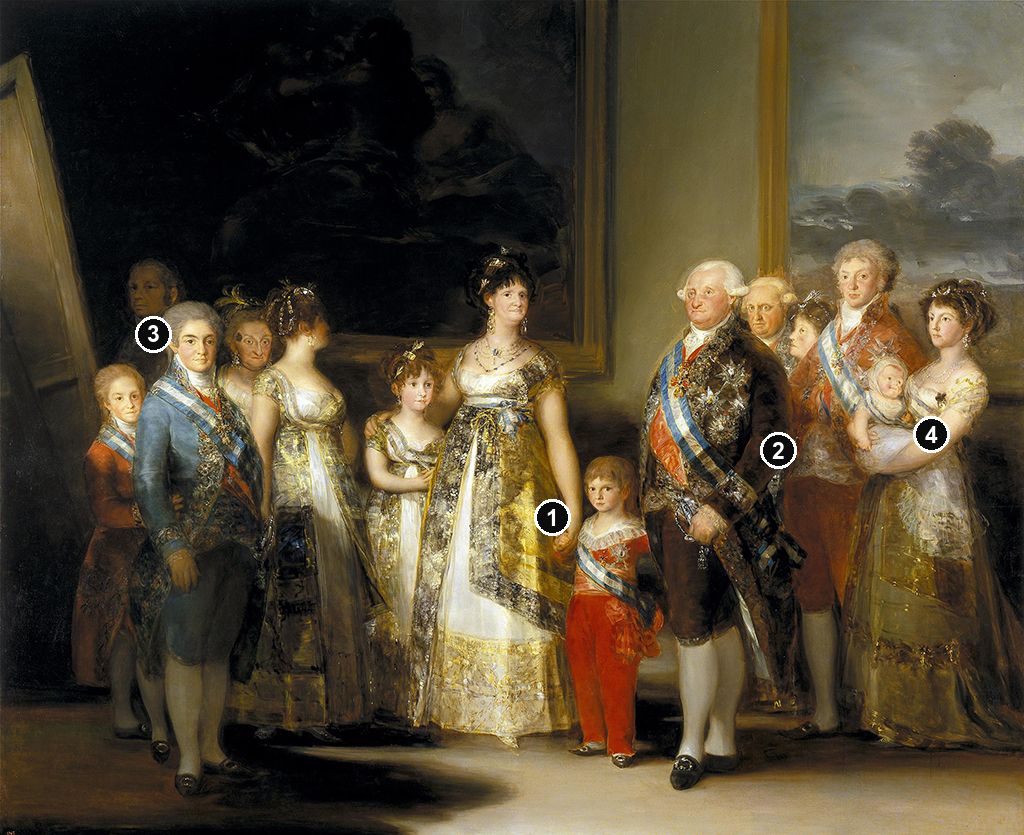
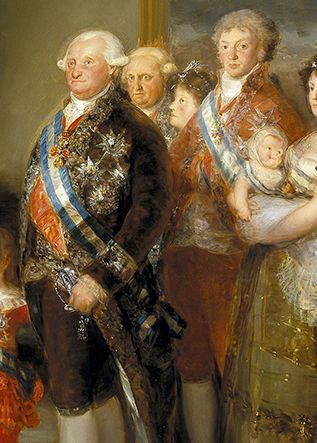
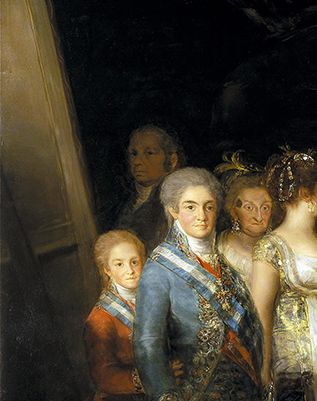
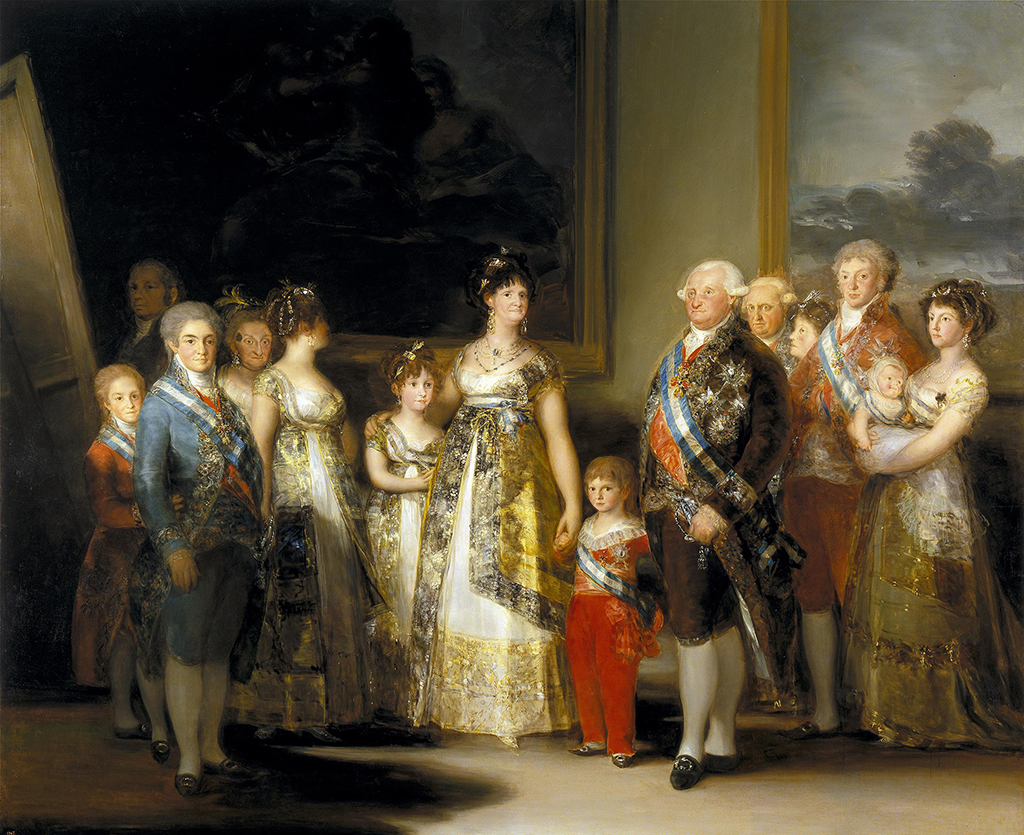
Queen María Luisa of Parma holds the hand of a small boy in red. Her other arm curves around a girl in a gleaming dress. King Charles IV stands just to their right and a little in front, his coat covered in distinctions that catch the light. At the other end of the group, the young man in blue is Ferdinand, Prince of Asturias and the future Ferdinand VII. Farther to the left, the face of Francisco de Goya emerges from the shadow. He has painted himself at work beside the back of a large canvas. The light enters from the left, picking out the embroidered clothes and bare faces of the royal family before thinning out across the room. [1] [2]
This is the large group portrait now in the Museo Nacional del Prado in Madrid, inventory P000726. Goya also painted individual portraits of Charles IV. Here his subject is the Bourbon royal family and its continuity across generations. The placement of the figures gives the eye several points of entry. The queen brings the younger children into the centre. The king and the heir stand forward in different parts of the picture, their blue sashes and dark shoes describing two advances towards us. The smallest figure, an infant carried by his mother, is held high at the right and brings the family into a third generation. [1] [2] [3]
At a Glance
- ArtistFrancisco de Goya y Lucientes
- TitleThe Family of Charles IV (La familia de Carlos IV)
- DateBegun in 1800, with the large group recorded in Goya’s account for work through June 1801. [2] [4]
- Medium and dimensionsOil on canvas, 280 × 336 cm (height × width). [2]
- CollectionMuseo Nacional del Prado, Madrid, P000726. [1]
Works across Goya’s career
The Parasol
1777The Nude Maja
1795–1800Saturn Devouring His Son
c. 1820–23The Dog
c. 1820–23Milkmaid of Bordeaux
c. 1827A family portrait commissioned at Aranjuez
María Luisa wrote from Aranjuez to Manuel Godoy on 22 April 1800. She relayed the king’s wish that Goya come to the royal residence once he had finished painting Godoy’s wife, the future Countess of Chinchón. The king wanted, in the translation printed in Goya: Images of Women, “one of all of us together”. The letter places the group portrait among other commissions in progress. It also gives the collective likeness a clear origin in the wishes of the sitters. Earlier in the same letter María Luisa says she would prefer Goya to work where he already was if he could achieve a good likeness there, to spare the family the inconvenience of sitting. Two days later she repeats that he should finish the first portrait properly. By 9 June she reports that other portraits are finished and the likenesses convincing, and that Goya will begin another of her the following day. On 14 June she reports that he is painting the king at the Casa del Labrador. These letters track the production of several likenesses in successive sittings, while Goya’s later bill tells us how many Aranjuez portraits he claimed expenses for. [3] [4]
Goya had already served the couple in a very different capacity when they were Prince and Princess of Asturias. The Parasol, for example, was designed for a tapestry for their dining room at El Pardo. In April 1789 Charles appointed him a court painter. On 31 October 1799 the king promoted Goya and Mariano Salvador Maella to primeros pintores de cámara, First Court Painters. The official records and Goya’s later expense claims put the family portrait immediately after that promotion. The change of assignment from palace decoration to a collective royal likeness gave him a different problem of scale. The painting needed to hold a room from a distance and still make each individual recognisable to people who knew the family. [4] [5]
In an account dated 23 July 1800, Goya itemised the expenses of making ten portraits of the king, queen and royal family at Aranjuez. He charged 980 reales for the canvases and stretcher for the ten likenesses and 420 for packing cases and transport. The large canvas for the assembled family appears separately at 860 reales. He also listed carriages for four journeys and the cost of his upkeep. The paperwork gives us two scales of work, from portable likenesses and the arrangements for moving them to a support more than three metres wide. In the completed picture Goya stands before a full-size canvas. His accounts show how much of the work for an object on that scale happened away from it. [4]
The chronology can be followed in stages. The Fundación Goya en Aragón dates the object to 1800 and places the work between Aranjuez and Madrid in the spring and summer of that year. The National Gallery of Art catalogue identifies the Aranjuez portraits as the basis for the final grouping assembled in Madrid. In a further account dated 1 July 1801, Goya included the full-length group among works made by the monarchs’ order in the year ending 30 June 1801. The correspondence, the bill for the sittings and the later account document different stages of the undertaking. They allow the start of the work to be dated confidently and place the large canvas within the following year’s work. The July 1801 account records expenditure across several commissions, including the group. It supplies a reporting period for the work. [2] [3] [4]
What survives from the sittings
Five of the ten oil studies described in the Aranjuez account are known today as works by Goya and are in the Prado. One is the Infante Carlos María Isidro, inventory P000731. The youth appears by himself, turned slightly, with his head, upper body and decorations already worked out. Look at the size of the form he occupies in the study and then locate his head immediately behind Ferdinand in the large picture. In the study the eye can travel from the infante’s face to the insignia on his coat in one movement. In the group portrait Ferdinand’s forward position partly screens him. The position of the younger brother becomes a fact about his relationship to the other people in the room. [2] [4] [6]
Another of the studies shows the king’s sister, the Infanta María Josefa. The dark ornament on her forehead and the jewellery in her hair are plainly visible in the independent study. In the group, her head emerges from deeper shadow above the younger figures. Anna Reuter sees this transfer from study to painting as a tempering of the directness of the earlier likeness. Francisco Javier Sánchez Cantón, writing about Goya’s portraits of children, also singled out the freedom of the individual studies. He found the children vividly characterised in the finished group and thought the smaller likenesses gave him an especially immediate sense of their personalities. These readings concern what a change of scale, setting and exposure to light can do to a face. They also explain why either kind of painting can make a sitter seem more present, depending on what the viewer is looking for. [3] [7] [8]
A recognisable face in two formats
A study such as the Prado’s Infante Carlos María Isidro gives a likeness room to operate on its own. Slight turns of the head organise most of the visible space, and an interval beside the head reads as open background. In the larger group, a turn of comparable degree can approach or withdraw from the body beside it. The painting has to make a face recognisable across a long field full of other heads. Details that occupy the centre of a study can therefore become accents linking one section of the group with the next. [17] [18]
Goya’s individual likeness of Charles IV in the uniform of a colonel offers a second comparison. Military dress carries signals of rank in both formats. In an individual portrait those signals refer first to the sitter and the office in which he asks to appear. In the family group the thickness of fabric, streaks of gold and the small marks of decorations must carry information across competing areas of colour. Continuities in dress make it possible to read different generations as part of the same institution. Differences in height and placement then shape how a viewer moves between them. [17] [18]
The comparison also helps in assessing claims about satire. A distinctive nose or concentrated expression looks different when it is the sole focus of a study and when it sits among a full assembly of strongly observed faces. To infer a tone for the entire group from one likeness, it would be necessary to show how the picture treats that particular face differently from the preparatory study and from its neighbours. The studies offer a way to test such a claim against choices of pose and finish, before appealing to a general impression of the dynasty. [17] [18]
The comparison between a study and a finished family portrait is also a comparison between scales of attention. The Prado catalogues the little likeness in its own right and links it to a broader body of royal portraiture. Stand far enough away in a reproduction of the group and small accents of colour can link faces before individual expressions are apparent. Study a head in isolation and the narrowest dark transition can carry the expression. The preparatory portraits therefore remain useful even where the positions in the larger work are already beyond doubt. They reveal how much change of emphasis a recognisable likeness can withstand. [17] [18]
Who is in the painting?
Begin with the central group. María Isabel stands to the viewer’s left of the queen and Francisco de Paula to the right. The queen’s arm bends behind her daughter and makes the girl’s upper body part of her own silhouette. On the other side her arm descends towards the boy’s hand. The boy is small enough that the joining of hands takes place below the adults’ waists, in an area of contrasting colour. The red of his clothes is visible almost from head to foot. The linked hands give the figures a relationship legible across the room. The children’s different heights also make the two gestures look practical. A child of one size can stand within the sweep of a parent’s arm and a smaller one can be held by the hand. [2] [3]
At the viewer’s left the Prince of Asturias makes a stronger vertical figure. The blue coat and the upright line of his body are visible below the cluster of less complete figures surrounding his head. His brother Carlos María Isidro stands close behind, his hand visible against Ferdinand’s side. The king’s sister María Josefa appears above and farther back. Between those figures and the queen’s group a young woman turns her head away. Jewellery and dress give her visible standing among the women even as the turn makes a likeness impossible to read. The Fundación leaves her unidentified. A Prado education dossier presents her as a figure representing Ferdinand’s future wife. Reuter questions that reading on the grounds that the marriage had yet to be planned in 1800, and considers Carlota Joaquina a possibility. [1] [2] [3]
On the right, Charles IV’s brother Antonio Pascual stands behind the king. Only the face in profile of the woman beside him is clearly visible. The Fundación identifies this face as the king and queen’s eldest daughter, Carlota Joaquina. Reuter tentatively proposes Antonio Pascual’s wife, María Amalia, for the profile. María Amalia was a daughter of the king and queen and had died in 1798, so that reading would make the profile a posthumous likeness. The two catalogues thus put Carlota’s name to different parts of the composition, and even within Reuter’s account the proposed identifications are provisional. The profile’s proximity to Antonio Pascual matters to both identifications, since they depend on different family ties. [1] [2] [3]
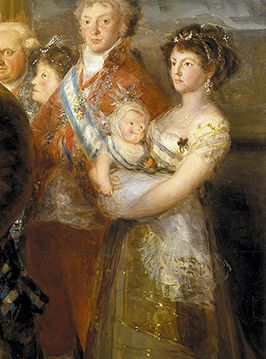
Farther to the right is the royal couple’s daughter the Infanta María Luisa, with her husband Luis de Borbón, the future King of Etruria. She carries their son Carlos Luis. The boy’s light clothes make a bright interruption in the sequence of heavy adult coats and gowns. Follow his mother’s arms and see how she turns him towards the open space. The embrace echoes the queen’s with her daughter, at a different height and with a baby who has to be carried. Viewed together, these passages give the picture its generational structure. One woman stands with her own young children and another, herself a daughter of the first, holds the royal couple’s grandchild. [2] [3] [8]
Annotated Details from The Family of Charles IV
Read the queen and king in relation to the children, the painter and the royal orders.
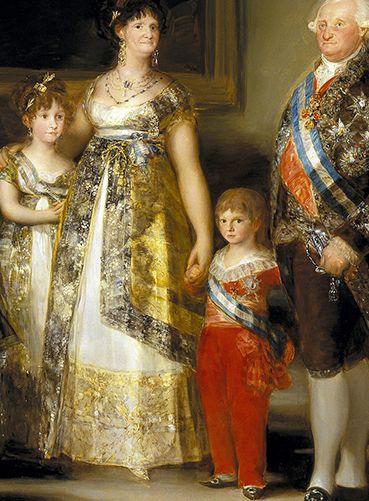
Details from THE FAMILY OF CHARLES IV
Details from the Prado canvas (P000726).
María Luisa and the children
The brightly lit queen stands with her younger children around her.
Charles IV and his insignia
Pale and coloured ribbons and decorations stand out against the king’s dark coat.
Goya beside the canvas
The painter appears in shadow at the left.
The infant at the right
A child is held above the layer of brightly embroidered clothes at the right.
Goya on film
Five films explore Goya’s portraits, prints, Black Paintings and painting techniques.
The Duke of Wellington by Goya
The portrait, its military decorations and its later theft.
Watch on YouTubeHow dress shows rank
The family is shallowly grouped against the wall, with overlapping bodies that partly conceal one another’s clothes. Goya uses the fall of those clothes to clarify where people stand. Charles IV’s shoes and the shadow at his feet bring him forward. His sash cuts across the dark coat and leads the eye up to the decorations clustered on his chest. Ferdinand’s coat builds a second large patch of blue to the left. The pale gold of the queen’s dress fills the space between them. Here the embroidery, jewels and sash carry authority through brightness and breadth. The king’s rank can be read from the clear space he occupies and the accumulation of insignia. The queen’s prominence comes from her place between the forward figures and the room her dress gives her to gather the children about her. [2] [3]
The Fundación identifies two orders whose sashes recur across the portrait. The men wear the Order of Charles III and the women the Order of María Luisa. Sashes appear at different angles as the sitters change their stance or turn across the picture. The repeated bands let a viewer recognise a shared distinction even where a lower body is hidden or a face catches little light. In the separate study of Carlos María Isidro, the Fundación identifies the Order of Charles III and the Golden Fleece, among other insignia. Comparison with that study shows how carefully Goya could specify the boy’s distinctions when he had an entire small canvas for a single upper body. In the group, entire shapes of coat or skirt have to register first and the smaller signs emerge on closer approach. [2] [6]
Reuter relates the queen’s high-waisted gown to a court dress design retained in the Royal Archives and notes its recurrence on María Isabel and the woman who turns away. That shared cut makes the women recognisable as a group across different poses. So does the painted treatment of their finery. At a distance the small accents merge into textiles and jewellery. As you come nearer, the gleam breaks up into touches of light laid against warmer folds. Spend a moment on the change from the queen’s brilliantly worked dress to the dark wall behind her shoulders. The abrupt shift makes it possible to follow both the sweep of the dress and its fine ornament. The contrast is one reason the body at the centre can attract the eye even though the king stands nearer the front. [2] [3]
The side light also gives weight to differences among heads. Charles’s white hair makes a broad light shape. Ferdinand’s grey sits against a deeper background. The shadow around María Josefa lowers the contrast of her features, and the painter’s features require a longer look still. Two large pictures hang at the back. A lighter stretch of wall separates their frames. The picture at the right offers a glimpse of landscape, while the dark forms in the one at the left are harder to resolve. Both help divide the room above the patchwork of clothes below. The back wall seems all the farther removed because of the concentrated brilliance of the crowd in front of it. [2] [3]
Velázquez and an earlier Bourbon family portrait
A painter at the left, the back of a large upright canvas and pictures hanging high in a dim interior recall Diego Velázquez’s Las Meninas, painted in 1656 and also held by the Prado. In both works the painted canvas hides the picture supposedly in progress. Its scale tells us something about the artist’s task, while the hidden front leaves the figure of the painter looking out towards a space we cannot see. In Las Meninas, that problem extends all the way through the room. A mirror at the back shows Philip IV and Mariana of Austria, and a man stands on the steps of a lit doorway. The Infanta Margarita and her attendants occupy the foreground, with light touching different figures and objects as the eye moves from front to back. [3] [9]
In Goya’s portrait the monarchs are fully embodied in the foreground group. No bright doorway divides the wall behind them. Goya sets his own head so far back and so low in contrast that a viewer can take in the family before noticing him. Velázquez gives the full standing figure of the working painter much greater weight. Reuter reads Goya’s inclusion of himself as an allusion to that precedent, and the Fundación also stresses the formal relationship. Compare the two canvases by locating the children first and then finding the painter. Velázquez directs a sequence of looks between his foreground group and the depth of the room. Goya gathers the family close to the picture plane and keeps the painter’s encounter with the viewer at its margin. [2] [3] [9]
Goya had already worked closely from Velázquez’s painting in his series of prints after the royal collection. A preparatory drawing carries an inscription identifying the original in the Royal Palace in Madrid. The catalogue for the print calls attention to the difficulty of rendering the junction of wall and ceiling and the details in the distance. Those were features Goya had studied closely enough to translate into another medium. When he came to paint the family of Charles IV he retained recognisable elements of the earlier picture, including the painted canvas and the artist’s figure, within an interior whose depth is far less conspicuous. [15]
A comparison within the Bourbon dynasty leads to Louis-Michel van Loo’s The Family of Philip V of 1743, another Prado painting, P002283. Van Loo sets the reigning couple, Philip V and Isabella Farnese, on seats beneath an immense canopy of red drapery. Columns and receding architecture extend the space beyond the group. The crown is placed within reach of the royal couple and relatives spread out to either side. Among them are the future Charles III and his wife María Amalia of Saxony, who would become the parents of Charles IV. The picture charts the branches of the family as they stood in the earlier generation. Set beside Goya’s painting, its architectural and ceremonial display makes the later picture’s enclosed wall, standing monarchs and almost uninterrupted band of figures especially conspicuous. [10] [11]
Both Bourbon portraits use dress and bodies to make relationships legible. What changes is how much the room contributes. Van Loo lets the eye travel up from the seated monarchs into large folds of fabric and then into the distant architecture. In Goya the eye travels laterally from the king towards the younger members of the family. An adult’s hand, a child’s sleeve or the gap between two heads has to do much of the work that changes of level and furnishings do in Van Loo. Reuter uses the earlier picture to bring out the austerity of Goya’s staging. The comparison also makes it easier to see how lavishly Goya paints the clothes within that restricted interior. [3] [11]
From royal collection to museum
The group portrait came from the Royal Collection. Its presence at the Royal Palace in Madrid in 1814 establishes an early location, years after the sittings. The Fundación records it in the Prado’s collections by 1824 and identifies it as the first Goya to enter the museum. The 1834 Royal Museum inventory places it in the monarchs’ Gabinete de Descanso, their retiring room. The published transcription of that entry gives a valuation of 83,000 reales and even misidentifies the king as Charles III. The Fundación gives 80,000 reales for the valuation. These are differing reported figures for the inventory history. The inventory provides evidence of custody and location at the museum. The Fundación and the exhibition catalogue identify 1872 as the first appearance in the published Prado catalogue, a later milestone in its public description. [2] [3] [12]
The canvas has its own history. The Fundación’s conservation summary, citing Margarita Moreno, reports that the original support comprises three pieces of cloth and has been relined. A lining is a secondary support attached to the original fabric. The joined cloth belongs to the making of the large painting, while the lining belongs to its later preservation. The object record also notes a reddish preparation beneath the paint and records treatment by Manuel Arpe in 1967. These are details from a documented conservation account. They give the colour and light that a viewer sees a physical context, from the preparation under the paint to the cloth that bears its weight. [2]
Why the painting has been read as satire
One early assessment survives in Frédéric Quilliet’s description of the paintings in the Royal Palace. He thought the group a little disjointed but good and noted Goya’s position behind the sitters. The same description lists seven smaller portraits nearby. Quilliet treated them as derived from the group. In the Boletín del Museo del Prado, José Luis Sancho connects five of them with the known preparatory studies. Read alongside Goya’s bill for the Aranjuez sittings, the two records show how readily the relation between studies and finished picture could be read in the opposite direction once they were hung together. [4] [16]
The set expressions and keenly observed differences of face have prompted some viewers to see the family as a caricature. Edward J. Olszewski traced how negative readings circulated through art history textbooks, how they entered specialist writing, and how remarks attributed to nineteenth-century French writers were repeated without documentation. His inquiry concerns the history of looking at the picture, and the readiness of later viewers to find a comment on the Bourbons in the structure of Goya’s likenesses. Reuter offers a different explanation for the formality of the poses. She connects it to the procedure of assembling separately painted studies, and interprets María Josefa’s treatment in the finished painting as more restrained than the study. The Metropolitan Museum’s essay on the Spanish Enlightenment allows a sharper response to some of the likenesses while also reading the composition as an assertion of royal unity. [3] [13] [14]
The faces give each of these readings somewhere to start. Look again at the figure of the queen. The unidealised features and frontal gaze coexist with the wide path of embroidered cloth and gestures that draw her children into the middle of the room. The light makes her distinctive as an individual and the composition makes her indispensable to the group. The king’s rank remains clear even though the child’s red suit may attract the eye more quickly than his dark coat. The royal commission is attested in the queen’s correspondence, and the surviving studies and expense accounts help explain the work of converting individual faces into a large family picture. [2] [3] [4]
Artworks directory
| Name | Date | Medium |
|---|---|---|
| And There’s No Help for It, Plate 15 | Printed 1863 | |
| Asmodea | c. 1820–23 | Wall painting transferred to canvas |
| Boys Inflating a Bladder | 1777–78 | Tapestry cartoon |
| Boys Picking Fruit | 1778 | Tapestry cartoon |
| Bullfight in a Divided Ring | 1825 | Lithograph |
| Card Players | 1777–78 | Tapestry cartoon |
| Card Players (sketch) | 1777–78 | Painted sketch |
| Dance on the Banks of the Manzanares | 1777 | Tapestry cartoon |
| Duel with Cudgels | c. 1820–23 | Wall painting transferred to canvas |
| Heads in a Landscape | c. 1820–23 | Easel painting |
| Judith and Holofernes | c. 1820–23 | Wall painting transferred to canvas |
| Leocadia | c. 1820–23 | Wall painting transferred to canvas |
| Maja and Cloaked Men | 1777 | Tapestry cartoon |
| Maja and Cloaked Men (sketch) | 1777 | Painted sketch |
| Majo Clapping in Time to the Music | 1777 | Drawing |
| Men Reading | c. 1820–23 | Wall painting transferred to canvas |
| Out Hunting for Teeth, Plate 12 | 1799 | Etching, burnished aquatint and burin |
| Picnic in the Countryside (sketch) | 1776–78 | Painted sketch |
| Picnic on the Banks of the Manzanares | 1776 | Tapestry cartoon |
| Pilgrimage to San Isidro | c. 1820–23 | Wall painting transferred to canvas |
| Preparatory study for The Sleep of Reason Produces Monsters | c. 1796–97 | Drawing |
| Procession of the Holy Office | c. 1820–23 | Wall painting transferred to canvas |
| Quarrel at the Cockerel Inn (sketch) | 1777 | Painted sketch |
| Quarrel in the New Tavern | 1777 | Tapestry cartoon |
| Saturn Devouring His Son | c. 1820–23 | Wall painting transferred to canvas |
| Seated Majo Smoking | c. 1776 | Drawing |
| The Dog | c. 1820–23 | Wall painting transferred to canvas |
| The Drinker | 1777 | Tapestry cartoon |
| The Fates | c. 1820–23 | Wall painting transferred to canvas |
| The Great He-Goat | c. 1820–23 | Wall painting transferred to canvas |
| The Kite | 1777–78 | Tapestry cartoon |
| The Parasol | 1777 | Oil on canvas, tapestry cartoon |
| The Second of May 1808 | 1814 | Oil on canvas |
| The Sleep of Reason Produces Monsters, Plate 43 | 1799 | Etching and aquatint |
| The Third of May 1808 | 1814 | Oil on canvas |
| Thou Who Canst Not, Plate 42 | 1799 | Etching and burnished aquatint |
| Three Figures | 1776 | Drawing (lost) |
| Two Old Men | c. 1820–23 | Wall painting transferred to canvas |
| Two Old Men Eating Soup | c. 1820–23 | Wall painting transferred to canvas |
| Two Women and a Man | c. 1820–23 | Wall painting transferred to canvas |
| Universal Language: The Author Dreaming | 1797 | Drawing |
| The Family of Charles IV | 1800 | Oil on canvas |
| Witches’ Sabbath (Osuna painting) | 1797–98 | Oil on canvas |
| The Nude Maja | 1795–1800 | Oil on canvas |
| The Clothed Maja | 1800–07 | Oil on canvas |
| Self-Portrait (Drawing) | c. 1796 | Brush and carbon black ink on laid paper |
| The Swing, Madrid Album B.21 | 1795–97 | Brush and carbon black washes |
| Majas Fighting, a Majo Observing, Madrid Album B.15 | 1796–97 | Brush, grey and black washes on laid paper |
| Majos and Majas Conversing, Madrid Album B.16 | c. 1794–97 | Ink wash on paper |
| Weeping Woman and Three Men, Madrid Album B.17 | 1795–97 | Brush, carbon black washes and black chalk |
| Maja Seated on a Chair and Two Companions Behind, Madrid Album B.18 | 1795–97 | Brush and carbon black washes |
| Girl and Bull, Madrid Album B.23 | 1796–97 | Brush and carbon black washes |
| Lovers Sitting on a Rock, Madrid Album B.24 | 1796–97 | Brush and carbon black washes |
| Mariano Ceballos Riding a Bull | 1825 | Crayon lithograph and scraper |
| Landscape (lifetime impression) | c. 1807–10 | Etching and aquatint |
| Self-Portrait (1815), Prado canvas | 1815 | Oil on canvas |
| Self-Portrait (1815), Academy panel | 1815 | Oil on panel |
| Self-Portrait with Dr Arrieta | 1820 | Oil on canvas |
| Christ Crucified | 1780 | Oil on canvas |
| The Last Communion of Saint Joseph of Calasanz | 1819 | Oil on canvas |
| Christ on the Mount of Olives | 1819 | Oil on panel |
| The Flower Girls, or Spring | 1786–87 | Oil on canvas |
| The Grape Harvest, or Autumn | 1786–87 | Oil on canvas |
| The Snowstorm, or Winter | 1786–87 | Oil on canvas |
| The Threshing Ground, or Summer | 1786–87 | Oil on canvas |
| Picnic on the Banks of the Manzanares | 1776 | Oil on canvas |
| The Kite | 1777–78 | Oil on canvas |
| Dance on the Banks of the Manzanares | 1777 | Oil on canvas |
| A Fight at the Venta Nueva | 1777 | Oil on canvas |
| Blind Man’s Bluff | 1788 | Oil on canvas |
| Dogs on a Lead | 1775 | Oil on canvas |
| Hunting with a Decoy | 1775 | Oil on canvas |
| Hunter Loading His Rifle | 1775 | Oil on canvas |
| The Angler | 1775 | Oil on canvas |
| The Hermitage of San Isidro on His Feast Day | 1788 | Oil on canvas |
| The Meadow of San Isidro | 1788 | Oil on canvas |
| The Straw Manikin | 1791–92 | Oil on canvas |
| Witches’ Flight | c. 1797–98 | Oil on canvas |
| A Scene from ‘The Forcibly Bewitched’ | 1798 | Oil on canvas |
| The Duchess of Alba in Black | 1797 | Oil on canvas |
| The Duchess of Alba in White | 1795 | Oil on canvas |
| Charles III in Hunting Dress | c. 1786 | Oil on canvas |
| The Duke and Duchess of Osuna and Their Children | 1787–88 | Oil on canvas |
| Manuel Osorio Manrique de Zúñiga | 1787–88 | Oil on canvas |
| The Marquesa de Pontejos | c. 1786 | Oil on canvas |
| Equestrian Portrait of the 1st Duke of Wellington | 1812 | Oil on canvas |
| The Duke of Wellington | 1812–14 | Oil on wood |
| Portrait of Ferdinand VII of Spain | 1814 | Oil on canvas |
| Gaspar Melchor de Jovellanos | 1798 | Oil on canvas |
| María Tomasa Palafox y Portocarrero | 1804 | Oil on canvas |
| Señora Sabasa García | c. 1806–11 | Oil on canvas |
| Don Juan Bautista de Muguiro | 1827 | Oil on canvas |
| Doña Isabel de Porcel | Before 1805 | Oil on canvas |
| The Colossus | After 1808 | Oil on canvas |
| The Burial of the Sardine | 1808–12 | Oil on panel |
| The Madhouse | 1808–12 | Oil on panel |
| A Procession of Flagellants | 1808–12 | Oil on panel |
| Portrait of Jacques Galos | 1826 | Oil on canvas |
| Portrait of Mariano Goya, the Artist’s Grandson | 1827 | Oil on canvas |
| Milkmaid of Bordeaux | c. 1827 | Oil on canvas |
| Portrait of Don Juan Antonio Cuervo | 1819 | Oil on canvas |
| María Luisa of Parma (Naples version) | c. 1800 | Oil on canvas |
| The Countess of Baena | 1819 | Oil on canvas |
| The Family of the Infante Don Luis | 1783–84 | Oil on canvas |
| The Holy Family | c. 1787 | Oil on canvas |
| Saint Barbara | c. 1773 | Oil on canvas |
| Saints Justa and Rufina | 1817 | Oil on canvas |
| El Tío Paquete | c. 1819–20 | Oil on canvas |
| The Forge | c. 1815–20 | Oil on canvas |
| Majas on a Balcony (Metropolitan Museum version) | c. 1800–10 | Oil on canvas |
| Maja and Celestina on a Balcony | c. 1808–12 | Oil on canvas |
| The Water Bearer | 1808–12 | Oil on canvas |
| Time and the Old Women | c. 1810 | Oil on canvas |
Frequently Asked Questions
Look past Ferdinand and Carlos María Isidro at the far left. Goya’s face is in shadow just beside the large canvas whose back is turned towards us. [2]
Discussion
Look again at the images and ideas explored in The Family of Charles IV. These editorial prompts invite your observations.
Look first at the queen’s hands, then at the king’s feet and Ferdinand’s position. Which of these details does most to establish who leads the group, and does your answer change depending on whether you are looking for family relationships or formal rank?
Reader Insights
Which figure first catches your eye, and where does your gaze go next?
How does Goya’s position affect the way you read the group?
Join the Conversation
Share a detail, comparison or question about The Family of Charles IV below.
References
- Museo Nacional del Prado, ¿Solo Goya?, education dossier, pp. 17–22. See also the museum’s collection record for P000726. View source 1. View source 2.
- Fundación Goya en Aragón, The Family of Charles IV, catalogue entry and conservation summary. View source.
- Anna Reuter, ‘The Family of Charles IV’, in Janis A. Tomlinson, ed., Goya: Images of Women (National Gallery of Art, 2002), cat. 52, pp. 175–178. Includes the English translation of María Luisa’s letter to Godoy of 22 April 1800. View source.
- Ángel Canellas López, ed., Francisco de Goya. Diplomatario (Institución Fernando el Católico, 1981). See documents XLVIII and XCVIII for the court appointments, CIII–CVI for the queen’s letters, and 215 and 219 for Goya’s expense accounts. View source.
- Fundación Goya en Aragón, The Parasol, catalogue entry. View source.
- Fundación Goya en Aragón, Carlos María Isidro de Borbón y Parma, infante de España, catalogue entry for the 1800 oil study, Prado P000731. View source.
- Fundación Goya en Aragón, Infanta María Josefa of Spain, catalogue entry for the 1800 oil study, Prado P000729. View source.
- Francisco Javier Sánchez Cantón, ‘Los niños en las obras de Goya’, in Goya. Cinco estudios (Institución Fernando el Católico, 1978), especially p. 84. View source.
- Museo Nacional del Prado, Las Meninas, collection record. See also the museum’s entry in El Museo del Prado en Palencia. View source 1. View source 2.
- Museo Nacional del Prado, The Family of Philip V, collection record P002283. The Galería de las Colecciones Reales identifies the 1743 canvas and some related individual portraits. View source 1. View source 2.
- Xavier F. Salomon, Goya and the Altamira Family, The Metropolitan Museum of Art Bulletin 71, no. 4 (2014), fig. 8 and its discussion. View source.
- Poder, patrimonio y cultura en España, La familia de Carlos IV, P000726 and transcription of the 1834 Royal Museum inventory entry, no. 13, fol. 419 recto. View source.
- Edward J. Olszewski, ‘Exorcising Goya’s The Family of Charles IV’, Artibus et Historiae 20, no. 40 (1999), pp. 169–185. View source.
- James Voorhies, ‘Francisco de Goya (1746–1828) and the Spanish Enlightenment’, The Metropolitan Museum of Art, 2003. View source.
- Fundación Goya en Aragón, Las Meninas, Goya’s print after Velázquez, and the preparatory drawing. View source 1. View source 2.
- José Luis Sancho, ‘Cuando el Palacio era el Museo Real’, Arbor, p. 131, entries 903–910, for the transcription of Frédéric Quilliet. See also Sancho’s ‘Francisco de Goya y Fréderic Quilliet en el Palacio Real de Madrid, 1808’, Boletín del Museo del Prado 19, no. 37 (2001), p. 120, for identification of the studies. View source 1. View source 2.
- Museo Nacional del Prado, Infante Carlos María Isidro. View source.
- Museo Nacional del Prado, Charles IV in the Uniform of a Colonel of the Royal Guard. View source.