


 by Tom Gurney
Tom Gurney BSc (Hons) is an art history expert with over 20 years experience
Published on June 19, 2020 / Updated on November 20, 2026
Email: tomgurney1@gmail.com / Phone: +44 7429 011000
Introduction
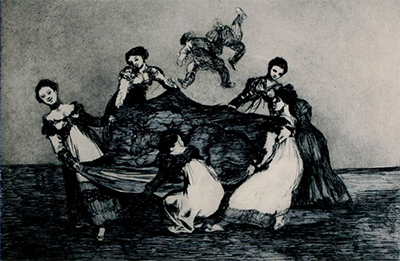
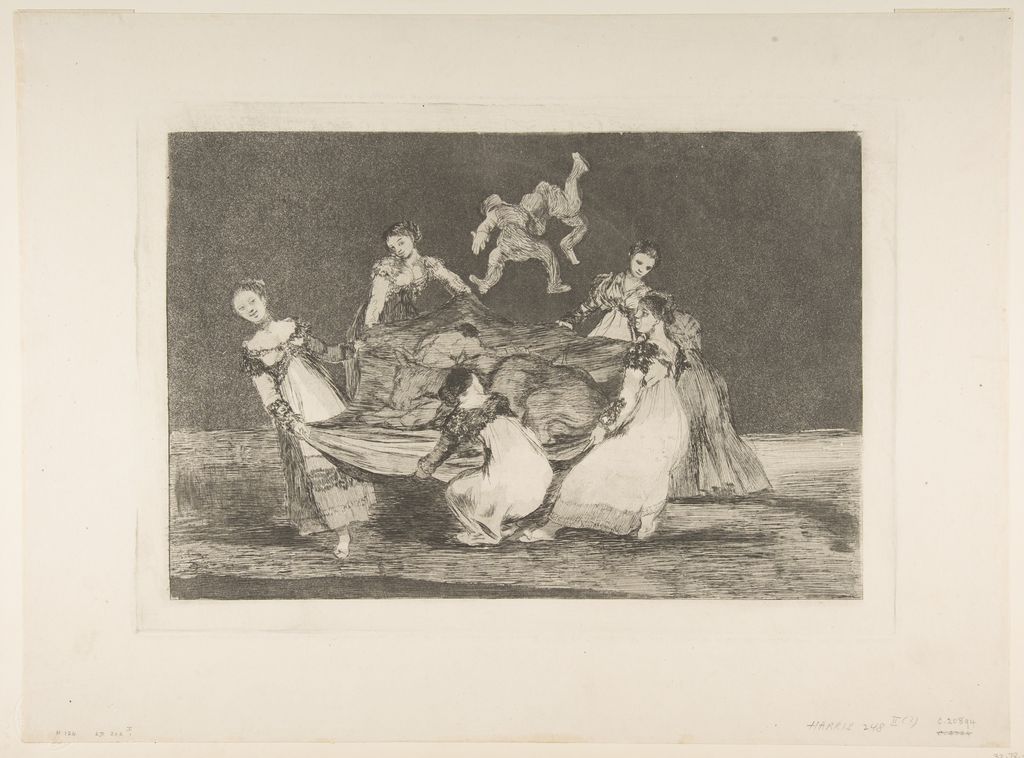
In Feminine Folly, women pull a blanket taut and send two human figures tumbling into the air. A donkey lies among the folds and the ground ends at a bare horizon. Francisco de Goya had painted the blanket game before, in a bright tapestry cartoon. In this print the gesture is familiar, but it is harder to say who is playing and who is being played with. That gap between a recognisable action and an uncertain meaning runs through Los Disparates, Goya’s last major series of intaglio prints. [1] [2]
At a Glance
- Artist and dateFrancisco de Goya. Work was under way around 1815–16, with catalogues differing on whether it continued beyond about 1819, possibly up to his departure for France in 1824. [2] [3]
- MediumPrints from copperplates, chiefly etching and aquatint. Individual plates also show work with tools such as drypoint, a burnisher or a burin. [2]
- First publicationsThe Real Academia de Bellas Artes de San Fernando published eighteen as Los Proverbios in Madrid in 1864. The Paris journal L’Art first published four more in 1877. [4] [5]
- Where the plates areThe eighteen Madrid coppers are in Calcografía Nacional. The four used for the Paris publication entered the Louvre’s Chalcographie in 2011. [2] [6]
From Madrid to two posthumous publications
Goya approached the age of seventy as he began work on the group. There is an early clue in a copy of La Tauromaquia that belonged to his friend Juan Agustín Ceán Bermúdez. It contains a proof of A Way of Flying before the addition of aquatint, showing that work on at least one design later grouped with the Disparates overlapped with his bullfighting prints. The circumstances of its survival make it a useful marker for one image. The dating of the entire series involves other evidence, and the Calcografía catalogue leaves both about 1819 and 1824 open as possible endpoints. The prints appeared in published sets after Goya’s death in 1828. The political climate under Ferdinand VII matters to their interpretation, while the surviving plates and papers leave the reason for withholding or abandoning publication open. [2] [3] [7]
In 1862 the Academy acquired eighteen copperplates from Jaime Machén Casalins, in the same purchase as eighty coppers for The Disasters of War. Two years later it issued the eighteen designs as Los Proverbios, ‘The Proverbs’. A bound example in Washington’s National Gallery of Art preserves the lithographed title page, which announces a collection of eighteen plates invented and etched by Goya. The number on that title page tells us what the Academy issued. Even when the design dates to Goya’s lifetime, the paper in that volume carries ink laid down in 1864. [2] [4]
Four plates had become separated from the Madrid group and had belonged to the Spanish painter Eugenio Lucas Velázquez. The publishers of L’Art printed the designs as separate insertions in the journal’s second tome for 1877. The Banco de España’s surviving volume records the four insertions opposite pages 6, 40, 56 and 82. In that order, the journal called them Rain of Bulls, Other Laws for the People, What a Warrior! and A Circus Queen. The Mie Prefectural Art Museum catalogues the same four designs as 19–22, beginning with Disparate conocido, the warrior image. Its own catalogue gives the original page location alongside each modern number. Thus Animal Folly, the elephant design, is number 21 in Mie’s grouping and the second of the four to appear in the French volume. A proof of the elephant design at the Museo Lázaro Galdiano carries the handwritten number 22. The three identifiers record the numbering on a proof, the position in a journal and the position in a modern catalogue. [5] [6] [8] [15]
Why the titles and numbers vary
The Academy’s title encouraged viewers to look for Spanish sayings behind the pictures. A plate can consequently appear under a proposed proverb, under a title found on an annotated proof, and under a translation of either. The British Museum’s Feminine Folly, for example, also carries the title ‘Heavier than a dead donkey’. The words draw attention to a specific object in the folds, while Disparate femenino invites the viewer to judge the women’s game. A working proof held by the Museo Lázaro Galdiano bears that Spanish wording, widely accepted as Goya’s handwriting, and the manuscript numbers 15 and 16. The same design opens the Academy’s set. The survival of several numbering conventions makes a plate title, publisher and specific museum record more useful together than a bare number. [1] [2] [7] [9]
Los Disparates, usually rendered as The Follies, takes its name from that kind of caption. A handwritten title on one proof gives evidence about one image. A title page supplies a different kind of evidence about the way a publisher framed a volume. The Calcografía catalogue traces other names, including ‘second caprices’ and ‘dreams’, and notes the lack of a lifetime title page or sale announcement for this group. The twenty-two surviving designs are the basis of the modern series. Its planned extent and Goya’s preferred arrangement remain uncertain. [2] [4] [8]
The title page and the separate fate of Plate D
The title page of Los Proverbios belongs to the published object. Its authority is considerable when the question is what a nineteenth-century reader saw on opening the edition. Its authority is different when the question is what Goya called a design while making it. In a catalogue, the publisher’s title often stays visible so that an existing book remains findable. A term such as Disparates can then enter through evidence from individual works and their proofs. Keeping the two names visible allows them to describe different stages of the series. [17] [18]
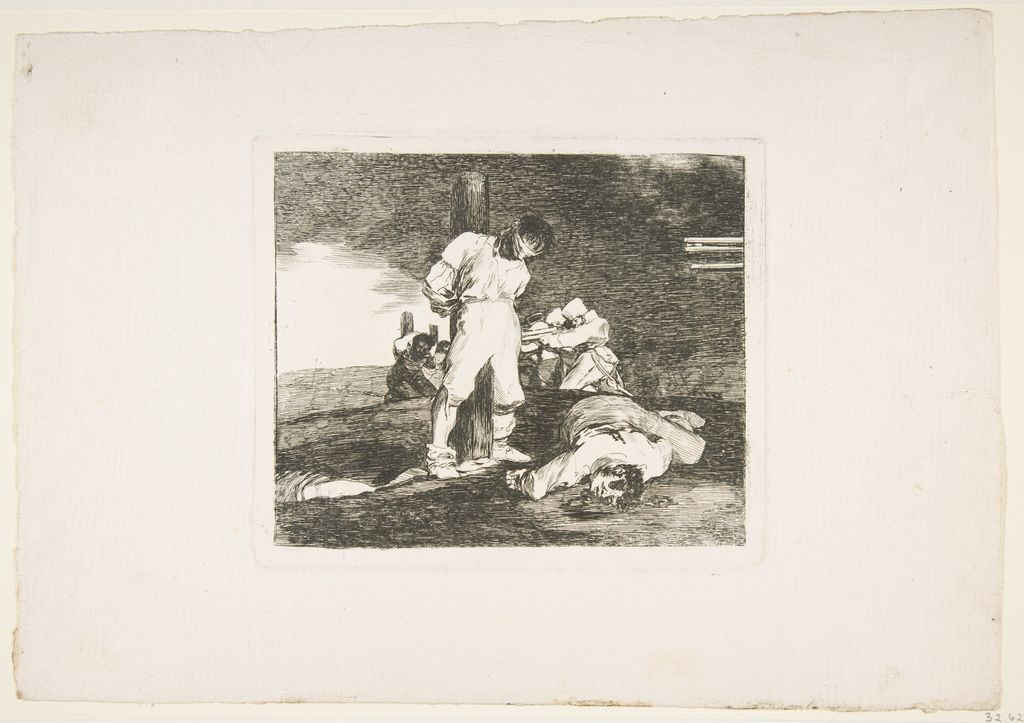
Little Bulls’ Folly provides an immediate reason to distinguish a series from the contents of the first book. The Met describes the print as Plate D. The letter helps a modern reader place a design published separately relative to the eighteen numbered prints. It should not be converted into a place where Goya imagined it following a numbered predecessor. Looking at the mass of the animals and the precarious forms around them can suggest visual affinities elsewhere in the group. Such comparisons are evidence about composition, even when a placement in an original sequence remains beyond recovery. [17] [18]
This matters when an interpretation proposes that a sequence gradually changes its attitude to fear, carnival or authority. A first edition can support an account of the sequence a particular public received. To decide whether the meaning was planned by the artist, a reader has to ask whether any independent evidence fixes the same succession. That distinction lets a reader take the acquired title Proverbs seriously while still attending to the peculiar way each scene defeats a simple correspondence with a proverb. [17] [18]
The Met dates its impression of Plate D to publication in 1877 while giving an earlier range for the making of the design. Those are two answers a reader might encounter to the apparently simple question of when an image dates from. The difference explains how an object from the period of Goya’s work on the series could enter public circulation later than the first edition. It also means the letters and numerals found in modern catalogues can be handles for the publication record. They help retrieve images that once came before readers in separate groups. [17] [18]
Goya on film
Five films explore Goya’s portraits, prints, Black Paintings and painting techniques.
The Duke of Wellington by Goya
The portrait, its military decorations and its later theft.
Watch on YouTubeFeminine Folly from drawing to print
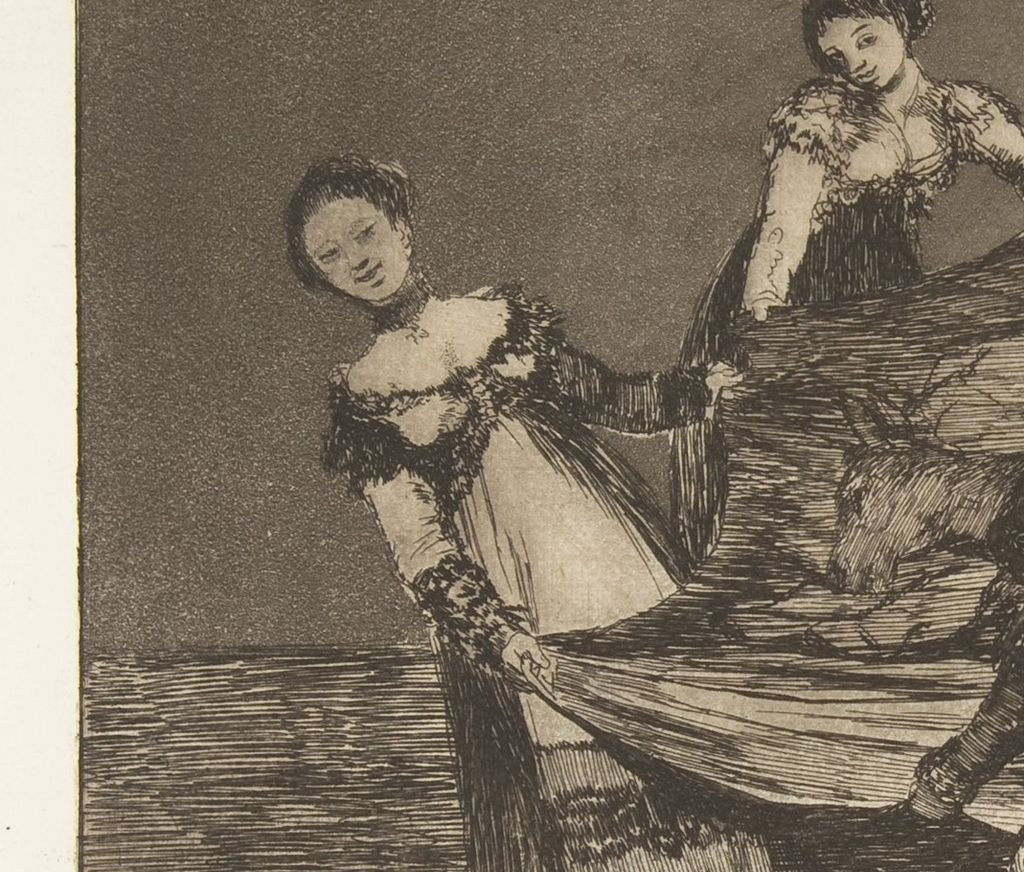
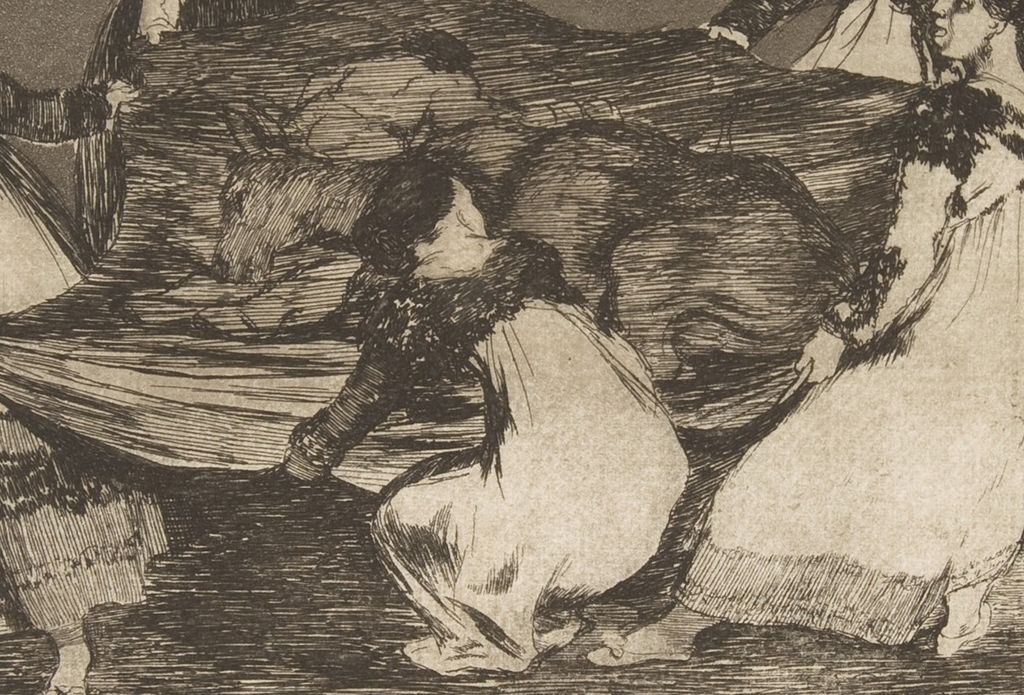
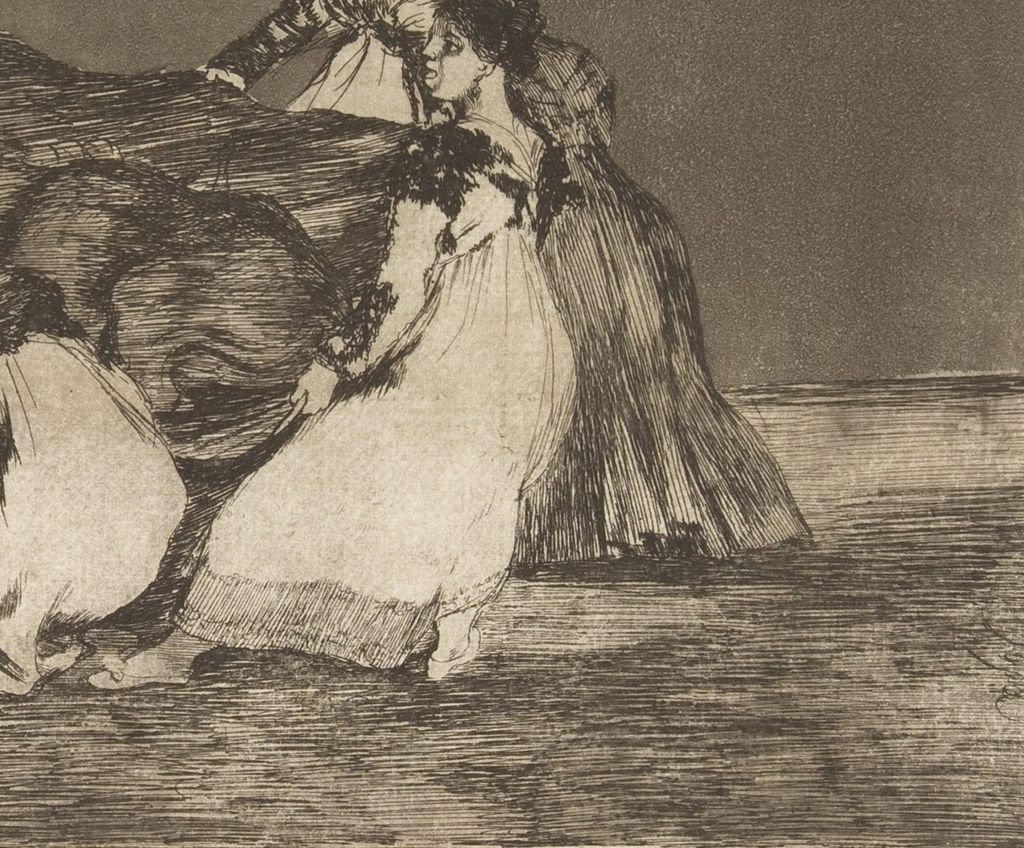
In Goya’s preparatory drawing at the Prado, red ink wash and chalk give the scene a definite setting. A semicircular opening suggests a cave-like interior and a sketchy crowd stands beside the four figures at the blanket. The ground rises and falls in patches of shadow. By the printed stage the circle of women has grown, the crowd and opening have gone, and the puppets and donkey have appeared. A nearly bare horizon and a broad, dark sky make the movement of the airborne figures unusually easy to follow. Their bent limbs seem to continue the jagged rhythm set up by the women’s arms, even though the women are braced against the ground and the figures are being thrown. [1] [9] [10]
Two impressions at the Metropolitan Museum of Art let us look at a later stage of the process. The museum dates the plate to about 1815–19 and its earlier sheet to about 1848–54, after Goya’s death but before the first edition. It dates the other impression to the Academy publication of 1864. Both are catalogued as etching, aquatint and drypoint. In the Met’s photographs, the earlier sheet shows a paler strip of ground towards the right and a more visibly granular sky. In the 1864 impression the foreground reads as darker and the sky looks more even. The women, the donkey and the airborne figures occupy the same positions. Differences in how dark a passage prints, or how it appears in a photograph, need separate evidence before they can establish a change to the copper. The drawing and the prints, by comparison, show changes to the composition itself. [10] [11] [12]
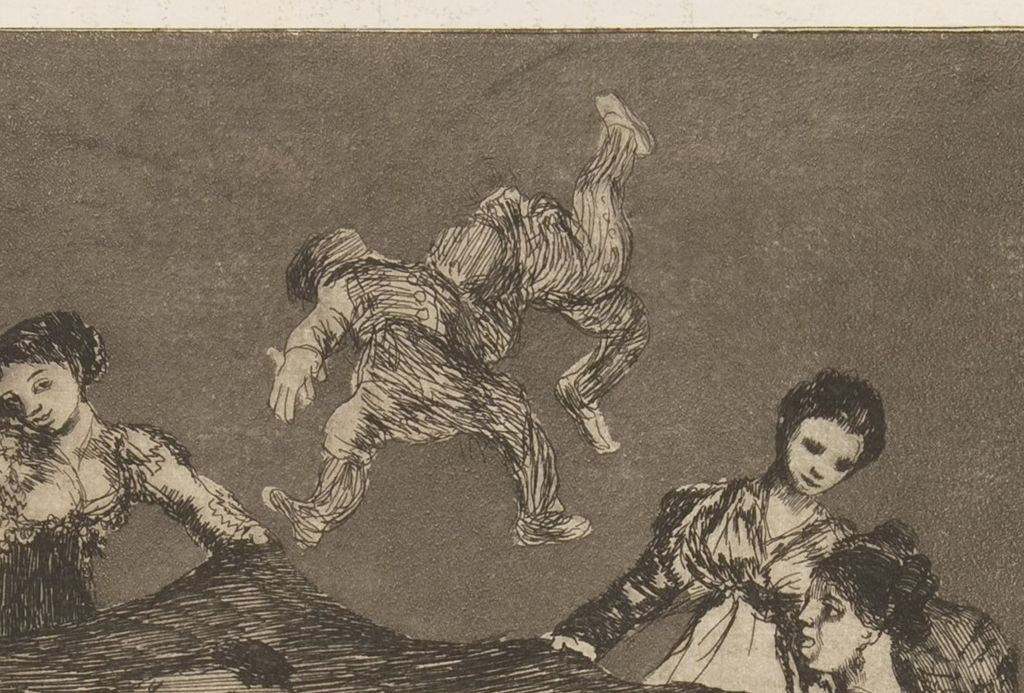
The Fondation Custodia’s catalogue proposes that the puppets make a joke of men who let themselves be manipulated. The same account notes the longstanding attempts to attach sayings about donkeys and puppets to the image. The print allows a particular look at the power involved in the game. The two bodies hang at different angles and their loose joints make it difficult to read their gestures as deliberate. The women have the firm footing and hold the cloth that gives other bodies their motion. That imbalance survives whether the figures are understood as straw puppets or as human beings represented as puppets. [1] [11] [12]
Annotated Details from Feminine Folly
Look at the blanket, the figures above it and the dark field behind them.
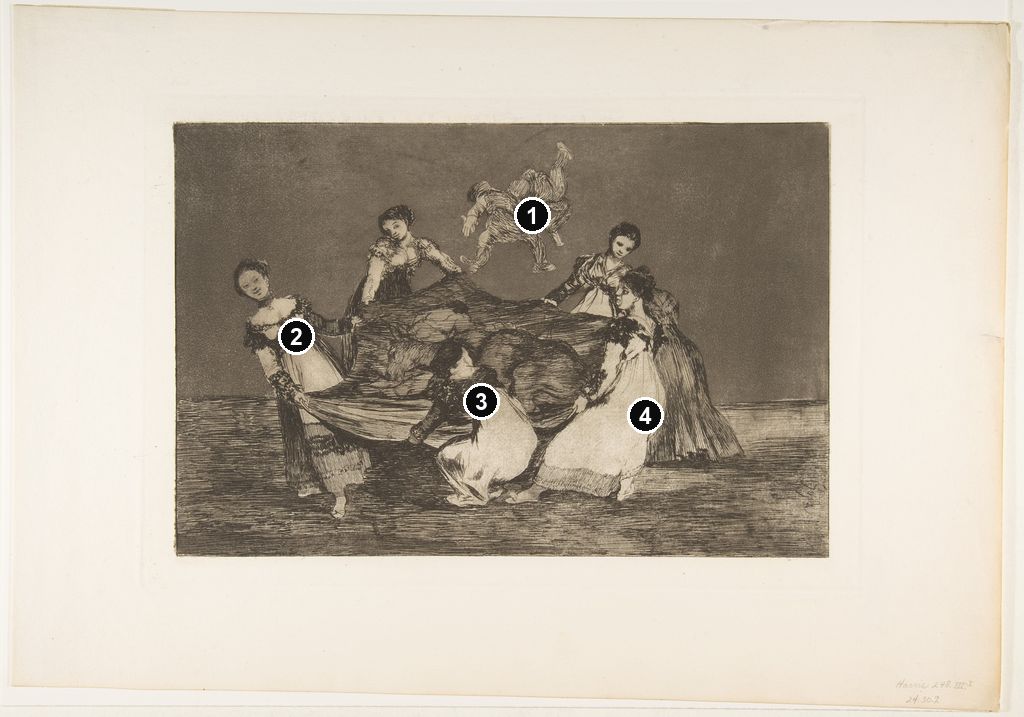
Details from FEMININE FOLLY
Details from the Metropolitan Museum of Art’s 1864 impression (24.30.2).
The airborne figures
Limbs and folds cut across the dark background above the blanket.
The woman at left
She leans back, with her hands close to the left edge of the blanket.
The blanket
Light and dark folds make the sagging surface distinct from the figures standing around it.
The women at right
The nearest woman’s pale skirt catches the light along the right edge of the group.
A Way of Flying
In the National Gallery of Victoria’s first-edition A Way of Flying, winged figures emerge from a dark field. The largest has a broad span and a visible human face and legs. Others fly at different angles, receding as their outlines and limbs become harder to distinguish. The wings give them the appearance of bats, but the visible attachments make flight look like an invention they are trying out. Without a fixed horizon, the viewer has little sense of how far they have travelled or how high they have risen. Their different attitudes can suggest a range of manoeuvres or a loss of control. [13]
The Ceán album proof was numbered 34, while the 1864 edition placed the image thirteenth. Fundación Goya en Aragón raises the possibility that the Academy grouped the plate with the Disparates after Goya’s death, pointing to its presence in the bullfighting album and to the picture’s unusually affirmative view of human invention. The National Gallery of Victoria uses the same proof to explore how early Goya might have begun the series. The proof documents an early version of the image and a lifetime context in which it circulated. The relevant evidence for its later position is the Academy volume. [3] [13] [14]
Animal Folly and the Paris printing
In Animal Folly, an elephant towers above a group of people. One presents a book and another has a set of bells. A broad patch of light between the roughly hatched rocks and the dark ground makes the elephant’s silhouette easy to pick out, down to the upturned tip of its trunk. Fine hatching describes the curve of its back and the folds of its hide. The people crowd into a corner. Their gestures are insistent, but the animal gives little indication of what it makes of them. The title supplied by L’Art, usually translated as Other Laws for the People, encourages a reader to make the meeting about authority or instruction. The title Disparate de bestia, recorded on a handwritten proof, leaves the emphasis on the animal and the absurdity of the encounter. [5] [6] [15]
The Banco de España’s Animal Folly demonstrates what a publisher could change while using the same copper. José Manuel Matilla Rodríguez describes a standard magazine issue printed in black on laid paper with the author and title lettered beneath. A small group of deluxe copies also contained three kinds of impression taken before the plate was lettered, using different inks and supports. The bank’s separately catalogued impression is printed in sienna on wove paper. The authority suggested by an engraved caption belongs to the publication’s history, just as the warmth of this particular sheet belongs to the choice of ink. A lettered and an unlettered impression can represent different states of the copper. A change of ink or paper can affect the appearance of sheets printed from the same state. [5] [15]
Carnival, politics and the limits of interpretation
The Calcografía Nacional catalogue by Clemente Barrena, Javier Blas, Juan Carrete and José Miguel Medrano considers how carnival could give Goya a way to portray the suspension of ordinary rules. A blanket game that turns people into playthings fits that reading. A mood of menace can also coexist with the physical joke. The catalogue relates these festive reversals to a possible criticism of authority under Ferdinand VII, while considering other accounts of the prints’ distortions and apparently unconnected events. With little that dates or locates most of the action, a plausible reference to political power in one image cannot identify the people or explain the action in the next. [2]
In Los Caprichos, Goya used printed captions to bring words and images into contact during his lifetime. The surviving Disparates ask a different sort of attention because the words we encounter on a museum label may come from a proof, a publisher or a later catalogue. The Prints guide compares the series and their audiences. The Etchings guide shows how to look for changes to the copper and how to distinguish etched line from aquatint tone. [2] [7]
Artworks directory
| Name | Date | Medium |
|---|---|---|
| And There’s No Help for It, Plate 15 | Printed 1863 | |
| Asmodea | c. 1820–23 | Wall painting transferred to canvas |
| Boys Inflating a Bladder | 1777–78 | Tapestry cartoon |
| Boys Picking Fruit | 1778 | Tapestry cartoon |
| Bullfight in a Divided Ring | 1825 | Lithograph |
| Card Players | 1777–78 | Tapestry cartoon |
| Card Players (sketch) | 1777–78 | Painted sketch |
| Dance on the Banks of the Manzanares | 1777 | Tapestry cartoon |
| Duel with Cudgels | c. 1820–23 | Wall painting transferred to canvas |
| Heads in a Landscape | c. 1820–23 | Easel painting |
| Judith and Holofernes | c. 1820–23 | Wall painting transferred to canvas |
| Leocadia | c. 1820–23 | Wall painting transferred to canvas |
| Maja and Cloaked Men | 1777 | Tapestry cartoon |
| Maja and Cloaked Men (sketch) | 1777 | Painted sketch |
| Majo Clapping in Time to the Music | 1777 | Drawing |
| Men Reading | c. 1820–23 | Wall painting transferred to canvas |
| Out Hunting for Teeth, Plate 12 | 1799 | Etching, burnished aquatint and burin |
| Picnic in the Countryside (sketch) | 1776–78 | Painted sketch |
| Picnic on the Banks of the Manzanares | 1776 | Tapestry cartoon |
| Pilgrimage to San Isidro | c. 1820–23 | Wall painting transferred to canvas |
| Preparatory study for The Sleep of Reason Produces Monsters | c. 1796–97 | Drawing |
| Procession of the Holy Office | c. 1820–23 | Wall painting transferred to canvas |
| Quarrel at the Cockerel Inn (sketch) | 1777 | Painted sketch |
| Quarrel in the New Tavern | 1777 | Tapestry cartoon |
| Saturn Devouring His Son | c. 1820–23 | Wall painting transferred to canvas |
| Seated Majo Smoking | c. 1776 | Drawing |
| The Dog | c. 1820–23 | Wall painting transferred to canvas |
| The Drinker | 1777 | Tapestry cartoon |
| The Fates | c. 1820–23 | Wall painting transferred to canvas |
| The Great He-Goat | c. 1820–23 | Wall painting transferred to canvas |
| The Kite | 1777–78 | Tapestry cartoon |
| The Parasol | 1777 | Oil on canvas, tapestry cartoon |
| The Second of May 1808 | 1814 | Oil on canvas |
| The Sleep of Reason Produces Monsters, Plate 43 | 1799 | Etching and aquatint |
| The Third of May 1808 | 1814 | Oil on canvas |
| Thou Who Canst Not, Plate 42 | 1799 | Etching and burnished aquatint |
| Three Figures | 1776 | Drawing (lost) |
| Two Old Men | c. 1820–23 | Wall painting transferred to canvas |
| Two Old Men Eating Soup | c. 1820–23 | Wall painting transferred to canvas |
| Two Women and a Man | c. 1820–23 | Wall painting transferred to canvas |
| Universal Language: The Author Dreaming | 1797 | Drawing |
| The Family of Charles IV | 1800 | Oil on canvas |
| Witches’ Sabbath (Osuna painting) | 1797–98 | Oil on canvas |
| The Nude Maja | 1795–1800 | Oil on canvas |
| The Clothed Maja | 1800–07 | Oil on canvas |
| Self-Portrait (Drawing) | c. 1796 | Brush and carbon black ink on laid paper |
| The Swing, Madrid Album B.21 | 1795–97 | Brush and carbon black washes |
| Majas Fighting, a Majo Observing, Madrid Album B.15 | 1796–97 | Brush, grey and black washes on laid paper |
| Majos and Majas Conversing, Madrid Album B.16 | c. 1794–97 | Ink wash on paper |
| Weeping Woman and Three Men, Madrid Album B.17 | 1795–97 | Brush, carbon black washes and black chalk |
| Maja Seated on a Chair and Two Companions Behind, Madrid Album B.18 | 1795–97 | Brush and carbon black washes |
| Girl and Bull, Madrid Album B.23 | 1796–97 | Brush and carbon black washes |
| Lovers Sitting on a Rock, Madrid Album B.24 | 1796–97 | Brush and carbon black washes |
| Mariano Ceballos Riding a Bull | 1825 | Crayon lithograph and scraper |
| Landscape (lifetime impression) | c. 1807–10 | Etching and aquatint |
| Self-Portrait (1815), Prado canvas | 1815 | Oil on canvas |
| Self-Portrait (1815), Academy panel | 1815 | Oil on panel |
| Self-Portrait with Dr Arrieta | 1820 | Oil on canvas |
| Christ Crucified | 1780 | Oil on canvas |
| The Last Communion of Saint Joseph of Calasanz | 1819 | Oil on canvas |
| Christ on the Mount of Olives | 1819 | Oil on panel |
| The Flower Girls, or Spring | 1786–87 | Oil on canvas |
| The Grape Harvest, or Autumn | 1786–87 | Oil on canvas |
| The Snowstorm, or Winter | 1786–87 | Oil on canvas |
| The Threshing Ground, or Summer | 1786–87 | Oil on canvas |
| Picnic on the Banks of the Manzanares | 1776 | Oil on canvas |
| The Kite | 1777–78 | Oil on canvas |
| Dance on the Banks of the Manzanares | 1777 | Oil on canvas |
| A Fight at the Venta Nueva | 1777 | Oil on canvas |
| Blind Man’s Bluff | 1788 | Oil on canvas |
| Dogs on a Lead | 1775 | Oil on canvas |
| Hunting with a Decoy | 1775 | Oil on canvas |
| Hunter Loading His Rifle | 1775 | Oil on canvas |
| The Angler | 1775 | Oil on canvas |
| The Hermitage of San Isidro on His Feast Day | 1788 | Oil on canvas |
| The Meadow of San Isidro | 1788 | Oil on canvas |
| The Straw Manikin | 1791–92 | Oil on canvas |
| Witches’ Flight | c. 1797–98 | Oil on canvas |
| A Scene from ‘The Forcibly Bewitched’ | 1798 | Oil on canvas |
| The Duchess of Alba in Black | 1797 | Oil on canvas |
| The Duchess of Alba in White | 1795 | Oil on canvas |
| Charles III in Hunting Dress | c. 1786 | Oil on canvas |
| The Duke and Duchess of Osuna and Their Children | 1787–88 | Oil on canvas |
| Manuel Osorio Manrique de Zúñiga | 1787–88 | Oil on canvas |
| The Marquesa de Pontejos | c. 1786 | Oil on canvas |
| Equestrian Portrait of the 1st Duke of Wellington | 1812 | Oil on canvas |
| The Duke of Wellington | 1812–14 | Oil on wood |
| Portrait of Ferdinand VII of Spain | 1814 | Oil on canvas |
| Gaspar Melchor de Jovellanos | 1798 | Oil on canvas |
| María Tomasa Palafox y Portocarrero | 1804 | Oil on canvas |
| Señora Sabasa García | c. 1806–11 | Oil on canvas |
| Don Juan Bautista de Muguiro | 1827 | Oil on canvas |
| Doña Isabel de Porcel | Before 1805 | Oil on canvas |
| The Colossus | After 1808 | Oil on canvas |
| The Burial of the Sardine | 1808–12 | Oil on panel |
| The Madhouse | 1808–12 | Oil on panel |
| A Procession of Flagellants | 1808–12 | Oil on panel |
| Portrait of Jacques Galos | 1826 | Oil on canvas |
| Portrait of Mariano Goya, the Artist’s Grandson | 1827 | Oil on canvas |
| Milkmaid of Bordeaux | c. 1827 | Oil on canvas |
| Portrait of Don Juan Antonio Cuervo | 1819 | Oil on canvas |
| María Luisa of Parma (Naples version) | c. 1800 | Oil on canvas |
| The Countess of Baena | 1819 | Oil on canvas |
| The Family of the Infante Don Luis | 1783–84 | Oil on canvas |
| The Holy Family | c. 1787 | Oil on canvas |
| Saint Barbara | c. 1773 | Oil on canvas |
| Saints Justa and Rufina | 1817 | Oil on canvas |
| El Tío Paquete | c. 1819–20 | Oil on canvas |
| The Forge | c. 1815–20 | Oil on canvas |
| Majas on a Balcony (Metropolitan Museum version) | c. 1800–10 | Oil on canvas |
| Maja and Celestina on a Balcony | c. 1808–12 | Oil on canvas |
| The Water Bearer | 1808–12 | Oil on canvas |
| Time and the Old Women | c. 1810 | Oil on canvas |
Frequently Asked Questions
A working proof can preserve Goya’s changes or handwriting. Other proofs were pulled after his death, including trial impressions before the 1864 edition. Some sheets were also printed before lettering specifically for the 1877 publication. Look for the institution’s printing date as well as the date for the design. [7] [11] [15]
Discussion
Look again at the images and ideas explored in Los Disparates. These editorial prompts invite your observations.
Look at the blanket, the women’s hands and the airborne figures in Feminine Folly. How much of the scene would you read as a game if the image came without either of its familiar titles?
Reader Insights
Which marks in Feminine Folly help you distinguish the figures from the background?
What details become easier to read when you compare the two impressions?
Join the Conversation
Share a detail, comparison or question about Los Disparates below.
References
- Fondation Custodia. Disparate femenino, trial proof, 2011-P.31. See the discussion of the titles, tapestry cartoon and Prado study, and notes 4–7. View source.
- Clemente Barrena, Javier Blas, Juan Carrete and José Miguel Medrano. Francisco de Goya en Calcografía Nacional, extract from Calcografía Nacional: catálogo general, 2004. See the Disparates section, PDF pp. 62–68, especially entry 3973 for the 1862 acquisition. View source.
- National Gallery of Victoria and Museo Nacional del Prado. Goya: Drawings from the Prado Museum, exhibition labels. See the label for A Way of Flying. View source.
- National Gallery of Art. Los Proverbios (Disparates), first-edition bound volume, 1943.3.4717. See the University of Seville’s digitised 1864 copy. View source 1. View source 2.
- José Manuel Matilla Rodríguez. Disparates, Banco de España, G_2357. Record and discussion of L’Art, third year, tome II, 1877, facing pp. 6, 40, 56 and 82. View source.
- Musée du Louvre, Chalcographie. Copperplate records for Disparate conocido, 11440 C, Disparate de bestia, 11441 C, Disparate de tontos, 11442 C and Disparate puntual, 11443 C. View source 1. View source 2. View source 3. View source 4.
- British Museum. Disparate femenino, trial impression, 1863,1114.794. See the curator’s comments on the privately printed set and Goya’s working proofs. View source.
- Mie Prefectural Art Museum. Los Disparates, Japanese catalogue of the eighteen Madrid prints and the four 1877 impressions. View source.
- Fundación Goya en Aragón. Feminine Folly, catalogue 1326. See the handwritten numbers on the Museo Lázaro Galdiano proof. See also Calcografía Nacional, R-3409-70 for the proof’s accession 11588. View source 1. View source 2.
- Fundación Goya en Aragón. Disparate femenino, preparatory drawing, Museo Nacional del Prado, D04375. View source.
- The Metropolitan Museum of Art. Feminine Folly, impression printed about 1848–54, 32.78.2. View source.
- The Metropolitan Museum of Art. Feminine Folly, impression published in 1864, 24.30.2. View source.
- National Gallery of Victoria. A Way of Flying, first edition, P23.13-1981. View source.
- Fundación Goya en Aragón. A Way of Flying, catalogue 1346. View source.
- José Manuel Matilla Rodríguez and Manuela Mena. Disparate de bestia / Otras leyes para el pueblo, Banco de España, G_2357_6. See the discussion of edition variants and chronology. For the manuscript title, see Fundación Goya en Aragón, catalogue 1358. View source 1. View source 2.
- Fundación Goya en Aragón. Disparate volante, catalogue 1333. View source.
- Metropolitan Museum of Art, Title page for Los Proverbios. View source.
- Metropolitan Museum of Art, Little Bulls’ Folly, Plate D. View source.







