


 by Tom Gurney
Tom Gurney BSc (Hons) is an art history expert with over 20 years experience
Published on June 19, 2020 / Updated on November 20, 2026
Email: tomgurney1@gmail.com / Phone: +44 7429 011000
Introduction
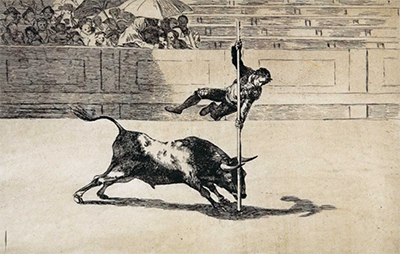
In the opening print of La Tauromaquia, a rider pursues a bull through rocky country. By the end of the series there is barely any landscape left. In plate 33, a bull has caught the matador Pepe Illo in a Madrid arena, and the people close enough to intervene almost disappear at the sides. Francisco de Goya published these scenes in 1816 as part of a set of 33 numbered prints. Between the hunt and the fatal goring, the pictures move through imagined origins, contests involving kings and knights, and the exploits of named professional bullfighters. As the setting becomes more regulated, the danger begins to reach people who thought they were there to watch. [1] [2] [3]
At a Glance
- First editionMadrid, 1816, with 33 numbered prints. An advertisement offered individual sheets at 10 reales de vellón and the complete set at 300. [1] [4]
- MediumCopperplate intaglio. The series includes etching, aquatint, drypoint and burin work, with the combination varying by design. [1]
- Expanded editionEugène Loizelet printed 40 designs in Paris in 1876. Seven of them were on the reverse sides of copperplates already used in the numbered series. [5] [6]
What Goya put on sale in 1816
The Diario de Madrid advertised the series on 28 October 1816. Customers could buy it from a print shop on Calle Mayor opposite the house of the Count of Oñate. Buying all 33 sheets individually would have cost 330 reales de vellón, so the advertised set saved 30. A customer interested in Martincho or Pepe Illo could have bought a single episode. A customer who wanted the history promised by the advertisement could follow the numbering from the open country to the death in Madrid. The Banco de España catalogue describes the publication as a commercial failure. The advertised prices and the number of designs are documented separately from the number of copies actually sold. [1] [4]
The first edition gives readers a number in the upper right of the print and supplies the fuller titles on a separate sheet. The captions can establish what someone was meant to recognise, especially when an anonymous face stands for a named person. The curators of the Prado–National Gallery of Victoria exhibition describe a proof set in the Boston Public Library with short handwritten titles attributed to Goya. The more elaborate titles associated with the published set were devised by his friend, the art historian Juan Agustín Ceán Bermúdez. The difference matters in plate 21, where the published wording supplies an identification that cannot be recovered from the face of the man struck by the bull. [7] [8]
From a hunt to a spectacle with rules
Plate 1, The Way in Which the Ancient Spaniards Hunted Bulls on Horseback in the Open Country, makes the encounter look like a pursuit through rough terrain. The spear links rider and animal across open ground. The other hunters and the uneven landscape give the action a possible history beyond the instant of contact. The National Gallery of Victoria’s first-edition impression (1998.255.1) preserves the number at upper right and the fine marks of the distant country alongside the much stronger lines of the animals. With no arena wall to fix the limits of the image, the land seems to continue beyond the paper. [2]
A few sheets later the caption to plate 5 calls Gazul the first Moor to spear bulls according to rules. Plate 10 puts the emperor Charles V on horseback in the ring at Valladolid. Within the series, each figure has a role in a history of the practice, from hunting to a public feat that could be associated with a named hero or sovereign. The opening thirteen plates draw on accounts and traditions that circulated in Goya’s time. The curator José Manuel Matilla identifies Nicolás Fernández de Moratín’s historical account as one of several relevant texts, alongside the bullfighting manual associated with Pepe Illo and José Vargas Ponce’s critical dissertation. These sources help explain the different claims the pictures make about skill, ancestry and spectacle. The image of Gazul and its caption show how Goya’s sequence presents the development of bullfighting. Establishing when particular rules actually developed would require independent historical evidence. [1] [7] [9] [10]
Martincho’s chair and Ceballos’s mount
In plate 18 Martincho sits facing the bull on a chair with his feet shackled. The pose temporarily gives a seated man the composure of someone who can afford to wait. The chair also makes a quick retreat hard to imagine. The detail changes the meaning of the pale interval between man and bull. The viewer can judge how much ground remains between them and see why the crowd is paying attention to a man who appears almost motionless. The title calls the feat Temeridad, a term that can suggest daring or recklessness. In plate 19 the same performer appears in another stunt at Zaragoza, this time on a table. The consecutive prints give one named performer two different ways to restrict his own movements and make the cost of a small mistake visible. [7] [11] [12]
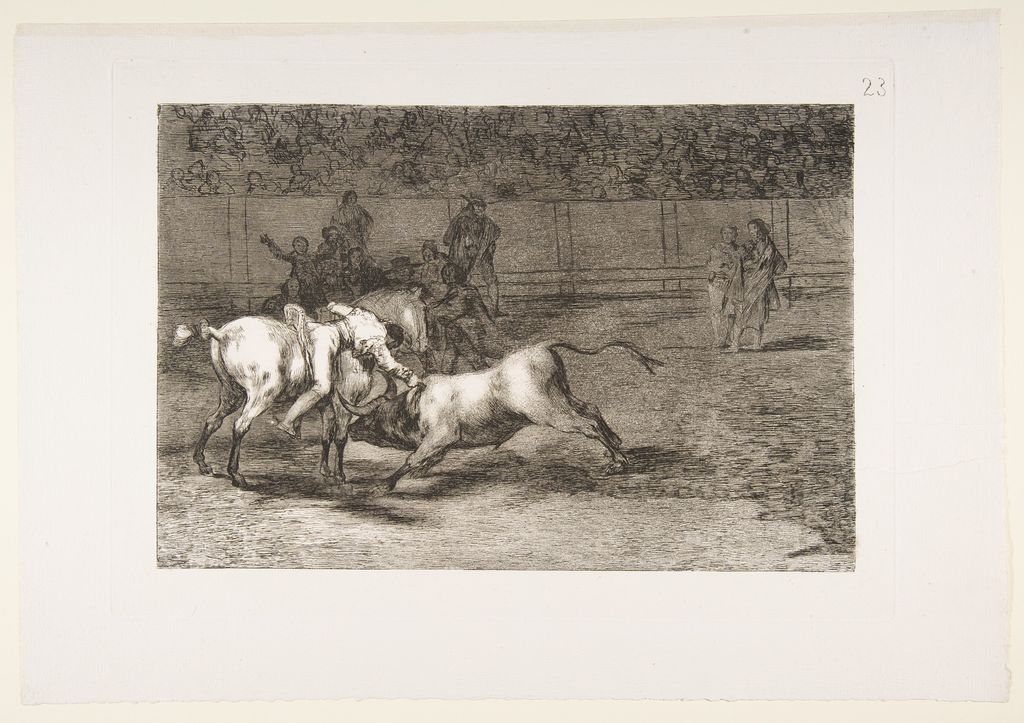
Goya gives Mariano Ceballos a different kind of sequence. In plate 23, Ceballos kills a bull from horseback. The title of plate 24 begins by calling him the same man, but the animal beneath him in the second sheet is another bull. The Prado holds a preparatory study for plate 24 (D4311) in pencil and red chalk. The National Gallery of Art in Washington holds a first-edition impression (1943.3.1643, Harris 227 III(1)). Following the outlines in that impression makes it easier to distinguish Ceballos’s mount from the bull he faces. Once he is seated on an animal of the same kind as his opponent, the reader has to do a little more work to tell which body is carrying the rider and which is bearing down on him. [13] [14] [15]
When the bull reaches the spectators
The action in plate 21 occupies the right of the image. Above and around the bull, bodies tumble or struggle away. To the left there are empty tiers. The change is especially clear beside the Prado’s preparatory drawing, a red chalk study (D4308) catalogued by the Fundación Goya en Aragón. In the drawing, roughly sketched figures occupy much of the lower half across the width of the sheet. In the print, the open space left by those figures lets the eye travel right until it meets the dense group. This is cropping within the composition, visible in the bodies cut off at the right edge. It is distinct from the trimming of a printed sheet. The National Gallery of Victoria records the image area of its first-edition impression (1998.255.21, Harris 224 III.1) as 21.1 × 32.2 cm and the plate mark as 24.8 × 34.9 cm. [16] [17]
The first-edition title identifies the casualty as the mayor of Torrejón. The handwritten title in the Boston proof set says the bull killed two people and claims that Goya saw it. The Fundación catalogue describes a proposed connection with a Madrid bullring incident on 15 June 1801, and the Prado–NGV exhibition leaves the precise identification of the incident and victim open. Reports of bulls getting into the stands establish that such a breach was possible. The two captions show how a claim to have witnessed an event and a claim to know the identity of its victim can come from different sources. [7] [18]
Where a barrier belongs in the image
Plate 21 asks the viewer to reconstruct the bullring from a few crucial forms. Much of the arena is left empty. The lines identifying the edge of the enclosure lead towards a compact mass of bodies instead of completing the circle around the arena. A barrier normally makes it possible to remain a watcher. Here its shortened visible length concentrates attention on the point at which the bull and the spectators occupy the same space. The distance from the action to the nearly empty area of the print is one of the chief sources of the shock. [27] [28]
The printed title singles out the death of the mayor of Torrejón. That specificity has a visible counterpart in the density towards one side. Even so, separating each person in the group into a named historical participant would ask the sheet to supply distinctions that its economy of line does not support. The crowd is made legible by repeated relationships of arms, heads and shoulders. The title gives one death a particular place in historical memory, and the composition describes a danger to the people around him. [27] [28]
Comparison with the Banco de España’s catalogue of the series helps explain why that episode belongs near feats of agility and bravado. Several plates establish a division between those who run the immediate risk and those who watch. Plate 21 pushes the incidents beyond the established lines. The crowd becomes an active mass as people reach, fall or turn away. Setting the plate beside one dominated by a single performer reveals how unevenly the series distributes space, and how actively the audience defines what an act in the ring can become. [27] [28]
The Banco de España preserves the series as a group. Look at a sheet of La Tauromaquia from such a collection alongside the Met’s impression of Plate 21 and note where the margin and caption end. A narrow view might preserve all the figures while losing the material division between image and words. The title names the official who died and places the event within the front rows. Both are pieces of information one has to bring to the view of the crowd. Keeping the margin in sight makes it clear how the sheet separates that documentary naming from the group of marks through which it pictures panic. [27] [28]
Goya on film
Five films explore Goya’s portraits, prints, Black Paintings and painting techniques.
The Duke of Wellington by Goya
The portrait, its military decorations and its later theft.
Watch on YouTubeHow Goya brought the series to a close
The tension between feats and fatalities was familiar to an audience that could debate bullfighting as well as attend it. Vargas Ponce treated Pepe Illo’s death as a reason to question the practice. The Prado–NGV exhibition reads the choice of that death as the ending as a condemnation. Writing for the Calcografía Nacional, Javier Blas places more weight on the way Goya makes viewers feel the drama and cautions against inferring a definite position from the artist’s connection with opponents of the bullfight. The publication history provides some context. With Los Caprichos already in circulation and The Disasters of War still unpublished, Goya offered the bullring as a familiar subject. What the reader encountered was a sequence with room for the attraction of skill and for its consequences. [6] [7] [26]
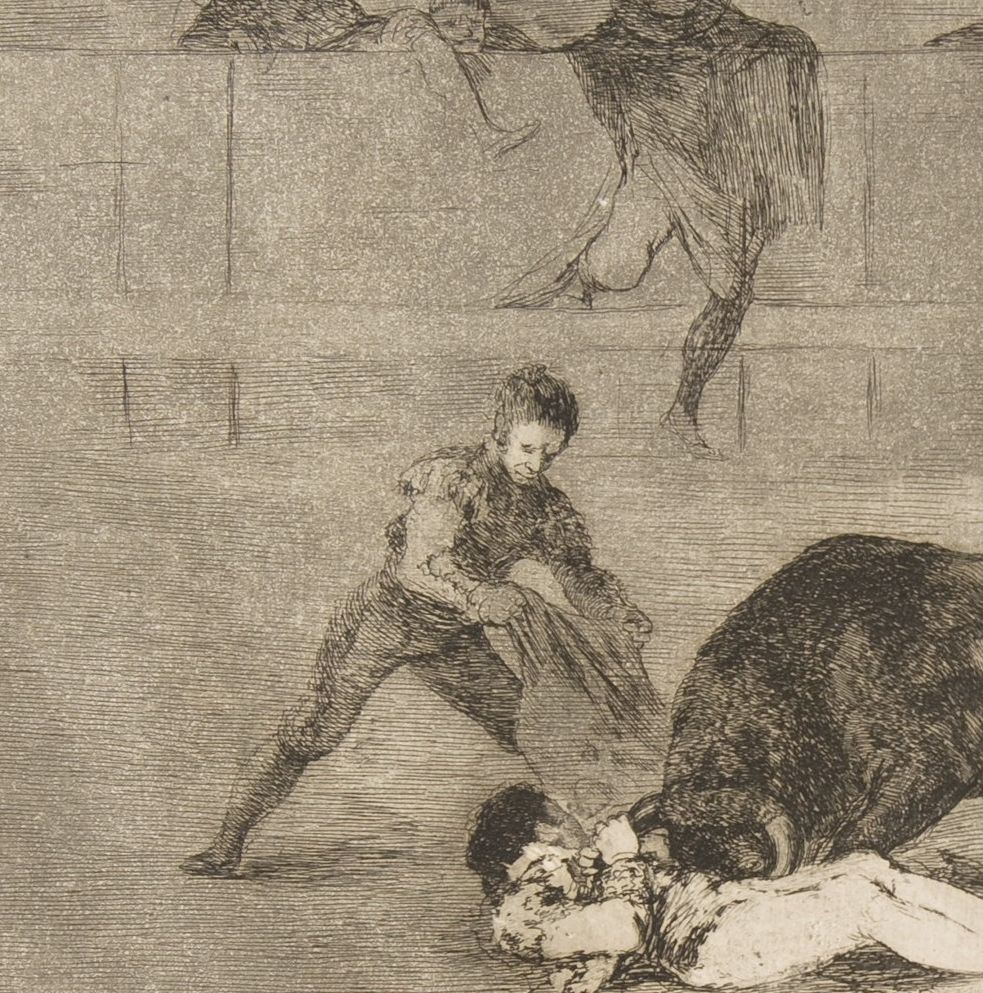
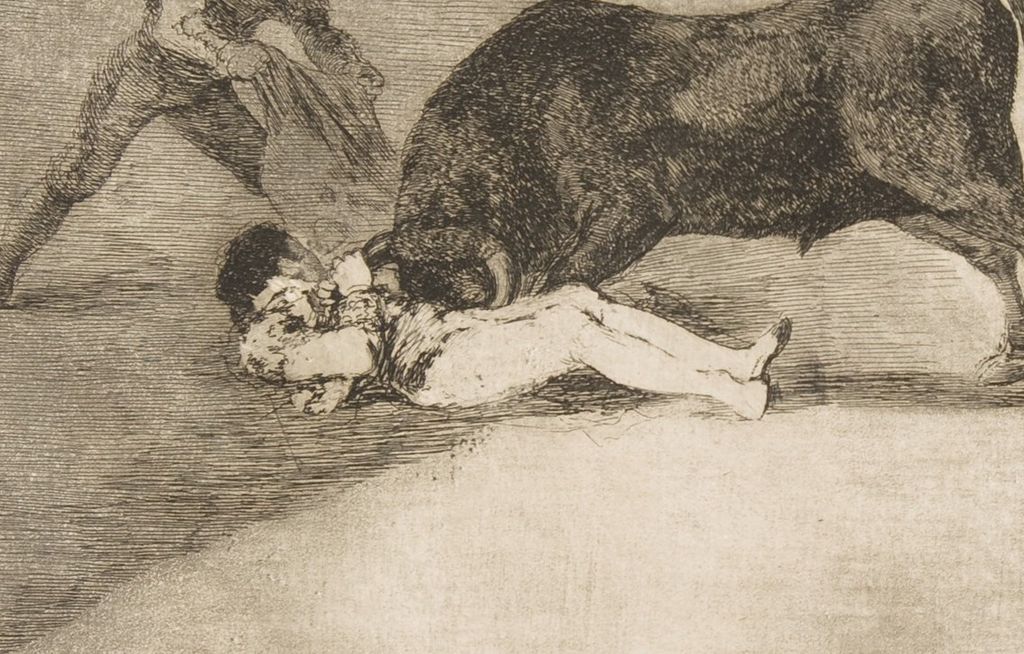
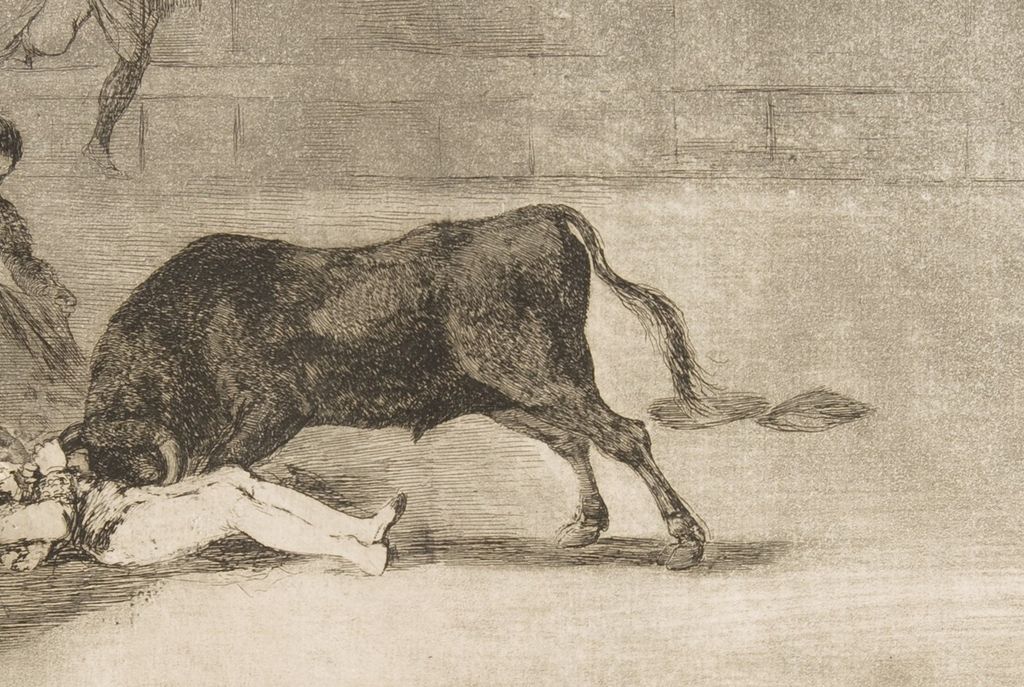
The subject of plate 33 can be tied to a documented fatality. José Delgado, known as Pepe Illo or Pepe Hillo, was gored in Madrid on 11 May 1801. Elsewhere in the series, plate 29 shows him in command of a manoeuvre. In plate 33, the viewer sees the bull over the fallen man. The figures at the edges seem too far away to change the outcome, even where they appear close enough to see what is happening. Looking closely at the National Gallery of Victoria’s first-edition plate 33, one can follow narrow dark outlines along the animal’s back and around the figures, against broader fields of grain. Etching supplies lines bitten into copper. Aquatint gives the plate an ink-holding texture that prints as areas of tone, which can be lightened by polishing the copper with a burnisher. The guide to Goya’s etchings follows those effects across other works. [3] [19] [20] [21]
Plate 31 gives an especially legible example of how Goya could shape aquatint after etching it. In the National Gallery of Victoria’s first-edition impression (1998.255.31), the cloud at the bull’s neck shares an area of tone with the animal itself. Lighter marks within the grain suggest smoke. The Prado–NGV exhibition identifies this effect as burnishing back into the aquatint. Goya used the change in density to distinguish something almost transparent from a solid body at the centre of the action. [7]
There are two other compositions of the fatal goring, eventually lettered E and F. Their presence in the expanded series makes the ending of 1816 easier to see as a choice. In E, the bull lifts the matador off his feet. The copper for that design survives as the back of plate 11, whose front shows El Cid. The Fundación catalogue records a proof of E made before additional burnishing and lettering. It also discusses a possible flaw in the biting of the aquatint as a reason Goya set that design aside. In F, the men around the bull are close enough to try to intervene. For the buyer in 1816, plate 33 was the last sheet and the only version of the death in the set. A reader of the expanded edition could turn to E and F to see how Goya had tried other arrangements of the animal, the fallen man and the figures trying to help him. [19] [22] [23]
Annotated Details from The Death of Pepe Illo
Follow the figures from the barrier to the fatal encounter in the arena.
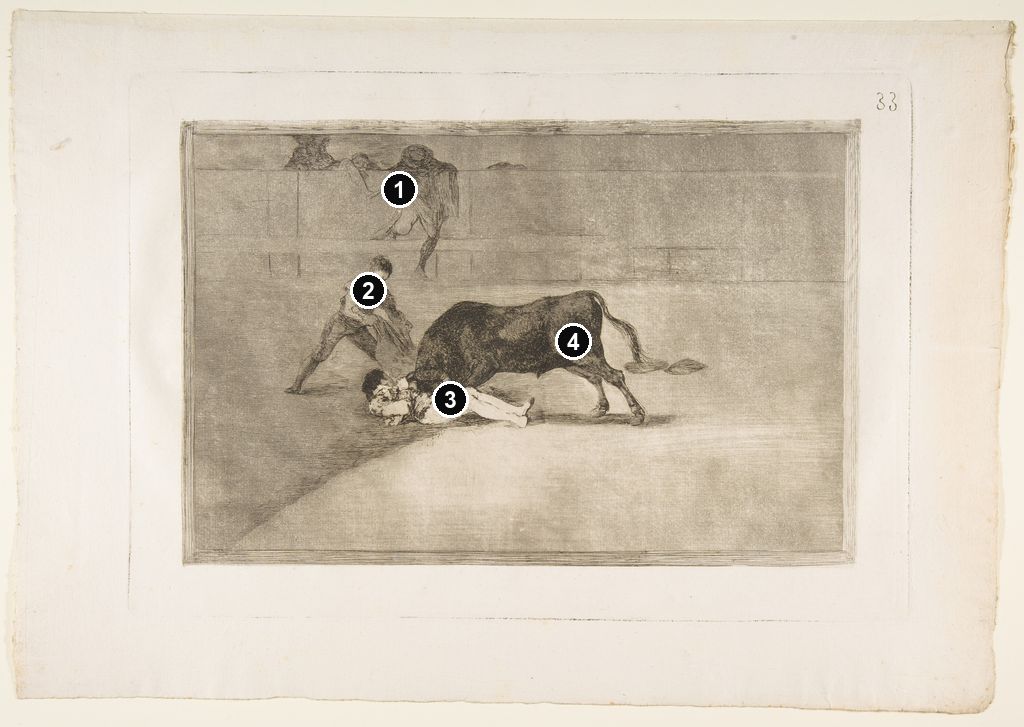
Details from THE DEATH OF PEPE ILLO
Details from Plate 33 in the Metropolitan Museum of Art (21.19.33).
Figures by the barrier
Two dark forms interrupt the long horizontal marks at the back of the arena.
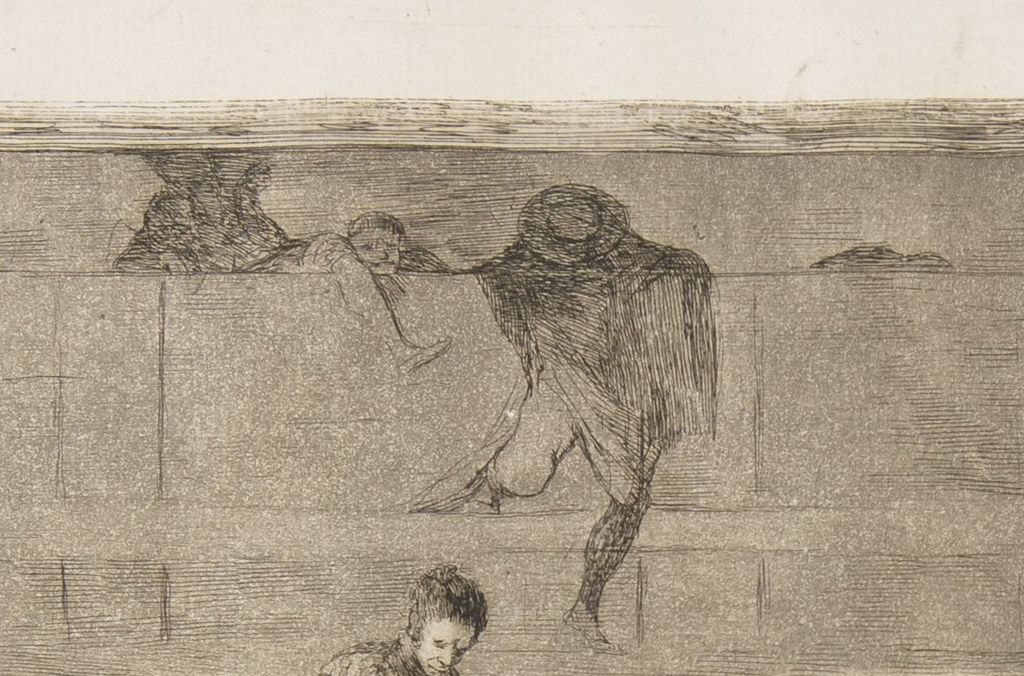
The man approaching
A man leans forward from the left, with his legs set apart.
The fallen matador
The pale body lies low beneath the bull’s head.
The bull
The dark outline of the bull interrupts the open ground. Its tail curves out to the right.
How 33 copperplates yielded 40 designs
The 1855 printing at the Calcografía Nacional retained the 33 numbered scenes. Eugène Loizelet acquired the coppers in Paris and issued the expanded third edition in 1876. He printed seven additional designs, designated A–G, from the backs of seven plates. A single physical copper can therefore account for two different designs, and a single design can account for many paper impressions across editions. The Academy acquired the 33 coppers in 1979 from Madrid’s Círculo de Bellas Artes. The Calcografía Nacional now treats the surviving plates as collection objects in their own right. [5] [6]
The first-edition plate 33 in Melbourne (1998.255.33, Harris 236 III.1) and Princeton’s Loizelet impression (x1946-250, Harris 236) both carry the number 33 at upper right. The Melbourne sheet measures 26.8 × 37.1 cm. The Princeton sheet is 32.5 × 48.7 cm, and its record identifies the support as laid Arches paper. Their recorded plate-mark widths are both 35.2 cm. Putting the two sheets side by side therefore offers a way to see how much the margins can vary around a familiar design. Princeton gives 1816 for the work and 1876 for the printing. To work out what a date means for an individual object, look for the edition, printer or publisher in the record alongside the date of the design. The guide to Goya’s prints explains how to read those details across his series. [3] [24]
Ceballos returns in Bordeaux
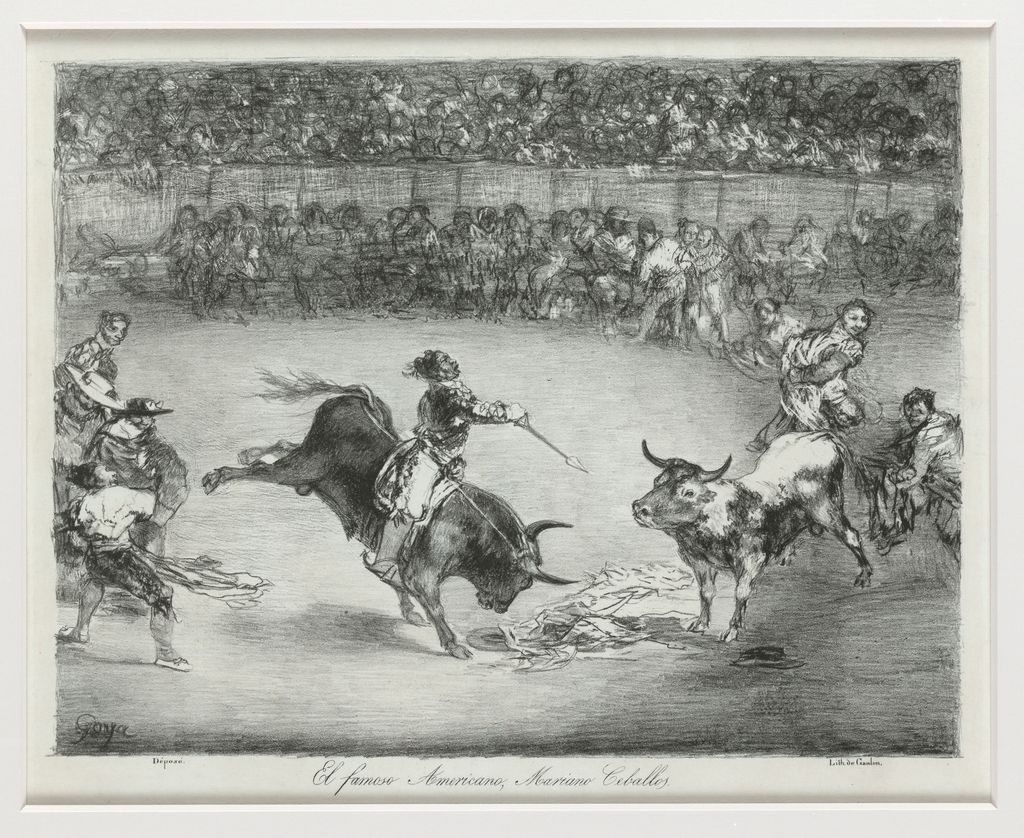
In 1825, Goya came back to the subject of Ceballos on a bull in The Bulls of Bordeaux. The Metropolitan Museum of Art catalogues its lithograph of Ceballos (46.103) as worked with crayon and scraper. The rough grain brings the tiers of spectators forward, with broken streaks of light in the stands and along the sand. In the earlier copperplate print the overlapping bodies command more of the image on their own. Between the two prints, a familiar feat lets the eye move between different ways of drawing a crowd and different degrees of attention to the space around the fighter. [14] [25]
Artworks directory
| Name | Date | Medium |
|---|---|---|
| And There’s No Help for It, Plate 15 | Printed 1863 | |
| Asmodea | c. 1820–23 | Wall painting transferred to canvas |
| Boys Inflating a Bladder | 1777–78 | Tapestry cartoon |
| Boys Picking Fruit | 1778 | Tapestry cartoon |
| Bullfight in a Divided Ring | 1825 | Lithograph |
| Card Players | 1777–78 | Tapestry cartoon |
| Card Players (sketch) | 1777–78 | Painted sketch |
| Dance on the Banks of the Manzanares | 1777 | Tapestry cartoon |
| Duel with Cudgels | c. 1820–23 | Wall painting transferred to canvas |
| Heads in a Landscape | c. 1820–23 | Easel painting |
| Judith and Holofernes | c. 1820–23 | Wall painting transferred to canvas |
| Leocadia | c. 1820–23 | Wall painting transferred to canvas |
| Maja and Cloaked Men | 1777 | Tapestry cartoon |
| Maja and Cloaked Men (sketch) | 1777 | Painted sketch |
| Majo Clapping in Time to the Music | 1777 | Drawing |
| Men Reading | c. 1820–23 | Wall painting transferred to canvas |
| Out Hunting for Teeth, Plate 12 | 1799 | Etching, burnished aquatint and burin |
| Picnic in the Countryside (sketch) | 1776–78 | Painted sketch |
| Picnic on the Banks of the Manzanares | 1776 | Tapestry cartoon |
| Pilgrimage to San Isidro | c. 1820–23 | Wall painting transferred to canvas |
| Preparatory study for The Sleep of Reason Produces Monsters | c. 1796–97 | Drawing |
| Procession of the Holy Office | c. 1820–23 | Wall painting transferred to canvas |
| Quarrel at the Cockerel Inn (sketch) | 1777 | Painted sketch |
| Quarrel in the New Tavern | 1777 | Tapestry cartoon |
| Saturn Devouring His Son | c. 1820–23 | Wall painting transferred to canvas |
| Seated Majo Smoking | c. 1776 | Drawing |
| The Dog | c. 1820–23 | Wall painting transferred to canvas |
| The Drinker | 1777 | Tapestry cartoon |
| The Fates | c. 1820–23 | Wall painting transferred to canvas |
| The Great He-Goat | c. 1820–23 | Wall painting transferred to canvas |
| The Kite | 1777–78 | Tapestry cartoon |
| The Parasol | 1777 | Oil on canvas, tapestry cartoon |
| The Second of May 1808 | 1814 | Oil on canvas |
| The Sleep of Reason Produces Monsters, Plate 43 | 1799 | Etching and aquatint |
| The Third of May 1808 | 1814 | Oil on canvas |
| Thou Who Canst Not, Plate 42 | 1799 | Etching and burnished aquatint |
| Three Figures | 1776 | Drawing (lost) |
| Two Old Men | c. 1820–23 | Wall painting transferred to canvas |
| Two Old Men Eating Soup | c. 1820–23 | Wall painting transferred to canvas |
| Two Women and a Man | c. 1820–23 | Wall painting transferred to canvas |
| Universal Language: The Author Dreaming | 1797 | Drawing |
| The Family of Charles IV | 1800 | Oil on canvas |
| Witches’ Sabbath (Osuna painting) | 1797–98 | Oil on canvas |
| The Nude Maja | 1795–1800 | Oil on canvas |
| The Clothed Maja | 1800–07 | Oil on canvas |
| Self-Portrait (Drawing) | c. 1796 | Brush and carbon black ink on laid paper |
| The Swing, Madrid Album B.21 | 1795–97 | Brush and carbon black washes |
| Majas Fighting, a Majo Observing, Madrid Album B.15 | 1796–97 | Brush, grey and black washes on laid paper |
| Majos and Majas Conversing, Madrid Album B.16 | c. 1794–97 | Ink wash on paper |
| Weeping Woman and Three Men, Madrid Album B.17 | 1795–97 | Brush, carbon black washes and black chalk |
| Maja Seated on a Chair and Two Companions Behind, Madrid Album B.18 | 1795–97 | Brush and carbon black washes |
| Girl and Bull, Madrid Album B.23 | 1796–97 | Brush and carbon black washes |
| Lovers Sitting on a Rock, Madrid Album B.24 | 1796–97 | Brush and carbon black washes |
| Mariano Ceballos Riding a Bull | 1825 | Crayon lithograph and scraper |
| Landscape (lifetime impression) | c. 1807–10 | Etching and aquatint |
| Self-Portrait (1815), Prado canvas | 1815 | Oil on canvas |
| Self-Portrait (1815), Academy panel | 1815 | Oil on panel |
| Self-Portrait with Dr Arrieta | 1820 | Oil on canvas |
| Christ Crucified | 1780 | Oil on canvas |
| The Last Communion of Saint Joseph of Calasanz | 1819 | Oil on canvas |
| Christ on the Mount of Olives | 1819 | Oil on panel |
| The Flower Girls, or Spring | 1786–87 | Oil on canvas |
| The Grape Harvest, or Autumn | 1786–87 | Oil on canvas |
| The Snowstorm, or Winter | 1786–87 | Oil on canvas |
| The Threshing Ground, or Summer | 1786–87 | Oil on canvas |
| Picnic on the Banks of the Manzanares | 1776 | Oil on canvas |
| The Kite | 1777–78 | Oil on canvas |
| Dance on the Banks of the Manzanares | 1777 | Oil on canvas |
| A Fight at the Venta Nueva | 1777 | Oil on canvas |
| Blind Man’s Bluff | 1788 | Oil on canvas |
| Dogs on a Lead | 1775 | Oil on canvas |
| Hunting with a Decoy | 1775 | Oil on canvas |
| Hunter Loading His Rifle | 1775 | Oil on canvas |
| The Angler | 1775 | Oil on canvas |
| The Hermitage of San Isidro on His Feast Day | 1788 | Oil on canvas |
| The Meadow of San Isidro | 1788 | Oil on canvas |
| The Straw Manikin | 1791–92 | Oil on canvas |
| Witches’ Flight | c. 1797–98 | Oil on canvas |
| A Scene from ‘The Forcibly Bewitched’ | 1798 | Oil on canvas |
| The Duchess of Alba in Black | 1797 | Oil on canvas |
| The Duchess of Alba in White | 1795 | Oil on canvas |
| Charles III in Hunting Dress | c. 1786 | Oil on canvas |
| The Duke and Duchess of Osuna and Their Children | 1787–88 | Oil on canvas |
| Manuel Osorio Manrique de Zúñiga | 1787–88 | Oil on canvas |
| The Marquesa de Pontejos | c. 1786 | Oil on canvas |
| Equestrian Portrait of the 1st Duke of Wellington | 1812 | Oil on canvas |
| The Duke of Wellington | 1812–14 | Oil on wood |
| Portrait of Ferdinand VII of Spain | 1814 | Oil on canvas |
| Gaspar Melchor de Jovellanos | 1798 | Oil on canvas |
| María Tomasa Palafox y Portocarrero | 1804 | Oil on canvas |
| Señora Sabasa García | c. 1806–11 | Oil on canvas |
| Don Juan Bautista de Muguiro | 1827 | Oil on canvas |
| Doña Isabel de Porcel | Before 1805 | Oil on canvas |
| The Colossus | After 1808 | Oil on canvas |
| The Burial of the Sardine | 1808–12 | Oil on panel |
| The Madhouse | 1808–12 | Oil on panel |
| A Procession of Flagellants | 1808–12 | Oil on panel |
| Portrait of Jacques Galos | 1826 | Oil on canvas |
| Portrait of Mariano Goya, the Artist’s Grandson | 1827 | Oil on canvas |
| Milkmaid of Bordeaux | c. 1827 | Oil on canvas |
| Portrait of Don Juan Antonio Cuervo | 1819 | Oil on canvas |
| María Luisa of Parma (Naples version) | c. 1800 | Oil on canvas |
| The Countess of Baena | 1819 | Oil on canvas |
| The Family of the Infante Don Luis | 1783–84 | Oil on canvas |
| The Holy Family | c. 1787 | Oil on canvas |
| Saint Barbara | c. 1773 | Oil on canvas |
| Saints Justa and Rufina | 1817 | Oil on canvas |
| El Tío Paquete | c. 1819–20 | Oil on canvas |
| The Forge | c. 1815–20 | Oil on canvas |
| Majas on a Balcony (Metropolitan Museum version) | c. 1800–10 | Oil on canvas |
| Maja and Celestina on a Balcony | c. 1808–12 | Oil on canvas |
| The Water Bearer | 1808–12 | Oil on canvas |
| Time and the Old Women | c. 1810 | Oil on canvas |
Frequently Asked Questions
An edition is a published group of impressions. A state refers to the physical condition of the design on the plate at the time of printing. The proof of E before extra burnishing records an earlier state of that image. The two impressions of plate 33 in Melbourne and Princeton illustrate the difference in paper and margins between objects printed in different editions. [3] [22] [24]
Discussion
Look again at the images and ideas explored in La Tauromaquia. These editorial prompts invite your observations.
Compare the distance between Martincho and the bull in plate 18 with the space around the bull in plate 21. How does knowing where people are able to move change what you expect to happen next?
Reader Insights
Where does the empty space direct your attention in the final print?
What changes when the people watching become part of the bullfight?
Join the Conversation
Share a detail, comparison or question about La Tauromaquia below.
References
- Banco de España, José Manuel Matilla Rodríguez. Tauromaquia, first-edition catalogue and transcription of the advertised price. View source.
- National Gallery of Victoria. The Way in Which the Ancient Spaniards Hunted Bulls on Horseback in the Open Country, first edition, 1998.255.1, Harris 204 III.1. View source.
- National Gallery of Victoria. The Unlucky Death of Pepe Illo in the Ring at Madrid, first edition, 1998.255.33, Harris 236 III.1. View source.
- Biblioteca Nacional de España. Goya en la BNE, on the notice of 28 October 1816. View source.
- Real Academia de Bellas Artes de San Fernando. Goya / Picasso. Tauromaquias, copperplate provenance and publication history. View source.
- Fundación Goya en Aragón. Modo como los antiguos españoles cazaban los toros a caballo en el campo, plate 1 and series history. View source.
- National Gallery of Victoria and Museo Nacional del Prado. Goya: Drawings from the Prado Museum, artwork labels. View source.
- Museo de Bellas Artes de Álava, Museotik. Los moros establecidos en España, on the Boston titles and Ceán Bermúdez. View source.
- National Gallery of Victoria. The Spirited Moor Gazul Is the First to Spear Bulls According to Rules, 1998.255.5. View source.
- National Gallery of Victoria. Charles V Spearing a Bull in the Ring at Valladolid, 1998.255.10. View source.
- National Gallery of Victoria. The Daring of Martincho in the Ring at Zaragoza, first edition, 1998.255.18, Harris 221 III.1. View source.
- Rijksmuseum. Stierenvechter staand op een tafel in de arena, plate 19 from the 1876 edition. View source.
- The Metropolitan Museum of Art. Mariano Ceballos, Alias the Indian, Kills the Bull from His Horse, plate 23. View source.
- National Gallery of Art, Washington. The Same Ceballos Mounted on Another Bull Breaks Short Spears in the Ring at Madrid, plate 24, first edition, 1943.3.1643, Harris 227 III(1). View source.
- Fundación Goya en Aragón. Preparatory drawing for plate 24, Museo Nacional del Prado, D4311. View source.
- Fundación Goya en Aragón. Preparatory drawing for plate 21, Museo Nacional del Prado, D4308, catalogue entry 1950. View source.
- National Gallery of Victoria. Dreadful Events in the Front Rows of the Ring at Madrid, and Death of the Mayor of Torrejón, first edition, 1998.255.21, Harris 224 III.1. View source.
- Fundación Goya en Aragón. Desgracias acaecidas en el tendido de la plaza de Madrid y muerte del alcalde de Torrejón, plate 21. View source.
- Fundación Goya en Aragón. La desgraciada muerte de Pepe Illo en la plaza de Madrid, plate 33 and the events of 11 May 1801. View source.
- Fundación Goya en Aragón. Pepe Illo haciendo el recorte al toro, plate 29. View source.
- The Metropolitan Museum of Art. The Printed Image in the West: Aquatint, technique essay. View source.
- Fundación Goya en Aragón. La muerte de Pepe Illo, plate E and its surviving proof. View source.
- Fundación Goya en Aragón. La muerte de Pepe Illo, plate F. View source.
- Princeton University Art Museum. Death of Pepe Illo, printed 1876, x1946-250, Harris 236. View source.
- The Metropolitan Museum of Art. Mariano Ceballos Riding a Bull, 1825, 46.103. View source.
- Javier Blas, Calcografía Nacional, Real Academia de Bellas Artes de San Fernando. Tauromaquia, on the structure, reception and interpretation of the series. View source.
- Metropolitan Museum of Art, Dreadful Events in the Front Rows, Plate 21. View source.
- Banco de España, Tauromaquia. View source.







