


 by Tom Gurney
Tom Gurney BSc (Hons) is an art history expert with over 20 years experience
Published on June 19, 2020 / Updated on November 20, 2026
Email: tomgurney1@gmail.com / Phone: +44 7429 011000
Introduction
In Francisco de Goya’s The Bulls of Bordeaux, a bull bucks under the rider Mariano Ceballos, a man hangs from the horns of another bull, and a wooden barrier lets two fights unfold at once. Goya made the four stone lithographs in 1825, during his last years in France. Look past the animals and performers and a second subject comes into view. The people watching press against the boards, gather in the ring or fill the stands until their faces merge into a single, restless band. [1] [2] [3] [4]
At a Glance
- Artist and dateFrancisco de Goya, 1825. The series is also known as Los toros de Burdeos. [5]
- Medium and workshopStone lithographs in black ink, made with lithographic crayon and scraping and printed in Bordeaux by Cyprien Gaulon. [5] [6]
- Published subjectsMariano Ceballos Riding a Bull, Bravo toro, Spanish Entertainment and Bullfight in a Divided Ring. The Metropolitan Museum of Art holds an impression of each. [7]
- EditionThe French legal-deposit record gives 100 impressions of each lithograph. A related design survives as a unique proof in Bordeaux. [5] [8]
How the lithographs reached print
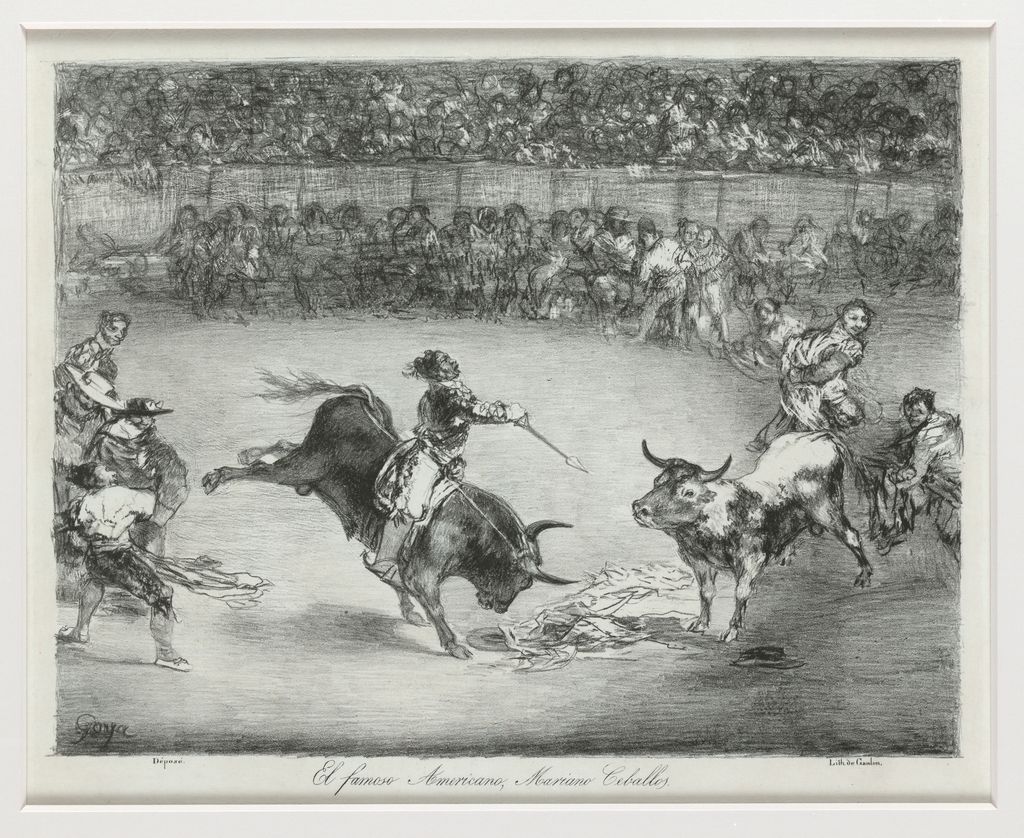
Goya settled in Bordeaux in 1824, the year he left Spain on royal leave. He already knew about lithography from work in Madrid in 1819 at José María Cardano’s establishment. In Bordeaux he worked with the lithographer and publisher Cyprien Gaulon, whose full name is recorded by the Met as Cyprien Charles Marie Nicolas Gaulon. Gaulon’s workshop was on rue Saint-Rémi. In the margin of Mariano Ceballos, the French wording gives a deposit notice, “Déposé”, at the left and the printer’s credit, “Lith. de Gaulon”, at the right. The Spanish caption across the middle names the performer. In the image above, low at the left, Goya put his own name. [1] [5] [6] [9] [10]
The Bibliothèque nationale de France records legal deposits at the Gironde prefecture on 17 and 29 November and 23 December 1825. The same catalogue gives the run as 100 impressions of each of the four subjects. Goya’s letters tell us how he hoped those impressions would reach buyers. On 6 December he wrote to Joaquín María Ferrer in Paris about a trial lithograph he had sent via a man named Baranda. He described it as a scene with young bulls, a corrida de novillos, and wanted Ferrer and Cardano to see whether it might sell. He had made three more of the same size and theme and was prepared to send copies as requested. The description fits Spanish Entertainment, with its young bulls in a crowded ring. [3] [5] [11]
On 20 December Goya acknowledged Ferrer’s reply of the 13th and set out his reasoning. He had imagined that Parisian connoisseurs and the city’s Spanish residents might find the prints interesting, and that a dealer could sell them cheaply without invoking his name. The letters establish the attempt to place the prints in Paris. The deposit register establishes the size of the Bordeaux edition. The letters show Goya trying to reach a market beyond Bordeaux, with buyers in mind whose interest might run from print collecting to a familiarity with bullfighting. [5] [11] [12]
How Goya drew on stone
A stone lithograph begins with a drawing in greasy material on a flat surface. Once the drawing has been fixed, the printer dampens the stone and rolls ink over it. The ink adheres to the treated drawing areas and is repelled by the wet areas around them. On a grained stone, light crayon pressure can leave gaps between the marks, so that on paper black flecks and exposed paper create the impression of grey. A heavier stroke closes up those gaps. Scraping can remove drawing material where the artist wants the paper to show through. [4] [13]
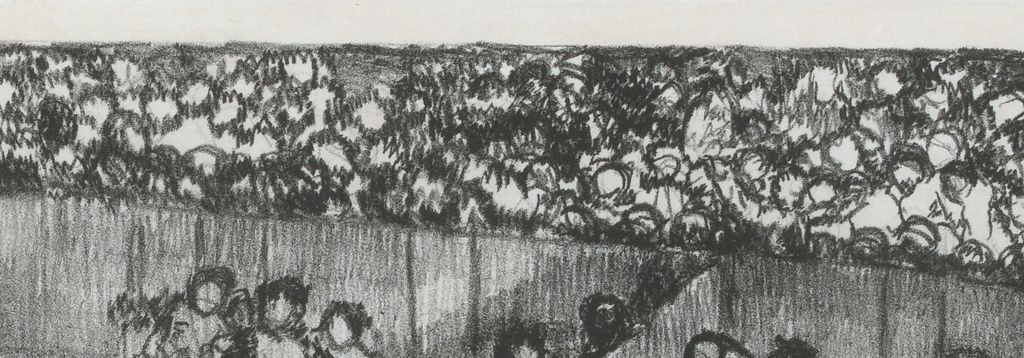
In Bullfight in a Divided Ring, small pale marks in the dark stand begin to resolve into heads, while the patches of light on the near bull’s back are far larger and sharper. The wooden barrier has enough vertical streaks to suggest separate boards. The animal, meanwhile, reads first as a black weight driving at the man. Goya adjusted his marks to the distance and function of each thing, from the broken surface of a crowd to a concentrated patch of light on an animal. The thin highlights and crayon darks remain visible beside one another in the same impression. [4]
Laurent Matheron’s biography, published in 1858, describes Goya setting the stone upright on an easel, laying in a grey tone, scraping out lighter passages and bringing the crayon back to strengthen shadows or pick out movement. The Met also discusses his use of a magnifying glass. This account appeared thirty-three years after the prints were made. Goya’s letter of 20 December provides contemporary evidence that he complained about his eyesight and steadiness of hand when writing. Matheron describes a sequence of revisions that helps account for the marks visible in the prints, where narrow highlights cut into broad passages of crayon. [4] [6] [12]
Mariano Ceballos Riding a Bull
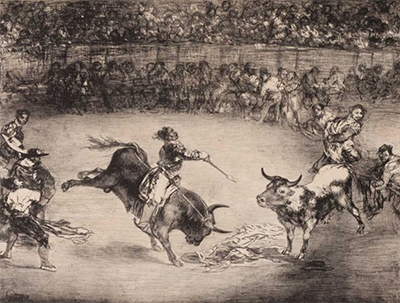
In Mariano Ceballos Riding a Bull (El famoso Americano, Mariano Ceballos), the dark mount bucks head down. Its rider turns and extends a short spear towards the bull approaching from the right. That animal has a pied hide, with patches of bare light running into the black. Goya sets the rider’s cap and upper body against light sand, then brings him down into the dense dark of the mount. A tangle of light lines on the ground between the animals suggests a dropped cape and gives their horns a narrow space in which to meet. [1] [9]
The Met’s 1825 impression, 46.103, is catalogued as crayon lithograph and scraper. Its figures at the edges look towards the centre, and an upper strip of spectators and second rank along the boards enclose the bright opening around Ceballos. Move from the rider’s sleeve to those spectators and the same drawing material seems to perform two jobs. Beside the spear the marks indicate a particular bent arm, while in the stands tiny strokes trade individual features for the effect of a full arena. [1] [7]
From the posture of one rider to the motion of a crowd
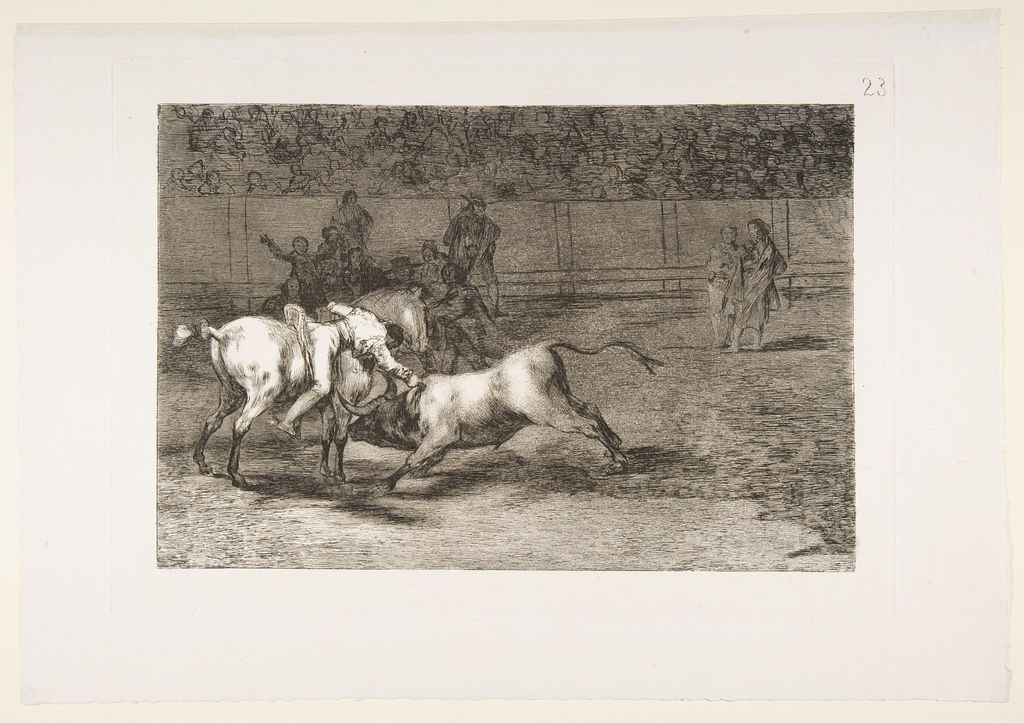
Putting the lithograph beside Plate 24 of La Tauromaquia keeps the comparison focused on a recognisable feat. The earlier title indicates that Ceballos, already encountered in the sequence, is mounted on another bull in the Madrid ring. The lithograph asks a viewer to recognise the same performer in an image which gives the people behind him and the activity on the ground a different weight. Goya could return to a subject without needing to repeat the small physical arrangement that made it legible in copper. [1] [24]
Look first at the seated rider’s centre of gravity, then at the animal’s nearest feet. That relationship helps the eye separate motion in the foreground from motion suggested by the spectators. In the lithograph, textures around the figures make it possible to recognise the mass of the audience before picking out many distinct faces. The arena is held together by the spread of those marks. In the earlier print, larger areas of open ground make the rider and animal easier to isolate from everything around them. [1] [24]
The two sheets also differ in what the medium offers an artist drawing a crowd. Lithographic marks can retain the appearance of drawing directly into a broadly worked field. Copper permits drawn lines and bitten areas of tone to be brought into especially clear separation. Both effects are choices about what should register first. In Bordeaux the act draws its scale from the people watching it. The earlier series gives one encounter a place among the acts a named performer could undertake. The comparison restores some of the uncertainty to the late image by making visible how much is going on around him. [1] [24]
The catalogue entries make the material change exact. Plate 24 combines etching with burnished aquatint, drypoint and burin. The Bordeaux sheet uses lithographic crayon and a scraper, and the Met identifies Gaulon as publisher. Marks made with a scraper belong to the working of the lithographic design, so the word lithograph by itself does not describe how all the lights were obtained. Those distinctions give something concrete to look for when comparing an impression. In the earlier print, some lines cut a clear edge against areas of tone. The crayon field in the later image makes an edge emerge from many smaller marks. [1] [24]
Goya on film
Five films explore Goya’s portraits, prints, Black Paintings and painting techniques.
The Duke of Wellington by Goya
The portrait, its military decorations and its later theft.
Watch on YouTubeBravo toro
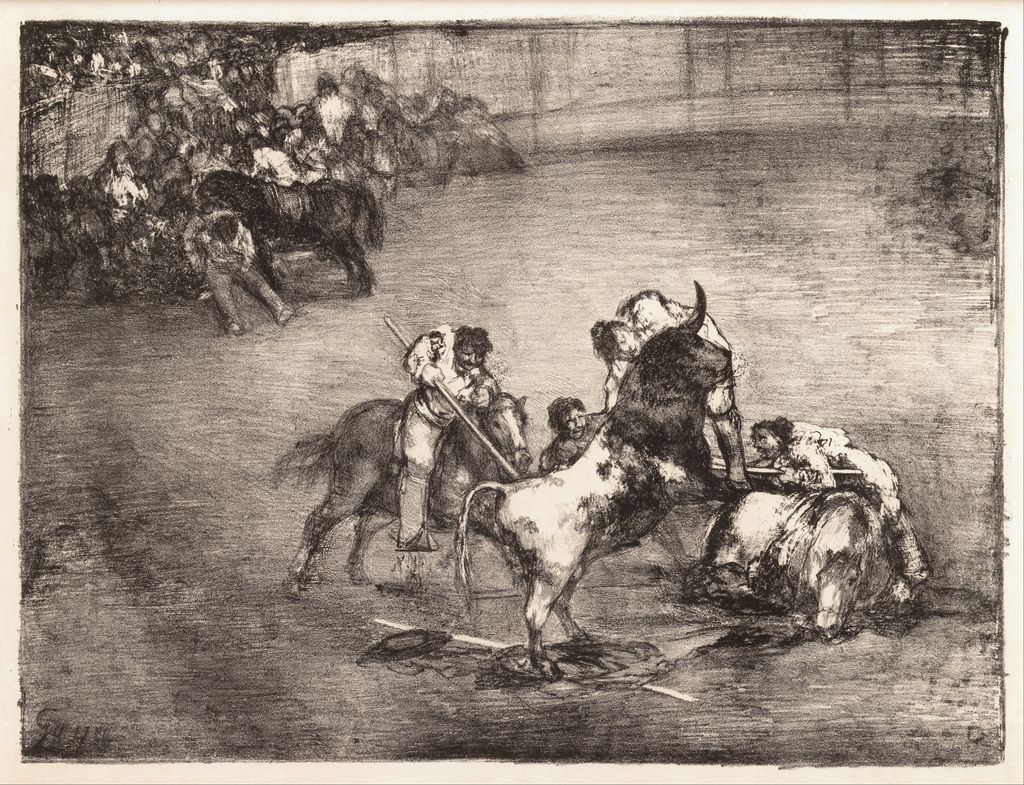
The Met calls its impression of Bravo toro (20.60.2) A Picador Caught by a Bull. It dates it to 1825 and records crayon lithograph and scraper. A picador is a mounted fighter who uses a long lance. On the right, a bull carries a man across its head near a fallen horse. The spears point towards the incident from opposite sides. One rider approaches from the left, where spectators register as a dark concentration behind him. The large open stretch of sand between the groups leaves the endangered man and horse conspicuously exposed. [2] [6]
The Fundación Goya en Aragón and Museo Goya read the scene as recalling the fatal goring of the matador José Delgado, known as Pepe Hillo, in Madrid in 1801. The title used by the Met names the figure by role, and the print itself supplies no caption identifying the casualty. Goya had already taken up Pepe Hillo’s death in La Tauromaquia. Whether we read the lithograph as a return to that event or as a scene of a mounted man caught by a bull, the composition makes the same demand of the eye. We have to distinguish the slung body, the animal carrying it and the men attempting to intervene inside a knot of rapid strokes. [2] [14] [20]
Spanish Entertainment
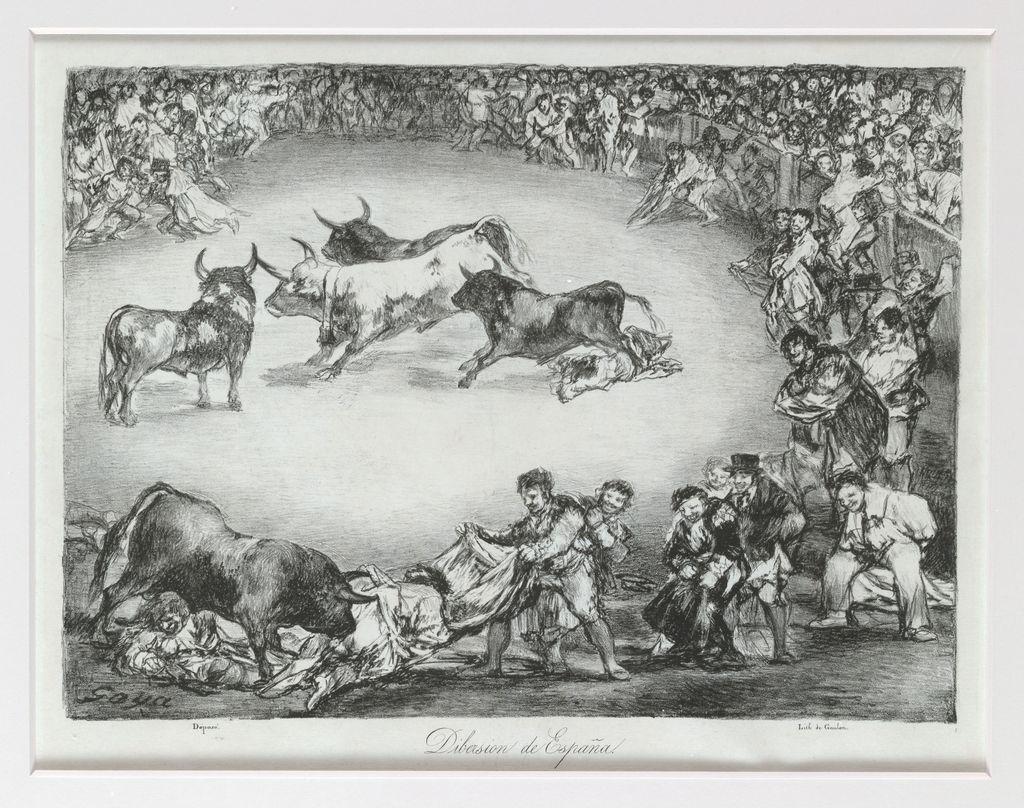
In Spanish Entertainment (Dibersión de España), people have spilled into the arena. The great arc of bodies around the centre acts like a second fence, temporarily keeping the loose animals and people in view. At the front left the arrangement falls apart as an animal scatters figures nearby. Farther in, a fallen man and his cape almost disappear among the sketched legs. The compact group around the animals gives way to broad ranks of tiny dark and light marks that can be read as a crowd long before any face emerges. [3] [15]
The Met dates its impression, 20.60.3, to 1825. A lettered impression catalogued by the Fundación includes the deposit notice and Gaulon’s workshop credit, and the Fundación also records proofs before the lettering. This is one reason to specify which sheet is under discussion when examining a margin. In the Fundación’s record the caption in the centre reads “Dibersión en España”. The subject remains recognisable in the line of people on foot, the bulls scattered across the foreground and the chaotic mass they form together. [3] [7] [15]
Bullfight in a Divided Ring
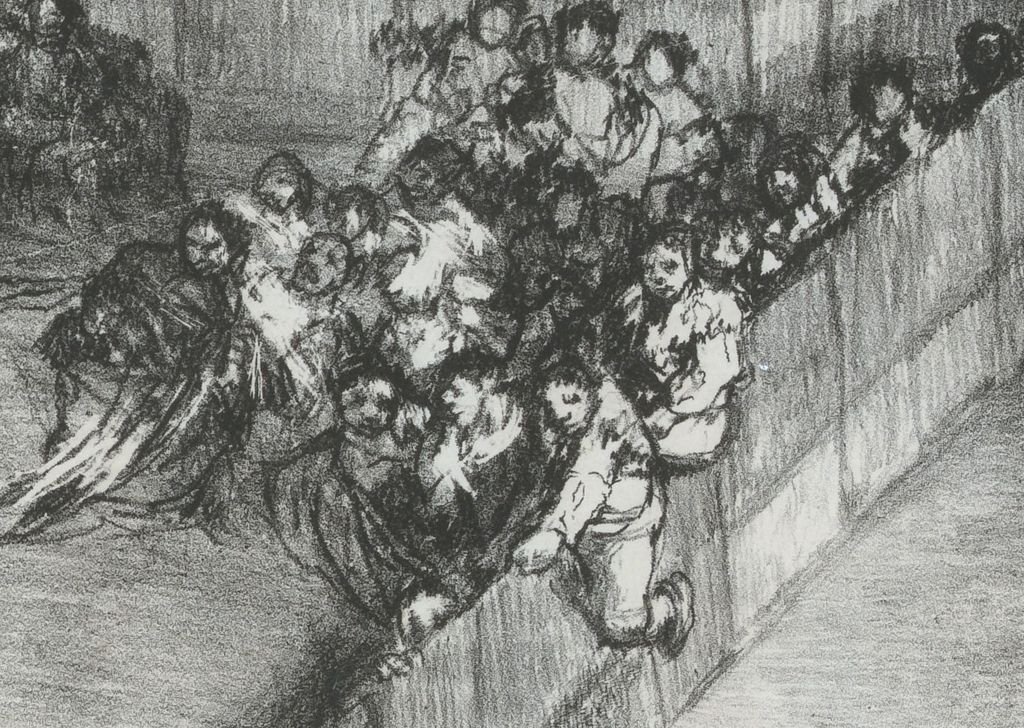
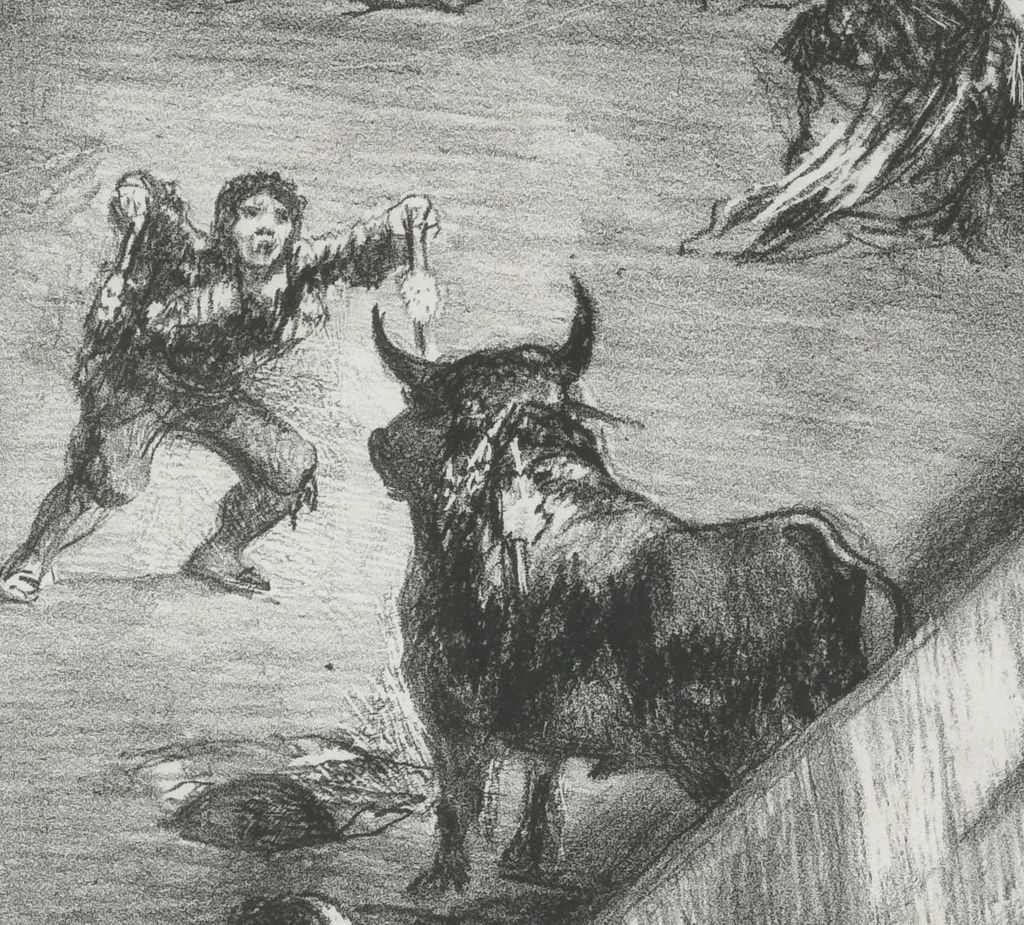
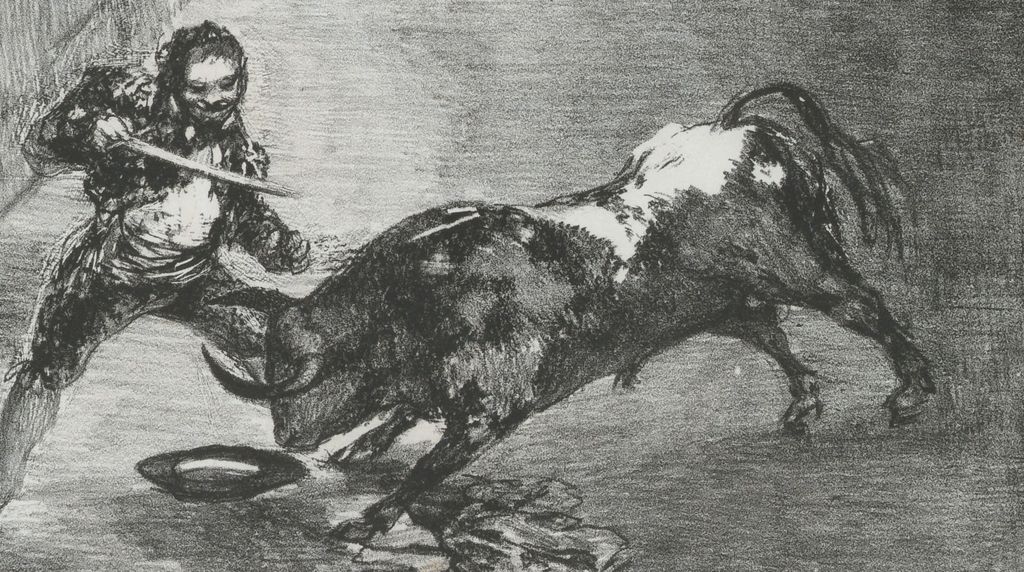
In Bullfight in a Divided Ring (Plaza partida), the partition runs from the lower left towards the far side of the ring. Goya gives each section its own encounter. On the near side a bull bears down with its head low, and a man sets his feet apart as he brings his blade forward. A hat lies on the sand. Across the barrier a second bull stands in profile, and the fighter raises his arms. A spectator seen from behind grips the near end of the barrier. Farther along, bodies straddle it. People appear able to watch either encounter by turning their heads, much as the viewer of the print can switch from side to side. [4] [16]
The Met’s 1825 impression, 20.60.4, shows how the barrier organises the lithograph. Its long straight edge crosses the curved human band in the stands. It also offers a ledge from which the onlookers can lean out and enter the picture’s more open spaces. In Spanish Entertainment the ring crowd itself makes a boundary, which threatens to dissolve. In Plaza partida the physical barrier holds, even as people perch on it or reach over it. [3] [4] [16]
Annotated Details from Bullfight in a Divided Ring
Follow the barrier through the ring and compare the handling of the two encounters.
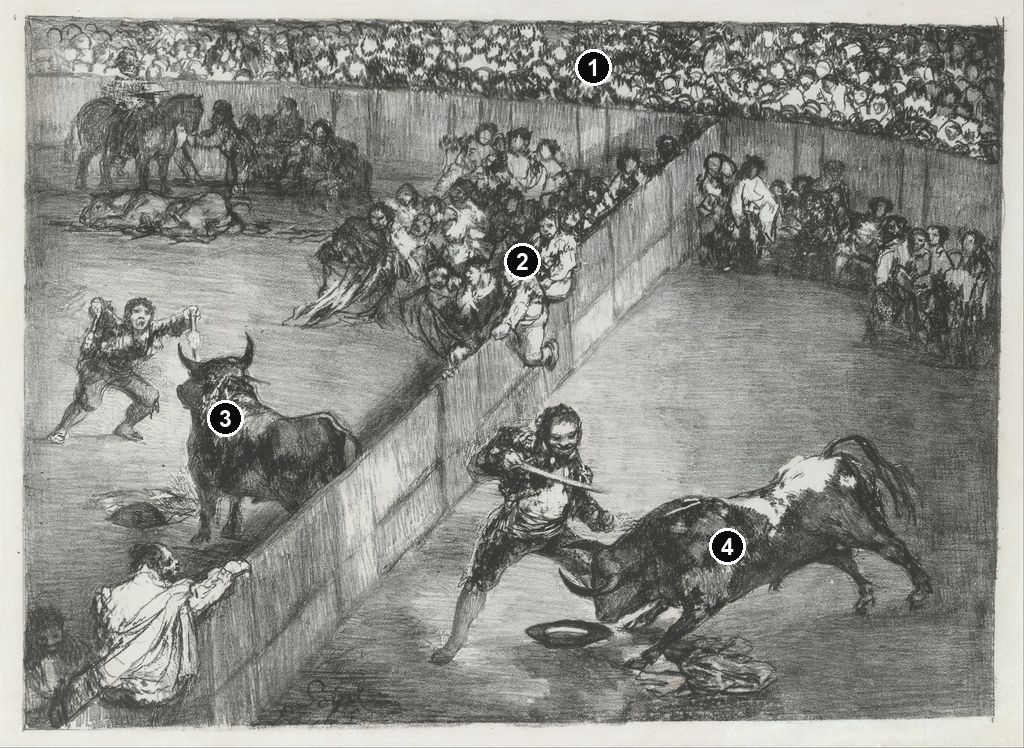
Details from BULLFIGHT IN A DIVIDED RING
Details from the 1825 lithograph in the Metropolitan Museum of Art (20.60.4).
The crowd above the ring
The distant spectators compress into bands of small heads, pale patches and dark strokes.
People on the barrier
The divider cuts across the ring. Spectators perch on it and lean towards the nearer half.
The action at left
A bull stands side-on to the viewer. The man behind it is set against a broad, pale stretch of the ring.
The nearer encounter
The lowered head and angled body of the bull lead towards the figure facing it. Broad dark tones alternate with bright marks along its back.
From La Tauromaquia to Bordeaux
Goya also showed Ceballos fighting from the back of another bull in La Tauromaquia, first issued in Madrid in 1816 as a series of 33 prints. The National Gallery of Art in Washington holds a first-edition impression of plate 24 (1943.3.1643), catalogued as etching, burnished aquatint, drypoint and burin. Compare the compact confrontation in that sheet with the expanse of sand and packed spectators in the Bordeaux Ceballos. The eye can follow etched lines around the earlier figures against a field of aquatint. In the later print the crayon leaves irregular grains, broad strokes and fragmentary edges, especially where the moving figures and the stands emerge from grey. [1] [17] [18]
The Prado holds a preparatory study for plate 24, drawn in pencil and red chalk (D4311). Ceballos and his mount already fill the study, while the other bull foreshortens behind them. The Bordeaux print gives the same feat a public setting. The added tiers of spectators put the rider’s balance on display and make the space around him feel precariously open. [1] [21]
In intaglio printing, ink held below the surface of a metal plate transfers to the sheet under pressure. Acid bites lines for an etching and makes a fine pitted surface for aquatint. Burnishing smooths the pitted surface to lighten it. Pressure around the edge of the copper can leave a rectangular plate mark. The flat lithographic stone gives Goya other ways to move between dark and light, including changes of crayon pressure and scraping back the drawing. The same unusual feat by Ceballos makes it possible to see what carried over between the two projects and how a change of printing surface affected the texture and scale of the scene. Read more about Goya’s etchings and the range of his prints. [1] [13] [17] [19] [22]
Artworks directory
| Name | Date | Medium |
|---|---|---|
| And There’s No Help for It, Plate 15 | Printed 1863 | |
| Asmodea | c. 1820–23 | Wall painting transferred to canvas |
| Boys Inflating a Bladder | 1777–78 | Tapestry cartoon |
| Boys Picking Fruit | 1778 | Tapestry cartoon |
| Bullfight in a Divided Ring | 1825 | Lithograph |
| Card Players | 1777–78 | Tapestry cartoon |
| Card Players (sketch) | 1777–78 | Painted sketch |
| Dance on the Banks of the Manzanares | 1777 | Tapestry cartoon |
| Duel with Cudgels | c. 1820–23 | Wall painting transferred to canvas |
| Heads in a Landscape | c. 1820–23 | Easel painting |
| Judith and Holofernes | c. 1820–23 | Wall painting transferred to canvas |
| Leocadia | c. 1820–23 | Wall painting transferred to canvas |
| Maja and Cloaked Men | 1777 | Tapestry cartoon |
| Maja and Cloaked Men (sketch) | 1777 | Painted sketch |
| Majo Clapping in Time to the Music | 1777 | Drawing |
| Men Reading | c. 1820–23 | Wall painting transferred to canvas |
| Out Hunting for Teeth, Plate 12 | 1799 | Etching, burnished aquatint and burin |
| Picnic in the Countryside (sketch) | 1776–78 | Painted sketch |
| Picnic on the Banks of the Manzanares | 1776 | Tapestry cartoon |
| Pilgrimage to San Isidro | c. 1820–23 | Wall painting transferred to canvas |
| Preparatory study for The Sleep of Reason Produces Monsters | c. 1796–97 | Drawing |
| Procession of the Holy Office | c. 1820–23 | Wall painting transferred to canvas |
| Quarrel at the Cockerel Inn (sketch) | 1777 | Painted sketch |
| Quarrel in the New Tavern | 1777 | Tapestry cartoon |
| Saturn Devouring His Son | c. 1820–23 | Wall painting transferred to canvas |
| Seated Majo Smoking | c. 1776 | Drawing |
| The Dog | c. 1820–23 | Wall painting transferred to canvas |
| The Drinker | 1777 | Tapestry cartoon |
| The Fates | c. 1820–23 | Wall painting transferred to canvas |
| The Great He-Goat | c. 1820–23 | Wall painting transferred to canvas |
| The Kite | 1777–78 | Tapestry cartoon |
| The Parasol | 1777 | Oil on canvas, tapestry cartoon |
| The Second of May 1808 | 1814 | Oil on canvas |
| The Sleep of Reason Produces Monsters, Plate 43 | 1799 | Etching and aquatint |
| The Third of May 1808 | 1814 | Oil on canvas |
| Thou Who Canst Not, Plate 42 | 1799 | Etching and burnished aquatint |
| Three Figures | 1776 | Drawing (lost) |
| Two Old Men | c. 1820–23 | Wall painting transferred to canvas |
| Two Old Men Eating Soup | c. 1820–23 | Wall painting transferred to canvas |
| Two Women and a Man | c. 1820–23 | Wall painting transferred to canvas |
| Universal Language: The Author Dreaming | 1797 | Drawing |
| The Family of Charles IV | 1800 | Oil on canvas |
| Witches’ Sabbath (Osuna painting) | 1797–98 | Oil on canvas |
| The Nude Maja | 1795–1800 | Oil on canvas |
| The Clothed Maja | 1800–07 | Oil on canvas |
| Self-Portrait (Drawing) | c. 1796 | Brush and carbon black ink on laid paper |
| The Swing, Madrid Album B.21 | 1795–97 | Brush and carbon black washes |
| Majas Fighting, a Majo Observing, Madrid Album B.15 | 1796–97 | Brush, grey and black washes on laid paper |
| Majos and Majas Conversing, Madrid Album B.16 | c. 1794–97 | Ink wash on paper |
| Weeping Woman and Three Men, Madrid Album B.17 | 1795–97 | Brush, carbon black washes and black chalk |
| Maja Seated on a Chair and Two Companions Behind, Madrid Album B.18 | 1795–97 | Brush and carbon black washes |
| Girl and Bull, Madrid Album B.23 | 1796–97 | Brush and carbon black washes |
| Lovers Sitting on a Rock, Madrid Album B.24 | 1796–97 | Brush and carbon black washes |
| Mariano Ceballos Riding a Bull | 1825 | Crayon lithograph and scraper |
| Landscape (lifetime impression) | c. 1807–10 | Etching and aquatint |
| Self-Portrait (1815), Prado canvas | 1815 | Oil on canvas |
| Self-Portrait (1815), Academy panel | 1815 | Oil on panel |
| Self-Portrait with Dr Arrieta | 1820 | Oil on canvas |
| Christ Crucified | 1780 | Oil on canvas |
| The Last Communion of Saint Joseph of Calasanz | 1819 | Oil on canvas |
| Christ on the Mount of Olives | 1819 | Oil on panel |
| The Flower Girls, or Spring | 1786–87 | Oil on canvas |
| The Grape Harvest, or Autumn | 1786–87 | Oil on canvas |
| The Snowstorm, or Winter | 1786–87 | Oil on canvas |
| The Threshing Ground, or Summer | 1786–87 | Oil on canvas |
| Picnic on the Banks of the Manzanares | 1776 | Oil on canvas |
| The Kite | 1777–78 | Oil on canvas |
| Dance on the Banks of the Manzanares | 1777 | Oil on canvas |
| A Fight at the Venta Nueva | 1777 | Oil on canvas |
| Blind Man’s Bluff | 1788 | Oil on canvas |
| Dogs on a Lead | 1775 | Oil on canvas |
| Hunting with a Decoy | 1775 | Oil on canvas |
| Hunter Loading His Rifle | 1775 | Oil on canvas |
| The Angler | 1775 | Oil on canvas |
| The Hermitage of San Isidro on His Feast Day | 1788 | Oil on canvas |
| The Meadow of San Isidro | 1788 | Oil on canvas |
| The Straw Manikin | 1791–92 | Oil on canvas |
| Witches’ Flight | c. 1797–98 | Oil on canvas |
| A Scene from ‘The Forcibly Bewitched’ | 1798 | Oil on canvas |
| The Duchess of Alba in Black | 1797 | Oil on canvas |
| The Duchess of Alba in White | 1795 | Oil on canvas |
| Charles III in Hunting Dress | c. 1786 | Oil on canvas |
| The Duke and Duchess of Osuna and Their Children | 1787–88 | Oil on canvas |
| Manuel Osorio Manrique de Zúñiga | 1787–88 | Oil on canvas |
| The Marquesa de Pontejos | c. 1786 | Oil on canvas |
| Equestrian Portrait of the 1st Duke of Wellington | 1812 | Oil on canvas |
| The Duke of Wellington | 1812–14 | Oil on wood |
| Portrait of Ferdinand VII of Spain | 1814 | Oil on canvas |
| Gaspar Melchor de Jovellanos | 1798 | Oil on canvas |
| María Tomasa Palafox y Portocarrero | 1804 | Oil on canvas |
| Señora Sabasa García | c. 1806–11 | Oil on canvas |
| Don Juan Bautista de Muguiro | 1827 | Oil on canvas |
| Doña Isabel de Porcel | Before 1805 | Oil on canvas |
| The Colossus | After 1808 | Oil on canvas |
| The Burial of the Sardine | 1808–12 | Oil on panel |
| The Madhouse | 1808–12 | Oil on panel |
| A Procession of Flagellants | 1808–12 | Oil on panel |
| Portrait of Jacques Galos | 1826 | Oil on canvas |
| Portrait of Mariano Goya, the Artist’s Grandson | 1827 | Oil on canvas |
| Milkmaid of Bordeaux | c. 1827 | Oil on canvas |
| Portrait of Don Juan Antonio Cuervo | 1819 | Oil on canvas |
| María Luisa of Parma (Naples version) | c. 1800 | Oil on canvas |
| The Countess of Baena | 1819 | Oil on canvas |
| The Family of the Infante Don Luis | 1783–84 | Oil on canvas |
| The Holy Family | c. 1787 | Oil on canvas |
| Saint Barbara | c. 1773 | Oil on canvas |
| Saints Justa and Rufina | 1817 | Oil on canvas |
| El Tío Paquete | c. 1819–20 | Oil on canvas |
| The Forge | c. 1815–20 | Oil on canvas |
| Majas on a Balcony (Metropolitan Museum version) | c. 1800–10 | Oil on canvas |
| Maja and Celestina on a Balcony | c. 1808–12 | Oil on canvas |
| The Water Bearer | 1808–12 | Oil on canvas |
| Time and the Old Women | c. 1810 | Oil on canvas |
Frequently Asked Questions
The Musée des Beaux-Arts de Bordeaux holds a unique proof of Combat de taureaux, also known as Corrida (Bx E 998.2). The museum records “Goya” at the lower left and the misspelt “Bodeaux 1825” at the lower right. The proof came from Matheron’s collection and was acquired by the city in 1898. It belongs to the group of related designs. The published edition consisted of four subjects. [5] [8]
The designs are close in size, generally about 30 by 41 cm. The dimensions of the paper depend on which impression is measured. At the Met the Ceballos image is 31 by 40.2 cm on a sheet 46.5 by 55.5 cm. Its Spanish Entertainment image is 30.3 by 41.5 cm on a sheet 42.2 by 53 cm. The Met’s sheet of Bullfight in a Divided Ring is 41.9 by 52.2 cm, while the National Museum of Western Art’s impression in Tokyo (G.1993-0083) measures 45.5 by 61 cm. What changes most between those two impressions is the space around the image. [1] [3] [4] [23]
Discussion
Look again at the images and ideas explored in The Bulls of Bordeaux. These editorial prompts invite your observations.
Where would you look first if you were in Goya’s audience? In Ceballos the gap between the bulls directs attention towards a single performer. In the divided ring, the spectator at the bottom left seems poised to switch between two simultaneous events. Looking from one print to the next, notice how each crowd puts you at a different distance from the action. [1] [4]
Reader Insights
Where does the barrier in the Divided Ring direct your attention?
What do the differences between the four crowds tell you about how Goya set each scene?
Join the Conversation
Share a detail, comparison or question about The Bulls of Bordeaux below.
References
- The Metropolitan Museum of Art. Mariano Ceballos Riding a Bull, 1825, 46.103. View source.
- The Metropolitan Museum of Art. A Picador Caught by a Bull, 1825, 20.60.2. View source.
- The Metropolitan Museum of Art. Spanish Entertainment, 1825, 20.60.3. View source.
- The Metropolitan Museum of Art. Bullfight in a Divided Ring, 1825, 20.60.4. View source.
- Bibliothèque nationale de France. Los toros de Burdeos, catalogue record FRBNF42514440, with the Gironde deposit dates and edition size. View source.
- Musée des Beaux-Arts de Bordeaux. Goya exhibition dossier, pp. 11–12, on the workshop, Matheron’s account and the Bordeaux prints. View source.
- The Metropolitan Museum of Art. Goya in The Metropolitan Museum of Art, p. 75, list of the four Bordeaux impressions, Harris 283.II–286.II. View source.
- Musée des Beaux-Arts de Bordeaux. Combat de taureaux, 1825, Bx E 998.2. View source.
- Fundación Goya en Aragón. El famoso Americano, Mariano Ceballos, catalogue entry and inscriptions. View source.
- Museo de Huesca. Goya en el Museo de Huesca, on Cardano and the Bordeaux edition. View source.
- Francisco de Goya. Letter to Joaquín María Ferrer, 6 December 1825, Universidad de Zaragoza, Diplomatario, doc. 272. View source.
- Francisco de Goya. Letter to Joaquín María Ferrer, 20 December 1825, transcription and manuscript description, Museo Nacional del Prado, Memoria de actividades, p. 46. View source.
- The Metropolitan Museum of Art. Lithograph, Materials and Techniques. View source.
- Museo Goya. Bravo toro, NIG 2345, with the Pepe Hillo interpretation. View source.
- Fundación Goya en Aragón. Diversión de España, with inscriptions, early proofs and analysis. View source.
- Fundación Goya en Aragón. Plaza partida, on the partition and the two encounters. View source.
- National Gallery of Art, Washington. La Tauromaquia, plate 24, 1943.3.1643, first-edition impression, Harris 227, state III(1). View source.
- Banco de España. Tauromaquia, catalogue record with the first-edition advertisement. View source.
- The Metropolitan Museum of Art. The Printed Image in the West: Aquatint. View source.
- Fundación Goya en Aragón. Bravo toro, catalogue entry and inscription. View source.
- Fundación Goya en Aragón. Preparatory drawing for La Tauromaquia, plate 24, Museo Nacional del Prado, D4311. View source.
- The Metropolitan Museum of Art. Etching, Materials and Techniques. View source.
- National Museum of Western Art, Tokyo. Bullfight in a Divided Ring, 1825, G.1993-0083. View source.
- Metropolitan Museum of Art, Plate 24 of La Tauromaquia. View source.







