

 by Tom Gurney
Tom Gurney BSc (Hons) is an art history expert with over 20 years experience
Published on June 19, 2020 / Updated on August 8, 2026
Email: tomgurney1@gmail.com / Phone: +44 7429 011000
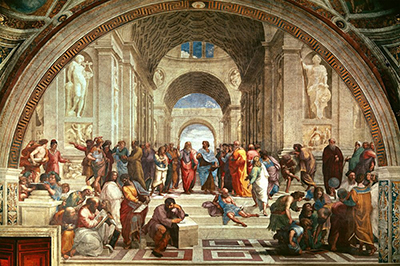
Raphael's School of Athens begins with a fiction. Philosophers who lived in different cities and different centuries have entered the same immense hall. Plato and Aristotle advance through its centre as though still absorbed in discussion. Socrates counts arguments on his fingers. Pythagoras bends over a book; Euclid stoops to demonstrate a geometrical proposition; Diogenes has abandoned every social formality and spread himself across the steps. Thought is made visible not as solitude but as a crowded, physical activity—spoken, written, calculated, disputed, taught and watched.
The setting is equally imaginary. It resembles no surviving academy in ancient Athens, yet it feels built rather than merely painted. Barrel vaults recede through a sequence of massive piers; statues occupy deep niches; a brilliant opening of blue sky closes the central axis. Raphael uses linear perspective to bring a multitude of bodies into a single, lucid order. The result is one of the defining images of the Renaissance, but its fame can obscure its strangeness. This is ancient philosophy reconstructed inside the papal palace by a painter in his twenties, for a room where theology, poetry and law occupied the other walls. The painted hall also borrows the language of classical architectural orders, even though it reconstructs no single ancient building.
At a Glance
- ArtistRaphael, with workshop assistance
- TitleThe School of Athens
- Dateapproximately 1509–1511
- MediumFresco
- LocationStanza della Segnatura, Vatican Palace, Vatican City
- WallTraditionally identified as the wall of Philosophy
- CommissionPope Julius II
- Central figuresPlato and Aristotle
- ProgrammeOne of four principal wall subjects devoted to Theology, Philosophy, Poetry and Justice
- Preparatory workA large surviving cartoon is in the Veneranda Biblioteca Ambrosiana, Milan[1][2][6]
Contents
- A Library Made into a World
- A Gathering Outside Historical Time
- Annotated Details
- Plato and Aristotle at the Centre
- Socrates and the Art of Argument
- Pythagoras, Number and Harmonic Order
- Diogenes on the Steps
- Heraclitus and the Michelangelo Problem
- Euclid, Geometry and the Work of Demonstration
- Globes, Cosmology and Raphael's Signature
- Architecture as an Argument
A Library Made into a World
The Stanza della Segnatura was the first of the Vatican rooms decorated by Raphael for Pope Julius II. It probably served Julius as a private library and study before later becoming associated with the papal tribunal known as the Segnatura Gratiae et Iustitiae. Books would once have stood beneath images that organised bodies of knowledge on the walls and ceiling. The decoration did not simply embellish a working room; it gave intellectual activity a monumental setting.[2][8]
The ceiling establishes the governing structure. Four female personifications represent Theology, Philosophy, Poetry and Justice. Each corresponds to the great composition below it: Theology to the Disputation of the Holy Sacrament, Philosophy to the School of Athens, Poetry to Parnassus, and Justice to the wall of the Cardinal and Theological Virtues and the Law. Smaller ceiling scenes and medallions extend the same network of ideas.[3]
This programme matters because The School of Athens was never intended to stand alone. Reproductions often detach it from the room, turning it into a universal poster of rational thought. In the Vatican, philosophy faces theology. Poetry occupies one adjoining wall; justice occupies the other. Raphael's ancient thinkers therefore belong to a larger argument about different kinds of knowledge and the forms through which truth becomes available.
The opposition between philosophy and theology is not necessarily hostile. The two walls are visually related through broad semicircular arrangements, elevated central zones and large assemblies whose many parts remain intelligible. Yet their worlds differ. In the Disputation, divine truth descends through a vertical order from God the Father to Christ, the Holy Spirit and the Eucharist. In the School of Athens, no divine revelation appears. Human beings reason, teach, observe and compare within a constructed earthly space.
Raphael was unusually young for such a commission. Born in 1483, he reached Rome after establishing himself in Umbria and Florence. Julius's project required him to work at a new scale and within a learned court that included theologians, humanists, architects and antiquarians. The fresco is not a painted transcript of one scholar's programme. It is the product of dialogue among patronage, learned counsel and Raphael's own extraordinary ability to convert abstract categories into bodies and space.
A Gathering Outside Historical Time
There was no historical meeting corresponding to this scene. Plato died before several of the philosophers traditionally identified in the fresco were born; figures associated with Greek, Hellenistic and later intellectual traditions occupy one continuous present. Raphael creates a community of knowledge rather than reconstructing an event.
That freedom allows him to arrange thinkers by kind of activity. The central pair walk and argue. Teachers gather listeners around them. Mathematicians work with diagrams, tablets and globes. Solitary figures withdraw into reflection. A few participants look outward, connecting the imagined assembly to the room occupied by Julius II and his visitors.
The common setting gives ancient thought an architectural home it never possessed in this form. The title School of Athens encourages the idea of an institution, but the fresco does not resemble a classroom with one master. It is closer to an ideal republic of inquiry. Knowledge has centres without having a single controlling figure. Plato and Aristotle dominate the axis, yet Pythagoras, Euclid and others establish competing local centres around the lower edges.
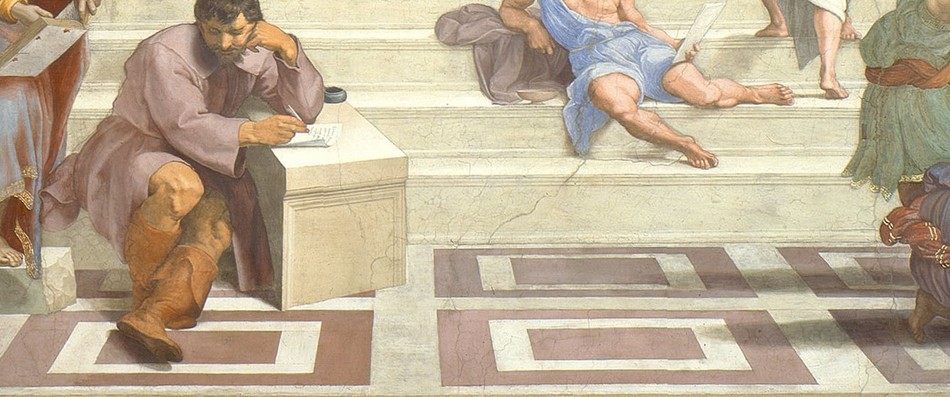
Raphael makes this plural structure easy to read through intervals. He does not distribute heads evenly. Figures condense into groups and then separate across small openings of floor or steps. The largest void surrounds Plato and Aristotle, giving their movement room to continue. Diogenes occupies the central steps but lies diagonally across them, interrupting the main procession without blocking it. Heraclitus withdraws into the foreground, close to the viewer yet psychologically remote.
This variety turns intellectual difference into bodily difference. Socrates is upright and argumentative. Pythagoras is bent over a text. Euclid's whole group leans toward the compass. Diogenes refuses decorum. Plato points; Aristotle extends his hand. Raphael does not need labels floating beside them. Attributes, gestures and relationships make many identities or philosophical roles legible.
Not every proposed name has equal authority. Over centuries, viewers have tried to identify almost every face. Some figures are secured by books, instruments, iconographic tradition or the Vatican's own record. Others remain plausible suggestions rather than facts. The fresco invites identification because it individualises so many heads, but a responsible reading must preserve the difference between recognition and speculation.[1][4]
Annotated Details from The School of Athens
The annotated view keeps the whole work in sight while isolating visible details that reward close looking. The source image is a public-domain Wikimedia Commons reproduction used only for this local close-reading feature.
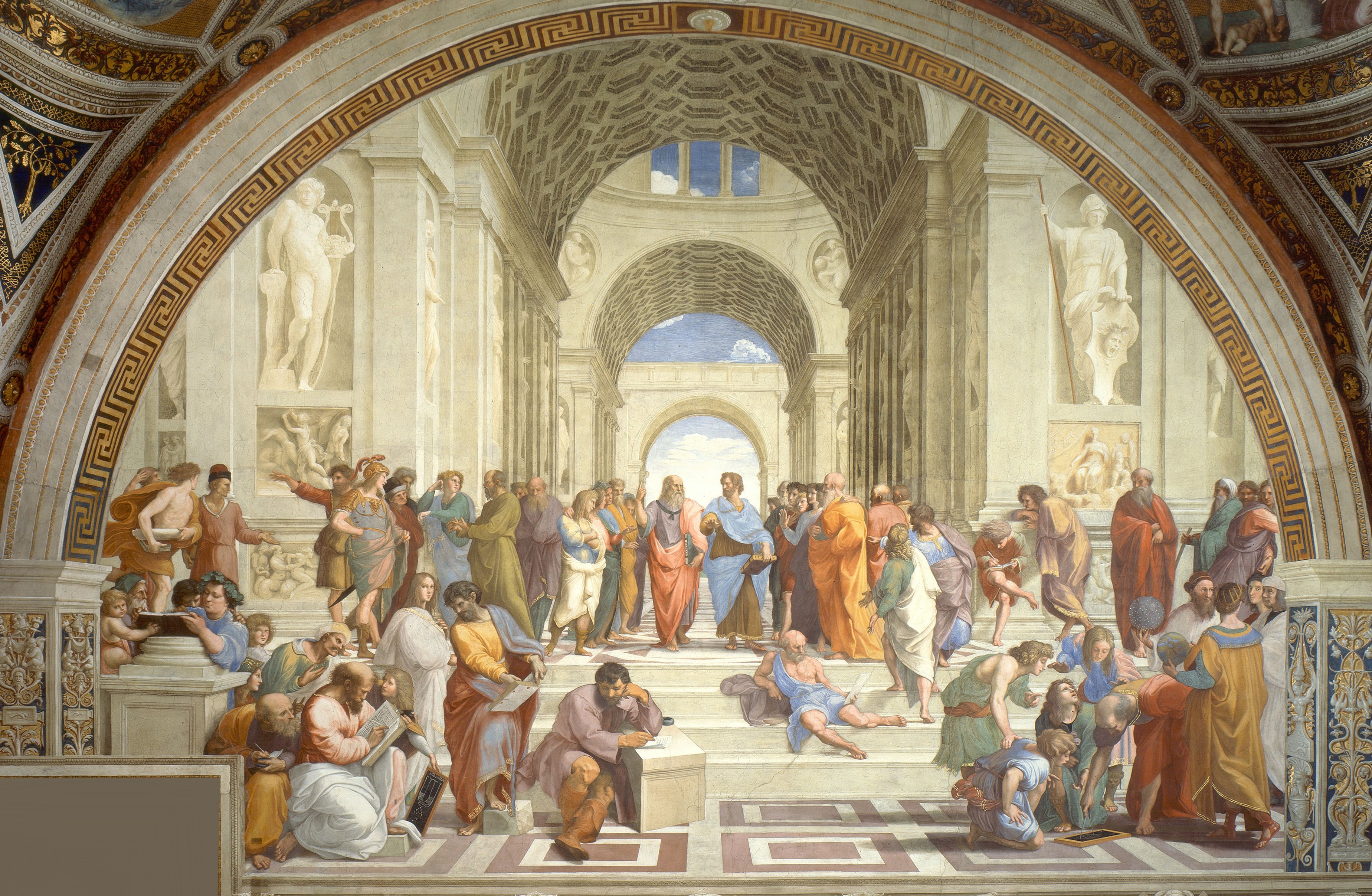
Details from THE SCHOOL OF ATHENS
Close looking highlights visible details in the work while keeping source and image posture controlled.
Plato and Aristotle
The central pair turns the fresco into a debate between upward, idealising thought and outward, worldly observation.
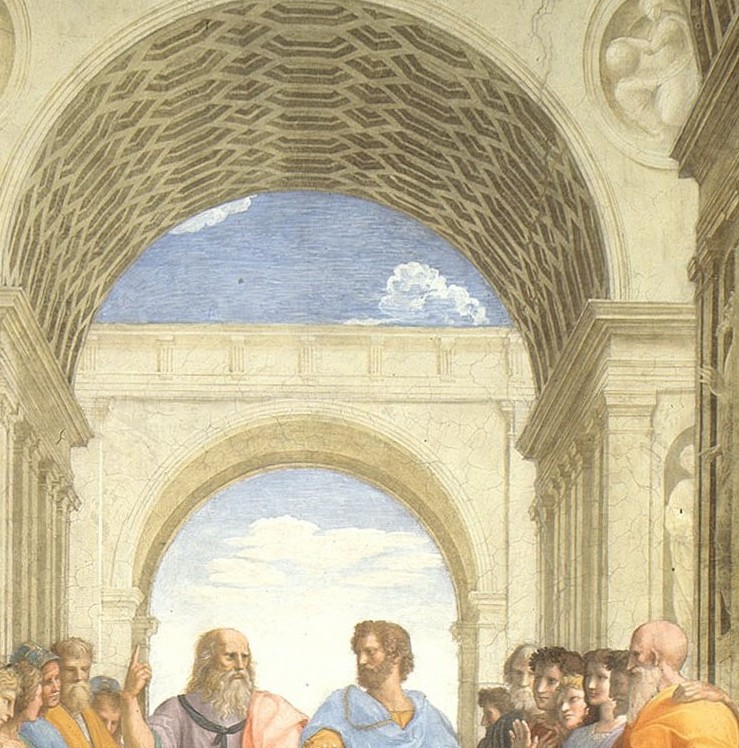
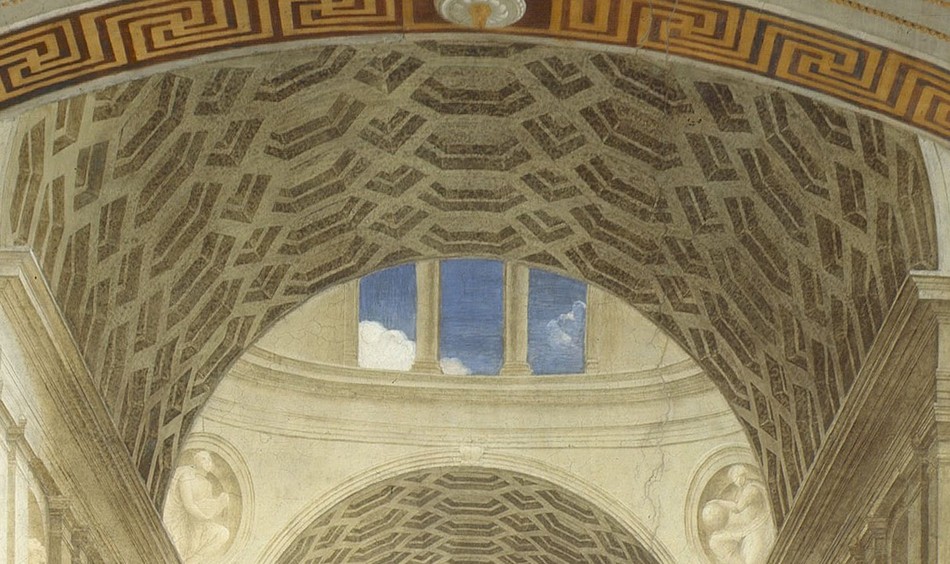
Architectural vanishing point
The coffered vault and distant arch draw the viewer's eye through the assembled thinkers.
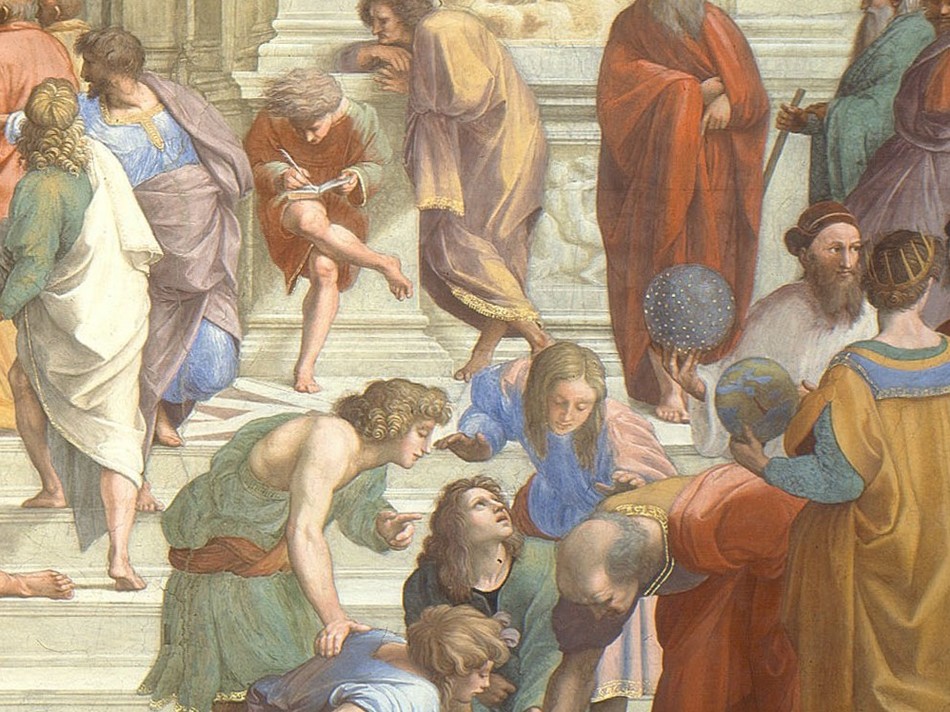
Euclid's demonstration
The bent figure at lower right anchors abstract knowledge in measured drawing and shared attention.
Pythagorean group
The writing and reading figures at lower left give mathematical thought its own compact theatre.
Diogenes on the steps
The solitary reclining figure interrupts the grand order with philosophical detachment.
Heraclitus figure
The brooding seated figure in the foreground slows the movement of the crowd.
Right-hand astronomers
Globes and turning heads make cosmic knowledge visible as exchange, not isolated possession.
Foreground pavement
The pavement's geometry stabilises the crowd and extends the painted architecture toward the viewer.
Plato and Aristotle at the Centre
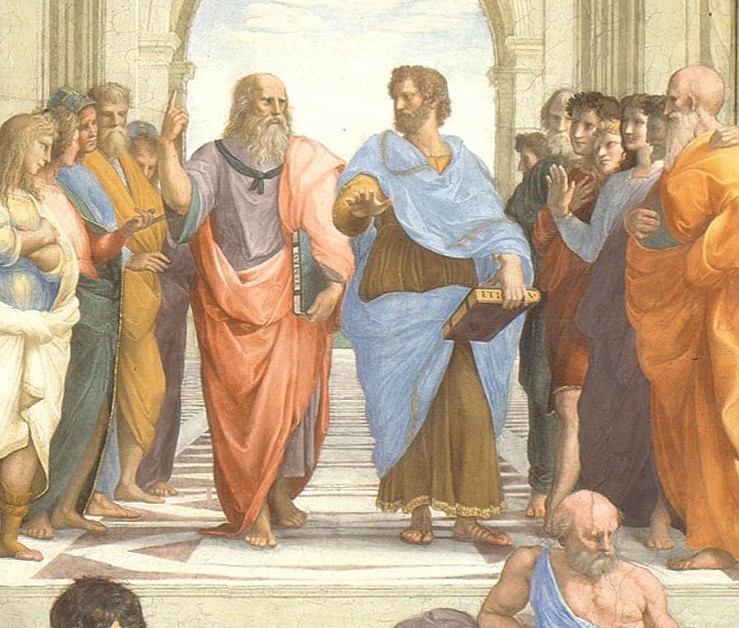
Plato and Aristotle enter from the depth of the hall, framed by the final arch and the patch of sky beyond it. They are not enthroned. They walk. The movement makes philosophy appear active and conversational, while the architectural axis gives their exchange exceptional weight.
Plato is the older man on the left. He carries the Timaeus and points upward with his right index finger. Aristotle, younger and more richly dressed, holds the Nicomachean Ethics and extends his right hand horizontally, palm downward. Their gestures have become a compact visual summary of two philosophical orientations: Plato directs attention toward transcendent form and intelligible reality; Aristotle measures knowledge through the world of experience, ethics and embodied life.[1][4]
The contrast is persuasive because Raphael avoids caricature. Aristotle does not point crudely at the ground, and Plato is not disengaged from the world around him. They move together, look toward one another and occupy the same path. Their disagreement is presented as a relationship. The fresco's central idea is therefore not that one must defeat the other, but that thought advances through the tension between different accounts of reality.
Their books sharpen the distinction. The Timaeus offered Renaissance readers a cosmological dialogue in which the visible universe and its ordered causes could be joined. The Ethics concerns the cultivation of human flourishing through action and habit. Raphael makes the titles readable enough to guide interpretation, turning bound volumes into intellectual attributes as decisive as the keys of a saint or the weapon of a hero.
Colour helps separate the two men while binding them to the larger composition. Plato's garments combine warm and cool notes; Aristotle's blue and earth-toned drapery gives his broad gesture material gravity. The repeated reds, blues, greens and golds across the surrounding groups prevent the centre from becoming an isolated emblem. Their debate radiates outward through a community already practising many forms of knowledge.
The familiar claim that Plato's face is a portrait of Leonardo da Vinci remains attractive, especially because Raphael had studied Leonardo's work in Florence and because the long-haired, bearded type resembles later images of the older artist. Yet the resemblance should not be treated as a documented sitting. Raphael may have used the visual authority of a contemporary sage to give an ancient philosopher presence without intending a literal portrait in the modern sense.
Aristotle is sometimes said to embody a more youthful, worldly counterweight. His broad stride and open hand do carry a different energy from Plato's vertical gesture. But the two bodies are carefully balanced. One arm rises while the other settles; one book stands upright while the other lies more horizontally; one robe falls in long folds while the other spreads across the moving legs. Raphael makes philosophical contrast inseparable from compositional harmony.
Socrates and the Art of Argument
On the left, Socrates appears in profile, bald-headed and compact, wearing a green garment. He addresses a group that includes a young soldier. His hands are the centre of the exchange. One finger after another marks the progression of an argument, turning dialectical reasoning into a visible count.[1]
Socrates wrote no philosophical treatise. His ideas are known through the accounts of others, especially Plato, and the act of questioning is fundamental to his afterlife. Raphael therefore gives him neither a grand book nor an isolated monument. He exists through conversation. The surrounding listeners complete his identity.
The soldier is often identified as Alcibiades, the brilliant and controversial Athenian associated with Socrates in Plato's dialogues. Other names have been proposed for figures nearby. The specific identifications may remain open, but their social variety is clear. Philosophy addresses men of action as well as professional scholars. Armour enters the academy without transforming the scene into history painting.
The group is tightly organised. Socrates turns toward his companions while standing across the dominant left-to-right flow. His compact gestures make a small theatre of reasoning within the larger hall. Faces respond differently: attention, calculation and uncertainty appear around him. Raphael shows argument as a sequence received by several minds rather than as a speech delivered to a passive crowd.
His placement also distinguishes speech from writing. Below him, Pythagoras works over a book and tablet. At the centre, Plato and Aristotle carry canonical texts. Socrates has only his body and listeners. In a room probably used as a library, Raphael gives oral philosophy a force equal to the written page.
Pythagoras, Number and Harmonic Order
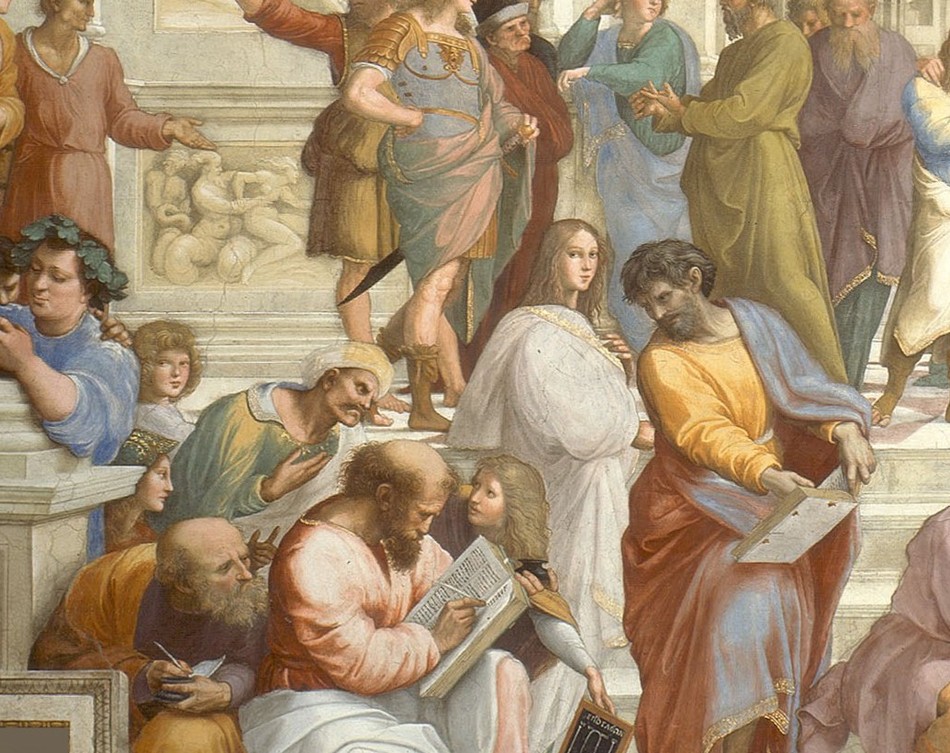
The lower-left group gathers around Pythagoras. He writes in a large book while a youth presents a tablet. The tablet contains diagrammatic and numerical material associated with musical harmony. Other figures lean close enough to create an intimate enclosure of shoulders, hands and concentrated gazes.[1][4]
Pythagoras stands at a fertile intersection in the room's programme. Number governs proportion, musical interval and cosmic order. His presence therefore belongs to philosophy, but it also reaches toward the poetry wall, where Apollo plays a bowed instrument among the Muses. Raphael's programme does not lock every discipline inside one compartment; correspondences pass across the room.
The book is physically substantial. Its open leaves establish a bright plane near the bottom of the fresco, while the writing hand gives the group a precise focus. Learning appears to occur through notation, copying and demonstration. The surrounding men do not merely admire Pythagoras; they look at the object through which knowledge is being made communicable.
A turbaned figure leans into the group and is often identified as Averroes, the medieval Andalusi philosopher whose commentaries played a major part in transmitting and interpreting Aristotle. The proposed identification broadens the fresco beyond classical Greece. Whether every name is secure or not, the visual type acknowledges that ancient knowledge reached Renaissance Europe through long histories of translation and commentary.
At the edge of the group, a standing figure in white has generated especially persistent debate. Modern popular accounts sometimes identify this person as Hypatia, the Alexandrian mathematician and philosopher. Other proposals include Francesco Maria della Rovere or a generic ideal youth. No attribute settles the matter. The desire to find Hypatia is understandable, particularly in a scene so dominated by men, but desire cannot substitute for evidence. The figure is best left with an openly debated identity.
This uncertainty does not make the figure insignificant. The direct gaze interrupts the inward concentration of the Pythagorean group and acknowledges the viewer. Raphael uses such outward looks sparingly. They turn the ancient assembly into a porous fiction, one that can include the papal court—and us—without pretending that every participant can be named.
Diogenes on the Steps
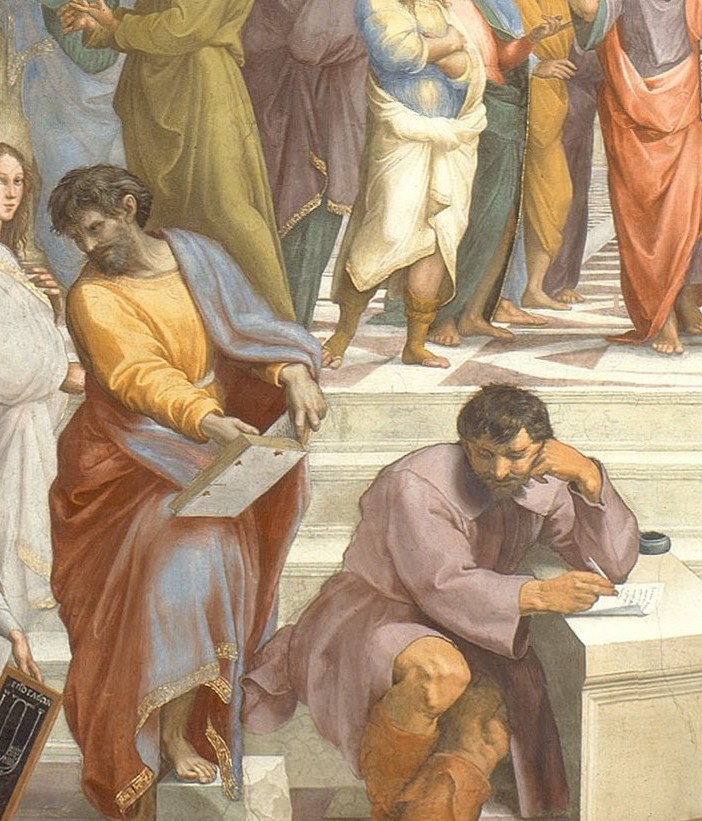
Diogenes lies alone across the centre steps, dressed in a loose blue garment and absorbed in a sheet or book. His isolation is spatial, social and philosophical. Associated with Cynic rejection of convention and material excess, he refuses the decorum observed by nearly everyone else.
Raphael makes the refusal structurally important. The steps form the path along which Plato and Aristotle move toward the viewer. Diogenes occupies that path diagonally, forcing the eye to negotiate around him. He belongs at the centre while declining to join the central procession.
His pose is open and almost untidy. One leg extends down the step; the other bends. An elbow supports his upper body while the page rests casually before him. The surrounding architecture is monumental, but he requires almost nothing from it. The contrast between the splendour of the papal interior and a philosopher famous for radical simplicity would have been impossible to miss.
Yet Raphael does not mock him. Diogenes receives generous space and a powerful silhouette. His independence provides a pause between the crowded lower groups and the central pair. The fresco's order is capacious enough to include someone who resists ordered society.
The page in his hand introduces a productive contradiction. A philosopher remembered for rejecting convention is represented through reading or writing. Raphael may be less concerned with literal biography than with making contemplation visible. The body is detached from the crowd, but the mind remains active.
Heraclitus and the Michelangelo Problem
In the immediate foreground, a brooding figure rests his head on one hand and writes on a block of stone. He is traditionally identified as Heraclitus, the philosopher of flux, opposition and hidden order. The Vatican identifies his features with Michelangelo.[1]
This figure differs markedly from those around him. The pose is heavier, the boots more emphatic, the drapery broader and more sculptural. He bends into himself rather than toward a teaching group. The stone support projects forward like a block waiting to be carved.
The connection with Michelangelo has a compelling Roman context. While Raphael worked in the papal apartments, Michelangelo was painting the Sistine Chapel ceiling. The two artists were engaged in Julius II's most ambitious visual projects, and later biography turned their relationship into a rivalry. Heraclitus can therefore be read as both ancient philosopher and contemporary artistic presence.
The figure appears not to have occupied the same form in the surviving Ambrosiana cartoon, and it is commonly understood as a late addition to the painted composition. That difference has encouraged the idea that Raphael responded to Michelangelo's developing ceiling after gaining access to it. The precise sequence is difficult to reconstruct as an anecdote, but the material comparison between cartoon and fresco confirms that the figure entered through revision rather than being fixed from the earliest complete design.[4][6][7]
Raphael does not imitate Michelangelo everywhere in the fresco. He inserts a body whose compact monumentality and inward pressure feel deliberately different from his own more social rhythms. The contrast is respectful, competitive and assimilative at once. Michelangelo's manner becomes one voice inside Raphael's parliament of styles.
Heraclitus also changes the foreground. Without him, the lower centre would open more directly toward the steps. His large body and stone block create a visual threshold. Thought has literal weight here. The writing hand moves slowly; the head bears down; the body turns philosophical melancholy into something nearly sculptural.
Euclid, Geometry and the Work of Demonstration
At lower right, a bald teacher bends over a slate and uses a compass to demonstrate a geometrical figure. Four youths gather around him in a sequence of reactions. One leans close, another watches from above, and another appears ready to follow the operation. The Vatican identifies the teacher as Euclid, with features associated with the architect Donato Bramante.[1]
The group is among Raphael's clearest accounts of teaching. Geometry is not represented by an emblem suspended in the air. It happens through a tool, a surface and shared attention. The teacher's wide stance stabilises the action while his shoulders form an arch over the diagram.
The students make understanding visible as a process. Their heads descend toward the slate at different angles; their gazes converge without becoming mechanically identical. The compass describes a small arc that echoes the vast curves of the architecture behind them. Measurement at the scale of the hand corresponds to order at the scale of the building.
Bramante's possible presence deepens that connection. As the architect associated with Julius II's rebuilding of St Peter's and as a fellow Urbinate at the papal court, he embodied practical geometry, ancient study and contemporary invention. Raphael later became an architect himself. Whether the face is treated as a portrait or a respectful likeness, the group joins mathematical knowledge to the designed environment surrounding it.
The identification is sometimes given as Archimedes rather than Euclid. Both names reflect the figure's role as mathematical demonstrator. The Vatican's current label provides the best public anchor, while the history of alternatives reminds us that Renaissance attributes often define a field of knowledge more securely than one historical person.
Globes, Cosmology and Raphael's Signature
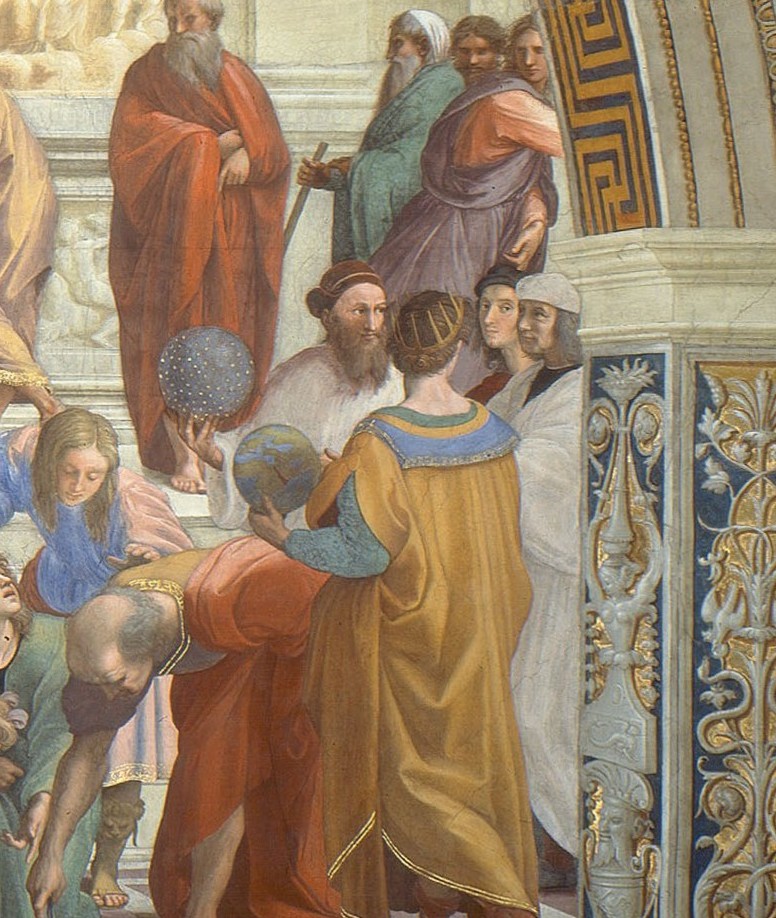
Behind the geometry group, two standing men hold spheres. One faces the viewer with a celestial globe and is identified as Zoroaster; the other, seen largely from behind, holds a terrestrial globe and is identified as Ptolemy. Their objects extend philosophy from number and geometry to the structure of the heavens and earth.[1]
The pairing is intellectually dense. Renaissance readers associated Ptolemy with astronomy, geography and the mapping of the world, even though modern viewers may first think of his geocentric cosmology. The crowned figure's back is turned, so his identity depends heavily on attribute and tradition. Zoroaster, dressed in white, presents the starry sphere more openly.
At the extreme right, Raphael inserts himself. His dark cap and calm, youthful face appear beside another figure often identified as the painter Sodoma. Raphael does not occupy the centre or claim an ancient philosopher's full body. He joins at the margin and looks out.[1]
The self-portrait is modest in scale but bold in implication. A painter responsible for this assembly places artistic intelligence among the forms of knowledge the fresco celebrates. He is both maker and witness, outside the ancient fiction by date yet inside it by invention.
His quietness is part of the claim. Raphael does not enlarge himself or borrow the commanding gesture of a philosopher. Authorship is expressed through attention: he notices the viewer while the world he designed continues around him.
His gaze reverses the normal relation between artwork and spectator. We look at Raphael's creation and discover Raphael looking back. The encounter makes authorship present without breaking the scene's order. He does not hold a brush; the fresco itself is the evidence of his art.
The placement beside the globes is also suggestive. Painting constructs worlds through proportion, perspective, colour and observation. Raphael's face appears where cosmology, geometry and representation converge. The artist does not need to be labelled “Painting” as an abstract faculty. His work demonstrates the discipline.
Architecture as an Argument
The hall is one of the fresco's principal protagonists. Massive piers divide the space into bays. Coffered barrel vaults rise above them, and a great central arch frames the sky. Statues of Apollo and Minerva occupy niches, linking reason to divine patrons of intellectual and artistic culture.[1][4]
No exact ancient building has been copied. The space combines Roman imperial scale with contemporary architectural imagination. Its pale stone, broad arches and coffering recall ruins, baths and basilicas, while its centralised sequence belongs to the ambitions of High Renaissance Rome.
The relation to Bramante and the new St Peter's is often emphasised. Julius II had laid the foundation stone of Bramante's basilica in 1506, and the project became the largest architectural enterprise of the papal court. Raphael's hall does not provide a literal record of the unfinished church. It evokes the same culture of building: ancient Roman authority renewed through modern design.[4][8]
Perspective makes that culture intelligible. Orthogonals in the pavement and architecture move toward a vanishing region between Plato and Aristotle. The eye is drawn to the central pair not only by their position and gestures but by the geometry of the entire hall. Philosophy stands at the point where a constructed world becomes coherent.
Raphael avoids making the perspective rigid. Bodies cross the pavement lines, gather against piers and interrupt the steps. The architecture supplies order; the figures supply local variation. This balance prevents the fresco from becoming a diagram populated by mannequins.
The scale of the building exceeds ordinary need. Philosophers do not require such enormous vaults to converse. Monumentality is rhetorical. It gives intellectual activity the public grandeur of imperial and sacred architecture. Julius's private library becomes, imaginatively, a civilisation devoted to knowledge.
The open sky is crucial. After several receding arches, the blue interval relieves the pale masonry and gives the central figures an atmospheric halo without using a supernatural light. Plato's raised finger approaches this opening, while Aristotle's horizontal hand remains against the architecture and crowd. The setting itself participates in their contrast.
From Drawing to Fresco
Raphael's apparent ease was supported by extensive preparation. The great surviving cartoon in the Biblioteca Ambrosiana is the most spectacular evidence. Made from many joined sheets, it preserves a near-full-scale design for the principal figures. Its black-chalk forms show how Raphael organised the crowd before transferring the composition to wet plaster.[6][7]
A cartoon is not a small sketch enlarged mechanically at the last moment. It operates at the scale of execution. Drapery edges, heads, limbs and group relationships can be tested against the actual dimensions of the wall. Transfer leaves physical evidence through incising, pricking or related methods, although different areas and campaigns may use different procedures.
The Ambrosiana cartoon also shows that preparation did not end invention. Comparison with the fresco reveals changes and additions. Heraclitus is the most famous, but adjustments across groups demonstrate that Raphael remained responsive during execution. The cartoon was an authoritative stage, not an untouchable final command.
Smaller studies addressed individual figures and problems before the full-scale design. Surviving sheets associated with the Vatican rooms reveal rapid searches for pose, drapery, head direction and group rhythm. Recent Metropolitan Museum research places these drawings within a process in which observation, antique models, memory and live invention continually interact.[9][10][11]
Fresco imposes its own rhythm. Pigment is applied to fresh plaster in manageable sections, commonly discussed as giornate, because the surface must remain workable. A composition this large could not be painted as one continuous wet field. Planning had to anticipate daily divisions while allowing joins to disappear within forms and architecture.
Workshop participation was essential to a papal campaign of this scale. Assistants could prepare surfaces, transfer designs and execute portions under Raphael's direction. Attribution within a fresco cycle is therefore more complex than the single name attached to a portable panel. Raphael's authorship lies in the conception, controlling design and decisive passages, while the material object records organised collaboration.[5]
Conservation research has made this process increasingly visible. Examination of plaster, pigment, transfer marks and later intervention can distinguish original technique from restoration. Such evidence does not diminish the fresco's imaginative power. It explains how that power became physically possible.
Bodies, Antique Models and Contemporary Rome
The fresco celebrates antiquity without pretending to archaeological neutrality. Raphael and his circle studied ancient sculpture, reliefs, buildings, coins and literary descriptions. They also looked at living bodies and contemporary art. The resulting philosophers feel ancient because their world has been invented from many kinds of evidence rather than copied from one source.[4][9]
Diogenes recalls reclining figures known from antique art, but his loose asymmetry serves a specific philosophical character. The muscular bodies around the lower groups carry sculptural authority without becoming quotations displayed for recognition. Apollo and Minerva occupy architectural niches like ancient cult or civic statues, yet they preside over a Christian papal library.
Contemporary faces further collapse time. Bramante may appear as Euclid; Michelangelo appears as Heraclitus; Raphael shows himself at the margin; Plato may carry echoes of Leonardo. These likenesses do not turn the fresco into a disguised group portrait. They make antiquity present by allowing modern creative intelligence to inhabit ancient roles.
This strategy reflects a Renaissance understanding of imitation. To imitate a respected model was not necessarily to reproduce it passively. The artist selected, transformed and brought several examples into a new order. Raphael's fresco makes that process visible at the largest scale: philosophical histories, Roman forms and contemporary bodies become a world none of them could produce alone.
The papal setting adds a further layer. Ancient philosophy is not shown as an enemy defeated by Christianity. It receives one of the room's four monumental walls. Yet it is framed within a programme commissioned by the pope, opposite an explicitly Eucharistic vision. The relationship is one of incorporation, distinction and debate.
Colour, Rhythm and the Experience of Knowledge
The fresco is often reproduced primarily as a composition of lines, but colour is indispensable. Clear reds, blues, greens, ochres and whites distinguish participants while creating correspondences across distance. A blue garment on one side answers another blue across the centre; warm robes step forward against pale stone; white catches the eye at moments of intellectual or spatial transition.
Raphael uses drapery to make thinking rhythmic. Plato's vertical gesture is extended by long folds. Aristotle's mantle opens with his arm. Socrates' compact clothing suits his enumerating hands. Diogenes' blue cloth spreads with his body. Heraclitus' heavy folds intensify withdrawal. The geometrical students create a knot of bent backs and sleeves around the slate.
No single tempo controls the wall. The central pair advance slowly. Socrates speaks in measured beats. Pythagoras writes. Diogenes pauses. Euclid demonstrates. The globe bearers stand. Raphael turns intellectual diversity into a choreography of attention.
The viewer participates in that choreography. At a distance, the architecture and main groups are immediately legible. Closer looking reveals attributes, glances and smaller exchanges. Repeated study produces a sequence: first order, then plurality, then uncertainty. The fresco rewards both overview and inspection because philosophy itself moves between systems and particulars.
The image also invites an imagined soundscape. Socrates speaks, pages shift, a compass touches its tablet and clustered students murmur, yet the vast architecture seems to absorb those sounds. Raphael paints no orator addressing the whole assembly. Speech remains local, passed through small circles. The scale of the hall and the intimacy of the conversations work against one another, making philosophical life feel both civic and personal.
Its position in a room intensifies the experience. A visitor cannot see every wall frontally at once. Turning from theology to philosophy or from poetry to justice activates the programme through the body. Knowledge is distributed around the viewer, not flattened into one image.
The Afterlife of an Ideal Academy
Before following the fresco into its later fame, it is worth asking what sort of community Raphael has actually imagined. The assembly is expansive in chronology and intellectual method, but it is not inclusive in a modern sense. Almost every securely identified participant is male, and the ancient Mediterranean world is filtered through the interests of a sixteenth-century papal court. The disputed identification of the white-clad figure near Pythagoras as Hypatia has become popular partly because it answers a genuine absence. Yet naming one ambiguous face cannot turn the fresco into a documentary gathering or resolve the historical limits of its canon.
Those limits are part of the work's history. Renaissance humanists recovered ancient texts through particular institutions, languages, handwritten copies and commentarial traditions. The philosophers most useful to Christian theology, courtly education, mathematics and the liberal arts naturally acquired exceptional visibility. Raphael's gathering reflects this learned environment. It is universal in aspiration, not comprehensive in fact.
The same distinction applies to geographical breadth. Athens supplies the traditional title, but the figures and intellectual histories exceed the city. Pythagorean traditions developed across the Greek world; Zoroaster belongs to a much larger history of European imaginings about Persian wisdom; Averroes, if that identification is sustained, represents the Arabic transmission and interpretation of Aristotle; Ptolemy worked in Roman Egypt. “Athens” functions as an emblem of ancient philosophy rather than a precise map.
Raphael's decision to give so many figures individual faces complicates the ideal. A purely allegorical painting could have represented branches of knowledge with a small number of personifications. Here, thought seems to require personality. People disagree because they have different bodies, temperaments, tools and social habits. The monumental programme becomes credible through small incidents: a student cranes his neck; a reader steadies a page; a listener watches a counting hand; one philosopher lies where others walk.
The range of ages is equally important. Bearded elders, mature teachers and smooth-faced youths share the hall. Knowledge passes between generations rather than appearing fully formed in one authoritative mind. Several younger figures are defined chiefly through attention. They bend toward books and diagrams, learning how to look before they possess attributes of their own.
Raphael also makes room for refusal. Diogenes does not join a seminar; Heraclitus does not turn toward a group. Their solitude prevents the fresco's social ideal from becoming compulsory harmony. A community of thought must include the person who withdraws from it and the thinker whose melancholy resists easy exchange.
Seen this way, the fresco's order is not the absence of conflict. Plato and Aristotle disagree; schools of thought gather separately; social and solitary philosophies coexist. Architecture gives those differences a common measure without resolving them. The enduring appeal of the image lies partly in that balance. It offers intellectual community as a designed achievement—spacious enough for argument, precise enough to prevent the crowd from becoming noise.
The School of Athens rapidly became a model of monumental composition. Drawings, engravings, paintings, casts, photographs and textbooks carried it far beyond the Vatican. Its central pair could be isolated as an emblem of philosophical difference; its full assembly could represent education, civilisation or the Renaissance itself.
That afterlife has simplified the fresco as often as it has celebrated it. Reproductions can make every proposed identity seem certain. The Christian papal room disappears. The physical labour of fresco and workshop collaboration gives way to the myth of effortless genius. The architecture becomes a neutral grand backdrop rather than part of Julius II's rebuilding culture.
The surviving cartoon offers a different kind of afterlife. Preserved and displayed in Milan, it lets viewers encounter Raphael's design as a material object of joined paper, chalk, revision and conservation. The Ambrosiana's 2019 redisplay foregrounded both its fragility and its importance as a work in its own right.[6][7]
Modern technical research has likewise moved attention from iconographic decoding toward making. Pigment, plaster, transfer and conservation reveal a fresco that has endured change. The more famous the image becomes, the more valuable this material evidence is: it returns an icon to the particular wall, room and campaign from which it came.[5]
The fresco remains powerful because it can sustain these corrections without losing its invitation. Raphael imagines knowledge as a common space in which disagreement does not dissolve order. Bodies cluster around problems; teachers need students; books meet gestures; mathematics meets architecture; solitude remains possible within community.
The academy is fictional, but its social hope is real. Thinking can take different forms and still occupy one world.
Artist Up Close
Look first at the small patch of blue sky above Plato and Aristotle. It is easy to miss because the architecture appears so dominant. Yet this opening prevents the centre from closing into stone. Plato's finger rises toward it; the two heads are silhouetted against its light; the eye receives a moment of distance after travelling through repeated arches.
Then move down to the hands. Plato points, Aristotle levels, Socrates counts, Pythagoras writes, Diogenes holds a page, Heraclitus supports his head and records a thought, Euclid turns a compass, Zoroaster and Ptolemy support spheres. Raphael has painted a history of philosophy through manual actions. Knowledge is not only stored in faces or books. It happens through bodies handling the world.
Finally, find Raphael at the far right. His face is quieter than the great gestures around him. He does not interrupt. By placing himself inside the crowd, he suggests that painting belongs among the intellectual practices the room honours—not because the artist claims to be Plato, but because the whole coherent fiction has been made through design.
Frequently Asked Questions
Discussion
What detail most changes how you read The School of Athens?
Reader Insights
Which source detail gives the page its strongest anchor?
Which visual or historical distinction should readers keep in mind?
How does this page change the wider picture of Raphael's career?
Join the Conversation
Share your reading below.
References
- Vatican Museums, “School of Athens,” official object page. View source.
- Vatican Museums, “Room of the Segnatura,” official room and programme record. View source.
- Vatican Museums, “Ceiling,” official account of the four faculties and their corresponding walls. View source.
- Vatican Museums, “Raffaello,” Face to Face with Masterpieces series, 2026. View source.
- Barbara Agosti and Silvia Ginzburg, foreword to Raphael in Rome: Style, Technique, Conservation, Edizioni Musei Vaticani. View source.
- Veneranda Biblioteca Ambrosiana, “School of Athens — Preliminary Cartoon,” official collection record. View source.
- Veneranda Biblioteca Ambrosiana, “Il Raffaello dell'Ambrosiana. In principio il Cartone,” conservation and redisplay account. View source.
- Department of European Paintings, Metropolitan Museum of Art, “The Papacy and the Vatican Palace,” Heilbrunn Timeline of Art History. View source.
- Ingrid D. Rowland, “Raphael and Antiquity,” Metropolitan Museum of Art, 16 June 2026. View source.
- Metropolitan Museum of Art, “Drawings for the Vatican Palace,” audio-guide transcript for Raphael: Sublime Poetry, 2026. View source.
- Metropolitan Museum of Art, “Raphael: Sublime Poetry,” official exhibition overview and research summary, 2026. View source.