

 by Tom Gurney
Tom Gurney BSc (Hons) is an art history expert with over 20 years experience
Published on June 19, 2020 / Updated on August 21, 2026
Email: tomgurney1@gmail.com / Phone: +44 7429 011000
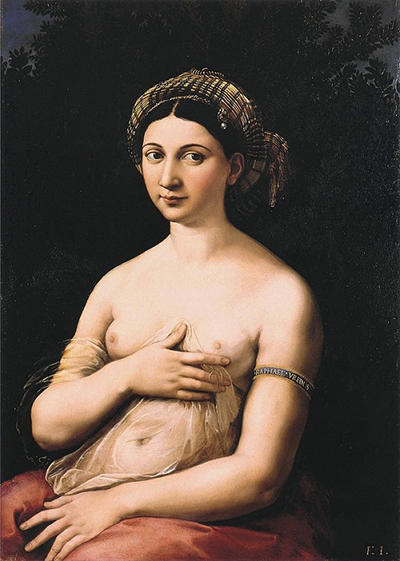
Raphael's La Fornarina is both one of the Renaissance's most intimate images and one of its most persistent biographical traps. A young woman sits half-dressed before myrtle and quince, meeting the viewer while her hands partly cover and partly display her body. A blue band around her upper arm bears the gold inscription RAPHAEL URBINAS.[1]
Tradition identifies her as Margherita Luti, the baker's daughter said to have been Raphael's lover. No surviving document securely names the sitter, and the familiar title came later. The painting can evoke a living beloved without turning legend into a birth certificate.
It also presents more than an ordinary likeness. Her hand pose recalls the ancient Venus pudica, while myrtle and quince belonged to the goddess of love and to fertility. Portrait, ideal beauty and erotic mythology remain deliberately entangled.[1]
At a Glance
- ArtistRaphael
- TitleLa Fornarina, also called Portrait of a Young Woman
- Dateabout 1520
- CollectionGallerie Nazionali di Arte Antica, Palazzo Barberini, Rome
- Inventory2333
- Mediumoil on wood
- Dimensions87 × 63 cm
- Traditional sitterMargherita Luti, said to be a baker's daughter and Raphael's beloved
- Sitter certaintyunproven
- Principal visual typehalf-length woman with the hand pose of a modest Venus
- Signature
RAPHAEL URBINASon the blue upper-arm band - Botanical symbolsmyrtle and quince, associated with love and fertility
- Related worka close early copy in the Galleria Borghese, attributed to Raffaellino del Colle
Contents
- A famous name without a secure identity
- Margherita Luti
- Vasari and Raphael's love life
- No known commissioner
- Raphael's final years
- A half-length encounter
- The direct gaze
- The Venus pudica pose
- Portrait or Venus?
- The exposed breast
A famous name without a secure identity
“Fornarina” means a female baker or, by tradition, the daughter of a baker.
The name has encouraged generations to imagine a specific young woman from Trastevere called Margherita Luti. The story supplies class contrast, romance and a picturesque Roman setting.
The evidence is less complete. The museum presents the identification as tradition, not documented certainty.[1]
The sitter may have been known to Raphael, but the painting itself does not state her civil name.
Margherita Luti
Margherita Luti is commonly described as the daughter of a Sienese baker living in Rome.
She became the central figure in stories about Raphael's emotional and sexual life. Later writers connected her with his models, his refusal or delay in marrying Maria Bibbiena and even his death.
Those narratives combine early anecdotes, later archival discoveries and romantic invention.
They can be studied as reception history while the portrait identity remains open.
Vasari and Raphael's love life
Giorgio Vasari described Raphael as strongly inclined toward women and told a story about his distraction during work for Agostino Chigi.
According to Vasari, the artist worked better when the woman he loved was allowed to remain nearby. He also mentioned a beautiful portrait of her.
Vasari did not provide the modern chain of proof that would securely identify La Fornarina as Margherita Luti.
His account helped create the biographical frame, but it must be read as sixteenth-century artist biography rather than sworn testimony.
No known commissioner
No patron is securely recorded for the painting.[1]
That absence has encouraged the idea that Raphael made it for himself. A private purpose would suit the directness of the image and the artist's name placed against the sitter's skin.
Absence of a contract, however, is not proof of a love affair. Many records have been lost, and portraits could move away from their original context.
The commission remains unknown, making privacy plausible but not certain.
Raphael's final years
The work dates to about 1520, near the end of Raphael's short life.[1]
He was then directing a large workshop and balancing paintings, Saint Peter's, antiquarian study and major designs. His late portraiture combines extraordinary surface control with concentrated psychological presence.
Raphael died on 6 April 1520. The painting may have remained in his studio at that time, although the precise circumstances require cautious phrasing.
Its nearness to his death has intensified the desire to read it as a final personal confession.
A half-length encounter
The woman occupies nearly the entire panel.
Her head turns gently while shoulders, arms and torso establish a broad triangular stability. The low placement of one arm and the raised hand at her breast organise the exposed body.
There is no elaborate room or distant view to absorb attention. Dark foliage presses close behind her.
The composition creates intimacy without pretending the viewer has caught an unposed moment.
The direct gaze
Her eyes meet the spectator with calm alertness.
The gaze does not read simply as invitation, shyness or defiance. Its steadiness coexists with a carefully arranged pose and controlled expression.
That ambiguity gives the painting much of its durability. Viewers feel addressed but cannot define the relationship.
The sitter becomes both subject and observer, returning the look directed at her body.
The Venus pudica pose
One hand rises toward the breast while the other rests across the lower body.
The arrangement recalls ancient statues of the Venus pudica, in which the goddess covers herself while drawing attention to what she conceals.[1]
Raphael adapts that paradox to a half-length living woman. Modesty and display become the same gesture.
The classical reference makes the image erotic without reducing it to nudity alone.
Portrait or Venus?
The choice need not be absolute.
Distinctive features and direct presence encourage portrait reading. The hand pose, plants and idealised presentation encourage identification with Venus or a woman fashioned as Venus.
Renaissance portraits could use mythological attributes to elevate a sitter. Images of ideal beauty could begin from an observed model.
La Fornarina gains power by holding likeness and type together.
The exposed breast
The translucent garment leaves one breast uncovered while the other is partly veiled and touched by the hand.
This asymmetry avoids a static display. Fabric, flesh and gesture produce a sequence in which concealment is temporary and theatrical.
The exposed body has often been used to assign the sitter a social category—from lover to courtesan—but costume alone cannot establish biography.
The image is constructed through classical erotic convention as well as observation.
The transparent veil
A nearly weightless veil crosses the torso and gathers around the body.
Raphael paints transparency by allowing flesh tones to remain visible beneath pale, cool passages. Edges and folds indicate material that is present but difficult to separate from skin.
The veil both dresses and undresses the sitter.
Its technical delicacy heightens the conceptual uncertainty between modest covering and sensuous revelation.
The coral-red textile
A richer coral or red cloth rests across the lower part of the composition.
Its saturated colour anchors the pale body and transparent veil. Folds catch light with a silk-like sheen, introducing luxury into the otherwise sparse setting.
Red also carries associations with desire, warmth and material value, though no single symbolic code is required.
The textile provides a visual threshold between viewer and sitter.
The blue armlet
The band around the upper left arm is the painting's most extraordinary identifying device.
Gold letters spell RAPHAEL URBINAS, Raphael of Urbino.[1] The signature appears not on a neutral ledge but on something touching the woman's skin.
It asserts authorship while seeming to bind sitter and artist physically.
That intimacy has encouraged readings of pledge, possession, affection and artistic creation.
Signature or bond?
At minimum, the inscription names the painter.
Its placement invites more. An armlet can resemble a token of attachment, and the museum describes it as both signature and pledge of love.[1]
Modern viewers should also notice the possessive implications of a man's name around a woman's body. The image may celebrate connection while asserting artistic control over her representation.
Meaning lies in this tension rather than in one decoded answer.
The ring question
Technical examinations have prompted claims that a ring was concealed on the woman's left hand.
Some writers interpret it as evidence of engagement or secret marriage. That conclusion goes beyond what a ring alone can prove, especially when its date, alteration and precise form are debated.
The Borghese copy lacks a comparable visible ring, a difference noted by its catalogue.[2]
The safest reading treats the feature as material evidence whose marital meaning remains speculative.
Myrtle
Myrtle grows in the dark background.[1]
The evergreen was sacred to Venus and associated with love, marriage and fertility. Its presence supports the goddess-like reading of the sitter.
The leaves also create a dense pattern around the head, replacing a distant landscape with an intimate bower.
Botany functions as both symbol and pictorial enclosure.
Quince
A branch of quince appears among the foliage and carries associations with fertility and marriage.[1]
Classical and Renaissance traditions linked the fruit with Venus and bridal customs. Beside the myrtle, it strengthens the vocabulary of love.
Symbolic plants do not identify Margherita Luti by name.
They define the realm in which the woman is represented: erotic beauty, union and generative abundance.
Flesh against foliage
The cool, dark green background makes the sitter's skin appear especially luminous.
Edges remain soft enough to keep her within the atmosphere, while colour contrast brings the body forward. The plants feel near, not panoramic.
Raphael uses the setting almost like a living curtain.
Natural growth becomes a foil for the deliberately organised human figure.
Face and idealisation
The museum points to an imperfect face with marked features beneath the Venus construction.[1]
That description helps resist the assumption that ideal beauty requires featureless perfection. Slight asymmetries and individual proportions make the gaze credible.
Raphael idealises through composition, surface and type without erasing all specificity.
The face holds the portrait aspect against the mythological pose.
Hands and agency
The hands are structurally central.
One appears to guard the breast while the other controls the veil and lower boundary. Their placement makes the sitter participate in the display rather than remain passively exposed.
At the same time, the pose comes from a long visual tradition designed by male artists for viewers.
Her apparent agency and the painting's constructed eroticism coexist.
Raphael and female models
Renaissance workshops often used male assistants to pose even for female figures, but living women also modelled in various circumstances.
Raphael's late drawings and paintings show increasingly attentive study of female bodies and dress. A recurring model may have contributed to several works.
Similarity among faces does not prove that one named woman sat for every Madonna, saint or mythological figure.
An artist's idealising habits can produce family resemblance across different sitters.
Relationship to La Velata
The veiled noblewoman in the Pitti Palace has often been identified with the same beloved named by tradition.[3]
The two faces share broad traits, and Vasari connected the veiled portrait with a woman loved by Raphael. Their social presentations differ sharply: La Velata is richly dressed and marked as married; La Fornarina is semi-nude and Venus-like.
These differences could represent one person in two modes, two sitters shaped by one ideal or some combination of model and invention.
The paintings do not settle the question.
The Borghese copy
Galleria Borghese owns a close early copy attributed to Raffaellino del Colle, a member of Raphael's wider workshop inheritance.[2]
It repeats the pose and armlet but differs in support, background and details. The museum notes the absence of the ring seen or proposed in the Barberini work.[2]
Copies can preserve an earlier state, record fame or serve another collector. They are not transparent photographs of the original.
Comparison helps distinguish Raphael's specific handling from the composition's reproducible structure.
Giulio Romano and possible completion
Because Raphael died close to the painting's date, scholars have asked whether Giulio Romano or another assistant completed or modified parts.
The question belongs to technical and stylistic study, not biographical certainty. Raphael's signature and conception are central; workshop participation in a late object remains possible.
It is unwise to assign every uneven passage automatically to an assistant.
Condition, restoration and deliberate variation can also change how a surface appears.
Early provenance
The painting belonged to the Sforza of Santa Fiora, early owners of the palace later transformed by the Barberini, and became one of the Barberini family's early acquisitions.[1]
An Italian national catalogue traces early descriptions and later inventories, including its presence in Barberini records.[4]
These notices confirm the work's early fame but do not recover its first destination completely.
Movement through elite Roman collections helped preserve the panel while changing its interpretive setting.
The 1595 description
An early written notice from 1595 describes a half-length nude woman painted from life by Raphael in the Santa Fiora collection.[4]
This evidence is valuable because it predates the Barberini inventory and places emphasis on a living model rather than a named mythological subject. It confirms recognition of Raphael and the work's striking natural presence.
It does not call the sitter Margherita Luti.
The gap between “painted from life” and “identified person” is precisely where later tradition expanded.
The Barberini inventories
The painting entered Barberini ownership early and appears in family records from the seventeenth century.[4]
Inventory language helps track dimensions, attribution and changing description, although titles were not always standardised. A woman, a beloved model and a famous Raphael could be described in overlapping ways.
Collection records establish custody more readily than intimate biography.
They show what owners believed they possessed, which may combine observation with inherited story.
When did “Fornarina” take hold?
The familiar title became dominant long after Raphael's death.
Once the unnamed woman was connected with the artist's beloved and a baker's daughter, the nickname supplied an apparently complete identity. It was short, memorable and socially picturesque.
Titles can harden hypotheses into seeming facts because they appear beside the object at every reproduction.
Calling the work La Fornarina is now unavoidable; explaining the title's uncertainty prevents it from masquerading as a contemporary name.
Palazzo Barberini
The painting is now displayed at Palazzo Barberini, home of the Gallerie Nazionali di Arte Antica.[1]
The grand seventeenth-century palace places Raphael's intimate panel among works assembled and inherited by a papal family. That context differs from a private studio or bedroom.
Museum display invites close art-historical comparison while also turning an enigmatic encounter into a public masterpiece.
Current room and loan status should be checked before a visit.
Romantic invention
Later centuries transformed Raphael and the Fornarina into an archetypal artist-model couple.
Writers and painters imagined studio meetings, forbidden love, jealousy and grief. Jean-Auguste-Dominique Ingres repeatedly depicted Raphael embracing his model before the unfinished portrait.[5]
Such works tell us about nineteenth-century desire to unite art and romance.
They do not supply missing documentation for the sixteenth-century sitter.
Ingres and the imagined studio
Ingres made the Raphael–Fornarina relationship a recurring subject, placing the couple inside an idealised studio.[5]
Raphael embraces the model while looking toward her portrait, collapsing desire for the woman into desire to paint. The studio becomes a theatre where genius needs a beloved muse.
Ingres worked three centuries after the supposed event. His scenes are interpretations of fame, not eyewitness reconstructions.
Their importance lies in showing how completely the portrait had become a love story by the nineteenth century.
The artist and model myth
The story appeals because it gives artistic creation a personal muse.
A beautiful woman inspires a great man; the painting becomes both product and evidence of love. This structure has shaped novels, films and popular tours.
It can also reduce the sitter to a function in Raphael's biography.
Keeping her name uncertain restores some resistance: the woman exceeds the story constructed around her.
The danger of biographical certainty
Once a sitter is declared Raphael's lover, every feature can be recruited as evidence.
The armlet becomes ownership, the ring becomes marriage, the plants become fertility, the missing contract becomes privacy and the date becomes farewell. Each inference supports the next until the chain appears documentary.
Historical care requires breaking that circle. Some features genuinely concern love and union; none independently proves the sitter's legal identity.
The image can be personal without allowing its private circumstances to be recovered in full.
Copies, variants and a lost context
The Borghese version proves that Raphael's composition circulated early enough to be copied by an artist connected with his following.[2]
Its different background and material history show that copying was not a neutral duplication. A variant could adjust setting, support and small attributes while preserving the famous pose.
Other repetitions and prints widened the distance between the original panel and its first context.
They also helped establish the figure as a type recognisable even when specific handling changed.
Condition and technical looking
Oil on wood changes over centuries through movement of the panel, cracking, cleaning, retouching and varnish alteration.
Technical images can reveal hidden stages, but every discovery still requires interpretation. A dark form beneath the surface may be an earlier intention, later addition or repair.
The painting's sensual immediacy should not encourage the belief that its surface arrives untouched from 1520.
Conservation history mediates the flesh and fabric now visible as surely as museum light does.
The body and the artist's name
Few Renaissance signatures enter so directly into the represented body.
RAPHAEL URBINAS sits at the boundary between object and flesh: painted letters on a painted armlet around a painted woman. The inscription identifies the maker while becoming part of her costume.[1]
It can be read as pride, affection, claim or performance. The signature does not stand outside the erotic image to authenticate it neutrally.
Raphael makes authorship one of the relationships the portrait asks the viewer to judge.
Sensuality and power
The painting is sensual, but sensuality is organised by power.
Raphael's name, the spectator's gaze and the sitter's exposure create an unequal visual situation. Her direct look and active hands complicate that inequality without dissolving it.
Modern interpretation can acknowledge erotic beauty while asking who controls the encounter.
The work remains compelling because it refuses a fully comfortable answer.
Why La Fornarina matters
The portrait brings Raphael's classical learning into an intensely present human image.
The Venus pudica pose, myrtle and quince establish a language of love and fertility. The distinctive face and gaze keep that language attached to someone who feels observed. Signature and armlet make artistic authorship part of the subject.
Its later fame exposes the gap between painting and biography. Margherita Luti may be the sitter, but tradition has often treated possibility as fact because romance is easier to remember than uncertainty.
La Fornarina matters most when both levels remain open: a late masterpiece of flesh, fabric and foliage, and a historical screen onto which viewers have projected the ideal artist's beloved.
Its refusal to resolve into either documented biography or impersonal allegory is not a defect in the record. It is the condition that lets the observed woman, the Venus type and Raphael's emphatic claim of authorship remain simultaneously visible.
Artist Up Close
Begin with the armlet and read RAPHAEL URBINAS. Consider why the signature touches the sitter rather than occupying a ledge.[1]
Follow the two hands and compare their apparent modesty with the way they direct attention.
Identify myrtle and quince in the background, then connect them with Venus, fertility and marriage without using them to name the woman.[1]
Look through the transparent veil to see how thin paint creates material over flesh.
Finally, compare the Barberini panel with the Borghese copy. Note support, background, hand details and the different quality of modelling.[2]
Frequently Asked Questions
RAPHAEL URBINAS, meaning Raphael of Urbino. It serves as the artist's signature and may also suggest a personal bond.[1]Discussion
What detail most changes how you read La Fornarina?
Reader Insights
Which source detail gives the page its strongest anchor?
Which visual or historical distinction should readers keep in mind?
How does this page change the wider picture of Raphael's career?
Join the Conversation
Share your reading below.
References
- Gallerie Nazionali Barberini Corsini, “La Fornarina,” inventory 2333 View source.
- Galleria Borghese, “La Fornarina,” attributed to Raffaellino del Colle, copy after Raphael, inventory 355 View source.
- Uffizi Galleries, “Woman with a Veil,” inventory 1912 no. 245 View source.
- Catalogo Generale dei Beni Culturali, “La Fornarina,” catalogue record 1201385939 View source.
- The Frick Collection, “Raphael's La Fornarina,” archived exhibition release View source.