

 by Tom Gurney
Tom Gurney BSc (Hons) is an art history expert with over 20 years experience
Published on June 19, 2020 / Updated on August 21, 2026
Email: tomgurney1@gmail.com / Phone: +44 7429 011000
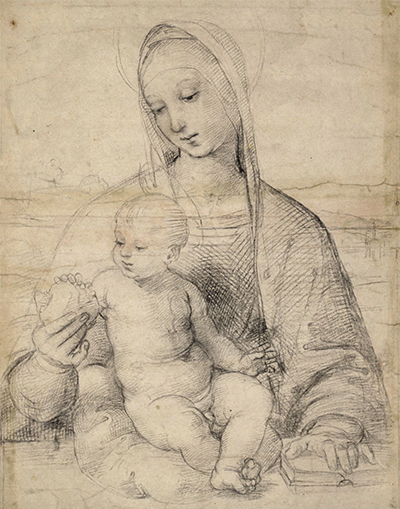
Raphael's drawings are the most direct surviving record of how his art changed before it reached a wall, panel, tapestry, sculpture or building. On paper he could test a first arrangement, repeat a hand, turn a head, study an antique body, calculate architecture or give a collaborator a design precise enough to execute.[1][2]
No single “Raphael drawing style” covers this activity. Metalpoint rewards control; pen can move from searching line to emphatic contour; chalk builds bodies through tone; a full-size cartoon carries a composition toward transfer. A rapid sketch and a highly finished study may serve different moments of the same project.
Drawings also complicate authorship. Raphael trained gifted assistants, and his designs were copied during and after his life. Modern study therefore combines visual judgment, provenance, material examination and non-invasive science rather than trusting a famous inscription alone.[1]
At a Glance
- ArtistRaphael, supported in later years by a large workshop
- Active periodabout 1500–20
- Major mediametalpoint, pen and ink, black chalk, red chalk, white heightening, wash, blind stylus, charcoal and opaque water-based colour
- Common supportshandmade laid paper, sometimes prepared or tinted for metalpoint and heightening
- Main functionsinvention, composition, figure study, drapery, head and hand study, copying, patronal presentation, workshop direction and transfer
- Full-size transfer drawinga cartoon, from the Italian cartone, meaning large paper
- Transfer methodspricking and pouncing, tracing, indentation, squaring and direct copying
- Important collectionsAshmolean Museum, Uffizi, Louvre, British Museum, Royal Collection, Albertina and many others
- Largest celebrated cartoon groupseven surviving tapestry cartoons for the Sistine Chapel, now at the V&A on loan from the Royal Collection
- Attribution categoriesautograph, workshop, pupil, circle, copy after Raphael and later imitation
- Scientific studymicroscopy, infrared methods, X-ray fluorescence and paper analysis
- Essential pointmarks of use, revision and transfer are evidence of purpose, not flaws separating drawing from art
Contents
- Drawing as thought
- More than preparation
- Early formation in Umbria
- Florence and the art of learning
- Rome and expanding scale
- Metalpoint
- Prepared paper
- Pen and ink
- Black chalk
- Red chalk
Drawing as thought
A drawing can preserve a decision before it becomes fixed.
Raphael might place several alternatives on one sheet, rotate the paper and try again in unused space. A first line need not be correct; its relation to later lines reveals the search.
This makes drawings different from polished paintings, where revision is often hidden beneath the surface.
Paper lets viewers encounter uncertainty as an active part of invention.
More than preparation
Many sheets were made in preparation for another work, but that description does not make them secondary in quality.
A focused head can contain tonal subtlety absent from the distant figure in a fresco. A compositional sketch can show possibilities abandoned before completion.
Some drawings were valued and collected as demonstrations of skill even when their practical use had ended.
Their beauty arises from purpose: concentrated attention, economical means and visible change.
Early formation in Umbria
Raphael learned within the precise drawing culture associated with Perugino's workshop.
Clear contours, carefully arranged figure groups and transferable designs supported panel painting and fresco. Young artists copied models and acquired a repertory of poses.
Metalpoint and pen encouraged discipline. Forms had to be constructed with deliberate line rather than endlessly erased.
Raphael absorbed this order, then made it increasingly flexible as his experience widened.
Florence and the art of learning
In Florence, Raphael studied Leonardo, Michelangelo and Fra Bartolommeo among others.
Drawing allowed that learning to happen actively. He could copy a pose, analyse how bodies interlocked or test the emotional direction of a glance.
The National Gallery traces how his encounter with Michelangelo's dynamism helped animate figures, while Leonardo offered lessons in expressive relationship and tonal atmosphere.[6]
Influence becomes visible on paper as transformation rather than passive borrowing.
Rome and expanding scale
Raphael's arrival in Rome in 1508 brought vast walls, papal programmes and new organisational demands.
The Vatican rooms required many figures to remain intelligible across architecture. Later tapestry and building projects had to communicate designs to specialists working in other media and sometimes other cities.
Drawings became instruments of both imagination and management.
The speed of the workshop did not eliminate study; it increased the need for clear stages and distributed information.
Metalpoint
Metalpoint uses a metal stylus drawn across paper coated with a prepared ground.
The point leaves a fine line through chemical and physical contact. It cannot be erased as freely as chalk, so the artist builds form through light, controlled strokes.
Raphael used metalpoint throughout his career, including late studies for the Sistine tapestries.[4]
Its delicacy suits subtle contours, small hatching and figures whose volumes emerge through accumulated precision.
Prepared paper
Metalpoint requires a surface capable of receiving the trace.
Artists coated paper with mixtures that might include bone ash, pigment and binder, sometimes giving it a coloured tone. That tone could serve as a middle value between dark lines and white heightening.
Prepared sheets were material constructions before the first figure appeared.
Their colour and texture influence every mark, so support cannot be treated as an empty background.
Pen and ink
Pen offers both speed and definition.
A fine point can describe contour, while repeated hatching makes shadow. Diluted ink wash can broaden tone across a body or drapery fold.
Raphael often reinforced a selected line after searching around it. The surrounding lighter strokes preserve alternative positions.
Pen's decisiveness makes these moments especially legible: thought accumulates rather than disappearing.
Black chalk
Black chalk allowed Raphael to move between contour and modelling.
Its line could be sharp at the point or broad along the side. Pressure deepened darks; rubbing softened transitions; paper tone held the middle register.
Late studies such as the Ashmolean apostles use a wide tonal range to anticipate light, expression and even aspects of colour in the final painting.[5]
Chalk made a figure feel present without requiring paint.
Red chalk
Red chalk provides a warm line especially suited to flesh.
It can describe anatomy with fine hatching or broad, velvety modelling. Raphael used it for figure studies and exploratory work, sometimes over marks made with a blind stylus.
The warm material does not reproduce skin colour literally. It creates a bodily association through its relation to blood, warmth and living surface.
Its use also reflects exchanges with Florentine drawing practice.
White heightening
White chalk or bodycolour adds light rather than merely leaving paper blank.
On tinted support, a draughtsman can work outward from a middle tone: dark chalk defines shadow and white marks catch forehead, nose, shoulder or cloth.
Selective heightening makes illumination part of the design.
It is most effective when restrained. A few pale accents can establish volume across a much larger dark-chalk field.
Stylus and invisible beginnings
A blind stylus can indent paper without depositing a coloured line.
Artists used it to establish proportions, transfer outlines or lay down a structure beneath visible chalk. Raking light or technical imaging can reveal these almost invisible grooves.
Such marks remind viewers that the immediately visible image may not be the first stage.
Raphael's process sometimes begins below ordinary sight.
Recto and verso
The front of a sheet is called the recto and the reverse the verso.
Raphael often used both. A study on one side may relate to another project, date or function from marks on the reverse.
Turning paper can therefore change the historical identity of what appears to be one object. Inventory numbers commonly add r. or v. to specify the side.
Descriptions that ignore the verso risk discarding half the evidence.
Rotating the sheet
Artists did not always maintain one fixed top edge.
Raphael could rotate paper ninety degrees to fit another figure or architectural thought into an open area. What looks sideways in a modern frame may have been upright during its making.
This efficient use of paper reflects both cost and mental mobility.
Orientation belongs to each individual sketch, not always to the sheet as a whole.
First compositional sketches
Early ideas can appear in tiny, rapid arrangements.
Bodies may be reduced to loops and strokes while the artist tests balance, movement and empty space. Facial details matter less than the direction of a group.
Several alternatives can occupy one page, revealing rejected structures beside the chosen one.
These sketches record composition as action before it becomes anatomy or finish.
Figure studies
Once a broad arrangement emerged, Raphael investigated individual bodies.
He could study a nude beneath future drapery, allowing weight, twist and balance to be understood before clothing complicated the form. Models, antique sculpture and other artists' designs all contributed.
The resulting sheet may appear secular even when destined for a saint or biblical ancestor.
Anatomical study served credibility, not necessarily the final state of dress.
Heads and expression
Raphael devoted separate sheets to heads because expression carries narrative.
The angle of eyes, pressure of brow and opening of mouth can direct attention across a multi-figure scene. Age changes skin, hair and the weight of experience.
Late black-chalk studies develop such differences through tone rather than outline alone.[5]
A head is therefore both an individual likeness type and a compositional signal.
Hands as narrative instruments
Hands point, pray, grasp, shield, bless and express shock.
In a distant fresco or altarpiece, a clear gesture can communicate more immediately than a subtle face. Raphael repeatedly tested fingers and wrists to avoid stiffness.
Separate studies allowed him to join anatomical plausibility with readable action.
The most memorable gestures often feel inevitable because paper held their many alternatives first.
Drapery studies
Cloth clarifies both body and status.
Raphael studied folds over models or arranged fabric, observing where weight pulls downward and where a bent limb creates compression. Hatching and wash translate colour into light and shadow.
Drapery can expand a figure's silhouette or bind a group through repeated curves.
It is not decoration placed on a completed body; it participates in movement and composition.
Studies from antiquity
Ancient sculpture supplied Raphael with poses, proportions and ways of making the body monumental.
Drawing from an antique was an act of analysis. The artist selected a viewpoint, translated marble into line and could alter what he saw for a Christian or contemporary subject.
The Uffizi Adam study, for example, relates a biblical ancestor to the celebrated Spinario type.[3]
Antiquity entered new art through observed and transformed bodies.
Copies after other masters
Raphael also learned by drawing from recent art.
Copies after Leonardo or Michelangelo could isolate a movement or group relationship. The copied motif then changed when placed in another narrative and style.
Workshop pupils repeated Raphael's own designs for similar educational reasons.[1]
Copying in this context ranges from study to preservation; it should not be equated automatically with deception.
Architectural drawing
Raphael's paper practice extended beyond figures.
Plans, elevations, sections, details and perspective sketches helped him investigate buildings. A quick room-vault idea can share a sheet with a nude, as in the Uffizi study for Adam.[3]
Architectural drawings communicate dimensions and relationships that cannot be improvised safely at full scale.
They also preserve projects later altered, demolished or never built.
Modelli
A modello is a developed design made to clarify a proposal, guide assistants or show a patron.
It is generally more resolved than a first sketch but need not be full size. Degree of finish depends on audience and task.
A patronal presentation may suppress uncertainty, while a workshop sheet can remain densely practical.
The term describes function better than beauty: a highly finished drawing may still be working equipment.
What is a cartoon?
A Renaissance cartoon is a large, often full-scale working drawing, not an animated or comic image.
The word comes from Italian cartone, meaning a large sheet or strong paper. Multiple pieces could be joined to reach the dimensions of a painting, fresco or tapestry.[2][3]
Cartoons establish contours and sometimes tone or colour near the end of design development.
Their scale makes them both powerful artworks and vulnerable tools.
Pricking and pouncing
One transfer method involved piercing small holes along cartoon outlines.
The artist or assistant placed the drawing against the prepared surface and struck powdered charcoal through the holes. Removing the cartoon left a dotted guide, or spolvero, to be joined into lines.[2]
Prick marks reveal that a sheet was used rather than merely admired.
Infrared examination of paintings can sometimes connect those dots with a surviving cartoon.[2]
Tracing and indentation
Outlines could also be transferred by tracing with a stylus.
A darkened intermediate sheet placed beneath the drawing deposited lines on the painting support. Alternatively, pressure could indent the surface directly.[2]
These methods leave different physical signatures. Grooves, offset material or reinforced contours can reconstruct the sequence.
Transfer is a mechanical act guided by artistic choice: which lines mattered enough to carry forward?
Squaring
A grid allows a design to be enlarged, reduced or moved section by section.
Corresponding squares help preserve proportion across changes of scale. Lines drawn over a figure may appear intrusive to modern eyes but record a practical transition.
Raphael and his circle used such systems when coordinating large works.
The grid converts image into measurable relationships without eliminating the need for redrawing.
The Sistine tapestry cartoons
Raphael and his studio created ten full-scale cartoons for tapestries commissioned by Leo X for the Sistine Chapel. Seven survive.[3]
They were painted in opaque water-based colour on many joined paper sheets. The designs guided weavers in Pieter van Aelst's Brussels workshop.
Because tapestry is woven from the back, the finished textiles reverse the cartoons.[3]
These immense works sit between drawing and painting while remaining fundamentally production models.
Cutting and rejoining the cartoons
The tapestry cartoons were cut into vertical strips about a metre wide to make handling easier for weavers.[3]
After entering the collection of the future Charles I in 1623, the surviving sheets eventually served English tapestry production. William III later ordered the strips reassembled.
Their seams are evidence of travel and function.
What museums now display as monumental art survived because working fragments were collected, used again and reunited.
Drawing for prints and sculpture
Raphael's designs travelled into media he did not personally execute.
Marcantonio Raimondi and other printmakers translated compositions into engraved lines. Sculptors such as Lorenzetto converted drawings into bodies in stone.
Graphic clarity made such collaboration possible, but translation always introduced another maker's technique and decisions.
A print or statue “after Raphael” preserves his invention without becoming his physical handiwork.
Workshop circulation
Raphael's Roman workshop depended on drawings moving among people.
A sheet could assign a figure, preserve a master's correction or provide a model for repetition. Assistants learned by copying and by adapting designs to new spaces.
The Ashmolean collection includes works by Giulio Romano, Perin del Vaga and others that trace this shared culture.[1]
Workshop efficiency and individual artistry were intertwined.
Autograph, workshop and circle
An autograph drawing is judged to be by Raphael's own hand.
“Workshop” usually indicates production under his immediate organisation; “pupil” names a trained associate; “circle” signals proximity without proven direct supervision. “After Raphael” identifies dependence on one of his designs.
These labels answer different questions and should not be treated as polite synonyms.
Precise attribution helps recover who drew, who learned and how an idea circulated.
Connoisseurship
Connoisseurship compares habits of line, correction, anatomy, hatching and composition across sheets.
Raphael's touch can be both controlled and searching, while gifted pupils may approach it closely. Condition and retouching complicate judgment.
Strong conclusions come from patterns, not one attractive feature.
Visual expertise remains essential, but it now works alongside paper history and scientific evidence.
Scientific examination
The Ashmolean's current research project uses non-invasive methods including X-ray fluorescence and infrared reflectography.[1]
These tools can distinguish materials, detect marks beneath visible media and identify later additions without taking damaging samples. Microscopy reveals paper fibres, abrasion and transfer holes.
Science does not assign authorship automatically.
It supplies material facts that strengthen or challenge conclusions reached through style and documentation.
The Ashmolean collection
The Ashmolean holds one of the world's most important groups of Raphael drawings.[1]
About eighty sheets are described by its project as unanimously considered autograph, within a wider body of roughly two hundred Raphael, school and copy drawings under study.[1]
The collection illuminates early formation, major projects and workshop associates.
Its breadth makes attribution differences visible rather than filtering the story to masterpieces alone.
Thomas Lawrence and 1846
The museum's great holding originated substantially in the collection of the portrait painter Sir Thomas Lawrence.
After his death, supporters raised funds to secure important drawings for Oxford. The acquisition in 1846 established a public resource of exceptional depth.[1]
Collector history affects what survives together and how sheets are mounted or named.
The modern collection is itself a nineteenth-century construction built from much older dispersals.
Trimming, division and mounting
Drawings have often been cut to fit albums, separate valuable studies or remove damaged edges.
Mounts can protect paper but also conceal versos and inscriptions. Old repairs, wash lines and collector stamps add further layers.
Two fragments may once have belonged to one larger sheet, yet joining them requires physical and graphic evidence.[4]
Object history can change the very shape through which Raphael's thought is known.
Condition and light
Paper and drawing media are sensitive to light, moisture and handling.
Chalk can smudge; iron-based inks may corrode; white heightening can alter; prepared grounds may abrade. Museums therefore limit display periods and control illumination.
A famous sheet may not be continuously visible even when a collection is open.
Restricted exposure is part of preserving subtle marks for future study.
Drawings and finished works
Comparing a study with its painting reveals both continuity and change.
A transferred contour may remain exact while expression alters during painting. Drapery can be simplified at distance, or a figure moved to clarify a group.
The National Gallery's study of Saint Catherine uses surviving drawings, a pricked cartoon and infrared evidence to reconstruct this sequence.[2]
No stage alone contains the complete creative process.
Why Raphael's drawings matter
Raphael's reputation for harmony can make his finished works seem effortlessly resolved.
Drawings replace that illusion with visible labour: alternative poses, strengthened contours, transfer dots, grids, smudges and reused paper. Harmony becomes an achievement produced through choice.
They also reveal his capacity to learn. Perugian discipline, Leonardo's tonal feeling, Michelangelo's bodily force and ancient sculpture entered a practice that transformed rather than merely repeated them.
Finally, the sheets show Raphael as director. A design could travel from his hand through assistant, cartoon, weaver, engraver, sculptor or builder. Drawing was the medium that allowed a vast collaborative enterprise to retain coherence.
Artist Up Close
First identify the medium. Ask whether line was made by pen, metalpoint or chalk, and whether white has been added to a toned support.
Look for changes: repeated limbs, reinforced contours, rubbing, abandoned heads or rotated sketches.
Check both recto and verso in the catalogue entry. Note dimensions, inventory number and whether the sheet was trimmed or mounted.
Search for evidence of function—prick holes, stylus grooves, grids or outlines copied from another drawing.[2]
Then compare the relevant finished work. Record what Raphael preserved, altered and delegated rather than judging the sheet only by resemblance.
Frequently Asked Questions
Discussion
What detail most changes how you read Drawings?
Reader Insights
Which source detail gives the page its strongest anchor?
Which visual or historical distinction should readers keep in mind?
How does this page change the wider picture of Raphael's career?
Join the Conversation
Share your reading below.
References
- Ashmolean Museum, “Drawings by Raphael and His School at the Ashmolean Museum,” View source.
- National Gallery, London, “Studying Raphael: Drawings and Cartoons,” View source.
- Royal Collection Trust, “The Raphael Cartoons,” View source.
- J. Paul Getty Museum, European Drawings 1: Catalogue of the Collections View source.
- Ashmolean Museum, “Studies of Two Apostles,” WA1846.209 View source.
- National Gallery, London, “Raphael: From Urbino to Rome — Michelangelo's Dynamism,” View source.