* As an Amazon Associate, and partner with Google Adsense and Ezoic, I earn from qualifying purchases.
by Tom Gurney Tom Gurney BSc (Hons) is an art history expert with over 20 years experience
Published on June 19, 2020 / Updated on September 28, 2026
Email: tomgurney1@gmail.com / Phone: +44 7429 011000
Degas Prints: Introduction
A print begins with an image made on one surface and transferred to another. For Edgar Degas that transfer was often an opportunity to change the image, not simply to repeat it. In a black-ink monotype he could work on a plate, take an impression, then use the faint ink left behind for a second, different impression. He might add pastel to a printed base. He also made etched prints whose lines and tones came from a more durable plate. The word “print” covers these distinct acts; looking at a Degas sheet means asking which one took place. [1][2][3][6][14]
Degas took up monotype in the mid-1870s. He used it to test textures, dark interiors, performers, intimate figures and later landscapes. The process could make an image look immediate, but its printed mark was often a beginning. His 1892 Landscape in the Metropolitan Museum of Art is a monotype in coloured oil paints heightened with pastel. The pale, misty hills might at first look like a drawing or a painting; the museum's full medium description explains why the surface belongs to a history of printing and later work by hand. [1][9]
Degas Prints at a Glance
Main experimental processMonotype, taken up in the mid-1870s
How a monotype beginsInk or paint worked on a plate, then transferred under pressure to paper
Typical resultOne principal impression, sometimes followed by a paler second pull
Other techniquesEtching, soft-ground etching, aquatint and drypoint in specific works
Printed base plus drawingPastel over monotype, as in Orsay's Ballet / L'Étoile
What to read on a labelProcess, plate or sheet dimensions, state, medium added by hand and accession
MoMA describes the basic process plainly: an artist draws with ink or paint on a metal plate, lays paper against it and runs the pair through a press. The ink moves to the paper, reversing the image. Unlike a conventional etched plate, the unincised monotype plate does not hold a stable network of cut lines ready to make a long run of near-matching prints. Much of its image can move, smear or be wiped away before printing. The pressure of the press fixes one moment in that unstable surface. [1][2]
The result is often called unique, and it usually has one main impression. “Usually” matters. Degas could pass the plate through the press a second time, using ink that remained after the first pull. That paler second impression is sometimes called a ghost. It shares an origin with the first but is not simply another copy of it. Its lighter marks can offer a new base for pastel or other work. MoMA's account of a Café Singer pair calls related impressions “cognates”: separate works connected by the same plate and changed through printing and later additions. [1][3]
A reader can therefore ask three questions when a label says “monotype.” Was this the principal impression or a lighter second pull? Was the surface worked again after printing? Does another related impression survive? The answers may be known for a particular object, but they cannot be assumed from the term alone. Even when no pair is documented, the black or coloured marks on the sheet record a transfer, not marks drawn directly onto that paper in the same way as a charcoal study. [1][2][3]
This difference does not place monotype outside drawing or painting. Degas's hand could arrange ink with gestures close to drawing, and a later layer of pastel could turn the printed foundation into something visually different. It is more useful to describe the sequence than to force a hybrid sheet into one familiar category. The drawings and pastels pages take up the other materials, while this page follows what the printed stage contributes. [1][3][8]
An Early Landscape in Black Ink
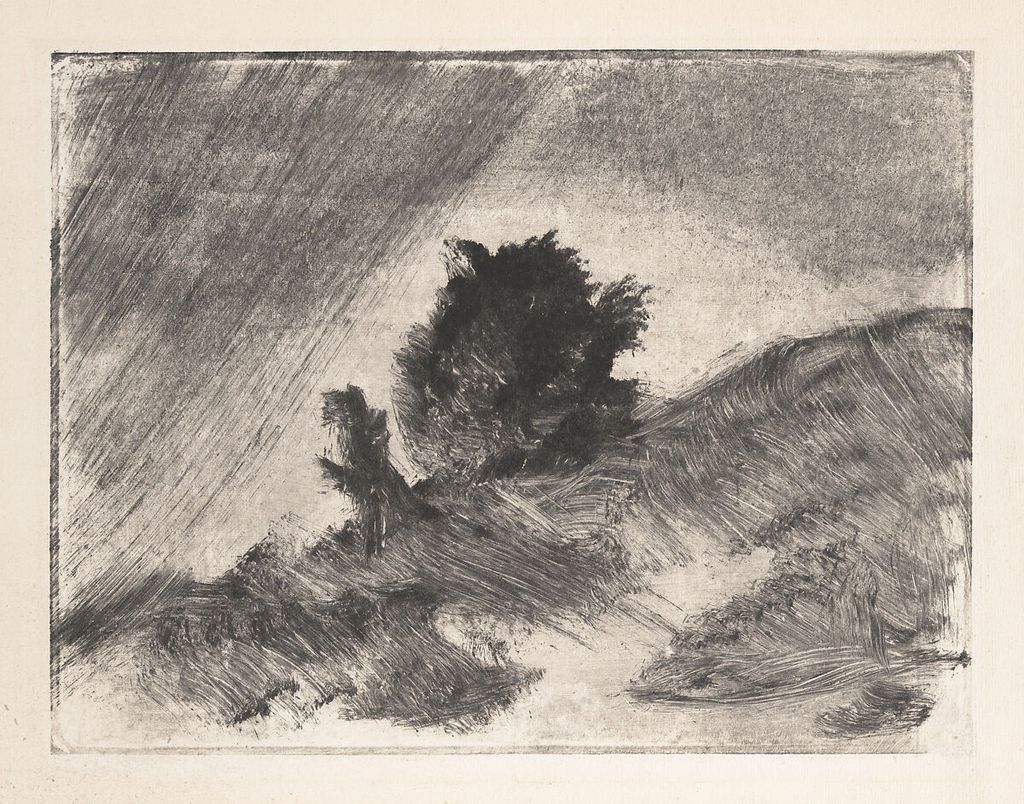
Edgar Degas, Landscape, c. 1877–79, monotype. The Metropolitan Museum of Art, 2024.387. Collection record.
The Met's Landscape, dated about 1877–79 and numbered 2024.387, is a small black-and-white monotype. Dark ink forms a hillside and a cluster of trees or shrubs; slanting strokes move across the upper part like rain. The plate is only about 16 by 21 centimetres. Within that narrow field, dragged and removed ink creates a sense of weather and depth without the repeated contours of an etched plate. The museum identifies the plate as unincised and relates the image to Rembrandt's print The Three Trees. That comparison comes from the owner's record; it is not a claim that Degas reproduced Rembrandt's composition exactly. [4]
The source image makes the surface look restless. Black areas hold the slope; pale striations cut across it; a small group of forms near the centre seems both fixed and buffeted by weather. Those are effects a viewer can describe without assuming the exact tool that made every line. The Met names manipulation of ink on the plate as the governing method. A monotype can suggest movement even when no dancer or jockey appears. Here motion belongs to the weather and to the visible shift between dark and light. [4]
This early Landscape also prevents an overly narrow definition of Degas's print subjects. His monotypes include urban scenes and bodies, but a landscape was already a field for experiment in the 1870s. It differs from the coloured 1892 Landscape used as this page's lead image. The two works share a generic title while differing in date, accession, medium and visual character. Calling them simply “Degas's Landscape” would hide the progression and risk attaching the wrong record to an image. [4][9]
The Fireside and a Difficult Interior
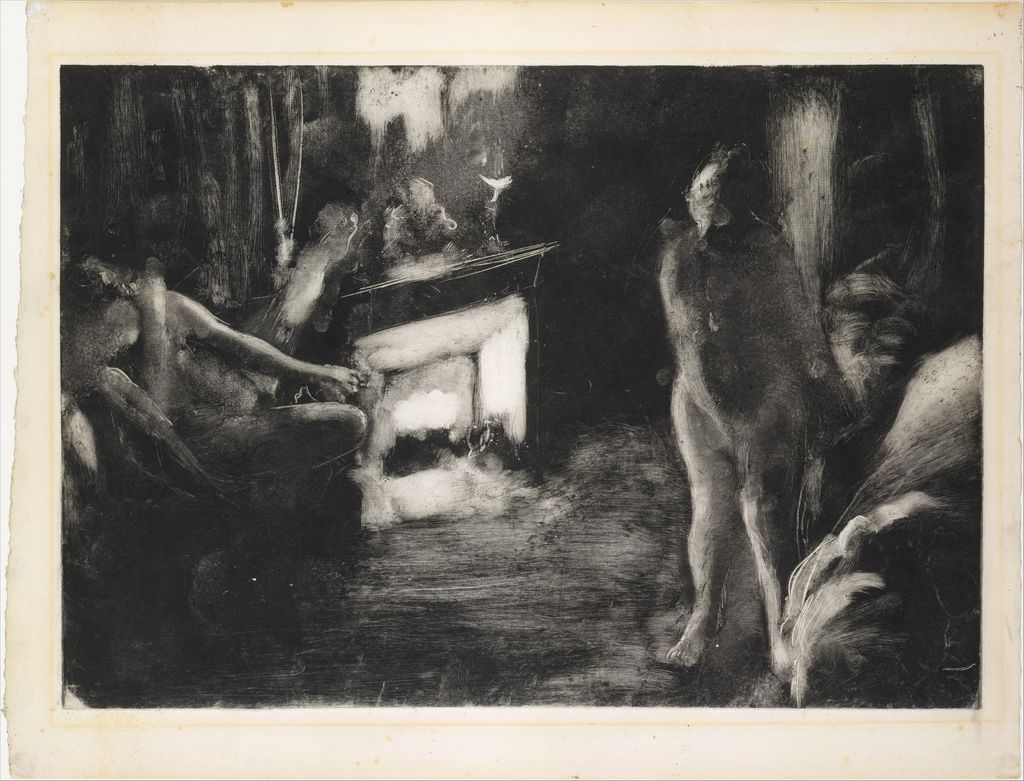
Edgar Degas, The Fireside, c. 1876–77, monotype in black ink. The Metropolitan Museum of Art, 68.670. Collection record.
In The Fireside, about 1876–77, Degas made a larger monotype in black ink on heavy laid paper. The Met identifies it as accession 68.670 and places it among his images of brothel interiors. A dark room opens around figures and a hearth; broad areas of ink hold back detail while pale marks bring parts of bodies and furniture forward. The viewer has to work to distinguish the figures from the surrounding darkness. That encounter with partial visibility is an effect of the printed image, not proof that the scene was observed without arrangement. [5]
The museum's account supplies a context of prostitution and the maisons closes in which Degas was interested. It does not turn the depicted women into named sitters or offer direct testimony from them. We should not treat the monotype as an unmediated account of their lives. It is an artist's image of a commercial and unequal setting, made for viewers outside it. That difference matters when considering both its subject and its formal choices: obscurity can shape how bodies are viewed, while also limiting what the image tells us about the people represented. [5]
Compared with the small early landscape, The Fireside uses dark ink to organise an interior and the bodies within it. Its subject brings questions of looking and privacy that a landscape does not. The monotype process gives the room its deep, unstable black; the social setting gives that visual effect a different weight. Degas's bathers raise related questions of access to a private space. The Met's classification and medium line make clear that The Fireside is a monotype, even though its smoky tones could be mistaken for charcoal in a reproduction. [4][5]
Etching Is a Different Kind of Print
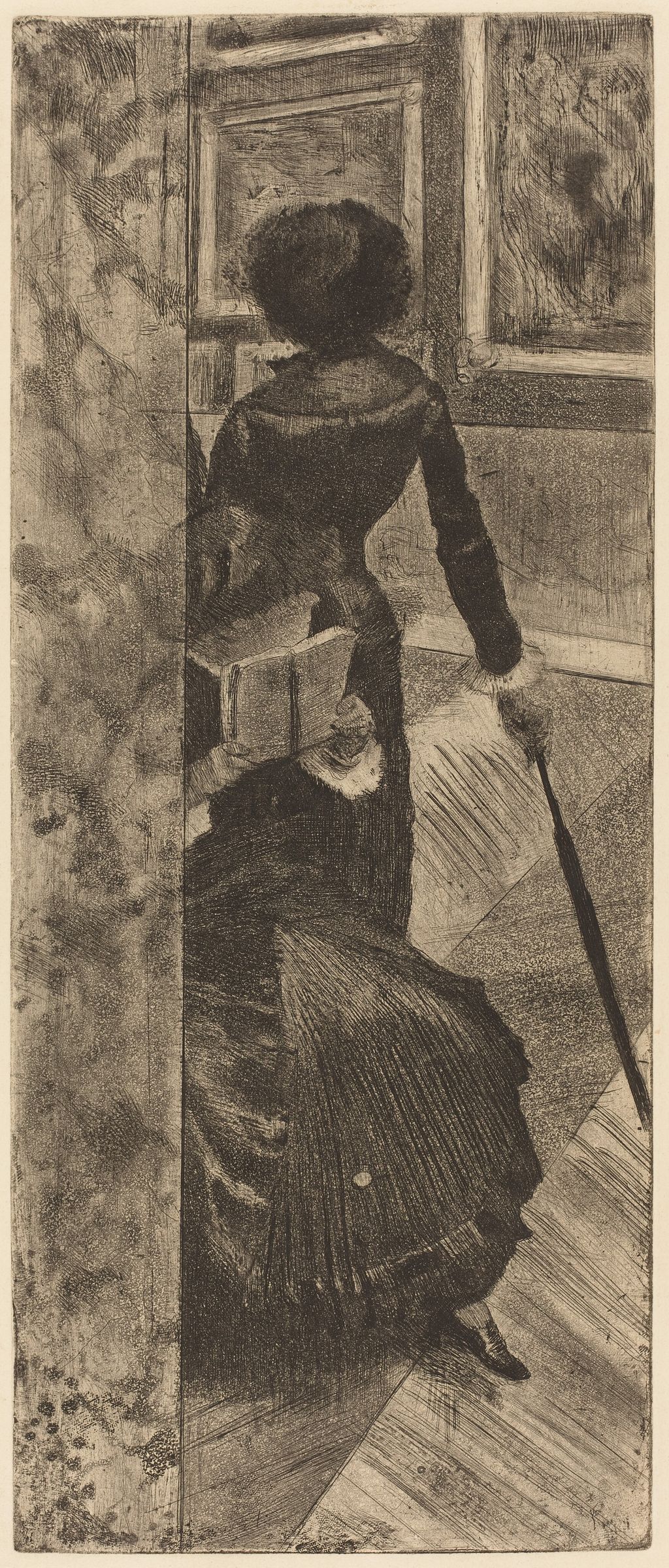
Edgar Degas, Mary Cassatt at the Louvre: The Paintings Gallery, 1879–80, etching, soft-ground etching, aquatint and drypoint. National Gallery of Art, Washington, 1946.21.106. Collection record.
Not every Degas print began with ink spread across an unincised plate. Mary Cassatt at the Louvre: The Paintings Gallery, dated 1879–80 by the National Gallery of Art in Washington, uses etching, soft-ground etching, aquatint and drypoint on wove paper. Its accession is 1946.21.106. One can see a figure from behind looking towards framed works, with dense marks forming clothing, wall and floor. The image is a print of someone looking at art, made through several graphic procedures rather than one monotype pull. [6]
These techniques belong to the intaglio family: ink is held in lines or areas below a metal plate's surface and pressed onto damp paper. Etching uses acid to bite exposed metal; soft-ground etching can pick up marks made through a pliable coating; drypoint scratches the metal directly and can leave a burr that holds ink; aquatint creates tonal fields. A label listing several of them is describing a layered plate-making process. It should not be flattened into the word “engraving,” nor should the result be called a monotype because the image was printed. [10][11][12]
The NGA records a particular state of The Paintings Gallery. A “state” describes a stage of changes to a printing plate; an “impression” is one sheet printed from it. A plate, its state and a surviving impression are thus related but different things. The museum's catalogue information helps establish which version it holds. It also has other Degas prints of Cassatt in the Louvre, including The Etruscan Gallery. Similar subject and sitter do not make them one object or one plate. The separate accession numbers and medium lines are the safest starting point for comparison. [6][13]
A printed image can be revised by changing its plate as well as by adding to a sheet after printing. The choice differs from Degas's mutable monotype plate: etched lines and aquatint areas remain physically present until the plate is reworked. A viewer of The Paintings Gallery can look at its rich mixture of fine lines and tone while recognising that the NGA's specific medium list, not a guess made from a thumbnail, identifies how the impression was produced. The exact balance among its component techniques requires closer print study than a general overview can offer. [6][10][11][12]
Watch: Edgar Degas
Explore his paintings, drawings and sculpture in three short videos.
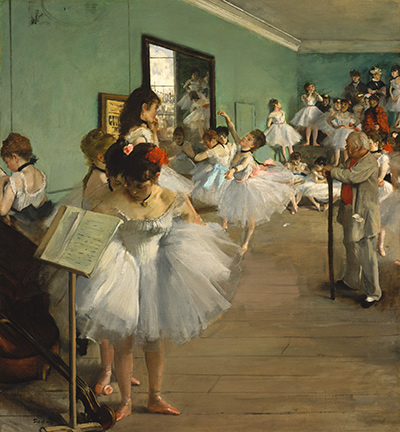
Degas, The Dance Class
Smarthistory
Look closely at Degas’s off-duty dancers and his unusual view into the rehearsal room.
Degas's printmaking connected him to other artists. He and Mary Cassatt, Camille Pissarro, Félix Bracquemond and others planned a journal of original prints called Le Jour et la Nuit. The National Gallery of Art's account states that it was never completed. The project matters because it shows artists thinking about how a print could be made and circulated as an original work, rather than only as a reproduction of an oil painting. It does not give us a series of published issues to describe. [7]
The unrealised journal should not make every Degas print a collaboration. Mary Cassatt at the Louvre depicts a fellow artist, while the print itself was made by Degas. The connections are real—shared exhibitions, attention to print techniques and a proposed publication—but they are different kinds of relationship. The biography follows their artistic exchange; here the project helps place printmaking within an active circle rather than an isolated studio habit. [6][7]
Pastel Over a Printed Foundation
The Musée d'Orsay calls its Ballet, also titled L'Étoile, a “pastel on monotype.” It dates the work about 1876–77 and assigns accession RF 12258. The museum's material label is a concise account of sequence: a printed image provided a foundation, then pastel changed the visible result. The star dancer on the stage is therefore neither simply a dry pastel drawing nor simply an untouched black-ink print. The medium name tells a reader to look for both stages. [8]
MoMA's Café Singer account offers a different, general example of how a lighter second monotype impression could become a tonal map for pastel. It explains why a printed ground can be useful without asserting that the Orsay Ballet is the second pull of the same documented pair. That would need object-specific evidence. The two museum accounts can be read together for process, provided their different works remain distinct. [3][8]
A printed foundation can give tone, reversal and repeated structure; pastel can add colour, edges and emphasis. Which contribution dominates depends on the sheet. The pastels page examines how Degas handled dry colour and supports. Orsay's medium and date for The Star demonstrate that a print could become part of a work in another medium. [3][8]
The 1892 Landscape: A Printed Image in Colour
The Met's later Landscape, accession 1972.636, shows how far the monotype could move from black-ink urban scenes. The museum dates it to 1892 and describes the medium as “monotype in oil colors, heightened with pastel.” Pale blues, greens and earth colours gather into hills partly obscured by mist. The broad forms do not specify every tree or contour. Instead, areas of colour and slight changes of tone make the scene feel open and unsettled. [9]
The Met relates this work to Degas's journeys through Burgundy around 1890 and says he thought of some such views as “imaginary landscapes.” That description permits a cautious connection to memory and travel without turning the scene into a topographically exact site. It also explains why the page's lead image looks unlike the familiar Parisian dancer. A plate worked in colour, then touched with pastel, could support an image in which landscape is a field of sensations and arrangements rather than an illustration of one identifiable place. [9]
This is the second Met work titled Landscape discussed here. The c. 1877–79 object is a small black monotype, accession 2024.387; the 1892 one is a larger colour monotype with pastel, accession 1972.636. Their matching English titles do not license switching images, dates or media between them. Read with The Fireside and The Paintings Gallery, they show why “Degas prints” cannot mean only one subject or one technique. [4][5][6][9]
How to Read a Degas Print Label
First, read the entire medium line. “Monotype” suggests an image transferred from a mutable plate. “Pastel on monotype” adds a later worked layer. “Etching, soft-ground etching, aquatint and drypoint” identifies several processes combined on a printable plate. If a reproduction looks drawn, that appearance does not erase the printed stage; if it looks painted, the medium may still include monotype. [1][2][6][8][9]
Next, separate an object from its relatives. A second monotype pull can be lighter; pastel may make it a different work. An etched plate can have successive states and many impressions. Related titles may refer to different compositions. The Met's two Landscapes are distinct objects, and the NGA's Louvre prints need their own accession numbers. A search result or familiar title alone cannot establish a match. [3][4][6][9][13]
Finally, ask what a printed image allowed Degas to do with the subject. Dark ink in The Fireside makes an interior difficult to read; dragged black in the early Landscape suggests weather; line and tone in The Paintings Gallery organise the experience of looking; colour and pastel in the later Landscape make a scene that the Met associates with memory. These effects are visible, but interpretation must stay near the exact record and acknowledge where a social context, a making step or a second impression remains uncertain. Prints were one of Degas's ways of returning to a problem and making the next version different. [4][5][6][9]
A selected index of documented works, combining owner records with entries sampled across Michel Schulman’s digital catalogue raisonné. It is not a complete catalogue. View the full catalogue
Where does transferred ink leave a soft or broken edge?
Context
How does a monotype differ from an etching in these works?
Open Question
What changes when pastel is added above printed ink?
Join the Conversation
Share your reading of these works below.
References
Museum of Modern Art, Edgar Degas: A Strange New Beauty, exhibition overview, 2016. View source
Heidi Hirschl, “Lasting Impressions: The Monotype Medium from Edgar Degas to Elizabeth Peyton”, Museum of Modern Art, 27 May 2016. View source
Museum of Modern Art, Café Singer exhibition audio, Edgar Degas: A Strange New Beauty, 2016, transcript discussing second impressions and pastel. View source
Metropolitan Museum of Art, Landscape, c. 1877–79, monotype, accession 2024.387. View source
Metropolitan Museum of Art, The Fireside, c. 1876–77, monotype in black ink, accession 68.670. View source
National Gallery of Art, Washington, Mary Cassatt at the Louvre: The Paintings Gallery, 1879–80, etching, soft-ground etching, aquatint and drypoint, accession 1946.21.106. View source
National Gallery of Art, “Mary Cassatt, the Daring Printmaker”, 2026, account of the unrealised Le Jour et la Nuit. View source
Musée d'Orsay, Ballet / L'Étoile, c. 1876–77, pastel on monotype, accession RF 12258. View source
Metropolitan Museum of Art, Landscape, 1892, monotype in oil colours heightened with pastel, accession 1972.636. View source
Museum of Modern Art, “Intaglio”, art-term definition. View source
Museum of Modern Art, “Aquatint”, art-term definition; National Gallery of Art, printmaking technique descriptions, for acid-biting and tonal areas. View source · View source
Museum of Modern Art, “Drypoint”, art-term definition; National Gallery of Art, printmaking technique descriptions, for direct scratching and burr. View source · View source
National Gallery of Art, Mary Cassatt at the Louvre: The Etruscan Gallery, 1879–80, a separate etched-print composition, accession 1943.3.3366. View source
Splash image: Edgar Degas, Landscape, 1892, monotype in oil colours, heightened with pastel. The Metropolitan Museum of Art, 1972.636. Collection record. View source
Tom Gurney is an art history expert. He received a BSc (Hons) degree from Salford University, UK, and has also studied famous artists and art movements for over 20 years.
Tom has also published a number of books related to art history and continues to contribute to a number of different art websites. You can read more on Tom Gurney here.



 Buy Art Prints Now
 by Tom Gurney