

 Buy Art Prints Now
from Amazon
* As an Amazon Associate, and partner with Google Adsense and Ezoic, I earn from qualifying purchases.
 by Tom Gurney
Tom Gurney BSc (Hons) is an art history expert with over 20 years experience
Published on June 19, 2020 / Updated on September 28, 2026
Email: tomgurney1@gmail.com / Phone: +44 7429 011000
Introduction
Hilaire-Germain-Edgar Degas was born in Paris on 19 July 1834 and died there on 27 September 1917. Between those dates he moved from the study of old masters and ambitious family portraits to images of modern theatres, racecourses, workplaces and private rooms. He drew, painted, printed, modelled in wax, collected art and, for a short time, made photographs. The shift in subject did not erase his early training. Throughout his life he studied how a figure could be placed, revised and made to carry a sense of movement. [1][2][3] [17]
The life also resists a smooth account of artistic progress. Family finance affected his work and sales. The cotton trade linked his Parisian family to New Orleans and its history of slavery and racial exploitation. He worked closely with artists whose methods differed from his own, then severed long friendships through his antisemitic position during the Dreyfus Affair. Difficulties with his sight are documented early, although their medical cause and precise effect on particular works are not established. These events belong within the biography, rather than serving as explanations imposed on every picture. [1][8][11][12]
At a Glance
- Life1834–1917 [1]
- TrainingLouvre, École des Beaux-Arts and Italy [1]
- Exhibitionsseven of eight independent group shows [6][7]
Degas in time and context
Academic study and Italy
1853–59Collecting intensifies
1890sIndependent group exhibitions
1874–86Edgar Degas
1834–1917Édouard Manet
1832–1883Camille Pissarro
1830–1903Mary Cassatt
1844–1926Four stages of Degas’s career
Learning through earlier art
Degas obtained permission to copy at the Louvre in 1853, studied with Louis Lamothe, and spent substantial periods in Italy in 1856–59. Portraiture and history painting tested his command of line and arrangement.
Paris, war and New Orleans
Portraits and history painting gave way to racecourses, theatres and urban work. He served in the National Guard in 1870–71 and visited family in New Orleans in 1872–73, where he made A Cotton Office in New Orleans.
A different kind of modern painter
Degas took part in seven of the eight independent exhibitions held from 1874 to 1886; he did not show in 1882. Painting, pastel, printmaking and sculpture offered different ways to return to movement and modern subjects.
Experiment, collecting and change
Pastel and other media remained central while Degas collected art with particular intensity in the 1890s. After 1898 his antisemitic, anti-Dreyfus position damaged long friendships. A forced move in 1912 disrupted his working life; the exact date of his last work is not established.
Timeline and career-stage sources: Met chronology, exhibition records, collection study, Dreyfus account; work dates follow the linked owning institutions.
Contents
- Childhood, Family and Education, 1834–1855
- Italy and the Ambition to Paint History, 1856–1859
- Paris, Manet and Modern Subjects in the 1860s
- War, Sight and a Journey to New Orleans, 1870–1873
- Independent Exhibitions and Family Finance, 1873–1881
- Work, Exchange and Collecting in the 1880s and 1890s
- The Dreyfus Affair and Broken Friendships
- Sight, the 1912 Move and the Last Years
- A Life Across the Works
Childhood, Family and Education, 1834–1855
Degas was the eldest child of Auguste De Gas, a banker, and Marie Célestine Musson, whose family came from New Orleans. His parents' different family connections gave him a life that extended beyond Paris. His mother died in 1847, while Edgar was still a child. The surviving chronology establishes that loss, but it cannot by itself tell us what he felt or supply a hidden cause for his later subjects. [1][2][8]
He studied at the Lycée Louis-le-Grand and received his baccalauréat in 1853. That year he obtained permission to copy at the Louvre and to work in the Bibliothèque nationale's print collection. He also registered for law, the profession his father hoped he might pursue. A registration is not evidence that he completed legal study. Drawing and looking at art occupied him more persistently. In 1855 he studied with Louis Lamothe and entered the École des Beaux-Arts. Academic training meant sustained attention to proportion, line, anatomy and earlier painters; for Degas it was a working resource, not merely a phase to be overcome. [1][2][3]
The family's support gave the young artist opportunities that many contemporaries could not afford. He could travel, copy and develop large pictures without depending immediately on each sale. That advantage should be kept in view when following his later financial difficulties. Those difficulties were real, but they did not make his early circumstances precarious. [1][2]
His name also marks the gap between family convention and a public identity as an artist. Museum chronologies often give the family name as “De Gas,” while his works and modern catalogues use “Degas.” That change should not be made to carry an elaborate theory of independence. The more useful question is how the family's banking and social position made training possible, then how Degas built a professional career within and beyond those connections. His father supported music as well as art, and musical gatherings formed part of the social world in which Edgar later knew fellow artists. [1][2][8]
Italy and the Ambition to Paint History, 1856–1859
Degas spent substantial periods in Italy between 1856 and 1859. He studied paintings and drawings in museums and churches, made copies and visited relatives. He learned from Renaissance masters while observing people in his own extended family. His early plans included the large-scale historical subjects esteemed by the French academic system, but portraiture offered another testing ground for ambitious composition. [1][2][3]
One of the most demanding results was The Bellelli Family, known in the Musée d'Orsay collection as Portrait de famille. It shows his aunt Laure, her husband Gennaro Bellelli and their two daughters. Orsay gives the painting a broad working date of 1858–69, rather than fixing its making to one Italian visit. Degas developed family studies into a major canvas over time. The painting belongs to his biography because it joins the people he knew to the compositional ambitions of his training. Its separated figures and carefully ordered room also suggest why the line between a formal portrait and a scene of lived relations was already productive for him. A fuller account of the work's arrangement belongs with the paintings and portraiture pages. [1][3][15]
Back in Paris, Degas did not simply exchange the past for the present. He continued to copy and collect earlier art while looking for subjects in the city around him. During the 1860s, portraits and historical projects gave way to more frequent images of horses, theatres, cafés and people at work. The skill of building a picture through studies could be applied to those new settings. His biography is therefore a story of changing uses for training as much as a story of changing subjects. [1][3][4]
The Italian years also brought together two habits that stayed with him: learning through exact looking and working in sequences rather than treating a picture as a single spontaneous record. Drawings of family members could be used while a larger portrait was being planned; copies of earlier masters could become a store of compositional problems to revisit. What later appears to be an abruptly seen figure might rest on repeated studies of balance and placement. This does not mean every Degas painting has a recoverable chain of preparatory sheets. It explains why his academic formation remained relevant when his subjects became unmistakably contemporary. [1][3][15]
Paris, Manet and Modern Subjects in the 1860s
Édouard Manet became an important artistic interlocutor. Both men came from prosperous Parisian families and moved in overlapping musical and social circles. They drew and portrayed one another, shared interests in modern painting and sometimes disagreed sharply. The Metropolitan Museum of Art's Manet/Degas exhibition stresses how little direct correspondence survives to settle the details of their relationship. Accounts often assign a precise date and scene to their first meeting, but the evidence is not firm enough to make that meeting the hinge of Degas's career. [8]
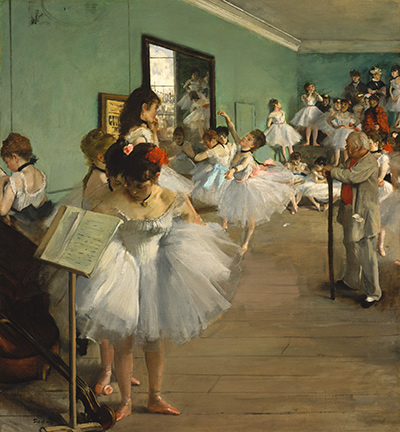
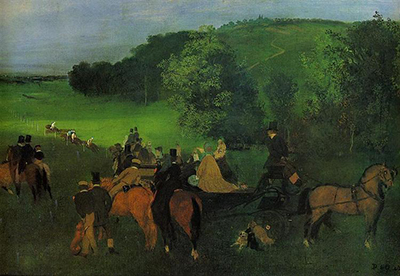
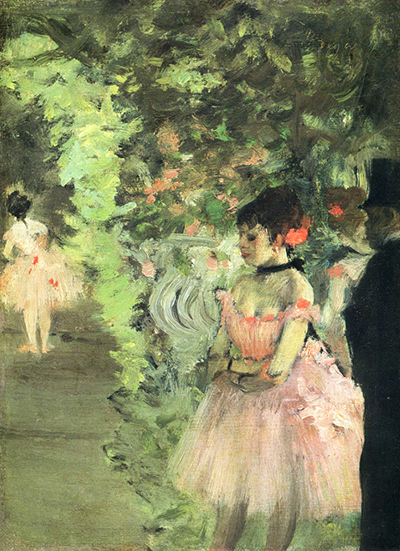
Degas's interest in modern subjects cannot be credited to one friend. Manet mattered within a wider world of artists, writers, performers, collectors and dealers. Degas looked at the art of his predecessors and at what Paris made visible: the work behind performances, the rhythms of leisure and the people who moved between public and private spaces. He was particularly drawn to intervals before or after a principal event. A racecourse could show jockeys gathered and waiting; a rehearsal room could show dancers stretching rather than dancing for an audience. These choices developed across years of observation and revision. [3][4][8][16]
He continued to seek recognition through established exhibitions while independent exhibiting became increasingly possible. The later label “Impressionist” can conceal how differently artists within that circle worked. Degas's academic drawing, indoor light and often deliberate construction remained central. He would take part in the group exhibitions and help shape them, but his artistic path was not a conversion from careful drawing to spontaneous outdoor painting. [3][6]
His friendship with Manet illustrates both exchange and limits. They were near enough to portray one another and to respond to each other's art, yet the relationship was not a continuous agreement about painting or politics. The Met's exhibition guide calls it enigmatic precisely because the surviving record is fragmentary. It is tempting to make one artist the decisive influence on the other, but the documented relationship supports a more modest picture of conversation, attention and tension within overlapping Parisian circles. This matters when a painting is said to resemble Manet's work: similarity is a question for comparison, rather than proof of an episode in their friendship. [8]
War, Sight and a Journey to New Orleans, 1870–1873
The Franco-Prussian War interrupted Parisian life in 1870–71. Degas served in the National Guard, as did Manet. A letter from 1872 records trouble with his eyes; it is one of the early pieces of evidence for the sight difficulties that recur in accounts of his life. It does not establish a diagnosis or prove that his service caused the condition. Nor can it be used to read a particular later picture as a medical symptom. [1][2][8]
In late 1872 he travelled to New Orleans, staying with relatives until March 1873. He lived within the household of his uncle Michel Musson. His brothers René and Achille were involved in buying cotton, while Musson worked as a cotton factor, an intermediary in the trade. For a Parisian artist, the trip was a family visit and a chance to work in a different place. For a biographer it also requires attention to the economic system in which that family worked. [1][5][8]
Art historian Michelle Foa, speaking in the Met's Manet/Degas guide, explains that the Musson family's cotton business had been tied to slavery before emancipation and to the exploitation of sharecroppers afterward. She identifies Confederate bond investments among the family's financial burdens and says that Michel Musson and William Bell later joined the White League. These are sourced facts about Degas's relatives and their world. His surviving letters from the visit do not tell us what he thought about those local political commitments. It would be an unwarranted inference to turn their actions into a claim about his own views at that moment. [8]
Degas wrote about the light affecting his eyes and made works connected to the cotton office, including the painting now known as A Cotton Office in New Orleans. The office picture is a constructed group scene, not a complete record of the labour and racial relations on which the trade depended. It brings the family business into the frame while leaving much of its social system outside it. The Cotton Office page examines the picture and its people in detail. Degas hoped that a British cotton merchant might buy the painting, but that sale did not occur. The Musée des Beaux-Arts de Pau acquired it in 1878. [1][5][8]
The dates and letters show work continuing despite the difficulties he reported. The Met chronology records the brothers' arrival in New York in October 1872, Degas with relatives in New Orleans by early November, and a February 1873 letter to the artist James Tissot saying he was making two cotton-office pictures. By late March he was back in Paris. Those documents establish travel, family contact and work in progress. They do not settle how the finished painting should be read, what every figure thought about the cotton trade or whether Degas shared the later political actions of his relatives. Keeping those questions apart allows the New Orleans period to be neither romanticised as an exotic artistic interlude nor treated as a source of claims beyond the evidence. [1][8]
Watch: Edgar Degas
Explore his paintings, drawings and sculpture in three short videos.
Degas, The Dance Class
Look closely at Degas’s off-duty dancers and his unusual view into the rehearsal room.
Watch on YouTubeIndependent Exhibitions and Family Finance, 1873–1881
In December 1873 a group of artists established an independent exhibiting society. Degas took part in its first exhibition in 1874 and in six more through 1886. He appeared in 1874, 1876, 1877, 1879, 1880, 1881 and 1886, missing the 1882 show. The seven-of-eight count is supported by Musée d'Orsay and the French Ministry of Culture's participant lists. Those lists show participation; they do not, on their own, establish that a particular Degas canvas appeared in any given year. [1][6][7]
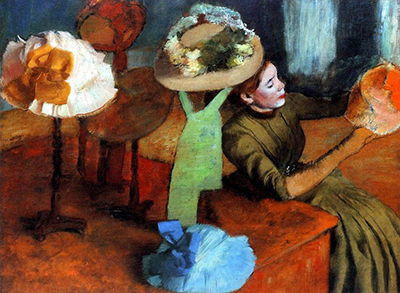
These exhibitions offered a way to show work outside the Salon, but they were not a single shared style. Degas helped organise them and pressed for a broad range of artists and subjects. He cared about urban life and changing ways of seeing, yet retained a strong commitment to line and to working inside. He explored theatre rehearsals, milliners, laundresses, racecourses and portraits over many years. The independent exhibitions were both a practical means of reaching viewers and a setting for arguments about what contemporary art might include. [3][4][6]
His absence from the 1882 show is a useful reminder that participation was a series of decisions, not a permanent membership with a fixed programme. The exhibitions changed their participants and the relations among them from one year to the next. Degas's own choices also changed: he could show work concerned with performance beside pictures of labour or domestic privacy. A dancer might be visible in practice rather than on stage; a woman ironing might be occupied by effort rather than presented as a picturesque type. These subjects were not interchangeable, and their individual social settings matter. The group label helps locate a public career, but it cannot do the looking required by each work. [3][4][6][7]
At the same time, his financial position was changing. Sales through dealers began to matter more in 1873. His father died in February 1874. The family banking firm and estate involved credit and obligations that unfolded over several years. Loans connected to his brother René and creditor claims added to the pressure. The Met's 1988 chronology places developments through 1875–77 rather than describing one sudden loss of a fortune. Degas's work entered a market in which prices, dealers and buyers affected his choices, although financial need alone cannot explain a subject or a method. [1]
The sequence shows how professional and family obligations could meet without becoming the same thing. Paul Durand-Ruel bought Degas works in early 1873, but his purchases stopped during that year's downturn. Deschamps became an important dealer. In 1876 Degas urged him to sell the New Orleans cotton-office painting while the family firm faced liquidation and debts. The picture's hoped-for sale was a practical concern, yet it had been conceived during an earlier family visit. In 1877 Degas was still seeking a settlement with creditors. A biography can follow those dated pressures without claiming that the painting was made only to discharge them. [1]
One artistic relationship grew within this period. Mary Cassatt met Degas in 1877, and he invited her into the independent circle; she showed with the group from 1879. Their exchange involved drawing and printmaking as well as mutual attention to one another's work. Cassatt later helped American collectors encounter his art. The National Gallery of Art describes a friendship that continued to Degas's death, which matters when weighing broad claims that he lost every close relationship in old age. [9]
Degas, Cassatt and colleagues including Camille Pissarro, Félix Bracquemond and Gustave Caillebotte planned a print journal called Le Jour et la Nuit. It was never completed. The unfinished project still shows an active exchange of ideas about original prints and how to reach a public. It should not be described as a published journal or as proof that the collaborators always agreed. [10]
Work, Exchange and Collecting in the 1880s and 1890s
Degas did not confine himself to one medium or settle permanently on one subject. Paintings of performance and work were joined by pastels, drawings, prints, monotypes and sculpture. These media offered different ways to repeat and change an observed form. A drawn study could support a painting; a printed impression could be worked again in colour; wax could test the body in space. Later pastels became prominent, but oil painting did not vanish from his practice. The paintings, pastels, drawings, prints and sculptures pages follow the techniques through individual works. [3][4][13]
The best-known sculpture is Little Dancer Aged Fourteen, made in wax and other materials between 1878 and 1881 and shown in 1881. It was the only sculpture Degas exhibited publicly. The original survives at the National Gallery of Art in Washington, with its mixed materials and clothing. The bronze figures familiar from many collections belong to posthumous casting, a different stage in the object's history. The distinction matters in a life story: Degas's private modelling practice became far more visible after his death than it had been to his contemporaries. [4][13]
He also collected other artists' work throughout his adult life. Ann Dumas's study of his private collection shows purchases and exchanges before the 1890s, followed by particularly intensive collecting in that decade. Ingres and Delacroix were important to him, as were works by contemporaries. The collection was a record of sustained looking and of relationships with artists and dealers. It was not merely a stock of models to be matched one by one with Degas pictures. [11]
The growth of the collection and the market for his art complicate the familiar image of a man who retreated completely from society as he aged. Dumas describes visits to dealers and auctions and continuing contact with artistic circles. He could be private, exacting or quarrelsome, but those traits are not the same as continuous isolation. He remained engaged with art as maker, buyer and viewer. [1][11]
Dumas also describes the collection as an environment in which Degas lived with art. It included work by Ingres and Delacroix alongside pictures and prints by Manet, Cézanne, Gauguin, Van Gogh and Cassatt. Some came through purchase, some through gifts or exchanges. The holdings are evidence of attention and participation in a community of artists, not a set of secret keys to his paintings. This is especially important for a prolific maker of pastels and drawings: the fact that he owned a work by another artist is a starting point for research, not a demonstrated act of borrowing. [11]
Around 1895 he also took up photography for a brief period. The Met's photograph Self-Portrait with Christine and Yvonne Lerolle, probably made in 1895–96, shows Degas with two women from a family in his social circle. It is a useful biographical image because it records an experiment in another medium and a connection with people around him. A photograph of a gathering cannot establish the state of every friendship before or after it was made. [14]
The photograph also unsettles an easy division between an early Degas who studied people and a late Degas who worked only from memory. The camera gave him another way to arrange figures and light at a moment when he was still engaged with friends and artistic experiments. It should not be treated as the master source for his painted compositions: its known date and named sitters tell us more securely about this particular encounter and his temporary interest in photography. The medium's brief place in his career is striking precisely because drawing, painting and collecting had already occupied him for decades. [1][11][14]
The Dreyfus Affair and Broken Friendships
The Dreyfus Affair divided French public life. After Émile Zola's intervention in 1898, Degas took an antisemitic, anti-Dreyfus position. Musée d'Orsay curator Isabelle Cahn records that he read antisemitic newspapers, joined the nationalist Ligue de la patrie française and broke with the Halévy family and other supporters of Dreyfus, including Charles Ephrussi, Gustave Geffroy and Octave Mirbeau. The Met's 1988 catalogue includes later testimony about the rupture with the Halévys. The evidence supports describing his position and its effect on relationships plainly. [1][11][12]
The Halévys had been long-standing friends. Their estrangement therefore changed a relationship woven into Degas's social and artistic life, rather than adding a marginal political footnote. The evidence does not support a claim that every friendship ended; Cassatt, for example, remained an important connection in the National Gallery of Art's account. Nor does Degas's position dictate one fixed political meaning for every dancer, portrait or bather he made. His antisemitism is part of the record of the person and the period, and individual works need their own evidence when interpreted. [1][9][12]
Two later records make the rupture more concrete while preserving the nature of the evidence. The Met chronology cites Julie Manet's journal for an 1899 incident in which Degas declined to contribute a drawing to a Mallarmé publication because its publisher supported Dreyfus. It also records a 1911 account of Élie Halévy declining a lunch at which Degas would be present. These are reported acts and testimony, not a complete transcript of Degas's beliefs or every conversation in those years. Together with Orsay's account of the nationalist league and broken ties, they make the political and personal consequences too substantial to compress into a vague reference to an “unpleasant temperament.” [1][12]
This episode also changes how a later-life account should be written. A story that attributes all social distance to poor sight or to temperament would miss a documented choice that damaged relationships. At the same time, the surviving sources do not permit a complete map of whom he saw each year or a simple division between an active early life and a solitary late one. [1][11][12]
Sight, the 1912 Move and the Last Years
Degas's eyesight became increasingly difficult. The 1872 correspondence establishes that problems were present decades before his final years, while later accounts describe a serious decline. He found some work harder. The sources do not give a secure diagnosis, a single cause or a precise date on which he stopped making art. Statements that a particular change of colour or handling was caused by one medical condition go beyond the evidence available here. [1][3][11]
In 1912 he had to leave his long-occupied rooms on the rue Victor Massé. The move disrupted the place where he lived and worked and where much of his collection was kept. Dumas describes this upheaval within a longer history of collecting and social activity; it should not be turned into proof that he had already ceased all artistic or personal contact. His circumstances narrowed, and care from others became more important in his last years. He died in Paris on 27 September 1917, aged eighty-three. [1][2][11]
The Met chronology says the old residence was to be demolished and that friends helped him move to the boulevard de Clichy. A remark reported by Daniel Halévy later that year has Degas saying he had not worked since the move. It is important as testimony to the disruption, but it is not a dated inventory of every work made before death. Accounts of blindness, the last pastel or the last sculpture can sound definite when the record is not. The safer account is that sight and health worsened, the move broke a long-established working arrangement, and the exact end of production cannot be fixed from the sources used here. [1][11]
The estate's handling of his work shaped what later generations could see. His own studio works and the art he had collected were distinct groups. Dumas records three sales of the private collection in 1918 and five sales of studio works in 1918–19. Sculpture models from his studio entered a separate chain of preservation and casting; later bronzes should not be confused with the original wax figures he had shaped. The posthumous market expanded Degas's reputation and dispersed the objects that had surrounded him, while also making provenance and version central questions for museums and viewers. [1][11][13]
A Life Across the Works
Degas's biography connects the old masters he copied, the families and colleagues he knew, the institutions he challenged and the commercial systems in which his work circulated. It helps explain why he could make pictures of apparently casual moments through prolonged study, and why he returned to certain subjects without producing one definitive version. It also requires a clear view of the people and structures around the art: the cotton economy behind the New Orleans visit, the women whose labour and performance became subjects, and the friendships damaged by his politics. [1][3][8][12]
For a first look at the pictures, begin with the artist overview and then follow a subject: ballet and dancers, horse racing, bathers or portraiture. The biography supplies dates and relationships. The individual artwork pages test what those facts can and cannot tell us about a particular object.
Artworks directory
A selected index of documented works, combining owner records with entries sampled across Michel Schulman’s digital catalogue raisonné. It is not a complete catalogue. View the full catalogue
Discussion
Reader Insights
Which documented event changes your understanding of Degas’s career?
How should the New Orleans visit be placed in a biography?
What can the evidence tell us about his later work and sight?
Join the Conversation
Share your reading of Degas’s work below.
References
- Jean Sutherland Boggs, Douglas W. Druick, Henri Loyrette, Michael Pantazzi and Gary Tinterow, Degas, Metropolitan Museum of Art, New York, 1988; chronology pp. 47–52, 59–60 and relevant essays pp. 212, 214–15, 494, 496–98. View source
- National Gallery of Victoria, “The Life of Degas,” exhibition chronology, 2016, entries for 1834–55, 1870–73 and 1912–17. View source
- Ruth Schenkel, “Edgar Degas (1834–1917): Painting and Drawing,” Heilbrunn Timeline of Art History, Metropolitan Museum of Art, 2004. View source
- National Gallery of Art, “Edgar Degas,” artist profile. View source
- Musée des Beaux-Arts de Pau, “Edgar Degas,” account of the New Orleans visit and A Cotton Office in New Orleans. View source
- Marina Ferretti and Xavier Rey, “Degas, an impressionist painter?” Musée d'Orsay exhibition account, 2015. View source
- Jeannette Ivain, “Expositions impressionnistes,” French Ministry of Culture, 2004, participant indexes for 1874–86. View source
- Metropolitan Museum of Art, Manet/Degas visiting guide, 2023, especially “An Enigmatic Relationship,” “Family Origins and Tensions” and Michelle Foa's New Orleans audio transcript. View source
- National Gallery of Art, Degas/Cassatt exhibition overview, 2014. View source
- National Gallery of Art, “Mary Cassatt, the Daring Printmaker,” 2026, account of the planned Le Jour et la Nuit journal. View source
- Ann Dumas, “Degas and His Collection,” in The Private Collection of Edgar Degas, Metropolitan Museum of Art, New York, 1997, pp. 3–27. View source
- Isabelle Cahn, “Les artistes du musée d’Orsay et L’affaire Dreyfus,” Musée d'Orsay, updated 25 June 2026, Degas section. View source
- Suzanne Glover Lindsay, Daphne S. Barbour and Shelley G. Sturman, Edgar Degas Sculpture, National Gallery of Art, 2011, publication overview; and National Gallery of Art, original Little Dancer Aged Fourteen, 1878–81, accession 1999.80.28. View source · View source
- Metropolitan Museum of Art, [Self-Portrait with Christine and Yvonne Lerolle], probably 1895–96, gelatin silver print, accession 2004.335. View source
- Musée d'Orsay, Portrait de famille / La famille Bellelli, 1858–69, RF 2210. View source
- Metropolitan Museum of Art, The Dance Class, 1874, accession 1987.47.1; and National Gallery of Art, The Races, 1871–72, accession 1942.9.18. View source · View source
- Splash image: Edgar Degas, [Self-Portrait with Christine and Yvonne Lerolle], probably 1895–96, photograph. The Metropolitan Museum of Art, 2004.335. Collection record. View source