

 Buy Art Prints Now
from Amazon
* As an Amazon Associate, and partner with Google Adsense and Ezoic, I earn from qualifying purchases.
 by Tom Gurney
Tom Gurney BSc (Hons) is an art history expert with over 20 years experience
Published on September 28, 2026
Email: tomgurney1@gmail.com / Phone: +44 7429 011000
Degas Ballet Dancers: Introduction
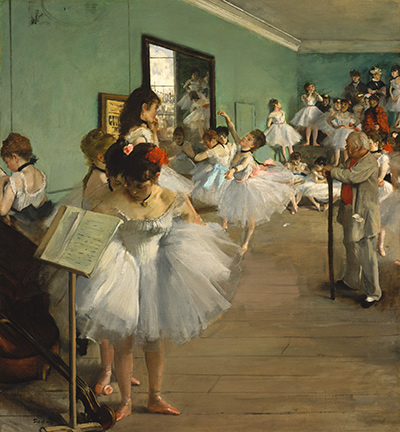
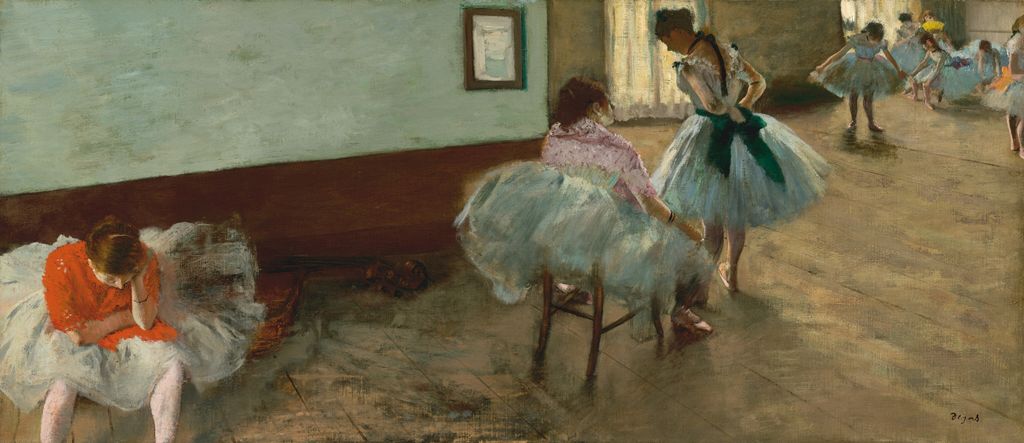
In Edgar Degas's The Dance Lesson, a dancer in a red jacket bends over at the near edge of a long room. Two others occupy the centre, one sitting while the other adjusts a bow at her waist. More figures practice, wait or attend to their costumes farther back. The painting offers no single leap as its climax. It asks us to look at everything around dancing: the interval, the repeated preparation and the room in which bodies work. The National Gallery of Art dates this particular canvas to about 1879 and identifies it as accession 1995.47.6. [1] [13]
The scene looks like a moment caught in passing. It was carefully assembled. The NGA describes a compositional sketch, figures drawn from Degas's other studies, and changes made after the figures were placed. That difference between apparent immediacy and sustained construction runs through his ballet art. Degas knew the Paris Opéra and its dancers, yet a dance picture is not a photograph of a class he happened to see. It is a made image whose choice of viewpoint, figures and medium affects what we learn about the work of performance. [1][2]
Ballet Dancers at a Glance
- Main settingsDance studio, stage, wings and backstage spaces of the Paris Opéra
- Repeated activitiesPractice, waiting, adjusting costume, performing and recovering
- Two opera housesSalle Le Peletier, destroyed in 1873; Palais Garnier, opened in 1875
- A key cautionFamiliar rooms and apparently candid actions were often rearranged in the studio
- A labour exampleMarie van Goethem, the student associated with Little Dancer Aged Fourteen
- Access and powerWealthy subscribers could enter backstage areas, a privilege visible in some works
- How to identify a pictureTitle, owning institution, accession number, date and medium together
Contents
- Introduction
- At a Glance
- An Opera House, and an Imagined One
- The Lesson Is Work
- Waiting, Rest and Performance
- Who Could Go Backstage?
- Marie van Goethem and the Little Dancer
- How Degas Made Dancers Move on a Still Surface
- Reading a Degas Ballet Picture
An Opera House, and an Imagined One
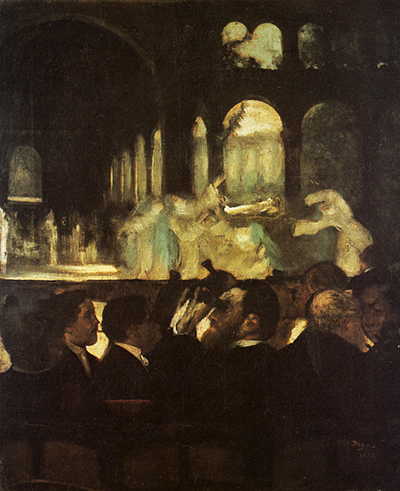
Degas's access to the Opéra gave him a sustained view of its auditorium, stage, wings and rehearsal spaces. The institution itself changed while he was developing his dance subjects. The Salle Le Peletier burned in 1873; the Palais Garnier opened in 1875. A painting made after the fire can still evoke the earlier building. Musée d'Orsay notes that Degas returned to features associated with Le Peletier even after he knew the newer theatre. A date and an architectural resemblance therefore answer different questions. One dates an object; the other may help explain the imagined setting it constructs. [2][3]
The Orsay exhibition account is unusually direct about this gap. It says Degas altered the layout of dance spaces, opened or removed passages, and created recesses to serve a composition. It also recounts his admission that he had made images of dance examinations without seeing the examinations themselves. We need not turn this into a claim that he never observed dancers. His familiarity with the Opéra and his use of studies are well documented. But the finished room could gather observed movements and invented architecture into one persuasive space. [2][4]
This distinction matters because “behind the scenes” can sound like unfiltered access to truth. The biography traces how Degas entered artistic and musical circles. A dance picture does another kind of work: it controls who appears close, who is cut off, who rests and who is watched. Those choices can show a viewer the demands of ballet while still carrying the artist's interests and the assumptions of his time. [1][2][5]
The Lesson Is Work
Degas returned to practice more often than a visitor might expect from a painter of theatre. Orsay's La Classe de danse, dated between 1873 and 1876, shows the end of a lesson under the ballet master Jules Perrot. Dancers stretch, adjust dress and hair, and seem tired after exertion. The museum treats the floor as part of their working equipment, not just a neutral backdrop. In this particular painting, the boards pull the eye diagonally across the room while Perrot's baton supplies the class's measure. It belongs to Orsay as RF 1976. [3]
The NGA's Dance Lesson is a different canvas. Its long, shallow shape gives much of its area to the worn floor and leaves figures at varied distances from us. At the front, the red-jacketed dancer's downward posture suggests a pause. In the centre, dress adjustment interrupts any expectation of a polished stage pose. The NGA reports that Degas arranged these figures using drawings and other paintings, then changed some details while working. “Informal” describes how the picture appears to us; it does not establish that every figure was seen in the room together. [1]
The gallery places this canvas at the beginning of a group of long horizontal ballet scenes. Its breadth allows the resting dancer to remain prominent even while activity continues at the far end. Degas shifted a foot, changed a chair and painted out part of a violin case as he refined the scene. Those visible alterations make revision concrete. They also show how much work went into an image that leaves space for the apparently accidental. A viewer need not decide whether the red-jacketed figure is tired, distracted or simply pausing to see that Degas deliberately gives her a large share of the picture. [1]
Nor should the many works called Dance Class be folded into one image. The NGA also holds The Dance Class, c. 1873, accession 2014.79.710, with a stair and a crowded studio. Orsay's La Classe de danse is RF 1976. The Met holds another The Dance Class, 1874, accession 1987.47.1. Similar English titles describe a subject, not an object identity. The Met painting's own page can follow its version in detail; the subject hub compares what lessons and rehearsals do across works. [3][6][7]
Practice is repetitive physical labour. Orsay describes dancers working under teachers through positions, balances and turns before the image of a stage solo is possible. The NGA's Opéra exhibition likewise stresses rigorous training and the life of young students called “rats” in period usage. That historical term needs context: it was attached especially to child students and carried social judgments. It should not stand in for every dancer, or reduce an individual worker to a picturesque type. [2][4]
Waiting, Rest and Performance
The Opéra produced spectacle, but Degas often put what happens beside it in the foreground. Orsay's Répétition d'un ballet sur la scène, a 1874 oil painting numbered RF 1978, sets dancing figures against others at rest or waiting. Its view is from above and to one side, with stage lights marking the space. The owner record points to changes Degas made in the thin paint, including the legs of dancers at rest. Rehearsal becomes both the subject and a clue to the painter's own revision. [8]
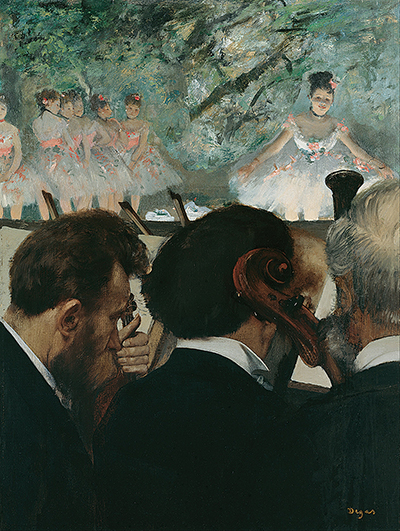
Orsay's Ballet, also called L'Étoile, presents a contrasting image: a star dancer onstage. Its owner dates it about 1876–77 and calls it pastel on monotype, RF 12258. That medium means the visible scene brings together a printed base and a later pastel layer. The Orsay account of the Opéra draws attention to the subscriber partly concealed behind the scenery. The solo is therefore not only a dancer isolated in theatrical light. It includes the relation between a performer and someone permitted to look from the wings. The Star page follows the individual work. [2][9]
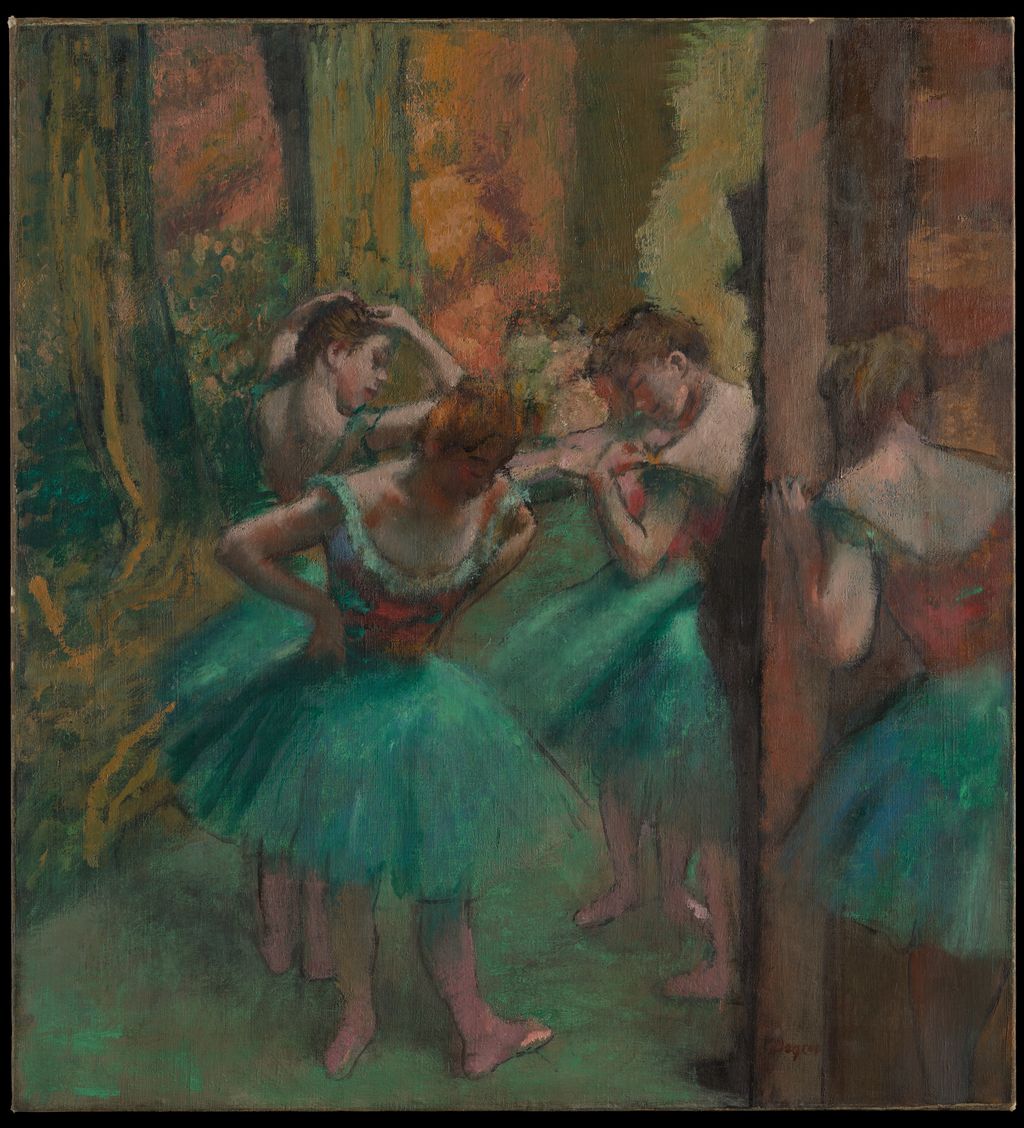
Later, Dancers, Pink and Green placed a cluster of dancers near the wings of a performance. The Met dates this oil canvas to about 1890 and records it as 29.100.42. Green skirts and pink upper garments catch the light, while a dark, top-hatted patron is visible at the edge. The museum identifies his privileged presence as part of Opéra backstage life. It also describes heavy layers of oil paint worked with brushes and fingers. The vivid result should not make us forget that access to the stage and access to the dancers were unequally shared. [10]
These works are separated by time, owner, medium and composition. They are not successive views of one performance. Taken together, they widen the meaning of a ballet subject: a person rehearses, waits, adjusts, performs or moves through a corridor, and the painter decides which moment becomes visible. For the material differences between oil and pastel, see paintings, pastels and prints. The point here is how each choice shapes the account of working and being seen. [1][8][9][10]
Who Could Go Backstage?
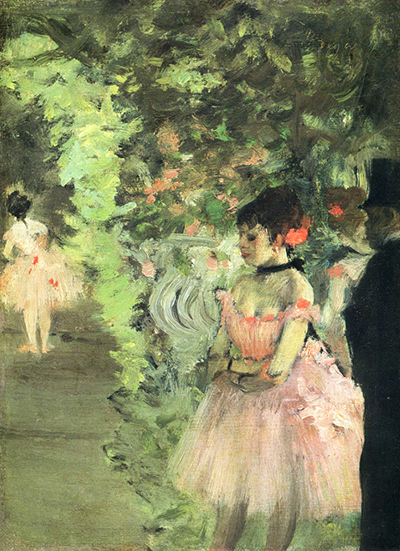
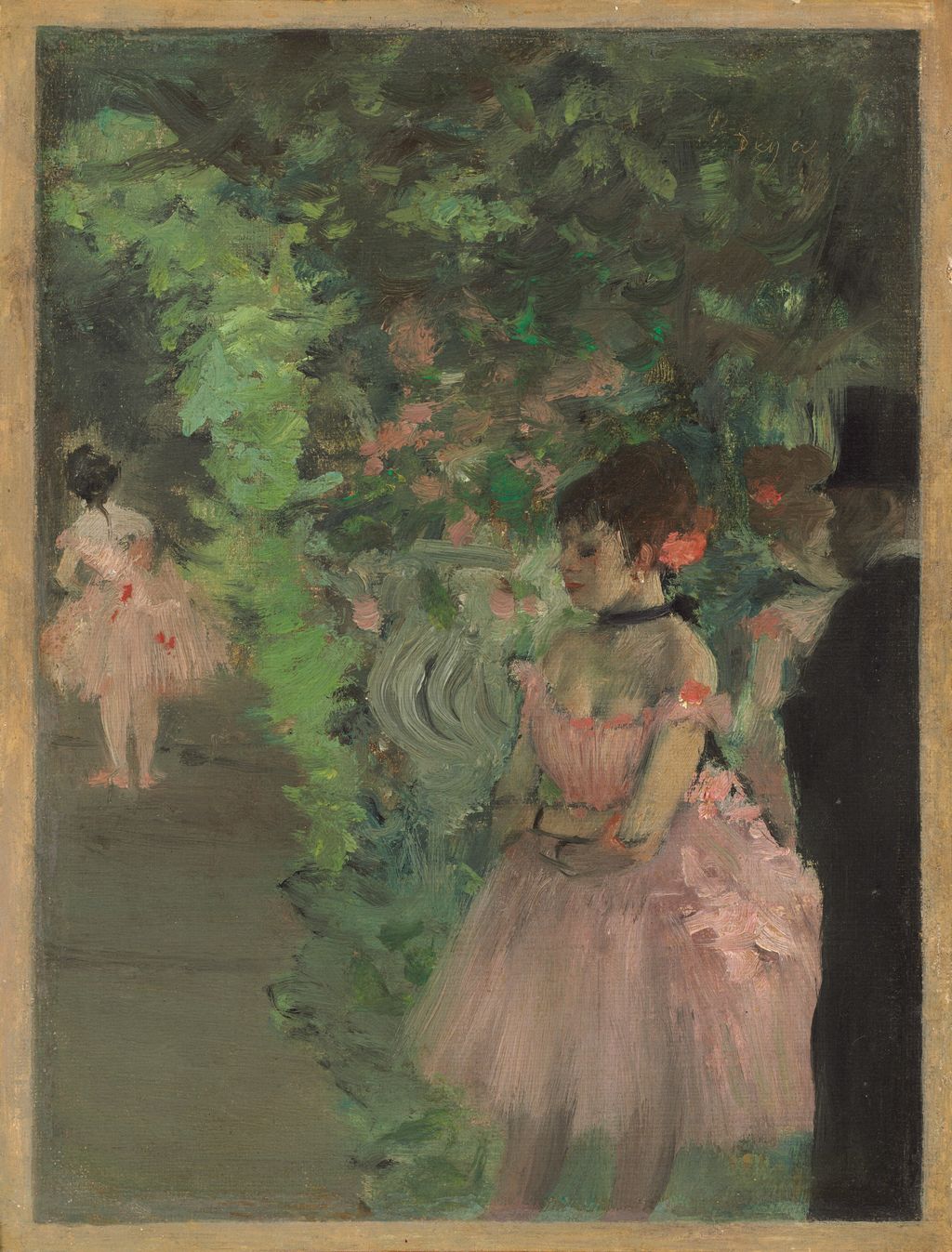
In the NGA's Dancers Backstage, a dancer near the front holds her arms close to her body. Other dancers and a man in dark evening clothes occupy the space around her. The painting is small and loosely worked, but its arrangement makes the man's presence difficult to ignore. The gallery identifies him as an abonné, a wealthy subscriber with backstage privileges. The owner interprets the encounter and notes that the dancer turns away. We can describe her painted pose; we cannot recover her private thoughts from it. The work is accession 1970.17.25, distinct from the Met picture with another top-hatted patron. [5][10]
Subscriptions mattered because some male audience members could cross from the public auditorium into places where dancers worked. Orsay's Opéra account describes the mothers, subscribers and dancers who recur in Degas's backstage imagery. It also connects some prints to fiction about young performers and predatory patrons. Those contexts make it impossible to describe the wings as a purely neutral workroom. At the same time, a historical social type or fictional plot cannot be pasted onto every real dancer in every painting. The figures may be unidentified, and their experiences are not supplied by the artist's composition alone. [2][5][11]
The NGA's scholarly study of young dancers warns against a simple universal story. Period writers repeated a stereotype about impoverished dancers and wealthy patrons, rooted partly in earlier Opéra practice and extreme cases, even as some practices changed. There were also documented cases of precarious circumstances. The evidence is uneven: contracts and school registers can establish a particular student's training or departure; gossip about a family may reflect hostile social assumptions. Treating both as the same kind of record would erase the distance between a person's life and what others said about it. [11]
The distinction also changes the way a picture can be described. A patron visible in a wing is evidence of the artist's chosen subject and composition. The historical privileges of subscribers help explain why that subject was possible. Neither establishes the name or personal history of the woman next to him. Where a museum offers an interpretation of her turned body, that reading can be reported as interpretation. A claim about what happened before or after the depicted instant would require different evidence. [2][5][11]
This is why the question of looking belongs beside the question of labour. The audience paid to see grace onstage. The dancer's work included practice and endurance before that spectacle. Some subscribers could see or approach more than the audience as a whole. Degas, another man with access, made images from within this unequal world. A strong reading can notice those positions without assigning one motive to every pictured dancer or claiming that a painted glance proves a particular event. [2][4][5][11]
Watch: Edgar Degas
Explore his paintings, drawings and sculpture in three short videos.
Degas, The Dance Class
Look closely at Degas’s off-duty dancers and his unusual view into the rehearsal room.
Watch on YouTubeMarie van Goethem and the Little Dancer
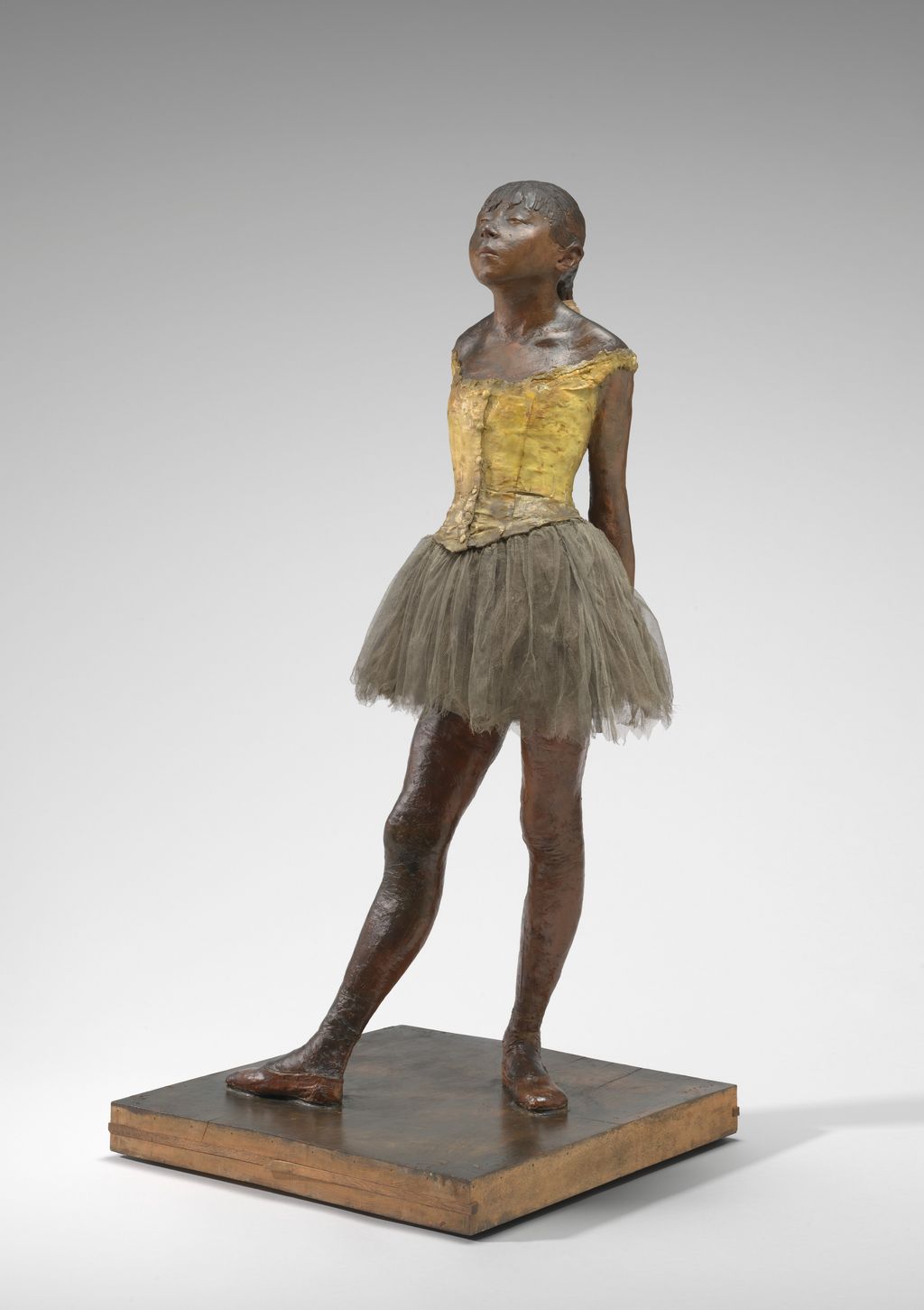
One student can be discussed by name, with appropriate limits. The NGA identifies Marie van Goethem as the model associated with Degas's Little Dancer Aged Fourteen, an original wax and mixed-material sculpture made in 1878–81. The museum describes her as the daughter of a Belgian tailor and a laundress, part of the working-class background common among students. The scholarly NGA chapter follows her through Opéra sources: Marie and her younger sister entered the dance academy in 1878, and records place her in the corps de ballet before her removal for nonattendance in 1882. This is evidence about Marie, not a ready-made biography of all dancers. [11][12]
The sculpture holds a poised but strenuous position. Its materials, clothes and scale startled some 1881 viewers; the Little Dancer page examines the object and its reception. The model has a documented relation to training, modeling and a family's need for work. Even here there is a boundary: an image made from a model does not tell us everything she felt while posing or everything that happened after the last known record. The original wax is NGA object 1999.80.28, not one of the bronzes cast after Degas's death. [11][12]
Marie is particularly tempting to make into the voice of an entire group because so many painted dancers remain unnamed. The NGA study is more careful. It connects her to records and a preparatory drawing, and separates those materials from later accounts that repeated stories about the family. Her known career was brief; it does not supply a typical career length for another student. The fact that we can name her should deepen our attention to one working person, while leaving the many unidentified figures neither interchangeable nor available for invented biographies. [11]
How Degas Made Dancers Move on a Still Surface
Degas did not need to paint a flying leap to make a dance picture active. In The Dance Lesson, the viewer's eye moves from the near, withdrawn figure across a broad floor to the smaller dancers at the rear. Adjusted clothing, bending and waiting suggest actions about to continue. The NGA points out that he transferred figures from studies, placed them in a new arrangement and then altered details. A still canvas can convey a sequence of possible movements by placing unlike poses together. [1]
The 1874 Orsay stage rehearsal shows a different device: stage lights and an elevated viewpoint hold active dancers against those resting. The later Met Dancers, Pink and Green relies on dense colour and the wing's shadow. Orsay's Ballet/L'Étoile uses a monotype under pastel, bringing a printed foundation into a radiant stage scene. These material and compositional choices are specific to their works. They also explain why neither “realist document” nor “pretty ballet scene” is an adequate label for the whole group. [8][9][10]
The subject crosses drawings, paintings, pastels, prints and sculptures. A drawing might preserve a gesture for later use; a painting could assemble several such gestures into a room; a pastel on monotype could remake a stage view; a wax figure could hold one position in three dimensions. Those are possible relationships, not a single prescribed pipeline for every dancer work. The exact medium line and owner record tell us which steps are secure in each case. [1][4][9][12]
Reading a Degas Ballet Picture
Begin with the object. A title such as Dance Class is shared by different paintings; institution, accession, date and medium keep them apart. Ask next whether the figure is practicing, waiting, performing or near the wings. The setting may resemble a place Degas visited without reproducing one observed moment. Read the viewer's position too: are we looking from above a studio floor, across stage lights, or into a private corridor? [1][2][3][6][7][8]
Then ask who else may enter that space. Teachers, musicians, mothers and subscribers appear in the visual and historical record, but not all in every picture. Where a wealthy subscriber is painted, the encounter deserves attention; where no such figure appears, do not invent one. The dancer remains a worker with a life beyond the frame, even when a museum can name only one student or a work's original owner. Degas's achievement and the limits of his view become clearer when we hold the disciplined art and the unequal working world together. [2][5][10][11][12]
Selected ballet dancers
Artworks directory
A selected index of documented works, combining owner records with entries sampled across Michel Schulman’s digital catalogue raisonné. It is not a complete catalogue. View the full catalogue
Discussion
Share what you notice in Degas’s ballet dancers.
Reader Insights
Which details show preparation rather than a finished performance?
How does backstage access shape who can look at a dancer?
Where do repeated or interrupted movements organize the picture?
Join the Conversation
Share your reading of these works below.
References
- National Gallery of Art, Washington, The Dance Lesson, c. 1879, oil on canvas, accession 1995.47.6. View source
- Musée d'Orsay, Degas at the Opera, exhibition presentation, 2019–20. View source
- Musée d'Orsay, La Classe de danse, 1873–76, oil on canvas, accession RF 1976. View source
- National Gallery of Art, Degas at the Opéra exhibition release, 2020. View source
- National Gallery of Art, Washington, Dancers Backstage, 1876/1883, oil on canvas, accession 1970.17.25. View source
- National Gallery of Art, Washington, The Dance Class, c. 1873, oil on canvas, accession 2014.79.710. View source
- Metropolitan Museum of Art, The Dance Class, 1874, oil on canvas, accession 1987.47.1. View source
- Musée d'Orsay, Répétition d'un ballet sur la scène, 1874, oil on canvas, accession RF 1978. View source
- Musée d'Orsay, Ballet / L'Étoile, c. 1876–77, pastel on monotype, accession RF 12258. View source
- Metropolitan Museum of Art, Dancers, Pink and Green, c. 1890, oil on canvas, accession 29.100.42. View source
- National Gallery of Art, “Young Dancers in Nineteenth-Century Art”, scholarly chapter in its Little Dancer conservation publication. View source
- National Gallery of Art, Washington, Little Dancer Aged Fourteen, 1878–81, original mixed-material wax sculpture, accession 1999.80.28. View source
- Splash image: Edgar Degas, The Dance Lesson, c. 1879, oil on canvas. National Gallery of Art, Washington, 1995.47.6. Collection record. View source