

 Buy Art Prints Now
from Amazon
* As an Amazon Associate, and partner with Google Adsense and Ezoic, I earn from qualifying purchases.
 by Tom Gurney
Tom Gurney BSc (Hons) is an art history expert with over 20 years experience
Published on June 19, 2020 / Updated on September 28, 2026
Email: tomgurney1@gmail.com / Phone: +44 7429 011000
Degas Little Dancer Of Fourteen Years: Introduction
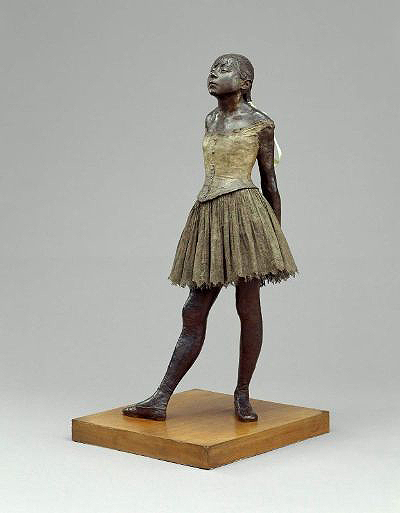
Degas's Little Dancer Aged Fourteen stands with one foot advanced, both feet turned outward and her hands clasped behind her back. Her chin rises above almost closed eyes. She wears a bodice, a layered skirt and ballet slippers, yet her body is not an ordinary carved or cast figure. The visible skin is modeled wax; fabric, human hair and real footwear have been worked into the sculpture. From a distance she may look like a familiar image of ballet. Close up, the different materials make her presence more difficult to classify. Is this an artwork, a figure on display, or a portrait of a young person at work? Degas brought such questions into an exhibition in 1881. [1][2][3] [9]
The sculpture in the National Gallery of Art (NGA), Washington, is the unique original dressed figure that Degas made. It is important to start there because many photographs online show later bronzes or plaster versions under the same title. Those later objects can be valuable works and evidence of the sculpture's afterlife, but they were not the wax figure that Degas modeled and exhibited. The difference is especially visible in the real costume of the original. This page follows that NGA wax, accession 1999.80.28, and identifies other versions only when they help explain it. [1][4]
At a glance
- ArtistEdgar Degas
- Artist's exhibited titlePetite danseuse de quatorze ans; usually translated Little Dancer Aged Fourteen
- Date1878–81
- MediumPigmented beeswax, clay and a metal/rope armature with real hair, fabric costume and linen slippers, on a wooden base
- Height98.9 cm without the base
- Original objectNational Gallery of Art, Washington, 1999.80.28
- First public showingSixth Impressionist exhibition, Paris, 1881
Contents
- Introduction
- At a Glance
- Marie van Goethem, a named model
- What the pose lets us see
- Wax, fabric and an armature
- A different kind of figure at an art show
- Work, class and the Opéra
- Studies and other versions
- What happened to the original?
- Looking carefully at the original
The NGA's object record gives a more detailed material list, including old paintbrushes within the construction and several kinds of cloth. The museum's technical research explains what is visible, what radiography and sample analysis reveal, and which changes may have happened after Degas's death. This is a sculpture made from several joined parts, not simply a block of wax covered by clothes. [1][3]
Marie van Goethem, a named model
The young dancer is identified as Marie Geneviève van Goethem. An inscription on a preparatory drawing supports that name. The NGA's 2014 brochure gives her birth as 7 June 1865, correcting an older date often repeated in accounts of the work. She was born in Paris to parents from Belgium; her father was a tailor and her mother a laundress. She studied at the Paris Opéra. These facts let us meet the model as a person with a documented family and training, rather than an anonymous emblem of ballet. They do not give us a full biography or a record of every sitting for Degas. [2][4]
The title poses a small trap. “Aged Fourteen” is the title under which the sculpture was listed for exhibition; it is not a dated birth certificate. Marie's corrected 1865 birth means that she was not fourteen throughout the period 1878–81 assigned to the sculpture, nor exactly fourteen at the 1881 display. The NGA's research suggests the project may have begun around 1879, when she reached that age, while leaving room for some earlier related studies. The most accurate public account gives the museum's date span and explains the title without forcing every drawing and modeling session into a single year. [2][5]
Marie was dismissed from the Opéra ballet school in the summer of 1882, probably after repeated missed rehearsals, according to the NGA brochure. Her later life does not appear in the records discussed there. That gap has encouraged dramatic stories, but none can be treated as a documented sequel. The statue records Degas's work with a young dancer; it does not tell us why she missed rehearsals, how she felt about posing, or what happened to her after she left the school. Treating the missing record as an open question respects her more than supplying an ending that merely fits a modern expectation of tragedy. [2]
What the pose lets us see
The dancer does not leap or bow. She holds a position. Her right foot is forward and both feet turn outward; her shoulders pull back with her clasped hands. The pelvis and torso do not form a perfect classical vertical line. The head tilts up, the eyes nearly shut, and the face is modeled with features that Degas did not smooth into an ideal mask. A viewer may read effort, concentration, discomfort or resolve in this posture. Those are possible responses to a shaped figure, not direct access to Marie's private feelings. [1][4]
We can move around the original in a way a painting cannot allow. From the side, the advanced foot and thrown-back head become more striking. From behind, the braid and the way the hands meet are easier to see. The squared wooden base fixes the stance, while the nearly life-sized scale brings the figure into our space. Her body is neither miniature decoration nor a full-sized monument. It sits in an in-between scale close enough to a living adolescent that viewers in 1881 had to reckon with the sculpture's physical presence. [1][5]
The student dancer's held position also redirects attention from theatrical spectacle to preparation. Ballet training includes repeating positions under instruction, and the pose can be understood as part of that disciplined world. The NGA describes Marie's working-class family background and the demands surrounding the Opéra's student dancers. Such context helps explain why a subject who now seems charming could trouble viewers when first shown. It would be a mistake, though, to say the specific pose documents a particular rehearsal or a precise encounter with a patron. The sculpture gives a posed work of art rather than a dated report from the school. [1][2][6]
That distinction matters even in the movement of her feet. The right foot extends in front rather than balancing on a toe, and both shoes meet the base. The dancer has been made to sustain a position for our inspection. At an actual rehearsal, the same position would be part of a changing sequence, watched by a teacher and altered as needed. Here the sequence has stopped. The result can feel both sturdy and precarious: the legs make a clear stance, but the head and shoulders draw away from the vertical line beneath them. Degas's choice keeps the young dancer from dissolving into an easy emblem of weightless grace. The viewer encounters the bodily effort of holding a pose, even though the sculpture cannot record the actual strain of any one sitting. [1][5]
The title and pose also invite a question about who gets treated as a subject worthy of sculpture. Many public statues of the time commemorated statesmen, military achievement or ideal figures; this one singled out a working student. That contrast does not make the wax a political manifesto. It does explain the pressure of seeing a recognizable girl, wearing practical dance clothes, at nearly living scale in a fine-art exhibition. Her ordinary labor and social position were part of what contemporary reviewers recognized, often through prejudiced descriptions. Degas's sculpture can be read as an experiment in what a modern subject might look like in three dimensions without needing to claim that he made it to convey a documented social program. [4][5]
Wax, fabric and an armature
The sculpture's structure begins inside. NGA conservators describe lead pipes, rope and other materials forming an armature; clay built up the body, and Degas applied layers of beeswax over it. Radiographs show old paintbrushes used to strengthen the arms. Those humble studio tools are not a picturesque guess. They are part of what technical examination found within the surviving object. The model's skin has colored wax, sometimes with pigment mixed through it and sometimes paint at the surface. Small areas, including the lips, were worked differently. The varying treatment helps the figure seem bodily without making its material disappear. [1][3]
Degas adapted actual clothing to the figure. The bodice is cotton faille, altered to fit the torso and partly covered in wax. The skirt has multiple layers of cotton and silk net or fabric, rather than one simple piece of tulle. The slippers are real linen shoes, cut and adjusted for this particular stance, then touched with colored wax and ribbons. The wig is human hair; the conservation study reports how it was braided, tied and integrated with wax at the scalp. Fabric and hair are not props placed next to a finished sculpture. Degas made them part of its body and surface. [1][3]
The effect is easy to flatten in a small photograph. Wax can look like bronze; old fabric may look painted; a cropped image can hide the base and the layered skirt. In person, the sculpture joins visibly unlike substances and makes the viewer notice that joining. A wax shoulder meets a cloth strap, a modeled leg continues into a real slipper, and a wig enters the wax of the head. Those junctions are central to its technical achievement. They also made it hard to place within the expectations of fine-art sculpture in 1881. [3][4]
Conservation adds another caution: the object we see today is not guaranteed to be materially identical in every detail to the one displayed in 1881. NGA researchers describe damage or disturbance that may have happened when a mold was made after Degas's death, especially around the lower bodice. They compare old photographs, plaster and bronze versions, fabric condition and the wax itself. No photograph of the sculpture from Degas's lifetime has been found. We can identify the unique original wax, yet still acknowledge uncertainty about its exact original costume appearance and color at the exhibition. [3][5]
The clothes deserve this care because fabric changes even when the form beneath it survives. Tulle can discolor, shorten, stiffen or tear; a ribbon can be moved; an old wax surface can gather dirt. The NGA's technical notes describe five layers of material in the original tutu and say that the plaster and bronze versions did not receive an equally elaborate assemblage. That is a concrete difference between the original and a reproduction. It also means a photograph of a later cast cannot be used to reconstruct every cloth edge that the 1881 audience saw. The mixed-media method made the figure new and compelling, while giving its long-term care a complexity that a solid bronze statue does not share. [3]
The same study is careful about causes. Where a bodice fold differs between the wax, early photographs and later copies, conservators can propose that moldmaking disturbed it; they cannot watch the event happen. Their explanation depends on material evidence and comparisons, and it remains open to refinement. This is a useful model for reading the entire sculpture. Some facts are secure because the object can be measured or analyzed, others are strong inferences from related evidence, and still others remain unknown. The present wax offers a direct encounter with Degas's handwork, but its survival for more than a century has its own history. [3]
A different kind of figure at an art show
Wax was familiar in other settings before Degas exhibited this work: anatomical and anthropological displays, waxworks and entertainment, and small models used in making sculpture. A dressed wax figure could suggest a doll or mannequin as well as art. The NGA's technical authors point out that the construction was far more complex than a doll's, and its modeling cannot be reduced to a scientific specimen. But the associations were available to viewers and critics in 1881. They help explain why the figure felt challenging even before anyone argued about Marie's appearance. [3][4]
Degas had intended to show Little Dancer in 1880, but it did not appear, although a display case was set up. It returned in the catalogue for the sixth Impressionist exhibition the next year. The NGA's detailed history says the case stood empty at first and the sculpture arrived about two weeks after opening. It was seen for only roughly the latter half of the exhibition. The case, now lost, was part of the encounter. It separated the wax from the audience and made the figure look as though she might belong to an unusual collection. Some critics called it a “glass cage.” That phrase was their reaction to the display, not a neutral description of Marie herself. [5]
The 1881 response was varied. Some reviewers mocked the figure's materials, face, social class or supposed ugliness. Others praised its force and modernity; still others gave it little attention. The NGA's scholarly review warns against a simplified story in which every critic hated it. The hostility that did appear is historically revealing: class prejudice and pseudo-scientific ideas about bodies shaped how certain writers discussed an adolescent working-class model. Their words tell us about those writers' assumptions. They should not be adopted as a present-day evaluation of Marie. [4][5]
Display conditions sharpened the disagreement. The NGA reconstructs a small, relatively dim exhibition room with a warm wall color and a reflective case. The figure occupied a central position within that installation. A viewer did not see a neutral photograph on a plain background; they saw wax, cloth and glass interacting with the room's light. The case could protect a fragile object, make it seem precious, or recall museum displays of specimens. Critics responded differently to these possibilities. Since no lifetime photograph of the installation is known, the reconstruction relies on period descriptions and should not be presented as a perfectly recoverable view. It is nonetheless enough to show why modern reproductions against gray or white cannot stand in for the first encounter. [5]
The work's delayed arrival matters too. An exhibition visitor during the opening fortnight might have seen only an empty case; a later visitor encountered the figure inside it. Published critics therefore did not all respond to the same sequence of sights. Some had time to hear rumor and expectation before seeing the wax. The NGA history makes this point by separating an announced sculpture from an installed one. When we say the Little Dancer “was exhibited in 1881,” the sentence is true but compressed. The more exact account is that the sculpture appeared for about two weeks of that exhibition, after a period in which its case was already there. [5]
One critic, Joris-Karl Huysmans, recognized the sculpture as a startlingly modern effort while also reading the child through the era's unsettling language about appearance and social type. Another, Charles Ephrussi, admired its newness but commented critically on the color of the wax. Such combinations resist a clean division between friends and enemies of the work. A critic could be impressed by the artistic experiment and still speak about the model in terms we should examine critically. What made the sculpture powerful in 1881 was not a single scandalous detail: the materials, subject, life scale and display case acted together. [3][5]
Watch: Edgar Degas
Explore his paintings, drawings and sculpture in three short videos.
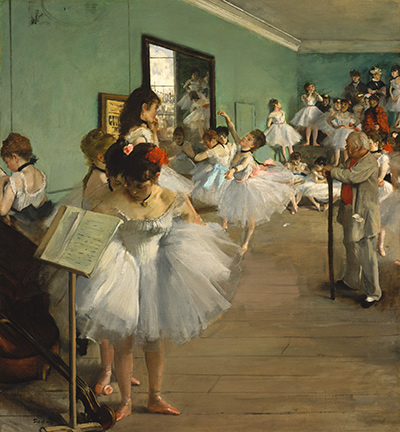
Degas, The Dance Class
Look closely at Degas’s off-duty dancers and his unusual view into the rehearsal room.
Watch on YouTubeWork, class and the Opéra
Marie belonged to the world of the Paris Opéra's young student dancers. The role required training and labor; a family of limited means might see the school as an opportunity as well as a demanding institution. The NGA's public interpretation notes that wealthy male subscribers could gain backstage access and that young dancers faced risks from such unequal relationships. This is important social context, especially when later images of ballet turn a student into a timeless symbol of grace. It does not establish that a specific person abused Marie or that Degas built the sculpture to tell one concealed story about her. [2][6]
The insult “opera rats,” used of young dancers, carried ideas about poverty and dirt as well as their quick movement around the stage. Rather than repeat it as a cute nickname, it is better to recognize the social distance it expressed. In the sculpture, a young trainee occupies the space traditionally reserved for more exalted subjects. She is not shown as an ethereal star: her face and body retain the physical specificity that some 1881 critics found disturbing. What each viewer makes of her chin and closed eyes may differ, but the work's refusal to idealize is visible. [1][6]
Work at the Opéra also existed on a ladder of opportunity. Instruction could create a route into a performing career, but progression was uncertain and attendance demanded time a working family might struggle to spare. The source record for Marie supplies only a few points on that path: entry, study and dismissal. It does not show precisely how household money, illness, school discipline or personal choice interacted in her case. A page about this sculpture can explain that ballet was labor without claiming to diagnose her absence from rehearsals. The visible figure's posture is a powerful prompt to think about training; the historical documents, however, set the boundary for what may be said about this particular student. [2][5]
It also matters that we know her name. The inscription linking Marie to the studies means the model can be discussed as a historical person, although her voice is not preserved in these object records. The missing voice should keep our claims modest. We can describe her circumstances, the documented dates and the formal choices Degas made. We cannot claim to know whether she felt proud, frightened, bored or exploited at a particular sitting. A history of art that pays attention to class and labor is strongest when it states what documents show and leaves unrecorded experience unassigned. [2][5]
Studies and other versions
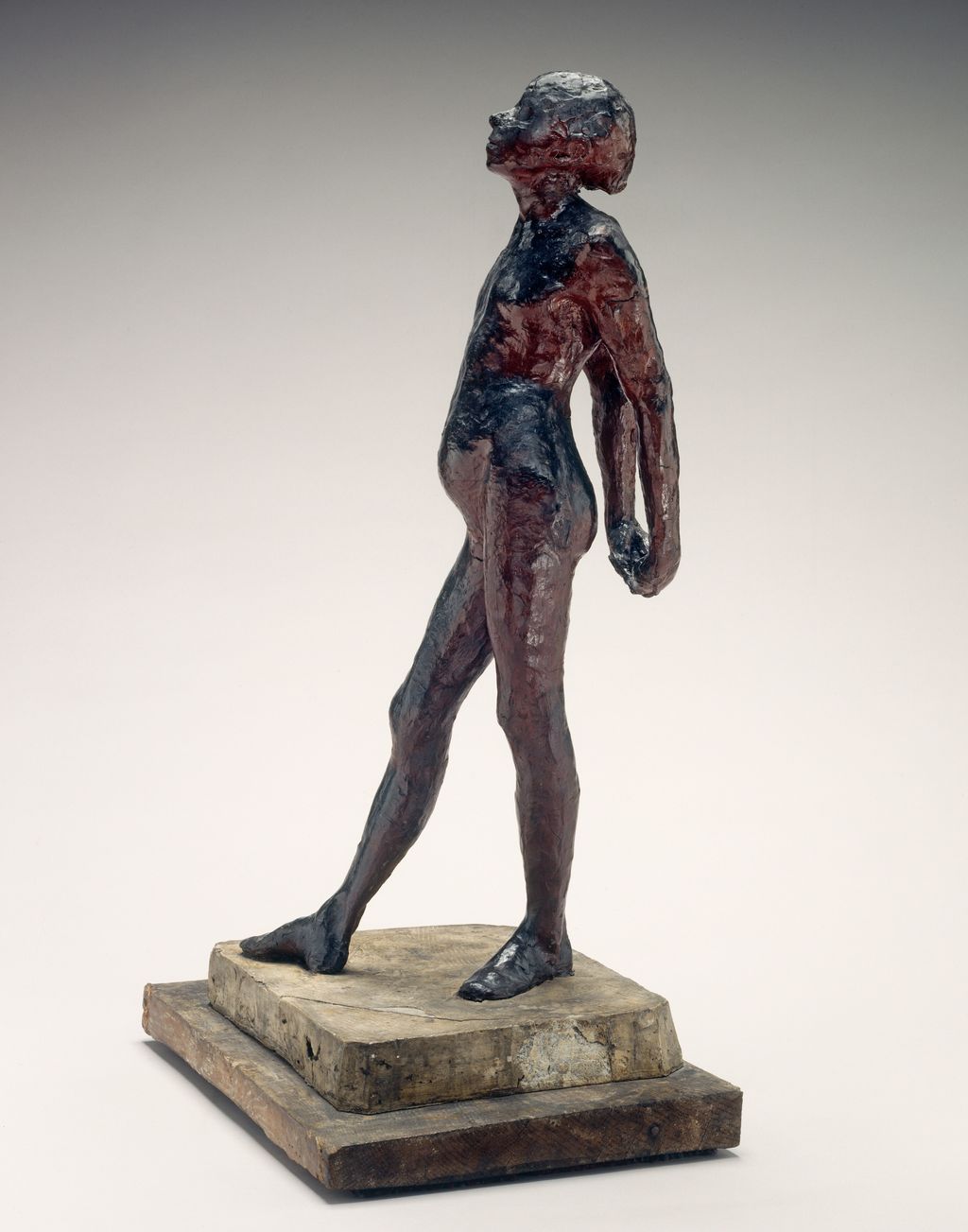
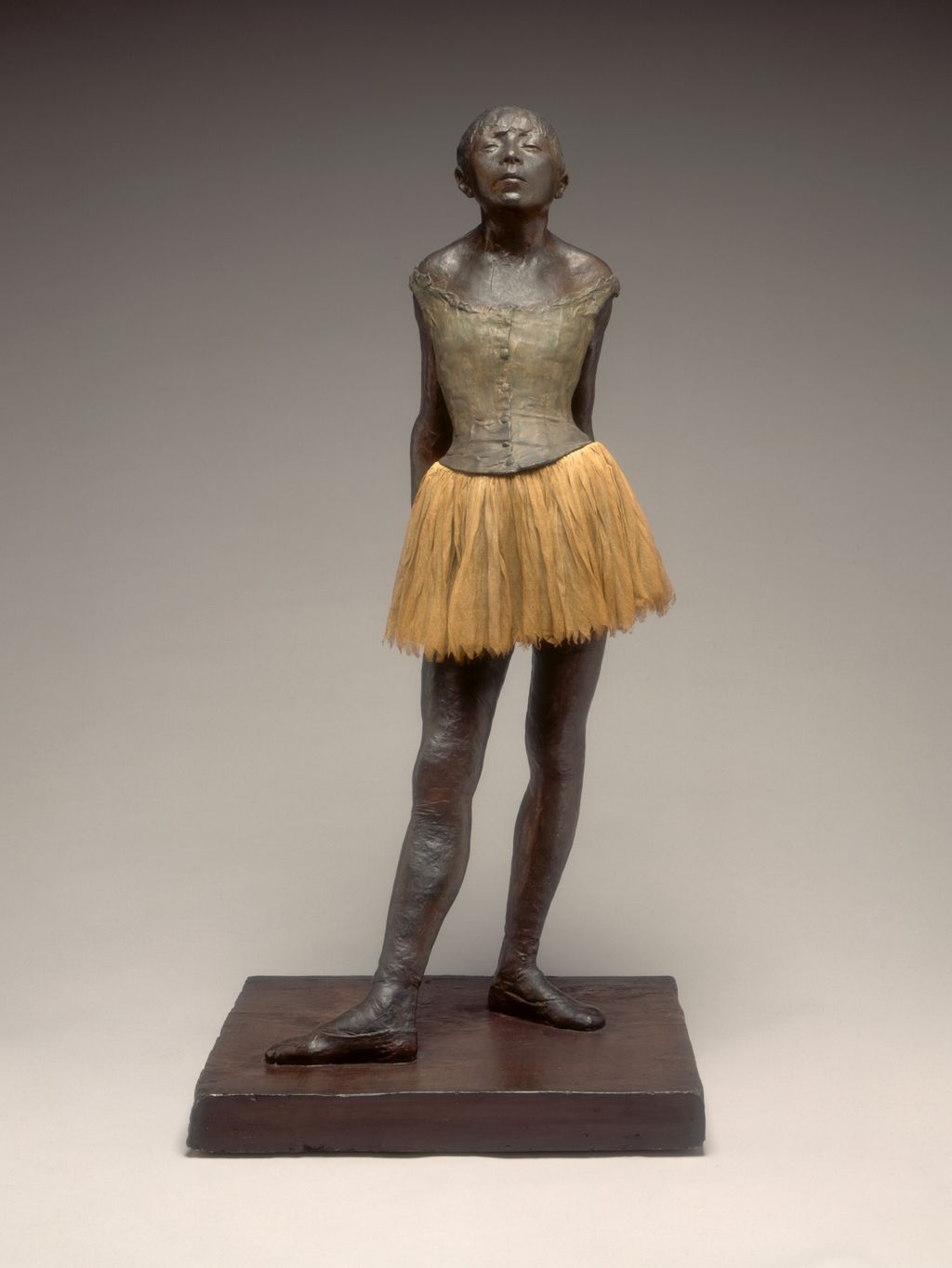
NGA owns a separate wax Study in the Nude of Little Dancer Aged Fourteen, accession 1985.64.46. It is substantially shorter than the dressed original and has its own structure and base. Looking from one to the other can illuminate Degas's attention to weight, turned-out feet and a thrown-back head. It does not prove that the nude figure was simply the dressed one before clothes were put on. The two are different sculptures. Drawings also relate to the project, but the NGA's research cautions against arranging all of them in a single certain line from first idea to final form. Different poses, clothing and apparent stages of the model's physical development complicate that tidy sequence. [5][7]
Another NGA object, 1985.64.62, is a painted plaster Little Dancer cast possibly in 1920 or 1921 after Degas's original wax. It resembles the finished figure in pose and costume but was made after his death. The plaster can help scholars study moldmaking and later versions; it cannot be treated as what viewers saw in 1881. The original wax and the plaster have separate accessions, materials, base measurements and histories. A side-by-side display of them should make those differences explicit in captions rather than simply giving both the same short title. [1][8]
Bronze casts multiplied the image further. Many visitors first encounter the Little Dancer in bronze, perhaps without realizing there is a unique original wax. Posthumous bronzes transmit the pose and features but change the material character: the wax body becomes metal, and versions of the costume may differ. The NGA exhibition account explains that casting took place mainly in the 1920s and that Paul Mellon later acquired the surviving original waxes. To say Degas “made only one Little Dancer” means he made one original dressed sculpture of this subject; it does not deny the later plaster and bronze descendants or the related nude study. [2][4][8]
The version distinction is not an exercise in pedantry. It affects what a claim about the work can mean. If we say Degas chose pigmented wax and layered real fabric, we are speaking about the original. If we discuss the circulation of the famous silhouette through museums and collections, we may be speaking about later casts. A photograph showing a dark, narrow skirt or an altered base should be checked against a named collection record before its material is identified. The title alone is insufficient to tell us which object it shows. [1][3][8]
The different versions also answer different questions. The nude wax helps ask how Degas explored a young body in a held stance; the posthumous plaster helps ask how an original was translated into a form suitable for casting; a bronze helps ask how the image circulated once it could be multiplied. None substitutes for the original dressed wax when the question concerns the material effect of 1881. Nor does the original erase the importance of later versions: for many people, those copies were the only accessible Little Dancer. A good caption can orient a reader quickly by naming its medium, date of making, collection and accession. With that information, comparison becomes a way to study change rather than an accidental mix of photographs. [1][4][7][8]
What happened to the original?
After the 1881 exhibition, the original remained with Degas. The NGA provenance records a later passage through his heirs and the Hébrard family, then a consignment through Knoedler. Paul Mellon bought it in 1956; his bequest brought it to the National Gallery of Art in 1999. This history explains why the artist's own wax is now available to compare with the casts that helped make the image familiar. It also reminds us that an artwork's current home and present material condition have histories of their own. [1]
That path was not a smooth transfer from a celebrated debut to a museum treasure. The sculpture spent decades in Degas's studio after its brief exhibition. The NGA's project history reports that its condition caused concern and that Degas was uncertain about parting with it when approached. After his death, heirs, dealers and foundry decisions shaped what people could see and how the image multiplied. Following the original's ownership does not tell us every motive of those participants, but it makes the chronology legible: an artist's singular wax became the source of later versions, and the wax itself eventually entered a public collection. Its current fame should not erase the long interval in which access to that particular object was limited. [1][5]
For much of that period, the Little Dancer was known by other titles, including forms of “Dressed Dancer” or “Big Dressed Dancer.” The NGA's conservation publication traces those later names and restores the title from the Impressionist exhibition catalogues, Petite danseuse de quatorze ans. Naming matters here because it can hide two distinctions. “Big” differentiates the dressed work from a smaller nude variant, while “Aged Fourteen” comes from Degas's contemporary exhibited title. Neither term should blur the wax with posthumous casts or turn the title into a complete biography of Marie. [5]
Looking carefully at the original
Begin with the feet and ask how much weight seems to rest on the back leg. Follow the bent line through hip and chest toward the lifted chin. Then look at the substances that make the figure: wax skin, cloth bodice, tulle skirt, real shoes, braided hair and wooden base. At each junction, Degas made a choice about how close the work should come to a living dancer and how visibly it should remain a constructed object. The answer is not settled by calling it merely realistic or merely strange. The two impressions work together. [1][3]
Finally, keep Marie van Goethem beside the material history. She was an identified Opéra student from a working family, not a generic child invented for sculpture; the record of her life is also incomplete. The original wax holds a particular pose that Degas shaped and revised, while the 1881 responses reveal the expectations and prejudices of its first audience. Its later copies show how widely the image travelled. Knowing which version is before us makes all of those histories clearer. For Degas's broader three-dimensional work, see sculptures; for his repeated attention to student performers, see ballet dancers. [1][2][5]
At any reproduction, begin with a practical question: which collection and accession does its caption give? That answer opens the way to its particular materials and history. [1][8]
Selected little dancer of fourteen years
Artworks directory
A selected index of documented works, combining owner records with entries sampled across Michel Schulman’s digital catalogue raisonné. It is not a complete catalogue. View the full catalogue
Discussion
Share what you notice in Degas’s little dancer of fourteen years.
Reader Insights
Which materials are visible on the original dressed wax?
What evidence connects Marie van Goethem to the model?
How does a later plaster differ from the wax shown in 1881?
Join the Conversation
Share your reading of these works below.
References
- National Gallery of Art, Little Dancer Aged Fourteen, original wax, 1878–81, accession 1999.80.28; object, dimensions, materials and provenance. View source
- National Gallery of Art, Degas's Little Dancer brochure, 2014, by Alison Luchs and Margaret Doyle, especially pp. 2–4 and 8; Marie van Goethem and the posthumous history. View source
- National Gallery of Art, “Technical Notes: Little Dancer Aged Fourteen”, Modeling Movement: Degas's Dancers; armature, wax, hair, costume and material alterations. View source
- National Gallery of Art, “Edgar Degas Only Made One ‘Little Dancer.’ And It's Ours”, owner introduction to original versus casts and reception. View source
- National Gallery of Art, “History of the Project” and “Original State: Little Dancer Aged Fourteen”, Modeling Movement: Degas's Dancers; title, corrected chronology, 1880/1881 exhibitions, varied reviews, lost display case and study limits. View source · View source
- National Gallery of Art, Little Dancer Aged Fourteen object interpretation, on Opéra schooling and social context; read alongside the more nuanced detailed history in [5]. View source
- National Gallery of Art, Study in the Nude of Little Dancer Aged Fourteen, c. 1878–81, original wax, accession 1985.64.46. View source
- National Gallery of Art, Little Dancer Aged Fourteen, plaster cast possibly 1920/21, accession 1985.64.62; see also the NGA 2014 exhibition overview for original wax and later bronzes. View source · View source
- Splash image: Edgar Degas, Little Dancer Aged Fourteen, 1878–81, pigmented beeswax, clay, armature, real hair and fabric costume. National Gallery of Art, Washington, 1999.80.28. Collection record. View source