


 by Tom Gurney
Tom Gurney BSc (Hons) is an art history expert with over 20 years experience
Published on January 16, 2026 / Updated on January 18, 2026
Email: tomgurney1@gmail.com / Phone: +44 7429 011000
Jeanne Hébuterne - Muse, Artist and Tragic Figure in the Life of Amedeo Modigliani
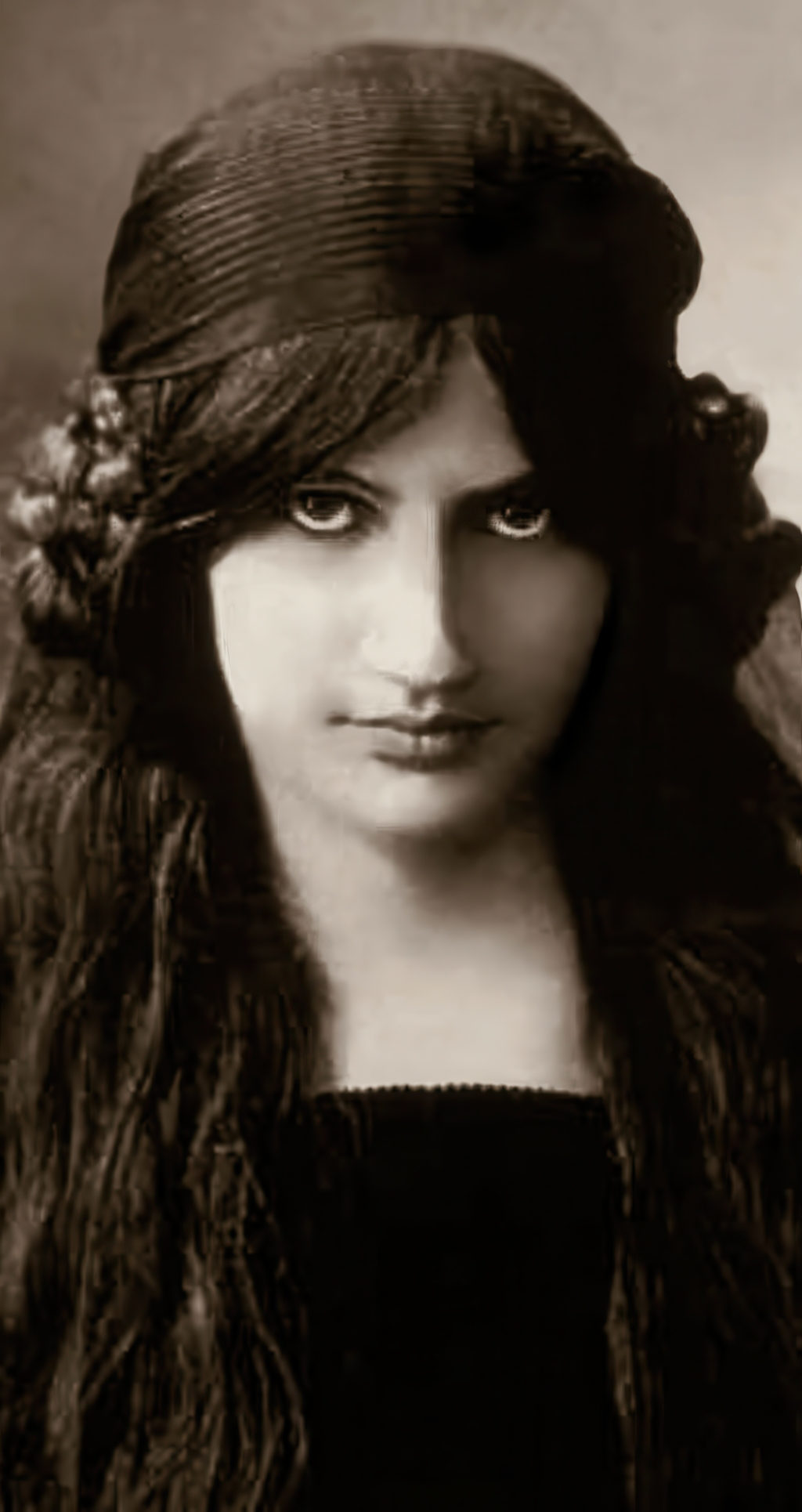
Jeanne Hébuterne was a French painter with a tragic story and who is most famous for her connection to the great Amedeo Modigliani. This article will help us understand more about the lady herself, who became Amedeo's most well known muse.
She is known by many for having a calm presence, with distinctive facial features through her work with Modigliani, but her own story has too often been ignored - we address that here by focusing on her own art, predominantly oil painting, and also providing more on her short but eventful life journey.
The story of Hébuterne would often portray her as young and naive, very much under the influence of her older partner, but in reality she had a strong and creative personality of her own. In recent years, more has been published about her own life, and she is finally being treated as an individual in her own right, rather than just merely a side story in Amedeo's life.
By examining her upbringing we also better understand what attracted her to this alternative life in Paris and her relationship with the turbulent individual that was Modigliani. We can also compare their art, and look for influences in each direction, with the artistic communities in early 20th century Paris being a hotbed for the exchange of ideas, sometimes across different disciplines.
The article below tracks the early life of Hébuterne through to her untimely demise at such a young age, covers both her own art as well as where she features as a muse in others'. There is also discussion of her role as a mother of their child, laying a path that would lead up to the present day through future generations.
Jeanne Hébuterne at a Glance
- Born:6 April 1898, Meaux, France
- Died:26 January 1920, Paris
- Known for:Painter; muse of Amedeo Modigliani
- Relationship:Modigliani's companion from 1917-1920
- Children:Jeanne Modigliani (born 1918)
- Notable legacy:Subject of Modigliani's most famous portraits
Early Life and Family Background
Jeanne Hébuterne was born on 6 April 1898 in Meaux, France. She was brought up in a strict, middle-class Catholic family, with her mother being particularly religious. Her father worked as an accountant, and the family was financially comfortable. Her older brother André would become a painter himself, and Jeanne herself would show artistic and creative promise from an early age.
Her traditionally minded parents did not wish to see either herself or her brother pursue a creative path, but they did agree to Jeanne receiving formal art training. She enrolled at the Académie Colarossi in Paris. This period of study would also bring her into close contact with the heart of the Montparnasse artistic community, where avant-garde painters, poets, and sculptors congregated - she was now a long way away from her strict religious upbringing and experiencing exciting new characters who would influence her outlook on many things.
Meeting Amedeo Modigliani
Jeanne Hébuterne first met Amedeo Modigliani in May, 1917, having been introduced to each other by sculptor Chana Orloff. Amedeo was already suffering serious illness, and was considerably older than Jeanne, 33 to just 19. It would become an unusual but intense pairing.
Upon being alerted to this new relationship, Jeanne's parents were immediately hostile. They did not believe their daughter should be socialising with any of this community, and that Amedeo was a purely bad influence on their young child. Considering his life in poverty, and serious addictions to drugs and alcohol, most would have come to the same conclusion. Additionally, there was the further complication of Amedeo being Jewish, whilst they were practicing Catholics.
Sadly, Jeanne's choice to remain with Amedeo and continue their relationship ultimately led to her becoming entirely detached from her own family.
Jeanne Hébuterne as Modigliani's Muse
Soon after meeting for the first time, Jeanne would become a regular muse for Amedeo Modigliani. She posed for him from 1917-1919, and in total there would be over 20 paintings plus a large number of quick sketches.
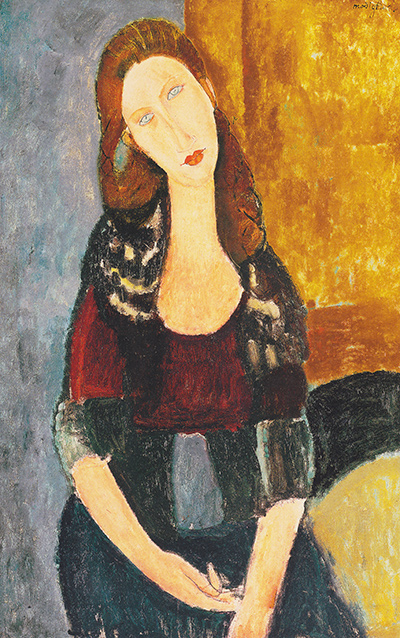
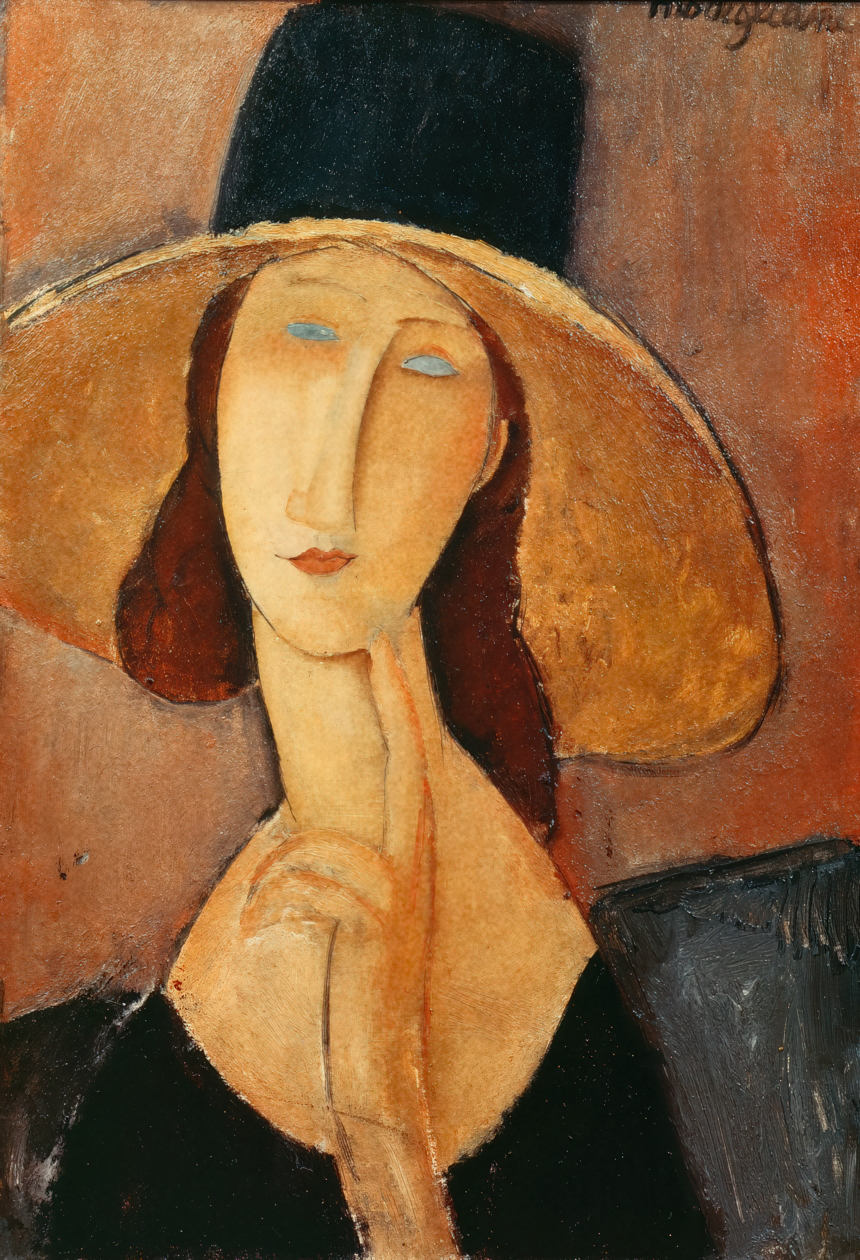
Modigliani's late portraits featuring elongated faces, with long necks. Interestingly, these were features that Jeanne naturally possessed, and potentially was the inspiration for this stylistic development. Additionally, African masks and other non-European artefacts also inspired this approach.
Despite their passionate relationship, Modigliani would not portray Jeanne in a sexual manner. He treated her respectfully, and presented her as introspective, fragile, and inward-looking, often seated, still, and emotionally remote. His portraits of her are widely regarded as among the artist's most emotionally restrained and psychologically sensitive paintings.
Alongside the oval faces and long necks, many of these portraits would also feature downcast or vacant eyes, a Calm, restrained posture and a muted, harmonious colour palette.
Famous Paintings of Jeanne Hébuterne by Amedeo Modigliani
Whilst the Jeanne Hébuterne series as a whole is highly regarded by art critics, there were several particular works within it that have received particular attention.
Artistic Collaboration and Mutual Influence
Whilst working as a muse for Amedeo, Jeanne continued to explore her own artistic career. Still very young, influences would flood into her mind from Modigliani himself, but also many other members of the local Paris community. She predominantly focused on portraits and landscapes. Her work bears some similarities within her partner, but many differences too - she possessed a more gentle touch and less avant-garde nature in composition.
Initially, Jeanne would have been seen as merely a muse, but in recent decades her own work as an artist has gained more respect and coverage. She was also particularly respected for her use of colour, which was more subtle than Modigliani, and she liked a contemplative atmosphere in her small but intriguing oeuvre.
Life Together: Poverty, Illness, and Exile
Jeanne and Amedeo lived together in poverty, which sadly caused the latter's health problems to worsen at a faster rate. Tubercular meningitis gave Modigliani regular bouts of coughing, sometimes sending blood from his mouth at unfortunate moments. His use of alcohol and drugs would continue to push him into a downwards spiral, and even his love for his partner was not enough to escape this downwards trajectory.
In a desperate attempt to start again afresh, the couple headed to Nice in 1918. Jeanne was pregnant, and perhaps hoping to keep the family unit together with a change of scenery. Their daughter, also called Jeanne, was born in November, 1918, and took the Modigliani name. At this time, war had left a scar of financial and mental toil across Paris, and it was hoped that Nice could restore their health, both physically and mentally.
By 1919 the couple decided to return to Paris. Amedeo did not respond well to this change and his health worsened once more. On 24 January 1920, Amedeo Modigliani died at the age of 35. Jeanne was devastated, and felt entirely isolated back with her family, with whom she had been estranged for several years. At this point she was also heavily pregnant with their second child.
Jeanne Hébuterne's Death
Jeanne Hébuterne died on the 26th of January, 1920. She was just 21 years of age.
Jeanne Hébuterne leapt from a fifth-floor window, killing herself and her unborn child, just two days after Modigliani's death.
She is today buried alongside Amedeo at the Père Lachaise Cemetery, but for around a decade was elsewhere, due to the wishes of her parents. Today, they have become a place of pilgrimage, both for followers of modern art, but also those drawn in by the sheer tragedy of this story.
The Life of her Daughter, Jeanne Modigliani
Jeanne Modigliani (1918-1984) played a major role in protecting and promoting the legacy of her parents, particularly Amedeo. She was raised in Italy, by Amedeo's relatives and would go on to become an art historian, contributing an impressive biographies of his life. She did also connect with her mother's history too, and wrote of her mother's strength of character, and qualities as an artist.
Posthumous Reputation and Rediscovery
Today, Jeanne Hébuterne is seen as a talented painter who also represents the difficulties faced by women in the art industry during the 20th century. Her relationship with Amedeo was a genuine one, and whilst playing a major role in one of the most significant series of his career, she also had much else to offer besides just that.
Without the role of her daughter, it is difficult to see how her name would have survived in the way it has. Thankfully, we are today well aware of her own life, and she slowly came out of the shadow of her artist partner from around the late 20th century onwards.
Jeanne Hébuterne: The Story
Jeanne Hébuterne occupies a unique position in modern art history — simultaneously muse, artist, mother and tragic figure. Her portraits are among the most recognisable images in Modigliani's oeuvre, while her life story has become emblematic of:
- The myth of the suffering artist
- The marginalisation of women's creativity
- The human cost of artistic legend
Reconsidering Jeanne Hébuterne means moving beyond romantic tragedy toward a fuller understanding of her agency, talent, and enduring presence. Thankfully, we are already on that journey, just as we are with many other famous women in the history of art.
Jeanne Hébuterne and the Myth of the "Tragic Muse"
Jeanne Hébuterne's legacy has long been shaped by the romanticised image of the doomed muse — a narrative common in early modern art history, particularly when female figures are closely associated with male genius. This myth has sadly denied a level of autonomy to her, ignored her genuine artistic qualities and generally undervalued the significance of her life.
She was educated, artistically trained and intellectually engaged. Yes, Jeanne is generally regarded by art historians as shy and quiet, but not without an inner confidence and independent mind. She chose to break from her comfortable background, and felt more at home in Montparnasse than with her strict parenting. She sacrificed too much for this to be a rebellious gesture, and she made her love for Amedeo could never be questioned.
Modern art historians have started to address the imbalance in the narrative surrounding her life, promoting her qualities and achievements, and placing her on a more even footing with her famous partner.
Jeanne Hébuterne's Paintings: Style, Technique and List of Works
Jeanne Hébuterne's own artistic output is small but significant. Approximately 25 works are securely attributed to her, many preserved by her family and later by her daughter.
The predominant features frequently found in her work include Muted, harmonious colour palettes, softly contoured faces and forms, a restrained emotional register and an absence of overt modernist distortion. It must be pointed out, though, that there is great variation in her oeuvre, as the artist was trying out different ideas and attempting to forge her own style at this early point.
Her portraits often depict women and children, rendered with quiet dignity. Unlike Modigliani's elongated abstractions, Jeanne's figures retain more traditional proportions, suggesting her grounding in academic training. Rather than imitation, her work reflects parallel development — shaped by shared influences such as Cézanne, early Picasso, and the post-Impressionist atmosphere of Montparnasse.
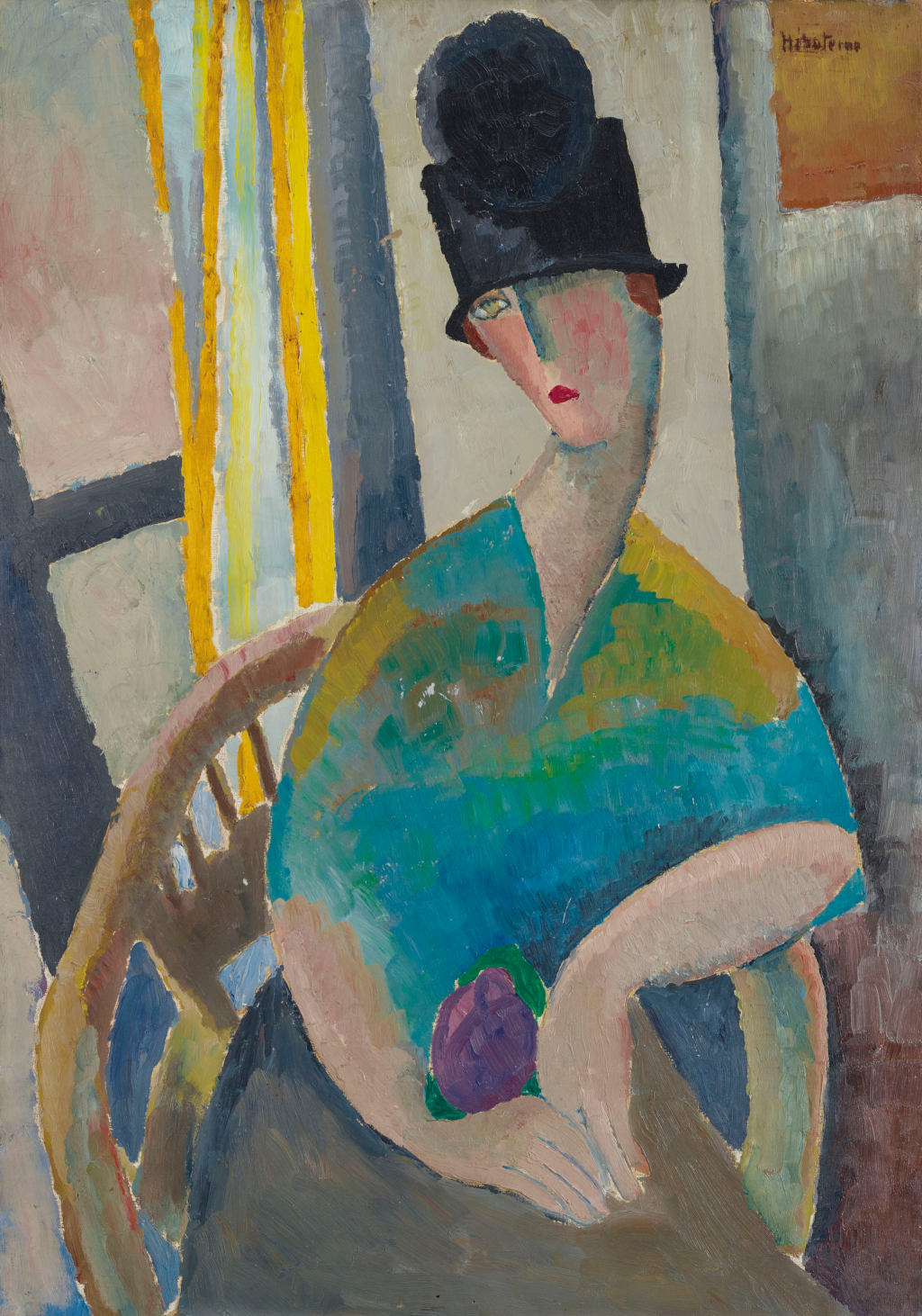
Woman in Cloche Hat, Jeanne Hébuterne
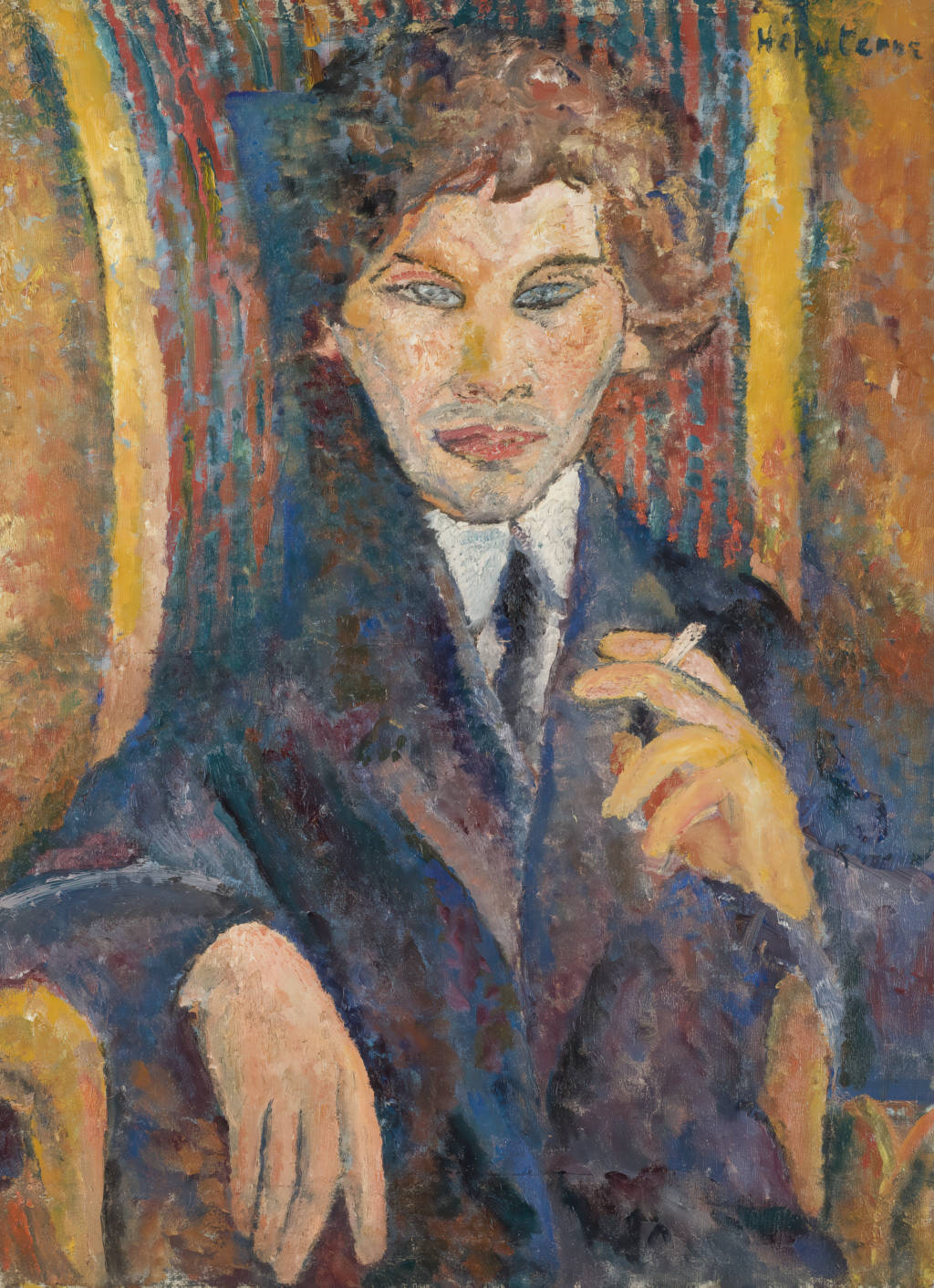
Portrait of Chaim Soutine, Jeanne Hebuterne
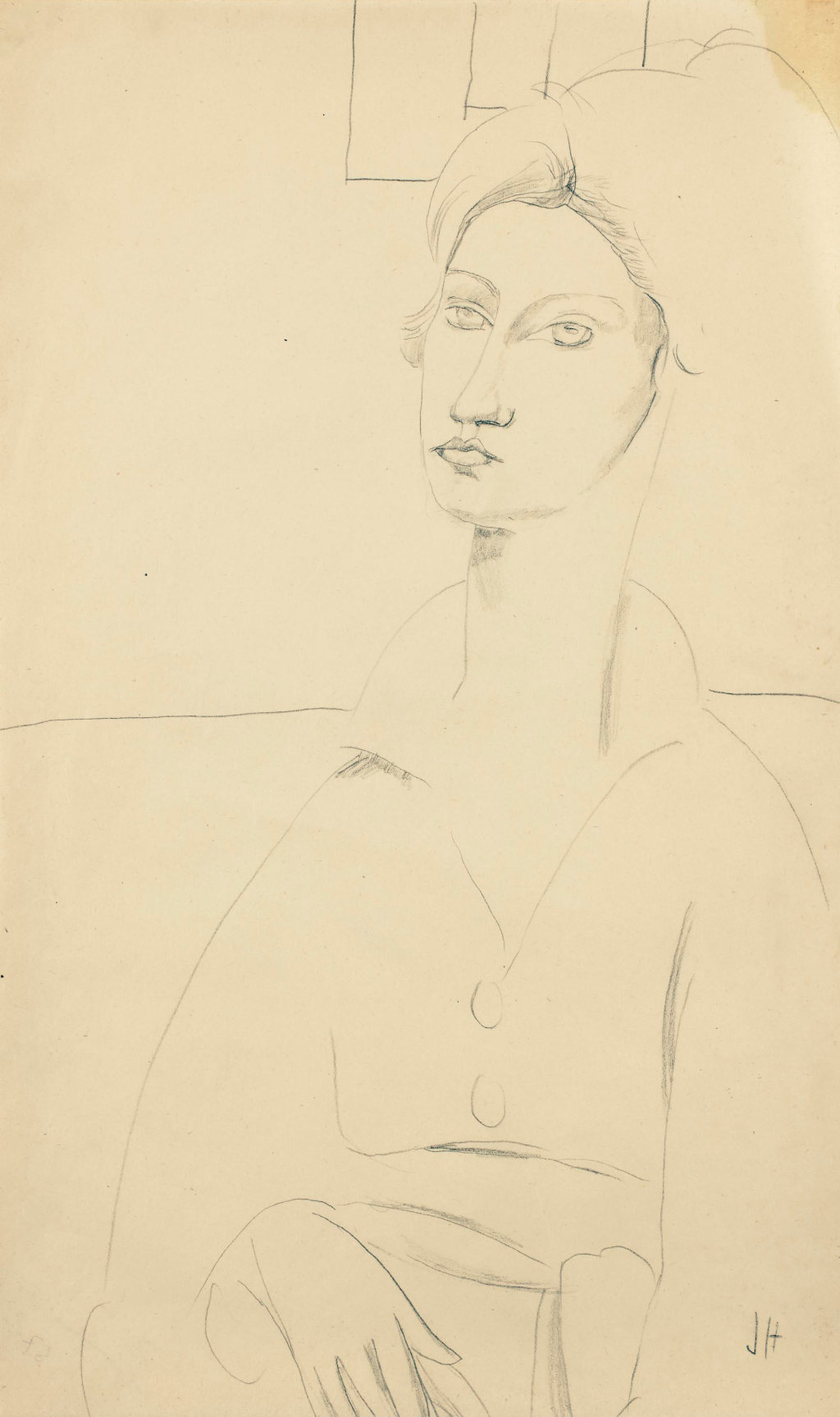
Self Portrait, drawing (graphite and black pencil on fine paper), Jeanne Hebuterne
References
- 5 minutes with... Self Portrait by Jeanne Hébuterne
- Jeanne Hébuterne on Wikipedia
- Searching for Jeanne Hébuterne
- Modigliani and Jeanne Hebuterne
- In search of Jeanne Hébuterne & Modigliani
- Met Museum Painting