 by Tom Gurney
Tom Gurney BSc (Hons) is an art history expert with over 20 years experience
Published on June 19, 2020 / Page Updated on November 6, 2026
Email: tomgurney1@gmail.com / Phone: +44 7429 011000
Introduction
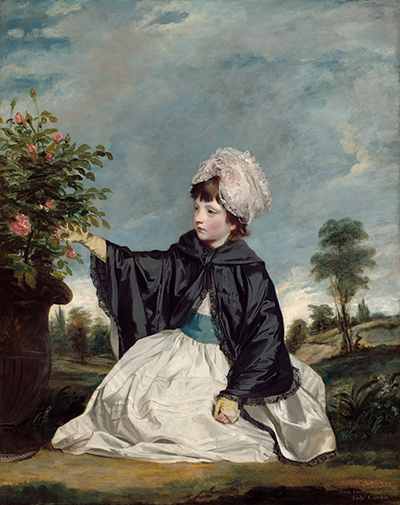
Joshua Reynolds's Lady Caroline Howard is one of his most memorable portraits of childhood. Painted in 1778, it shows the seven-year-old daughter of Frederick Howard, 5th Earl of Carlisle, kneeling beside a rose-filled urn in an open landscape. The National Gallery of Art in Washington records the work as an oil on canvas, 143 by 113 cm, in the Andrew W. Mellon Collection, accession 1937.1.106.[1] Google Arts & Culture's National Gallery of Art partner record corroborates the same title, date, medium, dimensions and repository.[2]
The painting looks charming at first, but it is not a simple image of childhood innocence. Reynolds gives Lady Caroline a serious face, an averted gaze, one hand reaching toward a pink rose and the other closed near her knee. The pose suggests grace, but also tension. She is presented as a child, an aristocratic daughter, a future woman of rank and a carefully shaped symbol of cultivated virtue.
That complexity is why the portrait matters. Reynolds was not merely recording a pretty child in a garden. He was building a portrait that could satisfy a powerful father, participate in Royal Academy display, circulate through print, and still preserve something of a child's particular temperament. The result is tender, formal and psychologically alert at the same time.
At a Glance
- TitleLady Caroline Howard
- ArtistJoshua Reynolds
- SitterLady Caroline Howard, later Lady Cawdor
- Date1778 [1]
- MediumOil on canvas [1]
- CollectionNational Gallery of Art, Washington [1]
- Accession1937.1.106 [1]
- Dimensions143 × 113 cm [1]
- AgeSeven
- Royal Academy1779, no. 252, A young lady [1]
Contents
- Introduction
- The painting in Washington
- A child of Castle Howard
- Roses and ideal meaning
- The serious child
- Childhood and the Grand Manner
- Royal Academy and print afterlife
- Later Lady Cawdor
- Technique and presence
- Why Lady Caroline Howard matters
The painting in Washington
The National Gallery of Art identifies the sitter as Lady Caroline Howard, daughter of Frederick, 5th Earl of Carlisle, and Margaret Caroline Howard, and niece of Lady Delmé.[1] She was later known as Lady Cawdor after marriage, and the inscription in the lower right, added by another later hand, gives both “Lady Caroline Howard” and “Lady Cawdor.”[1] That later name should not obscure the painting's subject: Caroline as a seven-year-old child in 1778.
NGA's visual description is unusually helpful. Lady Caroline kneels in a hilly, tree-lined landscape, wearing a long white dress, a lace-edged black cape, a wide blue sash, a lacy bonnet and yellow gloves whose fingers are folded back. With one hand she touches a pink rose in a brown urn; the other hand rests near her knee in a loose fist. Above and behind her, the landscape opens into soft hills, trees and a large sky.[1]
The painting is now on view in the West Building at the National Gallery of Art.[1] Its modern American home is part of its long history, but the portrait began as a family commission. NGA traces the provenance from Frederick Howard at Castle Howard through family descent, then through Duveen Brothers and Andrew W. Mellon before the 1937 gift to the National Gallery.[1]
This movement from Castle Howard to Washington matters because the portrait has always worked at more than one scale. It was a father's image of his daughter, a Reynolds exhibition painting, a print subject, a Mellon collection picture and a museum work. Each setting changes the viewer's emphasis, but the child remains at the centre.
The Wikimedia Commons record created from National Gallery of Art open-access data also confirms the accession number, dimensions, 1778 date and NGA source image.[3] That open-access status is useful for the modern life of the painting. A portrait once made for an aristocratic house is now both physically in Washington and digitally available as a public museum image.
A child of Castle Howard
Frederick Howard, 5th Earl of Carlisle, was not a casual patron. Martin Postle's essay on Carlisle as a collector presents him as an active purchaser and supporter of contemporary British art, with a long relationship to Reynolds and Castle Howard as an important setting for display.[4] Reynolds had known Carlisle since childhood and painted him more than once, so Caroline's portrait belonged to an established family and patronage network.
Postle describes Lady Caroline Howard as an exceptional commission, made after a period in which Carlisle's finances had been severely strained.[4] That detail makes the portrait more pointed. It was not simply another purchase in a smooth stream of aristocratic collecting. Carlisle still chose to commission this image of his daughter, and Postle calls it one of Reynolds's most accomplished images of childhood.[4]
The commission therefore speaks of affection, dynastic display and cultural ambition at once. A portrait of a child could express tenderness, but for an aristocratic family it also marked continuity. Caroline was not a public political figure, yet she carried the visual identity of a house, a name and a future set of alliances.
This is why Reynolds's treatment is so carefully elevated. He does not paint her merely as a little girl at play. He makes her part of a cultivated landscape, places her beside roses, dresses her in white and gives her a composition that balances natural childhood with aristocratic formation.
The Carlisle connection also links Caroline's portrait to Reynolds's larger position as painter to a politically and culturally active elite. The National Gallery in London presents him as the dominant portrait painter of his generation, one who enlarged British portraiture through antique, Italian and northern European models.[9] Caroline's portrait is small in age but not in ambition. It applies that elevating programme to a child.
Postle's account of Carlisle's collecting makes the commission feel even more layered. Carlisle was not only a father choosing a likeness; he was a collector, a patron and a man with a long visual relationship to Reynolds.[4] In that context, Lady Caroline Howard becomes both domestic and artistic: an image of affection that also belongs to an important patron's continuing investment in British painting.
Roses and ideal meaning
The roses are not neutral decoration. NGA states that Reynolds liked to give his portraits associations beyond the merely descriptive, and that roses are symbolically related to Venus and the Three Graces. The gallery suggests that Reynolds may have meant to allude to Chastity, Beauty and Love as ideals to which Lady Caroline should aspire.[1]
That reading is essential because it prevents the portrait from becoming sentimental. The child reaches toward beauty, but the roses also represent ideals imposed upon her. She is shown at the edge of girlhood and future womanhood, in a pose that turns childhood curiosity into moral and social symbolism.
The rose-filled urn also makes the setting artificial in a productive way. This is not a wild rose bush encountered by chance. It is cultivated, contained and placed beside her. Nature has been shaped into an attribute, just as Caroline's childhood is shaped into a portrait.
Reynolds often used such devices to raise portraiture above straightforward likeness. In this case, the elevation is delicate. The sitter remains a recognisable child, but the roses make her part of a larger language of beauty and virtue. The portrait becomes both personal and emblematic.
The urn is important because it turns the roses into an arranged object rather than a natural discovery. Caroline reaches toward flowers that have already been gathered, planted or positioned for display. The action looks spontaneous, but the setting is controlled. Reynolds makes childhood seem natural inside a structure of adult meanings.
That structure is not cruel, but it is visible. Chastity, Beauty and Love are not childhood thoughts; they are adult ideals projected onto the child. The portrait is therefore poised between the innocence it depicts and the expectations it quietly teaches. Caroline reaches for the rose, but the viewer is asked to read the gesture through an inherited symbolic code.
The serious child
The inherited way of reading child portraits is often too simple: the child is cute, restless, innocent or charming. Reynolds's Lady Caroline Howard is more interesting than that. NGA emphasises the seriousness of her expression, the averted gaze and the tension of her closed left hand.[1] These details complicate the sweetness of the costume and flowers.
Her father apparently knew that complexity. NGA reports that Carlisle described his daughter as determined and strong-minded, and wrote that she was “always a great favorite.”[1] The phrase is affectionate, but not bland. It suggests a child whose personality was vivid enough to require discipline and lovable enough to make that discipline difficult.
Reynolds seems to have understood the value of that tension. Caroline is not smiling at the viewer. She is absorbed, turned slightly away, reaching and holding back at the same time. The closed hand near her knee gives the picture a small but powerful resistance. It keeps her from becoming a decorative doll.
This is where Reynolds is at his best as a painter of children. He can idealise without entirely smoothing away individuality. Caroline's dress, roses and landscape make her part of an elevated child-portrait type, but her face and hands preserve the feeling of a particular temperament.
That temperament is the difference between sentiment and portraiture. A purely sentimental child would be all softness: rosy cheeks, flowers, white fabric, sweet compliance. Caroline has those ingredients around her, but Reynolds gives her a harder point of attention. Her gaze is elsewhere; her fingers are not all open; her face is grave. The painting allows childhood to be serious.
This seriousness also protects the portrait from the easy assumption that a child sitter must have been bored or unwilling. The painting does not need that speculation. Its drama is subtler. Reynolds shows a child whose internal life has not been flattened by the requirements of display. She participates in the image, but she is not entirely surrendered to it.
Childhood and the Grand Manner
Reynolds's Grand Manner is usually associated with adult sitters, full-length portraits, classical references, drapery and public role. But Lady Caroline Howard shows how the same ambition could be adapted to a child. NGA notes that Reynolds imposed formal qualities associated with Greek, Roman and Renaissance art to give his compositions solidity and nobility.[1]
In Caroline's portrait, that nobility does not come from scale alone. It comes from the arrangement of body, landscape, colour and symbol. The child is low to the ground, kneeling rather than standing, but the composition still gives her dignity. The urn, roses and open sky organise the scene around her.
The portrait also avoids treating childhood as mere informality. Caroline may be kneeling, but she is not disorderly. Her body is arranged with care. Her clothing is pristine. Her action is focused. Reynolds allows movement, but only within a controlled pictorial system.
This balance is central to eighteenth-century aristocratic childhood portraiture. A child had to seem natural enough to be endearing and shaped enough to belong to rank. Reynolds gives Caroline both qualities. She appears youthful, but she is already being prepared visually for the ideals of her class and gender.
The Grand Manner often turned adult sitters into historical or heroic types. With Caroline, Reynolds lowers the volume but keeps the principle. The child does not need armour, tragic allegory or classical costume. Her elevation comes through pose, light, landscape and symbol. The result is a kind of miniature moral theatre, quiet but highly organised.
The white dress is central to this effect. It makes the child luminous against the landscape, but it also suggests purity and discipline. The blue sash gives colour and structure, while the black cape provides a darker note that keeps the costume from becoming weightless. Reynolds's colour choices help the viewer feel both delicacy and control.
Royal Academy and print afterlife
The original painting was exhibited at the Royal Academy in 1779, no. 252, as A young lady.[1] That title is revealing. It presents Caroline less as a named child than as an elegant type. Viewers could admire the picture without necessarily knowing the family story, though many in Reynolds's world would have recognised the social network behind it.
Postle notes that Reynolds exhibited the original in 1779 and that Valentine Green's mezzotint was published in December 1778.[4] That sequence shows how quickly the image entered public circulation. The print was not an afterthought from decades later; it was part of the portrait's immediate cultural life.
The Fitzwilliam Museum records a 1778 mezzotint by Valentine Green after Reynolds titled Lady Caroline Howard.[5] Auckland Art Gallery also holds a 1778 Green/Reynolds mezzotint, giving the dimensions as 509 by 365 mm.[6] The British Museum's Lady Cawdor record likewise connects her to a Green print after Reynolds.[7]
Print mattered because it allowed the portrait to travel. A child of Castle Howard could become a public image of childhood, aristocratic beauty and Reynoldsian grace. The print circulated Caroline's likeness, but it also circulated Reynolds's skill at turning a child into a culturally legible ideal.
The timing of Green's print is striking. If Postle's December 1778 date is followed, the print appeared before the Royal Academy exhibition of the original in 1779.[4] That suggests confidence in the image and in its public appeal. Caroline's portrait was not left to private family memory; it was quickly prepared for a wider audience.
This print afterlife also helps explain why the portrait belongs beside Reynolds's better-known child images. His children were often more than sitters. Once engraved or mezzotinted, they could become types of feeling, innocence, rank or charm. Caroline's image circulated as an aristocratic child with symbolic flowers, not simply as a private daughter.
Later Lady Cawdor
The child in Reynolds's portrait later became Isabella Caroline Campbell, Lady Cawdor of Castlemartin. The British Museum identifies the Rt Hon Lady Cawdor as the daughter of Frederick, 5th Earl of Carlisle, and wife of John Campbell, 1st Baron Cawdor, with life dates 1771-1848.[7] The National Portrait Gallery's person record similarly identifies Isabella Caroline Campbell, née Howard, Lady Cawdor of Castlemartin, within the Howard family network.[8]
This later identity explains the lower-right inscription recorded by NGA, but it should not dominate the portrait. Reynolds painted her as Lady Caroline Howard, a child in 1778, not as the later Lady Cawdor. The later title belongs to the painting's afterlife and to the sitter's biography after childhood.
Still, the later name sharpens the portrait's meaning. The image shows a girl before marriage, office and adult status. Yet it already looks toward those futures through roses, dress, discipline and aristocratic display. The child is not only present; she is being imagined forward.
That forward-looking quality is common in elite child portraiture. Families saw children not only as children but as continuities of lineage, alliance and reputation. Reynolds's portrait is affectionate, but it is also socially predictive.
The later Lady Cawdor records also remind us that Caroline had a life beyond Reynolds's idealising frame. Portraits of children can trap sitters at a single age, making them forever young in public memory. The British Museum and NPG records restore the adult identity: wife, family member, aristocratic woman within another network of portraits and prints.[7][8]
That adult identity should not rewrite the childhood image, but it does make the painting more poignant. Reynolds caught a child at seven, while later inscriptions and records follow her into adulthood. The painting holds one moment; the archive extends the life.
Technique and presence
The NGA object record points readers to John Hayes's systematic catalogue of British paintings, and the extracted catalogue material notes a broadly and fluidly executed painting with thick opaque layers, translucent glazes in the background and some slight modification from an underpainted design.[1] Those technical details should not overwhelm the interpretation, but they help explain the portrait's vitality.
The picture depends on softness and control. The white dress, pale clouds, pink roses and blue sash could easily become sugary. Reynolds prevents that by giving the surface breadth and by concentrating psychological pressure in the face and hands. The handling supports the interpretation: broad enough to feel airy, precise enough to preserve tension.
The landscape also contributes to the child's presence. The sky is large, the horizon low, and the figure close to the viewer. Caroline seems both sheltered and exposed, set against a world broader than herself. That proportion helps the portrait avoid claustrophobia; it gives childhood a stage.
The rose gesture is the hinge between technique and meaning. Her gloved fingers touch a bloom, while the other hand closes. One hand opens toward ideal beauty; the other holds back. Reynolds makes that small contrast carry the emotional intelligence of the portrait.
Mannings's catalogue remains the user-requested control for Reynolds's painted works, even though an exact catalogue number for this picture was not found in the reliable open extracts used here.[10] That caution matters. The article can rely on NGA for current object facts and on Postle for Castle Howard context, while keeping Mannings as the broader catalogue spine rather than inventing unavailable numbering.
Why Lady Caroline Howard matters
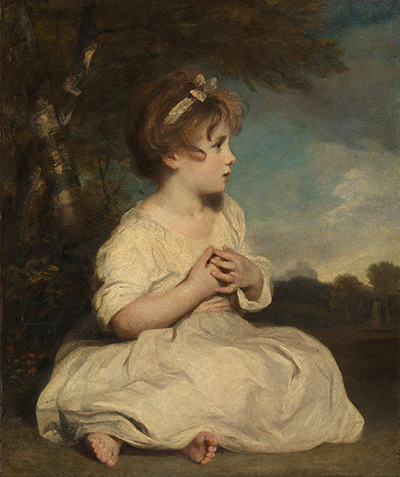
Lady Caroline Howard matters because it shows Reynolds's child portraiture at a high level of ambition. It is not as theatrically charged as The Infant Samuel or as widely generalised as The Age of Innocence, but it offers something equally valuable: a child whose aristocratic identity, symbolic future and private temperament are held in balance.
The painting also reveals the sophistication of a family commission. Carlisle wanted an image of his daughter, but Reynolds produced more than likeness. He created a portrait that could satisfy family feeling, public exhibition, print circulation and the ideals of polite culture.
Its charm is real, but charm is not the whole story. The roses bring Venus and the Graces into the picture; the averted gaze refuses simple display; the closed hand preserves will; the white dress and blue sash construct rank; the print afterlife turns the child into a public image. Reynolds makes childhood visible as both personality and expectation.
That is why the portrait still feels alive. Lady Caroline is not only an emblem of innocence. She is a small person being arranged by art, family and society, yet not entirely absorbed by them. In that tension, Reynolds finds one of his most delicate forms of truth.
Frequently Asked Questions
Discussion
How does Reynolds preserve a child's particular temperament while surrounding her with adult ideals of rank, beauty and virtue?
Reader Insights
What do the averted gaze and closed hand contribute beyond simple sweetness?
How does the arranged urn turn a spontaneous gesture into a lesson in social symbolism?
How did Castle Howard patronage, Royal Academy display and mezzotint circulation reshape a private family portrait?
Join the Conversation
Share your reading below.
References
- National Gallery of Art, Washington, Lady Caroline Howard, 1937.1.106, https://www.nga.gov/artworks/113-lady-caroline-howard.
- Google Arts & Culture / National Gallery of Art, Lady Caroline Howard, https://artsandculture.google.com/asset/lady-caroline-howard-sir-joshua-reynolds/5gHXCaam9oc8BQ?hl=en.
- Wikimedia Commons / National Gallery of Art, Sir Joshua Reynolds, Lady Caroline Howard, 1778, NGA 113, https://commons.wikimedia.org/wiki/File:Sir_Joshua_Reynolds,_Lady_Caroline_Howard,_1778,_NGA_113.jpg.
- Martin Postle, “Frederick Howard, 5th Earl of Carlisle as a collector of contemporary British Art,” Art & the Country House, https://www.artandthecountryhouse.com/essays/essays-index/frederick-howard-5th-earl-of-carlisle-as-a-collector-of-contemporary-british-art/castle-howard-introduction/charles-jervas-a-memorandum-of-1733-at-raynham-hall/castle-howard-before-and-after-the-5th-earl-of-carlisle-the-evidence-of-the-1759-and-1825-inventories/object-in-focus-william-pars-sir-john-coxe-hippisley.
- Fitzwilliam Museum, Valentine Green after Sir Joshua Reynolds, Lady Caroline Howard, P.138-1957, https://data.fitzmuseum.cam.ac.uk/id/object/176307.
- Auckland Art Gallery Toi o Tāmaki, Valentine Green and Joshua Reynolds, Lady Caroline Howard, https://www.aucklandartgallery.com/explore-art-and-ideas/artwork/516/lady-caroline-howard.
- British Museum, “Rt Hon Lady Cawdor,” https://www.britishmuseum.org/collection/term/BIOG22307.
- National Portrait Gallery, “Isabella Caroline Campbell (née Howard), Lady Cawdor of Castlemartin,” https://www.npg.org.uk/collections/search/person/mp85182/isabella-caroline-campbell-nee-howard-lady-cawdor-of-castlemartin.
- National Gallery, London, “Sir Joshua Reynolds 1723-1792,” https://www.nationalgallery.org.uk/artists/sir-joshua-reynolds.
- David Mannings, Sir Joshua Reynolds: A Complete Catalogue of His Paintings, with subject pictures catalogued by Martin Postle, Yale University Press / Paul Mellon Centre for Studies in British Art, 2000.