


 by Tom Gurney
Tom Gurney BSc (Hons) is an art history expert with over 20 years experience
Published on November 28, 2025 / Updated on November 29, 2025
Email: tomgurney1@gmail.com / Phone: +44 7429 011000
The Horse Fair (1852-55) is Rosa Bonheur's most celebrated masterpiece and one of the highlights of 19th-century French Realism.
Painted on a monumental scale, it re-creates the bustling horse market on the Boulevard de l'Hôpital in Paris, capturing an exciting and energetic atmosphhere, featuring the realities of urban life.
Today, the painting remains one of the most widely studied works by a woman artist before 1900, admired for its impressive technical qualities and also the preserverence of the artist to ensure precision in the final piece.
Overview of The Horse Fair
- Artist:Rosa Bonheur (1822-1899)
- Date:1852-1855
- Medium:Oil on canvas
- Dimensions:244 x 506.7 cm (96 x 199½ in)
- Current location:The Metropolitan Museum of Art, New York
- Movement:Realism
Bonheur first exhibited The Horse Fair at the Paris Salon of 1853. She subsequently reworked the piece over several years, such was her desire to achieve the most accurate finish. Its grand scale and meticulous detailed helped to establish her international reputation, particularly in Britain and the United States, where animal painting was enormously popular.
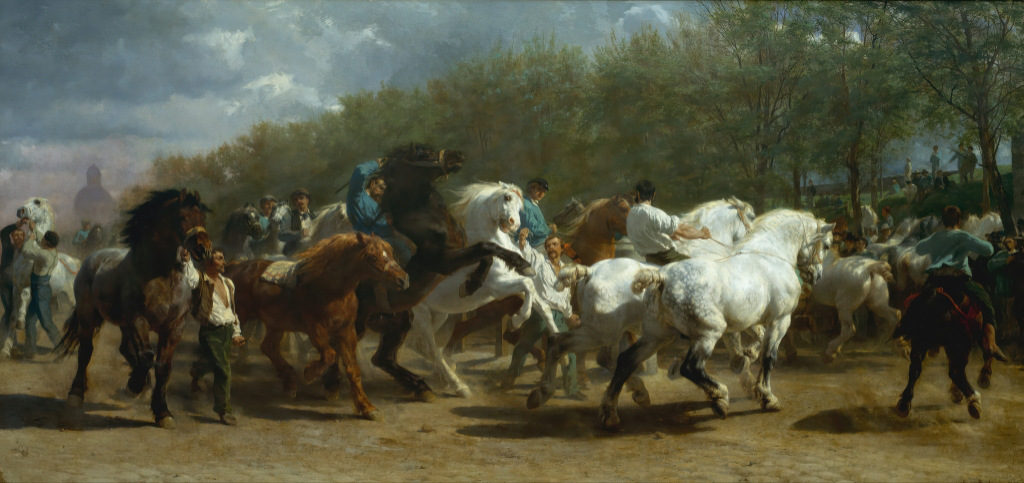
Central Rearing Horse: The most dynamic form — Bonheur uses it as the emotional anchor.
White Horse Turning: A contrasting calm against the chaos — balancing the composition.
Foreground Mud and Shadows: Creates realism and anchors the viewer's eye.
The Setting: The Paris Horse Market
The horse market shown here was located along the Boulevard de l'Hôpital, close to the Pitié-Salpêtrière Hospital. He we find dealers who brought a variety of horses to be tested, traded and paraded to local buyers. Bonheur visited the market repeatedly at dawn, sketching horses as they were trotted or galloped in tight circles and therefore put in lots of study prior to putting together the initial sketches.
The diagonal sweep of movement — from lower left to upper right — is an intentional play by the artist in order to provide a direction of energy and movement. Men in blue sashes act as handlers, controlling the playful horses. You will see ropes and bridles applied for this purpose. Beyond the action rises a line of trees and the faint suggestion of urban structures, rooting the scene in the reality of modern Paris.
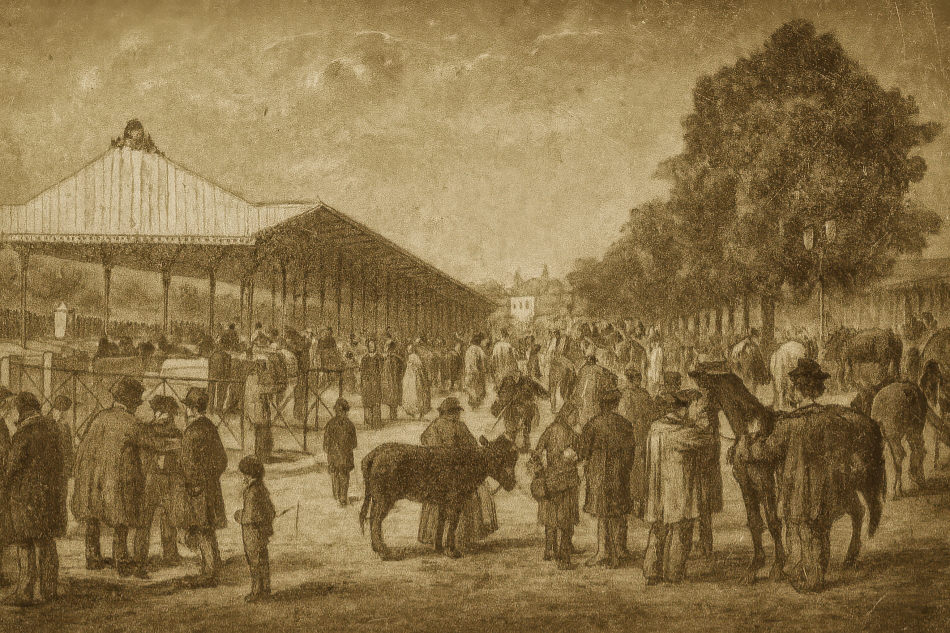
Paris Horse Market Drawing
The Real Paris Horse Market: Noise, Mud and Movement
The scene depicted in The Horse Fair is based on the horse market held along the Boulevard de l'Hôpital, close to the Salpêtrière. In the mid-19th century, this was one of the busiest animal markets in France. It supplied horses for transport, agriculture and the military to a wide variety of local and national buyers.
Dealers, breeders, and buyers gathered in large numbers, creating an atmosphere filled with noise and excitement, both from the workers and the animals.
Contemporary descriptions emphasise the organised chaos of the setting. Horses were paraded at speed, sometimes in large groups, so that buyers could assess their strength, gait, and suitability for work. The ground quickly became churned to mud, especially after rain, adding to the dramatic movement of the animals. In many parts of Europe, and further afield, this same type of atmosphere can be seen in the farming industry, but is certainly lesser known today.
Rosa Bonheur's Realism
Sketches and Studies from the Market
Rosa Bonheur was rigorous in her preparation, which was essential for any animal artist, as shown earlier with the likes of George Stubbs. Just as with Stubbs, she would initially study the muscle and bone structure of animals prior to even starting the sketches. The balance of movement was a further challenge and consideration which needed additional thought. Bonheur would not aim for photographic reproduction, but rather to understand what lie beneath the skin, in order to reflect light accurately.
How Rosa Bonheur Prepared This Masterpiece
Rosa Bonheur was always respected for the detailed preparation which laid beneath her animal paintings. Long before The Horse Fair was completed, she developed a method of preparation that combined a daily routine of sketching, anatomical study and direct observation of working animals in a variety of environments.
Bonheur visited abattoirs, farms, riding schools, and the Paris horse market in all weather. She would arrive early and stay for hours, capturing every aspect of the daily routine, ensuring she fully understood the lives of the workers and their animals.
Her studio at the Château de By, north of Paris, hosted much of this work, developed after her initial observations 'in the field'. Bonheur even kept live animals on the estate, including horses and sheep. She was, therefore, able to access them any time and also had a love for animals, as well as an artistic interest. She believed that a painter of animals had a duty to understand their anatomy, habits and temperament.
This commitment to realism explains the extraordinary precision found in every head toss, muscle strain, and hoof in The Horse Fair. The painting is the result of hundreds of on-the-spot sketches later developed into detailed oil studies, all completed before the final composition was scaled up onto a monumental canvas. This proven process was developed and refined over many years, meaning mistakes were made and learnt from along the way.
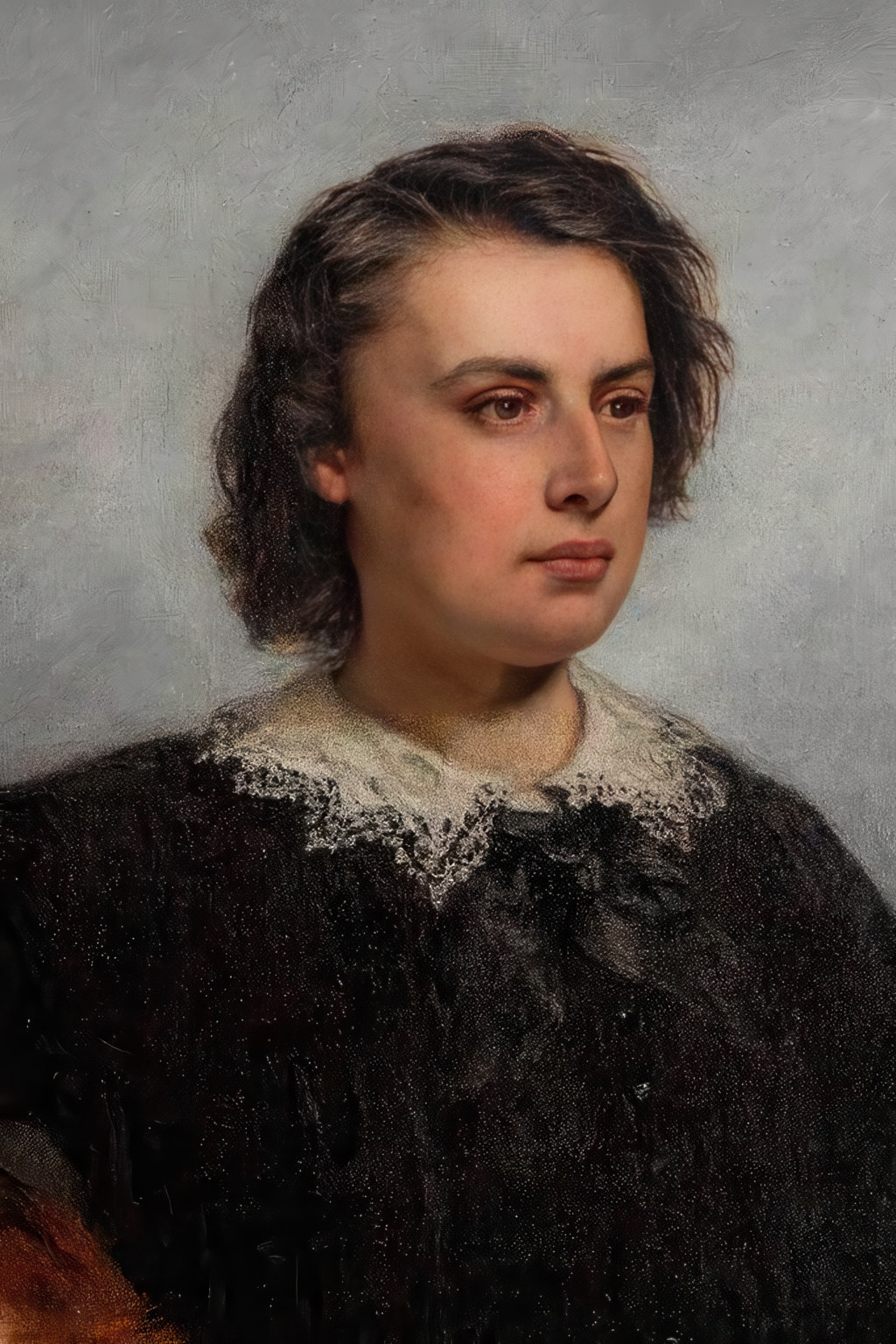
I became an animal painter because I loved to move among animals. I would study an animal and draw it in the position it took, and when it changed to another position I would draw that.
Permission to Wear Men's Clothing
Bonheur was initially met with confusion by the dealers and public in these various markets, but she received official permission to paint and eventually would be welcomed by the male-dominated audience. Her success started to grow and knowledge of her career started to shift views on women in art.
Anatomical Accuracy
Realism, for Bonheur, meant more than recording appearances. She studied animal anatomy in detail, even attending dissections to understand the mechanics of horse movement - she may well have learnt from the work of Stubbs about his famous methods of study and preparation. This knowledge is evident throughout the painting, with the balance of muscle, light and gravity.
Meaning & Symbolism of The Horse Fair
Horses as Symbols of Power and Freedom
Horses have long symbolised freedom, vigour, and the untamed force of nature - artists have featured them for almost as long as art itself has existed. Bonheur's The Horse Fair is not simply a depiction of a commercial horse market — it is a drama of restrained power. The animals surge forward in waves, guided rather than controlled. Their physical strength becomes a metaphor for vitality and resilience, though these beautiful creatures have been used by other artists for alternative meanings.
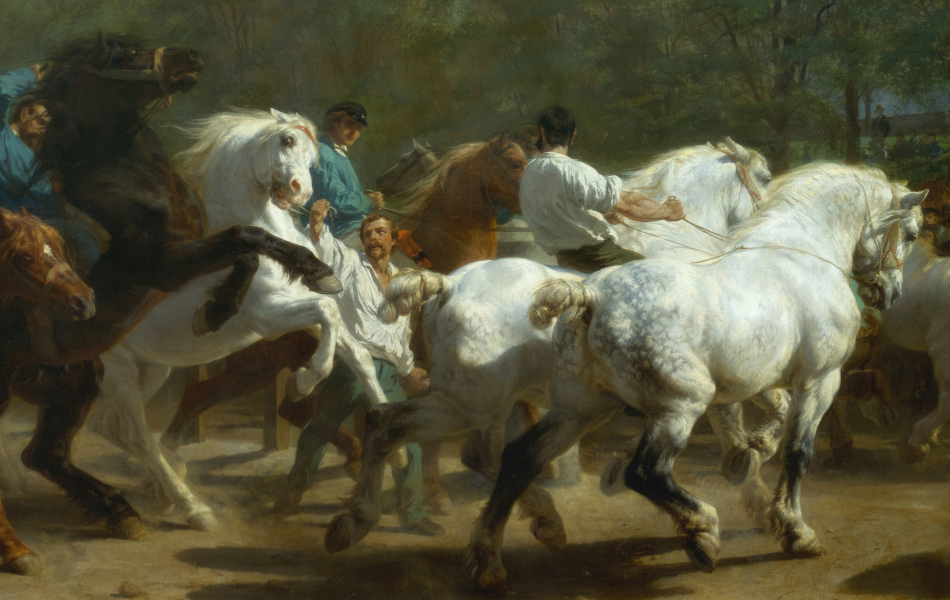
Their physical strength becomes a metaphor for vitality
Controlled Energy and Chaotic Movement
The tension between control and chaos helps to create an energy which builds across the canvas, particularly for those lucky enough to see this artwork in person. Some horses are calm, others restless or rearing. The riders' postures are also varied, representing their struggles with touches of authority, mastery and difficulty on show.
Bonheur stages this contrast deliberately, creating a rhythm of order and disorder that propels the viewer's eye across the canvas, providing small scenes within a large overall composition.
Realism as Social Commentary
The Realism are movement was all about everyday life, and accurately replicating it, for better and for worse. Bonheur does that perfectly here, showing man and animal working side-by-side, but in scenarious that were not always comfortable, easy or even glamorous.
Composition Analysis
The Diagonal Sweep
The entire composition is driven by a powerful diagonal that cuts from the lower left to the upper right. This directs movement, tension, and visual energy, giving the canvas its unmistakable dynamism.
Clusters and Counterpoints
Bonheur arranges horses in overlapping clusters, creating a sense of depth and crowding without confusion. The white horse turning its head forms a visual pivot, while darker horses provide contrast elsewhere on the canvas - it choosing such a large canvas, the artist is able to feature a host of figures but without cramming things too closely together.
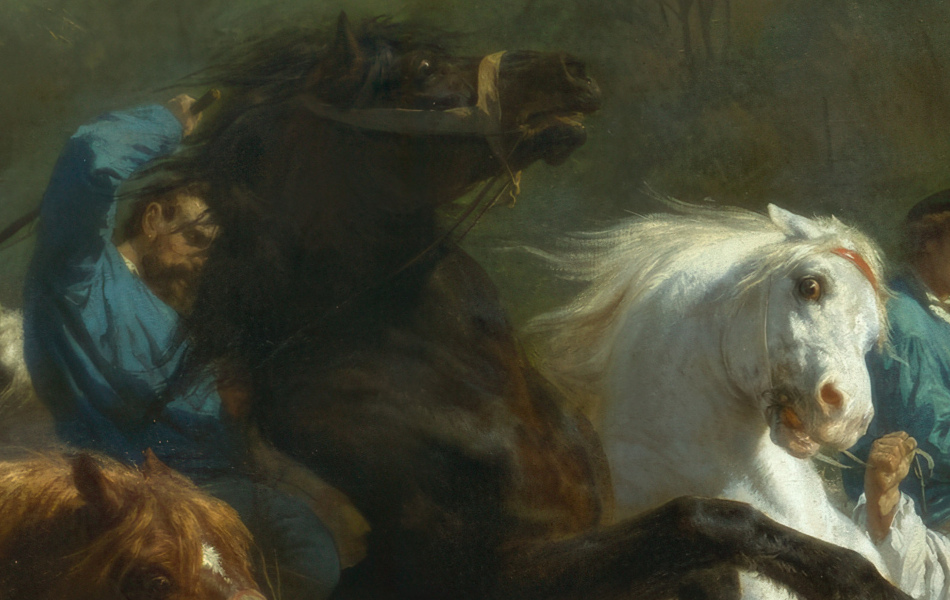
White horse turning its head
Light and Atmosphere
Soft, diffused daylight falls from above, illuminating coats and muscles. Unlike many dramatic Realism paintings, nothing is theatrical; the mood is brisk and cool, consistent with early-morning activity. Bonheur is able to find beauty in normal everyday life.
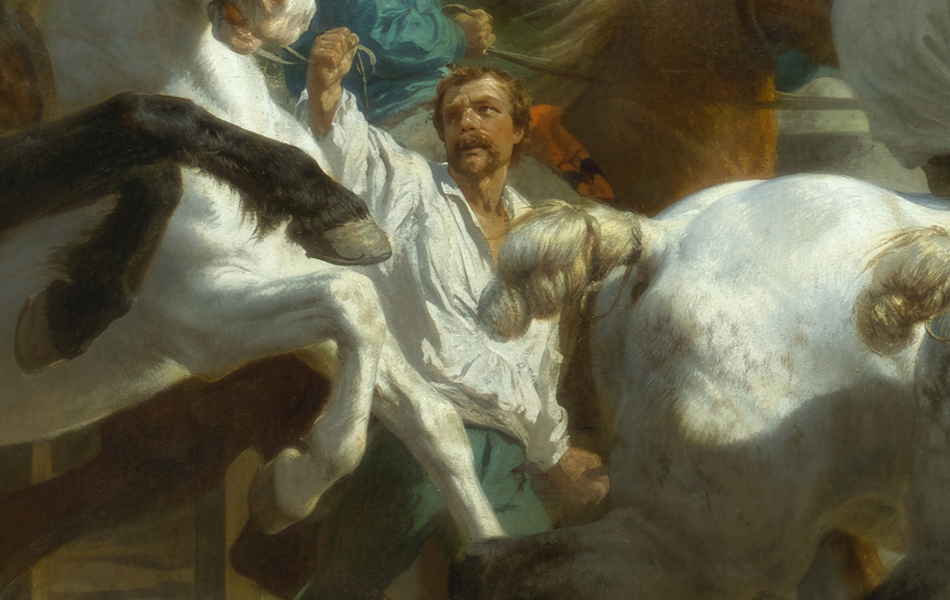
Soft, diffused daylight falls from above
A Painting of Remarkable Scale
The Horse Fair is not only Bonheur's finest achievement — it is also an incredibly large artwork. Measuring nearly five metres across and more than two metres high, the work has a commanding presence in any gallery space, and only a few would be big enough to comfortably display it. The scale was unusual for an animal painting in the 1850s, and it placed Bonheur more in tune with history painters, whose canvases traditionally dominated the Salon walls.
The size allowed Bonheur to give the viewer the sensation of standing in the middle of the galloping procession. Many critics at the 1853 Salon commented on the immersive quality of the work, noting that the viewer seemed to feel the ground tremble under the weight of the animals, and many artists used size as a means of filling a viewer's window of vision.
Reception and Legacy
Salon Success
At the 1853 Salon, The Horse Fair drew large crowds and immediate praise. Critics admired the accuracy of the work, as well as the aesthetic beauty of the piece. Bonheur's reputation was cemented almost overnight and she was able to boast followers in France, Britain and USA.
Popularity in Britain and America
The painting toured Britain and the United States in the 1850s and 60s, generating considerable admiration. American collectors, most notably Cornelius Vanderbilt, took an early interest in Bonheur's work. Her reputation in the Anglosphere continued well into the 20th century.
Eventually The Horse Fair was acquired by Cornelius Vanderbilt, who presented it to the Metropolitan Museum of Art in 1887. Its arrival in New York was widely reported in the press, and it remains one of the museum's most beloved 19th-century European paintings.
Reproductions, engravings and prints circulated widely, helping the painting reach a mass audience. In the United States, the work achieved similar acclaim. American collectors admired Bonheur's technical precision, and the painting's democratic subject matter found a particularly receptive audience.
The long touring history contributed significantly to Bonheur's international reputation and helped solidify The Horse Fair as her defining masterpiece.
Where to See The Horse Fair Today
Visitors can see the painting today at the Metropolitan Museum of Art, New York. It remains one of the museum's most recognisable 19th century canvases. Its scale and energy make it a highlight of the European paintings galleries and a recent interest in women artists has also helped artists such as Bonheur to finally receive the attention that they deserve.
Related Works by Rosa Bonheur
- Ploughing in the Nivernais
- Weaning the Calves
- The Highland Shepherd
- A Limier Briquet Hound
These works also demonstrate Bonheur's extraordinary skill with animal subjects.
Conclusion
The Horse Fair remains Rosa Bonheur's finest achievement, combining beauty and honesty in the Realism manner. Its enduring appeal lies in its clarity, sincerity and impressive ambition. For modern viewers, it offers not only a glimpse into 19th-century urban life but also a testament to the determination and talent of one of history's great animal painters who went to extraordinary lengths in order to truly perfect her craft.
Rosa Bonheur and The Horse Fair Quiz
References
- Ashton, Dore. Rosa Bonheur: A Life and a Legend. New York: Viking Press, 1981.
A detailed biography covering Bonheur's working practices, studies at the Paris horse market, and the early Salon reception of The Horse Fair. - Nochlin, Linda. Women, Art, and Power and Other Essays. Boulder, CO: Westview Press, 1988.
Includes foundational feminist analysis of women artists, with discussion of Bonheur's career, artistic strategy, and social context. - Shriver, Rosalia. Rosa Bonheur: With a Checklist of Works in American Collections. Philadelphia: University of Pennsylvania Press, 1982.
A comprehensive study including historical context for The Horse Fair, Bonheur's technique, and her preparation through studies from life. - Weisberg, Gabriel P., and the Petrucci Family Foundation. Rosa Bonheur: A Catalogue Raisonné. Paris: Revue du Louvre (various volumes).
The most authoritative scholarly catalogue of Bonheur's work, providing detailed technical entries, preparatory studies, and provenance. - House, John, ed. Impressionism for England: Samuel Courtauld Collects. New Haven: Yale University Press, 1994.
Contains analysis of the British and American reception of major 19th-century artists, including Bonheur and The Horse Fair's popularity abroad.